
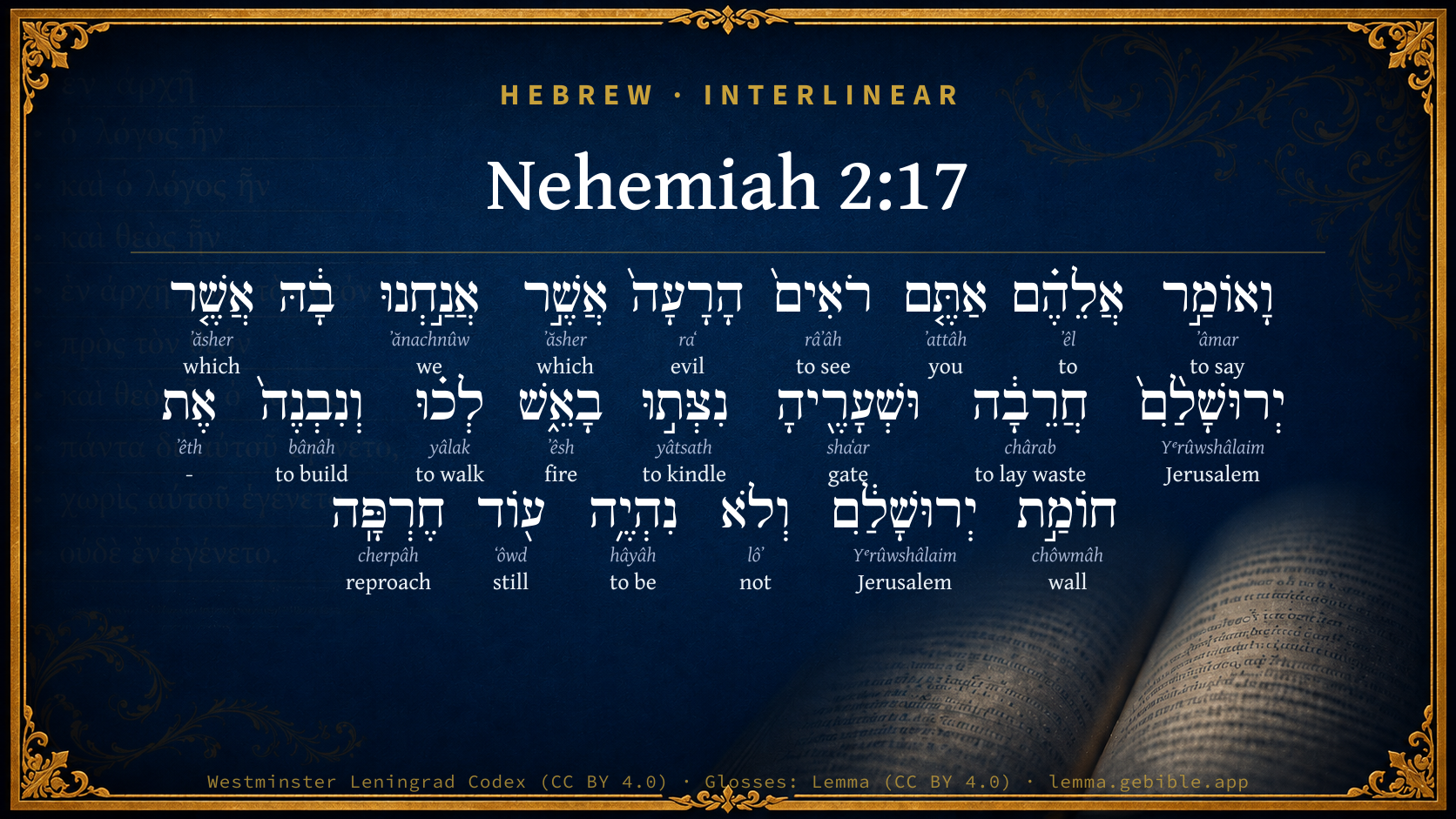
Nehemiah 2:17

Hebrew (Westminster Leningrad Codex) Nehemiah 2:17 appears in the Hebrew Old Testament. The text above is from the Westminster Leningrad Codex. Each word links to its Strong’s number, a concise gloss, and parsing drawn from the Open Scriptures Hebrew Bible morphology. Click any word for its full Brown-Driver-Briggs (BDB) entry.
Download image
Cite this verse

Nehemiah 2:17 (World English Bible). Public Domain. Lemma interlinear Bible study tool, https://lemma.gebible.app/v/nehemiah/2/17.

Show BibTeX & RIS
BibTeX
RIS
English Translation
Then said I to them, You see the evil case that we are in, how Jerusalem lies waste, and the gates of it are burned with fire: come, and let us build up the wall of Jerusalem, that we be no more a reproach.
World English Bible · Public Domain
Download a study sheet

One document with this verse’s original text, its word-by-word gloss line, the meaning frame, cross-references with their text, attributed commentary, and full source and license credits — printable, and it pastes into notes with its structure intact.

This verse Autodidact and up

Study sheet (.html) Plain text (.txt)

A passage Seminary Student

Up to 50 verses in one chapter. A passage sheet keeps up to 6 commentary sources and 12 cross-references per verse, in the order this page ranks them, and says so on the sheet whenever that leaves anything out. Ask for a single verse and you get the Autodidact verse sheet above.

Everything on this page stays free to read, with no account — the sheet is a download of what is already on screen, not access to it.

Want to remove ads? Support Godless Engineer
Compare translations 3

The same verse in 3 English versions, stacked beneath the original-language interlinear above. Click any original word for its lexicon entry.

Each is an independent rendering of the whole verse — the interlinear is not word-aligned to these translations.

Highlighted words mark where these versions differ — a whole-verse word diff, not a word-by-word alignment.

  • World English Bible Public Domain
    Then said I to them, You see the evil case that we are in, how Jerusalem lies waste, and the gates of it are burned with fire: come, and let us build up the wall of Jerusalem, that we be no more a reproach.
  • King James Version Public Domain
    Then said I unto them, Ye see the distress that we are in, how Jerusalem lieth waste, and the gates thereof are burned with fire: come, and let us build up the wall of Jerusalem, that we be no more a reproach.
  • unfoldingWord Literal Text CC BY-SA 4.0
    And I said to them, “You see the evil that we are in, that Jerusalem is desolate and its gates have been burned by fire. Come, and let us build the wall of Jerusalem, and we will no longer be a reproach.”

unfoldingWord Literal Text — © unfoldingWord, licensed CC BY-SA 4.0. Word-aligned USFM3 via Door43 (git.door43.org/unfoldingWord/en_ult).

Versions to compare (up to 4)

3 of 4 selected

Show all 18 translations

Every available English version of this verse, each an independent rendering of the whole verse.

  • World English Bible Public Domain
    Then said I to them, You see the evil case that we are in, how Jerusalem lies waste, and the gates of it are burned with fire: come, and let us build up the wall of Jerusalem, that we be no more a reproach.
  • Berean Standard Bible Public Domain
    Then I said to them, “You see the trouble we are in. Jerusalem lies in ruins, and its gates have been burned down. Come, let us rebuild the wall of Jerusalem, so that we will no longer be a disgrace.”
  • Majority Standard Bible Public Domain
    Then I said to them, “You see the trouble we are in. Jerusalem lies in ruins, and its gates have been burned down. Come, let us rebuild the wall of Jerusalem, so that we will no longer be a disgrace.”
  • King James Version Public Domain
    Then said I unto them, Ye see the distress that we are in, how Jerusalem lieth waste, and the gates thereof are burned with fire: come, and let us build up the wall of Jerusalem, that we be no more a reproach.
  • American Standard Version (1901) Public Domain
    Then said I unto them, Ye see the evil case that we are in, how Jerusalem lieth waste, and the gates thereof are burned with fire: come, and let us build up the wall of Jerusalem, that we be no more a reproach.
  • Revised Version (1885) Public Domain
    Then said I unto them, Ye see the evil case that we are in, how Jerusalem lieth waste, and the gates thereof are burned with fire: come and let us build up the wall of Jerusalem, that we be no more a reproach.
  • Geneva Bible (1599) Public Domain
    Afterward I said vnto them, Ye see the miserie that we are in, how Ierusalem lyeth waste, and the gates thereof are burnt with fire: come and let vs buylde the wall of Ierusalem, that we be no more a reproche.
  • Douay-Rheims (1899) Public Domain
    Then I said to them: You know the affliction wherein we are, because Jerusalem is desolate, and the gates thereof are consumed with fire: come, and let us build up the walls of Jerusalem, and let us be no longer a reproach.
  • Young's Literal Translation Public Domain
    and I say unto them, `Ye are seeing the evil that we are in, in that Jerusalem `is' waste, and its gates have been burnt with fire; come and we build the wall of Jerusalem, and we are not any more a reproach.'
  • Literal Standard Version CC BY-SA 4.0
    and I say to them, “You are seeing the evil that we are in, in that Jerusalem [is] desolate, and its gates have been burned with fire; come and we build the wall of Jerusalem, and we are not a reproach anymore.”
  • Unlocked Literal Bible CC BY-SA 4.0
    I said to them, “You see the trouble we are in, how Jerusalem lies in ruins and its gates have been destroyed by fire. Come, let us rebuild the wall of Jerusalem, so we will no longer be in disgrace.”
  • unfoldingWord Literal Text CC BY-SA 4.0
    And I said to them, “You see the evil that we are in, that Jerusalem is desolate and its gates have been burned by fire. Come, and let us build the wall of Jerusalem, and we will no longer be a reproach.”
  • Darby Bible Public Domain
    And I said to them, Ye see the distress that we are in, that Jerusalem lies waste, and its gates are burned with fire. Come, and let us build up the wall of Jerusalem, that we be no more a reproach.
  • World Messianic Bible Public Domain
    Then I said to them, “You see the bad situation that we are in, how Jerusalem lies waste, and its gates are burned with fire. Come, let’s build up the wall of Jerusalem, that we won’t be disgraced.”
  • Webster's Bible Public Domain
    Then said I to them, Ye see the distress that we are in, how Jerusalem lieth waste, and its gates are burned with fire: come, and let us build up the wall of Jerusalem, that we may be no more a reproach.
  • Free Bible Version CC BY-SA 4.0
    Then I said to them, “Look at the trouble we're in! Jerusalem is a heap of rubble, and its gates have been burned down. Come on, let's rebuild the wall of Jerusalem, so that we won't be so ashamed any more.”
  • Bible in Basic English Public Domain
    Then I said to them, You see what a bad condition we are in; how Jerusalem is a waste, and its doorways burned with fire: come, let us get to work, building up the wall of Jerusalem, so that we may no longer be put to shame.
  • JPS Tanakh (1917) Public Domain
    Then said I unto them: 'Ye see the evil case that we are in, how Jerusalem lieth waste, and the gates thereof are burned with fire; come and let us build up the wall of Jerusalem, that we be no more a reproach.'

Literal Standard Version (2020), Covenant Press — licensed CC BY-SA 4.0. Text via the HelloAO Bible API (eBible.org). Unlocked Literal Bible (unfoldingWord) — licensed CC BY-SA 4.0. Text via the HelloAO Bible API (eBible.org). unfoldingWord Literal Text — © unfoldingWord, licensed CC BY-SA 4.0. Word-aligned USFM3 via Door43 (git.door43.org/unfoldingWord/en_ult). Free Bible Version, Dr. Jonathan Gallagher — licensed CC BY-SA 4.0. Text via the HelloAO Bible API (eBible.org).

Word by word

More ways to search: Search by grammar → Find every occurrence → Compare this word →

Practice this passage: Drill this verse → Learn its vocabulary →

נִצְּת֣וּ
yâtsath
H3341
“to kindle”
Verb, Niphal, Perfect, 3rd Person, Common, Plural
Part of Speech
Verb
Stem
Niphal
Form
Perfect
Person
3rd Person
Gender
Common
Number
Plural
Full BDB Definition

Origin: a primitive root

TWOT: 899

to kindle, burn, set on fire - (Qal) to kindle - (Niphal) - to be kindled - to be left desolate - (Hiphil) to set on fire, kindle
  1. וָאוֹמַ֣ר ʼâmar H559 “and · to say” Conjunction + Verb, Qal, Sequential Imperfect, 1st Person, Common, Singular
  2. אֲלֵהֶ֗ם ʼêl H413 “to · them” Preposition + Suffix, Personal, 3rd Person, Masculine, Plural
  3. אַתֶּ֤ם ʼattâh H859 “you” Pronoun, Personal, 2nd Person, Masculine, Plural
  4. רֹאִים֙ râʼâh H7200 “seeing” Verb, Qal, Participle Active, Masculine, Plural, Absolute
  5. הָרָעָה֙ raʻ H7451 “the · evil” Particle, Definite Article + Noun, Common, Feminine, Singular, Absolute
  6. אֲשֶׁ֣ר ʼăsher H834 “which” Particle, Relative
  7. אֲנַ֣חְנוּ ʼănachnûw H587 “we” Pronoun, Personal, 1st Person, Common, Plural
  8. אֲשֶׁ֤ר ʼăsher H834 “which” Particle, Relative
  9. יְרוּשָׁלִַ֨ם֙ Yᵉrûwshâlaim H3389 “Jerusalem” Noun, Proper
  10. חֲרֵבָ֔ה chârab H2717 “in ruins” Adjective, Adjective, Feminine, Singular, Absolute
  11. וּשְׁעָרֶ֖יהָ shaʻar H8179 “and · gates · her” Conjunction + Noun, Common, Masculine, Plural, Construct + Suffix, Personal, 3rd Person, Feminine, Singular
  12. בָאֵ֑שׁ ʼêsh H784 “in/at the · fire” Preposition, Determined + Noun, Common, Both, Singular, Absolute
  13. לְכ֗וּ yâlak H3212 “walk” Verb, Qal, Imperative, 2nd Person, Masculine, Plural
  14. וְנִבְנֶה֙ bânâh H1129 “and · to build” Conjunction + Verb, Qal, Cohortative, 1st Person, Common, Plural
  15. אֶת ʼêth H853 “-” Particle, Direct Object
  16. חוֹמַ֣ת chôwmâh H2346 “wall of” Noun, Common, Feminine, Singular, Construct
  17. יְרוּשָׁלִַ֔ם Yᵉrûwshâlaim H3389 “Jerusalem” Noun, Proper
  18. וְלֹא lôʼ H3808 “and · not” Conjunction + Particle, Negative
  19. נִהְיֶ֥ה hâyâh H1961 “to be” Verb, Qal, Imperfect, 1st Person, Common, Plural
  20. ע֖וֹד ʻôwd H5750 “still” Adverb
  21. חֶרְפָּֽה cherpâh H2781 “reproach” Noun, Common, Feminine, Singular, Absolute

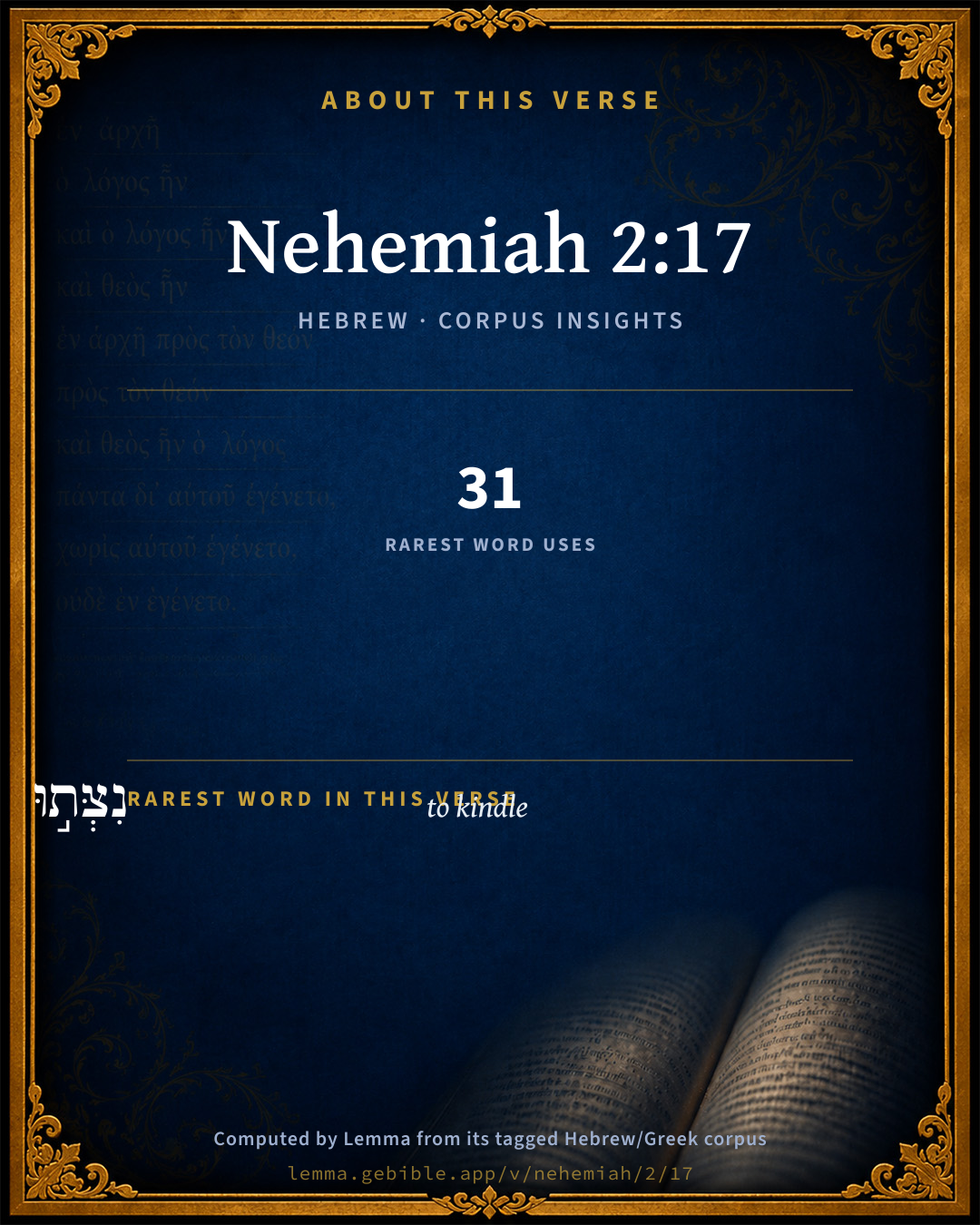
About this verse

These counts appear in no published source. They are computed here, from the morphology-tagged text and Lemma’s own curated glosses. What Lemma adds →

23
words
20
distinct lemmas
Historical
section

Shared distinctive vocabulary

נִצְּת֣וּ to kindle H3341 occurs in 28 verses of the Hebrew Bible. Also found in:

Grammatical profile

  • 6 verbs
  • 7 nouns
  • 1 adjective
  • 2 pronouns
  • 2 prepositions
  • 1 adverb
  • 4 particles

Verb forms

  • וָאוֹמַ֣ר Qal · Sequential Imperfect
  • רֹאִים֙ Qal · Participle Active
  • נִצְּת֣וּ Niphal · Perfect
  • לְכ֗וּ Qal · Imperative
  • וְנִבְנֶה֙ Qal · Cohortative
  • נִהְיֶ֥ה Qal · Imperfect

Repetition

Words recur within this verse — often emphatic in Hebrew:

  • יְרוּשָׁלִַ֨ם֙ Jerusalem H3389 ×2
  • אֲשֶׁ֣ר which H834 ×2

Cross-references

16

Topical passages linked to Nehemiah 2:17 in the Treasury of Scripture Knowledge — connected by theme and wording, ordered by reader-vote popularity; previews shown in the World English Bible.

  • Ezekiel 5:14 Moreover I will make you a desolation and a reproach among the nations that are round about you, in the sight of all that pass by.
  • Isaiah 35:3–4 Strengthen you the weak hands, and confirm the feeble knees.
  • Nehemiah 1:3 They said to me, The remnant who are left of the captivity there in the province are in great affliction and reproach: the wall of Jerusalem also is broken down, and the gates of it are burned with fire.
  • Psalms 79:4 We have become a reproach to our neighbors, A scoffing and derision to those who are around us.
  • Lamentations 3:45–46 You have made us an off-scouring and refuse in the midst of the peoples.
  • Lamentations 3:51 My eye affects my soul, because of all the daughters of my city.
  • Psalms 89:50–51 Remember, Lord, the reproach of your servants, How I bear in my heart the taunts of all the mighty peoples,
  • Lamentations 2:8–9 Yahweh has purposed to destroy the wall of the daughter of Zion; He has stretched out the line, he has not withdrawn his hand from destroying; He has made the rampart and wall to lament; they languish together.
  • Ezekiel 22:4–5 You have become guilty in your blood that you have shed, and are defiled in your idols which you have made; and you have caused your days to draw near, and are come even to your years: therefore have I made you a reproach to the nations, and a mocking to all the countries.
  • Ezra 5:1–2 Now the prophets, Haggai the prophet, and Zechariah the son of Iddo, prophesied to the Jews who were in Judah and Jerusalem; in the name of the God of Israel [prophesied they] to them.
  • Psalms 44:13 You make us a reproach to our neighbors, A scoffing and a derision to those who are around us.
  • Psalms 79:12 Pay back to our neighbors seven times into their bosom Their reproach with which they have reproached you, Lord.
  • Jeremiah 24:9 I will even give them up to be tossed back and forth among all the kingdoms of the earth for evil; to be a reproach and a proverb, a taunt and a curse, in all places where I shall drive them.
  • Lamentations 2:2 The Lord has swallowed up all the habitations of Jacob, and has not pitied: He has thrown down in his wrath the strongholds of the daughter of Judah; He has brought them down to the ground; he has profaned the kingdom and the princes of it.
  • Ezra 10:2–4 Shecaniah the son of Jehiel, one of the sons of Elam, answered Ezra, We have trespassed against our God, and have married foreign women of the peoples of the land: yet now there is hope for Israel concerning this thing.
  • 1 Samuel 11:2 Nahash the Ammonite said to them, On this condition will I make it with you, that all your right eyes be put out; and I will lay it for a reproach on all Israel.

Cross-references courtesy of OpenBible.info (CC BY 4.0).

Hebrew and Greek witnesses Masoretic Hebrew ↔ Greek Septuagint

The same verse in the two great witnesses to the Old Testament, shown verse-for-verse.

These are two independent witnesses, not word-aligned to each other, and the Septuagint is shown in lemma (dictionary) form.

Hebrew Nehemiah 2:17 Masoretic · Westminster Leningrad Codex

וָאוֹמַ֣ר אֲלֵהֶ֗ם אַתֶּ֤ם רֹאִים֙ הָרָעָה֙ אֲשֶׁ֣ר אֲנַ֣חְנוּ בָ֔הּ אֲשֶׁ֤ר יְרוּשָׁלִַ֨ם֙ חֲרֵבָ֔ה וּשְׁעָרֶ֖יהָ נִצְּת֣וּ בָאֵ֑שׁ לְכ֗וּ וְנִבְנֶה֙ אֶת חוֹמַ֣ת יְרוּשָׁלִַ֔ם וְלֹא נִהְיֶ֥ה ע֖וֹד חֶרְפָּֽה

Then said I to them, You see the evil case that we are in, how Jerusalem lies waste, and the gates of it are burned with fire: come, and let us build up the wall of Jerusalem, that we be no more a reproach.

World English Bible · Public Domain

Greek LXX Structure differs

The Septuagint has no separate book of Nehemiah. Its Greek text is the second half of Esdras B (2 Esdras), chapters 11–23; Ezra is the first half (1–10).

A verse-for-verse comparison isn’t shown here because the chapters and verses don’t line up. Switch to the LXX edition with the MT / LXX toggle above to read the Greek directly.

Hebrew: Westminster Leningrad Codex (CC BY 4.0). Greek: Septuagint (public domain); English from a public-domain English Septuagint. How the Septuagint differs from the Hebrew →

Commentary

Notes on Nehemiah 2:17 from classic Christian and Jewish commentators (each source and its license shown beneath its notes). The classic Christian expositions comment on the surrounding passage and are grouped to its opening verse, so a note may address several verses; the Jewish commentaries on the Tanakh (Rashi and others) are per-verse, so they appear only where the commentator wrote on this verse.

Lemma curates 59 commentaries, every one of them public domain or Creative Commons licensed, each selected and text-cleaned for this edition rather than reprinted as found. About our sources →

Trapp's Complete Commentary

John Trapp

Neh 2:17 Then said I unto them, Ye see the distress that we [are] in, how Jerusalem [lieth] waste, and the gates thereof are burned with fire: come, and let us build up the wall of Jerusalem, that we be no more a reproach.

Ver. 17. Then said I unto them] Then, when I saw it a fit season to say it. It is an excellent skill to time a word, Isa 50:4. To circumstantiate it aright, Pro 25:11. That it may run as upon wheels: Nehemiah’s words do so, notably. Verba prius ad limam revocata, quam ad linguam, words well weighed ere uttered. Nescit paenitenda loqui qui proferenda prius sue tradidit examini, He cannot but speak wisely who speaketh warily.

Jerusalem lieth waste] i.e., open to the spoiler; as the pope made account this land was in Henry VIII’s time, when he had given it primo occupaturo, to him that should first invade and seize it.

Come, and let us build, &c.] With forces united, with one shoulder, Multorum manibus grande levatur onus.

That we be no more a reproach] Quam multa quam paucis! How much in a little! said Cicero of Brutus’s laconical epistle; and the like may we say of this pithy and pathetic speech. Those that love to hear themselves talk, saith Bishop Pilkington upon this text, and with many words to colour their ill meaning, may here learn how a simple truth, plainly told in few words, worketh more in good men’s hearts than a painted tale that hath little truth and less good meaning in it. An honest matter speaketh for itself, and needeth no colouring; and he that useth most flattering and subtle words maketh wise men mistrust the matter to be ill. A few words well placed are much better than a long unsavoury tale. Thus he.

John Trapp, A Commentary or Exposition upon All the Books of the Old and New Testament (1647–1656) — public domain. Text from a community e-Sword module.

Joseph Benson's Commentary

Neh 2:17-18. That we be no more a reproach — Exposed to the scorn and insults of the people around about. I told them of the hand of my God, &c. — That is, he informed them how favourable God had made the king to him, and what discourse he had had with him, and what authority and commission he had received from him. They said, Let us rise up and build — Let us begin and proceed with vigour, diligence, and resolution, as those that are determined to go through with the work. They strengthened their hands — Their own and one another’s.

Joseph Benson's Commentary on the Old and New Testaments (1811–1818) — public domain. Text from a community e-Sword module.

Whedon's Commentary on the Bible

Daniel D. Whedon

PREPARATIONS TO BUILD, Neh_2:17-18.

17. Ye see the distress — The same word is rendered affliction in Neh_1:3. Nehemiah had now seen with his own eyes that the report was true which informed him in Shushan of the desolation of Jerusalem. The distress to which the Jews were subjected by inability to rebuild their city, so long desolate, could be regarded by them in no other light than as a reproach.

Daniel D. Whedon (gen. ed.), Commentary on the Old and New Testaments (1874–1909) — public domain. Text from a community e-Sword module.

Geneva Bible (1599)

Geneva Bible translators

That is, contemned of other nations, as though God had forsaken us.

Geneva Bible (1599) marginal notes — public domain. Text via Bolls.life.

Ellicott's Commentary for English Readers

(17) Then.—There is no note of time. When his plans were matured, Nehemiah made an earnest appeal to their patriotism.

A Bible Commentary for English Readers, edited by Charles John Ellicott (1878–1897) — public domain. Text from a community e-Sword module.

The Cambridge Bible for Schools and Colleges

gen. ed. J. J. S. Perowne

17. Nehemiah’s appeal. It is implied that Nehemiah having satisfied himself as to the practicability of his plan called an assembly of those mentioned in the previous verse. How soon after his nocturnal ride is not stated.

the distress] R.V. the evil case, the same word as in Neh_1:1

Jerusalem lieth waste, &c.] Cf. Neh_2:3.

that we be no more a reproach] See Neh_1:3, where the words ‘affliction’ and ‘reproach’ are the same as the ‘distress’ or ‘evil case,’ and ‘reproach’ in this verse.

a reproach] i.e. an object of reproach by reason of our inability to defend ourselves, cf. Psa_22:6, ‘a reproach of men, and despised of the people;’ Joe_2:19, ‘I will no more make you a reproach among the nations.’ Eze_22:4.

The Cambridge Bible for Schools and Colleges (gen. ed. J. J. S. Perowne; Cambridge University Press, 1878–1918) — public domain. Text from a community e-Sword module.

John Gill's Exposition

Then I told them of the hand of my God which was good upon me..... Of the kind providence of God in exalting him in the court of the king of Persia, in giving him an opportunity of laying the sad case of Jerusalem before him, and in inclining his heart to show favour to him, and grant his request:

as also the king's words that he had spoken to me; what passed between them on this subject, the commission he gave him, and the letters he sent by him to his governors on this side the river:

and they said, let us rise up and build; encouraged by this account of things, they proposed to set about the work immediately:

so they strengthened their hands for this good work; animated and encouraged one another to proceed to it at once with cheerfulness, and to go on in it with spirit and resolution.

John Gill's Exposition of the Whole Bible (1746–1763) — public domain (CC PDM 1.0). Text via the HelloAO Bible API.

The Pulpit Commentary

Then said I unto them. Ewald boldly assumes that this happened the next day; but there is nothing to show that it was so soon. The original contains, no note of time not even the word "then." Nehemiah simply says, "And I said to them." The distress. Or "affliction," as the word is translated in Neh_1:3. No special suffering seems to be intended, beyond that of lying open to attack, and being a "reproach" in the sight of the heathen. Lieth waste. On this hyperbole see the comment upon ver. 3.

The Pulpit Commentary (1880–1919), ed. H.D.M. Spence-Jones & Joseph S. Exell — public domain. Text from a community e-Sword module.

unfoldingWord translationNotes

Door43 World Missions Community

You see the trouble

Here "you" is plural, referring to all the people mentioned in Nehemiah 02:16. (See: Forms of You)

its gates have been destroyed by fire

This can be stated in active form. AT: "how our enemies destroyed its gates by fire" (See: Active or Passive)

so we will no longer be in disgrace

"so we will no longer be ashamed"

the good hand of my God was on me

God's "good hand" represents his "favor." AT: "my God's favor was upon me" (See: Metonymy)

rise up and build

This is an idiom. AT: "begin building" (See: Idiom)

So they strengthened their hands for the good work

The phrase "strengthened their hands" means to prepare to do something. AT: "So they prepared do this good work" (See: Idiom)

translationWords

trouble

Jerusalem

ruin

gate

fire

good

hand

God

king

word

raise

works

unfoldingWord translationNotes — © Distant Shores Media and the Door43 World Missions Community, licensed CC BY-SA 4.0. Source: git.door43.org/Door43/en_tn.

Rashi

Rabbi Shlomo Yitzchaki (Rashi)

And I said to them On the morrow I said to them.

and we shall no longer be a reproach that our adversaries should not plunder and pillage us.

Rashi on the Tanakh — English translations: “The Judaica Press complete Tanach with Rashi, translated by A. J. Rosenberg” (CC BY 4.0); “Pentateuch with Rashi's commentary by M. Rosenbaum and A.M. Silbermann, 1929-1934” (public domain); “The Metsudah Tanach series, Lakewood, N.J” (CC BY 4.0); and “The Book of Joshua, Metsudah Publications, 1997” (CC BY 4.0). Text via Sefaria.

Lesson kit

Teaching starters — assembled from the data on this page, not authored interpretation. Every prompt links to the verse data it draws on. Edit before teaching.

Nehemiah, in the Historical, opens this verse with 23 words (20 distinct Hebrew lemmas). Its most distinctive word is yâtsath (“to kindle”). A historical commentator’s framing appears above. Read the whole chapter for the surrounding context.

Discussion questions

  1. The word yâtsath carries the sense “to kindle.” How does it shape the verse?
  2. How does Joshua 8:8, which shares the word «to kindle», read alongside this verse?
  3. What does the repetition of “Jerusalem” (2× in this one verse) do in this verse?
  4. These translations render this verse differently. What is at stake in choosing one wording over another?
  5. «וָאוֹמַ֣ר» is a Qal Sequential Imperfect verb. How does that grammatical form shape the action described?
  6. Compare how Trapp's Complete Commentary and Joseph Benson's Commentary read this verse. Where do they agree or differ?

Things to notice

Reading settings

Reading text

Shown beneath each verse's original-language words.

Old Testament
Old Testament edition

Read the OT as the Masoretic Hebrew (MT) or the Greek Septuagint (LXX).

English shown for the Greek Septuagint (in the Hebrew ↔ Greek comparison).

Comparing translations? Open the Compare panel on any verse page to stack up to four side by side.