
Deuteronomy 6:8

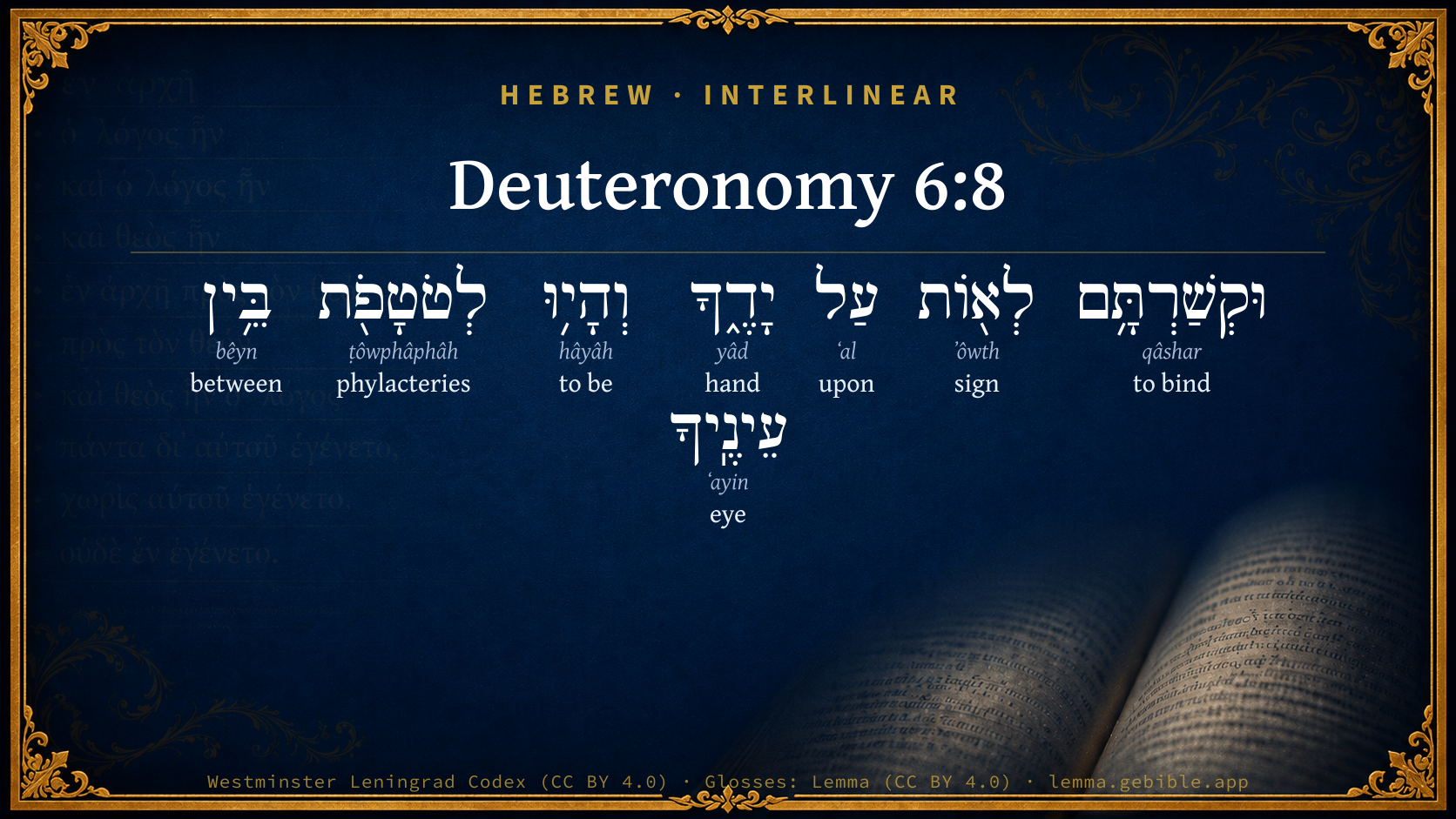
Hebrew (Westminster Leningrad Codex) Deuteronomy 6:8 appears in the Hebrew Old Testament. The text above is from the Westminster Leningrad Codex. Each word links to its Strong’s number, a concise gloss, and parsing drawn from the Open Scriptures Hebrew Bible morphology. Click any word for its full Brown-Driver-Briggs (BDB) entry.
Download image
Cite this verse

Deuteronomy 6:8 (World English Bible). Public Domain. Lemma interlinear Bible study tool, https://lemma.gebible.app/v/deuteronomy/6/8.

Show BibTeX & RIS
BibTeX
RIS
English Translation
You shall bind them for a sign on your hand, and they shall be for symbols between your eyes.
World English Bible · Public Domain
Download a study sheet

One document with this verse’s original text, its word-by-word gloss line, the meaning frame, cross-references with their text, attributed commentary, and full source and license credits — printable, and it pastes into notes with its structure intact.

This verse Autodidact and up

Study sheet (.html) Plain text (.txt)

A passage Seminary Student

Up to 50 verses in one chapter. A passage sheet keeps up to 6 commentary sources and 12 cross-references per verse, in the order this page ranks them, and says so on the sheet whenever that leaves anything out. Ask for a single verse and you get the Autodidact verse sheet above.

Everything on this page stays free to read, with no account — the sheet is a download of what is already on screen, not access to it.

Want to remove ads? Support Godless Engineer
Compare translations 3

The same verse in 3 English versions, stacked beneath the original-language interlinear above. Click any original word for its lexicon entry.

Each is an independent rendering of the whole verse — the interlinear is not word-aligned to these translations.

Highlighted words mark where these versions differ — a whole-verse word diff, not a word-by-word alignment.

  • World English Bible Public Domain
    You shall bind them for a sign on your hand, and they shall be for symbols between your eyes.
  • King James Version Public Domain
    And thou shalt bind them for a sign upon thine hand, and they shall be as frontlets between thine eyes.
  • unfoldingWord Literal Text CC BY-SA 4.0
    And you shall tie them as a sign on your hand. And they will be as frontlets between your eyes.

unfoldingWord Literal Text — © unfoldingWord, licensed CC BY-SA 4.0. Word-aligned USFM3 via Door43 (git.door43.org/unfoldingWord/en_ult).

Versions to compare (up to 4)

3 of 4 selected

Show all 18 translations

Every available English version of this verse, each an independent rendering of the whole verse.

  • World English Bible Public Domain
    You shall bind them for a sign on your hand, and they shall be for symbols between your eyes.
  • Berean Standard Bible Public Domain
    Tie them as reminders on your hands and bind them on your foreheads.
  • Majority Standard Bible Public Domain
    Tie them as reminders on your hands and bind them on your foreheads.
  • King James Version Public Domain
    And thou shalt bind them for a sign upon thine hand, and they shall be as frontlets between thine eyes.
  • American Standard Version (1901) Public Domain
    And thou shalt bind them for a sign upon thy hand, and they shall be for frontlets between thine eyes.
  • Revised Version (1885) Public Domain
    And thou shalt bind them for a sign upon thine hand, and they shall be for frontlets between thine eyes.
  • Geneva Bible (1599) Public Domain
    And thou shalt binde them for a signe vpon thine hand, and they shalbe as frontlets betweene thine eyes.
  • Douay-Rheims (1899) Public Domain
    And thou shalt bind them as a sign on thy hand, and they shall be and shall move between thy eyes.
  • Young's Literal Translation Public Domain
    and hast bound them for a sign upon thy hand, and they have been for frontlets between thine eyes,
  • Literal Standard Version CC BY-SA 4.0
    and have bound them for a sign on your hand, and they have been for frontlets between your eyes,
  • Unlocked Literal Bible CC BY-SA 4.0
    You will tie them as a sign upon your hand, and they will serve as frontlets between your eyes.
  • unfoldingWord Literal Text CC BY-SA 4.0
    And you shall tie them as a sign on your hand. And they will be as frontlets between your eyes.
  • Darby Bible Public Domain
    And thou shalt bind them for a sign on thy hand, and they shall be for frontlets between thine eyes.
  • World Messianic Bible Public Domain
    You shall bind them for a sign on your hand, and they shall be for frontlets between your eyes.
  • Webster's Bible Public Domain
    And thou shalt bind them for a sign upon thy hand, and they shall be as frontlets between thy eyes.
  • Free Bible Version CC BY-SA 4.0
    Tie them on your hands as reminders and put them on your foreheads as well.
  • Bible in Basic English Public Domain
    Let them be fixed as a sign on your hand, and marked on your brow;
  • JPS Tanakh (1917) Public Domain
    And thou shalt bind them for a sign upon thy hand, and they shall be for frontlets between thine eyes.

Literal Standard Version (2020), Covenant Press — licensed CC BY-SA 4.0. Text via the HelloAO Bible API (eBible.org). Unlocked Literal Bible (unfoldingWord) — licensed CC BY-SA 4.0. Text via the HelloAO Bible API (eBible.org). unfoldingWord Literal Text — © unfoldingWord, licensed CC BY-SA 4.0. Word-aligned USFM3 via Door43 (git.door43.org/unfoldingWord/en_ult). Free Bible Version, Dr. Jonathan Gallagher — licensed CC BY-SA 4.0. Text via the HelloAO Bible API (eBible.org).

Word by word

More ways to search: Search by grammar → Find every occurrence → Compare this word →

Practice this passage: Drill this verse → Learn its vocabulary →

לְטֹטָפֹ֖ת
ṭôwphâphâh
H2903
“to/for · phylacteries”
Preposition + Noun, Common, Feminine, Plural, Absolute
Part of Speech
Preposition + Noun
Type
Common
Gender
Feminine
Number
Plural
State
Absolute
Full BDB Definition

Origin: from an unused root meaning to go around or bind

TWOT: 804a

bands, phylacteries, frontlets, marks
  1. וּקְשַׁרְתָּ֥ם qâshar H7194 “and · to bind · them” Conjunction + Verb, Qal, Sequential Perfect, 2nd Person, Masculine, Singular + Suffix, Personal, 3rd Person, Masculine, Plural
  2. לְא֖וֹת ʼôwth H226 “to/for · sign” Preposition + Noun, Common, Both, Singular, Absolute
  3. עַל ʻal H5921 “upon” Preposition
  4. יָדֶ֑ךָ yâd H3027 “hand · your” Noun, Common, Both, Singular, Construct + Suffix, Personal, 2nd Person, Masculine, Singular
  5. וְהָי֥וּ hâyâh H1961 “and · to be” Conjunction + Verb, Qal, Sequential Perfect, 3rd Person, Common, Plural
  6. בֵּ֥ין bêyn H996 “between” Preposition
  7. עֵינֶֽיךָ ʻayin H5869 “eyes · your” Noun, Common, Both, Dual, Construct + Suffix, Personal, 2nd Person, Masculine, Singular

About this verse

These counts appear in no published source. They are computed here, from the morphology-tagged text and Lemma’s own curated glosses. What Lemma adds →

8
words
8
distinct lemmas
Pentateuch
section

Notable vocabulary

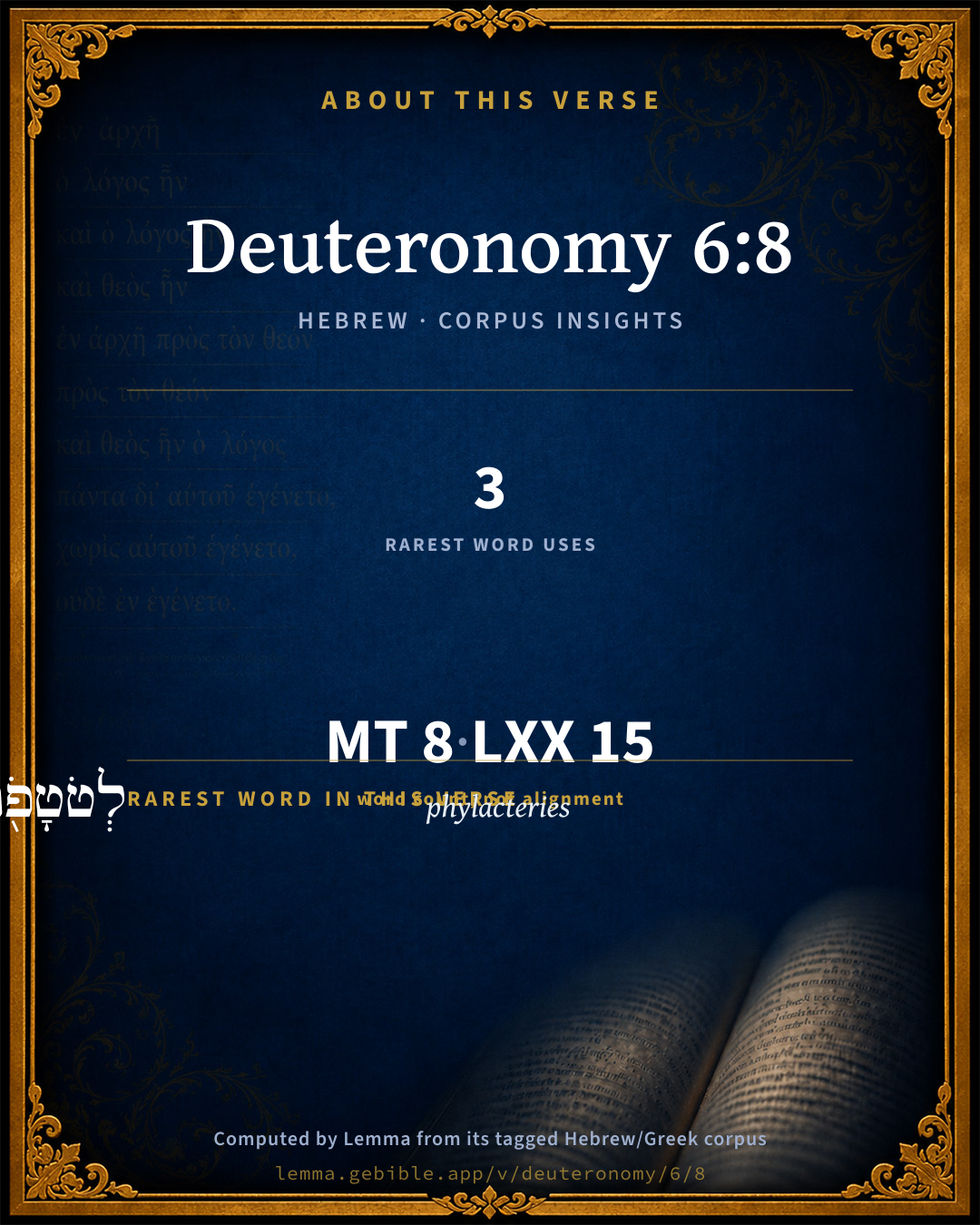
The rarest word here is לְטֹטָפֹ֖ת phylacteries H2903 — appearing just 3 times in the whole Hebrew Bible.

Shared distinctive vocabulary

לְטֹטָפֹ֖ת phylacteries H2903 occurs in 3 verses of the Hebrew Bible. Also found in:

Grammatical profile

  • 2 verbs
  • 4 nouns
  • 2 prepositions

Verb forms

  • וּקְשַׁרְתָּ֥ם Qal · Sequential Perfect
  • וְהָי֥וּ Qal · Sequential Perfect

Hebrew & Septuagint length

In English translation the verse runs 19 words from the Hebrew and 19 from the Septuagint (LXX English) — the same length.

A rough comparison of the two English renderings, which tokenize alike — not a word-level alignment.

Word counts can differ between the Hebrew and the Greek without any difference in meaning — e.g. the Hebrew direct-object marker אֵת has no separate Greek word, and Greek often adds the article ὁ.

In the original languages it is 8 Hebrew tokens and 15 Greek tokens — but the two are counted differently (Hebrew bundles its prefixes and suffixes into one token; the Greek is in lemma form), so that isn’t a like-for-like length.

Cross-references

9

Topical passages linked to Deuteronomy 6:8 in the Treasury of Scripture Knowledge — connected by theme and wording, ordered by reader-vote popularity; previews shown in the World English Bible.

  • Proverbs 6:21 Bind them continually on your heart. Tie them around your neck.
  • Deuteronomy 11:18 Therefore shall you lay up these my words in your heart and in your soul; and you shall bind them for a sign on your hand, and they shall be for symbols between your eyes.
  • Proverbs 3:3 Don't let kindness and truth forsake you. Bind them around your neck. Write them on the tablet of your heart.
  • Exodus 13:9 It shall be for a sign to you on your hand, and for a memorial between your eyes, that the law of Yahweh may be in your mouth; for with a strong hand Yahweh has brought you out of Egypt.
  • Proverbs 7:3 Bind them on your fingers. Write them on the tablet of your heart.
  • Exodus 13:16 It shall be for a sign on your hand, and for symbols between your eyes: for by strength of hand Yahweh brought us forth out of Egypt."
  • Numbers 15:38–39 Speak to the children of Israel, and bid those who they make them fringes in the borders of their garments throughout their generations, and that they put on the fringe of each border a cord of blue:
  • Matthew 23:5 But all their works they do to be seen by men. They make their phylacteries broad, enlarge the fringes of their garments,
  • Hebrews 2:1 Therefore we ought to pay greater attention to the things that were heard, lest perhaps we drift away.

Cross-references courtesy of OpenBible.info (CC BY 4.0).

Hebrew and Greek witnesses Masoretic Hebrew ↔ Greek Septuagint

The same verse in the two great witnesses to the Old Testament, shown verse-for-verse.

These are two independent witnesses, not word-aligned to each other, and the Septuagint is shown in lemma (dictionary) form.

Hebrew Deuteronomy 6:8 Masoretic · Westminster Leningrad Codex

וּקְשַׁרְתָּ֥ם לְא֖וֹת עַל יָדֶ֑ךָ וְהָי֥וּ לְטֹטָפֹ֖ת בֵּ֥ין עֵינֶֽיךָ

You shall bind them for a sign on your hand, and they shall be for symbols between your eyes.

World English Bible · Public Domain

Greek LXX Deuteronomy 6:8 Septuagint · lemma form

καί ἀποἅπτω αὐτός εἰς σημεῖον ἐπί ὁ χείρ σύ καί εἰμί ἀσάλευτος πρό ὀφθαλμός σύ

And you shall fasten them for a sign upon your hand, and it shall be immoveable before your eyes.

LXX2012 (modern English Septuagint) · Public Domain

On this verse, Haydock's Catholic Bible Commentary discusses the Septuagint’s reading. Read the note in Commentary ↓

Hebrew: Westminster Leningrad Codex (CC BY 4.0). Greek: Septuagint (public domain); English from LXX2012 (modern English Septuagint) (Public Domain). How the Septuagint differs from the Hebrew →

Targum (Aramaic paraphrase)

2

The Targum is the ancient Jewish Aramaic paraphrase of the Hebrew Scriptures — an interpretive translation, not the Hebrew text itself. Onkelos (literal) and Pseudo-Jonathan (expansive) render the Torah, and Jonathan the Prophets. Coverage is partial: where no permissively-licensed English translation exists for a verse, only the Aramaic is shown. This is verse-level text, not a word-by-word alignment to the Hebrew.

  1. Targum Onkelos Torah (Genesis–Deuteronomy)
    וְתִקְטְרִנוּן לְאָת עַל יְדָךְ וִיהוֹן לִתְפִלִין בֵּין עֵינָיךְ

    And you shall tie them as a sign on your hand, and they shall be Tefillin between your eyes.

    Targum Onkelos — Aramaic: “Onkelos Genesis” (public domain); “Onkelos Exodus” (public domain); “Onkelos Leviticus” (public domain); “Onkelos Numbers” (public domain); “Onkelos Deuteronomy” (public domain). English: “Sefaria Community Translation” (CC0 1.0 (public-domain dedication)); “J.W. Etheridge. The Targums of Onkelos and Jonathan Ben Uzziel on the Pentateuch. London: Longmans, Green, 1862” (public domain). Text via Sefaria.

  2. Targum Pseudo-Jonathan Torah (Genesis–Deuteronomy)
    וְתִקְטוּרִינוּן לְאָתִין כְּתִיבִין עַל יְדָךְ דִּשְמָאלָא וִיהֲווֹן לִתְפִילִין עַל מוֹקְדָךְ כֻּלּוֹ קָבֵיל עַל עֵינָךְ

    And you shall bind them as written signs upon thy left hand, and they shall be for tephillin upon thy forehead over thine eyes.

    Targum Pseudo-Jonathan — Aramaic: “Targum Jonathan on Genesis” (public domain); “Targum Jonathan on Exodus” (public domain); “Targum Jonathan on Leviticus” (public domain); “Targum Jonathan on Numbers” (public domain); “Targum Jonathan on Deuteronomy” (public domain). English: “The Targum of Jonathan ben Uzziel, trans. J. W. Etheridge, London, 1862” (public domain). Text via Sefaria.

Commentary

Notes on Deuteronomy 6:8 from classic Christian and Jewish commentators (each source and its license shown beneath its notes). The classic Christian expositions comment on the surrounding passage and are grouped to its opening verse, so a note may address several verses; the Jewish commentaries on the Tanakh (Rashi and others) are per-verse, so they appear only where the commentator wrote on this verse.

Lemma curates 59 commentaries, every one of them public domain or Creative Commons licensed, each selected and text-cleaned for this edition rather than reprinted as found. About our sources →

Trapp's Complete Commentary

John Trapp

Deu 6:8 And thou shalt bind them for a sign upon thine hand, and they shall be as frontlets between thine eyes.

Ver. 8. And thou shalt bind them.] {See Trapp on "Mat 23:5"}

John Trapp, A Commentary or Exposition upon All the Books of the Old and New Testament (1647–1656) — public domain. Text from a community e-Sword module.

Joseph Benson's Commentary

Deu 6:8. Thou shalt bind them for a sign upon thy hand — As at that time there were few written copies of the whole law, and the people had it read to them only at the feast of tabernacles, God seems to have appointed, at least for the present, that some select sentences of the law, that were most weighty and comprehensive, should literally be written upon their gates and walls, or on slips of parchment, to be worn about their wrists, or bound upon their foreheads. The spirit of the command, however, and the chief thing intended, undoubtedly was, that they should give all diligence and use all means to keep God’s laws always in remembrance, as men frequently bind something upon their hands, or put something before their eyes, to prevent forgetfulness of a thing which they much desire to remember.

Joseph Benson's Commentary on the Old and New Testaments (1811–1818) — public domain. Text from a community e-Sword module.

Tyndale Open Study Notes

Tyndale Open Resources

6:8 Tie them: The Lord’s commandments (6:6) were to be as interwoven into the hearts and minds of children as though they were tied to them. Eventually, this figurative phrase in Judaism was practiced literally by wrapping the forearm with cords representing the Torah (see study note on 4:44). • wear them: This figure of speech was represented literally in later Judaism by a small box containing a few brief Torah texts. The box and its contents (Hebrew tefillin; Greek phylactery) were reminders of the need to teach and obey the covenant (cp. 11:18; Matt 23:5).

Tyndale Open Study Notes — © Tyndale Open Resources, licensed CC BY-SA 4.0. Text via the HelloAO Bible API.

Geneva Bible (1599)

Geneva Bible translators

Or, signs of remembrance.

Geneva Bible (1599) marginal notes — public domain. Text via Bolls.life.

Adam Clarke's Commentary

Verse 8. Thou shalt bind them for a sign upon thins hand] Is not this an allusion to an ancient and general custom observed in almost every part of the world? When a person wishes to remember a thing of importance, and is afraid to trust to the common operations of memory, he ties a knot on some part of his clothes, or a cord on his hand or finger, or places something out of its usual order, and in view, that his memory may be whetted to recollection, and his eye affect his heart. God, who knows how slow of heart we are to understand, graciously orders us to make use of every help, and through the means of things sensible, to rise to things spiritual.

And they shall be as frontlets] טטפת totaphoth seems to have the same meaning as phylacteries has in the New Testament; and for the meaning and description of these appendages to a Jew's dress and to his religion, see the notes on "Ex 13:9", and See "Mt 23:5", where a phylactery is particularly described.

Adam Clarke's Commentary on the Bible (1810–1826) — public domain. Text from a community e-Sword/MySword module.

Ellicott's Commentary for English Readers

(8) And thou shalt bind them . . .—From this precept the Jews derive the use of the Tephillin, the portions of the Law which they bind upon the head or arm when about to pray.

A Bible Commentary for English Readers, edited by Charles John Ellicott (1878–1897) — public domain. Text from a community e-Sword module.

The Cambridge Bible for Schools and Colleges

gen. ed. J. J. S. Perowne

8. thou shalt bind them for a sign … for frontlets, etc.] See for the exact meanings the notes on Exo_13:9; Exo_13:16. As there, so here probably the injunction is to be taken metaphorically and not literally, as the later Jews understood it, though they carried it out not by tattooing, which seems the meaning here, but by writing these words as well as Deu_11:15-21 and Exo_13:1-16 on small parchment rolls, enclosing them in metal covers, and wearing them, bound on the arm and brow, at morning prayer. They are called in late Hebrew tephillin and in the N.T. φυλακτἡρια. See E.B. ‘Frontlets.’

The Cambridge Bible for Schools and Colleges (gen. ed. J. J. S. Perowne; Cambridge University Press, 1878–1918) — public domain. Text from a community e-Sword module.

John Gill's Exposition

And thou shalt bind them for a sign upon thine hand,.... As a man ties anything to his hand for a token, that he may remember somewhat he is desirous of; though the Jews understand this literally, of binding a scroll of parchment, with this section and others written in it, upon their left hand, as the Targum of Jonathan here interprets the hand:

and they shall be as frontlets between thine eyes; and which the same Targum interprets of the Tephilim, or phylacteries, which the Jews wear upon their foreheads, and on their arms, and so Jarchi; of which See Gill on Mat 23:5.

John Gill's Exposition of the Whole Bible (1746–1763) — public domain (CC PDM 1.0). Text via the HelloAO Bible API.

Albert Barnes' Notes on the Bible

By adopting and regulating customary usages (e. g. Egyptian) Moses provides at once a check on superstition and a means of keeping the Divine Law in memory. On the “frontlets,” the “phylacteries” of the New Test. Mat 23:5, see Exo 13:16. On Deu 6:9; Deu 11:20 is based the Jewish usage of the mezuzah. This word denotes properly a door-post, as it is rendered here and in Exo 12:7, Exo 12:22; Exo 21:6 etc. Among the Jews however, it is the name given to the square piece of parchment, inscribed with Deu 6:4-9; Deu 11:13-21, which is rolled up in a small cylinder of wood or metal, and affixed to the right-hand post of every door in a Jewish house. The pious Jew touches the mezuzah on each occasion of passing, or kisses his finger, and speaks Psa 121:8 in the Hebrew language.

Albert Barnes' Notes on the Bible (1834–1885) — public domain. Text from a community e-Sword/MySword module.

Haydock's Catholic Bible Commentary

Sign, or seal, (Canticle of Canticles viii. 6.; Calmet) attached to the ring which the Jews wore on their fingers, (Haydock) to seal their letters, after they were enveloped and tied with linen. The Jews have bandages of vellum on their hand, with sentences of the law inscribed upon them, (Calmet) as well as others upon their forehead; while many get the whole law, particularly the Book of Deuteronomy, by heart: for which purpose, the Rabbins inform us, there were above 4000 schools and synagogues at Jerusalem, where the law of God was learnt and explained. The design of this injunction was not, however, to enforce the wearing of such bandages, as the Pharisees imagined, (Matthew xxiii. 5,) but to put all in mind that they ought to meditate frequently upon the commandments, (Tirinus) and regulate their lives by their direction. --- Shall move. Septuagint adds a negation, but to the same import, "it (the sign) shall not be removed from before thy eyes." (Haydock) --- Hebrew, "they shall be as totaphoth, frontlets, " ornaments hanging between the eyes. (Exodus xiii. 9.; Calmet) "Tephilim," (Chaldean) or "spectacles." (Grotius)

George Leo Haydock (1774–1849), Haydock's Catholic Family Bible and Commentary, 1859 edition — public domain. Excludes Psalms (Douay-Rheims chapter numbering differs from Protestant) and Deuterocanonical books (Catholic canon only).

Matthew Poole's English Annotations

Thou shalt give all diligence, and use all means, to keep them in thy remembrance, as men ofttimes bind something upon their hands, or put it before their eyes, to prevent forgetfulness of a thing which they much desire to remember: compare Pro 3:3; 6:21; 7:3. See Poole "Exo 13:16".

Matthew Poole's English Annotations on the Holy Bible (1683–1685) — public domain. Text from a community e-Sword/MySword module.

Whedon's Commentary on the Bible

Daniel D. Whedon

8. Thou shalt bind them… upon thine hand, and… between thine eyes — The Jews applied this literally. The so-called phylacteries, in Hebrew tephillin, are leather boxes with four compartments, in which are put four portions of the law written on parchment. The passage is Exo_13:9. On this box is the letter שׁ, (shin,) written in the usual form, for the right hand side of the wearer, and the same letter with four strokes for the left hand side. There was another box with only one compartment, but with the same passages for the arm of the worshipper. The phylacteries were bound to the forehead and arm by long leather straps. The straps around the head were to be tied in the shape of a ד, (daleth.) The straps on the arm must go around it seven times, and three times around the middle finger, with enough over to form the letter י, (yodh.) Thus, by the shin on the leather box, the daleth on the forehead, and the yodh on the hand, would be formed the word Shaddai — the Almighty.

Daniel D. Whedon (gen. ed.), Commentary on the Old and New Testaments (1874–1909) — public domain. Text from a community e-Sword module.

The Pulpit Commentary

The words of God were to be bound for a sign a memorial or directory upon thine hand, the instrument of acting, and to be as frontlets fillets or bands between thine eyes, the organs of direction in walking or moving, and so on the forehead, the chamber of thought and purpose; and they were to inscribe them on the posts of their houses, and on their gates. The purport of this is that they were constantly and everywhere to have these commandments of the Lord in view and in mind, so as to undeviatingly observe them. It seems, however, to have been a custom widely prevalent among the ancient Eastern peoples to carry about their persons slips of parchment or some other material, on which were written sentences of moral or religious import; and such sentences they were also wont to inscribe on conspicuous places of their dwellings; usages still to be found among the Moslems (see Wilkinson, "Ancient Egyptians," 3:364; Lane, "Modern Egypt," 1:358; Russell, "Nat. Hist. of Aleppo;" Thomson, "Land and the Book," 1:216), and the latter of which was not altogether unknown among Western nations (cf. Virgil, "Georg." lit. 26, etc.), of which traces may still be seen in Switzerland, Germany, and on old houses in both England and Scotland. This custom originated, probably, in a desire to have the sentiments inscribed always in mind; but for the most part these inscriptions came to be regarded as amulets or charms, the presence of which on the person or the house was a safeguard against evil influences, especially such as were supernatural. By the Jews this custom was followed; and they regarded it as authorized by the injunction of Moses in this passage. Taking his words literally, they had their t and their mezuzah, the former of which the phylacteries of the New Testament were strips of parchment, on which passages of the Law (Exo_13:2-10, Exo_13:11-17; Deu_6:4-10, Deu_6:13-22) were written, and these, enclosed in a box, were bound on the forehead and left wrist, and worn at prayers by the worshippers; the latter a slip of parchment, on which were written certain passages of Scripture (vers. 4-9; Deu_11:13-21) and which, enclosed in a reed or cylinder, was fixed on the right-hand doorpost of every room in the house (see arts. "Mezuzah" and "Phylacteries" in Kitto"s "Biblical Cyclopedia," 3rd edit.).

Vers. 8, 9. God"s words to be valued.

The usages to which allusion is made suggest

I THE DUTY OF A HIGH VALUATION OF GOD"S COMMANDS. Only precepts highly valued would be treated as described.

II THE NECESSITY OF TAKING MEANS TO SECURE THE KEEPING OF GOD"S COMMANDMENTS IN REMEMBRANCE. We may keep the injunction in spirit:

1. By frequent reading of Scripture. (Psa_1:2 Psa_119:11-16)

2. By frequent converse with others. (Mal_3:16)

3. By frequent recalling of God"s words to our thoughts. (Heb_2:3)

4. By the use of such expedients as experience suggests a privately, marked Bible, etc.

III THE IMPORTANCE OF CARRYING GOD"S COMMANDMENTS INTO EVERY DETAIL OF LIFE. Hands, eyes, doorposts, etc.-our working, seeing, home occupations, etc. J.O.

The Pulpit Commentary (1880–1919), ed. H.D.M. Spence-Jones & Joseph S. Exell — public domain. Text from a community e-Sword module.

John Wesley's Explanatory Notes

Thou shalt bind them - Thou shalt give all diligence, and use all means to keep them in thy remembrance, as men often bind something upon their hands, or put it before their eyes to prevent forgetfulness of a thing which they much desire to remember.

John Wesley, Explanatory Notes Upon the Whole Bible (1754–1765) — public domain. Text via the GEBible commentary corpus.

unfoldingWord translationNotes

Door43 World Missions Community

General Information:

Moses continues to tell the people of Israel Yahweh's words as if the Israelites are one person. (See: Forms of You)

tie them

This is a metonym for "write these words on parchment, put the parchment in a pouch, and tie the pouch." This metonym in turn may be a metaphor for "obey these words so that it is as if they were physically there." AT: "tie these words" (See: Metonymy and Metaphor)

as a sign upon your hand

"as something to make you remember my laws"

they will serve as frontlets

This is a metonym for "write these words on parchment, put the parchment in a pouch, and tie the pouch to your head so it sits." This metonym in turn may be a metaphor for "obey these words so that it is as if they were physically there." AT: "my words will serve as frontlets"(See: Metonymy and Metaphor)

frontlets

ornaments a person wears on the forehead

You will write

This is a command.

translationWords

sign

hand

servant

doorpost

gate

unfoldingWord translationNotes — © Distant Shores Media and the Door43 World Missions Community, licensed CC BY-SA 4.0. Source: git.door43.org/Door43/en_tn.

Rashi

Rabbi Shlomo Yitzchaki (Rashi)

וקשרתם AND THOU SHALT BIND THEM [ … UPON THY HAND] — These are the Tephillin that are placed on the arm,

לטטפות בין עיניך AND THEY SHALL BE FOR FRONTLETS BETWEEN THINE EYES — these are the Tephillin that are placed upon the head. It is in reference to the number of the Scriptural sections contained in them that they are termed טטפת, for טט denotes "two" in Katpi and פת in Afriki denotes "two" (Sanhedrin 4b; cf. Rashi on Exodus 13:16).

Rashi on the Tanakh — English translations: “The Judaica Press complete Tanach with Rashi, translated by A. J. Rosenberg” (CC BY 4.0); “Pentateuch with Rashi's commentary by M. Rosenbaum and A.M. Silbermann, 1929-1934” (public domain); “The Metsudah Tanach series, Lakewood, N.J” (CC BY 4.0); and “The Book of Joshua, Metsudah Publications, 1997” (CC BY 4.0). Text via Sefaria.

Lesson kit

Teaching starters — assembled from the data on this page, not authored interpretation. Every prompt links to the verse data it draws on. Edit before teaching.

Deuteronomy, in the Pentateuch, opens this verse with 8 words (8 distinct Hebrew lemmas). Its most distinctive word is ṭôwphâphâh (“phylacteries”). A historical commentator’s framing appears above. Read the whole chapter for the surrounding context.

Discussion questions

  1. How does “phylacteries” (ṭôwphâphâh) shape what this verse is saying?
  2. How does Exodus 13:16, which shares the word «phylacteries», read alongside this verse?
  3. These translations render this verse differently. What is at stake in choosing one wording over another?
  4. «וּקְשַׁרְתָּ֥ם» is a Qal Sequential Perfect verb. How does that grammatical form shape the action described?
  5. Compare how Trapp's Complete Commentary and Joseph Benson's Commentary read this verse. Where do they agree or differ?

Things to notice

Reading settings

Reading text

Shown beneath each verse's original-language words.

Old Testament
Old Testament edition

Read the OT as the Masoretic Hebrew (MT) or the Greek Septuagint (LXX).

English shown for the Greek Septuagint (in the Hebrew ↔ Greek comparison).

Comparing translations? Open the Compare panel on any verse page to stack up to four side by side.