
2 Chronicles 18:12

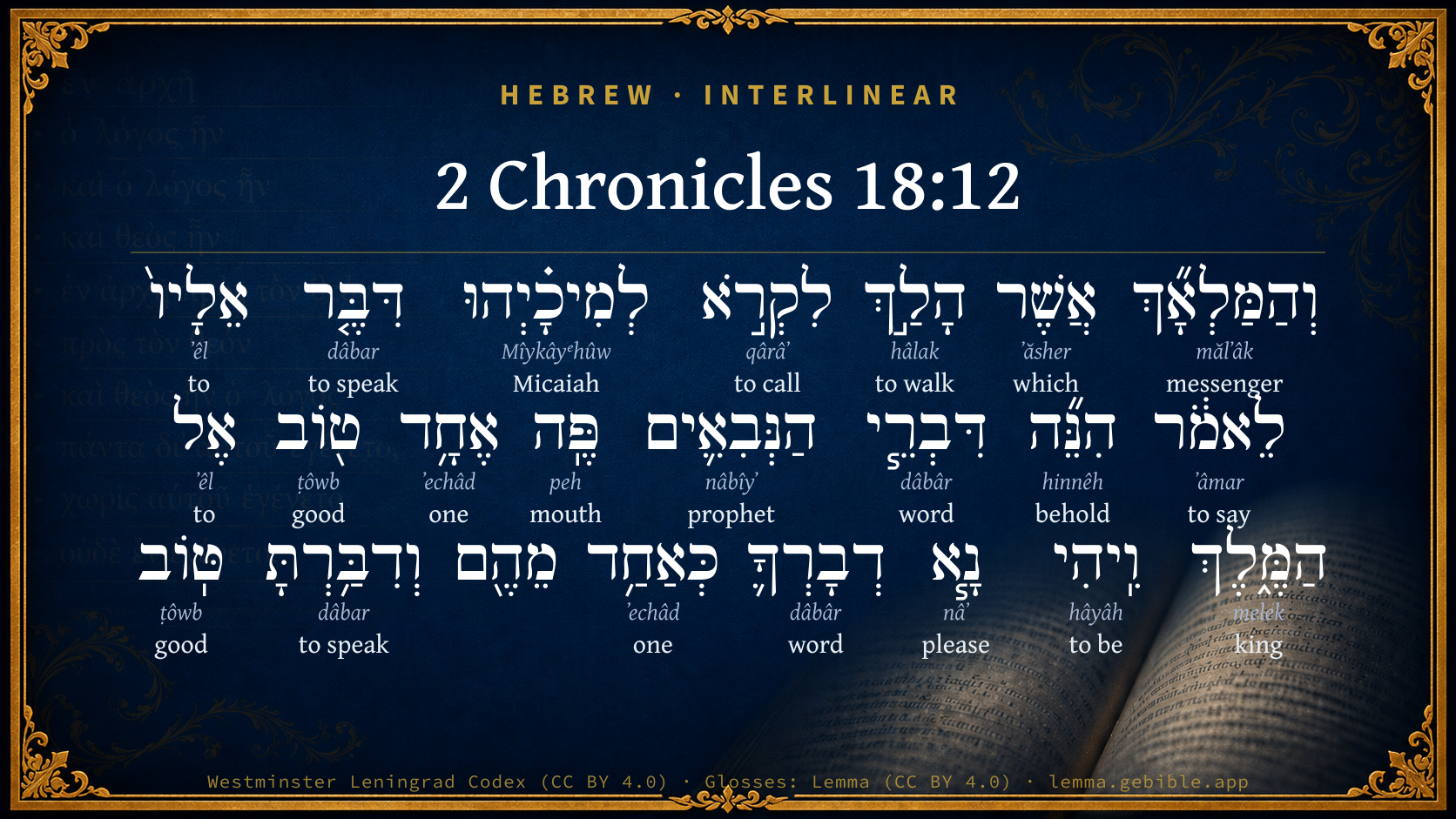
Hebrew (Westminster Leningrad Codex) 2 Chronicles 18:12 appears in the Hebrew Old Testament. The text above is from the Westminster Leningrad Codex. Each word links to its Strong’s number, a concise gloss, and parsing drawn from the Open Scriptures Hebrew Bible morphology. Click any word for its full Brown-Driver-Briggs (BDB) entry.
Download image
Cite this verse

2 Chronicles 18:12 (World English Bible). Public Domain. Lemma interlinear Bible study tool, https://lemma.gebible.app/v/2-chronicles/18/12.

Show BibTeX & RIS
BibTeX
RIS
English Translation
The messenger who went to call Micaiah spoke to him, saying, Behold, the words of the prophets [declare] good to the king with one mouth: let your word therefore, Please be like one of theirs, and speak you good.
World English Bible · Public Domain
Download a study sheet

One document with this verse’s original text, its word-by-word gloss line, the meaning frame, cross-references with their text, attributed commentary, and full source and license credits — printable, and it pastes into notes with its structure intact.

This verse Autodidact and up

Study sheet (.html) Plain text (.txt)

A passage Seminary Student

Up to 50 verses in one chapter. A passage sheet keeps up to 6 commentary sources and 12 cross-references per verse, in the order this page ranks them, and says so on the sheet whenever that leaves anything out. Ask for a single verse and you get the Autodidact verse sheet above.

Everything on this page stays free to read, with no account — the sheet is a download of what is already on screen, not access to it.

Want to remove ads? Support Godless Engineer
Compare translations 3

The same verse in 3 English versions, stacked beneath the original-language interlinear above. Click any original word for its lexicon entry.

Each is an independent rendering of the whole verse — the interlinear is not word-aligned to these translations.

Highlighted words mark where these versions differ — a whole-verse word diff, not a word-by-word alignment.

  • World English Bible Public Domain
    The messenger who went to call Micaiah spoke to him, saying, Behold, the words of the prophets [declare] good to the king with one mouth: let your word therefore, Please be like one of theirs, and speak you good.
  • King James Version Public Domain
    And the messenger that went to call Micaiah spake to him, saying, Behold, the words of the prophets declare good to the king with one assent; let thy word therefore, I pray thee, be like one of theirs, and speak thou good.
  • unfoldingWord Literal Text CC BY-SA 4.0
    And the messenger who went to call Micaiah spoke to him, saying, “Behold, the words of the prophets, one mouth, good to the king. And please let your word be as one from them, and speak good.”

unfoldingWord Literal Text — © unfoldingWord, licensed CC BY-SA 4.0. Word-aligned USFM3 via Door43 (git.door43.org/unfoldingWord/en_ult).

Versions to compare (up to 4)

3 of 4 selected

Show all 18 translations

Every available English version of this verse, each an independent rendering of the whole verse.

  • World English Bible Public Domain
    The messenger who went to call Micaiah spoke to him, saying, Behold, the words of the prophets [declare] good to the king with one mouth: let your word therefore, Please be like one of theirs, and speak you good.
  • Berean Standard Bible Public Domain
    Then the messenger who had gone to call Micaiah instructed him, “Behold, with one accord the words of the prophets are favorable to the king. So please let your words be like theirs, and speak favorably.”
  • Majority Standard Bible Public Domain
    Then the messenger who had gone to call Micaiah instructed him, “Behold, with one accord the words of the prophets are favorable to the king. So please let your words be like theirs, and speak favorably.”
  • King James Version Public Domain
    And the messenger that went to call Micaiah spake to him, saying, Behold, the words of the prophets declare good to the king with one assent; let thy word therefore, I pray thee, be like one of theirs, and speak thou good.
  • American Standard Version (1901) Public Domain
    And the messenger that went to call Micaiah spake to him, saying, Behold, the words of the prophets `declare' good to the king with one mouth: let thy word therefore, I pray thee, be like one of theirs, and speak thou good.
  • Revised Version (1885) Public Domain
    And the messenger that went to call Micaiah spake to him, saying, Behold, the words of the prophets declare good to the king with one mouth: let thy word, therefore, I pray thee, be like one of theirs, and speak thou good.
  • Geneva Bible (1599) Public Domain
    And the messenger that went to call Michaiah, spake to him, saying, Beholde, the wordes of the Prophets declare good to the King with one accord: let thy word therefore, I pray thee, be like one of theirs, and speake thou good.
  • Douay-Rheims (1899) Public Domain
    And the messenger that went to call Micheas, said to him: Behold the words of all the prophets with one mouth declare good to the king: I beseech thee therefore let not thy word disagree with them, and speak thou also good success.
  • Young's Literal Translation Public Domain
    And the messenger who hath gone to call for Micaiah hath spoken unto him, saying, `Lo, the words of the prophets -- one mouth -- `are' good towards the king, and let, I pray thee, thy word be like one of theirs: and thou hast spoken good.'
  • Literal Standard Version CC BY-SA 4.0
    And the messenger who has gone to call for Micaiah has spoken to him, saying, “Behold, the words of the prophets [as] one mouth [are] good toward the king, and please let your word be like one of theirs: and you have spoken good.”
  • Unlocked Literal Bible CC BY-SA 4.0
    The messenger who went to summon Micaiah said to him, “Look, the words of the prophets with one mouth are favorable to the king. Let your words agree with theirs, and speak favorably.”
  • unfoldingWord Literal Text CC BY-SA 4.0
    And the messenger who went to call Micaiah spoke to him, saying, “Behold, the words of the prophets, one mouth, good to the king. And please let your word be as one from them, and speak good.”
  • Darby Bible Public Domain
    And the messenger that went to call Micah spoke to him saying, Behold, the words of the prophets [declare] good to the king with one assent: let thy word therefore, I pray thee, be like one of theirs, and declare good.
  • World Messianic Bible Public Domain
    The messenger who went to call Micaiah spoke to him, saying, “Behold, the words of the prophets declare good to the king with one mouth. Let your word therefore, please be like one of theirs, and speak good.”
  • Webster's Bible Public Domain
    And the messenger that went to call Micaiah spoke to him, saying, Behold, the words of the prophets declare good to the king with one consent; let thy word therefore, I pray thee, be like one of theirs, and speak thou good.
  • Free Bible Version CC BY-SA 4.0
    The messenger who went to call Micaiah told him, “Look, all the prophets are unanimous in prophesying positively to the king. So please make sure to speak positively like them.”
  • Bible in Basic English Public Domain
    Now the servant who had gone to get Micaiah said to him, See now, all the prophets with one voice are saying good things to the king; so let your words be like theirs, and say good things.
  • JPS Tanakh (1917) Public Domain
    And the messenger that went to call Micaiah spoke to him, saying: 'Behold, the words of the prophets declare good to the king with one mouth; let thy word therefore, I pray thee, be like one of theirs, and speak thou good.'

Literal Standard Version (2020), Covenant Press — licensed CC BY-SA 4.0. Text via the HelloAO Bible API (eBible.org). Unlocked Literal Bible (unfoldingWord) — licensed CC BY-SA 4.0. Text via the HelloAO Bible API (eBible.org). unfoldingWord Literal Text — © unfoldingWord, licensed CC BY-SA 4.0. Word-aligned USFM3 via Door43 (git.door43.org/unfoldingWord/en_ult). Free Bible Version, Dr. Jonathan Gallagher — licensed CC BY-SA 4.0. Text via the HelloAO Bible API (eBible.org).

Word by word

More ways to search: Search by grammar → Find every occurrence → Compare this word →

Practice this passage: Drill this verse → Learn its vocabulary →

לְמִיכָ֗יְהוּ
Mîykâyᵉhûw
H4321
“to/for · Micaiah”
Preposition + Noun, Proper
Part of Speech
Preposition + Noun
Type
Proper
Full BDB Definition

Origin: abbrev. for H4322

TWOT: None

Micah or Micaiah or Michaiah = "who is like God" - an Ephraimite during the period of the judges - son of Imlah and a prophet of Samaria who predicted the defeat and death of king Ahab of Israel - son of Gemariah in the time of Jeremiah
  1. וְהַמַּלְאָ֞ךְ mălʼâk H4397 “and · the · messenger” Conjunction + Particle, Definite Article + Noun, Common, Masculine, Singular, Absolute
  2. אֲשֶׁר ʼăsher H834 “which” Particle, Relative
  3. הָלַ֣ךְ hâlak H1980 “to walk” Verb, Qal, Perfect, 3rd Person, Masculine, Singular
  4. לִקְרֹ֣א qârâʼ H7121 “to call” Preposition + Verb, Qal, Infinitive Construct
  5. דִּבֶּ֤ר dâbar H1696 “to speak” Verb, Piel, Perfect, 3rd Person, Masculine, Singular
  6. אֵלָיו֙ ʼêl H413 “to · him” Preposition + Suffix, Personal, 3rd Person, Masculine, Singular
  7. לֵאמֹ֔ר ʼâmar H559 “to say” Preposition + Verb, Qal, Infinitive Construct
  8. הִנֵּ֞ה hinnêh H2009 “behold” Particle, Demonstrative
  9. דִּבְרֵ֧י dâbâr H1697 “words of” Noun, Common, Masculine, Plural, Construct
  10. הַנְּבִאִ֛ים nâbîyʼ H5030 “the · prophets” Particle, Definite Article + Noun, Common, Masculine, Plural, Absolute
  11. פֶּֽה peh H6310 “mouth” Noun, Common, Masculine, Singular, Absolute
  12. אֶחָ֥ד ʼechâd H259 “one” Adjective, Cardinal number, Masculine, Singular, Absolute
  13. ט֖וֹב ṭôwb H2896 “good” Adjective, Adjective, Masculine, Singular, Absolute
  14. אֶל ʼêl H413 “to” Preposition
  15. הַמֶּ֑לֶךְ melek H4428 “the · king” Particle, Definite Article + Noun, Common, Masculine, Singular, Absolute
  16. וִֽיהִי hâyâh H1961 “and · to be” Conjunction + Verb, Qal, Jussive, 3rd Person, Masculine, Singular
  17. נָ֧א nâʼ H4994 “please” Particle, Exhortation
  18. דְבָרְךָ֛ dâbâr H1697 “word · your” Noun, Common, Masculine, Singular, Construct + Suffix, Personal, 2nd Person, Masculine, Singular
  19. כְּאַחַ֥ד ʼechâd H259 “like/as · one” Preposition + Adjective, Cardinal number, Masculine, Singular, Construct
  20. וְדִבַּ֥רְתָּ dâbar H1696 “and · to speak” Conjunction + Verb, Piel, Sequential Perfect, 2nd Person, Masculine, Singular
  21. טּֽוֹב ṭôwb H2896 “good” Adjective, Adjective, Masculine, Singular, Absolute

About this verse

These counts appear in no published source. They are computed here, from the morphology-tagged text and Lemma’s own curated glosses. What Lemma adds →

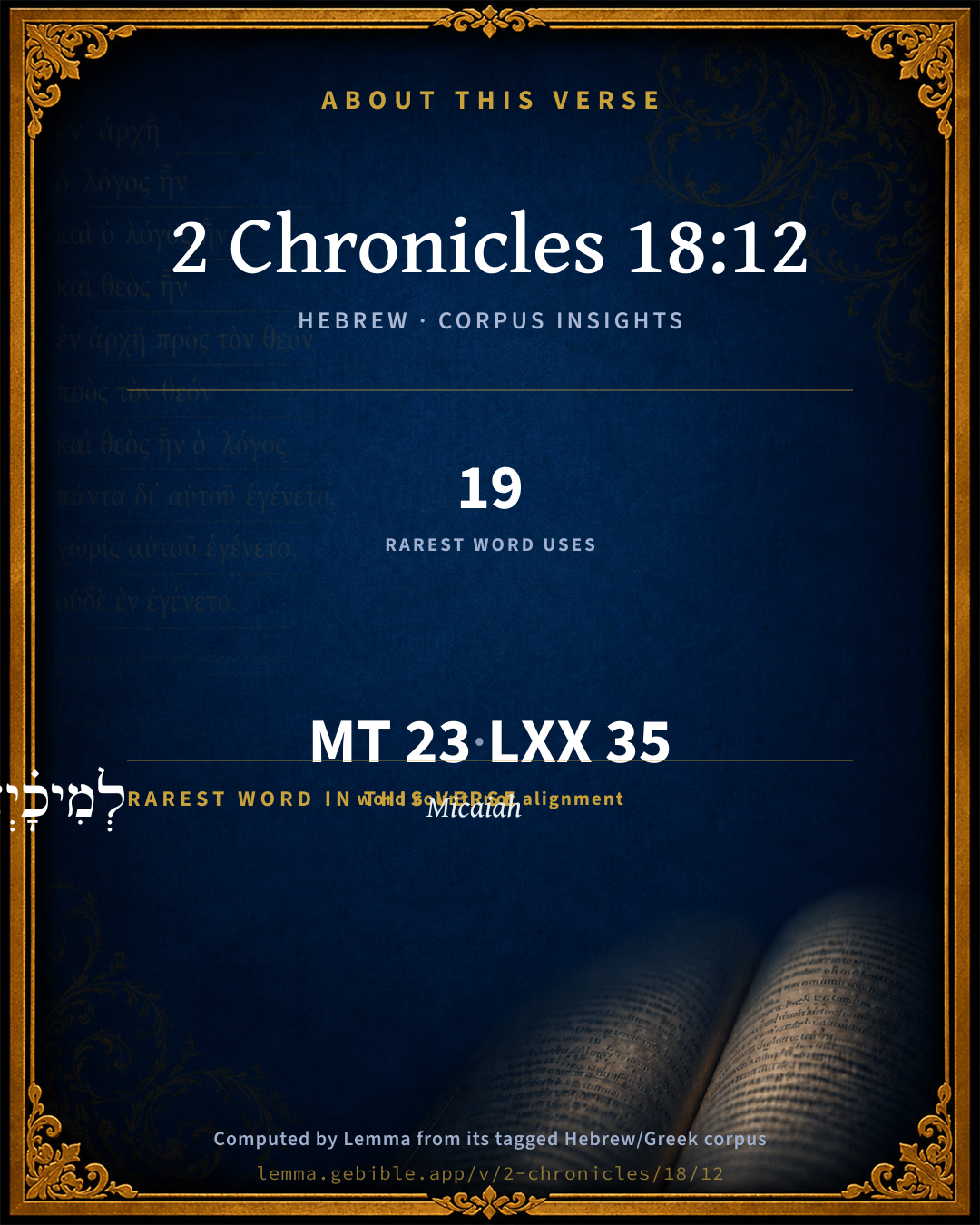
23
words
17
distinct lemmas
Historical
section

Notable vocabulary

The rarest word here is לְמִיכָ֗יְהוּ Micaiah H4321 — appearing just 19 times in the whole Hebrew Bible.

Shared distinctive vocabulary

לְמִיכָ֗יְהוּ Micaiah H4321 occurs in 19 verses of the Hebrew Bible. Also found in:

Grammatical profile

  • 6 verbs
  • 7 nouns
  • 4 adjectives
  • 3 prepositions
  • 3 particles

Verb forms

  • הָלַ֣ךְ Qal · Perfect
  • לִקְרֹ֣א Qal · Infinitive Construct
  • דִּבֶּ֤ר Piel · Perfect
  • לֵאמֹ֔ר Qal · Infinitive Construct
  • וִֽיהִי Qal · Jussive
  • וְדִבַּ֥רְתָּ Piel · Sequential Perfect

Repetition

Words recur within this verse — often emphatic in Hebrew:

  • דִּבֶּ֤ר to speak H1696 ×2
  • דִּבְרֵ֧י word H1697 ×2
  • אֶחָ֥ד one H259 ×2
  • ט֖וֹב good H2896 ×2
  • אֵלָיו֙ to H413 ×2

Hebrew & Septuagint length

In English translation the verse runs 39 words from the Hebrew and 45 from the Septuagint (LXX English) — closely comparable.

A rough comparison of the two English renderings, which tokenize alike — not a word-level alignment.

Word counts can differ between the Hebrew and the Greek without any difference in meaning — e.g. the Hebrew direct-object marker אֵת has no separate Greek word, and Greek often adds the article ὁ.

In the original languages it is 23 Hebrew tokens and 35 Greek tokens — but the two are counted differently (Hebrew bundles its prefixes and suffixes into one token; the Greek is in lemma form), so that isn’t a like-for-like length.

Cross-references

9

Topical passages linked to 2 Chronicles 18:12 in the Treasury of Scripture Knowledge — connected by theme and wording, ordered by reader-vote popularity; previews shown in the World English Bible.

  • Joshua 9:2 that they gathered themselves together, to fight with Joshua and with Israel, with one accord.
  • Job 22:13 You say, 'What does God know? Can he judge through the thick darkness?
  • Psalms 10:11 He says in his heart, "God has forgotten. He hides his face. He will never see it."
  • Isaiah 30:10 who tell the seers, "Don't see;" and to the prophets, "Don't prophesy to us right things, speak to us smooth things, prophesy deceits,
  • Hosea 7:3 They make the king glad with their wickedness, And the princes with their lies.
  • Amos 7:13 but don't prophesy again any more at Bethel; for it is the king's sanctuary, and it is a royal house!"
  • Micah 2:6 "Don't you prophesy!" They prophesy. "Don't prophesy about these things. Disgrace won't overtake us."
  • Micah 2:11 If a man walking in a spirit of falsehood lies: 'I will prophesy to you of wine and of strong drink;' He would be the prophet of this people.
  • 1 Corinthians 2:14–16 Now the natural man doesn't receive the things of God's Spirit, for they are foolishness to him, and he can't know them, because they are spiritually discerned.

Cross-references courtesy of OpenBible.info (CC BY 4.0).

Hebrew and Greek witnesses Masoretic Hebrew ↔ Greek Septuagint

The same verse in the two great witnesses to the Old Testament, shown verse-for-verse.

These are two independent witnesses, not word-aligned to each other, and the Septuagint is shown in lemma (dictionary) form.

Hebrew 2 Chronicles 18:12 Masoretic · Westminster Leningrad Codex

וְהַמַּלְאָ֞ךְ אֲשֶׁר הָלַ֣ךְ לִקְרֹ֣א לְמִיכָ֗יְהוּ דִּבֶּ֤ר אֵלָיו֙ לֵאמֹ֔ר הִנֵּ֞ה דִּבְרֵ֧י הַנְּבִאִ֛ים פֶּֽה אֶחָ֥ד ט֖וֹב אֶל הַמֶּ֑לֶךְ וִֽיהִי נָ֧א דְבָרְךָ֛ כְּאַחַ֥ד מֵהֶ֖ם וְדִבַּ֥רְתָּ טּֽוֹב

The messenger who went to call Micaiah spoke to him, saying, Behold, the words of the prophets [declare] good to the king with one mouth: let your word therefore, Please be like one of theirs, and speak you good.

World English Bible · Public Domain

Greek LXX 2 Chronicles 18:12 Septuagint · lemma form

καί ὁ ἄγγελος ὁ πορεύομαι ὁ καλέω ὁ μιχαιας λαλέω αὐτός λέγω ἰδού λαλέω ὁ προφήτης ἐν στόμα εἷς ἀγαθός περί ὁ βασιλεύς καί εἰμί δή ὁ λόγος σύ ὡς εἷς αὐτός καί λαλέω ἀγαθός

And the messenger that went to call Michaias spoke to him, saying, Behold, the prophets have spoken favourably concerning the king with one mouth; let now, I pray you, your words be as the words of one of them, and do you speak good things.

LXX2012 (modern English Septuagint) · Public Domain

On this verse, Ellicott's Commentary for English Readers discusses the Septuagint’s reading. Read the note in Commentary ↓

Hebrew: Westminster Leningrad Codex (CC BY 4.0). Greek: Septuagint (public domain); English from LXX2012 (modern English Septuagint) (Public Domain). How the Septuagint differs from the Hebrew →

Commentary

Notes on 2 Chronicles 18:12 from classic Christian and Jewish commentators (each source and its license shown beneath its notes). The classic Christian expositions comment on the surrounding passage and are grouped to its opening verse, so a note may address several verses; the Jewish commentaries on the Tanakh (Rashi and others) are per-verse, so they appear only where the commentator wrote on this verse.

Lemma curates 59 commentaries, every one of them public domain or Creative Commons licensed, each selected and text-cleaned for this edition rather than reprinted as found. About our sources →

Geneva Bible (1599)

Geneva Bible translators

Thinking, that whereas four hundred prophets had agreed in one thing, that he being but one man and in least estimation, durst not gainsay it.

Geneva Bible (1599) marginal notes — public domain. Text via Bolls.life.

Ellicott's Commentary for English Readers

(12) The words of the prophets . . . one assent.—See margin, and comp. Jos_9:2, “they assembled . . . to fight against Israel, one mouth “—i.e., with one consent.)

Probably instead of dibhrê, “words,” we should read dibbĕrû, “they said,” a far slighter change in Hebrew writing than in English: “Behold the prophets have with one mouth spoken good unto (or, of) the king.” So LXX.

Like one of their’s.—Literally, like one of them. Kings, like the word of one of them.

A Bible Commentary for English Readers, edited by Charles John Ellicott (1878–1897) — public domain. Text from a community e-Sword module.

The Cambridge Bible for Schools and Colleges

gen. ed. J. J. S. Perowne

12. with one assent] R.V. with one mouth (so Heb. here and 1 Kin.).

The Cambridge Bible for Schools and Colleges (gen. ed. J. J. S. Perowne; Cambridge University Press, 1878–1918) — public domain. Text from a community e-Sword module.

The Pulpit Commentary

This verse bespeaks very clearly the rotten condition of Church and state, prophets and king and "officers" (ver. 8).

The Pulpit Commentary (1880–1919), ed. H.D.M. Spence-Jones & Joseph S. Exell — public domain. Text from a community e-Sword module.

unfoldingWord translationNotes

Door43 World Missions Community

Micaiah

Translate this man's name the same as in 2 Chronicles 17:7. (See: How to Translate Names)

Look

"Listen" or "Pay attention to what I am about to tell you"

the words of the prophets with one mouth are favorable to the king

The prophets all saying the same thing is spoken of as if they all spoke with the same mouth. The phrase "the words of the prophets" represents the message that the prophets declare. AT: "the prophets all declare that good things will happen to the king" (See: Metaphor)

your words

"what you say"

As Yahweh lives

"as surely as Yahweh is alive." The people use this expression to show that what they say next is certainly true. This is a way of making a solemn promise. AT: "I solemnly swear" (See: Idiom)

or not

The understood information may be supplied. AT: "or should we not go" (See: Ellipsis)

should we go

The word "we" refers to Ahab, Jehoshaphat, and their armies but not to Micaiah. (See: Exclusive and Inclusive "We")

translationWords

messenger

prophet

Yahweh

God

Ramoth

Gilead

unfoldingWord translationNotes — © Distant Shores Media and the Door43 World Missions Community, licensed CC BY-SA 4.0. Source: git.door43.org/Door43/en_tn.

Lesson kit

Teaching starters — assembled from the data on this page, not authored interpretation. Every prompt links to the verse data it draws on. Edit before teaching.

2 Chronicles, in the Historical, opens this verse with 23 words (17 distinct Hebrew lemmas). Its most distinctive word is Mîykâyᵉhûw (“Micaiah”). A historical commentator’s framing appears above. Read the whole chapter for the surrounding context.

Discussion questions

  1. The word Mîykâyᵉhûw carries the sense “Micaiah.” How does it shape the verse?
  2. 1 Kings 22:8 shares the word «Micaiah» with this verse. How do the two illuminate each other?
  3. “to speak” occurs 2× in this one verse. What is the effect of the repetition?
  4. The translations on this page render this verse differently — a whole-verse word diff, not a word-by-word alignment. What might account for the different wordings?
  5. The verb «הָלַ֣ךְ» is Qal Perfect. How does its form color the action?
  6. Reading how Geneva Bible (1599) and Ellicott's Commentary for English Readers read this verse, where do the two commentators agree and where do they part?

Things to notice

Reading settings

Reading text

Shown beneath each verse's original-language words.

Old Testament
Old Testament edition

Read the OT as the Masoretic Hebrew (MT) or the Greek Septuagint (LXX).

English shown for the Greek Septuagint (in the Hebrew ↔ Greek comparison).

Comparing translations? Open the Compare panel on any verse page to stack up to four side by side.