
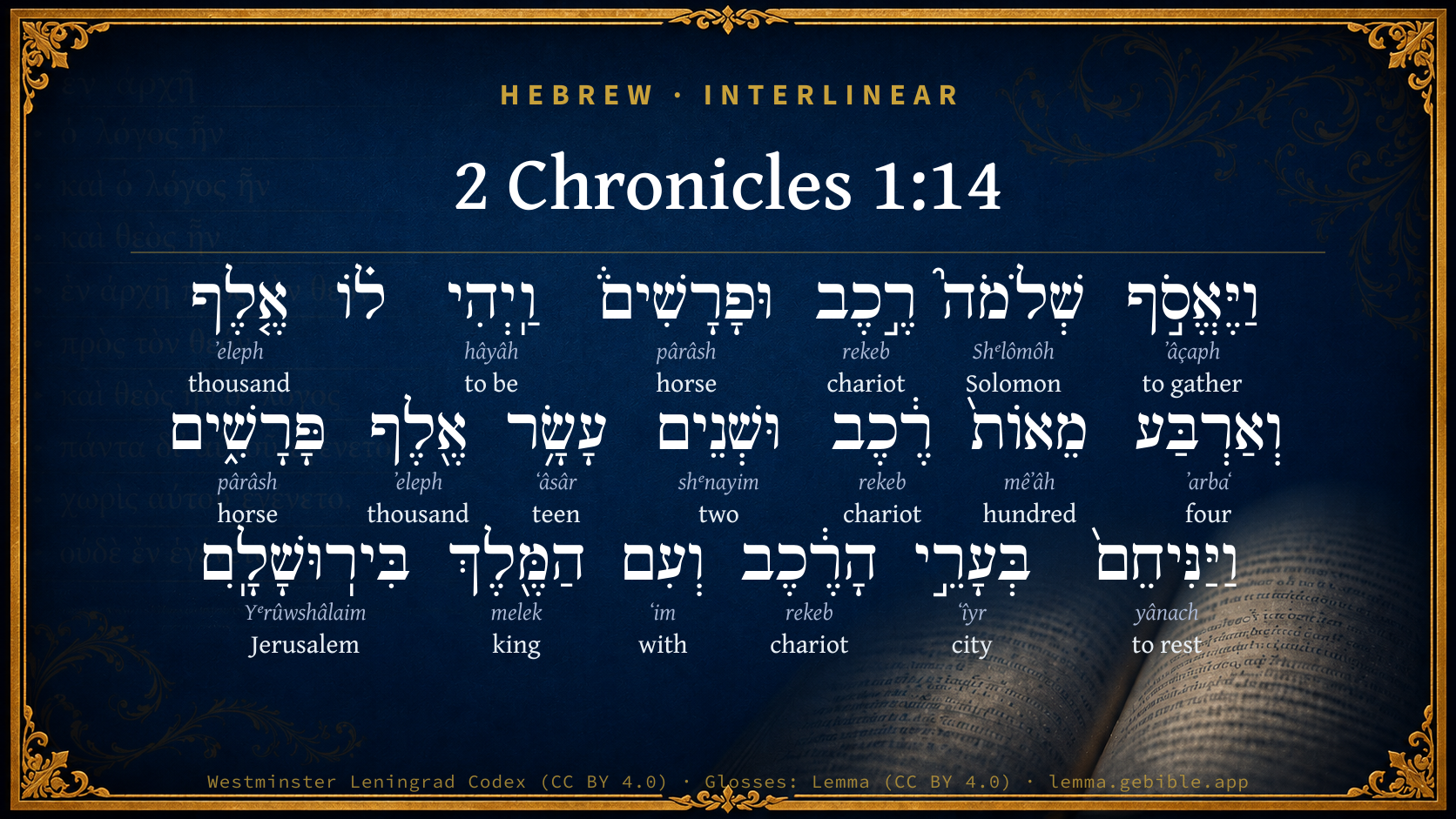
2 Chronicles 1:14

Hebrew (Westminster Leningrad Codex) 2 Chronicles 1:14 appears in the Hebrew Old Testament. The text above is from the Westminster Leningrad Codex. Each word links to its Strong’s number, a concise gloss, and parsing drawn from the Open Scriptures Hebrew Bible morphology. Click any word for its full Brown-Driver-Briggs (BDB) entry.
Download image
Cite this verse

2 Chronicles 1:14 (World English Bible). Public Domain. Lemma interlinear Bible study tool, https://lemma.gebible.app/v/2-chronicles/1/14.

Show BibTeX & RIS
BibTeX
RIS
English Translation
Solomon gathered chariots and horsemen: and he had one thousand four hundred chariots, and twelve thousand horsemen, that he placed in the chariot cities, and with the king at Jerusalem.
World English Bible · Public Domain
Download a study sheet

One document with this verse’s original text, its word-by-word gloss line, the meaning frame, cross-references with their text, attributed commentary, and full source and license credits — printable, and it pastes into notes with its structure intact.

This verse Autodidact and up

Study sheet (.html) Plain text (.txt)

A passage Seminary Student

Up to 50 verses in one chapter. A passage sheet keeps up to 6 commentary sources and 12 cross-references per verse, in the order this page ranks them, and says so on the sheet whenever that leaves anything out. Ask for a single verse and you get the Autodidact verse sheet above.

Everything on this page stays free to read, with no account — the sheet is a download of what is already on screen, not access to it.

Want to remove ads? Support Godless Engineer
Compare translations 3

The same verse in 3 English versions, stacked beneath the original-language interlinear above. Click any original word for its lexicon entry.

Each is an independent rendering of the whole verse — the interlinear is not word-aligned to these translations.

Highlighted words mark where these versions differ — a whole-verse word diff, not a word-by-word alignment.

  • World English Bible Public Domain
    Solomon gathered chariots and horsemen: and he had one thousand four hundred chariots, and twelve thousand horsemen, that he placed in the chariot cities, and with the king at Jerusalem.
  • King James Version Public Domain
    And Solomon gathered chariots and horsemen: and he had a thousand and four hundred chariots, and twelve thousand horsemen, which he placed in the chariot cities, and with the king at Jerusalem.
  • unfoldingWord Literal Text CC BY-SA 4.0
    And Solomon gathered chariots and horsemen, and there was to him 1,400 chariots and 12,000 horsemen, and he placed them in the chariot cities, and with the king in Jerusalem.

unfoldingWord Literal Text — © unfoldingWord, licensed CC BY-SA 4.0. Word-aligned USFM3 via Door43 (git.door43.org/unfoldingWord/en_ult).

Versions to compare (up to 4)

3 of 4 selected

Show all 18 translations

Every available English version of this verse, each an independent rendering of the whole verse.

  • World English Bible Public Domain
    Solomon gathered chariots and horsemen: and he had one thousand four hundred chariots, and twelve thousand horsemen, that he placed in the chariot cities, and with the king at Jerusalem.
  • Berean Standard Bible Public Domain
    Solomon accumulated 1,400 chariots and 12,000 horses, which he stationed in the chariot cities and also with him in Jerusalem.
  • Majority Standard Bible Public Domain
    Solomon accumulated 1,400 chariots and 12,000 horses, which he stationed in the chariot cities and also with him in Jerusalem.
  • King James Version Public Domain
    And Solomon gathered chariots and horsemen: and he had a thousand and four hundred chariots, and twelve thousand horsemen, which he placed in the chariot cities, and with the king at Jerusalem.
  • American Standard Version (1901) Public Domain
    And Solomon gathered chariots and horsemen: and he had a thousand and four hundred chariots, and twelve thousand horsemen, that he placed in the chariot cities, and with the king at Jerusalem.
  • Revised Version (1885) Public Domain
    And Solomon gathered chariots and horsemen: and he had a thousand and four hundred chariots, and twelve thousand horsemen, which he placed in the chariot cities, and with the king at Jerusalem.
  • Geneva Bible (1599) Public Domain
    And Salomon gathered the charets and horesemen: and he had a thousand and foure hundreth charets, and twelue thousande horsemen, whome he placed in the charet cities, and with the King at Ierusalem.
  • Douay-Rheims (1899) Public Domain
    And he gathered to himself chariots and horsemen, and he had a thousand four hundred chariots, and twelve thousand horsemen: and he placed them in the cities of the chariots, and with the king in Jerusalem.
  • Young's Literal Translation Public Domain
    and Solomon gathereth chariots and horsemen, and he hath a thousand and four hundred chariots, and twelve thousand horsemen, and he placeth them in the cities of the chariots, and with the king in Jerusalem.
  • Literal Standard Version CC BY-SA 4.0
    and Solomon gathers chariots and horsemen, and he has one thousand and four hundred chariots, and twelve thousand horsemen, and he places them in the cities of the chariots, and with the king in Jerusalem.
  • Unlocked Literal Bible CC BY-SA 4.0
    Solomon gathered chariots and horsemen, and he had 1,400 chariots and twelve thousand horsemen that he placed in the chariot cities, and with himself, the king in Jerusalem.
  • unfoldingWord Literal Text CC BY-SA 4.0
    And Solomon gathered chariots and horsemen, and there was to him 1,400 chariots and 12,000 horsemen, and he placed them in the chariot cities, and with the king in Jerusalem.
  • Darby Bible Public Domain
    And Solomon gathered chariots and horsemen; and he had a thousand four hundred chariots and twelve thousand horsemen; and he placed them in the chariot-cities, and with the king at Jerusalem.
  • World Messianic Bible Public Domain
    Solomon gathered chariots and horsemen. He had one thousand four hundred chariots and twelve thousand horsemen that he placed in the chariot cities, and with the king at Jerusalem.
  • Webster's Bible Public Domain
    And Solomon gathered chariots and horsemen: and he had a thousand and four hundred chariots, and twelve thousand horsemen, which he placed in the chariot cities, and with the king at Jerusalem.
  • Free Bible Version CC BY-SA 4.0
    Solomon built up an army of chariots and horses. He had 1,400 chariots and 12,000 horses, which he placed in the chariot cities, and also with him in Jerusalem.
  • Bible in Basic English Public Domain
    And Solomon got together war-carriages and horsemen; he had one thousand, four hundred carriages and twelve thousand horsemen, which he kept, some in the carriage-towns and some with the king at Jerusalem.
  • JPS Tanakh (1917) Public Domain
    And Solomon gathered chariots and horsemen; and he had a thousand and four hundred chariots, and twelve thousand horsemen, that he placed in the chariot cities, and with the king at Jerusalem.

Literal Standard Version (2020), Covenant Press — licensed CC BY-SA 4.0. Text via the HelloAO Bible API (eBible.org). Unlocked Literal Bible (unfoldingWord) — licensed CC BY-SA 4.0. Text via the HelloAO Bible API (eBible.org). unfoldingWord Literal Text — © unfoldingWord, licensed CC BY-SA 4.0. Word-aligned USFM3 via Door43 (git.door43.org/unfoldingWord/en_ult). Free Bible Version, Dr. Jonathan Gallagher — licensed CC BY-SA 4.0. Text via the HelloAO Bible API (eBible.org).

Word by word

More ways to search: Search by grammar → Find every occurrence → Compare this word →

Practice this passage: Drill this verse → Learn its vocabulary →

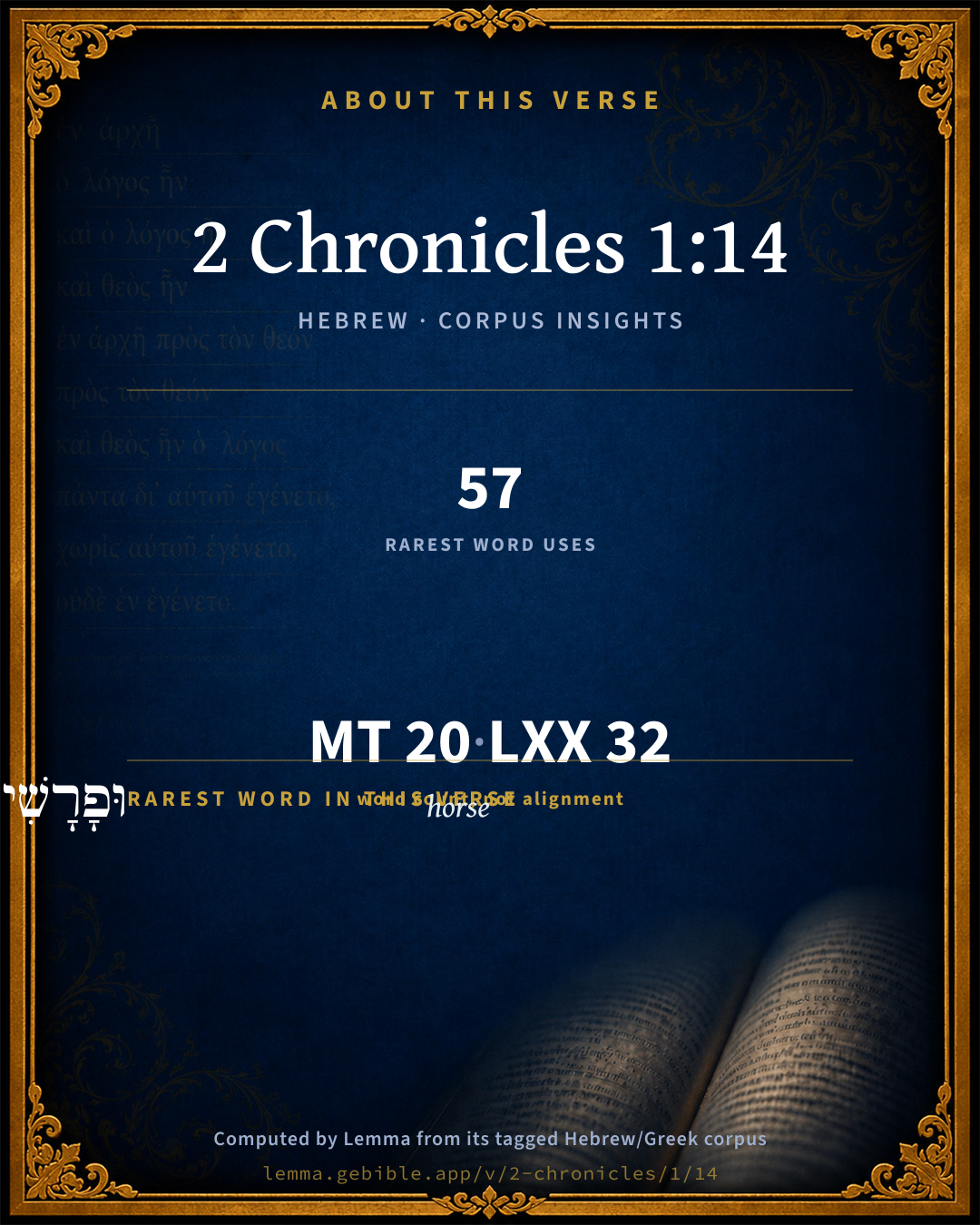
וּפָרָשִׁים֒
pârâsh
H6571
“and · horses”
Conjunction + Noun, Common, Masculine, Plural, Absolute
Part of Speech
Conjunction + Noun
Type
Common
Gender
Masculine
Number
Plural
State
Absolute
Full BDB Definition

Origin: from H6567

TWOT: 1836a

horse, steed, warhorse - horseman
  1. וַיֶּאֱסֹ֣ף ʼâçaph H622 “and · to gather” Conjunction + Verb, Qal, Sequential Imperfect, 3rd Person, Masculine, Singular
  2. שְׁלֹמֹה֮ Shᵉlômôh H8010 “Solomon” Noun, Proper
  3. רֶ֣כֶב rekeb H7393 “chariot” Noun, Common, Masculine, Singular, Absolute
  4. וַֽיְהִי hâyâh H1961 “and · to be” Conjunction + Verb, Qal, Sequential Imperfect, 3rd Person, Masculine, Singular
  5. אֶ֤לֶף ʼeleph H505 “thousand” Adjective, Cardinal number, Both, Singular, Absolute
  6. וְאַרְבַּע ʼarbaʻ H702 “and · four” Conjunction + Adjective, Cardinal number, Feminine, Singular, Absolute
  7. מֵאוֹת֙ mêʼâh H3967 “hundred” Adjective, Cardinal number, Both, Plural, Absolute
  8. רֶ֔כֶב rekeb H7393 “chariot” Noun, Common, Masculine, Singular, Absolute
  9. וּשְׁנֵים shᵉnayim H8147 “and · two” Conjunction + Adjective, Cardinal number, Masculine, Dual, Absolute
  10. עָשָׂ֥ר ʻâsâr H6240 “teen” Adjective, Cardinal number, Masculine, Singular, Absolute
  11. אֶ֖לֶף ʼeleph H505 “thousand” Adjective, Cardinal number, Both, Singular, Absolute
  12. פָּרָשִׁ֑ים pârâsh H6571 “horses” Noun, Common, Masculine, Plural, Absolute
  13. וַיַּנִּיחֵם֙ yânach H3240 “and · to rest · them” Conjunction + Verb, Hiphil, Sequential Imperfect, 3rd Person, Masculine, Singular + Suffix, Personal, 3rd Person, Masculine, Plural
  14. בְּעָרֵ֣י ʻîyr H5892 “in/at · cities of” Preposition + Noun, Common, Feminine, Plural, Construct
  15. הָרֶ֔כֶב rekeb H7393 “the · chariot” Particle, Definite Article + Noun, Common, Masculine, Singular, Absolute
  16. וְעִם ʻim H5973 “and · with” Conjunction + Preposition
  17. הַמֶּ֖לֶךְ melek H4428 “the · king” Particle, Definite Article + Noun, Common, Masculine, Singular, Absolute
  18. בִּירֽוּשָׁלִָֽם Yᵉrûwshâlaim H3389 “in/at · Jerusalem” Preposition + Noun, Proper

About this verse

These counts appear in no published source. They are computed here, from the morphology-tagged text and Lemma’s own curated glosses. What Lemma adds →

20
words
15
distinct lemmas
Historical
section

Shared distinctive vocabulary

וּפָרָשִׁים֒ horse H6571 occurs in 54 verses of the Hebrew Bible. Also found in:

Grammatical profile

  • 3 verbs
  • 9 nouns
  • 6 adjectives
  • 2 prepositions

Verb forms

  • וַיֶּאֱסֹ֣ף Qal · Sequential Imperfect
  • וַֽיְהִי Qal · Sequential Imperfect
  • וַיַּנִּיחֵם֙ Hiphil · Sequential Imperfect

Repetition

Words recur within this verse — often emphatic in Hebrew:

  • רֶ֣כֶב chariot H7393 ×3
  • וּפָרָשִׁים֒ horse H6571 ×2
  • אֶ֤לֶף thousand H505 ×2

Hebrew & Septuagint length

In English translation the verse runs 30 words from the Hebrew and 34 from the Septuagint (LXX English) — closely comparable.

A rough comparison of the two English renderings, which tokenize alike — not a word-level alignment.

Word counts can differ between the Hebrew and the Greek without any difference in meaning — e.g. the Hebrew direct-object marker אֵת has no separate Greek word, and Greek often adds the article ὁ.

In the original languages it is 20 Hebrew tokens and 32 Greek tokens — but the two are counted differently (Hebrew bundles its prefixes and suffixes into one token; the Greek is in lemma form), so that isn’t a like-for-like length.

Cross-references

6

Topical passages linked to 2 Chronicles 1:14 in the Treasury of Scripture Knowledge — connected by theme and wording, ordered by reader-vote popularity; previews shown in the World English Bible.

  • 1 Kings 4:26 Solomon had forty thousand stalls of horses for his chariots, and twelve thousand horsemen.
  • 1 Kings 10:26–29 Solomon gathered together chariots and horsemen: and he had a thousand and four hundred chariots, and twelve thousand horsemen, that he bestowed in the chariot cities, and with the king at Jerusalem.
  • 1 Kings 9:19 and all the store-cities that Solomon had, and the cities for his chariots, and the cities for his horsemen, and that which Solomon desired to build for his pleasure in Jerusalem, and in Lebanon, and in all the land of his dominion.
  • 2 Chronicles 9:25 Solomon had four thousand stalls for horses and chariots, and twelve thousand horsemen, that he bestowed in the chariot cities, and with the king at Jerusalem.
  • Deuteronomy 17:16 Only he shall not multiply horses to himself, nor cause the people to return to Egypt, to the end that he may multiply horses; because Yahweh has said to you, You shall henceforth return no more that way.
  • 1 Kings 10:16 King Solomon made two hundred bucklers of beaten gold; six hundred [shekels] of gold went to one buckler.

Cross-references courtesy of OpenBible.info (CC BY 4.0).

Hebrew and Greek witnesses Masoretic Hebrew ↔ Greek Septuagint

The same verse in the two great witnesses to the Old Testament, shown verse-for-verse.

These are two independent witnesses, not word-aligned to each other, and the Septuagint is shown in lemma (dictionary) form.

Hebrew 2 Chronicles 1:14 Masoretic · Westminster Leningrad Codex

וַיֶּאֱסֹ֣ף שְׁלֹמֹה֮ רֶ֣כֶב וּפָרָשִׁים֒ וַֽיְהִי ל֗וֹ אֶ֤לֶף וְאַרְבַּע מֵאוֹת֙ רֶ֔כֶב וּשְׁנֵים עָשָׂ֥ר אֶ֖לֶף פָּרָשִׁ֑ים וַיַּנִּיחֵם֙ בְּעָרֵ֣י הָרֶ֔כֶב וְעִם הַמֶּ֖לֶךְ בִּירֽוּשָׁלִָֽם

Solomon gathered chariots and horsemen: and he had one thousand four hundred chariots, and twelve thousand horsemen, that he placed in the chariot cities, and with the king at Jerusalem.

World English Bible · Public Domain

Greek LXX 2 Chronicles 1:14 Septuagint · lemma form

καί συνἄγω σαλωμών ἅρμα καί ἱππεύς καί γίγνομαι αὐτός χίλιοι καί τετρακόσιοι ἅρμα καί δώδεκα χιλίας ἱππεύς καί καταλείπω αὐτός ἐν πόλις ὁ ἅρμα καί ὁ λαός μετά ὁ βασιλεύς ἐν ἰερουσαλήμ

And Solomon collected chariots and horsemen: and he had fourteen hundred chariots, and twelve thousand horsemen: and he set them in the cities of chariots, and the people were with the king in Jerusalem.

LXX2012 (modern English Septuagint) · Public Domain

On this verse, Ellicott's Commentary for English Readers discusses the Septuagint’s reading. Read the note in Commentary ↓

Hebrew: Westminster Leningrad Codex (CC BY 4.0). Greek: Septuagint (public domain); English from LXX2012 (modern English Septuagint) (Public Domain). How the Septuagint differs from the Hebrew →

Commentary

Notes on 2 Chronicles 1:14 from classic Christian and Jewish commentators (each source and its license shown beneath its notes). The classic Christian expositions comment on the surrounding passage and are grouped to its opening verse, so a note may address several verses; the Jewish commentaries on the Tanakh (Rashi and others) are per-verse, so they appear only where the commentator wrote on this verse.

Lemma curates 59 commentaries, every one of them public domain or Creative Commons licensed, each selected and text-cleaned for this edition rather than reprinted as found. About our sources →

Jamieson, Fausset & Brown

Robert Jamieson, A. R. Fausset & David Brown

HIS STRENGTH AND WEALTH. (Ch2 1:14-17)

Solomon gathered chariots and horsemen--His passion for horses was greater than that of any Israelitish monarch before or after him. His stud comprised fourteen hundred chariots and twelve thousand horses. This was a prohibited indulgence, whether as an instrument of luxury or power. But it was not merely for his own use that he imported the horses of Egypt. The immense equestrian establishment he erected was not for show merely, but also for profit. The Egyptian breed of horses was highly valued; and being as fine as the Arabian, but larger and more powerful, they were well fitted for being yoked in chariots. These were light but compact and solid vehicles, without springs. From the price stated (Ch2 1:17) as given for a chariot and a horse, it appears that the chariot cost four times the value of a horse. A horse brought a 150 shekels, which, estimating the shekels at 2s. 3d. or 2s. 6d., amount to £17 2s. or £18 15s., while a chariot brought 600 shekels, equal to £68 9s. or £75; and as an Egyptian chariot was usually drawn by two horses, a chariot and pair would cost £112 sterling. As the Syrians, who were fond of the Egyptian breed of horses, could import them into their own country only through Judea, Solomon early perceived the commercial advantages to be derived from this trade, and established a monopoly. His factors or agents purchased them in the markets or fairs of Egypt and brought them to the "chariot cities," the depots and stables he had erected on the frontiers of his kingdom, such as Bethmarcaboth, "the house of chariots," and Hazarsusah, "the village of horses" (Jos 19:5; Kg1 10:28).

Jamieson, Fausset & Brown — Commentary Critical and Explanatory on the Whole Bible (1871) — public domain (CC PDM 1.0). Text via the HelloAO Bible API.

Trapp's Complete Commentary

John Trapp

2Ch 1:14 And Solomon gathered chariots and horsemen: and he had a thousand and four hundred chariots, and twelve thousand horsemen, which he placed in the chariot cities, and with the king at Jerusalem.

Ver. 14. And Solomon gathered chariots and horsemen.] This is here added to show how God made good to Solomon that other part of his promise also concerning riches and honours. And here the lawgiver might dispense with that law of his, {Deu 17:16} by a singular privilege to this king of Israel. See on 1Ki 4:26.

John Trapp, A Commentary or Exposition upon All the Books of the Old and New Testament (1647–1656) — public domain. Text from a community e-Sword module.

Joseph Benson's Commentary

2Ch 1:14. And Solomon gathered chariots and horsemen, which he placed in the chariot-cities, and with the king at Jerusalem — Of this and the three following verses, see the notes on 1Ki 10:26, &c.

Joseph Benson's Commentary on the Old and New Testaments (1811–1818) — public domain. Text from a community e-Sword module.

Keil & Delitzsch

C. F. Keil & F. Delitzsch

Solomon's chariots, horses, and riches. - In order to prove by facts the fulfilment of the divine promise which Solomon received in answer to his prayer at Gibeon, we have in Kg1 3:16-28 a narrative of Solomon's wise judgment, then in 2 Chron 4 an account of his public officers; and in Ch2 5:1-14 the royal magnificence, glory, and wisdom of his reign is further portrayed. In our Chronicle, on the contrary, we have in Ch2 1:14-17 only a short statement as to his chariots and horses, and the wealth in silver and gold to be found in the land, merely for the purpose of showing how God had given him riches and possessions. This statement recurs verbally in Kg1 10:26-29, in the concluding remarks on the riches and splendour of Solomon's reign; while in the parallel passage, 2 Chron 9:13-28, it is repeated in an abridged form, and interwoven with other statements. From this we see in how free and peculiar a manner the author of the Chronicle has made use of his authorities, and how he has arranged the material derived from them according to his own special plan.

(Note: The assertion of Thenius on Kg1 10:26., that he found this section in his authorities in two different places and in different connections, copied them mechanically, and only towards the end of the second passage remarked the repetition and then abridged the statement, is at once refuted by observing, that in the supposed repetition the first half (Ch2 9:25-26) does not at all agree with Kg1 10:26, but coincides with the statement in Kg1 5:6-7.)

For the commentary on this section, see on Kg1 10:26-28.

Ch2 1:14-15

Ch2 1:14, Ch2 1:15, with the exception of one divergence in form and one in matter, correspond word for word to Kg1 10:26 and Kg1 10:27. Instead of ויּנחם, he led them (Kings), there stands in Ch2 1:15, as in Ch2 9:25, the more expressive word ויּנּיהם, "he laid them" in the chariot cities; and in Ch2 1:15 ואת־הזּהב is added to את־הכּסף, while it is omitted from both Kg1 10:27 and also Ch2 9:27. It is, however, very suitable in this connection, since the comparison "like stones" has reference to quantity, and Solomon had collected not only silver, but also gold, in quantity.

Ch2 1:16-17

Ch2 1:16, Ch2 1:17 coincide with Kg1 10:28-29, except that מקרא is used for hw'q;mi, and ותּצא ותּעלה is altered into ויּוציאוּ ויּעלוּ. For the commentary on these verses, see Kg1 10:28.

Keil & Delitzsch — Biblical Commentary on the Old Testament (1861–1891) — public domain (CC PDM 1.0). Text via the HelloAO Bible API. (Old Testament only.)

Tyndale Open Study Notes

Tyndale Open Resources

1:14-17 The illustration of Solomon’s wealth and power (expanded on in 9:25-28) comes from the summary of his kingdom in 1 Kgs 10:26-29. In Kings, the summary of Solomon’s wealth provided a transition to the negative aspects of Solomon’s rule (1 Kgs 11). Here, Solomon’s amassing of wealth showed the fulfillment of God’s promise (2 Chr 1:12).

Tyndale Open Study Notes — © Tyndale Open Resources, licensed CC BY-SA 4.0. Text via the HelloAO Bible API.

Geneva Bible (1599)

Geneva Bible translators

Which were cities appointed to keep and maintain the chariots.

Geneva Bible (1599) marginal notes — public domain. Text via Bolls.life.

Adam Clarke's Commentary

Verse 14. He had a thousand and four hundred chariots] For these numbers, see the notes on 1Kg 4:26.

Adam Clarke's Commentary on the Bible (1810–1826) — public domain. Text from a community e-Sword/MySword module.

Ellicott's Commentary for English Readers

(14) And Solomon gathered chariots and horsemen.—Word for word as in 1Ki_10:26; see the Notes there.

Which he placed.—And he placed, or bestowed them (wayyanhîhem) (2Ch_9:25). Kings 50100 reads, “and he brought them into the chariot cities” (wayyanhem). The difference turns on the pointing only, and the versions there support our text; LXX., “he put; “Vulg., disposuit; Targum, ’ashrinnûn, “he lodged them;” Syriac, “he left them.” The chariots (rekeb; see 1Ch_18:4; 1Ch_19:6) and horsemen were, of course, military. The “chariot cities” probably lay in the south towards Egypt. The Simeonite Beth-marcaboth (house of chariots), and Hazar-susim (court of horses) may have been included amongst them. (See 1Ch_4:31.)

(14-17) Solomon’s “riches, and wealth, and honour” illustrated (comp. 1Ki_10:26-29). In the parallel passage of Kings, this short section closes the account of Solomon’s wealth and glory. 2Ch_9:25-28 is very similar; a fact which will not surprise those who bear in mind that the chronicler is careless of repetition.

A Bible Commentary for English Readers, edited by Charles John Ellicott (1878–1897) — public domain. Text from a community e-Sword module.

The Cambridge Bible for Schools and Colleges

gen. ed. J. J. S. Perowne

14–17 (= 1Ki_10:26-29). Solomon’s Horses and Chariots

14. the chariot cities] The greater part of Palestine is unsuitable for the evolutions of chariots, but flat country is found along the coast of the Mediterranean, in the plain of Esdrelon, and east of Jordan, and in these three districts the chariot cities were probably situated. Cp. G. A. Smith, Hist. Geography, p. 667, Appendix V.

The Cambridge Bible for Schools and Colleges (gen. ed. J. J. S. Perowne; Cambridge University Press, 1878–1918) — public domain. Text from a community e-Sword module.

Albert Barnes' Notes on the Bible

This passage is very nearly identical with 1Ki 10:26-29.

Albert Barnes' Notes on the Bible (1834–1885) — public domain. Text from a community e-Sword/MySword module.

Haydock's Catholic Bible Commentary

Chariots. See 3 Kings iv. 26. No king of Israel kept such a multitude of horses. (Calmet)

George Leo Haydock (1774–1849), Haydock's Catholic Family Bible and Commentary, 1859 edition — public domain. Excludes Psalms (Douay-Rheims chapter numbering differs from Protestant) and Deuterocanonical books (Catholic canon only).

Matthew Poole's English Annotations

Of this and the three following verses, See Poole "1Ki 10:26", &c.

Matthew Poole's English Annotations on the Holy Bible (1683–1685) — public domain. Text from a community e-Sword/MySword module.

The Pulpit Commentary

The attraction to Jerusalem of the signs of wealth chariots, horses, etc. on the part of Solomon. The excitement attending the great sacrifices at Gibeon, and before the ark in Jerusalem, had now subsided. And we obtain just a glimpse of the range of thought and purpose present to the mind of the reigning king. The largo expenditure of money would infer without fail the show of brilliant prosperity in the grand city for the time. Whether this would last, and whether it would not infer oppressive taxation somewhere or other (1Ki_9:15, 1Ki_9:21, 22 10:25) among the people, time would show. Had this expenditure been all to record, none could suppose the commencing of the practical part of the king"s reign either sound or auspicious. But, of course, it is to be qualified by other things that were transpiring, with which the parallel acquaints us (1Ki_3:16-28) only in different order. We now, however,begin a rapid and self-contained sketch of the reign of Solomon to his very death (ch. 9.) the sketch one of marked characteristics, and in consistent keeping with the presumable objects of this work. For it is very much monopolized by the account of the temple. The contents of this and the following three verses are identical with the parrallel 1Ki_10:26-29, except that the words, "and gold," of our ver. 15 (2Ch_9:20) are not found there. The position of these four verses in the parallel, towards the close of the account of Solomon, would seem more natural than their position here, which has somewhat the appearance of a fragment interpolated, as on the other hand the account of the harlot-mothers there. Solomon gathered chariots and horsemen. The chariot was no institution of Israel, (so Deu_20:1) neither of their earliest ancestors, nor of those more proximate. The earliest occasions of the mention of it (Gen_41:43 Gen_46:29 Gen_50:9) are in connection with Egypt, and almost all subsequent occasions for a long stretch of time show it in connection with some foreign nation, till we read (2Sa_8:4; 1Ch_18:4) of David "reserving horses" unhoughed "for a hundred chariots," apparently also "reserved" out of the very much larger number which he had taken in battle from Hadadezer King of Zobah. The very genius of the character of God"s people, a pilgrim -genius, as well as their long-time pilgrim-life, quite accounts for the "chariot," though it be a war-chariot, having never ranked among their treasures. (Deu_17:16; 1Sa_8:11) Now, however, Solomon thinks it the time to make it a feature of the nation"s power and splendour. He gives the large order for fourteen hundred chariots apparently to Egypt, (ver. 17; also 1Ch_9:28) the appropriate number of horses to which would be probably four thousand. (2Ch_9:25; comp. 1Ki_4:26, where note the corrupt numeral forty thousand, 10:26) Solomon"s fourteen hundred chariots were probably intended to exceed the numbers of the Egyptian king (2Ch_12:3; comp., 2Ch_14:6) of Hadadezer"s (2Sa_8:4; 1Ch_18:4) and of the Syrians. (2Sa_10:18) But, on the other hand, see 1Sa_13:5 and 1Ch_19:7, unless, as seems very probable, the numerals in these places are again incorrect. Dr. Smith"s "Dictionary of the Bible" contains an interesting article on the chariot (vol. 1:295). For significant allusions to the horsemen, reference may be made to 1Sa_8:11; 1Ki_20:20; 2Ki_2:12; Isa_21:7. Twelve thousand horsemen. These probably purport what we should call horse-soldiers, or cavalry. And. it is likely that they come to designate these in virtue of the Hebrew word here used ( meaning horses of the cavalry sort (see Gesenius, "Lexicon," sub voce). The chariot cities. In 2Ch_8:5, 6 we are expressly told that Solomon "built" purposely these cities, for the chariots and for the horsemen, just as he built the "store" cities. (see also 1Ki_9:17-19; Xenoph., "Anab.," 1:4.

The Pulpit Commentary (1880–1919), ed. H.D.M. Spence-Jones & Joseph S. Exell — public domain. Text from a community e-Sword module.

unfoldingWord translationNotes

Door43 World Missions Community

1,400 chariots

"one thousand four hundred chariots" (See: Numbers)

twelve thousand horsemen

"12,000 horsemen" (See: Numbers)

in the chariot cities

This is a reference to cities which stored his chariots.

The king made silver and gold as common in Jerusalem as the stones

The narrator uses exaggeration to emphasize the great amount of silver that was in Jerusalem. AT: "The king had so much silver in Jerusalem, it was like there was as much silver as there was stones on the ground" (See: Hyperbole and Generalization)

the sycamore trees

This is a tree that grows fruit that looks like figs. (See: Translate Unknowns)

translationWords

chariot

horseman

silver

gold

cedar

unfoldingWord translationNotes — © Distant Shores Media and the Door43 World Missions Community, licensed CC BY-SA 4.0. Source: git.door43.org/Door43/en_tn.

Rashi

Rabbi Shlomo Yitzchaki (Rashi)

and he left them in the chariot cities He left some of those horsemen and chariots in the chariot cities; since the king’s chariots were there, those cities were called the chariot cities, and some of them he left with him in Jerusalem.

Rashi on the Tanakh — English translations: “The Judaica Press complete Tanach with Rashi, translated by A. J. Rosenberg” (CC BY 4.0); “Pentateuch with Rashi's commentary by M. Rosenbaum and A.M. Silbermann, 1929-1934” (public domain); “The Metsudah Tanach series, Lakewood, N.J” (CC BY 4.0); and “The Book of Joshua, Metsudah Publications, 1997” (CC BY 4.0). Text via Sefaria.

Lesson kit

Teaching starters — assembled from the data on this page, not authored interpretation. Every prompt links to the verse data it draws on. Edit before teaching.

2 Chronicles, in the Historical, opens this verse with 20 words (15 distinct Hebrew lemmas). Its most distinctive word is pârâsh (“horse”). A historical commentator’s framing appears above. Read the whole chapter for the surrounding context.

Discussion questions

  1. The word pârâsh carries the sense “horse.” How does it shape the verse?
  2. Genesis 50:9 shares the word «horse» with this verse. How do the two illuminate each other?
  3. “chariot” occurs 3× in this one verse. What is the effect of the repetition?
  4. These translations render this verse differently. What is at stake in choosing one wording over another?
  5. The verb «וַיֶּאֱסֹ֣ף» is Qal Sequential Imperfect. How does its form color the action?
  6. Reading how Jamieson, Fausset & Brown and Trapp's Complete Commentary read this verse, where do the two commentators agree and where do they part?

Things to notice

Reading settings

Reading text

Shown beneath each verse's original-language words.

Old Testament
Old Testament edition

Read the OT as the Masoretic Hebrew (MT) or the Greek Septuagint (LXX).

English shown for the Greek Septuagint (in the Hebrew ↔ Greek comparison).

Comparing translations? Open the Compare panel on any verse page to stack up to four side by side.