
2 Chronicles 16:8

Hebrew (Westminster Leningrad Codex) 2 Chronicles 16:8 appears in the Hebrew Old Testament. The text above is from the Westminster Leningrad Codex. Each word links to its Strong’s number, a concise gloss, and parsing drawn from the Open Scriptures Hebrew Bible morphology. Click any word for its full Brown-Driver-Briggs (BDB) entry.
Download image
Cite this verse

2 Chronicles 16:8 (World English Bible). Public Domain. Lemma interlinear Bible study tool, https://lemma.gebible.app/v/2-chronicles/16/8.

Show BibTeX & RIS
BibTeX
RIS
English Translation
Weren't the Ethiopians and the Lubim a huge host, with chariots and horsemen exceeding many? yet, because you did rely on Yahweh, he delivered them into your hand.
World English Bible · Public Domain
Download a study sheet

One document with this verse’s original text, its word-by-word gloss line, the meaning frame, cross-references with their text, attributed commentary, and full source and license credits — printable, and it pastes into notes with its structure intact.

This verse Autodidact and up

Study sheet (.html) Plain text (.txt)

A passage Seminary Student

Up to 50 verses in one chapter. A passage sheet keeps up to 6 commentary sources and 12 cross-references per verse, in the order this page ranks them, and says so on the sheet whenever that leaves anything out. Ask for a single verse and you get the Autodidact verse sheet above.

Everything on this page stays free to read, with no account — the sheet is a download of what is already on screen, not access to it.

Want to remove ads? Support Godless Engineer
Compare translations 3

The same verse in 3 English versions, stacked beneath the original-language interlinear above. Click any original word for its lexicon entry.

Each is an independent rendering of the whole verse — the interlinear is not word-aligned to these translations.

Highlighted words mark where these versions differ — a whole-verse word diff, not a word-by-word alignment.

  • World English Bible Public Domain
    Weren't the Ethiopians and the Lubim a huge host, with chariots and horsemen exceeding many? yet, because you did rely on Yahweh, he delivered them into your hand.
  • King James Version Public Domain
    Were not the Ethiopians and the Lubims a huge host, with very many chariots and horsemen? yet, because thou didst rely on the LORD, he delivered them into thine hand.
  • unfoldingWord Literal Text CC BY-SA 4.0
    Were not the Cushites and the Lubites an abundant army with very many chariots and horsemen? Yet, because you relied on Yahweh, he gave them into your hand.

unfoldingWord Literal Text — © unfoldingWord, licensed CC BY-SA 4.0. Word-aligned USFM3 via Door43 (git.door43.org/unfoldingWord/en_ult).

Versions to compare (up to 4)

3 of 4 selected

Show all 18 translations

Every available English version of this verse, each an independent rendering of the whole verse.

  • World English Bible Public Domain
    Weren't the Ethiopians and the Lubim a huge host, with chariots and horsemen exceeding many? yet, because you did rely on Yahweh, he delivered them into your hand.
  • Berean Standard Bible Public Domain
    Were not the Cushites and Libyans a vast army with many chariots and horsemen? Yet because you relied on the LORD, He delivered them into your hand.
  • Majority Standard Bible Public Domain
    Were not the Cushites and Libyans a vast army with many chariots and horsemen? Yet because you relied on the LORD, He delivered them into your hand.
  • King James Version Public Domain
    Were not the Ethiopians and the Lubims a huge host, with very many chariots and horsemen? yet, because thou didst rely on the LORD, he delivered them into thine hand.
  • American Standard Version (1901) Public Domain
    Were not the Ethiopians and the Lubim a huge host, with chariots and horsemen exceeding many? yet, because thou didst rely on Jehovah, he delivered them into thy hand.
  • Revised Version (1885) Public Domain
    Were not the Ethiopians and the Lubim a huge host, with chariots and horsemen exceeding many? yet, because thou didst rely on the LORD, he delivered them into thine hand.
  • Geneva Bible (1599) Public Domain
    The Ethiopians and the Lubims, were they not a great hoste with charets and horsemen, exceeding many? yet because thou diddest rest vpon the Lord, he deliuered them into thine had.
  • Douay-Rheims (1899) Public Domain
    Were not the Ethiopians, and the Libyans much more numerous in chariots, and horsemen, and an exceeding great multitude: yet because thou trustedst in the Lord, he delivered them into thy hand?
  • Young's Literal Translation Public Domain
    Did not the Cushim and the Lubim become a very great force for multitude, for chariot, and for horsemen? and in thy leaning on Jehovah He gave them into thy hand,
  • Literal Standard Version CC BY-SA 4.0
    Did the Cushim and the Lubim not become a very great force for multitude, for chariot, and for horsemen? And in your leaning on YHWH He gave them into your hand,
  • Unlocked Literal Bible CC BY-SA 4.0
    Were not the Cushites and the Libyans a huge army, with very many chariots and horsemen? Yet, because you relied on Yahweh, he gave you victory over them.
  • unfoldingWord Literal Text CC BY-SA 4.0
    Were not the Cushites and the Lubites an abundant army with very many chariots and horsemen? Yet, because you relied on Yahweh, he gave them into your hand.
  • Darby Bible Public Domain
    Were not the Ethiopians and the Libyans a huge army, with very many chariots and horsemen? but when thou didst rely on Jehovah, he delivered them into thy hand.
  • World Messianic Bible Public Domain
    Weren’t the Ethiopians and the Lubim a huge army, with chariots and exceedingly many horsemen? Yet, because you relied on the LORD, he delivered them into your hand.
  • Webster's Bible Public Domain
    Were not the Cushites and the Lubims a numerous army, with very many chariots and horsemen? yet, because thou didst rely on the LORD, he delivered them into thy hand.
  • Free Bible Version CC BY-SA 4.0
    Didn't the Ethiopians and Libyans have a huge army with many chariots and horsemen? Yet because you trusted in the Lord, he made you victorious over them.
  • Bible in Basic English Public Domain
    Were not the Ethiopians and the Lubim a very great army, with war-carriages and horsemen more than might be numbered? but because your faith was in the Lord, he gave them up into your hands.
  • JPS Tanakh (1917) Public Domain
    Were not the Ethiopians and the Lubim a huge host, with chariots and horsemen exceeding many? yet, because thou didst rely on the LORD, He delivered them into thy hand.

Literal Standard Version (2020), Covenant Press — licensed CC BY-SA 4.0. Text via the HelloAO Bible API (eBible.org). Unlocked Literal Bible (unfoldingWord) — licensed CC BY-SA 4.0. Text via the HelloAO Bible API (eBible.org). unfoldingWord Literal Text — © unfoldingWord, licensed CC BY-SA 4.0. Word-aligned USFM3 via Door43 (git.door43.org/unfoldingWord/en_ult). Free Bible Version, Dr. Jonathan Gallagher — licensed CC BY-SA 4.0. Text via the HelloAO Bible API (eBible.org).

Word by word

More ways to search: Search by grammar → Find every occurrence → Compare this word →

Practice this passage: Drill this verse → Learn its vocabulary →

וְהַלּוּבִ֗ים
Lûwbîy
H3864
“and · the · Libyans”
Conjunction + Particle, Definite Article + Noun, Gentilic, Masculine, Plural, Absolute
Part of Speech
Conjunction + Particle + Noun
Type
Gentilic
Gender
Masculine
Number
Plural
State
Absolute
Full BDB Definition

Origin: partrial from a name probably derived from an unused root meaning to thirst

TWOT: None

Libyans = "empty-hearted ( Dan 11:43 )" Libyans = "afflicted ( Jer 46:9 )" - a people of northern Africa west of Egypt
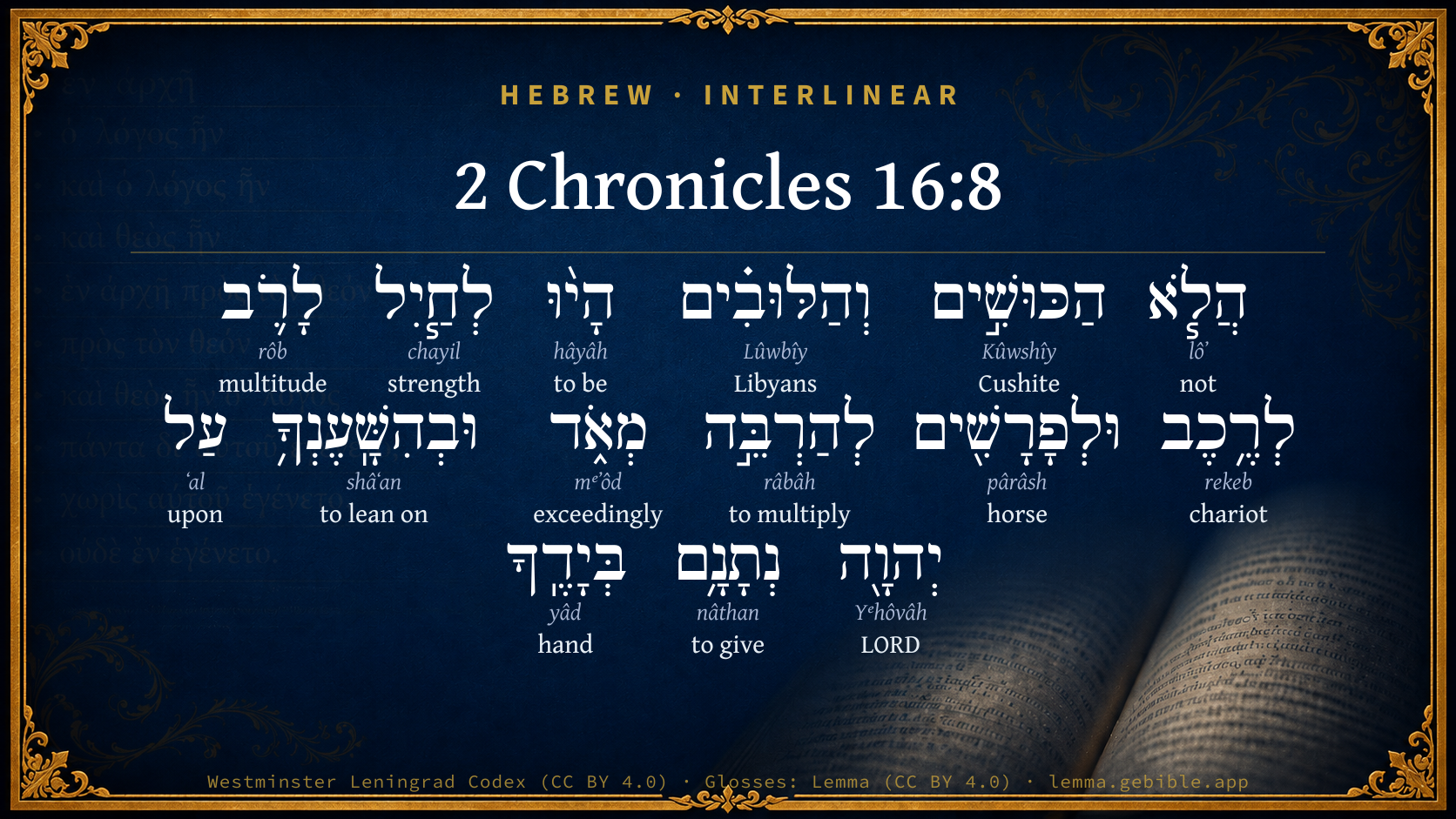
  1. הֲלֹ֧א lôʼ H3808 “not” Particle, Interrogative + Particle, Negative
  2. הַכּוּשִׁ֣ים Kûwshîy H3569 “the · Cushites” Particle, Definite Article + Noun, Gentilic, Masculine, Plural, Absolute
  3. הָי֨וּ hâyâh H1961 “to be” Verb, Qal, Perfect, 3rd Person, Common, Plural
  4. לְחַ֧יִל chayil H2428 “to/for · strength” Preposition + Noun, Common, Masculine, Singular, Absolute
  5. לָרֹ֛ב rôb H7230 “to/for · multitude” Preposition + Noun, Common, Both, Singular, Absolute
  6. לְרֶ֥כֶב rekeb H7393 “to/for · chariot” Preposition + Noun, Common, Masculine, Singular, Absolute
  7. וּלְפָרָשִׁ֖ים pârâsh H6571 “and · to/for · horses” Conjunction + Preposition + Noun, Common, Masculine, Plural, Absolute
  8. לְהַרְבֵּ֣ה râbâh H7235 “to/for · to multiply” Preposition + Verb, Hiphil, Infinitive Absolute
  9. מְאֹ֑ד mᵉʼôd H3966 “exceedingly” Adverb
  10. וּבְהִשָּֽׁעֶנְךָ֥ shâʻan H8172 “and · in/at · to lean on · you” Conjunction + Preposition + Verb, Niphal, Infinitive Construct + Suffix, Personal, 2nd Person, Masculine, Singular
  11. עַל ʻal H5921 “upon” Preposition
  12. יְהוָ֖ה Yᵉhôvâh H3068 “LORD” Noun, Proper
  13. נְתָנָ֥ם nâthan H5414 “to give · them” Verb, Qal, Perfect, 3rd Person, Masculine, Singular + Suffix, Personal, 3rd Person, Masculine, Plural
  14. בְּיָדֶֽךָ yâd H3027 “in/at · hand · your” Preposition + Noun, Common, Both, Singular, Construct + Suffix, Personal, 2nd Person, Masculine, Singular

About this verse

These counts appear in no published source. They are computed here, from the morphology-tagged text and Lemma’s own curated glosses. What Lemma adds →

15
words
15
distinct lemmas
Historical
section

Notable vocabulary

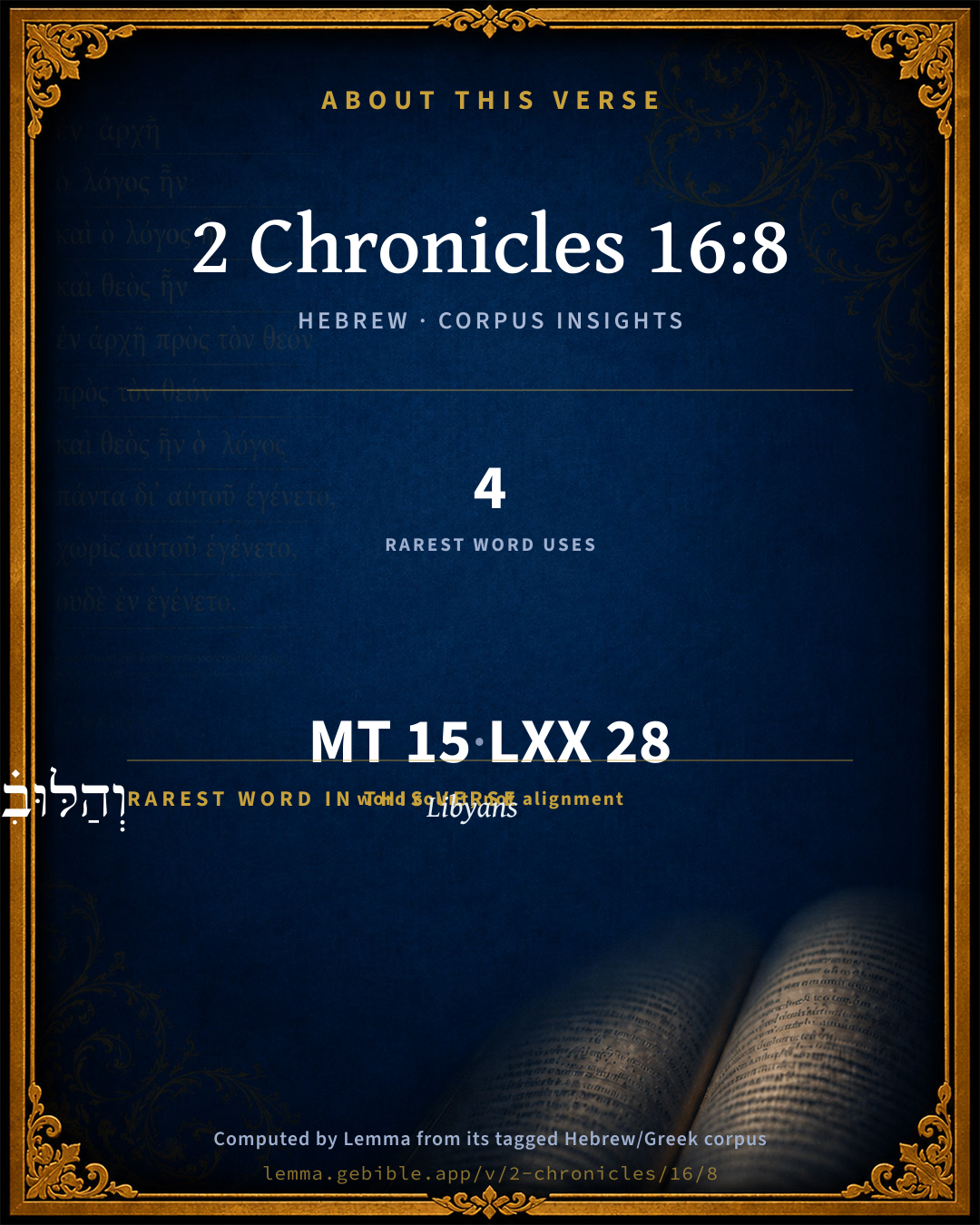
The rarest word here is וְהַלּוּבִ֗ים Libyans H3864 — appearing just 4 times in the whole Hebrew Bible.

Shared distinctive vocabulary

וְהַלּוּבִ֗ים Libyans H3864 occurs in 4 verses of the Hebrew Bible. Also found in:

Grammatical profile

  • 4 verbs
  • 8 nouns
  • 1 preposition
  • 1 adverb
  • 1 particle

Verb forms

  • הָי֨וּ Qal · Perfect
  • לְהַרְבֵּ֣ה Hiphil · Infinitive Absolute
  • וּבְהִשָּֽׁעֶנְךָ֥ Niphal · Infinitive Construct
  • נְתָנָ֥ם Qal · Perfect

Hebrew & Septuagint length

In English translation the verse runs 28 words from the Hebrew and 31 from the Septuagint (LXX English) — closely comparable.

A rough comparison of the two English renderings, which tokenize alike — not a word-level alignment.

Word counts can differ between the Hebrew and the Greek without any difference in meaning — e.g. the Hebrew direct-object marker אֵת has no separate Greek word, and Greek often adds the article ὁ.

In the original languages it is 15 Hebrew tokens and 28 Greek tokens — but the two are counted differently (Hebrew bundles its prefixes and suffixes into one token; the Greek is in lemma form), so that isn’t a like-for-like length.

Cross-references

7

Topical passages linked to 2 Chronicles 16:8 in the Treasury of Scripture Knowledge — connected by theme and wording, ordered by reader-vote popularity; previews shown in the World English Bible.

  • 2 Chronicles 12:3 with twelve hundred chariots, and sixty thousand horsemen. The people were without number who came with him out of Egypt: the Lubim, the Sukkiim, and the Ethiopians.
  • 2 Chronicles 13:16 The children of Israel fled before Judah; and God delivered them into their hand.
  • 2 Chronicles 14:9–12 There came out against them Zerah the Ethiopian with an army of a million troops, and three hundred chariots; and he came to Mareshah.
  • 2 Chronicles 16:7 At that time Hanani the seer came to Asa king of Judah, and said to him, Because you have relied on the king of Syria, and have not relied on Yahweh your God, therefore is the host of the king of Syria escaped out of your hand.
  • 2 Chronicles 13:18 Thus the children of Israel were brought under at that time, and the children of Judah prevailed, because they relied on Yahweh, the God of their fathers.
  • Psalms 9:9–10 Yahweh will also be a high tower for the oppressed; A high tower in times of trouble.
  • Psalms 37:39–40 But the salvation of the righteous is from Yahweh. He is their stronghold in the time of trouble.

Cross-references courtesy of OpenBible.info (CC BY 4.0).

Hebrew and Greek witnesses Masoretic Hebrew ↔ Greek Septuagint

The same verse in the two great witnesses to the Old Testament, shown verse-for-verse.

These are two independent witnesses, not word-aligned to each other, and the Septuagint is shown in lemma (dictionary) form.

Hebrew 2 Chronicles 16:8 Masoretic · Westminster Leningrad Codex

הֲלֹ֧א הַכּוּשִׁ֣ים וְהַלּוּבִ֗ים הָי֨וּ לְחַ֧יִל לָרֹ֛ב לְרֶ֥כֶב וּלְפָרָשִׁ֖ים לְהַרְבֵּ֣ה מְאֹ֑ד וּבְהִשָּֽׁעֶנְךָ֥ עַל יְהוָ֖ה נְתָנָ֥ם בְּיָדֶֽךָ

Weren't the Ethiopians and the Lubim a huge host, with chariots and horsemen exceeding many? yet, because you did rely on Yahweh, he delivered them into your hand.

World English Bible · Public Domain

Greek LXX 2 Chronicles 16:8 Septuagint · lemma form

οὐ ὁ αἰθίοψ καί λίβυες εἰμί εἰς δύναμις πολύς εἰς θάρσος εἰς ἱππεύς εἰς πλῆθος σφόδρα καί ἐν ὁ πείθω σύ ἐπί κύριος παραδίδωμι εἰς ὁ χείρ σύ

Were not the Ethiopians and Libyans a great force, in courage, in horsemen, in great numbers? and did not He deliver them into your hands, because you trusted in the Lord?

LXX2012 (modern English Septuagint) · Public Domain

Hebrew: Westminster Leningrad Codex (CC BY 4.0). Greek: Septuagint (public domain); English from LXX2012 (modern English Septuagint) (Public Domain). How the Septuagint differs from the Hebrew →

Commentary

Notes on 2 Chronicles 16:8 from classic Christian and Jewish commentators (each source and its license shown beneath its notes). The classic Christian expositions comment on the surrounding passage and are grouped to its opening verse, so a note may address several verses; the Jewish commentaries on the Tanakh (Rashi and others) are per-verse, so they appear only where the commentator wrote on this verse.

Lemma curates 59 commentaries, every one of them public domain or Creative Commons licensed, each selected and text-cleaned for this edition rather than reprinted as found. About our sources →

Trapp's Complete Commentary

John Trapp

2Ch 16:8 Were not the Ethiopians and the Lubims a huge host, with very many chariots and horsemen? yet, because thou didst rely on the LORD, he delivered them into thine hand.

Ver. 8. Were not the Ethiopians.] See 2Ch 14:9.

He delivered them into thine hand.] And should not experience have bred confidence? Shouldst thou by this base begging, nay, buying help of Benhadad, cast a blur on both God’s power {2Ch 16:8} and providence. {2Ch 16:9}

John Trapp, A Commentary or Exposition upon All the Books of the Old and New Testament (1647–1656) — public domain. Text from a community e-Sword module.

Joseph Benson's Commentary

2Ch 16:8. And the Lubims — Either the Libyans in Africa, or another people possibly descended from them, but now seated in some part of Arabia. See on 2Ch 12:3.

Joseph Benson's Commentary on the Old and New Testaments (1811–1818) — public domain. Text from a community e-Sword module.

Ellicott's Commentary for English Readers

(8) Were not the Ethiopians and the Lubims (Kûshîm and Lûbîm) a huge host?—An instance confirming what was said in 2Ch_16:7. Cushites and Lybians were banded together in Zerah’s great army, just as Syrians and Israelites might have united in assailing Judah, yet the victory had fallen to Asa (2Ch_14:9-15).

Cushites and Libyans were among the constituents of Shishak’s army (2Ch_12:3). Clearly, therefore, Zerah was master of Egypt.

(The Heb. of this and next verse is unmistakably the chronicler’s own. Literally it runs: “Did not the Cushites and the Libyans come to an army, to abundance, (as) to chariots and to horsemen, to abounding greatly?”)

Neither the Libyan contingent nor the horsemen are mentioned in 2 Chronicles 14. Apparently the writer is making extracts from fuller sources.

A Bible Commentary for English Readers, edited by Charles John Ellicott (1878–1897) — public domain. Text from a community e-Sword module.

The Cambridge Bible for Schools and Colleges

gen. ed. J. J. S. Perowne

8. and the Lubims] The Lubim are not mentioned in 2Ch_14:9-13, but as they were auxiliaries of the Egyptians (2Ch_12:3) it is quite probable that they represent the help given by Egypt to the Cushites as they passed the Egyptian border on their way to invade Judah. Cp. note on 2Ch_14:9 (three hundred chariots).

with very many etc.] R.V. with chariots and horsemen exceeding many. See note on 2Ch_14:9.

The Cambridge Bible for Schools and Colleges (gen. ed. J. J. S. Perowne; Cambridge University Press, 1878–1918) — public domain. Text from a community e-Sword module.

John Gill's Exposition

For the eyes of the Lord run to and fro throughout the whole earth,.... The eyes of his omniscience are everywhere, and the eyes of his mercy and goodness, of his care and providence, are here and there, and in every place throughout the whole world at once, see Zac 4:10,

to show himself strong in the behalf of them whose heart is perfect towards him; or, as in the margin, "strongly to hold" with such, to be on their side, take their part, strengthen them, support and supply them, and to protect and defend them who are sincere and upright in heart; whose graces are sincere and unfeigned, though not complete, nor they free from sin, and who, with the heart, sincerely believe in God, in which Asa at this time failed, though otherwise his heart is said to be perfect, Kg1 15:4, it was so in the general bent of it, and especially with respect to the worship of God, though there was something lacking in his faith at this time, as there often is in the best of men:

herein thou hast done foolishly; to trust in man, and not in the Lord, to part with his money, and lose the opportunity of having the whole Syrian army fall into his hands:

therefore from henceforth thou shalt have wars; which, though we read not of, was doubtless his case; some interpret it of his posterity.

John Gill's Exposition of the Whole Bible (1746–1763) — public domain (CC PDM 1.0). Text via the HelloAO Bible API.

Matthew Poole's English Annotations

The Lubims; either the Libyans in Africa; or another people, possibly descended from them, but now seated in some part of Arabia.

Matthew Poole's English Annotations on the Holy Bible (1683–1685) — public domain. Text from a community e-Sword/MySword module.

John Wesley's Explanatory Notes

Lubims - Either, the Lybians in Africa; or another people, possibly descended from them, but now seated in some part of Arabia.

John Wesley, Explanatory Notes Upon the Whole Bible (1754–1765) — public domain. Text via the GEBible commentary corpus.

Lesson kit

Teaching starters — assembled from the data on this page, not authored interpretation. Every prompt links to the verse data it draws on. Edit before teaching.

2 Chronicles, in the Historical, opens this verse with 15 words (15 distinct Hebrew lemmas). Its most distinctive word is Lûwbîy (“Libyans”). A historical commentator’s framing appears above. Read the whole chapter for the surrounding context.

Discussion questions

  1. The word Lûwbîy carries the sense “Libyans.” How does it shape the verse?
  2. How does 2 Chronicles 12:3, which shares the word «Libyans», read alongside this verse?
  3. The translations on this page render this verse differently — a whole-verse word diff, not a word-by-word alignment. What might account for the different wordings?
  4. «הָי֨וּ» is a Qal Perfect verb. How does that grammatical form shape the action described?
  5. Compare how Trapp's Complete Commentary and Joseph Benson's Commentary read this verse. Where do they agree or differ?

Things to notice

Reading settings

Reading text

Shown beneath each verse's original-language words.

Old Testament
Old Testament edition

Read the OT as the Masoretic Hebrew (MT) or the Greek Septuagint (LXX).

English shown for the Greek Septuagint (in the Hebrew ↔ Greek comparison).

Comparing translations? Open the Compare panel on any verse page to stack up to four side by side.