
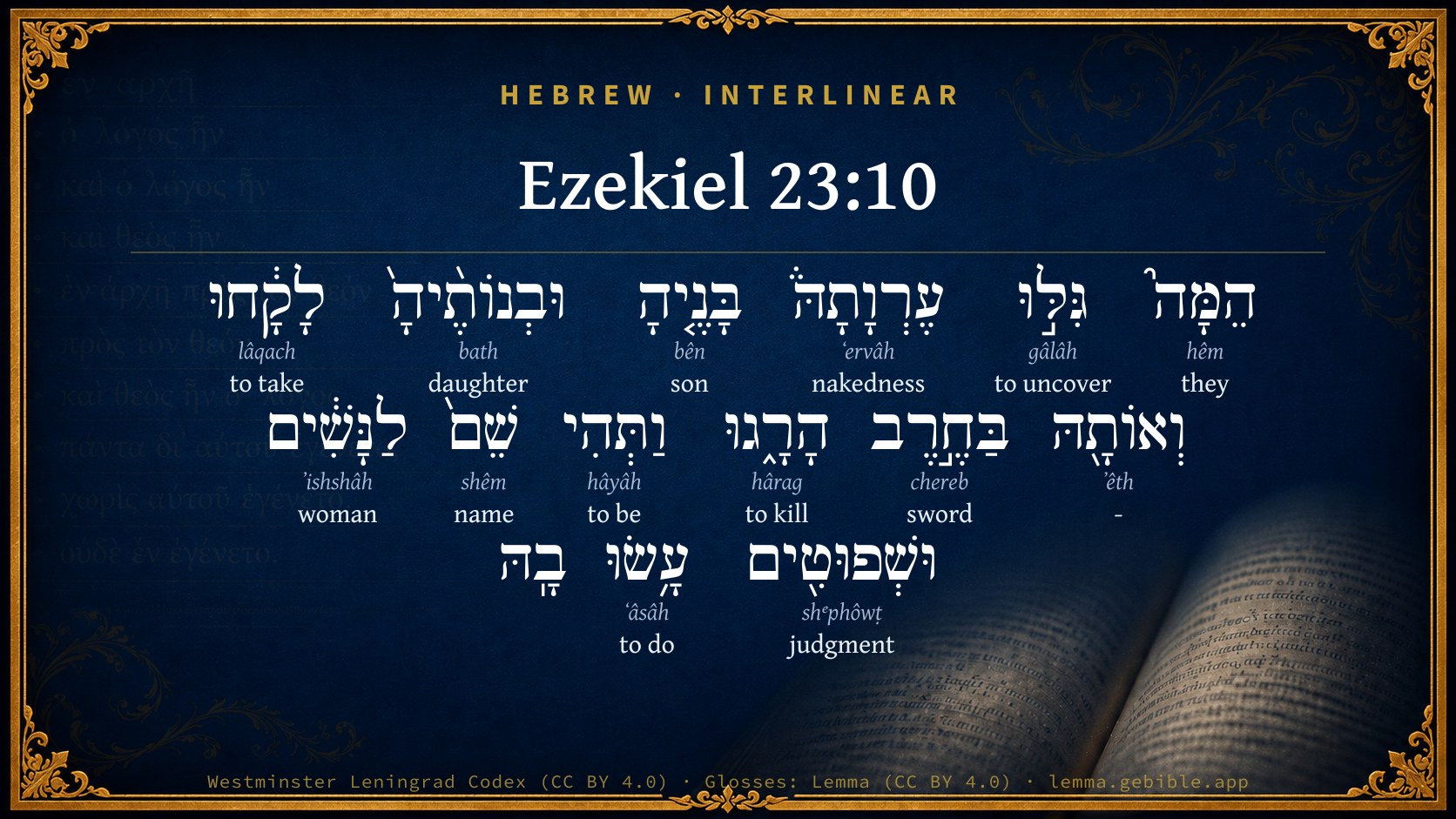
Ezekiel 23:10

Hebrew (Westminster Leningrad Codex) Ezekiel 23:10 appears in the Hebrew Old Testament. The text above is from the Westminster Leningrad Codex. Each word links to its Strong’s number, a concise gloss, and parsing drawn from the Open Scriptures Hebrew Bible morphology. Click any word for its full Brown-Driver-Briggs (BDB) entry.
Download image
Cite this verse

Ezekiel 23:10 (World English Bible). Public Domain. Lemma interlinear Bible study tool, https://lemma.gebible.app/v/ezekiel/23/10.

Show BibTeX & RIS
BibTeX
RIS
English Translation
These uncovered her nakedness; they took her sons and her daughters; and her they killed with the sword: and she became a byword among women; for they executed judgments on her.
World English Bible · Public Domain
Download a study sheet

One document with this verse’s original text, its word-by-word gloss line, the meaning frame, cross-references with their text, attributed commentary, and full source and license credits — printable, and it pastes into notes with its structure intact.

This verse Autodidact and up

Study sheet (.html) Plain text (.txt)

A passage Seminary Student

Up to 50 verses in one chapter. A passage sheet keeps up to 6 commentary sources and 12 cross-references per verse, in the order this page ranks them, and says so on the sheet whenever that leaves anything out. Ask for a single verse and you get the Autodidact verse sheet above.

Everything on this page stays free to read, with no account — the sheet is a download of what is already on screen, not access to it.

Want to remove ads? Support Godless Engineer
Compare translations 3

The same verse in 3 English versions, stacked beneath the original-language interlinear above. Click any original word for its lexicon entry.

Each is an independent rendering of the whole verse — the interlinear is not word-aligned to these translations.

Highlighted words mark where these versions differ — a whole-verse word diff, not a word-by-word alignment.

  • World English Bible Public Domain
    These uncovered her nakedness; they took her sons and her daughters; and her they killed with the sword: and she became a byword among women; for they executed judgments on her.
  • King James Version Public Domain
    These discovered her nakedness: they took her sons and her daughters, and slew her with the sword: and she became famous among women; for they had executed judgment upon her.
  • unfoldingWord Literal Text CC BY-SA 4.0
    They uncovered her nakedness, took her sons and daughters, killed her with the sword, and she became notorious among other women, so they executed judgment on her.

unfoldingWord Literal Text — © unfoldingWord, licensed CC BY-SA 4.0. Word-aligned USFM3 via Door43 (git.door43.org/unfoldingWord/en_ult).

Versions to compare (up to 4)

3 of 4 selected

Show all 18 translations

Every available English version of this verse, each an independent rendering of the whole verse.

  • World English Bible Public Domain
    These uncovered her nakedness; they took her sons and her daughters; and her they killed with the sword: and she became a byword among women; for they executed judgments on her.
  • Berean Standard Bible Public Domain
    They exposed her nakedness, seized her sons and daughters, and put her to the sword. Thus she became a byword among women, and they executed judgment against her.
  • Majority Standard Bible Public Domain
    They exposed her nakedness, seized her sons and daughters, and put her to the sword. Thus she became a byword among women, and they executed judgment against her.
  • King James Version Public Domain
    These discovered her nakedness: they took her sons and her daughters, and slew her with the sword: and she became famous among women; for they had executed judgment upon her.
  • American Standard Version (1901) Public Domain
    These uncovered her nakedness; they took her sons and her daughters; and her they slew with the sword: and she became a byword among women; for they executed judgments upon her.
  • Revised Version (1885) Public Domain
    These discovered her nakedness: they took her sons and her daughters, and her they slew with the sword: and she became a byword among women; for they executed judgments upon her.
  • Geneva Bible (1599) Public Domain
    These discouered her shame: they tooke away her sonnes and her daughters, and slewe her with the sworde, and she had an euill name among women: for they had executed iudgement vpon her.
  • Douay-Rheims (1899) Public Domain
    They discovered her disgrace, took away her sons and daughters, and slew her with the sword: and they became infamous women, and they executed judgments in her.
  • Young's Literal Translation Public Domain
    They have uncovered her nakedness, Her sons and her daughters they have taken, And her by sword they have slain, And she is a name for women, And judgments they have done with her.
  • Literal Standard Version CC BY-SA 4.0
    They have uncovered her nakedness, || They have taken her sons and her daughters, || And they have slain her by sword, || And she is a name for women, || And they have done judgments with her.
  • Unlocked Literal Bible CC BY-SA 4.0
    They uncovered her nakedness, took her sons and daughters, killed her with the sword, and she became notorious among other women, so they executed judgment on her.
  • unfoldingWord Literal Text CC BY-SA 4.0
    They uncovered her nakedness, took her sons and daughters, killed her with the sword, and she became notorious among other women, so they executed judgment on her.
  • Darby Bible Public Domain
    These discovered her nakedness, they took her sons and her daughters, and slew her with the sword; and she became a name among women; and they executed judgment upon her.
  • World Messianic Bible Public Domain
    These uncovered her nakedness. They took her sons and her daughters, and they killed her with the sword. She became a byword among women; for they executed judgments on her.
  • Webster's Bible Public Domain
    These uncovered her nakedness: they took her sons and her daughters, and slew her with the sword: and she became famous among women; for they had executed judgment upon her.
  • Free Bible Version CC BY-SA 4.0
    They stripped her naked, took away her sons and daughters, and killed her with the sword. She became infamous among women, and they punished her.
  • Bible in Basic English Public Domain
    By these her shame was uncovered: they took her sons and daughters and put her to death with the sword: and she became a cause of wonder to women; for they gave her the punishment which was right.
  • JPS Tanakh (1917) Public Domain
    These uncovered her nakedness; they took her sons and her daughters, and her they slew with the sword; and she became a byword among women, for judgments were executed upon her.

Literal Standard Version (2020), Covenant Press — licensed CC BY-SA 4.0. Text via the HelloAO Bible API (eBible.org). Unlocked Literal Bible (unfoldingWord) — licensed CC BY-SA 4.0. Text via the HelloAO Bible API (eBible.org). unfoldingWord Literal Text — © unfoldingWord, licensed CC BY-SA 4.0. Word-aligned USFM3 via Door43 (git.door43.org/unfoldingWord/en_ult). Free Bible Version, Dr. Jonathan Gallagher — licensed CC BY-SA 4.0. Text via the HelloAO Bible API (eBible.org).

Word by word

More ways to search: Search by grammar → Find every occurrence → Compare this word →

Practice this passage: Drill this verse → Learn its vocabulary →

וּשְׁפוּטִ֖ים
shᵉphôwṭ
H8196
“and · judgments”
Conjunction + Noun, Common, Masculine, Plural, Absolute
Part of Speech
Conjunction + Noun
Type
Common
Gender
Masculine
Number
Plural
State
Absolute
Full BDB Definition

Origin: from H8199

TWOT: 2443b

judgment, act of judgment
  1. הֵמָּה֮ hêm H1992 “they” Pronoun, Personal, 3rd Person, Masculine, Plural
  2. גִּלּ֣וּ gâlâh H1540 “to uncover” Verb, Piel, Perfect, 3rd Person, Common, Plural
  3. עֶרְוָתָהּ֒ ʻervâh H6172 “nakedness · her” Noun, Common, Feminine, Singular, Construct + Suffix, Personal, 3rd Person, Feminine, Singular
  4. בָּנֶ֤יהָ bên H1121 “sons · her” Noun, Common, Masculine, Plural, Construct + Suffix, Personal, 3rd Person, Feminine, Singular
  5. וּבְנוֹתֶ֨יהָ֙ bath H1323 “and · daughters · her” Conjunction + Noun, Common, Feminine, Plural, Construct + Suffix, Personal, 3rd Person, Feminine, Singular
  6. לָקָ֔חוּ lâqach H3947 “to take” Verb, Qal, Perfect, 3rd Person, Common, Plural
  7. וְאוֹתָ֖הּ ʼêth H853 “and · - · her” Conjunction + Particle, Direct Object + Suffix, Personal, 3rd Person, Feminine, Singular
  8. בַּחֶ֣רֶב chereb H2719 “in/at the · sword” Preposition, Determined + Noun, Common, Feminine, Singular, Absolute
  9. הָרָ֑גוּ hârag H2026 “to kill” Verb, Qal, Perfect, 3rd Person, Common, Plural
  10. וַתְּהִי hâyâh H1961 “and · to be” Conjunction + Verb, Qal, Sequential Imperfect, 3rd Person, Feminine, Singular
  11. שֵׁם֙ shêm H8034 “name” Noun, Common, Masculine, Singular, Absolute
  12. לַנָּשִׁ֔ים ʼishshâh H802 “to/for the · women” Preposition, Determined + Noun, Common, Feminine, Plural, Absolute
  13. עָ֥שׂוּ ʻâsâh H6213 “to do” Verb, Qal, Perfect, 3rd Person, Common, Plural

About this verse

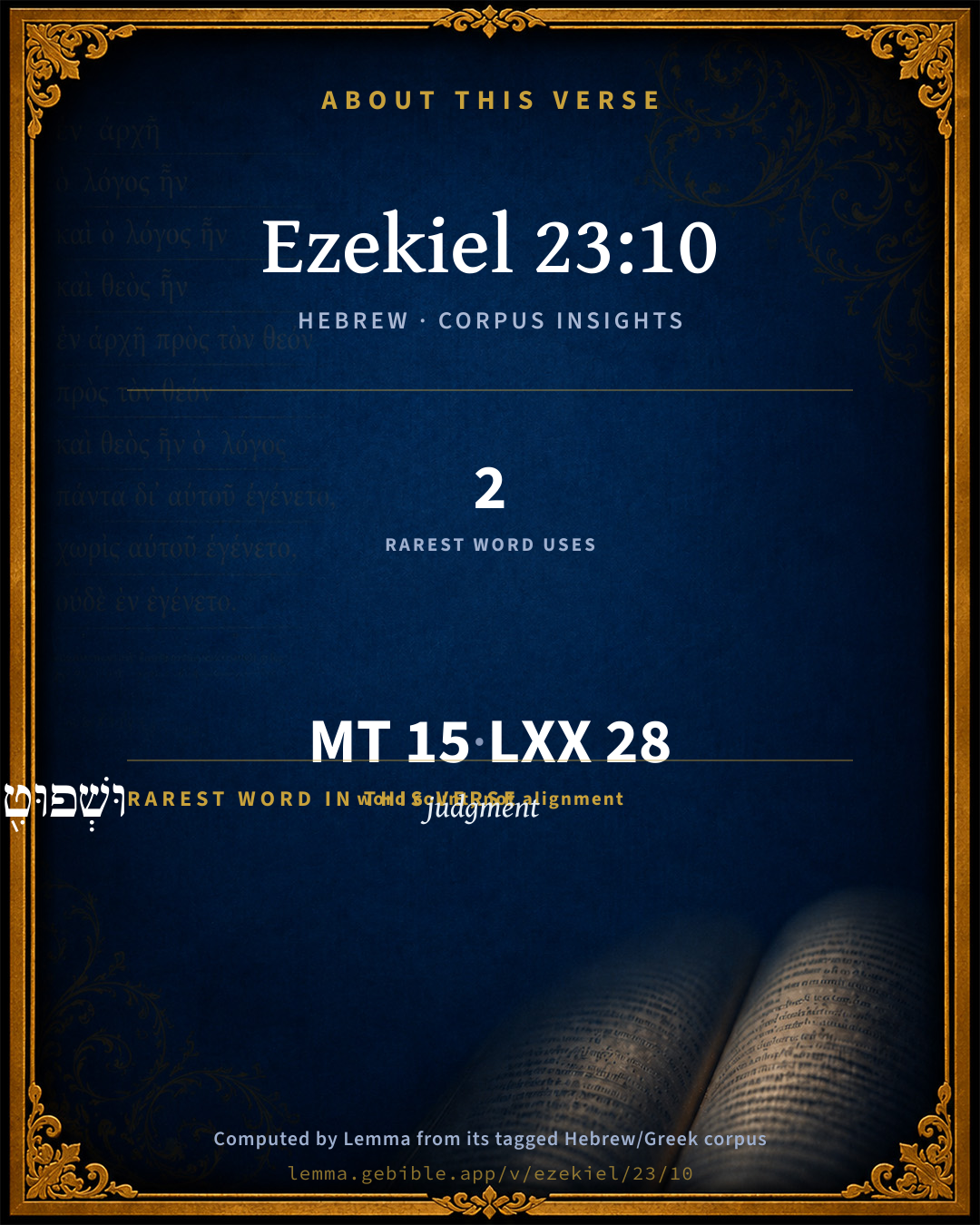
These counts appear in no published source. They are computed here, from the morphology-tagged text and Lemma’s own curated glosses. What Lemma adds →

15
words
14
distinct lemmas
Prophets
section

Notable vocabulary

The rarest word here is וּשְׁפוּטִ֖ים judgment H8196 — appearing just 2 times in the whole Hebrew Bible.

Shared distinctive vocabulary

וּשְׁפוּטִ֖ים judgment H8196 occurs in 2 verses of the Hebrew Bible. Also found in:

Grammatical profile

  • 5 verbs
  • 7 nouns
  • 1 pronoun
  • 1 preposition
  • 1 particle

Verb forms

  • גִּלּ֣וּ Piel · Perfect
  • לָקָ֔חוּ Qal · Perfect
  • הָרָ֑גוּ Qal · Perfect
  • וַתְּהִי Qal · Sequential Imperfect
  • עָ֥שׂוּ Qal · Perfect

Hebrew & Septuagint length

In English translation the verse runs 31 words from the Hebrew and 35 from the Septuagint (LXX English) — closely comparable.

A rough comparison of the two English renderings, which tokenize alike — not a word-level alignment.

Word counts can differ between the Hebrew and the Greek without any difference in meaning — e.g. the Hebrew direct-object marker אֵת has no separate Greek word, and Greek often adds the article ὁ.

In the original languages it is 15 Hebrew tokens and 28 Greek tokens — but the two are counted differently (Hebrew bundles its prefixes and suffixes into one token; the Greek is in lemma form), so that isn’t a like-for-like length.

Cross-references

6

Topical passages linked to Ezekiel 23:10 in the Treasury of Scripture Knowledge — connected by theme and wording, ordered by reader-vote popularity; previews shown in the World English Bible.

  • Ezekiel 23:29 and they shall deal with you in hatred, and shall take away all your labor, and shall leave you naked and bare; and the nakedness of your prostitution shall be uncovered, both your lewdness and your prostitution.
  • Hosea 2:10 Now I will uncover her lewdness in the sight of her lovers, And no one will deliver her out of my hand.
  • Jeremiah 22:8–9 Many nations shall pass by this city, and they shall say every man to his neighbor, Why has Yahweh done thus to this great city?
  • Ezekiel 16:37–41 therefore see, I will gather all your lovers, with whom you have taken pleasure, and all those who you have loved, with all those who you have hated; I will even gather them against you on every side, and will uncover your nakedness to them, that they may see all your nakedness.
  • Ezekiel 23:48 Thus will I cause lewdness to cease out of the land, that all women may be taught not to do after your lewdness.
  • Hosea 2:3 Lest I strip her naked, And make her bare as in the day that she was born, And make her like a wilderness, And set her like a dry land, And kill her with thirst.

Cross-references courtesy of OpenBible.info (CC BY 4.0).

Hebrew and Greek witnesses Masoretic Hebrew ↔ Greek Septuagint

The same verse in the two great witnesses to the Old Testament, shown verse-for-verse.

These are two independent witnesses, not word-aligned to each other, and the Septuagint is shown in lemma (dictionary) form.

Hebrew Ezekiel 23:10 Masoretic · Westminster Leningrad Codex

הֵמָּה֮ גִּלּ֣וּ עֶרְוָתָהּ֒ בָּנֶ֤יהָ וּבְנוֹתֶ֨יהָ֙ לָקָ֔חוּ וְאוֹתָ֖הּ בַּחֶ֣רֶב הָרָ֑גוּ וַתְּהִי שֵׁם֙ לַנָּשִׁ֔ים וּשְׁפוּטִ֖ים עָ֥שׂוּ בָֽהּ

These uncovered her nakedness; they took her sons and her daughters; and her they killed with the sword: and she became a byword among women; for they executed judgments on her.

World English Bible · Public Domain

Greek LXX Ezekiel 23:10 Septuagint · lemma form

αὐτός ἀποκαλύπτω ὁ αἰσχύνη αὐτός υἱός καί θυγάτηρ αὐτός λαμβάνω καί αὐτός ἐν ῥομφαία ἀποκτείνω καί γίγνομαι λάλημα εἰς γυνή καί ποιέω ἐκδίκησις ἐν αὐτός εἰς ὁ θυγάτηρ

They uncovered her shame: they took her sons and daughters, and killed her with the sword: and she became a byword among women: and they wrought vengeance in her for the sake of the daughters.

LXX2012 (modern English Septuagint) · Public Domain

Hebrew: Westminster Leningrad Codex (CC BY 4.0). Greek: Septuagint (public domain); English from LXX2012 (modern English Septuagint) (Public Domain). How the Septuagint differs from the Hebrew →

Targum (Aramaic paraphrase)

1

The Targum is the ancient Jewish Aramaic paraphrase of the Hebrew Scriptures — an interpretive translation, not the Hebrew text itself. Onkelos (literal) and Pseudo-Jonathan (expansive) render the Torah, and Jonathan the Prophets. Coverage is partial: where no permissively-licensed English translation exists for a verse, only the Aramaic is shown. This is verse-level text, not a word-by-word alignment to the Hebrew.

  1. Targum Jonathan Prophets (Joshua–Malachi)
    אִינוּן גַלִיאוּ קְלָנָהּ בְּנָהָא וּבְנָתָהָא שְׁבוֹ וְעַמָהּ בְּחַרְבָּא קְטִילוּ וַהֲוַת שׁוּם לִמְדִינָתָא וּפוּרְעֲנוּת דִינִין עֲבָדוּ בְּגַוָהּ:

    (no public-domain English translation for this verse)

    Targum Jonathan — Aramaic: “Mikraot Gedolot” (public domain). English: “Sefaria Community Translation” (CC0 1.0 (public-domain dedication)); “London "Chaldee Paraphrase," 1871” (public domain). Text via Sefaria.

Commentary

Notes on Ezekiel 23:10 from classic Christian and Jewish commentators (each source and its license shown beneath its notes). The classic Christian expositions comment on the surrounding passage and are grouped to its opening verse, so a note may address several verses; the Jewish commentaries on the Tanakh (Rashi and others) are per-verse, so they appear only where the commentator wrote on this verse.

Lemma curates 59 commentaries, every one of them public domain or Creative Commons licensed, each selected and text-cleaned for this edition rather than reprinted as found. About our sources →

Trapp's Complete Commentary

John Trapp

Eze 23:10 These discovered her nakedness: they took her sons and her daughters, and slew her with the sword: and she became famous among women; for they had executed judgment upon her.

Ver. 10. These discovered her nakedness,] i.e., They have shamefully punished her for a stinking strumpet. {as Eze 23:26}

And she became famous.] For her sins and punishments, much talked of. Heb., A name.

John Trapp, A Commentary or Exposition upon All the Books of the Old and New Testament (1647–1656) — public domain. Text from a community e-Sword module.

Geneva Bible (1599)

Geneva Bible translators

Meaning, the Assyrians.

Geneva Bible (1599) marginal notes — public domain. Text via Bolls.life.

Jamieson, Fausset & Brown

Robert Jamieson, A. R. Fausset & David Brown

became famous--literally, "she became a name," that is, as notorious by her punishment as she had been by her sins, so as to be quoted as a warning to others.

women--that is, neighboring peoples.

Jamieson, Fausset & Brown — Commentary Critical and Explanatory on the Whole Bible (1871) — public domain (CC PDM 1.0). Text via the HelloAO Bible API.

Ellicott's Commentary for English Readers

(10) She became famous.—A better word would be notorious. The conquest of Samaria and the captivity of the northern tribes had now been accomplished more than 130 years, and had made them a byword among the nations.

A Bible Commentary for English Readers, edited by Charles John Ellicott (1878–1897) — public domain. Text from a community e-Sword module.

The Cambridge Bible for Schools and Colleges

gen. ed. J. J. S. Perowne

10. famous among women] lit. a name to women, i.e. a notorious example to women to take warning from, Eze_23:48, Eze_36:3, Eze_16:41.

The Cambridge Bible for Schools and Colleges (gen. ed. J. J. S. Perowne; Cambridge University Press, 1878–1918) — public domain. Text from a community e-Sword module.

John Gill's Exposition

These discovered her wickedness,.... That is, stripped them of all their substance:

they took her sons and her daughters; and carried them captive:

and slew her with the sword; put an end to the kingdom of Israel, or the ten tribes, and which was never recovered to this day:

and she became famous among women; or among the provinces, as the Targum; she became famous, or rather infamous, among other nations; was talked of for her sins, her whoredoms and idolatries, and the vengeance of God upon her for them; she became a byword and a proverb among the kingdoms of the world for her wickedness and her destruction:

for they had executed judgment upon her; that is, the Assyrians, who were the instruments in God's hand in doing justice to her, and inflicting his judgments on her, and for that she became famous.

John Gill's Exposition of the Whole Bible (1746–1763) — public domain (CC PDM 1.0). Text via the HelloAO Bible API.

Albert Barnes' Notes on the Bible

Famous - Or, “infamous among women;” literally as in the margin, i. e., a byword among women.

Albert Barnes' Notes on the Bible (1834–1885) — public domain. Text from a community e-Sword/MySword module.

Haydock's Catholic Bible Commentary

Disgrace: satisfying their passions, ver. 29. (Calmet) --- Women. Having once lost all sense of decorum, they became more abandoned. (Haydock)

George Leo Haydock (1774–1849), Haydock's Catholic Family Bible and Commentary, 1859 edition — public domain. Excludes Psalms (Douay-Rheims chapter numbering differs from Protestant) and Deuterocanonical books (Catholic canon only).

Matthew Poole's English Annotations

These used her as lewd women deserve, stripped her naked, and exposed her to shame, as Eze 23:26. God her Husband had clothed her, and covered her nakedness, but she lightly esteemed her God, doted on idols, and idolaters strip her.

They took her sons and her daughters; made them captives, and carried them away as slaves, to serve the lusts of barbarous conquerors; so both sexes were used.

Slew her with the sword: as a person slain with the sword ceaseth to be, so this kingdom of Israel under Hoshea was by the sword of Shalmaneser utterly destroyed.

She became famous; her lewdness made her infamous, and God’s judgments for it made her more known in the world.

For they, the Assyrians, a proud, bitter, and violent enemy,

had executed judgment upon her; had executed their own malicious revenges, but God’s just displeasure, upon her.

Matthew Poole's English Annotations on the Holy Bible (1683–1685) — public domain. Text from a community e-Sword/MySword module.

John Wesley's Explanatory Notes

Discovered - Stript her naked, and exposed her to shame. Took her sons - Captives. Slew her - The kingdom of Israel, under Hoshea, was by Salmanesar utterly destroyed. They - The Assyrians, had executed God's just displeasure upon her.

John Wesley, Explanatory Notes Upon the Whole Bible (1754–1765) — public domain. Text via the GEBible commentary corpus.

Rashi

Rabbi Shlomo Yitzchaki (Rashi)

and she became a name for the women to take from them a curse for any adulteress to learn a lesson from her: See what happened to so and so because of her lewdness.

and... judgments [Heb. וּשְּׁפוּטִים,] like שְּׁפָטִים, judgments, justises, jostises in Old French, judgments, punishments.

Rashi on the Tanakh — English translations: “The Judaica Press complete Tanach with Rashi, translated by A. J. Rosenberg” (CC BY 4.0); “Pentateuch with Rashi's commentary by M. Rosenbaum and A.M. Silbermann, 1929-1934” (public domain); “The Metsudah Tanach series, Lakewood, N.J” (CC BY 4.0); and “The Book of Joshua, Metsudah Publications, 1997” (CC BY 4.0). Text via Sefaria.

Lesson kit

Teaching starters — assembled from the data on this page, not authored interpretation. Every prompt links to the verse data it draws on. Edit before teaching.

Ezekiel, in the Prophets, opens this verse with 15 words (14 distinct Hebrew lemmas). Its most distinctive word is shᵉphôwṭ (“judgment”). A historical commentator’s framing appears above. Read the whole chapter for the surrounding context.

Discussion questions

  1. What does “judgment” (shᵉphôwṭ) contribute to the verse as a whole?
  2. How does 2 Chronicles 20:9, which shares the word «judgment», read alongside this verse?
  3. The translations on this page render this verse differently — a whole-verse word diff, not a word-by-word alignment. What might account for the different wordings?
  4. «גִּלּ֣וּ» is a Piel Perfect verb. How does that grammatical form shape the action described?
  5. Compare how Trapp's Complete Commentary and Geneva Bible (1599) read this verse. Where do they agree or differ?

Things to notice

Reading settings

Reading text

Shown beneath each verse's original-language words.

Old Testament
Old Testament edition

Read the OT as the Masoretic Hebrew (MT) or the Greek Septuagint (LXX).

English shown for the Greek Septuagint (in the Hebrew ↔ Greek comparison).

Comparing translations? Open the Compare panel on any verse page to stack up to four side by side.