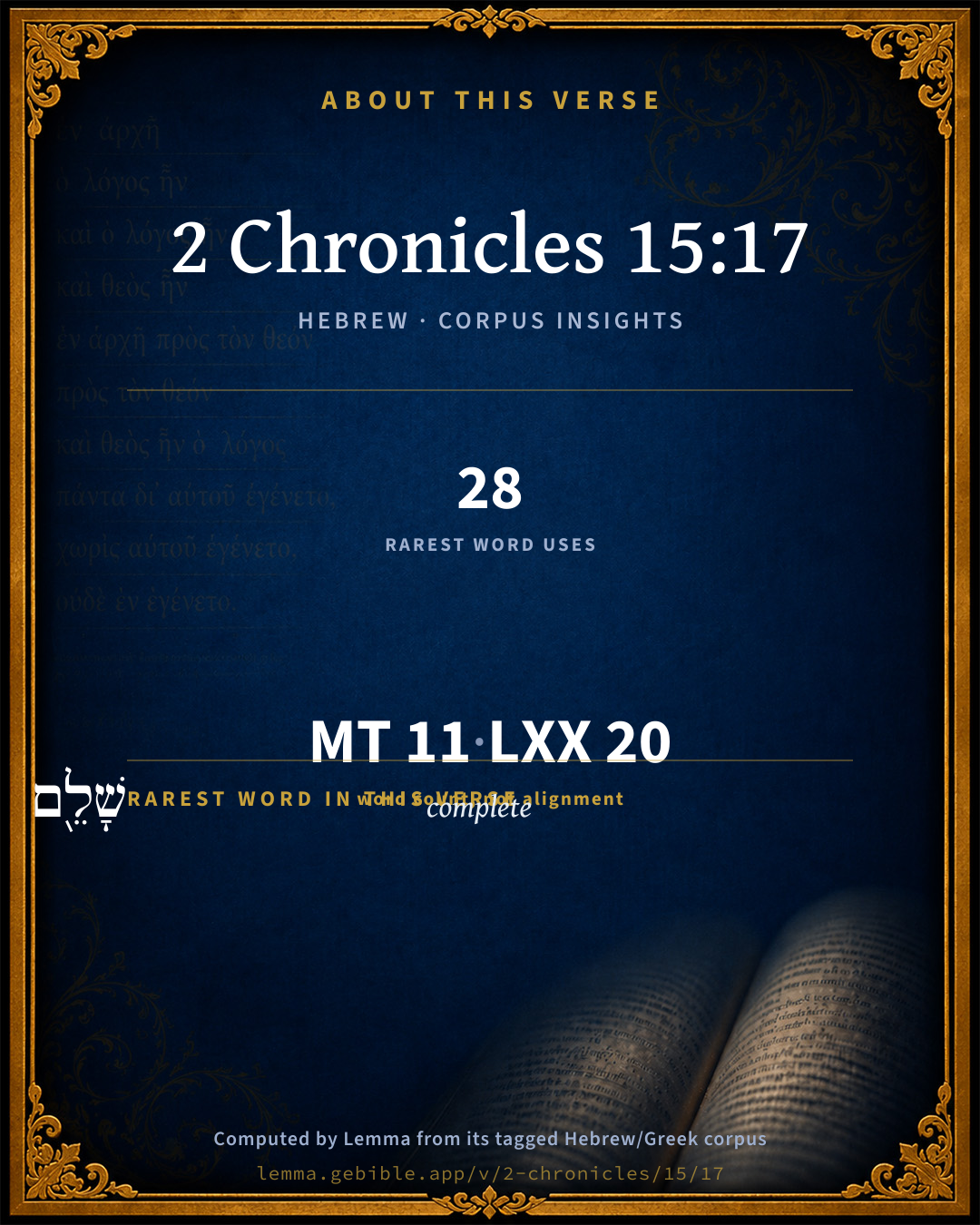
2 Chronicles 15:17

Hebrew (Westminster Leningrad Codex) 2 Chronicles 15:17 appears in the Hebrew Old Testament. The text above is from the Westminster Leningrad Codex. Each word links to its Strong’s number, a concise gloss, and parsing drawn from the Open Scriptures Hebrew Bible morphology. Click any word for its full Brown-Driver-Briggs (BDB) entry.
Download image
Cite this verse

2 Chronicles 15:17 (World English Bible). Public Domain. Lemma interlinear Bible study tool, https://lemma.gebible.app/v/2-chronicles/15/17.

Show BibTeX & RIS
BibTeX
RIS
English Translation
But the high places were not taken away out of Israel: nevertheless the heart of Asa was perfect all his days.
World English Bible · Public Domain
Download a study sheet

One document with this verse’s original text, its word-by-word gloss line, the meaning frame, cross-references with their text, attributed commentary, and full source and license credits — printable, and it pastes into notes with its structure intact.

This verse Autodidact and up

Study sheet (.html) Plain text (.txt)

A passage Seminary Student

Up to 50 verses in one chapter. A passage sheet keeps up to 6 commentary sources and 12 cross-references per verse, in the order this page ranks them, and says so on the sheet whenever that leaves anything out. Ask for a single verse and you get the Autodidact verse sheet above.

Everything on this page stays free to read, with no account — the sheet is a download of what is already on screen, not access to it.

Want to remove ads? Support Godless Engineer
Compare translations 3

The same verse in 3 English versions, stacked beneath the original-language interlinear above. Click any original word for its lexicon entry.

Each is an independent rendering of the whole verse — the interlinear is not word-aligned to these translations.

Highlighted words mark where these versions differ — a whole-verse word diff, not a word-by-word alignment.

  • World English Bible Public Domain
    But the high places were not taken away out of Israel: nevertheless the heart of Asa was perfect all his days.
  • King James Version Public Domain
    But the high places were not taken away out of Israel: nevertheless the heart of Asa was perfect all his days.
  • unfoldingWord Literal Text CC BY-SA 4.0
    But the high places they did not take away from Israel. Nevertheless, the heart of Asa was undivided all his days.

unfoldingWord Literal Text — © unfoldingWord, licensed CC BY-SA 4.0. Word-aligned USFM3 via Door43 (git.door43.org/unfoldingWord/en_ult).

Versions to compare (up to 4)

3 of 4 selected

Show all 18 translations

Every available English version of this verse, each an independent rendering of the whole verse.

  • World English Bible Public Domain
    But the high places were not taken away out of Israel: nevertheless the heart of Asa was perfect all his days.
  • Berean Standard Bible Public Domain
    The high places were not removed from Israel, but Asa’s heart was fully devoted all his days.
  • Majority Standard Bible Public Domain
    The high places were not removed from Israel, but Asa’s heart was fully devoted all his days.
  • King James Version Public Domain
    But the high places were not taken away out of Israel: nevertheless the heart of Asa was perfect all his days.
  • American Standard Version (1901) Public Domain
    But the high places were not taken away out of Israel: nevertheless the heart of Asa was perfect all his days.
  • Revised Version (1885) Public Domain
    But the high places were not taken away out of Israel: nevertheless the heart of Asa was perfect all his days.
  • Geneva Bible (1599) Public Domain
    But the hie places were not taken away out of Israel: yet the heart of Asa was perfit all his dayes.
  • Douay-Rheims (1899) Public Domain
    But high places were left in Israel: nevertheless the heart of Asa was perfect all his days.
  • Young's Literal Translation Public Domain
    yet the high places have not turned aside from Israel; only, the heart of Asa hath been perfect all his days.
  • Literal Standard Version CC BY-SA 4.0
    yet the high places have not been removed from Israel; only, the heart of Asa has been perfect all his days.
  • Unlocked Literal Bible CC BY-SA 4.0
    But the high places were not taken out of Israel. Nevertheless, Asa's heart was completely devoted all his days.
  • unfoldingWord Literal Text CC BY-SA 4.0
    But the high places they did not take away from Israel. Nevertheless, the heart of Asa was undivided all his days.
  • Darby Bible Public Domain
    But the high places were not removed from Israel; only, Asa's heart was perfect all his days.
  • World Messianic Bible Public Domain
    But the high places were not taken away out of Israel; nevertheless the heart of Asa was perfect all his days.
  • Webster's Bible Public Domain
    But the high places were not taken away out of Israel: nevertheless the heart of Asa was perfect all his days.
  • Free Bible Version CC BY-SA 4.0
    While the high places were not removed from Israel, Asa was completely devoted to the Lord all his life.
  • Bible in Basic English Public Domain
    But the high places were not taken away out of Israel; but still the heart of Asa was true to the Lord all his life.
  • JPS Tanakh (1917) Public Domain
    But the high places were not taken away out of Israel; nevertheless the heart of Asa was whole all his days.

Literal Standard Version (2020), Covenant Press — licensed CC BY-SA 4.0. Text via the HelloAO Bible API (eBible.org). Unlocked Literal Bible (unfoldingWord) — licensed CC BY-SA 4.0. Text via the HelloAO Bible API (eBible.org). unfoldingWord Literal Text — © unfoldingWord, licensed CC BY-SA 4.0. Word-aligned USFM3 via Door43 (git.door43.org/unfoldingWord/en_ult). Free Bible Version, Dr. Jonathan Gallagher — licensed CC BY-SA 4.0. Text via the HelloAO Bible API (eBible.org).

Word by word

More ways to search: Search by grammar → Find every occurrence → Compare this word →

Practice this passage: Drill this verse → Learn its vocabulary →

שָׁלֵ֖ם
shâlêm
H8003
“complete”
Adjective, Adjective, Masculine, Singular, Absolute
Part of Speech
Adjective
Type
Adjective
Gender
Masculine
Number
Singular
State
Absolute
Full BDB Definition

Origin: from H7999

TWOT: 2401d

complete, safe, peaceful, perfect, whole, full, at peace - complete - full, perfect - finished - safe, unharmed - peace (of covenant of peace, mind) - perfect, complete (of keeping covenant relation)
  1. וְהַ֨בָּמ֔וֹת bâmâh H1116 “and · the · high places” Conjunction + Particle, Definite Article + Noun, Common, Feminine, Plural, Absolute
  2. לֹא lôʼ H3808 “not” Particle, Negative
  3. סָ֖רוּ çûwr H5493 “to turn aside” Verb, Qal, Perfect, 3rd Person, Common, Plural
  4. מִיִּשְׂרָאֵ֑ל Yisrâʼêl H3478 “from · Israel” Preposition + Noun, Proper
  5. רַ֧ק raq H7535 “only” Particle, Accusative
  6. לְבַב lêbâb H3824 “heart of” Noun, Common, Masculine, Singular, Construct
  7. אָסָ֛א ʼÂçâʼ H609 “Asa” Noun, Proper
  8. הָיָ֥ה hâyâh H1961 “to be” Verb, Qal, Perfect, 3rd Person, Masculine, Singular
  9. כָּל kôl H3605 “all of” Noun, Common, Masculine, Singular, Construct
  10. יָמָֽיו yôwm H3117 “days · his” Noun, Common, Masculine, Plural, Construct + Suffix, Personal, 3rd Person, Masculine, Singular

About this verse

These counts appear in no published source. They are computed here, from the morphology-tagged text and Lemma’s own curated glosses. What Lemma adds →

11
words
11
distinct lemmas
Historical
section

Shared distinctive vocabulary

שָׁלֵ֖ם complete H8003 occurs in 27 verses of the Hebrew Bible. Also found in:

Grammatical profile

  • 2 verbs
  • 6 nouns
  • 1 adjective
  • 2 particles

Verb forms

  • סָ֖רוּ Qal · Perfect
  • הָיָ֥ה Qal · Perfect

Hebrew & Septuagint length

In English translation the verse runs 21 words from the Hebrew and 22 from the Septuagint (LXX English) — closely comparable.

A rough comparison of the two English renderings, which tokenize alike — not a word-level alignment.

Word counts can differ between the Hebrew and the Greek without any difference in meaning — e.g. the Hebrew direct-object marker אֵת has no separate Greek word, and Greek often adds the article ὁ.

In the original languages it is 11 Hebrew tokens and 20 Greek tokens — but the two are counted differently (Hebrew bundles its prefixes and suffixes into one token; the Greek is in lemma form), so that isn’t a like-for-like length.

Cross-references

8

Topical passages linked to 2 Chronicles 15:17 in the Treasury of Scripture Knowledge — connected by theme and wording, ordered by reader-vote popularity; previews shown in the World English Bible.

  • Deuteronomy 12:13–14 Take heed to yourself that you don't offer your burnt offerings in every place that you see;
  • 1 Kings 11:4 For it happened, when Solomon was old, that his wives turned away his heart after other gods; and his heart was not perfect with Yahweh his God, as was the heart of David his father.
  • 1 Kings 22:43 He walked in all the way of Asa his father; He didn't turn aside from it, doing that which was right in the eyes of Yahweh: however the high places were not taken away; the people still sacrificed and burnt incense in the high places.
  • 2 Kings 12:3 However the high places were not taken away; the people still sacrificed and burnt incense in the high places.
  • 2 Kings 14:4 However the high places were not taken away: the people still sacrificed and burnt incense in the high places.
  • 2 Chronicles 14:3–5 for he took away the foreign altars, and the high places, and broke down the pillars, and hewed down the Asherim,
  • 1 Kings 3:2–4 Only the people sacrificed in the high places, because there was no house built for the name of Yahweh until those days.
  • 2 Chronicles 16:7–12 At that time Hanani the seer came to Asa king of Judah, and said to him, Because you have relied on the king of Syria, and have not relied on Yahweh your God, therefore is the host of the king of Syria escaped out of your hand.

Cross-references courtesy of OpenBible.info (CC BY 4.0).

Hebrew and Greek witnesses Masoretic Hebrew ↔ Greek Septuagint

The same verse in the two great witnesses to the Old Testament, shown verse-for-verse.

These are two independent witnesses, not word-aligned to each other, and the Septuagint is shown in lemma (dictionary) form.

Hebrew 2 Chronicles 15:17 Masoretic · Westminster Leningrad Codex

וְהַ֨בָּמ֔וֹת לֹא סָ֖רוּ מִיִּשְׂרָאֵ֑ל רַ֧ק לְבַב אָסָ֛א הָיָ֥ה שָׁלֵ֖ם כָּל יָמָֽיו

But the high places were not taken away out of Israel: nevertheless the heart of Asa was perfect all his days.

World English Bible · Public Domain

Greek LXX 2 Chronicles 15:17 Septuagint · lemma form

πλήν ὁ ὑψηλός οὐ ἀποἵστημι ἔτι ὑποἄρχω ἐν ὁ ἰσραήλ ἀλλά ἤ καρδία ασα γίγνομαι πλήρης πᾶς ὁ ἡμέρα αὐτός

Nevertheless they removed not the high places: they still existed in Israel: nevertheless the heart of Asa was perfect all his days.

LXX2012 (modern English Septuagint) · Public Domain

Hebrew: Westminster Leningrad Codex (CC BY 4.0). Greek: Septuagint (public domain); English from LXX2012 (modern English Septuagint) (Public Domain). How the Septuagint differs from the Hebrew →

Commentary

Notes on 2 Chronicles 15:17 from classic Christian and Jewish commentators (each source and its license shown beneath its notes). The classic Christian expositions comment on the surrounding passage and are grouped to its opening verse, so a note may address several verses; the Jewish commentaries on the Tanakh (Rashi and others) are per-verse, so they appear only where the commentator wrote on this verse.

Lemma curates 59 commentaries, every one of them public domain or Creative Commons licensed, each selected and text-cleaned for this edition rather than reprinted as found. About our sources →

Trapp's Complete Commentary

John Trapp

2Ch 15:17 But the high places were not taken away out of Israel: nevertheless the heart of Asa was perfect all his days.

Ver. 17. But the high places.] See on 1Ki 15:14.

John Trapp, A Commentary or Exposition upon All the Books of the Old and New Testament (1647–1656) — public domain. Text from a community e-Sword module.

The Biblical Illustrator

Joseph S. Exell

2Ch_15:17

Nevertheless, the heart of Asa was perfect all his days.

Spiritual backsliding

We learn from the text that we cannot always infer the state of the heart from external symptoms.

I. You may have the appearance of something wrong while the heart is sound. This was Asas case.

II. Conversely you may have the heart unsound whilst as yet there is but little trace of it in the heart and life. In tracing this disease, consider--

1. Its working.

(1) The hearts relapse towards positive evil. There is the presentation to the mind of something of some worldly, fleshly things as pleasant and desirable; and then there not having been an immediate curbing of the rising inclination, the thoughts come to dwell with more and more complacency upon the object; and the man begins to wish that it might be lawful to have it, and to cast about and contrive for the modes of possession. And when the inclination has thus been formed and strengthened, it proposes to the understanding whether the enjoyment may not be had without hazard to the soul;and then there will soon be devised something plausible in the shape of an apology or warrant, something that shall serve to put conscience off its guard, or even make it concur in the prosecution of the design.

(2) The hearts decline from the love of godliness and of God.

2. Its symptoms. There was a time when you felt God to be your chief good--do you feel Him less so now? There was a time when you delighted in prayer--has it become more of a task now? Once you thought much of the work of Christ and longed to be with Him in heaven--are you now more contented with earth and more disposed to say, It is good for us to be here? Once you found sufficient scope for fervent affections in secret communion with God, in meditating on His perfections, and in admiring His love in the gift of His Son--now do your affections seem stifled unless you have some showy work on which to fasten them, some dazzling novelty with which to engage them? (H. Melvill, B.D.)

Caution in judging others

How ready are we to condemn and find fault with our neighbour, if his conduct do not seem in every respect consistent with his Christian profession! How soon we think he may be nothing but a hypocrite if we observe certain things in which he fails to carry out the principles of the gospel, though perhaps we know little or nothing of his peculiar circumstances, dangers, and temptations! It is enough for us that the high places are not taken away; immediately we condemn Asa, and infer that his heart cannot be right with God. Let the text teach charity first; and while we are not to shut our eyes to what is wrong, or count it matter of indifference whether or not the high places are removed, when the removing is that to which the Christian stands pledged, let us be cautious of judging our brethren, and delivering a verdict against them, when we are told, though the high places were not taken away out of Israel, nevertheless, the heart of Asa was perfect all his days. (H. Melville, B. D.)

Perfection, limited by power

Some of you might, indeed, be ready to make a wrong use of our text. You may say, If Asas heart was perfect with God, though he did not remove the high places, so may ours be, though you may see things in our conduct which may not be wholly consistent with a Christian profession. Yet, before using the case of Asa to justify the assertion that your heart may be right whilst your conduct is wrong, it may be as well to observe how far Asa had gone in the extermination of idols. The text merely says that the high places were not taken away out of Israel. Asa was king of Judah, but not of Israel; though he would seem to have possessed much influence in that kingdom. There was no reason to doubt that, where his power was clear, he had exerted it in restoring the worship of the true God; if he had not he would not have punished his nearest relations. You read that he removed Maachah, his mother, being queen, because she had made an idol in a grove: and Asa cut down her idol, and stamped it, and burnt it at the brook Kidron. You learn, in like manner, what was done with the idol of the high priest. So that, if he did not carry reform into Israel, he was vigorous in its application in his own fancily and household. When you can say as much--when you can say that, to the utmost of your power, you have laboured to serve God in your own family and household and neighbourhood, maintaining His cause among all those who come more immediately within the sphere of your influence--then you may hope that, as with Asa, the heart is perfect with God, though there are high places yet, in far distant lands, whose overthrow you have not attempted. (H. Melville, B. D.)

Unsoundness of heart suspected on insufficient grounds

And yet, in speaking on the case of the backslider in heart, it becomes us to take heed that we make not those sad who may be disposed, without sufficient cause, to write bitter things against themselves. It is not every person who suspects himself of unsoundness of heart who is really a backslider. We must declare there is commonly much greater cause for fear with your forward, confident, bustling professors, who would be quite offended if suspected of spiritual decline, than with the timid, scrupulous individual who is always ready to think worse of himself than others think of him. Tried by conscience--alas! what hardens conscience like contact with the world?--it may still make a man accuse himself of backsliding who is all the while pressing toward the mark for the prize of his high calling in Christ. Bodily sickness may be regarded as the taking away of the quickenings of the Spirit; the clouding of the understanding, and the clogging of the affections, will often make a believer fearful of spiritual relapse; he mistakes the infirmity of the body for disease of the soul--a decay of memory for a decay of piety; as though there must be less of devotedness, of abhorrence of sin, of meek reliance upon Christ in our dangers, our confusions, our difficulties in spiritual exercises, because of that unenlightenment of mind which is but the result, or symptom, of declining strength. Though a person may be quite correct in calling himself a backslider, yet the probabilities are greater for him who has no fears and no suspicions that he is really a backslider than for another who does not wait to be charged, but is painfully apprehensive of being in fault. For certainly, as a general rule in religion, to advance is, in some senses, to appear to go back. To grow in grace is to grow in knowledge of ourselves; and, alas! who can know himself better, and not think himself worse? If, however, we would not have the timid unduly severe in accusing themselves, we would have all diligent, and him that thinketh he standeth take heed lest he fall (H. Melville, B. D.)

.

The Biblical Illustrator, edited by Joseph S. Exell (c. 1880s–1900s) — public domain. Text from a community e-Sword module.

The Pulpit Commentary

The high places were not taken away out of Israel. It is possible, but scarcely tenable, that, by Israel, the northern kingdom may be here intended. But for the apparent discrepancy with those places which say that Asa did take away "the high places", (2Ch_14:3, 2Ch_14:5) see notes under them, and 1, pp. 16., 17., of Introduction to 1 Chronicles." "The high places" were hills on which sacrifices were illegitimately offered instead of at the chosen place at Jerusalem. The heart of Asa was perfect all his days. The words, "with Jehovah," following after the word "perfect" in the parallel, (1Ki_15:17) makes the already plain plainer. The exact meaning is that Asa was consistently free from idolatry to the end.

The Pulpit Commentary (1880–1919), ed. H.D.M. Spence-Jones & Joseph S. Exell — public domain. Text from a community e-Sword module.

Geneva Bible (1599)

Geneva Bible translators

In respect of his predecessors.

Which partly came through lack of zeal in him, partly through the negligence of his officers, and partly by the superstition of the people, that all were not taken away.

Because that God was called the God of Israel, by reason of his promise to Jacob: therefore Israel is sometimes taken for Judah, because Judah was his chief people.

Geneva Bible (1599) marginal notes — public domain. Text via Bolls.life.

Adam Clarke's Commentary

Verse 17. The high places were not taken away] He had totally suppressed or destroyed the idolatry; but some of the places, buildings, or altars, he permitted to remain.

Adam Clarke's Commentary on the Bible (1810–1826) — public domain. Text from a community e-Sword/MySword module.

Ellicott's Commentary for English Readers

(17) But the high places were not taken away.—See on 2Ch_14:3; 2Ch_14:5. An explanation of the discrepancy has been suggested there; but a better one perhaps may be thus stated. The former passage relates what the good king had resolved and attempted to effect; the present records his want of success, owing to the obstinate attachment of his people to their old sanctuaries.

A similar explanation applies to the apparent contradiction of 2Ch_17:6 by 2Ch_20:33.

Out of Israel.—Not in Kings. The southern kingdom is meant.

The heart of Asa was perfect.—Kings adds, with Jehovah. The meaning is, that though he failed to get rid of the high places, Asa himself was always faithful to the lawful worship of the Temple. (Comp. 1Ch_28:9.)

A Bible Commentary for English Readers, edited by Charles John Ellicott (1878–1897) — public domain. Text from a community e-Sword module.

The Cambridge Bible for Schools and Colleges

gen. ed. J. J. S. Perowne

17. the high places] Heb. bâmôth. These were not necessarily places of idolatrous worship, but they were sanctuaries not authorised fey the Law; Deu_12:1-7.

Israel] Cp. note on 2Ch_11:3.

perfect] i.e. “whole, undivided in its allegiance.”

The Cambridge Bible for Schools and Colleges (gen. ed. J. J. S. Perowne; Cambridge University Press, 1878–1918) — public domain. Text from a community e-Sword module.

Albert Barnes' Notes on the Bible

Comparing this verse with marginal references, it would seem that in 2Ch 14:3, 2Ch 14:5 the intention and endeavors of the monarch are in the writer’s mind, while here he is speaking of the practice of the people. However earnestly the most pious monarchs sought to root out the high-place worship, they failed of complete success. Compare a similar discrepancy, to be similarly explained, in the history of Jehoshaphat 2Ch 17:6; 2Ch 20:33.

The heart of Asa was perfect all his days - Not that Asa was sinless (see 2Ch 16:2-10, 2Ch 16:12); but that he was free from the sin of idolatry, and continued faithful to Yahweh all his life.

Albert Barnes' Notes on the Bible (1834–1885) — public domain. Text from a community e-Sword/MySword module.

Haydock's Catholic Bible Commentary

Israel, to the honour only of the true God, chap. xiv. 2., and 3 Kings xv. 14. (Haydock) --- Perfect, with respect to the external worship, (Tirinus) or hitherto, (Haydock) though he offended afterwards, chap. xvi. 7, 12. T. --- Other altars, besides that at Jerusalem, might be dispensed with, (Worthington) by God’s authority. (Haydock)

George Leo Haydock (1774–1849), Haydock's Catholic Family Bible and Commentary, 1859 edition — public domain. Excludes Psalms (Douay-Rheims chapter numbering differs from Protestant) and Deuterocanonical books (Catholic canon only).

Whedon's Commentary on the Bible

Daniel D. Whedon

17. The high places were not taken away — See note on 2Ch_14:3.

Daniel D. Whedon (gen. ed.), Commentary on the Old and New Testaments (1874–1909) — public domain. Text from a community e-Sword module.

Scofield Reference Notes

C. I. Scofield

Israel

i.e. the northen or ten-tribe kingdom.

The Scofield Reference Bible (1917 edition), notes by C. I. Scofield — public domain. Text from a community e-Sword module.

Rashi

Rabbi Shlomo Yitzchaki (Rashi)

The high places, however, were not removed private high places, upon which they had become accustomed to sacrificing to Heaven from the time that Shiloh was destroyed until the Temple was built. [Those who worshipped there] were punishable by כָּרֵת, premature death.

Rashi on the Tanakh — English translations: “The Judaica Press complete Tanach with Rashi, translated by A. J. Rosenberg” (CC BY 4.0); “Pentateuch with Rashi's commentary by M. Rosenbaum and A.M. Silbermann, 1929-1934” (public domain); “The Metsudah Tanach series, Lakewood, N.J” (CC BY 4.0); and “The Book of Joshua, Metsudah Publications, 1997” (CC BY 4.0). Text via Sefaria.

Lesson kit

Teaching starters — assembled from the data on this page, not authored interpretation. Every prompt links to the verse data it draws on. Edit before teaching.

2 Chronicles, in the Historical, opens this verse with 11 words (11 distinct Hebrew lemmas). Its most distinctive word is shâlêm (“complete”). A historical commentator’s framing appears above. Read the whole chapter for the surrounding context.

Discussion questions

  1. What does “complete” (shâlêm) contribute to the verse as a whole?
  2. Genesis 15:16 shares the word «complete» with this verse. How do the two illuminate each other?
  3. These translations render this verse differently. What is at stake in choosing one wording over another?
  4. The verb «סָ֖רוּ» is Qal Perfect. How does its form color the action?
  5. Reading how Trapp's Complete Commentary and The Biblical Illustrator read this verse, where do the two commentators agree and where do they part?

Things to notice

Reading settings

Reading text

Shown beneath each verse's original-language words.

Old Testament
Old Testament edition

Read the OT as the Masoretic Hebrew (MT) or the Greek Septuagint (LXX).

English shown for the Greek Septuagint (in the Hebrew ↔ Greek comparison).

Comparing translations? Open the Compare panel on any verse page to stack up to four side by side.