
2 Chronicles 30:10

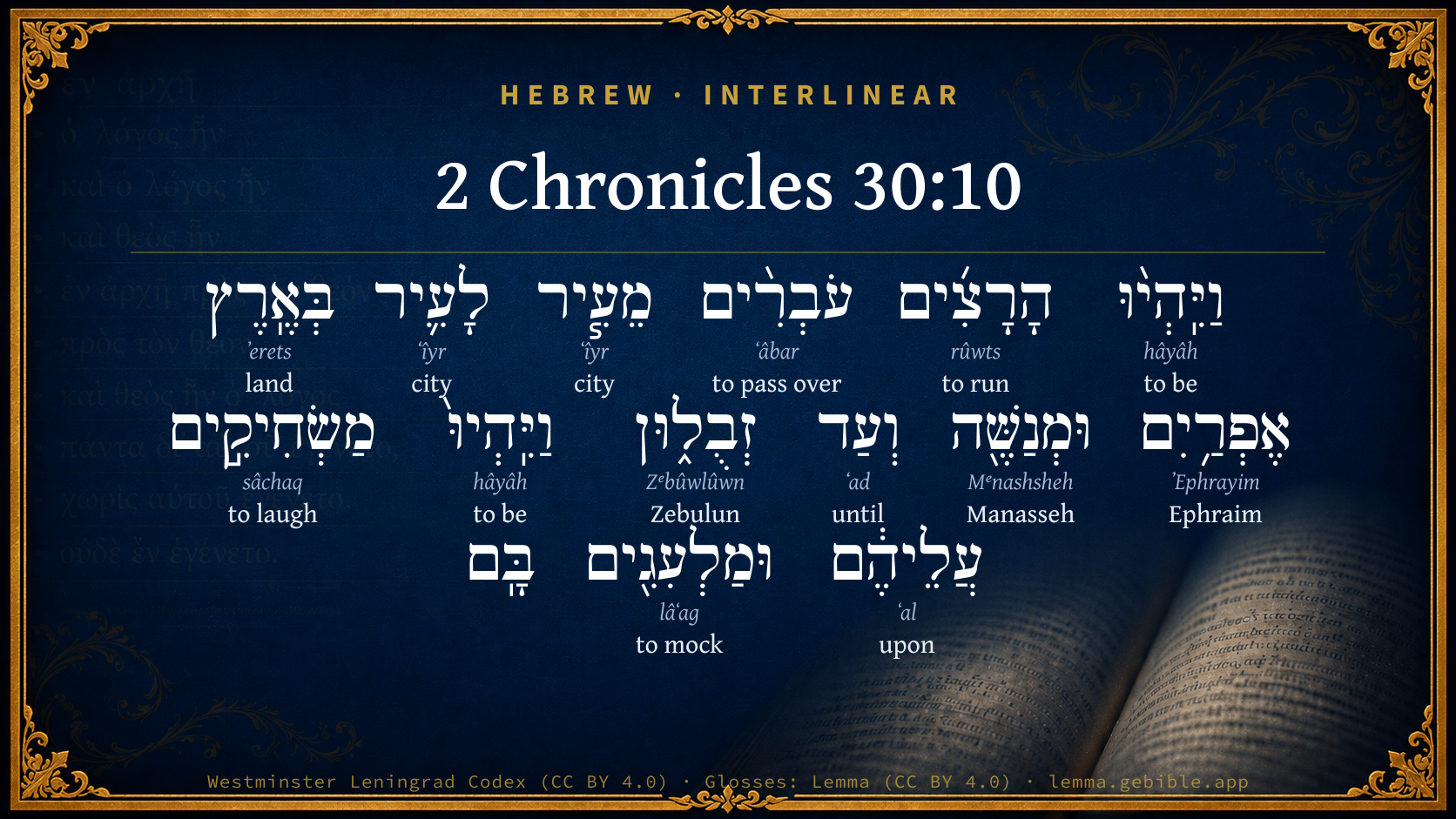
Hebrew (Westminster Leningrad Codex) 2 Chronicles 30:10 appears in the Hebrew Old Testament. The text above is from the Westminster Leningrad Codex. Each word links to its Strong’s number, a concise gloss, and parsing drawn from the Open Scriptures Hebrew Bible morphology. Click any word for its full Brown-Driver-Briggs (BDB) entry.
Download image
Cite this verse

2 Chronicles 30:10 (World English Bible). Public Domain. Lemma interlinear Bible study tool, https://lemma.gebible.app/v/2-chronicles/30/10.

Show BibTeX & RIS
BibTeX
RIS
English Translation
So the posts passed from city to city through the country of Ephraim and Manasseh, even to Zebulun: but they ridiculed them, and mocked them.
World English Bible · Public Domain
Download a study sheet

One document with this verse’s original text, its word-by-word gloss line, the meaning frame, cross-references with their text, attributed commentary, and full source and license credits — printable, and it pastes into notes with its structure intact.

This verse Autodidact and up

Study sheet (.html) Plain text (.txt)

A passage Seminary Student

Up to 50 verses in one chapter. A passage sheet keeps up to 6 commentary sources and 12 cross-references per verse, in the order this page ranks them, and says so on the sheet whenever that leaves anything out. Ask for a single verse and you get the Autodidact verse sheet above.

Everything on this page stays free to read, with no account — the sheet is a download of what is already on screen, not access to it.

Want to remove ads? Support Godless Engineer
Compare translations 3

The same verse in 3 English versions, stacked beneath the original-language interlinear above. Click any original word for its lexicon entry.

Each is an independent rendering of the whole verse — the interlinear is not word-aligned to these translations.

Highlighted words mark where these versions differ — a whole-verse word diff, not a word-by-word alignment.

  • World English Bible Public Domain
    So the posts passed from city to city through the country of Ephraim and Manasseh, even to Zebulun: but they ridiculed them, and mocked them.
  • King James Version Public Domain
    So the posts passed from city to city through the country of Ephraim and Manasseh even unto Zebulun: but they laughed them to scorn, and mocked them.
  • unfoldingWord Literal Text CC BY-SA 4.0
    And the runners were passing from city to city in the land of Ephraim and Manasseh, and until Zebulun, but they were mocking them and ridiculing them.

unfoldingWord Literal Text — © unfoldingWord, licensed CC BY-SA 4.0. Word-aligned USFM3 via Door43 (git.door43.org/unfoldingWord/en_ult).

Versions to compare (up to 4)

3 of 4 selected

Show all 18 translations

Every available English version of this verse, each an independent rendering of the whole verse.

  • World English Bible Public Domain
    So the posts passed from city to city through the country of Ephraim and Manasseh, even to Zebulun: but they ridiculed them, and mocked them.
  • Berean Standard Bible Public Domain
    And the couriers traveled from city to city through the land of Ephraim and Manasseh as far as Zebulun; but the people scorned and mocked them.
  • Majority Standard Bible Public Domain
    And the couriers traveled from city to city through the land of Ephraim and Manasseh as far as Zebulun, but the people scorned and mocked them.
  • King James Version Public Domain
    So the posts passed from city to city through the country of Ephraim and Manasseh even unto Zebulun: but they laughed them to scorn, and mocked them.
  • American Standard Version (1901) Public Domain
    So the posts passed from city to city through the country of Ephraim and Manasseh, even unto Zebulun: but they laughed them to scorn, and mocked them.
  • Revised Version (1885) Public Domain
    So the posts passed from city to city through the country of Ephraim and Manasseh, even unto Zebulun: but they laughed them to scorn, and mocked them.
  • Geneva Bible (1599) Public Domain
    So the postes went from citie to citie thorow the land of Ephraim and Manasseh, euen vnto Zebulun: but they laughed them to scorne, and mocked them.
  • Douay-Rheims (1899) Public Domain
    For if you turn again to the Lord: your brethren, and children shall find mercy before their masters, that have led them away captive, and they shall return into this land: for the Lord your God is merciful, and will not turn away his face from you, if you return to him.
  • Young's Literal Translation Public Domain
    And the runners are passing over from city to city, in the land of Ephraim and Manasseh, even unto Zebulun: and they are laughing at them, and mocking at them,
  • Literal Standard Version CC BY-SA 4.0
    And the runners are passing over from city to city in the land of Ephraim and Manasseh, even to Zebulun, but they are laughing at them and mocking at them,
  • Unlocked Literal Bible CC BY-SA 4.0
    So the couriers passed from city to city throughout the regions of Ephraim and Manasseh, all the way to Zebulun, but the people laughed at them and mocked them.
  • unfoldingWord Literal Text CC BY-SA 4.0
    And the runners were passing from city to city in the land of Ephraim and Manasseh, and until Zebulun, but they were mocking them and ridiculing them.
  • Darby Bible Public Domain
    And the couriers passed from city to city through the country of Ephraim and Manasseh, even to Zebulun; but they laughed them to scorn and mocked them.
  • World Messianic Bible Public Domain
    So the couriers passed from city to city through the country of Ephraim and Manasseh, even to Zebulun, but people ridiculed them and mocked them.
  • Webster's Bible Public Domain
    So the posts passed from city to city through the country of Ephraim and Manasseh even to Zebulun: but they laughed them to scorn, and mocked them.
  • Free Bible Version CC BY-SA 4.0
    The messengers went from town to town all over the land of Ephraim and Manasseh as far as Zebulun; but the people laughed at them and mocked them.
  • Bible in Basic English Public Domain
    So the runners went from town to town through all the country of Ephraim and Manasseh as far as Zebulun: but they were laughed at and made sport of.
  • JPS Tanakh (1917) Public Domain
    So the posts passed from city to city through the country of Ephraim and Manasseh, even unto Zebulun; but they laughed them to scorn, and mocked them.

Literal Standard Version (2020), Covenant Press — licensed CC BY-SA 4.0. Text via the HelloAO Bible API (eBible.org). Unlocked Literal Bible (unfoldingWord) — licensed CC BY-SA 4.0. Text via the HelloAO Bible API (eBible.org). unfoldingWord Literal Text — © unfoldingWord, licensed CC BY-SA 4.0. Word-aligned USFM3 via Door43 (git.door43.org/unfoldingWord/en_ult). Free Bible Version, Dr. Jonathan Gallagher — licensed CC BY-SA 4.0. Text via the HelloAO Bible API (eBible.org).

Word by word

More ways to search: Search by grammar → Find every occurrence → Compare this word →

Practice this passage: Drill this verse → Learn its vocabulary →

וּמַלְעִגִ֖ים
lâʻag
H3932
“and · mocking”
Conjunction + Verb, Hiphil, Participle Active, Masculine, Plural, Absolute
Part of Speech
Conjunction + Verb
Stem
Hiphil
Form
Participle Active
Gender
Masculine
Number
Plural
State
Absolute
Full BDB Definition

Origin: a primitive root

TWOT: 1118

to mock, deride, ridicule - (Qal) to mock, deride, have in derision - (Niphal) to stammer - (Hiphil) to mock, deride
  1. וַיִּֽהְי֨וּ hâyâh H1961 “and · to be” Conjunction + Verb, Qal, Sequential Imperfect, 3rd Person, Masculine, Plural
  2. הָרָצִ֜ים rûwts H7323 “the · running” Particle, Definite Article + Verb, Qal, Participle Active, Masculine, Plural, Absolute
  3. עֹבְרִ֨ים ʻâbar H5674 “passing over” Verb, Qal, Participle Active, Masculine, Plural, Absolute
  4. מֵעִ֧יר ʻîyr H5892 “from · city” Preposition + Noun, Common, Feminine, Singular, Absolute
  5. לָעִ֛יר ʻîyr H5892 “to/for the · city” Preposition, Determined + Noun, Common, Feminine, Singular, Absolute
  6. בְּאֶֽרֶץ ʼerets H776 “in/at · land of” Preposition + Noun, Common, Both, Singular, Construct
  7. אֶפְרַ֥יִם ʼEphrayim H669 “Ephraim” Noun, Proper
  8. וּמְנַשֶּׁ֖ה Mᵉnashsheh H4519 “and · Manasseh” Conjunction + Noun, Proper
  9. וְעַד ʻad H5704 “and · until” Conjunction + Preposition
  10. זְבֻל֑וּן Zᵉbûwlûwn H2074 “Zebulun” Noun, Proper
  11. וַיִּֽהְיוּ֙ hâyâh H1961 “and · to be” Conjunction + Verb, Qal, Sequential Imperfect, 3rd Person, Masculine, Plural
  12. מַשְׂחִיקִ֣ים sâchaq H7832 “laughing” Verb, Hiphil, Participle Active, Masculine, Plural, Absolute
  13. עֲלֵיהֶ֔ם ʻal H5921 “upon · them” Preposition + Suffix, Personal, 3rd Person, Masculine, Plural

About this verse

These counts appear in no published source. They are computed here, from the morphology-tagged text and Lemma’s own curated glosses. What Lemma adds →

15
words
12
distinct lemmas
Historical
section

Notable vocabulary

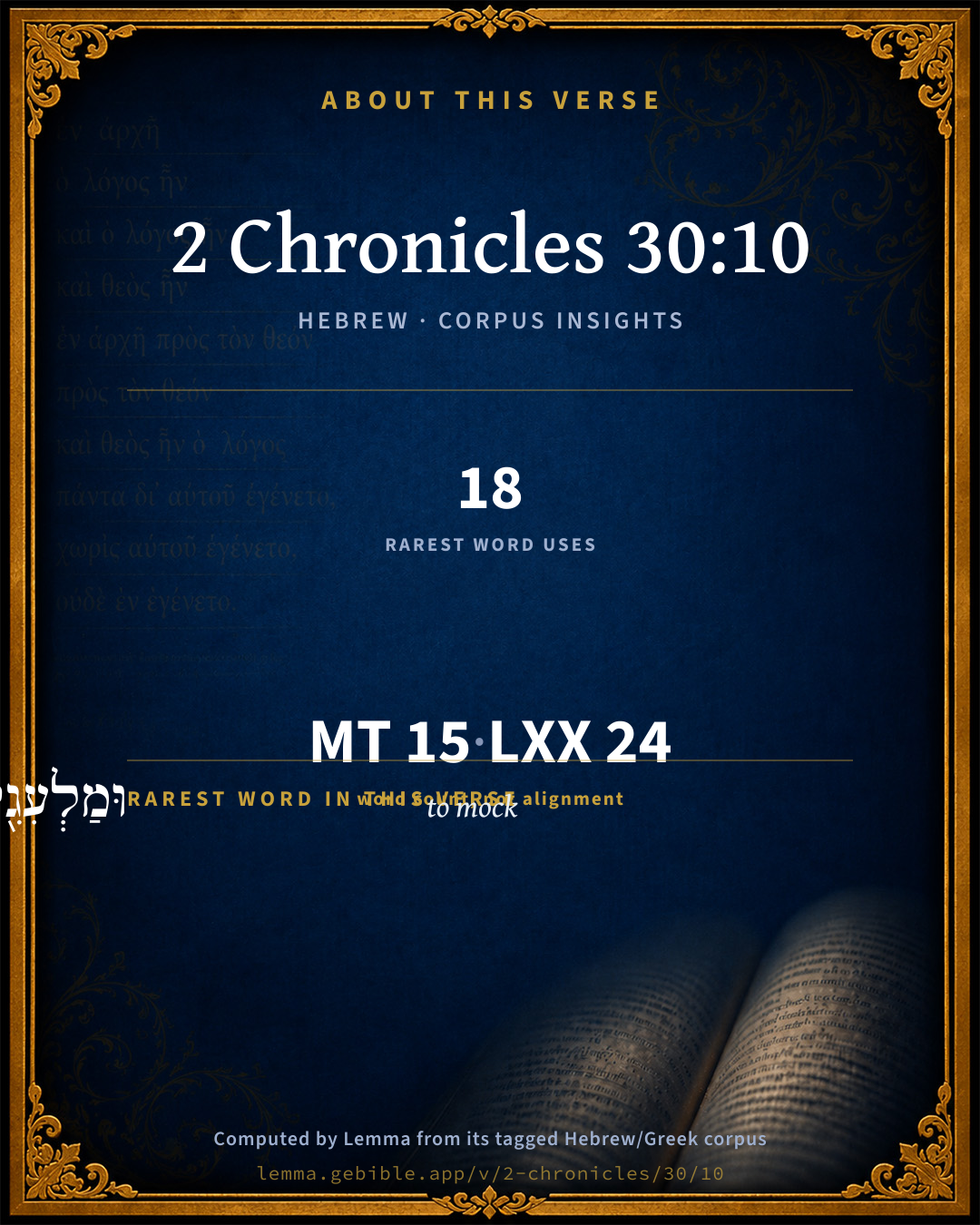
The rarest word here is וּמַלְעִגִ֖ים to mock H3932 — appearing just 18 times in the whole Hebrew Bible.

Shared distinctive vocabulary

וּמַלְעִגִ֖ים to mock H3932 occurs in 18 verses of the Hebrew Bible. Also found in:

Grammatical profile

  • 6 verbs
  • 6 nouns
  • 3 prepositions

Verb forms

  • וַיִּֽהְי֨וּ Qal · Sequential Imperfect
  • הָרָצִ֜ים Qal · Participle Active
  • עֹבְרִ֨ים Qal · Participle Active
  • וַיִּֽהְיוּ֙ Qal · Sequential Imperfect
  • מַשְׂחִיקִ֣ים Hiphil · Participle Active
  • וּמַלְעִגִ֖ים Hiphil · Participle Active

Repetition

Words recur within this verse — often emphatic in Hebrew:

  • וַיִּֽהְי֨וּ to be H1961 ×2
  • מֵעִ֧יר city H5892 ×2

Hebrew & Septuagint length

In English translation the verse runs 25 words from the Hebrew and 31 from the Septuagint (LXX English) — closely comparable.

A rough comparison of the two English renderings, which tokenize alike — not a word-level alignment.

Word counts can differ between the Hebrew and the Greek without any difference in meaning — e.g. the Hebrew direct-object marker אֵת has no separate Greek word, and Greek often adds the article ὁ.

In the original languages it is 15 Hebrew tokens and 24 Greek tokens — but the two are counted differently (Hebrew bundles its prefixes and suffixes into one token; the Greek is in lemma form), so that isn’t a like-for-like length.

Cross-references

16

Topical passages linked to 2 Chronicles 30:10 in the Treasury of Scripture Knowledge — connected by theme and wording, ordered by reader-vote popularity; previews shown in the World English Bible.

  • 2 Chronicles 36:16 but they mocked the messengers of God, and despised his words, and scoffed at his prophets, until the wrath of Yahweh arose against his people, until there was no remedy.
  • 2 Chronicles 30:6 So the posts went with the letters from the king and his princes throughout all Israel and Judah, and according to the commandment of the king, saying, You children of Israel, turn again to Yahweh, the God of Abraham, Isaac, and Israel, that he may return to the remnant that have escaped of you out of the hand of the kings of Assyria.
  • Genesis 19:14 Lot went out, and spoke to his sons-in-law, who were pledged to marry his daughters, and said, "Get up! Get out of this place, for Yahweh will destroy the city." But he seemed to his sons-in-law to be joking.
  • Nehemiah 2:19 But when Sanballat the Horonite, and Tobiah the servant, the Ammonite, and Geshem the Arabian, heard it, they ridiculed us, and despised us, and said, What is this thing that you do? will you rebel against the king?
  • Esther 3:13 Letters were sent by posts into all the king's provinces, to destroy, to kill, and to cause to perish, all Jews, both young and old, little children and women, in one day, even on the thirteenth [day] of the twelfth month, which is the month Adar, and to take the spoil of them for a prey.
  • Esther 3:15 The posts went forth in haste by the king's commandment, and the decree was given out in Shushan the palace. The king and Haman sat down to drink; but the city of Shushan was perplexed.
  • Esther 8:10 He wrote the name of king Ahasuerus, and sealed it with the king's ring, and sent letters by post on horseback, riding on swift steeds that were used in the king's service, bred of the stud:
  • Esther 8:14 So the posts who rode on swift steeds that were used in the king's service went out, being hurried and pressed on by the king's commandment; and the decree was given out in Shushan the palace.
  • Job 9:25 "Now my days are swifter than a runner. They flee away, they see no good,
  • Job 12:4 I am like one who is a joke to his neighbor, I, who called on God, and he answered. The just, the blameless man is a joke.
  • Luke 8:53 They were ridiculing him, knowing that she was dead.
  • Luke 16:14 The Pharisees, who were lovers of money, also heard all these things, and they scoffed at him.
  • Luke 22:63–64 The men who held Jesus mocked him and beat him.
  • Luke 23:35 The people stood watching. The rulers with them also scoffed at him, saying, "He saved others. Let him save himself, if this is the Christ of God, his chosen one!"
  • Acts 17:32 Now when they heard of the resurrection of the dead, some mocked; but others said, "We want to hear you again concerning this."
  • Hebrews 11:36 Others were tried by mocking and scourging, yes, moreover by bonds and imprisonment.

Cross-references courtesy of OpenBible.info (CC BY 4.0).

Hebrew and Greek witnesses Masoretic Hebrew ↔ Greek Septuagint

The same verse in the two great witnesses to the Old Testament, shown verse-for-verse.

These are two independent witnesses, not word-aligned to each other, and the Septuagint is shown in lemma (dictionary) form.

Hebrew 2 Chronicles 30:10 Masoretic · Westminster Leningrad Codex

וַיִּֽהְי֨וּ הָרָצִ֜ים עֹבְרִ֨ים מֵעִ֧יר לָעִ֛יר בְּאֶֽרֶץ אֶפְרַ֥יִם וּמְנַשֶּׁ֖ה וְעַד זְבֻל֑וּן וַיִּֽהְיוּ֙ מַשְׂחִיקִ֣ים עֲלֵיהֶ֔ם וּמַלְעִגִ֖ים בָּֽם

So the posts passed from city to city through the country of Ephraim and Manasseh, even to Zebulun: but they ridiculed them, and mocked them.

World English Bible · Public Domain

Greek LXX 2 Chronicles 30:10 Septuagint · lemma form

καί εἰμί ὁ τρέχω διαπορεύομαι πόλις ἐκ πόλις ἐν ὁ ὄρος ἐφράιμ καί μανασσή καί ἕως ζαβουλων καί γίγνομαι ὡς καταγελάω αὐτός καί καταμωκάομαι

So the posts went through from city to city in mount Ephraim, and Manasse, and as far as Zabulon: and they as it were laughed them to scorn, and mocked them.

LXX2012 (modern English Septuagint) · Public Domain

On this verse, The Cambridge Bible for Schools and Colleges discusses the Septuagint’s reading. Read the note in Commentary ↓

Hebrew: Westminster Leningrad Codex (CC BY 4.0). Greek: Septuagint (public domain); English from LXX2012 (modern English Septuagint) (Public Domain). How the Septuagint differs from the Hebrew →

Commentary

Notes on 2 Chronicles 30:10 from classic Christian and Jewish commentators (each source and its license shown beneath its notes). The classic Christian expositions comment on the surrounding passage and are grouped to its opening verse, so a note may address several verses; the Jewish commentaries on the Tanakh (Rashi and others) are per-verse, so they appear only where the commentator wrote on this verse.

Lemma curates 59 commentaries, every one of them public domain or Creative Commons licensed, each selected and text-cleaned for this edition rather than reprinted as found. About our sources →

Trapp's Complete Commentary

John Trapp

2Ch 30:10 So the posts passed from city to city through the country of Ephraim and Manasseh even unto Zebulun: but they laughed them to scorn, and mocked them.

Ver. 10. But they laughed them to scorn.] So profane and superstitious they were; so ready ripe for rain. It is a sad foretoken of a common calamity, when religion is become a matter, not of form only, but of scorn. Josephus saith that these Israelites thus invited slew both the messengers, and those prophets also that exhorted them to go up.

John Trapp, A Commentary or Exposition upon All the Books of the Old and New Testament (1647–1656) — public domain. Text from a community e-Sword module.

Joseph Benson's Commentary

2Ch 30:10. They laughed them to scorn, and mocked them — Having been long accustomed to serve other gods, the hearts of the generality of the ten tribes were so hardened, that they scoffed at this most gracious invitation to repentance. And what wonder that Hezekiah’s messengers were thus despitefully used by this apostate race, when even God’s messengers, his servants the prophets, who produced undeniable credentials from him, had been and still were worse treated. These Israelites, however, in a little time, paid dear for thus rejecting the counsel of God against themselves. In about two years and a half after their refusing this grace, Shalmaneser, the king of Assyria, invaded the country, and laid siege to Samaria, their capital city, and, at the end of three years more, took it, and carried the whole nation away captive into Assyria and Media, because they obeyed not the voice of the Lord their God, but transgressed his covenant, and all that Moses, the servant of the Lord, commanded, and would not hear nor do it, 2Ki 18:9-12.

Joseph Benson's Commentary on the Old and New Testaments (1811–1818) — public domain. Text from a community e-Sword module.

Geneva Bible (1599)

Geneva Bible translators

Though the wicked mock at the servants of God, by whom he calleth them to repentance, as Gen. 19:14, yet the word ceaseth not to fructify in the hearts of God’s elect.

Geneva Bible (1599) marginal notes — public domain. Text via Bolls.life.

Jamieson, Fausset & Brown

Robert Jamieson, A. R. Fausset & David Brown

the posts passed from city to city--It is not surprising that after so long a discontinuance of the sacred festival, this attempt to revive it should, in some quarters, have excited ridicule and opposition. Accordingly, among the tribes of Ephraim, Manasseh, and Zebulun, Hezekiah's messengers met with open insults and ill usage. Many, however, in these very districts, as well as throughout the kingdom of the ten tribes, generally complied with the invitation; while, in the kingdom of Judah, there was one unanimous feeling of high expectation and pious delight. The concourse that repaired to Jerusalem on the occasion was very great, and the occasion was ever after regarded as one of the greatest passovers that had ever been celebrated.

Jamieson, Fausset & Brown — Commentary Critical and Explanatory on the Whole Bible (1871) — public domain (CC PDM 1.0). Text via the HelloAO Bible API.

Ellicott's Commentary for English Readers

(10) So the posts passed.—And the couriers were passing.

Even unto Zebulun.—This tribe, which lay on the southern border of Naphtali, had suffered from Tiglath-pileser’s invasion (Isa_9:1). The messengers did not actually travel northward so far as Dan (2Ch_30:5). This mention of Zebulun as the limit of their journey lends an air of historical truth to the account.

Laughed them to scorn.—Literally, and they were laughing at them (hisḫîq: here only), and making mock of them (Psa_22:7). The verbs imply what the Israelites did continually. Vulg., “cursores pergebant . . . illis irridentibus et subsannantibus eos.”

A Bible Commentary for English Readers, edited by Charles John Ellicott (1878–1897) — public domain. Text from a community e-Sword module.

The Cambridge Bible for Schools and Colleges

gen. ed. J. J. S. Perowne

10. passed] LXX. ἦσαν … διαπορευόμενοι (more literal).

The Cambridge Bible for Schools and Colleges (gen. ed. J. J. S. Perowne; Cambridge University Press, 1878–1918) — public domain. Text from a community e-Sword module.

John Gill's Exposition

Nevertheless, divers of Asher, and Manasseh, and of Zebulun, humbled themselves,.... Confessed their idolatries and impieties, and expressed sorrow and repentance for them, and were willing to obey the commands of God, and attend his worship and ordinances:

and came to Jerusalem; to keep the passover.

John Gill's Exposition of the Whole Bible (1746–1763) — public domain (CC PDM 1.0). Text via the HelloAO Bible API.

Albert Barnes' Notes on the Bible

Ephraim and Manasseh are mentioned as the two tribes nearest to Judah, Zebulun as one of the furthest off.

Albert Barnes' Notes on the Bible (1834–1885) — public domain. Text from a community e-Sword/MySword module.

Haydock's Catholic Bible Commentary

Zabulon. Aser and Nephthali lay more to the north. But they were also invited, as well as the few who might remain on the other side the Jordan, 1 Paralipomenon v. 26. At least, we find that some of Aser came, v. 11. Thus those, who had been invited last, came first, while Ephraim continued more stubborn; (v. 18) and the greatest part derided the messengers, as we still see too frequently verified in the days of the gospel. H.

George Leo Haydock (1774–1849), Haydock's Catholic Family Bible and Commentary, 1859 edition — public domain. Excludes Psalms (Douay-Rheims chapter numbering differs from Protestant) and Deuterocanonical books (Catholic canon only).

Matthew Poole's English Annotations

They laughed, i.e. the generality of the ten tribes; who by long want of meat had now lost all their appetite to God’s ordinances, and from a neglect were now fallen into a contempt and derision of them; for which they paid dear. For about six years after their refusal of this offer of grace they were all carried captive, 2Ki 18:1,10.

Matthew Poole's English Annotations on the Holy Bible (1683–1685) — public domain. Text from a community e-Sword/MySword module.

Whedon's Commentary on the Bible

Daniel D. Whedon

10. They laughed them to scorn — They had no mind for reunion, and years of alienation and false worship had prepared them to treat with derision Hezekiah’s proposition.

Daniel D. Whedon (gen. ed.), Commentary on the Old and New Testaments (1874–1909) — public domain. Text from a community e-Sword module.

John Wesley's Explanatory Notes

They - The generality of the ten tribes; who by long want of meat had now lost their appetite to God's ordinances, for which they paid dear. For about six years after their refusal of this offer of grace they were all carried away captive, 2 Kings xviii, 1, 10.

John Wesley, Explanatory Notes Upon the Whole Bible (1754–1765) — public domain. Text via the GEBible commentary corpus.

unfoldingWord translationNotes

Door43 World Missions Community

the regions of Ephraim and Manasseh

Ephraim and Manasseh were two of the tribes in the northern part of Israel. Here the phrase "Ephraim and Manasseh" refers to the people who belonged to all ten of the northern tribes of Israel. See how you translated it in 2 Chronicles 30:1. AT: "the regions of the northern tribes of Israel" (See: Synecdoche)

all the way to Zebulun

Zebulun was one of the tribes farthest in the north of Israel, but there were three other tribes that reached farther north.

The hand of God also came on Judah

Here "the hand of God" represents his guidance as if he were guiding them with his hand. AT: "God guided the people of Judah" (See: Metaphor)

to give them one heart

Having "one heart" represents being united and agreeing. AT: "causing them to agree" (See: Metaphor)

to carry out the command

Here "carry out the command" is an idiom meaning to do what was commanded. AT: "to obey the command" (See: Idiom)

the command of the king and leaders by the word of Yahweh

The phrase "by the word of Yahweh" shows that the king and leaders gave their command in obedience to the word of Yahweh. AT: "the command that the king and leaders gave them in obedience to the word of Yahweh" or "what the king and the leaders commanded because of what Yahweh had said"

translationWords

Zebulun

mock

Asher

humble

Jerusalem

heart

word of God

unfoldingWord translationNotes — © Distant Shores Media and the Door43 World Missions Community, licensed CC BY-SA 4.0. Source: git.door43.org/Door43/en_tn.

Lesson kit

Teaching starters — assembled from the data on this page, not authored interpretation. Every prompt links to the verse data it draws on. Edit before teaching.

2 Chronicles, in the Historical, opens this verse with 15 words (12 distinct Hebrew lemmas). Its most distinctive word is lâʻag (“to mock”). A historical commentator’s framing appears above. Read the whole chapter for the surrounding context.

Discussion questions

  1. What does “to mock” (lâʻag) contribute to the verse as a whole?
  2. 2 Kings 19:21 shares the word «to mock» with this verse. How do the two illuminate each other?
  3. “to be” occurs 2× in this one verse. What is the effect of the repetition?
  4. These translations render this verse differently. What is at stake in choosing one wording over another?
  5. The verb «וַיִּֽהְי֨וּ» is Qal Sequential Imperfect. How does its form color the action?
  6. Reading how Trapp's Complete Commentary and Joseph Benson's Commentary read this verse, where do the two commentators agree and where do they part?

Things to notice

Reading settings

Reading text

Shown beneath each verse's original-language words.

Old Testament
Old Testament edition

Read the OT as the Masoretic Hebrew (MT) or the Greek Septuagint (LXX).

English shown for the Greek Septuagint (in the Hebrew ↔ Greek comparison).

Comparing translations? Open the Compare panel on any verse page to stack up to four side by side.