Deuteronomy 24:20

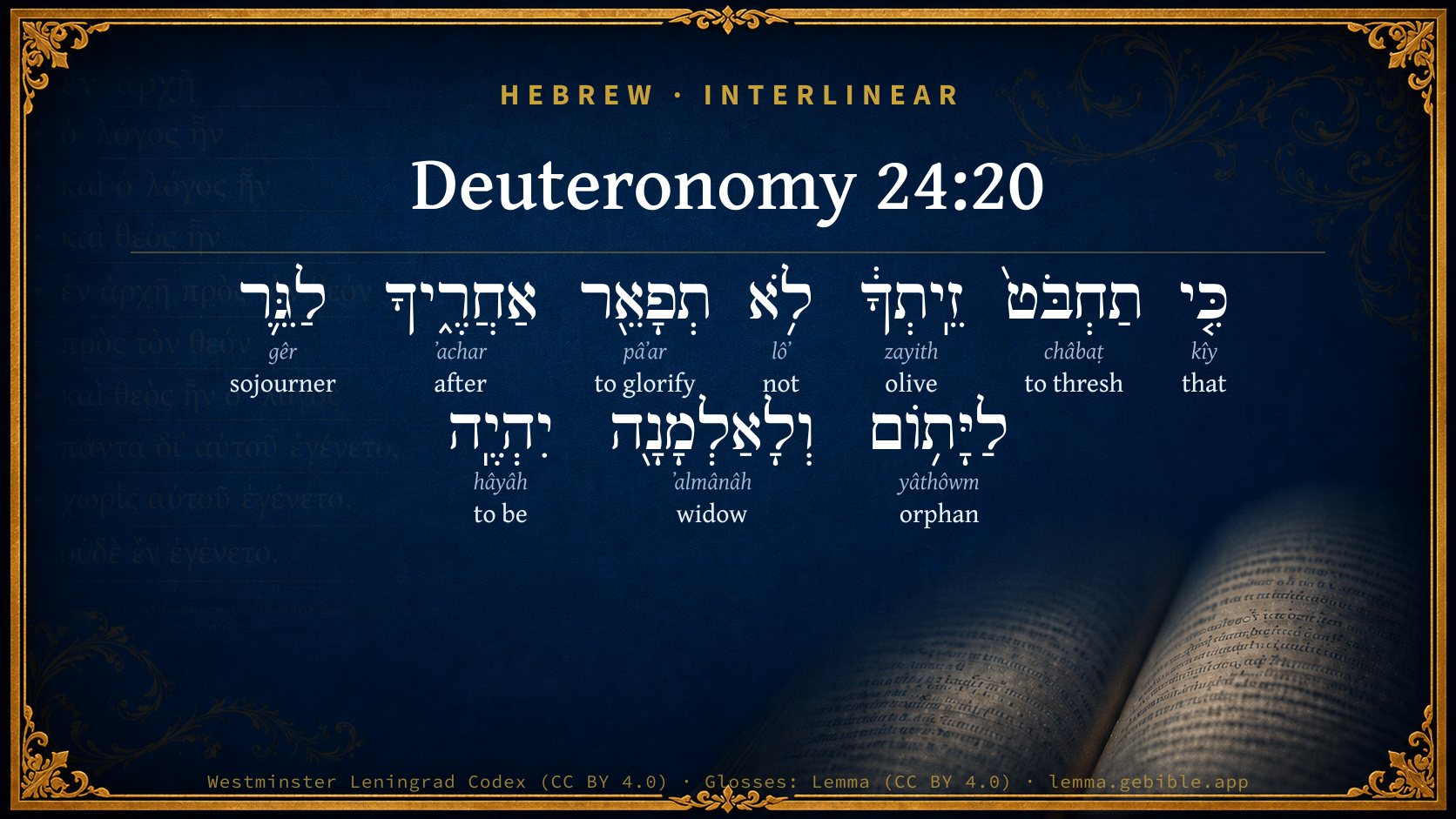
Hebrew (Westminster Leningrad Codex) Deuteronomy 24:20 appears in the Hebrew Old Testament. The text above is from the Westminster Leningrad Codex. Each word links to its Strong’s number, a concise gloss, and parsing drawn from the Open Scriptures Hebrew Bible morphology. Click any word for its full Brown-Driver-Briggs (BDB) entry.
Download image
Cite this verse

Deuteronomy 24:20 (World English Bible). Public Domain. Lemma interlinear Bible study tool, https://lemma.gebible.app/v/deuteronomy/24/20.

Show BibTeX & RIS
BibTeX
RIS
English Translation
When you beat your olive tree, you shall not go over the boughs again: it shall be for the foreigner, for the fatherless, and for the widow.
World English Bible · Public Domain
Highlights
  • 1 first appearance in the Hebrew Bible
Full analysis ↓
Download a study sheet

One document with this verse’s original text, its word-by-word gloss line, the meaning frame, cross-references with their text, attributed commentary, and full source and license credits — printable, and it pastes into notes with its structure intact.

This verse Autodidact and up

Study sheet (.html) Plain text (.txt)

A passage Seminary Student

Up to 50 verses in one chapter. A passage sheet keeps up to 6 commentary sources and 12 cross-references per verse, in the order this page ranks them, and says so on the sheet whenever that leaves anything out. Ask for a single verse and you get the Autodidact verse sheet above.

Everything on this page stays free to read, with no account — the sheet is a download of what is already on screen, not access to it.

Want to remove ads? Support Godless Engineer
Compare translations 3

The same verse in 3 English versions, stacked beneath the original-language interlinear above. Click any original word for its lexicon entry.

Each is an independent rendering of the whole verse — the interlinear is not word-aligned to these translations.

Highlighted words mark where these versions differ — a whole-verse word diff, not a word-by-word alignment.

  • World English Bible Public Domain
    When you beat your olive tree, you shall not go over the boughs again: it shall be for the foreigner, for the fatherless, and for the widow.
  • King James Version Public Domain
    When thou beatest thine olive tree, thou shalt not go over the boughs again: it shall be for the stranger, for the fatherless, and for the widow.
  • unfoldingWord Literal Text CC BY-SA 4.0
    When you beat your olive tree, you shall not go over the branches after yourself; it shall be for the foreigner, for the fatherless, or for the widow.

unfoldingWord Literal Text — © unfoldingWord, licensed CC BY-SA 4.0. Word-aligned USFM3 via Door43 (git.door43.org/unfoldingWord/en_ult).

Versions to compare (up to 4)

3 of 4 selected

Show all 18 translations

Every available English version of this verse, each an independent rendering of the whole verse.

  • World English Bible Public Domain
    When you beat your olive tree, you shall not go over the boughs again: it shall be for the foreigner, for the fatherless, and for the widow.
  • Berean Standard Bible Public Domain
    When you beat the olives from your trees, you must not go over the branches again. What remains will be for the foreigner, the fatherless, and the widow.
  • Majority Standard Bible Public Domain
    When you beat the olives from your trees, you must not go over the branches again. What remains will be for the foreigner, the fatherless, and the widow.
  • King James Version Public Domain
    When thou beatest thine olive tree, thou shalt not go over the boughs again: it shall be for the stranger, for the fatherless, and for the widow.
  • American Standard Version (1901) Public Domain
    When thou beatest thine olive-tree, thou shalt not go over the boughs again: it shall be for the sojourner, for the fatherless, and for the widow.
  • Revised Version (1885) Public Domain
    When thou beatest thine olive tree, thou shalt not go over the boughs again: it shall be for the stranger, for the fatherless, and for the widow.
  • Geneva Bible (1599) Public Domain
    When thou beatest thine oliue tree, thou shalt not goe ouer the boughes againe, but it shalbe for the stranger, for the fatherlesse, and for the widowe.
  • Douay-Rheims (1899) Public Domain
    If thou have gathered the fruit of thy olive trees, thou shalt not return to gather whatsoever remaineth on the trees: but shalt leave it for the stranger, for the fatherless, and the widow.
  • Young's Literal Translation Public Domain
    `When thou beatest thine olive, thou dost not examine the branch behind thee; to the sojourner, to the fatherless, and to the widow, it is.
  • Literal Standard Version CC BY-SA 4.0
    When you beat your olive, you do not examine the branch behind you; it is for the sojourner, for the fatherless, and for the widow.
  • Unlocked Literal Bible CC BY-SA 4.0
    When you shake your olive tree, you must not go over the branches again; it will be for the foreigner, for the fatherless, or for the widow.
  • unfoldingWord Literal Text CC BY-SA 4.0
    When you beat your olive tree, you shall not go over the branches after yourself; it shall be for the foreigner, for the fatherless, or for the widow.
  • Darby Bible Public Domain
    When thou shakest thine olive-tree, thou shalt not go over the boughs again; it shall be for the stranger, for the fatherless, and for the widow.
  • World Messianic Bible Public Domain
    When you beat your olive tree, you shall not go over the boughs again. It shall be for the foreigner, for the fatherless, and for the widow.
  • Webster's Bible Public Domain
    When thou beatest thy olive-tree, thou shalt not go over the boughs again: it shall be for the stranger, for the fatherless, and for the widow.
  • Free Bible Version CC BY-SA 4.0
    When you shake the olive trees to knock down the olives, don't go over the branches again. What's left is for the foreigners, the orphans, and the widows.
  • Bible in Basic English Public Domain
    When you are shaking the fruit from your olive-trees, do not go over the branches a second time: let some be for the man from a strange land, the child without a father, and the widow.
  • JPS Tanakh (1917) Public Domain
    When thou beatest thine olive-tree, thou shalt not go over the boughs again; it shall be for the stranger, for the fatherless, and for the widow.

Literal Standard Version (2020), Covenant Press — licensed CC BY-SA 4.0. Text via the HelloAO Bible API (eBible.org). Unlocked Literal Bible (unfoldingWord) — licensed CC BY-SA 4.0. Text via the HelloAO Bible API (eBible.org). unfoldingWord Literal Text — © unfoldingWord, licensed CC BY-SA 4.0. Word-aligned USFM3 via Door43 (git.door43.org/unfoldingWord/en_ult). Free Bible Version, Dr. Jonathan Gallagher — licensed CC BY-SA 4.0. Text via the HelloAO Bible API (eBible.org).

Word by word

More ways to search: Search by grammar → Find every occurrence → Compare this word →

Practice this passage: Drill this verse → Learn its vocabulary →

תַחְבֹּט֙
châbaṭ
H2251
“to thresh”
Verb, Qal, Imperfect, 2nd Person, Masculine, Singular
Part of Speech
Verb
Stem
Qal
Form
Imperfect
Person
2nd Person
Gender
Masculine
Number
Singular
Full BDB Definition

Origin: a primitive root

TWOT: 591

to beat, beat out, beat off, thresh - (Qal) - to beat out - to beat off - (Niphal) to be beaten out
  1. כִּ֤י kîy H3588 “that” Conjunction
  2. זֵֽיתְךָ֔ zayith H2132 “olive · your” Noun, Common, Masculine, Singular, Construct + Suffix, Personal, 2nd Person, Masculine, Singular
  3. לֹ֥א lôʼ H3808 “not” Particle, Negative
  4. תְפָאֵ֖ר pâʼar H6286 “to glorify” Verb, Piel, Imperfect, 2nd Person, Masculine, Singular
  5. אַחֲרֶ֑יךָ ʼachar H310 “after · you” Preposition + Suffix, Personal, 2nd Person, Masculine, Singular
  6. לַגֵּ֛ר gêr H1616 “to/for the · sojourner” Preposition, Determined + Noun, Common, Masculine, Singular, Absolute
  7. לַיָּת֥וֹם yâthôwm H3490 “to/for the · orphan” Preposition, Determined + Noun, Common, Masculine, Singular, Absolute
  8. וְלָאַלְמָנָ֖ה ʼalmânâh H490 “and · to/for the · widow” Conjunction + Preposition, Determined + Noun, Common, Feminine, Singular, Absolute
  9. יִהְיֶֽה hâyâh H1961 “to be” Verb, Qal, Imperfect, 3rd Person, Masculine, Singular

About this verse

These counts appear in no published source. They are computed here, from the morphology-tagged text and Lemma’s own curated glosses. What Lemma adds →

10
words
10
distinct lemmas
Pentateuch
section

Notable vocabulary

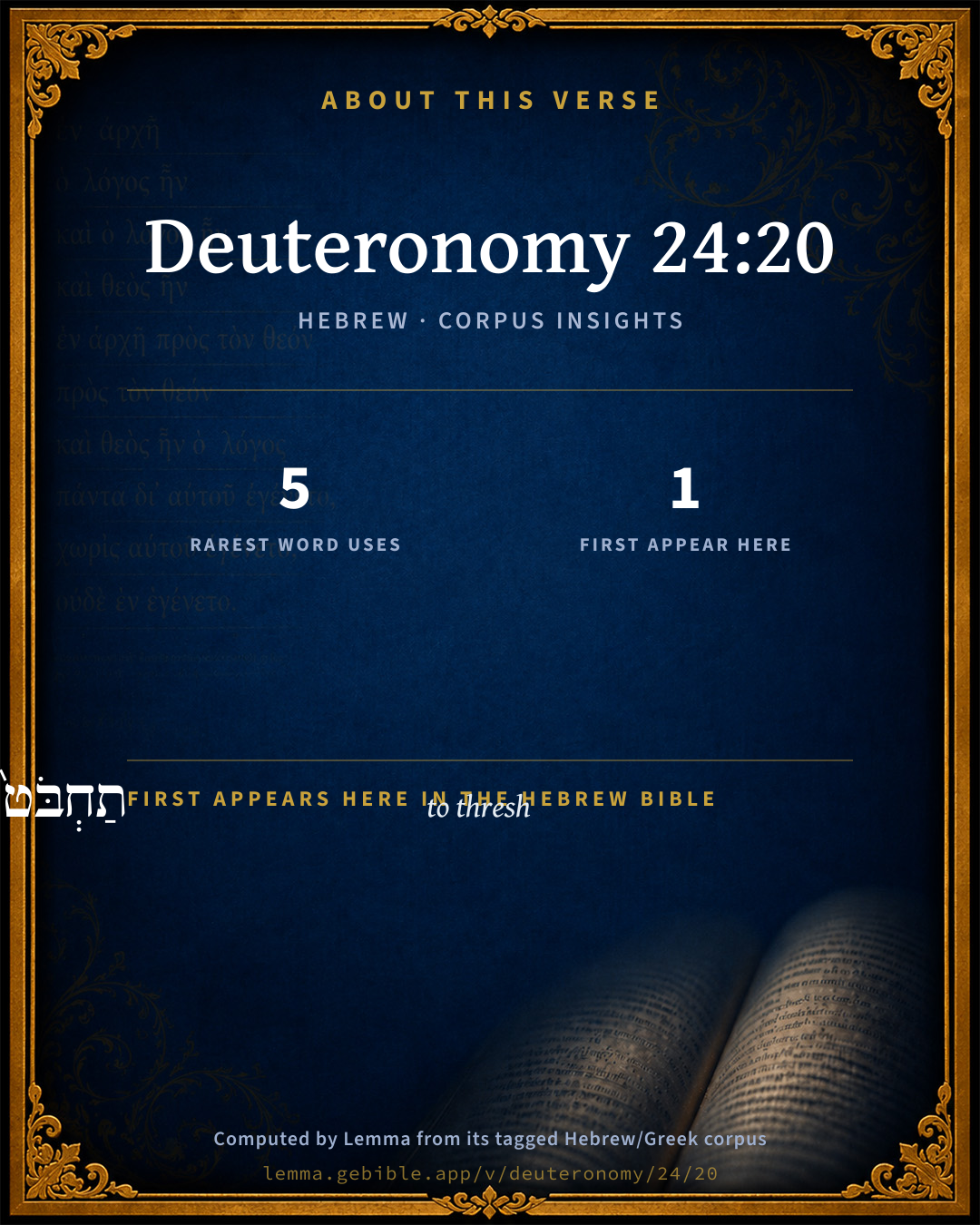
The rarest word here is תַחְבֹּט֙ to thresh H2251 — appearing just 5 times in the whole Hebrew Bible.

First appearance in Scripture

This word makes its first canonical appearance in the Hebrew Bible here:

  • תַחְבֹּט֙ to thresh H2251

Shared distinctive vocabulary

תַחְבֹּט֙ to thresh H2251 occurs in 5 verses of the Hebrew Bible. Also found in:

Grammatical profile

  • 3 verbs
  • 4 nouns
  • 1 preposition
  • 1 conjunction
  • 1 particle

Verb forms

  • תַחְבֹּט֙ Qal · Imperfect
  • תְפָאֵ֖ר Piel · Imperfect
  • יִהְיֶֽה Qal · Imperfect

Hebrew & Septuagint length

In English translation the verse runs 27 words from the Hebrew and 31 from the Septuagint (LXX English) — closely comparable.

A rough comparison of the two English renderings, which tokenize alike — not a word-level alignment.

Word counts can differ between the Hebrew and the Greek without any difference in meaning — e.g. the Hebrew direct-object marker אֵת has no separate Greek word, and Greek often adds the article ὁ.

Cross-references

1

Topical passages linked to Deuteronomy 24:20 in the Treasury of Scripture Knowledge — connected by theme and wording, ordered by reader-vote popularity; previews shown in the World English Bible.

  • Leviticus 19:10 You shall not glean your vineyard, neither shall you gather the fallen grapes of your vineyard; you shall leave them for the poor and for the foreigner. I am Yahweh your God.

Cross-references courtesy of OpenBible.info (CC BY 4.0).

Hebrew and Greek witnesses Masoretic Hebrew ↔ Greek Septuagint

The same verse in the two great witnesses to the Old Testament, shown verse-for-verse.

These are two independent witnesses, not word-aligned to each other, and the Septuagint is shown in lemma (dictionary) form.

Hebrew Deuteronomy 24:20 Masoretic · Westminster Leningrad Codex

כִּ֤י תַחְבֹּט֙ זֵֽיתְךָ֔ לֹ֥א תְפָאֵ֖ר אַחֲרֶ֑יךָ לַגֵּ֛ר לַיָּת֥וֹם וְלָאַלְמָנָ֖ה יִהְיֶֽה

When you beat your olive tree, you shall not go over the boughs again: it shall be for the foreigner, for the fatherless, and for the widow.

World English Bible · Public Domain

Greek LXX Deuteronomy 24:20 Septuagint · lemma form

ἐάν δέ ἐλαιολογέω οὐ ἐπι ἀναστρέφω καλαμάομαι ὁ ὀπίσω σύ ὁ προσήλυτος καί ὁ ὀρφανός καί ὁ χήρα εἰμί καί μιμνήσκω ὅτι οἰκέτης εἰμί ἐν γῆ αἴγυπτος διά οὗτος ἐγώ σύ ἐντέλλομαι ποιέω ὁ ῥῆμα οὗτος

And you shall remember that you were a bondman in the land of Egypt, and the Lord your God redeemed you from thence; therefore I charge you to do this thing.

LXX2012 (modern English Septuagint) · Public Domain

Hebrew: Westminster Leningrad Codex (CC BY 4.0). Greek: Septuagint (public domain); English from LXX2012 (modern English Septuagint) (Public Domain). How the Septuagint differs from the Hebrew →

Targum (Aramaic paraphrase)

2

The Targum is the ancient Jewish Aramaic paraphrase of the Hebrew Scriptures — an interpretive translation, not the Hebrew text itself. Onkelos (literal) and Pseudo-Jonathan (expansive) render the Torah, and Jonathan the Prophets. Coverage is partial: where no permissively-licensed English translation exists for a verse, only the Aramaic is shown. This is verse-level text, not a word-by-word alignment to the Hebrew.

  1. Targum Onkelos Torah (Genesis–Deuteronomy)
    אֲרֵי תַחְבּוֹט זֵיתָךְ לָא תְפַלֵי בַּתְרָךְ לְגִיוֹרָא לְיִתַּמָא וּלְאַרְמְלָא יְהֵי

    (no public-domain English translation for this verse)

    Targum Onkelos — Aramaic: “Onkelos Genesis” (public domain); “Onkelos Exodus” (public domain); “Onkelos Leviticus” (public domain); “Onkelos Numbers” (public domain); “Onkelos Deuteronomy” (public domain). English: “Sefaria Community Translation” (CC0 1.0 (public-domain dedication)); “J.W. Etheridge. The Targums of Onkelos and Jonathan Ben Uzziel on the Pentateuch. London: Longmans, Green, 1862” (public domain). Text via Sefaria.

  2. Targum Pseudo-Jonathan Torah (Genesis–Deuteronomy)
    אֲרוּם תִּשְׁבְּטוּן זֵיתֵיכוֹן לָא תְבַקְרִינוּן מִן בַּתְרֵיכוֹן לְגִיּוֹרָא לְיַתְמָא וּלְאַרְמְלָא יֶהֱווֹן

    When you beat your olive trees, you shall not search them after (you have done it); for the stranger, the orphan, and widow, let it be.

    Targum Pseudo-Jonathan — Aramaic: “Targum Jonathan on Genesis” (public domain); “Targum Jonathan on Exodus” (public domain); “Targum Jonathan on Leviticus” (public domain); “Targum Jonathan on Numbers” (public domain); “Targum Jonathan on Deuteronomy” (public domain). English: “The Targum of Jonathan ben Uzziel, trans. J. W. Etheridge, London, 1862” (public domain). Text via Sefaria.

Commentary

Notes on Deuteronomy 24:20 from classic Christian and Jewish commentators (each source and its license shown beneath its notes). The classic Christian expositions comment on the surrounding passage and are grouped to its opening verse, so a note may address several verses; the Jewish commentaries on the Tanakh (Rashi and others) are per-verse, so they appear only where the commentator wrote on this verse.

Lemma curates 59 commentaries, every one of them public domain or Creative Commons licensed, each selected and text-cleaned for this edition rather than reprinted as found. About our sources →

Geneva Bible (1599)

Geneva Bible translators

Or, gatherest thine olives.

Geneva Bible (1599) marginal notes — public domain. Text via Bolls.life.

The Cambridge Bible for Schools and Colleges

gen. ed. J. J. S. Perowne

20. beatest thine olive tree] Isa_27:6; Isa_24:13 (but with another vb. for beating). ‘Some climb into the trees and shake the boughs, while others stand below and beat off the fruit with long slender poles’ (Van Lennep, op. cit. 128).

The Cambridge Bible for Schools and Colleges (gen. ed. J. J. S. Perowne; Cambridge University Press, 1878–1918) — public domain. Text from a community e-Sword module.

John Gill's Exposition

When thou beatest thine olive tree,.... With sticks and staves, to get off the olives when ripe:

thou shall not go over the boughs again; to beat off some few that may remain; they were not nicely to examine the boughs over again, whether there were any left or not:

it shall be for the stranger, for the fatherless, and for the widow; who might come into their oliveyards after the trees had been beaten, and gather what were left.

John Gill's Exposition of the Whole Bible (1746–1763) — public domain (CC PDM 1.0). Text via the HelloAO Bible API.

Matthew Poole's English Annotations

When thou beatest thine olive tree with staves, as they used to do to fetch down the olives.

Matthew Poole's English Annotations on the Holy Bible (1683–1685) — public domain. Text from a community e-Sword/MySword module.

Rashi

Rabbi Shlomo Yitzchaki (Rashi)

לא תפאר — This means: thou shalt not entirely remove its (the olive tree’s) glory (תפארת) from it, i.e., its fruit (Chullin 131b). Hence they (the Rabbis) derived the law that one must leave פאה (some quantity of fruit) also on fruit-trees for the poor (cf. Mishnah Peah 4:1).

אחריך BEHIND THEE — This implies שכחה (forgotten fruit; that if he forgets to remove some fruit from the orchard, he must leave it for the poor).

Rashi on the Tanakh — English translations: “The Judaica Press complete Tanach with Rashi, translated by A. J. Rosenberg” (CC BY 4.0); “Pentateuch with Rashi's commentary by M. Rosenbaum and A.M. Silbermann, 1929-1934” (public domain); “The Metsudah Tanach series, Lakewood, N.J” (CC BY 4.0); and “The Book of Joshua, Metsudah Publications, 1997” (CC BY 4.0). Text via Sefaria.

Lesson kit

Teaching starters — assembled from the data on this page, not authored interpretation. Every prompt links to the verse data it draws on. Edit before teaching.

Deuteronomy, in the Pentateuch, opens this verse with 10 words (10 distinct Hebrew lemmas). Its most distinctive word is châbaṭ (“to thresh”). A historical commentator’s framing appears above. Read the whole chapter for the surrounding context.

Discussion questions

  1. The word châbaṭ carries the sense “to thresh.” How does it shape the verse?
  2. This is the first place “to thresh” appears in Scripture (first appears here). What does its debut here establish?
  3. How does Judges 6:11, which shares the word «to thresh», read alongside this verse?
  4. The translations on this page render this verse differently — a whole-verse word diff, not a word-by-word alignment. What might account for the different wordings?
  5. «תַחְבֹּט֙» is a Qal Imperfect verb. How does that grammatical form shape the action described?
  6. Compare how Geneva Bible (1599) and The Cambridge Bible for Schools and Colleges read this verse. Where do they agree or differ?

Things to notice

Reading settings

Reading text

Shown beneath each verse's original-language words.

Old Testament
Old Testament edition

Read the OT as the Masoretic Hebrew (MT) or the Greek Septuagint (LXX).

English shown for the Greek Septuagint (in the Hebrew ↔ Greek comparison).

Comparing translations? Open the Compare panel on any verse page to stack up to four side by side.