
2 Chronicles 21:9

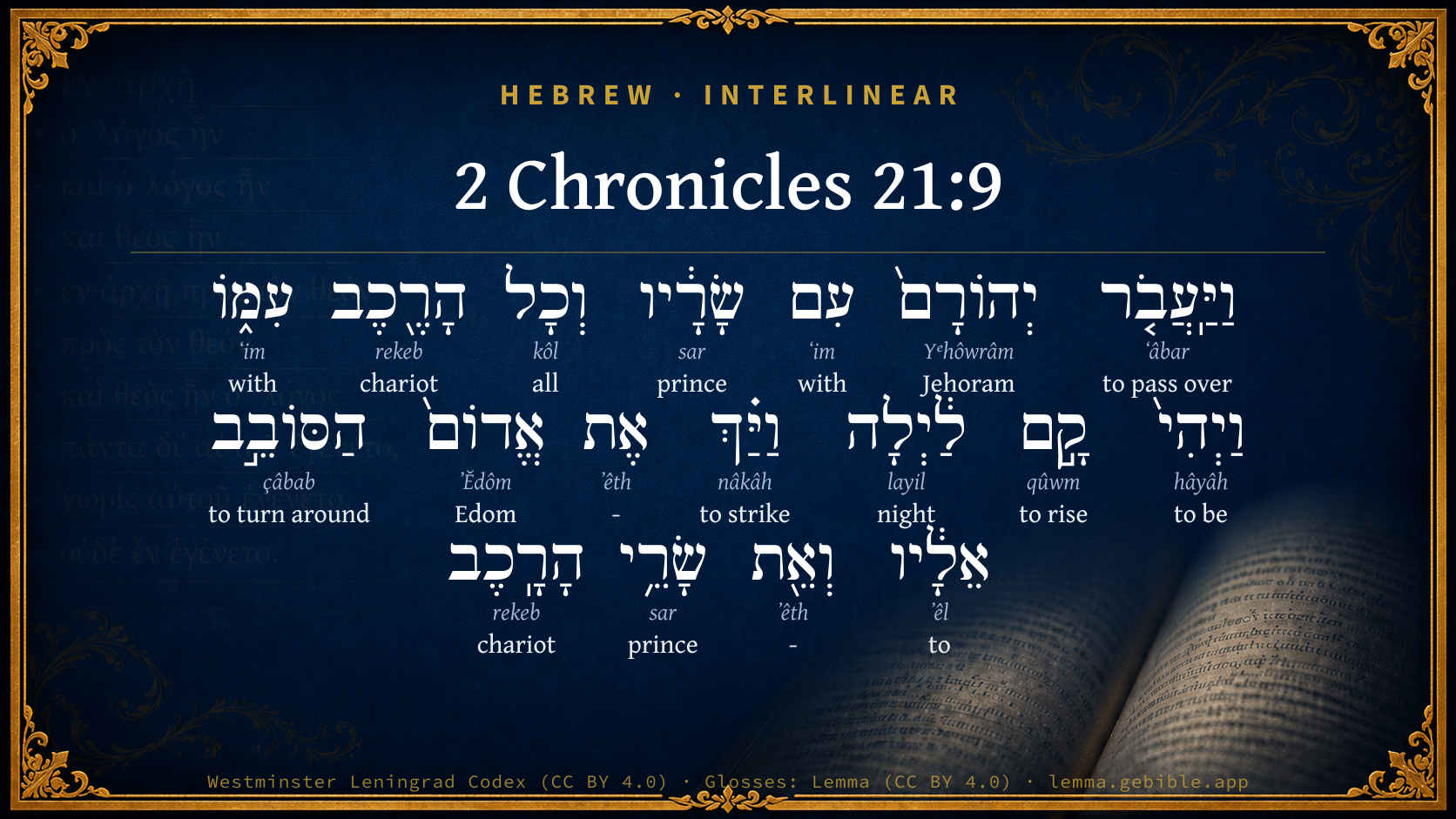
Hebrew (Westminster Leningrad Codex) 2 Chronicles 21:9 appears in the Hebrew Old Testament. The text above is from the Westminster Leningrad Codex. Each word links to its Strong’s number, a concise gloss, and parsing drawn from the Open Scriptures Hebrew Bible morphology. Click any word for its full Brown-Driver-Briggs (BDB) entry.
Download image
Cite this verse

2 Chronicles 21:9 (World English Bible). Public Domain. Lemma interlinear Bible study tool, https://lemma.gebible.app/v/2-chronicles/21/9.

Show BibTeX & RIS
BibTeX
RIS
English Translation
Then Jehoram passed over with his captains, and all his chariots with him: and he rose up by night, and struck the Edomites who surrounded him, along with the captains of the chariots.
World English Bible · Public Domain
Download a study sheet

One document with this verse’s original text, its word-by-word gloss line, the meaning frame, cross-references with their text, attributed commentary, and full source and license credits — printable, and it pastes into notes with its structure intact.

This verse Autodidact and up

Study sheet (.html) Plain text (.txt)

A passage Seminary Student

Up to 50 verses in one chapter. A passage sheet keeps up to 6 commentary sources and 12 cross-references per verse, in the order this page ranks them, and says so on the sheet whenever that leaves anything out. Ask for a single verse and you get the Autodidact verse sheet above.

Everything on this page stays free to read, with no account — the sheet is a download of what is already on screen, not access to it.

Want to remove ads? Support Godless Engineer
Compare translations 3

The same verse in 3 English versions, stacked beneath the original-language interlinear above. Click any original word for its lexicon entry.

Each is an independent rendering of the whole verse — the interlinear is not word-aligned to these translations.

Highlighted words mark where these versions differ — a whole-verse word diff, not a word-by-word alignment.

  • World English Bible Public Domain
    Then Jehoram passed over with his captains, and all his chariots with him: and he rose up by night, and struck the Edomites who surrounded him, along with the captains of the chariots.
  • King James Version Public Domain
    Then Jehoram went forth with his princes, and all his chariots with him: and he rose up by night, and smote the Edomites which compassed him in, and the captains of the chariots.
  • unfoldingWord Literal Text CC BY-SA 4.0
    And Jehoram passed over with his chiefs and all his chariots with him. And it happened he rose at night and he struck Edom surrounding him and the chiefs of the chariots.

unfoldingWord Literal Text — © unfoldingWord, licensed CC BY-SA 4.0. Word-aligned USFM3 via Door43 (git.door43.org/unfoldingWord/en_ult).

Versions to compare (up to 4)

3 of 4 selected

Show all 18 translations

Every available English version of this verse, each an independent rendering of the whole verse.

  • World English Bible Public Domain
    Then Jehoram passed over with his captains, and all his chariots with him: and he rose up by night, and struck the Edomites who surrounded him, along with the captains of the chariots.
  • Berean Standard Bible Public Domain
    So Jehoram crossed into Edom with his officers and all his chariots. When the Edomites surrounded him and his chariot commanders, he rose up and attacked by night.
  • Majority Standard Bible Public Domain
    So Jehoram crossed into Edom with his officers and all his chariots. When the Edomites surrounded him and his chariot commanders, he rose up and attacked by night.
  • King James Version Public Domain
    Then Jehoram went forth with his princes, and all his chariots with him: and he rose up by night, and smote the Edomites which compassed him in, and the captains of the chariots.
  • American Standard Version (1901) Public Domain
    Then Jehoram passed over with his captains, and all his chariots with him: and he rose up by night, and smote the Edomites that compassed him about, and the captains of the chariots.
  • Revised Version (1885) Public Domain
    Then Jehoram passed over with his captains, and all his chariots with him: and he rose up by night, and smote the Edomites which compassed him about, and the captains of the chariots.
  • Geneva Bible (1599) Public Domain
    And Iehoram went forth with his princes, and all his charets with him: and hee rose vp by night, and smote Edom, which had compassed him in, and the captaines of the charets.
  • Douay-Rheims (1899) Public Domain
    And Joram went over with his princes, and all his cavalry with him, and rose in the night, and defeated the Edomites who had surrounded him, and all the captains of his cavalry.
  • Young's Literal Translation Public Domain
    and Jehoram passeth over with his heads, and all the chariots with him, and it cometh to pass, he hath risen by night and smiteth the Edomites who are coming round against him, and the princes of the chariots,
  • Literal Standard Version CC BY-SA 4.0
    and Jehoram passes over with his heads, and all the chariots with him, and it comes to pass, he has risen by night and strikes the Edomites who are coming around against him, and the princes of the chariots,
  • Unlocked Literal Bible CC BY-SA 4.0
    Then Jehoram crossed over with his commanders and all his chariots. It was night when he rose up and fought against the Edomites who had surrounded him and his chariot commanders.
  • unfoldingWord Literal Text CC BY-SA 4.0
    And Jehoram passed over with his chiefs and all his chariots with him. And it happened he rose at night and he struck Edom surrounding him and the chiefs of the chariots.
  • Darby Bible Public Domain
    And Jehoram went over with his captains, and all the chariots with him; and he rose up by night, and smote the Edomites who had surrounded him, and the captains of the chariots.
  • World Messianic Bible Public Domain
    Then Jehoram went there with his captains and all his chariots with him. He rose up by night and struck the Edomites who surrounded him, along with the captains of the chariots.
  • Webster's Bible Public Domain
    Then Jehoram went forth with his princes, and all his chariots with him: and he rose by night, and smote the Edomites who encompassed him, and the captains of the chariots.
  • Free Bible Version CC BY-SA 4.0
    So Jehoram crossed into Edom with his officers and all his chariot army. The Edomites surrounded him and his chariot commanders, but he broke through during the night.
  • Bible in Basic English Public Domain
    Then Jehoram went over with his captains and all his war-carriages... made an attack by night on the Edomites, whose forces were all round him... on the captains of the war-carriages.
  • JPS Tanakh (1917) Public Domain
    Then Jehoram passed over with his captains, and all his chariots with him; and he rose up by night, and smote the Edomites that compassed him about, and the captains of the chariots.

Literal Standard Version (2020), Covenant Press — licensed CC BY-SA 4.0. Text via the HelloAO Bible API (eBible.org). Unlocked Literal Bible (unfoldingWord) — licensed CC BY-SA 4.0. Text via the HelloAO Bible API (eBible.org). unfoldingWord Literal Text — © unfoldingWord, licensed CC BY-SA 4.0. Word-aligned USFM3 via Door43 (git.door43.org/unfoldingWord/en_ult). Free Bible Version, Dr. Jonathan Gallagher — licensed CC BY-SA 4.0. Text via the HelloAO Bible API (eBible.org).

Word by word

More ways to search: Search by grammar → Find every occurrence → Compare this word →

Practice this passage: Drill this verse → Learn its vocabulary →

יְהוֹרָם֙
Yᵉhôwrâm
H3088
“Jehoram”
Noun, Proper
Part of Speech
Noun
Type
Proper
Full BDB Definition

Origin: from H3068 and H7311

TWOT: None

Jehoram or Joram = "Jehovah is exalted" - son of king Jehoshaphat of Judah and himself king of Judah for 8 years; his wife was the wicked Athaliah who was probably the instigator for his returning the nation of Judah to the worship of Baal - son of king Ahab of the northern kingdom of Israel and king of Israel himself for 12 years; he was murdered by Jehu on the plot of land for which his father had murdered Naboth thus fulfilling the prophecy of Elijah to the very letter - a priest in the reign of Jehoshaphat
  1. וַיַּֽעֲבֹ֤ר ʻâbar H5674 “and · to pass over” Conjunction + Verb, Qal, Sequential Imperfect, 3rd Person, Masculine, Singular
  2. עִם ʻim H5973 “with” Preposition
  3. שָׂרָ֔יו sar H8269 “princes · his” Noun, Common, Masculine, Plural, Construct + Suffix, Personal, 3rd Person, Masculine, Singular
  4. וְכָל kôl H3605 “and · all of” Conjunction + Noun, Common, Masculine, Singular, Construct
  5. הָרֶ֖כֶב rekeb H7393 “the · chariot” Particle, Definite Article + Noun, Common, Masculine, Singular, Absolute
  6. עִמּ֑וֹ ʻim H5973 “with · him” Preposition + Suffix, Personal, 3rd Person, Masculine, Singular
  7. וַיְהִי֙ hâyâh H1961 “and · to be” Conjunction + Verb, Qal, Sequential Imperfect, 3rd Person, Masculine, Singular
  8. קָ֣ם qûwm H6965 “rising” Verb, Qal, Participle Active, Masculine, Singular, Absolute
  9. לַ֔יְלָה layil H3915 “night” Noun, Common, Masculine, Singular, Absolute
  10. וַיַּ֗ךְ nâkâh H5221 “and · to strike” Conjunction + Verb, Hiphil, Sequential Imperfect, 3rd Person, Masculine, Singular
  11. אֶת ʼêth H853 “-” Particle, Direct Object
  12. אֱדוֹם֙ ʼĔdôm H123 “Edom” Noun, Proper
  13. הַסּוֹבֵ֣ב çâbab H5437 “the · turning around” Particle, Definite Article + Verb, Qal, Participle Active, Masculine, Singular, Absolute
  14. אֵלָ֔יו ʼêl H413 “to · him” Preposition + Suffix, Personal, 3rd Person, Masculine, Singular
  15. וְאֵ֖ת ʼêth H853 “and · -” Conjunction + Particle, Direct Object
  16. שָׂרֵ֥י sar H8269 “princes of” Noun, Common, Masculine, Plural, Construct
  17. הָרָֽכֶב rekeb H7393 “the · chariot” Particle, Definite Article + Noun, Common, Masculine, Singular, Absolute

About this verse

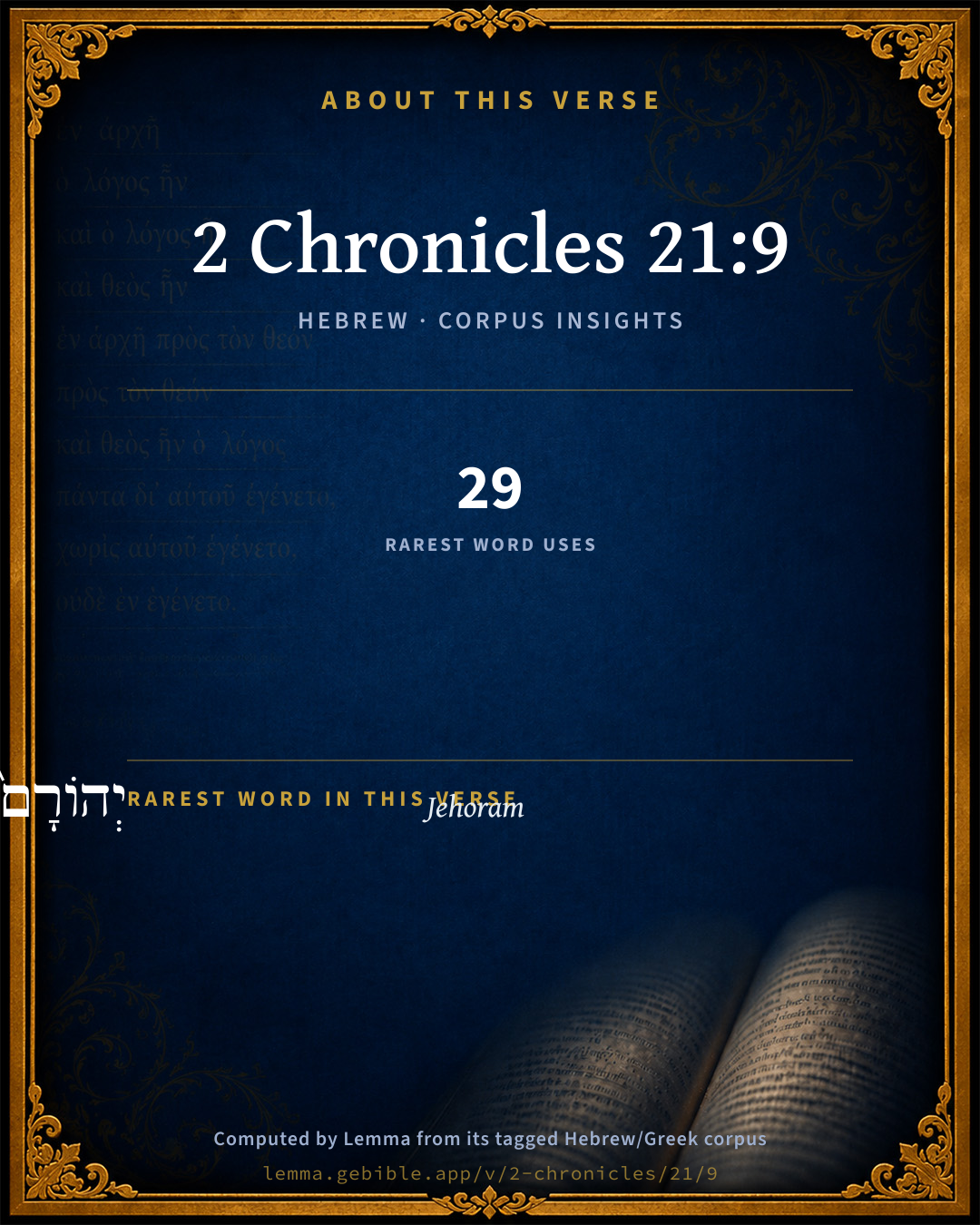
These counts appear in no published source. They are computed here, from the morphology-tagged text and Lemma’s own curated glosses. What Lemma adds →

18
words
14
distinct lemmas
Historical
section

Shared distinctive vocabulary

יְהוֹרָם֙ Jehoram H3088 occurs in 26 verses of the Hebrew Bible. Also found in:

Grammatical profile

  • 5 verbs
  • 8 nouns
  • 3 prepositions
  • 2 particles

Verb forms

  • וַיַּֽעֲבֹ֤ר Qal · Sequential Imperfect
  • וַיְהִי֙ Qal · Sequential Imperfect
  • קָ֣ם Qal · Participle Active
  • וַיַּ֗ךְ Hiphil · Sequential Imperfect
  • הַסּוֹבֵ֣ב Qal · Participle Active

Repetition

Words recur within this verse — often emphatic in Hebrew:

  • שָׂרָ֔יו prince H8269 ×2
  • הָרֶ֖כֶב chariot H7393 ×2
  • עִם with H5973 ×2

Hebrew & Septuagint length

In English translation the verse runs 33 words from the Hebrew and 42 from the Septuagint (LXX English) — closely comparable.

A rough comparison of the two English renderings, which tokenize alike — not a word-level alignment.

Word counts can differ between the Hebrew and the Greek without any difference in meaning — e.g. the Hebrew direct-object marker אֵת has no separate Greek word, and Greek often adds the article ὁ.

Hebrew and Greek witnesses Masoretic Hebrew ↔ Greek Septuagint

The same verse in the two great witnesses to the Old Testament, shown verse-for-verse.

These are two independent witnesses, not word-aligned to each other, and the Septuagint is shown in lemma (dictionary) form.

Hebrew 2 Chronicles 21:9 Masoretic · Westminster Leningrad Codex

וַיַּֽעֲבֹ֤ר יְהוֹרָם֙ עִם שָׂרָ֔יו וְכָל הָרֶ֖כֶב עִמּ֑וֹ וַיְהִי֙ קָ֣ם לַ֔יְלָה וַיַּ֗ךְ אֶת אֱדוֹם֙ הַסּוֹבֵ֣ב אֵלָ֔יו וְאֵ֖ת שָׂרֵ֥י הָרָֽכֶב

Then Jehoram passed over with his captains, and all his chariots with him: and he rose up by night, and struck the Edomites who surrounded him, along with the captains of the chariots.

World English Bible · Public Domain

Greek LXX 2 Chronicles 21:9 Septuagint · lemma form

καί οἴχομαι ιωραμ μετά ὁ ἄρχων καί πᾶς ὁ ἵππος μετά αὐτός καί γίγνομαι καί ἐγείρω νύξ καί πατάσσω εδωμ ὁ κυκλόω αὐτός καί ὁ ἄρχων ὁ ἅρμα καί φεύγω ὁ λαός εἰς ὁ σκήνωμα αὐτός

And Joram went with the princes, and all the cavalry with him: and it came to pass that he arose by night, and struck Edom that compassed him about, and the captains of the chariots, and the people fled to their tents.

LXX2012 (modern English Septuagint) · Public Domain

Hebrew: Westminster Leningrad Codex (CC BY 4.0). Greek: Septuagint (public domain); English from LXX2012 (modern English Septuagint) (Public Domain). How the Septuagint differs from the Hebrew →

Commentary

Notes on 2 Chronicles 21:9 from classic Christian and Jewish commentators (each source and its license shown beneath its notes). The classic Christian expositions comment on the surrounding passage and are grouped to its opening verse, so a note may address several verses; the Jewish commentaries on the Tanakh (Rashi and others) are per-verse, so they appear only where the commentator wrote on this verse.

Lemma curates 59 commentaries, every one of them public domain or Creative Commons licensed, each selected and text-cleaned for this edition rather than reprinted as found. About our sources →

Trapp's Complete Commentary

John Trapp

2Ch 21:9 Then Jehoram went forth with his princes, and all his chariots with him: and he rose up by night, and smote the Edomites which compassed him in, and the captains of the chariots.

Ver. 9. And smote the Edomites.] But could not subdue them. They might be more troublesome, as Carthage was to Rome, when but half destroyed, than before he meddled with them.

John Trapp, A Commentary or Exposition upon All the Books of the Old and New Testament (1647–1656) — public domain. Text from a community e-Sword module.

Ellicott's Commentary for English Readers

(9) Then Jehoram went forth.—And Jehoram passed over.

With his princes.—Captains (‘im sârâv); Kings, “to Zair,” which appears to be a corruption of “to Seir.” The chronicler has substituted an intelligible for an obscure expression.

And he rose up by night, and smote the Edomites which compassed him in.—Literally, and it came to pass, he rose. Brief as the notice is, it is evident that the verse relates not a victory of Jehoram’s, but his desperate escape by cutting his way through the enemy’s troops, which had surrounded him and his forces. (See on 2Ki_8:21, where it is added, “and the people fled to their tents.”) (Syriac. “And Jehoram passed over with his captains; and all his chariots with him. And it came to pass that when he rose in the night, he destroyed the Edomites, and the captains of the chariots came with him.”)

A Bible Commentary for English Readers, edited by Charles John Ellicott (1878–1897) — public domain. Text from a community e-Sword module.

The Cambridge Bible for Schools and Colleges

gen. ed. J. J. S. Perowne

9. Then Jehoram went forth] R.V. Then Jehoram passed over. The Heb. root rendered “pass over” means (a) to pass over a sea or river or other landmark, (b) to pass by persons. In the latter signification it is applied (as here) to the vanguard of an army which passes by the main body in order to take the lead; cp. Jos_6:7. In this case Jehoram pushed on with the vanguard (consisting of all his chariots) leaving the “people” (2Ki_8:21), i.e. the bulk of his army to follow. A disaster ensued. Jehoram was hemmed in by the Edomites, and though he cut his way through them by a night surprise, his success came too late, for the rest of the army, thinking that the vanguard was cut off, dispersed to their homes. This last fact, which explains the failure of the campaign, is omitted by the Chronicler. 2Ki_8:21 should read, And it came to pass, though he rose by night and smote the Edomites … that the people fled to their tents.

with his princes] In 2 Kin. to Zair. Nothing is known of such a place, but some place name is to be expected here.

and the captains of the chariots] The clause is governed by the verb “compassed” (read perhaps el for eth in the Heb.).

The Cambridge Bible for Schools and Colleges (gen. ed. J. J. S. Perowne; Cambridge University Press, 1878–1918) — public domain. Text from a community e-Sword module.

The Pulpit Commentary

With his princes. The parallel, 2Ki_8:21, reads, "to Zair." Of any such place nothing is known, and it has been proposed to supersede the word there by "Self," which a certain amount of similarity of the Hebrew characters might countenance. Possibly by some mishap, not so readily explainable by misoccurrence of characters simply, our words, "with his princes," should stand in place of "to Zair." It must be noted that the two first clauses of the verse in the parallel become something inconsequential (which is not the ease with the reading of our text) in that it says, "The king and chariots went forth to a place, and rose up by night," etc. The dislocation is, perhaps, not serious, but our text avoids it in reading, "The king, princes, and chariots went forth, and rose up by night and smote," etc.

The Pulpit Commentary (1880–1919), ed. H.D.M. Spence-Jones & Joseph S. Exell — public domain. Text from a community e-Sword module.

Rashi

Rabbi Shlomo Yitzchaki (Rashi)

who surrounded him He smote those Edomites who surrounded him and supported him to aid him, for it was their custom that when they were victorious in war, they would seize the mighty men and bring them with them lest they join their enemies to aid the Edomites, their countrymen. In this case, he got up at night suddenly and slew them. Our Sages, however, explained “those who surrounded him” as “those near him.”

Rashi on the Tanakh — English translations: “The Judaica Press complete Tanach with Rashi, translated by A. J. Rosenberg” (CC BY 4.0); “Pentateuch with Rashi's commentary by M. Rosenbaum and A.M. Silbermann, 1929-1934” (public domain); “The Metsudah Tanach series, Lakewood, N.J” (CC BY 4.0); and “The Book of Joshua, Metsudah Publications, 1997” (CC BY 4.0). Text via Sefaria.

Lesson kit

Teaching starters — assembled from the data on this page, not authored interpretation. Every prompt links to the verse data it draws on. Edit before teaching.

2 Chronicles, in the Historical, opens this verse with 18 words (14 distinct Hebrew lemmas). Its most distinctive word is Yᵉhôwrâm (“Jehoram”). A historical commentator’s framing appears above. Read the whole chapter for the surrounding context.

Discussion questions

  1. How does “Jehoram” (Yᵉhôwrâm) shape what this verse is saying?
  2. 1 Kings 22:50 shares the word «Jehoram» with this verse. How do the two illuminate each other?
  3. “prince” occurs 2× in this one verse. What is the effect of the repetition?
  4. The translations on this page render this verse differently — a whole-verse word diff, not a word-by-word alignment. What might account for the different wordings?
  5. The verb «וַיַּֽעֲבֹ֤ר» is Qal Sequential Imperfect. How does its form color the action?
  6. Reading how Trapp's Complete Commentary and Ellicott's Commentary for English Readers read this verse, where do the two commentators agree and where do they part?

Things to notice

Reading settings

Reading text

Shown beneath each verse's original-language words.

Old Testament
Old Testament edition

Read the OT as the Masoretic Hebrew (MT) or the Greek Septuagint (LXX).

English shown for the Greek Septuagint (in the Hebrew ↔ Greek comparison).

Comparing translations? Open the Compare panel on any verse page to stack up to four side by side.