1 Chronicles 23:3

Hebrew (Westminster Leningrad Codex) 1 Chronicles 23:3 appears in the Hebrew Old Testament. The text above is from the Westminster Leningrad Codex. Each word links to its Strong’s number, a concise gloss, and parsing drawn from the Open Scriptures Hebrew Bible morphology. Click any word for its full Brown-Driver-Briggs (BDB) entry.
Download image
Cite this verse

1 Chronicles 23:3 (World English Bible). Public Domain. Lemma interlinear Bible study tool, https://lemma.gebible.app/v/1-chronicles/23/3.

Show BibTeX & RIS
BibTeX
RIS
English Translation
The Levites were numbered from thirty years old and upward: and their number by their polls, man by man, was thirty-eight thousand.
World English Bible · Public Domain
Download a study sheet

One document with this verse’s original text, its word-by-word gloss line, the meaning frame, cross-references with their text, attributed commentary, and full source and license credits — printable, and it pastes into notes with its structure intact.

This verse Autodidact and up

Study sheet (.html) Plain text (.txt)

A passage Seminary Student

Up to 50 verses in one chapter. A passage sheet keeps up to 6 commentary sources and 12 cross-references per verse, in the order this page ranks them, and says so on the sheet whenever that leaves anything out. Ask for a single verse and you get the Autodidact verse sheet above.

Everything on this page stays free to read, with no account — the sheet is a download of what is already on screen, not access to it.

Want to remove ads? Support Godless Engineer
Compare translations 3

The same verse in 3 English versions, stacked beneath the original-language interlinear above. Click any original word for its lexicon entry.

Each is an independent rendering of the whole verse — the interlinear is not word-aligned to these translations.

Highlighted words mark where these versions differ — a whole-verse word diff, not a word-by-word alignment.

  • World English Bible Public Domain
    The Levites were numbered from thirty years old and upward: and their number by their polls, man by man, was thirty-eight thousand.
  • King James Version Public Domain
    Now the Levites were numbered from the age of thirty years and upward: and their number by their polls, man by man, was thirty and eight thousand.
  • unfoldingWord Literal Text CC BY-SA 4.0
    And the Levites were counted from sons of 30 years and above, and the counting was by their skulls, by males, 38,000.

unfoldingWord Literal Text — © unfoldingWord, licensed CC BY-SA 4.0. Word-aligned USFM3 via Door43 (git.door43.org/unfoldingWord/en_ult).

Versions to compare (up to 4)

3 of 4 selected

Show all 18 translations

Every available English version of this verse, each an independent rendering of the whole verse.

  • World English Bible Public Domain
    The Levites were numbered from thirty years old and upward: and their number by their polls, man by man, was thirty-eight thousand.
  • Berean Standard Bible Public Domain
    The Levites thirty years of age or older were counted, and the total number of men was 38,000.
  • Majority Standard Bible Public Domain
    The Levites thirty years of age or older were counted, and the total number of men was 38,000.
  • King James Version Public Domain
    Now the Levites were numbered from the age of thirty years and upward: and their number by their polls, man by man, was thirty and eight thousand.
  • American Standard Version (1901) Public Domain
    And the Levites were numbered from thirty years old and upward: and their number by their polls, man by man, was thirty and eight thousand.
  • Revised Version (1885) Public Domain
    And the Levites were numbered from thirty years old and upward: and their number by their polls, man by man, was thirty and eight thousand.
  • Geneva Bible (1599) Public Domain
    And the Leuites were numbred from ye age of thirtie yeere and aboue, and their nomber according to their summe was eight and thirtie thousand men.
  • Douay-Rheims (1899) Public Domain
    And the Levites were numbered from the age of thirty years, and upwards: and there were found of them thirty-eight thousand men.
  • Young's Literal Translation Public Domain
    and the Levites are numbered from a son of thirty years and upward, and their number, by their polls, is of mighty men thirty and eight thousand.
  • Literal Standard Version CC BY-SA 4.0
    and the Levites are numbered from a son of thirty years and upward, and their number, for their counted heads, is of thirty-eight thousand mighty men.
  • Unlocked Literal Bible CC BY-SA 4.0
    The Levites who were thirty years old and older were counted. They numbered thirty-eight thousand.
  • unfoldingWord Literal Text CC BY-SA 4.0
    And the Levites were counted from sons of 30 years and above, and the counting was by their skulls, by males, 38,000.
  • Darby Bible Public Domain
    And the Levites were numbered from thirty years old and upward; and their number, by their polls, man by man, was thirty-eight thousand.
  • World Messianic Bible Public Domain
    The Levites were counted from thirty years old and upward; and their number by their polls, man by man, was thirty-eight thousand.
  • Webster's Bible Public Domain
    Now the Levites were numbered from the age of thirty years and upward: and their number by their polls, man by man, was thirty and eight thousand.
  • Free Bible Version CC BY-SA 4.0
    The Levites over thirty years old were counted, and there was 38,000 in total.
  • Bible in Basic English Public Domain
    And the Levites, all those of thirty years old and over, were numbered; and the number of them, by heads, man by man, was thirty-eight thousand.
  • JPS Tanakh (1917) Public Domain
    And the Levites were numbered from thirty years old and upward; and their number by their polls, man by man, was thirty and eight thousand.

Literal Standard Version (2020), Covenant Press — licensed CC BY-SA 4.0. Text via the HelloAO Bible API (eBible.org). Unlocked Literal Bible (unfoldingWord) — licensed CC BY-SA 4.0. Text via the HelloAO Bible API (eBible.org). unfoldingWord Literal Text — © unfoldingWord, licensed CC BY-SA 4.0. Word-aligned USFM3 via Door43 (git.door43.org/unfoldingWord/en_ult). Free Bible Version, Dr. Jonathan Gallagher — licensed CC BY-SA 4.0. Text via the HelloAO Bible API (eBible.org).

Word by word

More ways to search: Search by grammar → Find every occurrence → Compare this word →

Practice this passage: Drill this verse → Learn its vocabulary →

לְגֻלְגְּלֹתָם֙
gulgôleth
H1538
“to/for · skulls · their”
Preposition + Noun, Common, Feminine, Plural, Construct + Suffix, Personal, 3rd Person, Masculine, Plural
Part of Speech
Preposition + Noun
Type
Common
Gender
Feminine
Number
Plural
State
Construct
Full BDB Definition

Origin: by reduplication from H1556

TWOT: 353l

head, poll, skull - skull - head, poll (of census)
  1. וַיִּסָּֽפְרוּ֙ çâphar H5608 “and · to count” Conjunction + Verb, Niphal, Sequential Imperfect, 3rd Person, Masculine, Plural
  2. הַלְוִיִּ֔ם Lêvîyîy H3881 “the · Levites” Particle, Definite Article + Noun, Gentilic, Masculine, Plural, Absolute
  3. מִבֶּ֛ן bên H1121 “from · son of” Preposition + Noun, Common, Masculine, Singular, Construct
  4. שְׁלֹשִׁ֥ים shᵉlôwshîym H7970 “thirty” Adjective, Cardinal number, Both, Plural, Absolute
  5. שָׁנָ֖ה shâneh H8141 “year” Noun, Common, Feminine, Singular, Absolute
  6. וָמָ֑עְלָה maʻal H4605 “and · above · toward” Conjunction + Adverb + Suffix, Demonstrative
  7. וַיְהִ֨י hâyâh H1961 “and · to be” Conjunction + Verb, Qal, Sequential Imperfect, 3rd Person, Masculine, Singular
  8. מִסְפָּרָ֤ם miçpâr H4557 “number · their” Noun, Common, Masculine, Singular, Construct + Suffix, Personal, 3rd Person, Masculine, Plural
  9. לִגְבָרִ֔ים geber H1397 “to/for · men” Preposition + Noun, Common, Masculine, Plural, Absolute
  10. שְׁלֹשִׁ֥ים shᵉlôwshîym H7970 “thirty” Adjective, Cardinal number, Both, Plural, Absolute
  11. וּשְׁמוֹנָ֖ה shᵉmôneh H8083 “and · eight” Conjunction + Adjective, Cardinal number, Masculine, Singular, Absolute
  12. אָֽלֶף ʼeleph H505 “thousand” Adjective, Cardinal number, Both, Singular, Absolute

About this verse

These counts appear in no published source. They are computed here, from the morphology-tagged text and Lemma’s own curated glosses. What Lemma adds →

13
words
12
distinct lemmas
Historical
section

Notable vocabulary

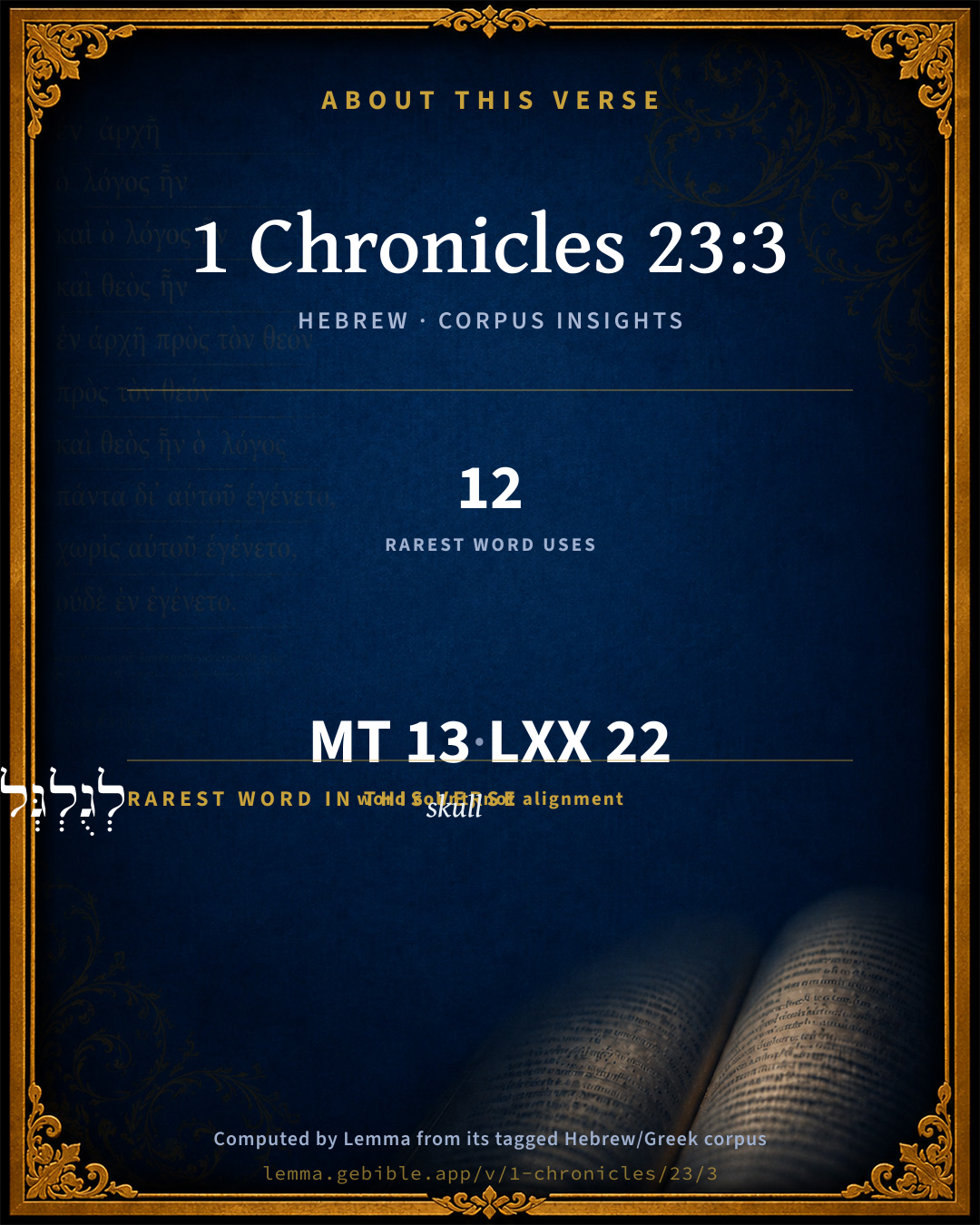
The rarest word here is לְגֻלְגְּלֹתָם֙ skull H1538 — appearing just 12 times in the whole Hebrew Bible.

Shared distinctive vocabulary

לְגֻלְגְּלֹתָם֙ skull H1538 occurs in 12 verses of the Hebrew Bible. Also found in:

Grammatical profile

  • 2 verbs
  • 6 nouns
  • 4 adjectives
  • 1 adverb

Verb forms

  • וַיִּסָּֽפְרוּ֙ Niphal · Sequential Imperfect
  • וַיְהִ֨י Qal · Sequential Imperfect

Repetition

A word recurs within this verse — often emphatic in Hebrew:

  • שְׁלֹשִׁ֥ים thirty H7970 ×2

Hebrew & Septuagint length

In English translation the verse runs 22 words from the Hebrew and 24 from the Septuagint (LXX English) — closely comparable.

A rough comparison of the two English renderings, which tokenize alike — not a word-level alignment.

Word counts can differ between the Hebrew and the Greek without any difference in meaning — e.g. the Hebrew direct-object marker אֵת has no separate Greek word, and Greek often adds the article ὁ.

In the original languages it is 13 Hebrew tokens and 22 Greek tokens — but the two are counted differently (Hebrew bundles its prefixes and suffixes into one token; the Greek is in lemma form), so that isn’t a like-for-like length.

Cross-references

2

Topical passages linked to 1 Chronicles 23:3 in the Treasury of Scripture Knowledge — connected by theme and wording, ordered by reader-vote popularity; previews shown in the World English Bible.

  • 1 Chronicles 23:24 These were the sons of Levi after their fathers' houses, even the heads of the fathers' [houses] of those of those who were counted, in the number of names by their polls, who did the work for the service of the house of Yahweh, from twenty years old and upward.
  • Numbers 4:2–49 "Take a census of the sons of Kohath from among the sons of Levi, by their families, by their fathers' houses,

Cross-references courtesy of OpenBible.info (CC BY 4.0).

Hebrew and Greek witnesses Masoretic Hebrew ↔ Greek Septuagint

The same verse in the two great witnesses to the Old Testament, shown verse-for-verse.

These are two independent witnesses, not word-aligned to each other, and the Septuagint is shown in lemma (dictionary) form.

Hebrew 1 Chronicles 23:3 Masoretic · Westminster Leningrad Codex

וַיִּסָּֽפְרוּ֙ הַלְוִיִּ֔ם מִבֶּ֛ן שְׁלֹשִׁ֥ים שָׁנָ֖ה וָמָ֑עְלָה וַיְהִ֨י מִסְפָּרָ֤ם לְגֻלְגְּלֹתָם֙ לִגְבָרִ֔ים שְׁלֹשִׁ֥ים וּשְׁמוֹנָ֖ה אָֽלֶף

The Levites were numbered from thirty years old and upward: and their number by their polls, man by man, was thirty-eight thousand.

World English Bible · Public Domain

Greek LXX 1 Chronicles 23:3 Septuagint · lemma form

καί ἀριθμέω ὁ λευίτης ἀπό τριακονταετός καί ἐπάνω καί γίγνομαι ὁ ἀριθμός αὐτός κατά κεφαλή αὐτός εἰς ἀνήρ τριάκοντα καί ὀκτώ χιλιάς

And the Levites numbered themselves from thirty years old and upward; and their number by their polls amounted to thirty and eight thousand men.

LXX2012 (modern English Septuagint) · Public Domain

Hebrew: Westminster Leningrad Codex (CC BY 4.0). Greek: Septuagint (public domain); English from LXX2012 (modern English Septuagint) (Public Domain). How the Septuagint differs from the Hebrew →

Commentary

Notes on 1 Chronicles 23:3 from classic Christian and Jewish commentators (each source and its license shown beneath its notes). The classic Christian expositions comment on the surrounding passage and are grouped to its opening verse, so a note may address several verses; the Jewish commentaries on the Tanakh (Rashi and others) are per-verse, so they appear only where the commentator wrote on this verse.

Lemma curates 59 commentaries, every one of them public domain or Creative Commons licensed, each selected and text-cleaned for this edition rather than reprinted as found. About our sources →

Trapp's Complete Commentary

John Trapp

1Ch 23:3 Now the Levites were numbered from the age of thirty years and upward: and their number by their polls, man by man, was thirty and eight thousand.

Ver. 3. Now the Levites were numbered.] Not as the people had been, {1Ch 21:5-6} out of curiosity and vainglory: but on piety and prudence, and by a divine instinct.

John Trapp, A Commentary or Exposition upon All the Books of the Old and New Testament (1647–1656) — public domain. Text from a community e-Sword module.

Joseph Benson's Commentary

1Ch 23:3. From the age of thirty years and upward — Not only till fifty, as it was appointed Num 4:2-3, but even till their death: for that was but a temporary law grounded upon a special reason, because the Levites were employed in carrying the tabernacle and sacred vessels from place to place; and therefore God would have them freed from those burdens when they came to feel the infirmities of age: which reason wholly ceasing upon the building of the temple, their work being far easier than it had been, and their service being more a privilege than a burden, their time of service is justly prolonged.

Joseph Benson's Commentary on the Old and New Testaments (1811–1818) — public domain. Text from a community e-Sword module.

Tyndale Open Study Notes

Tyndale Open Resources

23:3-5 The Levites are recorded according to their roles rather than their families.

Tyndale Open Study Notes — © Tyndale Open Resources, licensed CC BY-SA 4.0. Text via the HelloAO Bible API.

Jamieson, Fausset & Brown

Robert Jamieson, A. R. Fausset & David Brown

the Levites were numbered . . . thirty and eight thousand--Four times their number at the early census taken by Moses (see on Num. 4:1-49; Num. 26:1-51). It was, in all likelihood, this vast increase that suggested and rendered expedient that classification, made in the last year of David's reign, which the present and three subsequent chapters describe.

by their polls, man by man--Women and children were not included.

Jamieson, Fausset & Brown — Commentary Critical and Explanatory on the Whole Bible (1871) — public domain (CC PDM 1.0). Text via the HelloAO Bible API.

Adam Clarke's Commentary

Verse 3. Thirty years and upward] The enumeration of the Levites made in the desert, Nu 4:3, was from thirty years upwards to fifty years. In this place, the latter limit is not mentioned, probably because the service was not so laborious now; for the ark being fixed they had no longer any heavy burdens to carry, and therefore even an old man might continue to serve the tabernacle. David made another ordinance afterwards; see on 1Ch 23:24; 1Ch 23:27.

Adam Clarke's Commentary on the Bible (1810–1826) — public domain. Text from a community e-Sword/MySword module.

Ellicott's Commentary for English Readers

(3) Now . . . and—i.e., after the council had agreed upon it.

The Levites were numbered from the age of thirty years and upward.—A census like that which Moses instituted (Num_4:3; Num_4:23; Num_4:30, &c.), of all Levites “from thirty years old and upward unto fifty years,” for the work of the Tabernacle.

By their polls, man by man.—Lit., As to their skulls, as to men. The second phrase defines the first, and excludes women and children.

A Bible Commentary for English Readers, edited by Charles John Ellicott (1878–1897) — public domain. Text from a community e-Sword module.

The Cambridge Bible for Schools and Colleges

gen. ed. J. J. S. Perowne

3. by their polls] Lit. by their skulls. “Poll” is an almost obsolete word for “head,” retained in the compound word, “poll-tax.”

thirty and eight thousand] A great increase since the time of Moses; the males from a month old and upwards are reckoned at 22,000 in Num_3:39 and at 23,000 in Num_26:62.

The Cambridge Bible for Schools and Colleges (gen. ed. J. J. S. Perowne; Cambridge University Press, 1878–1918) — public domain. Text from a community e-Sword module.

John Gill's Exposition

Now the Levites were numbered from the age of thirty years, and upward,.... So they were numbered in the days of Moses, and by his order, and so they were now at first; though afterwards there was a new reckoning of them, Ch1 23:24.

and their number by their posts; or, according to their heads:

man by man, was thirty and eight thousand; which vastly exceeds the number in the times of Moses; see Num 4:47, but then those above fifty years of age were not numbered, as they now might; since their work in the temple would be much more easy, no burdens to carry, as the ark, the vessels, &c.

John Gill's Exposition of the Whole Bible (1746–1763) — public domain (CC PDM 1.0). Text via the HelloAO Bible API.

Haydock's Catholic Bible Commentary

Numbered at the same time, when David caused his son to be crowned, and made these fresh regulations, ver. 27., and chap. xxvi. 31. --- Upwards, according to the plan given by Moses. David afterwards ordered people of twenty years of age, to begin to serve in the tabernacle, as it was now fixed, and consequently the labours were diminished. This tended to augment the splendour of the religious worship, and to edify the people, who could not attend so constantly, in person.

George Leo Haydock (1774–1849), Haydock's Catholic Family Bible and Commentary, 1859 edition — public domain. Excludes Psalms (Douay-Rheims chapter numbering differs from Protestant) and Deuterocanonical books (Catholic canon only).

Matthew Poole's English Annotations

From the age of thirty years and upward; not only till fifty, as it was appointed, Num 4:2,3, but even till their death; for that was but a temporary law grounded upon a special reason, because the Levites were employed in carrying the tabernacle and sacred vessels from place to place; and therefore God would have them freed from those burdens when they came to feel the infirmities of age; which reason wholly ceasing upon the building of the temple, and their work being far easier than it had been, and their service being more a privilege than a burden, their time of service is justly and fitly prolonged.

Matthew Poole's English Annotations on the Holy Bible (1683–1685) — public domain. Text from a community e-Sword/MySword module.

The Pulpit Commentary

Now the Levites were numbered from the age of thirty years and upward. The thing which Joab had rightly resisted (1Ch_21:3-6) and shrunk from doing was now rightly done. There was now a practical and a legitimate object for doing it. This consideration helps to determine what it was that "displeased the Lord" in the former general census of David. In connection with this clause, 1Ch_27:23 should be noted, where we read, "But David took not the number ofthem from twenty years old and under: because the Lord had said he would increase Israel like to the stars of the heavens." The period from the age of thirty years up to fifty (Num_4:3, Num_4:23, Num_4:35, Num_4:39) was fixed under Moses, for those "that came to do the service of the ministry, and the service of the burden in the tabernacle of the congregation". (Num_4:47) It is not certain, however, that this census did not inquire, in point of fact, respecting some below this limit of age. For we may note ver. 24 in the first place, and this is partly explained by Num_8:23-25. The number "thirty and eight thousand" of our present verse may be compared with the "eight thousand and five hundred and four score" of Num_4:47, Num_4:48. It is to be observed how promptly the national council did on this occasion commence with the arrangement of the ministers of religion, "the Levites." As we read (Num_4:3) of "thirty years" of age as the appointed age for the commencement of their ministry, and (Num_7:3) of the present or "offering" of "six covered waggons and twelve oxen," which the twelve "princes of Israel, heads of the house of their fathers, princes of the tribes," offered "before the Lord," which greatly lessened the laborious work of the Levites; so we find the commencing age reduced from time to time, to "twenty-five" years, (Num_8:24) and to "twenty years" of age, as in our present chapter (vers. 24-28).

Vers. 3-32.

The sacred tribe: their service and ours.

We have here

I THE SPECIAL SERVICE WHICH THE LEVITES RENDERED TO ISRAEL. This was four-fold.

1. Assisting at the service of sacrifice. They were "to set forward the workof the house of the Lord" (ver. 4); "their office was to wait on the sons of Aaron for the service of the house of the Lord," etc. (vers. 28, 29); "to offer i.e. to help at the offering of all burnt sacrifices," etc. (vers. 31, 32).

2. Rendering the service of praise. "Four thousand of them praised theLord," etc. (ver. 5). These were to stand every morning and evening to thank and praise the Lord (ver. 30).

3. Administration of civic business and pacification: "officers and judges"(ver. 4).

4. Guardianship of the gates; preserving from profanation, and so fromDivine displeasure: "porters," i.e. gatekeepers (ver. 5).

II THE CHANGES WHICH OCCUR IN THE FORM OF SERVICE. Even under the same dispensation occasional changes occurred of the way in which God was served. An instance and indication of this is found here. The Levites had no more need to carry the tabernacle from place to place; they thus laid down one of their most solemn and important functions (vers. 25, 26). They were also henceforth to be numbered from twenty (instead of thirty) years of age (vers. 27, 28). And, further, they entered now on the service of instrumental music, systematically arranged (vers. 5, 30). If such minor changes occurred in the same era of religions history, how much greater changes in the order of service might we expect to find when one dispensation gave place to another, when the Law was lost in the gospel? Such we do find. We look, therefore, at

III OUR CORRESPONDING SERVICE UNDER CHRIST.

1. In the matter of sacrifice, the Levites cannot properly be said to haveany successors; for, the one all-sufficient atonement having been offered, there is no sacrifice to be presented, and, there being no officiating priest and no altar "in Christ Jesus," there is needed no ministering Levite. Only that we are all to be priests and Levites in that we are all to present "spiritual sacrifices" of prayer and praise, and of "doing good and communicating," continually unto him. However, there are humbler services to be rendered, needful work to be done, "for the service of the house of the Lord" (ver. 24); and in this useful and worthy ministry, those who take their part cheerfully and do their work faithfully are "approved of him.

2. In the matter of praise, the Levites find their successors in

(1) those who teach and lead in the service of song in the Christian sanctuary;

(2) all who join in and thus encourage others in that service. And they who do their best to perfect the praises of God understanding by that not only attaining to the perfect scientific form of service, but reaching the moral and spiritual ideal of a service in which the music of the instrument and of the voice is subordinated to the melody of the heart, (Eph_5:19) these render an invaluable ministry to the Church of Christ.

1. In respect of administration (officers and judges), as ecclesiastical lawhas given place to civil law, this function of Jehovah"s servants has passed into other hands; yet perhaps they who are peacemakers between their

2. fellows and help to decide disputes between brethren may be said to be the "judges" of the present time.

0. As to guardianship of the gates, with the open throne of grace andaccess at all times to all men, there is little room for us to perpetuate this work of the Levite. But we can, and should, take great pains to preserve the spirit of reverence and pure devotion in the hearts of all who come to worship Christ. C. Consecrated maturity.

On the occasion of the "census," the tribe of Levi had not been taken. A special enumeration of them was now made, and the pattern of the Mosaic census was followed. Those at the age of thirty and above, but under fifty, alone were numbered. But the years from thirty to fifty represent and include a man"s maturity; and, in the case of the Levites, this their maturity lay as a "living sacrifice" on the altar of God"s service. It appears that our Lord began his ministry at the age of thirty. But "who shall declare his generation? For he was cut off out of the land of the living; for the transgression of my people was he stricken." For probably at most three years of his maturity did he lie a "living sacrifice." Make the burden of address a serious and earnest plea that strong men should give the strength of their manhood to holy service for God in the Church and the world. It is the weakness of so many Christian institutions and enterprises . as it so notably is of our Sunday school system that the experienced men and women of middle life hold aloof from them. There have indeed been cases of precocious development before the age of thirty; and we may not, even in our theories or our thoughts, set limits to the gloriously free operations of that Divine Spirit who "divides to every man severally as he wills." Still, the general rule, comprehensively working, is that full culture including something like adequate experience and due self-control is not reached before that age. F.W. Robertson, A. Hallam, R. A. Vaughan, are very familiar illustrations of early maturity. It is also true that there is a limit all too soon reached in most cases to a man"s freshness, power, and originality. A man reaches maturity, and may maintain it awhile; but the time of strong and individual force for any man is usually very brief. No doubt there are cases of strength retained beyond the age of fifty; and there is suitable work in the world for the older men to do. But still, it is in large measure true that a man"s distinct life-witness and life-work are very brief a few swiftly passing years. When they are done he either passes fromthe earth-spheres, or else he must step aside lest he be run down by the hurrying throng who go so much faster than he can go, and who, he begins to think, are going wrong. A man"s strong manhood is his great trust, and this must be for the Lord, wholly consecrated unto him. Then it may be earnestly pressed upon us that

I WE SHOULD ESTIMATE ARIGHT THE PREPARING-TIMES OF LIFE: the spring-times, on which depends the summer beauty; the seedtime, on which depends the autumn harvest; the child-time, on which depends wise fatherhood; the apprenticeship-time, on which depend the business successes.

II WE SHOULD FEEL THE RESPONSIBILITY OF MATURE TIMES: when we can put strength, good judgment, cultured skill, ripe powers, into whatever work we undertake. It is often pressed on our attention that we are responsible for what we have; it may be much more earnestly impressed upon us that we are responsible for what we are or can be.

III WE SHOULD ACCEPT THE PROVIDENCES THAT SET US ASIDE FOR RESTING-TIMES. Some such come in the midst of life"s works for our refreshing. Such come at last when our great life-work is done. We may be spared awhile in the Beulah-land, but in our resting-times we have new and other missions to fulfil. Alas! it takes much grace to make us willing to step quietly aside, and say of the new generation growing up round us, "He must increase, but I must decrease.

In the mystery of the Divine order the later and resting-times of a man"s life may be preparings for the consecrated maturities of the heavenly and eternal spheres. R.T.

The Pulpit Commentary (1880–1919), ed. H.D.M. Spence-Jones & Joseph S. Exell — public domain. Text from a community e-Sword module.

John Wesley's Explanatory Notes

Upwards - Not only 'till fifty, as it was appointed, Num. iv, 2, 3, but even 'till their death: for that was but a temporary law grounded upon a special reason, because the Levites were employed in carrying the tabernacle and sacred vessels from place to place; and therefore God would have them freed from those burdens when they came to feel the infirmities of age: which reason wholly ceasing upon the building of the temple, their work being far easier than it had been, and their service being more a privilege than a burden, their time of service is justly prolonged.

John Wesley, Explanatory Notes Upon the Whole Bible (1754–1765) — public domain. Text via the GEBible commentary corpus.

Keil & Delitzsch

C. F. Keil & F. Delitzsch

Now the Levites were numbered from the age of thirty years, and upward,.... So they were numbered in the days of Moses, and by his order, and so they were now at first; though afterwards there was a new reckoning of them, Ch1 23:24.

and their number by their posts; or, according to their heads:

man by man, was thirty and eight thousand; which vastly exceeds the number in the times of Moses; see Num 4:47, but then those above fifty years of age were not numbered, as they now might; since their work in the temple would be much more easy, no burdens to carry, as the ark, the vessels, &c.

Keil & Delitzsch — Biblical Commentary on the Old Testament (1861–1891) — public domain (CC PDM 1.0). Text via the HelloAO Bible API. (Old Testament only.)

Lesson kit

Teaching starters — assembled from the data on this page, not authored interpretation. Every prompt links to the verse data it draws on. Edit before teaching.

1 Chronicles, in the Historical, opens this verse with 13 words (12 distinct Hebrew lemmas). Its most distinctive word is gulgôleth (“skull”). A historical commentator’s framing appears above. Read the whole chapter for the surrounding context.

Discussion questions

  1. What does “skull” (gulgôleth) contribute to the verse as a whole?
  2. How does Exodus 16:16, which shares the word «skull», read alongside this verse?
  3. What does the repetition of “thirty” (2× in this one verse) do in this verse?
  4. The translations on this page render this verse differently — a whole-verse word diff, not a word-by-word alignment. What might account for the different wordings?
  5. «וַיִּסָּֽפְרוּ֙» is a Niphal Sequential Imperfect verb. How does that grammatical form shape the action described?
  6. Compare how Trapp's Complete Commentary and Joseph Benson's Commentary read this verse. Where do they agree or differ?

Things to notice

Reading settings

Reading text

Shown beneath each verse's original-language words.

Old Testament
Old Testament edition

Read the OT as the Masoretic Hebrew (MT) or the Greek Septuagint (LXX).

English shown for the Greek Septuagint (in the Hebrew ↔ Greek comparison).

Comparing translations? Open the Compare panel on any verse page to stack up to four side by side.