
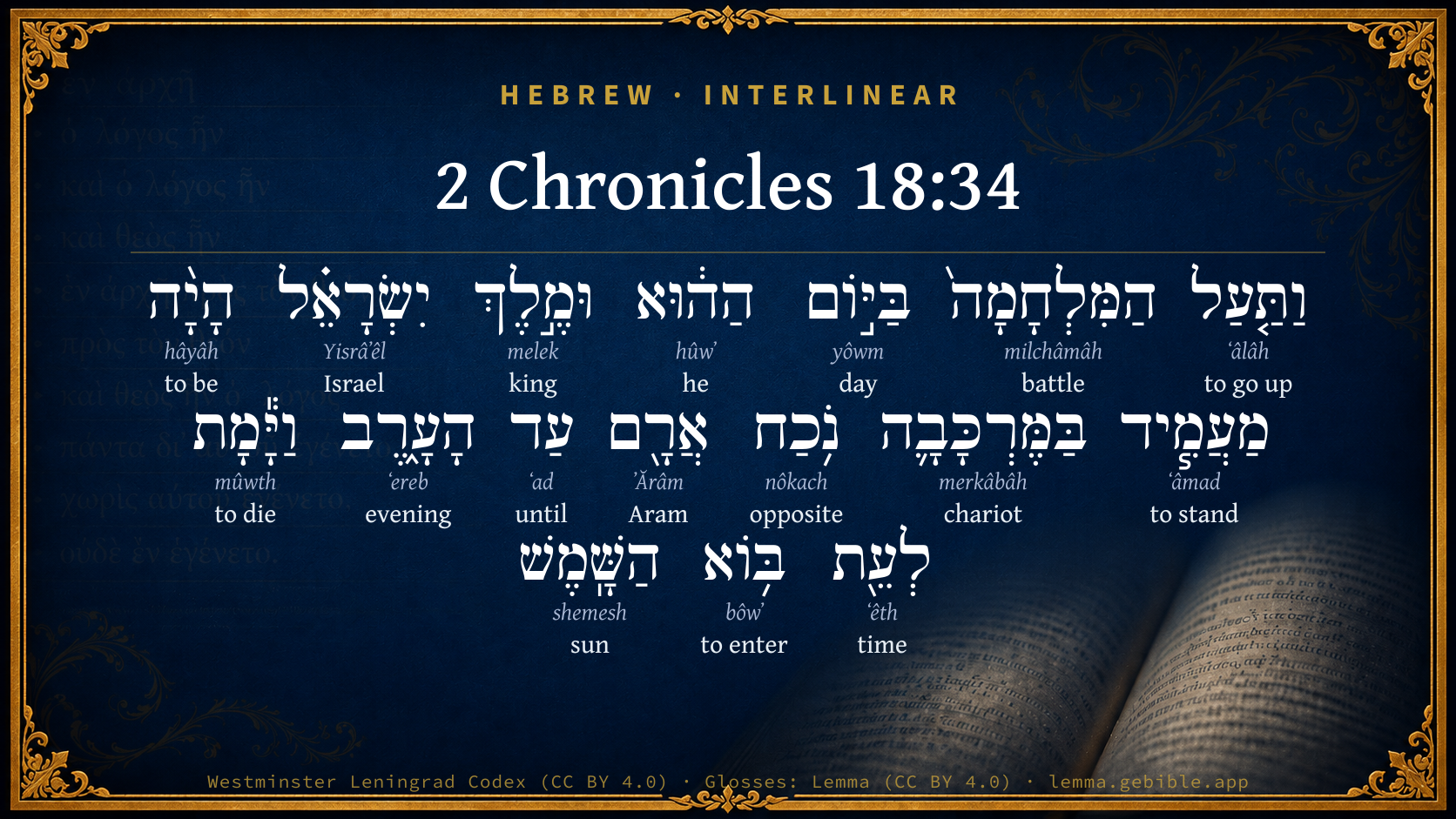
2 Chronicles 18:34

Hebrew (Westminster Leningrad Codex) 2 Chronicles 18:34 appears in the Hebrew Old Testament. The text above is from the Westminster Leningrad Codex. Each word links to its Strong’s number, a concise gloss, and parsing drawn from the Open Scriptures Hebrew Bible morphology. Click any word for its full Brown-Driver-Briggs (BDB) entry.
Download image
Cite this verse

2 Chronicles 18:34 (World English Bible). Public Domain. Lemma interlinear Bible study tool, https://lemma.gebible.app/v/2-chronicles/18/34.

Show BibTeX & RIS
BibTeX
RIS
English Translation
The battle increased that day: however the king of Israel stayed himself up in his chariot against the Syrians until the even; and about the time of the going down of the sun he died.
World English Bible · Public Domain
Download a study sheet

One document with this verse’s original text, its word-by-word gloss line, the meaning frame, cross-references with their text, attributed commentary, and full source and license credits — printable, and it pastes into notes with its structure intact.

This verse Autodidact and up

Study sheet (.html) Plain text (.txt)

A passage Seminary Student

Up to 50 verses in one chapter. A passage sheet keeps up to 6 commentary sources and 12 cross-references per verse, in the order this page ranks them, and says so on the sheet whenever that leaves anything out. Ask for a single verse and you get the Autodidact verse sheet above.

Everything on this page stays free to read, with no account — the sheet is a download of what is already on screen, not access to it.

Want to remove ads? Support Godless Engineer
Compare translations 3

The same verse in 3 English versions, stacked beneath the original-language interlinear above. Click any original word for its lexicon entry.

Each is an independent rendering of the whole verse — the interlinear is not word-aligned to these translations.

Highlighted words mark where these versions differ — a whole-verse word diff, not a word-by-word alignment.

  • World English Bible Public Domain
    The battle increased that day: however the king of Israel stayed himself up in his chariot against the Syrians until the even; and about the time of the going down of the sun he died.
  • King James Version Public Domain
    And the battle increased that day: howbeit the king of Israel stayed himself up in his chariot against the Syrians until the even: and about the time of the sun going down he died.
  • unfoldingWord Literal Text CC BY-SA 4.0
    And the battle went up that day, and the king of Israel was set up in the chariot opposite Aram until the evening. And he died at the time of the going of the sun.

unfoldingWord Literal Text — © unfoldingWord, licensed CC BY-SA 4.0. Word-aligned USFM3 via Door43 (git.door43.org/unfoldingWord/en_ult).

Versions to compare (up to 4)

3 of 4 selected

Show all 18 translations

Every available English version of this verse, each an independent rendering of the whole verse.

  • World English Bible Public Domain
    The battle increased that day: however the king of Israel stayed himself up in his chariot against the Syrians until the even; and about the time of the going down of the sun he died.
  • Berean Standard Bible Public Domain
    The battle raged throughout that day, and the king of Israel propped himself up in his chariot facing the Arameans until evening. And at sunset he died.
  • Majority Standard Bible Public Domain
    The battle raged throughout that day, and the king of Israel propped himself up in his chariot facing the Arameans until evening. And at sunset he died.
  • King James Version Public Domain
    And the battle increased that day: howbeit the king of Israel stayed himself up in his chariot against the Syrians until the even: and about the time of the sun going down he died.
  • American Standard Version (1901) Public Domain
    And the battle increased that day: howbeit the king of Israel stayed himself up in his chariot against the Syrians until the even; and about the time of the going down of the sun he died.
  • Revised Version (1885) Public Domain
    And the battle increased that day: howbeit the king of Israel stayed himself up in his chariot against the Syrians until the even: and about the time of the going down of the sun he died.
  • Geneva Bible (1599) Public Domain
    And the battel increased that day: and the King of Israel stood still in his charet against the Aramites vntil euen, and dyed at the time of the sunne going downe.
  • Douay-Rheims (1899) Public Domain
    And the fight was ended that day: but the king of Israel stood in his chariot against the Syrians until the evening, and died at the sunset.
  • Young's Literal Translation Public Domain
    And the battle increaseth on that day, and the king of Israel hath been stayed up in the chariot over-against Aram till the evening, and he dieth at the time of the going in of the sun.
  • Literal Standard Version CC BY-SA 4.0
    And the battle increases on that day, and the king of Israel has been propped up in the chariot in front of Aram until the evening, and he dies at the time of the going in of the sun.
  • Unlocked Literal Bible CC BY-SA 4.0
    The battle grew worse that day, and the king of Israel was held up in his chariot facing the Arameans until the evening. About the time that the sun was going down, he died.
  • unfoldingWord Literal Text CC BY-SA 4.0
    And the battle went up that day, and the king of Israel was set up in the chariot opposite Aram until the evening. And he died at the time of the going of the sun.
  • Darby Bible Public Domain
    And the battle increased that day; and the king of Israel stayed himself up in his chariot against the Syrians until the even; and about the time of the going down of the sun he died.
  • World Messianic Bible Public Domain
    The battle increased that day. However, the king of Israel propped himself up in his chariot against the Syrians until the evening; and at about sunset, he died.
  • Webster's Bible Public Domain
    And the battle increased that day: yet the king of Israel supported himself in his chariot against the Syrians until the evening: and about the time of the sun setting he died.
  • Free Bible Version CC BY-SA 4.0
    The battle lasted all day. The king of Israel propped himself up in his chariot to face the Arameans until the evening. But he died at sunset.
  • Bible in Basic English Public Domain
    But the fight became more violent while the day went on; and the king of Israel was supported in his war-carriage facing the Aramaeans till the evening; and by sundown he was dead.
  • JPS Tanakh (1917) Public Domain
    And the battle increased that day; howbeit the king of Israel stayed himself up in his chariot against the Arameans until the even; and about the time of the going down of the sun he died.

Literal Standard Version (2020), Covenant Press — licensed CC BY-SA 4.0. Text via the HelloAO Bible API (eBible.org). Unlocked Literal Bible (unfoldingWord) — licensed CC BY-SA 4.0. Text via the HelloAO Bible API (eBible.org). unfoldingWord Literal Text — © unfoldingWord, licensed CC BY-SA 4.0. Word-aligned USFM3 via Door43 (git.door43.org/unfoldingWord/en_ult). Free Bible Version, Dr. Jonathan Gallagher — licensed CC BY-SA 4.0. Text via the HelloAO Bible API (eBible.org).

Word by word

More ways to search: Search by grammar → Find every occurrence → Compare this word →

Practice this passage: Drill this verse → Learn its vocabulary →

נֹ֥כַח
nôkach
H5227
“opposite”
Preposition
Part of Speech
Preposition
Full BDB Definition

Origin: from the same as H5226

TWOT: 1365a

be in front of - in front of, opposite to, in the sight of, before, to the front, right on - towards the front of, in front of, on behalf of, as far as in front of
  1. וַתַּ֤עַל ʻâlâh H5927 “and · to go up” Conjunction + Verb, Qal, Sequential Imperfect, 3rd Person, Feminine, Singular
  2. הַמִּלְחָמָה֙ milchâmâh H4421 “the · battle” Particle, Definite Article + Noun, Common, Feminine, Singular, Absolute
  3. בַּיּ֣וֹם yôwm H3117 “in/at the · day” Preposition, Determined + Noun, Common, Masculine, Singular, Absolute
  4. הַה֔וּא hûwʼ H1931 “the · he” Particle, Definite Article + Pronoun, Personal, 3rd Person, Masculine, Singular
  5. וּמֶ֣לֶךְ melek H4428 “and · king of” Conjunction + Noun, Common, Masculine, Singular, Construct
  6. יִשְׂרָאֵ֗ל Yisrâʼêl H3478 “Israel” Noun, Proper
  7. הָיָ֨ה hâyâh H1961 “to be” Verb, Qal, Perfect, 3rd Person, Masculine, Singular
  8. מַעֲמִ֧יד ʻâmad H5975 “standing” Verb, Hiphil, Participle Active, Masculine, Singular, Absolute
  9. בַּמֶּרְכָּבָ֛ה merkâbâh H4818 “in/at the · chariot” Preposition, Determined + Noun, Common, Feminine, Singular, Absolute
  10. אֲרָ֖ם ʼĂrâm H758 “Aram” Noun, Proper
  11. עַד ʻad H5704 “until” Preposition
  12. הָעָ֑רֶב ʻereb H6153 “the · evening” Particle, Definite Article + Noun, Common, Masculine, Singular, Absolute
  13. וַיָּ֕מָת mûwth H4191 “and · to die” Conjunction + Verb, Qal, Sequential Imperfect, 3rd Person, Masculine, Singular
  14. לְעֵ֖ת ʻêth H6256 “to/for · time” Preposition + Noun, Common, Both, Singular, Absolute
  15. בּ֥וֹא bôwʼ H935 “to enter” Verb, Qal, Infinitive Construct
  16. הַשָּֽׁמֶשׁ shemesh H8121 “the · sun” Particle, Definite Article + Noun, Common, Both, Singular, Absolute

About this verse

These counts appear in no published source. They are computed here, from the morphology-tagged text and Lemma’s own curated glosses. What Lemma adds →

17
words
17
distinct lemmas
Historical
section

Notable vocabulary

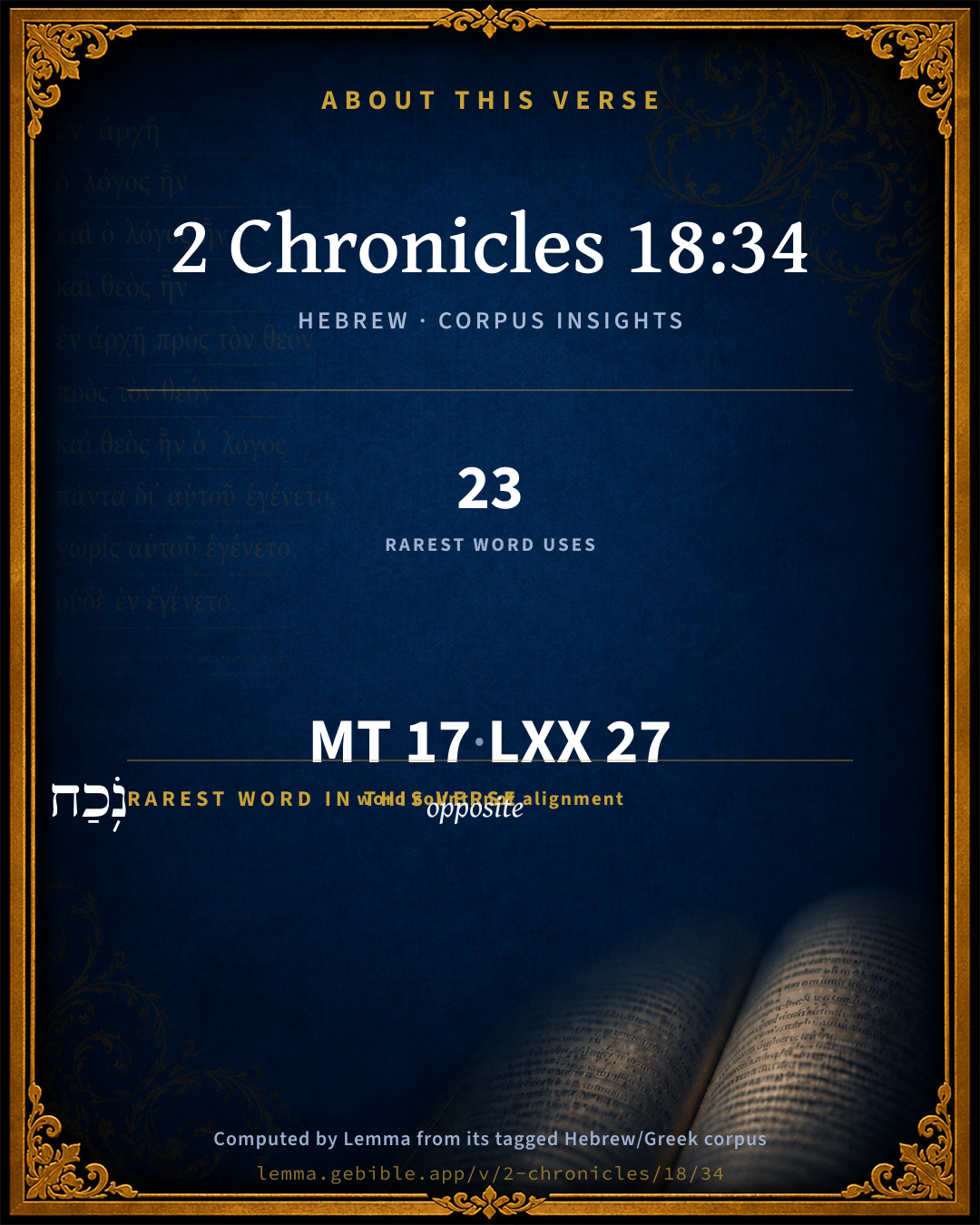
The rarest word here is נֹ֥כַח opposite H5227 — appearing just 23 times in the whole Hebrew Bible.

Shared distinctive vocabulary

נֹ֥כַח opposite H5227 occurs in 22 verses of the Hebrew Bible. Also found in:

Grammatical profile

  • 5 verbs
  • 9 nouns
  • 1 pronoun
  • 2 prepositions

Verb forms

  • וַתַּ֤עַל Qal · Sequential Imperfect
  • הָיָ֨ה Qal · Perfect
  • מַעֲמִ֧יד Hiphil · Participle Active
  • וַיָּ֕מָת Qal · Sequential Imperfect
  • בּ֥וֹא Qal · Infinitive Construct

Hebrew & Septuagint length

In English translation the verse runs 35 words from the Hebrew and 24 from the Septuagint (LXX English) — the Septuagint runs noticeably shorter here. See the side-by-side →

A rough comparison of the two English renderings, which tokenize alike — not a word-level alignment.

Word counts can differ between the Hebrew and the Greek without any difference in meaning — e.g. the Hebrew direct-object marker אֵת has no separate Greek word, and Greek often adds the article ὁ.

In the original languages it is 17 Hebrew tokens and 27 Greek tokens — but the two are counted differently (Hebrew bundles its prefixes and suffixes into one token; the Greek is in lemma form), so that isn’t a like-for-like length.

Cross-references

6

Topical passages linked to 2 Chronicles 18:34 in the Treasury of Scripture Knowledge — connected by theme and wording, ordered by reader-vote popularity; previews shown in the World English Bible.

  • Proverbs 13:21 Misfortune pursues sinners, But prosperity rewards the righteous.
  • Numbers 32:23 But if you will not do so, behold, you have sinned against Yahweh; and be sure your sin will find you out.
  • 2 Chronicles 18:16 He said, I saw all Israel scattered on the mountains, as sheep that have no shepherd: and Yahweh said, These have no master; let them return every man to his house in peace.
  • 2 Chronicles 18:19 Yahweh said, Who shall entice Ahab king of Israel, that he may go up and fall at Ramoth-gilead? One spoke saying after this manner, and another saying after that manner.
  • 2 Chronicles 18:27 Micaiah said, If you return at all in peace, Yahweh has not spoken by me. He said, Hear, you peoples, all of you.
  • Proverbs 28:17 A man who is tormented by life blood will be a fugitive until death; No one will support him.

Cross-references courtesy of OpenBible.info (CC BY 4.0).

Hebrew and Greek witnesses Masoretic Hebrew ↔ Greek Septuagint

The same verse in the two great witnesses to the Old Testament, shown verse-for-verse.

Here the Septuagint runs noticeably shorter than the Hebrew — LXX2012 (modern English Septuagint) 24 words vs World English Bible 35. A rough length comparison of the two English translations, not a word-level alignment — read both below.

These are two independent witnesses, not word-aligned to each other, and the Septuagint is shown in lemma (dictionary) form.

Hebrew 2 Chronicles 18:34 Masoretic · Westminster Leningrad Codex

וַתַּ֤עַל הַמִּלְחָמָה֙ בַּיּ֣וֹם הַה֔וּא וּמֶ֣לֶךְ יִשְׂרָאֵ֗ל הָיָ֨ה מַעֲמִ֧יד בַּמֶּרְכָּבָ֛ה נֹ֥כַח אֲרָ֖ם עַד הָעָ֑רֶב וַיָּ֕מָת לְעֵ֖ת בּ֥וֹא הַשָּֽׁמֶשׁ

The battle increased that day: however the king of Israel stayed himself up in his chariot against the Syrians until the even; and about the time of the going down of the sun he died.

World English Bible · Public Domain

Greek LXX 2 Chronicles 18:34 Septuagint · lemma form

καί τροπόω ὁ πόλεμος ἐν ὁ ἡμέρα ἐκεῖνος καί ὁ βασιλεύς ἰσραήλ εἰμί ἵστημι ἐπί ὁ ἅρμα ἕως ἑσπέρα ἐκ ἐναντίος συρία καί ἀποθνήσκω δύω ὁ ἥλιος

And the battle turned in that day; and the king of Israel remained on the chariot against Syria until evening, and died at sunset.

LXX2012 (modern English Septuagint) · Public Domain

Hebrew: Westminster Leningrad Codex (CC BY 4.0). Greek: Septuagint (public domain); English from LXX2012 (modern English Septuagint) (Public Domain). How the Septuagint differs from the Hebrew →

Commentary

Notes on 2 Chronicles 18:34 from classic Christian and Jewish commentators (each source and its license shown beneath its notes). The classic Christian expositions comment on the surrounding passage and are grouped to its opening verse, so a note may address several verses; the Jewish commentaries on the Tanakh (Rashi and others) are per-verse, so they appear only where the commentator wrote on this verse.

Lemma curates 59 commentaries, every one of them public domain or Creative Commons licensed, each selected and text-cleaned for this edition rather than reprinted as found. About our sources →

Trapp's Complete Commentary

John Trapp

2Ch 18:34 And the battle increased that day: howbeit the king of Israel stayed [himself] up in [his] chariot against the Syrians until the even: and about the time of the sun going down he died.

Ver. 34. About the time of the sun going down he died.] And so proved that a whole council - of false prophets especially - may err. Ahab might now have sent for Zedekiah, with his fellows, as Rodulphus Suevus did for the Popish bishops, who had put him on to take up arms against his master, the emperor, complaining of them at his death, that they had deceived him to his destruction, with the Popes,

"Petra dedit Petro, Petrus diadems Rodulpho."

John Trapp, A Commentary or Exposition upon All the Books of the Old and New Testament (1647–1656) — public domain. Text from a community e-Sword module.

Geneva Bible (1599)

Geneva Bible translators

He dissembled his hurt that his soldiers might fight more courageously.

Geneva Bible (1599) marginal notes — public domain. Text via Bolls.life.

Adam Clarke's Commentary

Verse 34. Stayed himself up - against the Syrians] There was a great deal of true personal courage and patriotism in this last act of the king of Israel: he well knew that if his troops found that he was mortally wounded, they would immediately give way, and the battle would not only be lost, but the slaughter would be great in the pursuit; therefore he stayed himself up till the evening, when the termination of the day must necessarily bring the battle to a close: and when this was done, the Israelites found that their king was slain, and so they left the field of battle to their foes. Thus Israel had a great loss, and the Syrians had got a great deliverance. Had it not been for this accident, the Syrians had probably been defeated. See on 1Kg 22:36.

IN the notes referred to above, the quibbling predictions of false prophets and lying oracles are mentioned, and several instances given; and the whole account of the lying spirit going forth from the Lord to deceive Ahab, particularly considered. See especially the notes as above on 2Ch 18:19; 2Ch 18:23-24.

The reader should never forget a truth so very frequently occurring in the Bible, that God is repeatedly represented as doing what, in the course of his providence, he only permits to be done.

Adam Clarke's Commentary on the Bible (1810–1826) — public domain. Text from a community e-Sword/MySword module.

Ellicott's Commentary for English Readers

(34) Increased.—Literally, went up, grew. (Comp. Gen_40:10; Amos 7, the growth of grass.)

Howbeit the king of Israel stayed himself up in his chariot.—Literally, and the king of Israel was (or, continued) holding himself up in the chariot, facing Aram, until the evening. 1Ki_22:35 reads: was held up in the chariot, &c, and he died in the evening. The reading of Chronicles is preferable, the sense being that Ahab bravely bore up against the pain of his wound, in order not to discourage his own side by retiring from the field. The rest of the narrative which tells of the return of the army and the washing of Ahab’s chariot at the pool of Samaria (1Ki_22:36-38) is omitted here, because Jehoshaphat was not concerned in it, and perhaps because the chronicler had a true perception of the real climax of this vivid story of the olden time.

A Bible Commentary for English Readers, edited by Charles John Ellicott (1878–1897) — public domain. Text from a community e-Sword module.

The Cambridge Bible for Schools and Colleges

gen. ed. J. J. S. Perowne

34. stayed himself up in his chariot] 1 Kin. was stayed up. The expression in Chron. probably means that Ahab by his continued presence on the field stayed his army from retreat until sundown. Ahab sustained his reputation as a good soldier (cp. 1Ki_20:14; 1Ki_22:31) to the last; his death caused the failure of the attack on Ramoth (1Ki_22:36).

of the sun going down] R.V. of the going down of the sun.

The Cambridge Bible for Schools and Colleges (gen. ed. J. J. S. Perowne; Cambridge University Press, 1878–1918) — public domain. Text from a community e-Sword module.

John Wesley's Explanatory Notes

He died - What can hurt those whom God will protect? And what can shelter those whom God will destroy? Jehoshaphat is saved in his robes; Ahab is killed in his armour!

John Wesley, Explanatory Notes Upon the Whole Bible (1754–1765) — public domain. Text via the GEBible commentary corpus.

Rashi

Rabbi Shlomo Yitzchaki (Rashi)

And the battle withdrew It withdrew, and not one of Israel was hurt except the king of Isra el, in accordance with the word of the prophet, (above verse 16): “These have no master. Let them return each one to his house in peace.” It does not say לְשָלוֹם, because Ahab was slain.

was standing in the chariot He exerted himself and stood up so that the Israelites should not realize that he was wounded and flee, for the beginning of defeat is fleeing.

Rashi on the Tanakh — English translations: “The Judaica Press complete Tanach with Rashi, translated by A. J. Rosenberg” (CC BY 4.0); “Pentateuch with Rashi's commentary by M. Rosenbaum and A.M. Silbermann, 1929-1934” (public domain); “The Metsudah Tanach series, Lakewood, N.J” (CC BY 4.0); and “The Book of Joshua, Metsudah Publications, 1997” (CC BY 4.0). Text via Sefaria.

Lesson kit

Teaching starters — assembled from the data on this page, not authored interpretation. Every prompt links to the verse data it draws on. Edit before teaching.

2 Chronicles, in the Historical, opens this verse with 17 words (17 distinct Hebrew lemmas). Its most distinctive word is nôkach (“opposite”). The Greek Septuagint runs shorter here. A historical commentator’s framing appears above. Read the whole chapter for the surrounding context.

Discussion questions

  1. How does “opposite” (nôkach) shape what this verse is saying?
  2. Genesis 25:21 shares the word «opposite» with this verse. How do the two illuminate each other?
  3. Compared with the Hebrew, the Septuagint runs shorter here. What questions does that raise?
  4. The translations on this page render this verse differently — a whole-verse word diff, not a word-by-word alignment. What might account for the different wordings?
  5. The verb «וַתַּ֤עַל» is Qal Sequential Imperfect. How does its form color the action?
  6. Reading how Trapp's Complete Commentary and Geneva Bible (1599) read this verse, where do the two commentators agree and where do they part?

Things to notice

Reading settings

Reading text

Shown beneath each verse's original-language words.

Old Testament
Old Testament edition

Read the OT as the Masoretic Hebrew (MT) or the Greek Septuagint (LXX).

English shown for the Greek Septuagint (in the Hebrew ↔ Greek comparison).

Comparing translations? Open the Compare panel on any verse page to stack up to four side by side.