
2 Chronicles 36:16

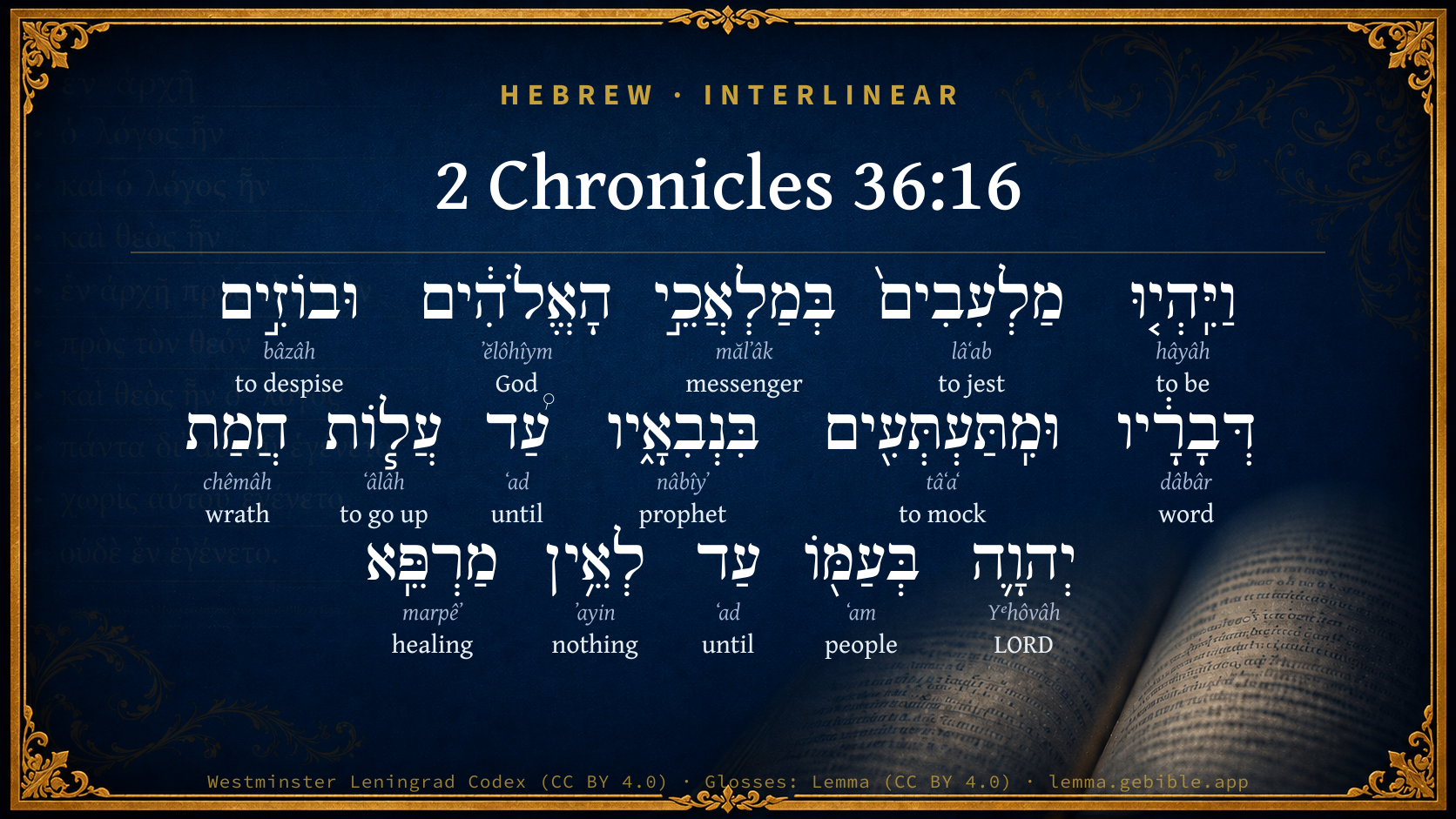
Hebrew (Westminster Leningrad Codex) 2 Chronicles 36:16 appears in the Hebrew Old Testament. The text above is from the Westminster Leningrad Codex. Each word links to its Strong’s number, a concise gloss, and parsing drawn from the Open Scriptures Hebrew Bible morphology. Click any word for its full Brown-Driver-Briggs (BDB) entry.
Download image
Cite this verse

2 Chronicles 36:16 (World English Bible). Public Domain. Lemma interlinear Bible study tool, https://lemma.gebible.app/v/2-chronicles/36/16.

Show BibTeX & RIS
BibTeX
RIS
English Translation
but they mocked the messengers of God, and despised his words, and scoffed at his prophets, until the wrath of Yahweh arose against his people, until there was no remedy.
World English Bible · Public Domain
Highlights
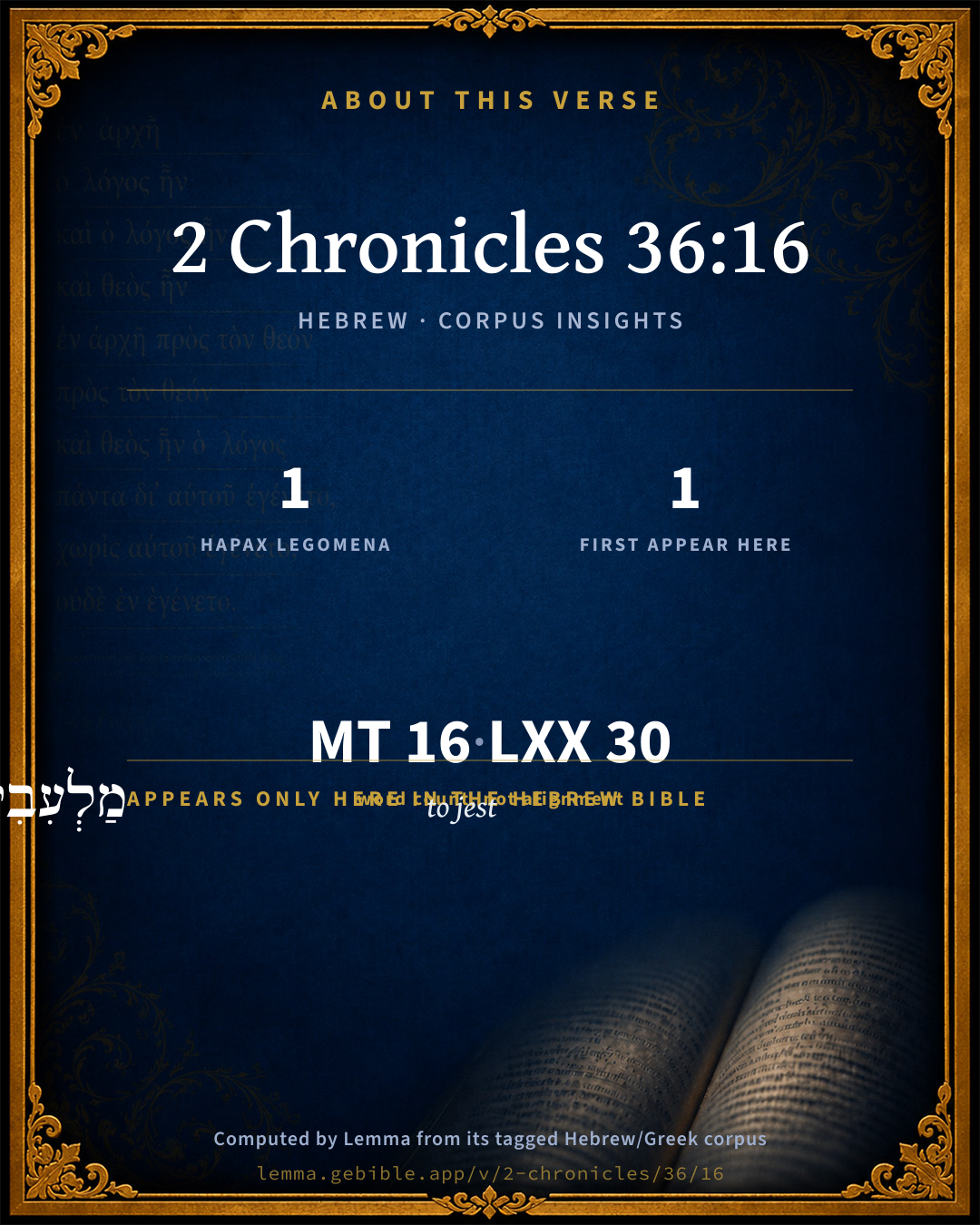
  • 1 hapax legomenon — only here in the Hebrew Bible
  • 1 first appearance in the Hebrew Bible
Full analysis ↓
Download a study sheet

One document with this verse’s original text, its word-by-word gloss line, the meaning frame, cross-references with their text, attributed commentary, and full source and license credits — printable, and it pastes into notes with its structure intact.

This verse Autodidact and up

Study sheet (.html) Plain text (.txt)

A passage Seminary Student

Up to 50 verses in one chapter. A passage sheet keeps up to 6 commentary sources and 12 cross-references per verse, in the order this page ranks them, and says so on the sheet whenever that leaves anything out. Ask for a single verse and you get the Autodidact verse sheet above.

Everything on this page stays free to read, with no account — the sheet is a download of what is already on screen, not access to it.

Want to remove ads? Support Godless Engineer
Compare translations 3

The same verse in 3 English versions, stacked beneath the original-language interlinear above. Click any original word for its lexicon entry.

Each is an independent rendering of the whole verse — the interlinear is not word-aligned to these translations.

Highlighted words mark where these versions differ — a whole-verse word diff, not a word-by-word alignment.

  • World English Bible Public Domain
    but they mocked the messengers of God, and despised his words, and scoffed at his prophets, until the wrath of Yahweh arose against his people, until there was no remedy.
  • King James Version Public Domain
    But they mocked the messengers of God, and despised his words, and misused his prophets, until the wrath of the LORD arose against his people, till there was no remedy.
  • unfoldingWord Literal Text CC BY-SA 4.0
    But they were deriding the messengers of God, and despising his words, and mocking his prophets, until the wrath of Yahweh went up against his people, until there was no healing.

unfoldingWord Literal Text — © unfoldingWord, licensed CC BY-SA 4.0. Word-aligned USFM3 via Door43 (git.door43.org/unfoldingWord/en_ult).

Versions to compare (up to 4)

3 of 4 selected

Show all 18 translations

Every available English version of this verse, each an independent rendering of the whole verse.

  • World English Bible Public Domain
    but they mocked the messengers of God, and despised his words, and scoffed at his prophets, until the wrath of Yahweh arose against his people, until there was no remedy.
  • Berean Standard Bible Public Domain
    But they mocked the messengers of God, despising His words and scoffing at His prophets, until the wrath of the LORD against His people was stirred up beyond remedy.
  • Majority Standard Bible Public Domain
    But they mocked the messengers of God, despising His words and scoffing at His prophets, until the wrath of the LORD against His people was stirred up beyond remedy.
  • King James Version Public Domain
    But they mocked the messengers of God, and despised his words, and misused his prophets, until the wrath of the LORD arose against his people, till there was no remedy.
  • American Standard Version (1901) Public Domain
    but they mocked the messengers of God, and despised his words, and scoffed at his prophets, until the wrath of Jehovah arose against his people, till there was no remedy.
  • Revised Version (1885) Public Domain
    but they mocked the messengers of God, and despised his words, and scoffed at his prophets, until the wrath of the LORD arose against his people, till there was no remedy.
  • Geneva Bible (1599) Public Domain
    But they mocked the messengers of God and despised his wordes, and misused his Prophets, vntill the wrath of the Lord arose against his people, and till there was no remedie.
  • Douay-Rheims (1899) Public Domain
    But they mocked the messengers of God, and despised his words, and misused the prophets, until the wrath of the Lord arose against his people, and there was no remedy.
  • Young's Literal Translation Public Domain
    and they are mocking at the messengers of God, and despising His words, and acting deceitfully with His prophets, till the going up of the fury of Jehovah against His people -- till there is no healing.
  • Literal Standard Version CC BY-SA 4.0
    but they are mocking at the messengers of God, and despising His words, and acting deceitfully with His prophets, until the going up of the fury of YHWH against His people—until there is no healing.
  • Unlocked Literal Bible CC BY-SA 4.0
    But they mocked God's messengers, despised his words, and scoffed at his prophets, until the wrath of Yahweh arose against his people, until there was no help for it.
  • unfoldingWord Literal Text CC BY-SA 4.0
    But they were deriding the messengers of God, and despising his words, and mocking his prophets, until the wrath of Yahweh went up against his people, until there was no healing.
  • Darby Bible Public Domain
    But they mocked at the messengers of God, and despised his words, and scoffed at his prophets, until the fury of Jehovah rose against his people, and there was no remedy.
  • World Messianic Bible Public Domain
    but they mocked the messengers of God, despised his words, and scoffed at his prophets, until the LORD’s wrath arose against his people, until there was no remedy.
  • Webster's Bible Public Domain
    But they mocked the messengers of God, and despised his words, and misused his prophets, until the wrath of the LORD arose against his people, till there was no remedy.
  • Free Bible Version CC BY-SA 4.0
    But they ridiculed God's messengers, they despised his warnings and mocked his prophets, until the Lord's anger against his people was provoked to such an extent it couldn't be stopped.
  • Bible in Basic English Public Domain
    But they put shame on the servants of God, making sport of his words and laughing at his prophets, till the wrath of God was moved against his people, till there was no help.
  • JPS Tanakh (1917) Public Domain
    but they mocked the messengers of God, and despised His words, and scoffed at His prophets, until the wrath of the LORD arose against His people, till there was no remedy.

Literal Standard Version (2020), Covenant Press — licensed CC BY-SA 4.0. Text via the HelloAO Bible API (eBible.org). Unlocked Literal Bible (unfoldingWord) — licensed CC BY-SA 4.0. Text via the HelloAO Bible API (eBible.org). unfoldingWord Literal Text — © unfoldingWord, licensed CC BY-SA 4.0. Word-aligned USFM3 via Door43 (git.door43.org/unfoldingWord/en_ult). Free Bible Version, Dr. Jonathan Gallagher — licensed CC BY-SA 4.0. Text via the HelloAO Bible API (eBible.org).

Word by word

More ways to search: Search by grammar → Find every occurrence → Compare this word →

Practice this passage: Drill this verse → Learn its vocabulary →

מַלְעִבִים֙
lâʻab
H3931
“jesting”
Verb, Hiphil, Participle Active, Masculine, Plural, Absolute
Part of Speech
Verb
Stem
Hiphil
Form
Participle Active
Gender
Masculine
Number
Plural
State
Absolute
Full BDB Definition

Origin: a primitive root

TWOT: 1117

to joke, jest - (Hiphil) to make jokes
  1. וַיִּֽהְי֤וּ hâyâh H1961 “and · to be” Conjunction + Verb, Qal, Sequential Imperfect, 3rd Person, Masculine, Plural
  2. בְּמַלְאֲכֵ֣י mălʼâk H4397 “in/at · messengers of” Preposition + Noun, Common, Masculine, Plural, Construct
  3. הָאֱלֹהִ֔ים ʼĕlôhîym H430 “the · God(s)” Particle, Definite Article + Noun, Common, Masculine, Plural, Absolute
  4. וּבוֹזִ֣ים bâzâh H959 “and · despising” Conjunction + Verb, Qal, Participle Active, Masculine, Plural, Absolute
  5. דְּבָרָ֔יו dâbâr H1697 “words · his” Noun, Common, Masculine, Plural, Construct + Suffix, Personal, 3rd Person, Masculine, Singular
  6. וּמִֽתַּעְתְּעִ֖ים tâʻaʻ H8591 “and · mocking” Conjunction + Verb, Hithpalpel, Participle Active, Masculine, Plural, Absolute
  7. בִּנְבִאָ֑יו nâbîyʼ H5030 “in/at · prophets · his” Preposition + Noun, Common, Masculine, Plural, Construct + Suffix, Personal, 3rd Person, Masculine, Singular
  8. עַ֠ד ʻad H5704 “until” Preposition
  9. עֲל֧וֹת ʻâlâh H5927 “to go up” Verb, Qal, Infinitive Construct
  10. חֲמַת chêmâh H2534 “wrath of” Noun, Common, Feminine, Singular, Construct
  11. יְהוָ֛ה Yᵉhôvâh H3068 “LORD” Noun, Proper
  12. בְּעַמּ֖וֹ ʻam H5971 “in/at · people · his” Preposition + Noun, Common, Masculine, Singular, Construct + Suffix, Personal, 3rd Person, Masculine, Singular
  13. עַד ʻad H5704 “until” Preposition
  14. לְאֵ֥ין ʼayin H369 “to/for · nothing” Preposition + Particle, Negative
  15. מַרְפֵּֽא marpêʼ H4832 “healing” Noun, Common, Masculine, Singular, Absolute

About this verse

These counts appear in no published source. They are computed here, from the morphology-tagged text and Lemma’s own curated glosses. What Lemma adds →

16
words
15
distinct lemmas
Historical
section

Notable vocabulary

1 hapax legomenon — a word that appears only here in the entire Hebrew Bible:

  • מַלְעִבִים֙ to jest H3931

First appearance in Scripture

This word makes its first canonical appearance in the Hebrew Bible here:

  • מַלְעִבִים֙ to jest H3931

Shared distinctive vocabulary

וּמִֽתַּעְתְּעִ֖ים to mock H8591 occurs in 2 verses of the Hebrew Bible. Also found in:

Grammatical profile

  • 5 verbs
  • 8 nouns
  • 2 prepositions
  • 1 particle

Verb forms

  • וַיִּֽהְי֤וּ Qal · Sequential Imperfect
  • מַלְעִבִים֙ Hiphil · Participle Active
  • וּבוֹזִ֣ים Qal · Participle Active
  • וּמִֽתַּעְתְּעִ֖ים Hithpalpel · Participle Active
  • עֲל֧וֹת Qal · Infinitive Construct

Repetition

A word recurs within this verse — often emphatic in Hebrew:

  • עַ֠ד until H5704 ×2

Hebrew & Septuagint length

In English translation the verse runs 30 words from the Hebrew and 32 from the Septuagint (LXX English) — closely comparable.

A rough comparison of the two English renderings, which tokenize alike — not a word-level alignment.

Word counts can differ between the Hebrew and the Greek without any difference in meaning — e.g. the Hebrew direct-object marker אֵת has no separate Greek word, and Greek often adds the article ὁ.

In the original languages it is 16 Hebrew tokens and 30 Greek tokens — but the two are counted differently (Hebrew bundles its prefixes and suffixes into one token; the Greek is in lemma form), so that isn’t a like-for-like length.

Cross-references

26

Topical passages linked to 2 Chronicles 36:16 in the Treasury of Scripture Knowledge — connected by theme and wording, ordered by reader-vote popularity; previews shown in the World English Bible.

  • Jeremiah 5:12–13 They have denied Yahweh, and said, It is not he; neither shall evil come on us; neither shall we see sword nor famine:
  • 2 Chronicles 30:10 So the posts passed from city to city through the country of Ephraim and Manasseh, even to Zebulun: but they ridiculed them, and mocked them.
  • Luke 22:63–64 The men who held Jesus mocked him and beat him.
  • Psalms 74:1 God, why have you rejected us forever? Why does your anger smolder against the sheep of your pasture?
  • Proverbs 6:15 Therefore his calamity will come suddenly. He will be broken suddenly, and that without remedy.
  • Jeremiah 32:3 For Zedekiah king of Judah had shut him up, saying, Why do you prophesy, and say, Thus says Yahweh, Behold, I will give this city into the hand of the king of Babylon, and he shall take it;
  • 1 Thessalonians 4:8 Therefore he who rejects doesn't reject man, but God, who has also given his Holy Spirit to you.
  • Ezra 5:12 But after that our fathers had provoked the God of heaven to wrath, he gave them into the hand of Nebuchadnezzar king of Babylon, the Chaldean, who destroyed this house, and carried the people away into Babylon.
  • Psalms 35:16 Like the profane mockers in feasts, They gnashed their teeth at me.
  • Proverbs 1:24–31 Because I have called, and you have refused; I have stretched out my hand, and no one has paid attention;
  • Proverbs 29:1 He who is often rebuked and stiffens his neck Will be destroyed suddenly, with no remedy.
  • Matthew 21:33–41 "Hear another parable. There was a man who was a master of a household, who planted a vineyard, set a hedge about it, dug a winepress in it, built a tower, leased it out to farmers, and went into another country.
  • Psalms 79:1–5 God, the nations have come into your inheritance. They have defiled your holy temple. They have laid Jerusalem in heaps.
  • Isaiah 28:22 Now therefore don't you be scoffers, lest your bonds be made strong; for a decree of destruction have I heard from the Lord, Yahweh of Hosts, on the whole earth.
  • Jeremiah 20:7 Yahweh, you have persuaded me, and I was persuaded; you are stronger than I, and have prevailed: I am become a laughing-stock all the day, every one mocks me.
  • Jeremiah 38:6 Then took they Jeremiah, and cast him into the dungeon of Malchijah the king's son, that was in the court of the guard: and they let down Jeremiah with cords. In the dungeon there was no water, but mire; and Jeremiah sank in the mire.
  • Matthew 5:12 Rejoice, and be exceedingly glad, for great is your reward in heaven. For that is how they persecuted the prophets who were before you.
  • Luke 16:14 The Pharisees, who were lovers of money, also heard all these things, and they scoffed at him.
  • Luke 18:32 For he will be delivered up to the Gentiles, will be mocked, treated shamefully, and spit on.
  • Luke 23:11 Herod with his soldiers humiliated him and mocked him. Dressing him in luxurious clothing, they sent him back to Pilate.
  • Luke 23:36 The soldiers also mocked him, coming to him and offering him vinegar,
  • Acts 2:13 Others, mocking, said, "They are filled with new wine."
  • Acts 7:52 Which of the prophets didn't your fathers persecute? They killed those who foretold the coming of the Righteous One, of whom you have now become betrayers and murderers.
  • Acts 13:41 'Behold, you scoffers, and wonder, and perish; For I work a work in your days, A work which you will in no way believe, if one declares it to you.'"
  • Acts 17:32 Now when they heard of the resurrection of the dead, some mocked; but others said, "We want to hear you again concerning this."
  • Hebrews 11:36 Others were tried by mocking and scourging, yes, moreover by bonds and imprisonment.

Cross-references courtesy of OpenBible.info (CC BY 4.0).

Hebrew and Greek witnesses Masoretic Hebrew ↔ Greek Septuagint

The same verse in the two great witnesses to the Old Testament, shown verse-for-verse.

These are two independent witnesses, not word-aligned to each other, and the Septuagint is shown in lemma (dictionary) form.

Hebrew 2 Chronicles 36:16 Masoretic · Westminster Leningrad Codex

וַיִּֽהְי֤וּ מַלְעִבִים֙ בְּמַלְאֲכֵ֣י הָאֱלֹהִ֔ים וּבוֹזִ֣ים דְּבָרָ֔יו וּמִֽתַּעְתְּעִ֖ים בִּנְבִאָ֑יו עַ֠ד עֲל֧וֹת חֲמַת יְהוָ֛ה בְּעַמּ֖וֹ עַד לְאֵ֥ין מַרְפֵּֽא

but they mocked the messengers of God, and despised his words, and scoffed at his prophets, until the wrath of Yahweh arose against his people, until there was no remedy.

World English Bible · Public Domain

Greek LXX 2 Chronicles 36:16 Septuagint · lemma form

καί εἰμί μυκτηρίζω ὁ ἄγγελος αὐτός καί ἐκοὐδενέω ὁ λόγος αὐτός καί ἐνπαίζω ἐν ὁ προφήτης αὐτός ἕως ἀναβαίνω ὁ θυμός κύριος ἐν ὁ λαός αὐτός ἕως οὐ εἰμί ἴαμα

Nevertheless they sneered at his messengers, and set at nothing his words, and mocked his prophets, until the wrath of the Lord rose up against his people, till there was no remedy.

LXX2012 (modern English Septuagint) · Public Domain

Hebrew: Westminster Leningrad Codex (CC BY 4.0). Greek: Septuagint (public domain); English from LXX2012 (modern English Septuagint) (Public Domain). How the Septuagint differs from the Hebrew →

Commentary

Notes on 2 Chronicles 36:16 from classic Christian and Jewish commentators (each source and its license shown beneath its notes). The classic Christian expositions comment on the surrounding passage and are grouped to its opening verse, so a note may address several verses; the Jewish commentaries on the Tanakh (Rashi and others) are per-verse, so they appear only where the commentator wrote on this verse.

Lemma curates 59 commentaries, every one of them public domain or Creative Commons licensed, each selected and text-cleaned for this edition rather than reprinted as found. About our sources →

Trapp's Complete Commentary

John Trapp

2Ch 36:16 But they mocked the messengers of God, and despised his words, and misused his prophets, until the wrath of the LORD arose against his people, till [there was] no remedy.

Ver. 16. But they mocked the messengers of God.] Yea, misused them, murdered them. See 2Ch 30:10 Mat 21:34-36.

Until the wrath of the Lord arose against his people.] Desperate sinners procure implacable wrath, irrevocable decrees, exterminating judgments. Men’s sins put thunderbolts into God’s hands, who may well say, Non nisi coactus, Not till needs must: "fury is not in me." As a woman bringeth not forth without pain, a bee stingeth not till provoked, so neither doth God proceed to punish till there be no remedy.

Till there was no remedy.] Heb., No healing. They would have no healing, and now they can have none though they would. Cantharides and scorpions are said to carry about them a remedy for their own poison; at ipsi peccato sua inest poena et supplicium; but so doth not sin, for it is sure of punishment, when once it hateth to be healed especially. Nowhere else in Scripture but here, and Pro 29:1, is it said "there is no remedy"; and it is fearful. What can we of this nation expect but an utter extermination for our notorious obstinacy? See the sentence, and tremble at it. {Eze 24:13-14} Josephus reporteth that in his time his countrymen the Jews were grown so desperately wicked, that if the Romans had not destroyed them, without doubt either the earth would have swallowed them up, or fire from heaven have consumed them.

John Trapp, A Commentary or Exposition upon All the Books of the Old and New Testament (1647–1656) — public domain. Text from a community e-Sword module.

Joseph Benson's Commentary

2Ch 36:16. But they mocked the messengers of God — Of which see instances Eze 11:3; Eze 20:49. Misused his prophets — Imprisoning and persecuting them as they did Jeremiah; or, seduced themselves by his prophets; that is, by the prophecies of his prophets, which they perverted, or misconstrued. An eminent instance of which we have in this, that because Jeremiah prophesied that Zedekiah should be led to Babylon, (Jer 32:5,) and Ezekiel, that he should not see Babylon, (Eze 12:13,) and therefore they believed neither, as the Hebrew writers relate. Till there was no remedy — Because the people would not repent, and God would not pardon them without repentance.

Joseph Benson's Commentary on the Old and New Testaments (1811–1818) — public domain. Text from a community e-Sword module.

Geneva Bible (1599)

Geneva Bible translators

Till God could no longer suffer their sins, but must needs punish them.

Geneva Bible (1599) marginal notes — public domain. Text via Bolls.life.

Ellicott's Commentary for English Readers

(16) But they mocked.—And they were mocking, mal’îbîm; only here (an Aramaism).

Misused.—Mitta’te’îm, only here. Derided, strictly, stammered. Another form of this verb occurs in Gen_27:12. (Comp. for the fact Isa_28:9-14; Ezekiel 33, 30; Jer_17:15; Jer_20:7-8.)

Till there was no remedy.—Healing; i.e., deliverance, σωτηρία (comp. 2Ch_21:18). God is said to heal, when he averts calamity (2Ch_30:20).

The wrath . . . arose.—Went up (‘âlâh), like smoke (Psa_18:8; 2Sa_11:20).

A Bible Commentary for English Readers, edited by Charles John Ellicott (1878–1897) — public domain. Text from a community e-Sword module.

The Cambridge Bible for Schools and Colleges

gen. ed. J. J. S. Perowne

16. mocked the messengers] Jeremiah was imprisoned, beaten, and threatened with death, Urijah (Jer_26:20-23) was put to death. Of the fate of Habakkuk (who also lived during the Chaldean period, Hab_1:6) nothing is known.

misused his prophets] R.V. scoffed at his prophets.

The Cambridge Bible for Schools and Colleges (gen. ed. J. J. S. Perowne; Cambridge University Press, 1878–1918) — public domain. Text from a community e-Sword module.

John Gill's Exposition

Therefore he brought upon them the king of the Chaldees,.... Nebuchadnezzar; and though it was the rebellion of Zedekiah which was the cause and occasion of his coming against them, yet it was the Lord that moved him to it, and gave him success:

who slew their young men with the sword, in the house of the sanctuary; in the temple, where they took sanctuary, imagining that sacred place would protect them from the rage of the enemy, but it did not:

and had no compassion on young man or maiden, old man, or him that stooped for age; spared none on account of age or sex, but put them all to the sword, or carried them captive:

he gave them into his hand; that is, the Lord delivered them into the hand of the king of Babylon, for their sins.

John Gill's Exposition of the Whole Bible (1746–1763) — public domain (CC PDM 1.0). Text via the HelloAO Bible API.

Albert Barnes' Notes on the Bible

Misused his prophets - Rather, “scoffed at his prophets.” The allusion is to verbal mockery, not to persecution.

Albert Barnes' Notes on the Bible (1834–1885) — public domain. Text from a community e-Sword/MySword module.

Haydock's Catholic Bible Commentary

Remedy. All attempts to convert them proved in vain; (T.) and God, perceiving that they even despised his calls, became inexorable. C.

George Leo Haydock (1774–1849), Haydock's Catholic Family Bible and Commentary, 1859 edition — public domain. Excludes Psalms (Douay-Rheims chapter numbering differs from Protestant) and Deuterocanonical books (Catholic canon only).

Matthew Poole's English Annotations

They mocked the messengers of God; of which see instances, Eze 11:3; 20:49.

Misused his prophets; imprisoning and persecuting them, as they did Jeremiah. Or, seduced themselves by his prophets, i.e. by their prophecies, which they perverted or misconstrued. An eminent instance we have in this, that because Jeremiah prophesied that Zedekiah should be led to Babylon, Jer 32:5, and Ezekiel, that he should not see Babylon, Eze 12:13, therefore they believed neither, as the Hebrew writers relate.

Till there was no remedy; because the people would not repent, and God would not pardon them.

Matthew Poole's English Annotations on the Holy Bible (1683–1685) — public domain. Text from a community e-Sword/MySword module.

The Pulpit Commentary

No remedy. (comp. our 2Ch_21:18; Pro_6:15 Pro_29:1; Jer_8:15 Jer_14:19 Jer_33:6; Mal_4:2)

The Pulpit Commentary (1880–1919), ed. H.D.M. Spence-Jones & Joseph S. Exell — public domain. Text from a community e-Sword module.

John Wesley's Explanatory Notes

No remedy - Because the people would not repent, and God would not pardon them.

John Wesley, Explanatory Notes Upon the Whole Bible (1754–1765) — public domain. Text via the GEBible commentary corpus.

Rashi

Rabbi Shlomo Yitzchaki (Rashi)

But they mocked the messengers of God the messengers of the Holy One, blessed be He.

and despised His words [The words] of the Holy One, blessed be He, for surely He is just. No one mocks even messengers of a flesh and blood [king] and they are afraid to transgress his command, whether for bad or for good, but His people despised His words and mocked and scoffed at His messengers, etc.

Rashi on the Tanakh — English translations: “The Judaica Press complete Tanach with Rashi, translated by A. J. Rosenberg” (CC BY 4.0); “Pentateuch with Rashi's commentary by M. Rosenbaum and A.M. Silbermann, 1929-1934” (public domain); “The Metsudah Tanach series, Lakewood, N.J” (CC BY 4.0); and “The Book of Joshua, Metsudah Publications, 1997” (CC BY 4.0). Text via Sefaria.

Lesson kit

Teaching starters — assembled from the data on this page, not authored interpretation. Every prompt links to the verse data it draws on. Edit before teaching.

2 Chronicles, in the Historical, opens this verse with 16 words (15 distinct Hebrew lemmas). Its most distinctive word is lâʻab (“to jest”). A historical commentator’s framing appears above. Read the whole chapter for the surrounding context.

Discussion questions

  1. What does “to jest” (lâʻab) contribute to the verse as a whole?
  2. This verse holds 1 word here found nowhere else in the Hebrew Bible. What might the rare word draw attention to?
  3. The word “to jest” first appears here in Scripture. What is being introduced at this debut?
  4. Genesis 27:12 shares the word «to mock» with this verse. How do the two illuminate each other?
  5. “until” occurs 2× in this one verse. What is the effect of the repetition?
  6. The translations on this page render this verse differently — a whole-verse word diff, not a word-by-word alignment. What might account for the different wordings?
  7. The verb «וַיִּֽהְי֤וּ» is Qal Sequential Imperfect. How does its form color the action?
  8. Reading how Trapp's Complete Commentary and Joseph Benson's Commentary read this verse, where do the two commentators agree and where do they part?

Things to notice

  • 1 word in this verse appears nowhere else in the Hebrew Bible.
  • 1 word makes its first canonical appearance in Scripture here.
  • This verse counts 16 Hebrew ↔ 30 Greek words.
  • These translations choose different wording for 15 words in this verse.
  • “until” occurs 2× in this single verse.

Reading settings

Reading text

Shown beneath each verse's original-language words.

Old Testament
Old Testament edition

Read the OT as the Masoretic Hebrew (MT) or the Greek Septuagint (LXX).

English shown for the Greek Septuagint (in the Hebrew ↔ Greek comparison).

Comparing translations? Open the Compare panel on any verse page to stack up to four side by side.