
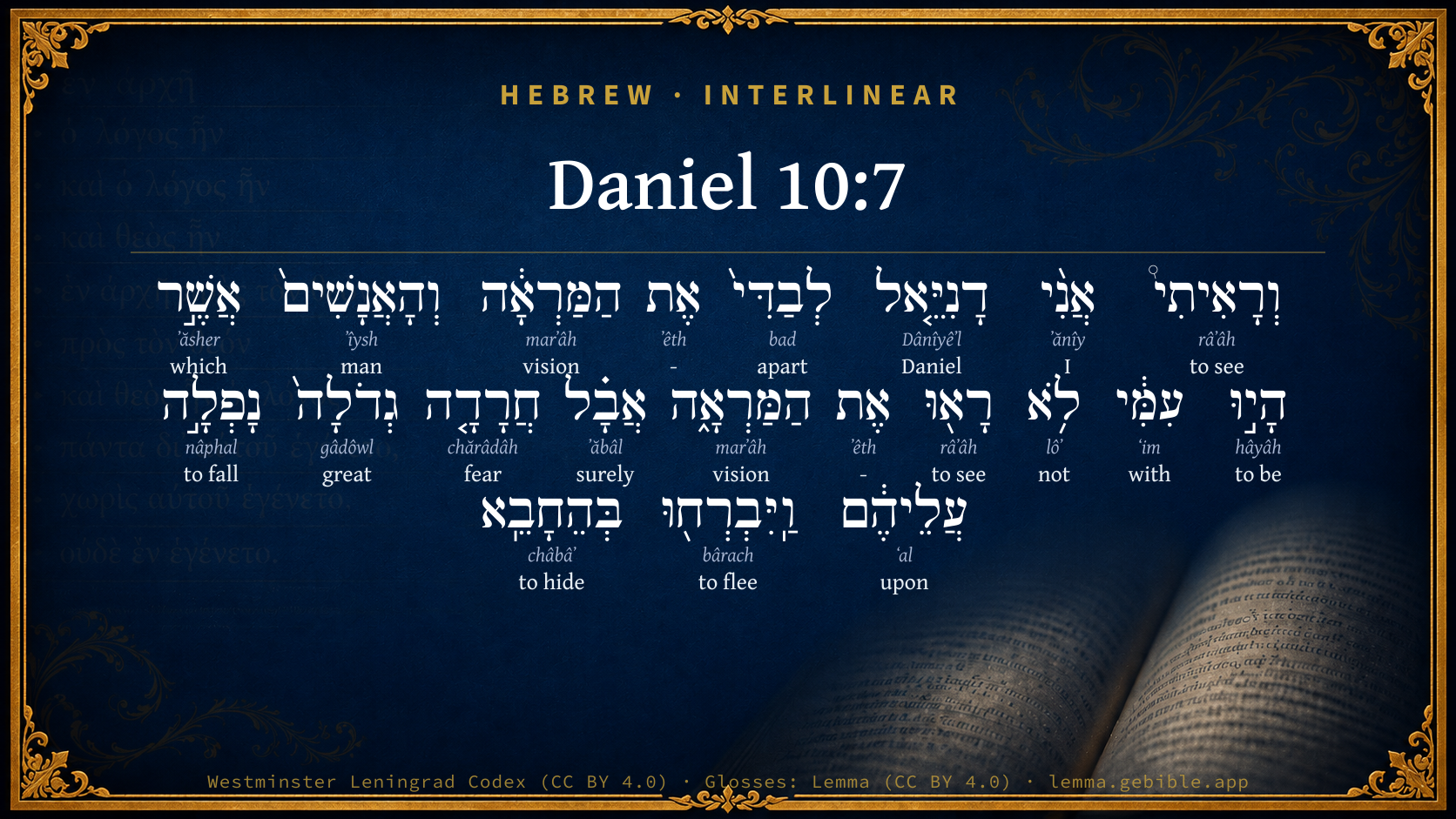
Daniel 10:7

Hebrew (Westminster Leningrad Codex) Daniel 10:7 appears in the Hebrew Old Testament. The text above is from the Westminster Leningrad Codex. Each word links to its Strong’s number, a concise gloss, and parsing drawn from the Open Scriptures Hebrew Bible morphology. Click any word for its full Brown-Driver-Briggs (BDB) entry.
Download image
Cite this verse

Daniel 10:7 (World English Bible). Public Domain. Lemma interlinear Bible study tool, https://lemma.gebible.app/v/daniel/10/7.

Show BibTeX & RIS
BibTeX
RIS
English Translation
I, Daniel, alone saw the vision; for the men who were with me didn't see the vision; but a great quaking fell on them, and they fled to hide themselves.
World English Bible · Public Domain
Download a study sheet

One document with this verse’s original text, its word-by-word gloss line, the meaning frame, cross-references with their text, attributed commentary, and full source and license credits — printable, and it pastes into notes with its structure intact.

This verse Autodidact and up

Study sheet (.html) Plain text (.txt)

A passage Seminary Student

Up to 50 verses in one chapter. A passage sheet keeps up to 6 commentary sources and 12 cross-references per verse, in the order this page ranks them, and says so on the sheet whenever that leaves anything out. Ask for a single verse and you get the Autodidact verse sheet above.

Everything on this page stays free to read, with no account — the sheet is a download of what is already on screen, not access to it.

Want to remove ads? Support Godless Engineer
Compare translations 3

The same verse in 3 English versions, stacked beneath the original-language interlinear above. Click any original word for its lexicon entry.

Each is an independent rendering of the whole verse — the interlinear is not word-aligned to these translations.

Highlighted words mark where these versions differ — a whole-verse word diff, not a word-by-word alignment.

  • World English Bible Public Domain
    I, Daniel, alone saw the vision; for the men who were with me didn't see the vision; but a great quaking fell on them, and they fled to hide themselves.
  • King James Version Public Domain
    And I Daniel alone saw the vision: for the men that were with me saw not the vision; but a great quaking fell upon them, so that they fled to hide themselves.
  • unfoldingWord Literal Text CC BY-SA 4.0
    I, Daniel, alone saw the vision, for the men who were with me did not see the vision. However, a great trembling fell on them, and they ran away to hide themselves.

unfoldingWord Literal Text — © unfoldingWord, licensed CC BY-SA 4.0. Word-aligned USFM3 via Door43 (git.door43.org/unfoldingWord/en_ult).

Versions to compare (up to 4)

3 of 4 selected

Show all 18 translations

Every available English version of this verse, each an independent rendering of the whole verse.

  • World English Bible Public Domain
    I, Daniel, alone saw the vision; for the men who were with me didn't see the vision; but a great quaking fell on them, and they fled to hide themselves.
  • Berean Standard Bible Public Domain
    Only I, Daniel, saw the vision; the men with me did not see it, but a great terror fell upon them, and they ran and hid themselves.
  • Majority Standard Bible Public Domain
    Only I, Daniel, saw the vision; the men with me did not see it, but a great terror fell upon them, and they ran and hid themselves.
  • King James Version Public Domain
    And I Daniel alone saw the vision: for the men that were with me saw not the vision; but a great quaking fell upon them, so that they fled to hide themselves.
  • American Standard Version (1901) Public Domain
    And I, Daniel, alone saw the vision; for the men that were with me saw not the vision; but a great quaking fell upon them, and they fled to hide themselves.
  • Revised Version (1885) Public Domain
    And I Daniel alone saw the vision: for the men that were with me saw not the vision; but a great quaking fell upon them, and they fled to hide themselves.
  • Geneva Bible (1599) Public Domain
    And I Daniel alone sawe the vision: for the men that were with me, sawe not the vision: but a great feare fell vpon them, so that they fled away and hid themselues.
  • Douay-Rheims (1899) Public Domain
    And I Daniel alone saw the vision: for the men that were with me saw it not: but an exceeding great terror fell upon them, and they fled away, and hid themselves.
  • Young's Literal Translation Public Domain
    `And I have seen -- I, Daniel, by myself -- the appearance: and the men who have been with me have not seen the appearance, but a great trembling hath fallen on them, and they flee to be hidden;
  • Literal Standard Version CC BY-SA 4.0
    And I, Daniel, have seen the vision by myself, and the men who have been with me have not seen the vision, but a great trembling has fallen on them, and they flee to be hidden;
  • Unlocked Literal Bible CC BY-SA 4.0
    I, Daniel, alone saw the vision, for the men who were with me did not see the vision. However, a great terror came on them, and they ran away to hide themselves.
  • unfoldingWord Literal Text CC BY-SA 4.0
    I, Daniel, alone saw the vision, for the men who were with me did not see the vision. However, a great trembling fell on them, and they ran away to hide themselves.
  • Darby Bible Public Domain
    And I Daniel alone saw the vision; and the men that were with me saw not the vision, but a great quaking fell on them, and they fled to hide themselves.
  • World Messianic Bible Public Domain
    I, Daniel, alone saw the vision, for the men who were with me didn’t see the vision, but a great quaking fell on them, and they fled to hide themselves.
  • Webster's Bible Public Domain
    And I Daniel alone saw the vision: for the men that were with me saw not the vision: but a great quaking fell upon them, so that they fled to hide themselves.
  • Free Bible Version CC BY-SA 4.0
    I, Daniel, was the only one to see this vision —the others with me did not see the vision, but they suddenly felt very frightened and ran away to hide themselves.
  • Bible in Basic English Public Domain
    And I, Daniel, was the only one who saw the vision, for the men who were with me did not see it; but a great shaking came on them and they went in flight to take cover.
  • JPS Tanakh (1917) Public Domain
    And I Daniel alone saw the vision; for the men that were with me saw not the vision; howbeit a great trembling fell upon them, and they fled to hide themselves.

Literal Standard Version (2020), Covenant Press — licensed CC BY-SA 4.0. Text via the HelloAO Bible API (eBible.org). Unlocked Literal Bible (unfoldingWord) — licensed CC BY-SA 4.0. Text via the HelloAO Bible API (eBible.org). unfoldingWord Literal Text — © unfoldingWord, licensed CC BY-SA 4.0. Word-aligned USFM3 via Door43 (git.door43.org/unfoldingWord/en_ult). Free Bible Version, Dr. Jonathan Gallagher — licensed CC BY-SA 4.0. Text via the HelloAO Bible API (eBible.org).

Word by word

More ways to search: Search by grammar → Find every occurrence → Compare this word →

Practice this passage: Drill this verse → Learn its vocabulary →

חֲרָדָ֤ה
chărâdâh
H2731
“fear”
Noun, Common, Feminine, Singular, Absolute
Part of Speech
Noun
Type
Common
Gender
Feminine
Number
Singular
State
Absolute
Full BDB Definition

Origin: from H2730

TWOT: 735b

fear, anxiety, quaking, trembling, (extreme) anxiety, anxious care - trembling, quaking - anxious care
  1. וְרָאִיתִי֩ râʼâh H7200 “and · to see” Conjunction + Verb, Qal, Perfect, 1st Person, Common, Singular
  2. אֲנִ֨י ʼănîy H589 “I” Pronoun, Personal, 1st Person, Common, Singular
  3. דָנִיֵּ֤אל Dânîyêʼl H1840 “Daniel” Noun, Proper
  4. לְבַדִּי֙ bad H905 “to/for · apart · my” Preposition + Noun, Common, Masculine, Singular, Construct + Suffix, Personal, 1st Person, Common, Singular
  5. אֶת ʼêth H853 “-” Particle, Direct Object
  6. הַמַּרְאָ֔ה marʼâh H4759 “the · vision” Particle, Definite Article + Noun, Common, Feminine, Singular, Absolute
  7. וְהָאֲנָשִׁים֙ ʼîysh H376 “and · the · men” Conjunction + Particle, Definite Article + Noun, Common, Masculine, Plural, Absolute
  8. אֲשֶׁ֣ר ʼăsher H834 “which” Particle, Relative
  9. הָי֣וּ hâyâh H1961 “to be” Verb, Qal, Perfect, 3rd Person, Common, Plural
  10. עִמִּ֔י ʻim H5973 “with · me” Preposition + Suffix, Personal, 1st Person, Common, Singular
  11. לֹ֥א lôʼ H3808 “not” Particle, Negative
  12. רָא֖וּ râʼâh H7200 “to see” Verb, Qal, Perfect, 3rd Person, Common, Plural
  13. אֶת ʼêth H853 “-” Particle, Direct Object
  14. הַמַּרְאָ֑ה marʼâh H4759 “the · vision” Particle, Definite Article + Noun, Common, Feminine, Singular, Absolute
  15. אֲבָ֗ל ʼăbâl H61 “surely” Adverb
  16. גְדֹלָה֙ gâdôwl H1419 “great” Adjective, Adjective, Feminine, Singular, Absolute
  17. נָפְלָ֣ה nâphal H5307 “to fall” Verb, Qal, Perfect, 3rd Person, Feminine, Singular
  18. עֲלֵיהֶ֔ם ʻal H5921 “upon · them” Preposition + Suffix, Personal, 3rd Person, Masculine, Plural
  19. וַֽיִּבְרְח֖וּ bârach H1272 “and · to flee” Conjunction + Verb, Qal, Sequential Imperfect, 3rd Person, Masculine, Plural
  20. בְּהֵחָבֵֽא châbâʼ H2244 “in/at · to hide” Preposition + Verb, Niphal, Infinitive Construct

About this verse

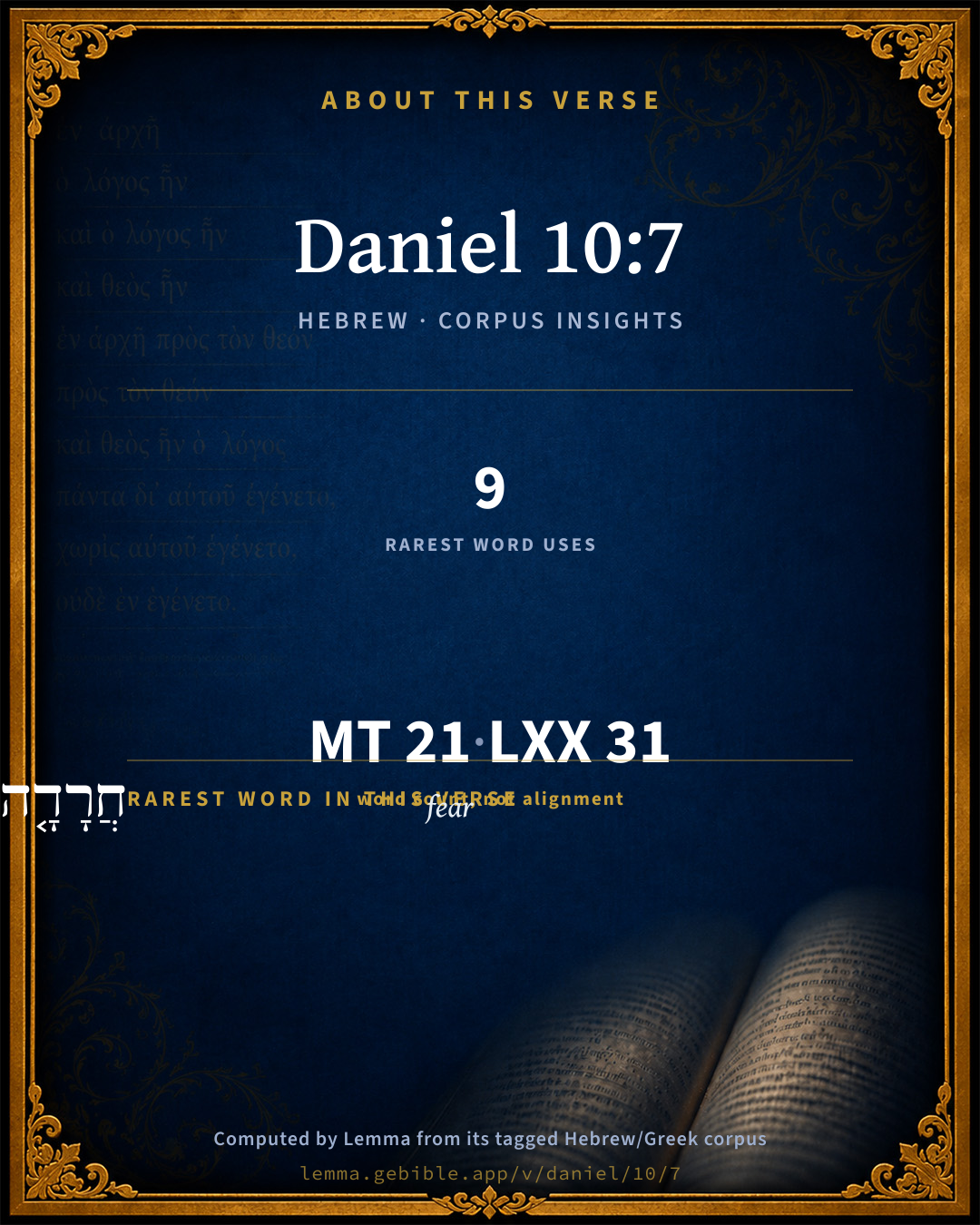
These counts appear in no published source. They are computed here, from the morphology-tagged text and Lemma’s own curated glosses. What Lemma adds →

21
words
18
distinct lemmas
Prophets
section

Notable vocabulary

The rarest word here is חֲרָדָ֤ה fear H2731 — appearing just 9 times in the whole Hebrew Bible.

Shared distinctive vocabulary

חֲרָדָ֤ה fear H2731 occurs in 8 verses of the Hebrew Bible. Also found in:

Grammatical profile

  • 6 verbs
  • 6 nouns
  • 1 adjective
  • 1 pronoun
  • 2 prepositions
  • 1 adverb
  • 4 particles

Verb forms

  • וְרָאִיתִי֩ Qal · Perfect
  • הָי֣וּ Qal · Perfect
  • רָא֖וּ Qal · Perfect
  • נָפְלָ֣ה Qal · Perfect
  • וַֽיִּבְרְח֖וּ Qal · Sequential Imperfect
  • בְּהֵחָבֵֽא Niphal · Infinitive Construct

Repetition

Words recur within this verse — often emphatic in Hebrew:

  • וְרָאִיתִי֩ to see H7200 ×2
  • הַמַּרְאָ֔ה vision H4759 ×2

Hebrew & Septuagint length

In English translation the verse runs 30 words from the Hebrew and 30 from the Septuagint (LXX English) — the same length.

A rough comparison of the two English renderings, which tokenize alike — not a word-level alignment.

Word counts can differ between the Hebrew and the Greek without any difference in meaning — e.g. the Hebrew direct-object marker אֵת has no separate Greek word, and Greek often adds the article ὁ.

In the original languages it is 21 Hebrew tokens and 31 Greek tokens — but the two are counted differently (Hebrew bundles its prefixes and suffixes into one token; the Greek is in lemma form), so that isn’t a like-for-like length.

Cross-references

8

Topical passages linked to Daniel 10:7 in the Treasury of Scripture Knowledge — connected by theme and wording, ordered by reader-vote popularity; previews shown in the World English Bible.

  • Acts 9:7 The men who traveled with him stood speechless, hearing the sound, but seeing no one.
  • Acts 22:9 "Those who were with me indeed saw the light and were afraid, but they didn't understand the voice of him who spoke to me.
  • Genesis 3:10 The man said, "I heard your voice in the garden, and I was afraid, because I was naked; and I hid myself."
  • Isaiah 2:10 Enter into the rock, And hide in the dust, From before the terror of Yahweh, And from the glory of his majesty.
  • Hebrews 12:21 and so fearful was the appearance, that Moses said, "I am terrified and trembling."
  • Ezekiel 12:18 Son of man, eat your bread with quaking, and drink your water with trembling and with fearfulness;
  • 2 Kings 6:17–20 Elisha prayed, and said, Yahweh, Please open his eyes, that he may see. Yahweh opened the eyes of the young man; and he saw: and, behold, the mountain was full of horses and chariots of fire round about Elisha.
  • Jeremiah 23:24 Can any hide himself in secret places so that I shall not see him? says Yahweh. Don't I fill heaven and earth? says Yahweh.

Cross-references courtesy of OpenBible.info (CC BY 4.0).

Hebrew and Greek witnesses Masoretic Hebrew ↔ Greek Septuagint

The same verse in the two great witnesses to the Old Testament, shown verse-for-verse.

These are two independent witnesses, not word-aligned to each other, and the Septuagint is shown in lemma (dictionary) form.

Hebrew Daniel 10:7 Masoretic · Westminster Leningrad Codex

וְרָאִיתִי֩ אֲנִ֨י דָנִיֵּ֤אל לְבַדִּי֙ אֶת הַמַּרְאָ֔ה וְהָאֲנָשִׁים֙ אֲשֶׁ֣ר הָי֣וּ עִמִּ֔י לֹ֥א רָא֖וּ אֶת הַמַּרְאָ֑ה אֲבָ֗ל חֲרָדָ֤ה גְדֹלָה֙ נָפְלָ֣ה עֲלֵיהֶ֔ם וַֽיִּבְרְח֖וּ בְּהֵחָבֵֽא

I, Daniel, alone saw the vision; for the men who were with me didn't see the vision; but a great quaking fell on them, and they fled to hide themselves.

World English Bible · Public Domain

Greek LXX Daniel 10:7 Septuagint · lemma form

καί ὁράω ἐγώ δανιηλ ὁ ὅρασις ὁ μέγας οὗτος καί ὁ ἄνθρωπος ὁ εἰμί μετά ἐγώ οὐ ὁράω ὁ ὅρασις οὗτος καί φόβος ἰσχυρός ἐπιπίπτω ἐπί αὐτός καί ἀποδιδράσκω ἐν σπουδή

And I Daniel only saw the vision: and the men that were with me saw not the vision; but a great amazement fell upon them, and they fled in fear.

LXX2012 (modern English Septuagint) · Public Domain

On this verse, John Gill's Exposition discusses the Septuagint’s reading. Read the note in Commentary ↓

Hebrew: Westminster Leningrad Codex (CC BY 4.0). Greek: Septuagint (public domain); English from LXX2012 (modern English Septuagint) (Public Domain). How the Septuagint differs from the Hebrew →

Commentary

Notes on Daniel 10:7 from classic Christian and Jewish commentators (each source and its license shown beneath its notes). The classic Christian expositions comment on the surrounding passage and are grouped to its opening verse, so a note may address several verses; the Jewish commentaries on the Tanakh (Rashi and others) are per-verse, so they appear only where the commentator wrote on this verse.

Lemma curates 59 commentaries, every one of them public domain or Creative Commons licensed, each selected and text-cleaned for this edition rather than reprinted as found. About our sources →

Trapp's Complete Commentary

John Trapp

Dan 10:7 And I Daniel alone saw the vision: for the men that were with me saw not the vision; but a great quaking fell upon them, so that they fled to hide themselves.

Ver. 7. And I Daniel alone saw the vision.] Holy prophets alone are capable of holy visions. {2Pe 1:19}

For the men that were with me saw not.] Sensible they were of some alteration upon the waters, and somewhat wrought upon; not for their information, but separation from Daniel, that he might more freely undergo the heavenly rapture. See the like, Act 9:7.

But a great quaking fell upon them.] Through sense of sin and fear of wrath. This served to show the truth of the vision.

John Trapp, A Commentary or Exposition upon All the Books of the Old and New Testament (1647–1656) — public domain. Text from a community e-Sword module.

The Biblical Illustrator

Joseph S. Exell

Dan_10:7

And I, Daniel, alone saw the vision.

Visions for ones self alone

Many and many of these men whom we see plodding on in their dusty ways are travelling with visions in their souls. Nobody knew it but themselves and God. Once years ago they saw a light. They knew it, only for a moment, what companionships, what attainments, they were made for! That light has never faded. It is the soul of good things which they are doing in the world to-day. It makes them sure when other men think their faith is gone. It will be with them to the end, until they come to all it prophesies. (Phillips Brooks.)

The Divine Fellowship of Loneness

The events here recorded are among the more advanced and elevated experiences of this man of God. The Lord is showing him things which are to take place; and in order to prepare him as the exponent of the divine purposes, he is raised into a supra-mundane state of soul.

I. THE SCENE: the vision. We have no positive data for speaking dogmatically as to what may be the composition of the visible nature of angels. We associate them with spiritual orders of Gods creatures; but as to man, he has a dual nature; within, spirit; without, a material body. In the wise and gracious purposes of our God, He has seen fit to take man into His counsels, and to make known to him His purposes. Taking, as we must, a broad view of this interesting fact, the Almighty uses a variety of means for communicating His mind and intentions to the children of men. The colours and forms, the harmonies and utilities of nature of imaging and voicing through the senses the wisdom, power and beneficence of God. The potent impact of the Spirits influence upon the mind of prophet and apostle has furnished us with the inimitable truths of this great book, the Bible, which infinitely surpasses the best productions of the human intellect. In dreams, when deep sleep has fallen upon men, hath the Lord made Himself known to and encouraged His faithful servants. Visions too, have their place among the methods of revealing. Dreams and visions evidently belong to the same class of phenomena; and yet are there not shades of difference? Dreams are what come to us when we are asleep; visions come oftentimes in moments of waking. In dreams men have had the symbols of things; in visions, the things themselves. Visions evidently belong to a higher and more direct order of celestial manifestation. Visions seem to hold in mysterious suspension the ordinary processes of thought and feeling, unfolding to the mind new worlds of knowledge. We have all read those marvellous visions of Old Testament history: Isaiah standing with speechless awe before the vision of God; Ezekiel encircled in the vast and wondrous region of visionary mystery, now looking into hidden chambers of abomination, then with seer-like eye peering among apparently conflicting wheels. Daniel sees in vision things which are to be. In this supreme fact we have the significance and symbol of life. Situated as we are in the midst of vast circles and orders of beings and ideas, all true life, which is essentially progressive, is made up of visions; and by these we attain the true ascent of man, passing up from shadows into light, and from the unknown to the known. A life of progress is one of constant waking. So far as the things of to-morrow and the knowledge of the future are concerned, we are now asleep. The hopes of future good which we now cherish are foreshadowing dreams, the dawning of these hoped for events are visions brightening things up to blessed realities. Thus we live and grow. Men are somewhat in the habit of pooh-poohing dreams, and of relegating visions to the region of superstitious fancies or even imbecile hopes. All the truth, however, is not with such men, nor all wisdom either. I say, dream on, only see to it that your dreams are pure and true, and be careful that your visions take their light from above. The purest ascent of life is often adumbrated by visions of hope and longing; and as we exercise faith and put forth effort, they crystallize into shape and become real possessions. God gives us visions of what we may be; by them we are roused to search and make inquiry, and then to believe; and so visions of a free spirit and a clean heart which the Lord gave us yesterday become our norms of character and life to-day. Note a few points in Daniels vision. It appears he was reduced to a very low state so far as enjoyment was concerned. Luxurious food, and exhilarating drinks were put away (verse 3). Visions do not generally come in fulness of body. It is when the physical is chastened that the spiritual ascends. It was when Peter was hungry that he had the vision which prepared the way for his visit to the Gentiles. Daniel saw a certain man (verse 5). This could be none other than the Christ, as we may gather from Rev_1:13; Rev_1:15, where he appears in similar form to John at Patmos. He was clothed in fine linen, as the high priest was on the day of Atonement, thus showing that He is the High Priest of our Profession. Whose loins are girded with fine gold. Girded ready for work. With fine gold, proof that everything of Christ is best, and that the best of everything is all too unworthy of Him. We have also a description of His form. Body like the beryl, a precious stone of an azure colour. His face as the appearance of lightning, a terror to evil-doers. Eyes as lamps, seeing all things. His arms and His feet like in colour to polished brass, prophetic of the brightness and power of the message of His gospel. The voice of His words like the voice of a multitude. The words of this new life are destined to overcome and supersede all other systems.

II. THE CIRCUMSTANCES: alone. In this remarkable experience and wondrous manifestation Daniel was alone. No other eye could follow this brilliant unfolding of God. Looking at this fact superficially there may occur a feeling of sadness; but looked at more deeply, it is seen to be inevitable. As every man has personality and individuality, so has he his loneness. While there are affinities or connecting links between man and man, there are dividing lines between all the individuals composing the human family. Science teaches that between every two particles of matter, even in the hardest substance there is space; in like manner between men there are bridgeless gulfs, so that the one cannot pass over to the other. While this is true of the general mass of men, it is more strikingly manifest in the higher forms and better conditions of mind and spirit. Best men and men at their best must needs be alone. He who progresses rapidly and soars loftily must be alone, inasmuch as he leaves the multitude behind. How true this is in the growth of intellect and the enlargement of heart, in the constraints of love and the sublimities of faith! He who waits on others will find progress slow work. In the larger commonwealth of intellectual and moral life God deals with the man, not with the mass. The individual stands directly related, and personally responsible, to his Maker; and in proportion to his realization of the possibilities of his own being will he be alone. The thinking man climbs heights and reaches lofty peaks at the far down foot of which lie panting the mass of puny men. The man of close communion with God and self and truth basks in a light that would dazzle to blindness men of weaker vision. Much of best life must be lived in splendid isolation. The worlds great reformers and deep thinkers have lived alone, because they have been far in advance of their own age. While there may be the loneness of weakness and eccentricity, still, in the main, lone souls are rendered such by their superiority and by the revelations they receive from the Father of lights. The Bible furnishes us with striking examples. Mark the happy oblivion and lofty loneness of Enoch who walked with God, and he was not for God took him. Note the elevation of Joseph in those prophetic dreams which excited the jealous ire of his brethren. Alone Elijah stood on Mount Carmel, and discomfited the prophets of Baal. Alone Paul was caught up into the third heaven. Alone John witnessed the prophetic visions of Patmos. Alone, aye, alone! down in the depths of His great soul Christ sorrowed and suffered, wept and sighed, bled and died. Alone He trod the winepress of the wrath of God. Thus alone are wrought out and made manifest the highest intents of the holiest purposes of our supreme moral Ruler. Have we not here, by implication at least, a word of caution? We are so prone to censure if not condemn all who do not conform to our pattern of thought. Christianity, brotherliness, and forbearance will prompt a tender consideration for such persons. As Daniel was left alone when the vision came, I gather that in the ordinary routine of life he had companionship; but in the supremely extraordinary, when he stood in the midst of the splendour of vision, he was alone. So men in the ordinary littlenesses and the common superficialities of small living may find plenty of fellows, but when they step up into the light of God and see Visions, they are left alone. It may be that you are exercised in mind from similar considerations, and you wonder why God has made you so much unlike the rest of mankind. You wish you could be as others are. Foolish desire! As wise for the eagle to wish it were an ostrich, or the lark to covet the blinking sombreness of the owl! Take your apportionment and even your peculiarity from God, and be not discontented nor discouraged with yourself. I observe here that the souls light, purity and power, consist in communion with God. Daniel lived in intimate fellowship with the Almighty. Hence he was conditioned for receiving a vision; and while less devout and less noble souls were unfitted for a new revelation and unprepared for s new truth, and terrified at a brighter light, he had a mind and heart adapted to the improved conditions which came with the vision, and stood unflinchingly amid this unearthly brightness. Thank God! heaven is not far removed into the dim distances of remotest space, but is nigh, even here, to the devout and reverent believer. Oh! had we pure hearts, spiritual minds, single eyes, and right spirits, we should find ourselves in the midst of heavenly surroundings. Be it ours to seek a loftier place, a fuller life, and a closer walk; then shall we have visions and experience days of heaven upon earth. (M. Brokenshire.)

The Biblical Illustrator, edited by Joseph S. Exell (c. 1880s–1900s) — public domain. Text from a community e-Sword module.

Joseph Benson's Commentary

Dan 10:7-9. The men that were with me saw not the vision — This was just as it happened to the company who were with St. Paul, when he had a vision, going to Damascus, Act 9:7. God can cast a cloud before the eyes of any one when he pleases, so that the organs may not be able to perform their usual functions; thus it is said, Luk 24:16, of the two disciples going to Emmaus, that their eyes were holden that they should not know him. But a great quaking fell upon them — Occasioned perhaps by their hearing some unusual and terrible sound. Thus the men with St. Paul heard a voice which struck them speechless, though they saw nothing. So that they fled to hide themselves — Through the terror and astonishment wherewith they were seized, they fled from the place, as from a place in which they were exposed to instant destruction. And there remained no strength in me — I fell into a swoon, or fainting-fit. My comeliness, or vigour, was turned in me into corruption — Houbigant reads it, The flower of my strength withered, and all my powers failed me. When I heard the voice of his words — The very sound of his words deprived me of all sense and power of motion. Then was I in a deep sleep — Then I lay lifeless, with my face prone upon the ground. — Houb.

Joseph Benson's Commentary on the Old and New Testaments (1811–1818) — public domain. Text from a community e-Sword module.

Tyndale Open Study Notes

Tyndale Open Resources

10:7-9 Daniel’s response was typical for humans in the presence of heavenly beings (cp. Josh 5:14; Isa 6:5; Acts 9:7-9; Rev 1:17).

Tyndale Open Study Notes — © Tyndale Open Resources, licensed CC BY-SA 4.0. Text via the HelloAO Bible API.

Jamieson, Fausset & Brown

Robert Jamieson, A. R. Fausset & David Brown

they fled--terrified by the presence of the presence of the angel.

Jamieson, Fausset & Brown — Commentary Critical and Explanatory on the Whole Bible (1871) — public domain (CC PDM 1.0). Text via the HelloAO Bible API.

Adam Clarke's Commentary

Verse 7. The men that were with me saw not the vision] An exactly parallel case with what occurred at the conversion of Saul of Tarsus, Ac 9:7. There was a Divine influence which they all felt, but only Daniel saw the corporeal appearance.

Adam Clarke's Commentary on the Bible (1810–1826) — public domain. Text from a community e-Sword/MySword module.

John Calvin's Commentaries

He pursues his own narrative in which he appears prolix, but not without design. This prophecy required all kinds of sanction for the purpose of inspiring unhesitating confidence in it, not only with those Jews of that generation, but with all posterity. Although the predictions of the eleventh chapter have been fulfilled, yet their utility is manifest to us as follows: first, we behold in them God’s perpetual care of his Church; secondly, we observe the pious never left destitute of any necessary consolation; and lastly, we perceive, as in a glass or in a living picture, the Spirit of God speaking in the prophets, as I have observed before, and shall have occasion to remark again. Daniel, therefore, has good reasons for impressing us with the certainty of the vision, and with whatever tends to prove its reality. He says, I alone saw the vision; but the men who were with me did not see it; just as the companions of Paul did not hear Christ’s voice, but only a confused sound: they did not understand his language, as Paul alone was permitted to comprehend it. (Acts 9:7) This is related to promote belief in the prophecy. Daniel’s power of hearing was not superior to his companions, but God intended to address him alone. Thus the voice, although like the voice of a multitude, did not penetrate the ears of those who were with him. He alone was the recipient of these prophecies, as he alone was endued with the power of predicting future events, and of consoling and exhorting the pious to live them a knowledge of futurity even to the last day. Should any one inquire how he carried his companions with him while he was probably lying on his bed at a distance from the bank of the river, the answer is easy. He had his domestics with him; the river’s bank only existed in the vision, and he was carried completely out of himself, and thus his family would be acquainted with the ecstasy without being aware of the cause. Daniel then continued at his own home, and only visited the bank of the river during the vision; although many witnesses were present, God struck them all with astonishment, while Daniel only perceived what is afterwards narrated. God deemed him worthy of this singular honor to fit him to become a teacher and instructor to others. The men who were with me, says he, saw not the vision; but a great terror fell upon them This distinction, as I have stated, shews Daniel to have been selected as the sole listener to the angel’s voice, and as receiving the information which he was afterwards to convey to others. Meanwhile, God intended many witnesses to notice Daniel’s entire freedom from any delusion through either a dream or a passing imagination. His companions, then, were fright-eyed This terror proves the Prophet to have been divinely instructed and not to have labored under any delirium. They fled, therefore, into hiding-places It afterwards follows: —

John Calvin's Commentaries (1540-1563) — public domain. Text from the Calvin Translation Society English edition (1840s-50s) via the Christian Classics Ethereal Library (ccel.org). Calvin's coverage is partial (roughly two-thirds of the Bible); uncommented books and verses are honest gaps, never fabricated. The 19th-century editor's footnotes and remarks are omitted so the notes are faithfully Calvin's own voice.

Ellicott's Commentary for English Readers

(7) I . . . alone saw the vision.—St. Jerome compares the account of St. Paul (Act_22:9). It may be added that, as upon that occasion (comp. Act_9:7), the companions of the prophet heard the voice but saw nothing. The words of the voice (Dan_10:6) are unrecorded.

A Bible Commentary for English Readers, edited by Charles John Ellicott (1878–1897) — public domain. Text from a community e-Sword module.

The Cambridge Bible for Schools and Colleges

gen. ed. J. J. S. Perowne

7. Cf. Act_9:7; Act_22:9.

howbeit (Dan_10:21) a great quaking] or trembling: the Heb. is the same as in Gen_27:33 (lit. ‘Isaac trembled with a great trembling’). They may have seen the effects of the vision upon Daniel (cf. Dan_10:8).

The Cambridge Bible for Schools and Colleges (gen. ed. J. J. S. Perowne; Cambridge University Press, 1878–1918) — public domain. Text from a community e-Sword module.

John Gill's Exposition

And I Daniel alone saw the vision,.... The object or person described; though he was not alone when he saw it, yet he alone saw it; the eyes of his body and mind being quicker than the rest, the Lord strengthening and enlightening both; for this was a peculiar and distinguishing favour granted to him:

for the men that were with me saw not the vision; at least not so clearly and distinctly as Daniel did; they might have some confused sight of an object that appeared very terrible; but, being struck with consternation, they had not presence of mind to look at it; and so could neither form nor retain scarce any idea of it: or their eyes might be held, and their sight clouded; or be stricken with a kind of blindness, or want of sight for a time, as the men of Sodom were; or the object was of such a nature, that without special illumination it could not be seen: the like happened to Elisha's young man, who saw not the chariots and horses of fire the prophet did, and to the men that were with the Apostle Paul, Kg2 6:17, who these men were, that were with Daniel, is not material to know; whether they were his three companions, who had been cast into the fiery furnace; or the Prophets Haggai, Zechariah, and Malachi, as Jarchi and Saadiah say from their Rabbins (r); neither of which are likely, since these, being good men and prophets, would doubtless have been favoured with the same vision: but rather they were the servants of Daniel, who waited upon him, he being now a great man in the Persian court; and these men being very likely Heathens, profane and unregenerate men, were not fit and prepared to see such a vision:

but a great quaking fell upon them: or "for", so Noldius; giving a reason why they saw not, because or the great fear and trembling upon them; either at the glimmering sight of this strange appearance, which they knew not what to make of; or rather at the sound of his voice, which was so very loud and terrible:

so that they fled to hide themselves; among the trees that grew upon the banks of the Tigris, as Adam among the trees of the garden; or in some wood or forest hard by; or in some caves and dens, which might be near at hand: this not only shows the confusion and consternation they were in, as the Septuagint and Arabic versions render it,

they fled with terror; or

through it, as the Syriac version; but serves to confirm the truth of the vision, that it was not a mere fancy and imagination of Daniel.

(r) T. Bab. Sanhedrin, fol. 93. 2.

John Gill's Exposition of the Whole Bible (1746–1763) — public domain (CC PDM 1.0). Text via the HelloAO Bible API.

Albert Barnes' Notes on the Bible

And I Daniel alone saw the vision - That is, he only saw it distinctly. The others who were with him appear to have seen or heard something which alarmed them, and they fled. Who those men were, or why they were with him, he does not say. They may have been his own countrymen, engaged with him in the act of devotion, or they may have been Babylonians occupied in the public service; but whoever they were, or whatever was the reason why they were there, they became alarmed and fled. The case was somewhat different with the companions of Saul of Tarsus when the Saviour appeared to him on his way to Damascus. These saw the light; they all fell to the earth together, but Saul only heard the voice of him that spake. Act 22:9.

Albert Barnes' Notes on the Bible (1834–1885) — public domain. Text from a community e-Sword/MySword module.

Matthew Poole's English Annotations

So Luk 24:16; Act 9:7.

1. The Lord hereby shows his power over our senses, both outward and inward, in a signal, distinguishing way.

2. The weakness of mortals to see or hear heavenly things, unless he strengthen them.

3. Their fleeing and quaking argued the terror of God upon them; and thereby the truth and certainty of the vision, by hearing such a sound though they saw it not, Act 9:7,8.

Matthew Poole's English Annotations on the Holy Bible (1683–1685) — public domain. Text from a community e-Sword/MySword module.

Whedon's Commentary on the Bible

Daniel D. Whedon

7. Too many men are ready to flee, when they feel they are in the presence of God, instead of waiting for the revealing vision. (Compare Act_9:7; Exo_20:18-20.) Whether the companions of Daniel were courtiers or servants or fellow Hebrews, who were fasting with him, is not intimated.

Daniel D. Whedon (gen. ed.), Commentary on the Old and New Testaments (1874–1909) — public domain. Text from a community e-Sword module.

The Pulpit Commentary

And I Daniel alone saw the vision; for the men that were with me saw not the vision.; but a great quaking fell upon them, so that they fled to hide themselves. The LXX in the main agrees with this, but seems to have read lemahar, in haste," instead of behayhabay. Theodotion renders the last word ejn fobw, implying that he read behaga". The reading of the Massoretic is superior, as being less expected. The Peshitta renders in accordance with Theodotion. Jerome agrees very exactly with the Massoretic text. And I Daniel alone saw the vision (comp. Act_9:7 Act_22:9) The Apostle Paul was solitary in hearing intelligible words and seeing Christ; his attendants saw the bright light and heard a voice, but neither saw the speaker nor were able to distinguish the purport of the words. For the men that were with me saw not the vision. Who those were that were with Daniel we cannot tell; probably they were the ordinary attendants of an officer of rank in the court of the great king. Rashi"s idea that they were Haggai, Zechariah, and Malachi, has no probability in favour of it. As little has Professor Fuller"s hint that they were Hananiah, Michael, and Azariah. But a great quaking fell upon them, so that they fled to hide themselves (comp. Exo_20:18; Gen_3:8) A yet finer parallel is Job_4:12-16. Eliphaz there describes a spiritpassing before him, although invisible; yet in the horror of contact with the spiritual, all his bones shook and the hair of his flesh stood up. There is a difference to be noted hero between the conduct of the attendants of Daniel and those of the Apostle Paul. As we read here, the attendants of Daniel flee to hide themselves, those of the apostle are first struck to the earth and then stand stupefied.

The Pulpit Commentary (1880–1919), ed. H.D.M. Spence-Jones & Joseph S. Exell — public domain. Text from a community e-Sword module.

Keil & Delitzsch

C. F. Keil & F. Delitzsch

According to this verse, the form described in Dan 10:5 and Dan 10:6 was visible to Daniel alone. His companions saw not the appearance, but they were so alarmed by the invisible nearness of the heavenly being that they fled and hid themselves. What is here said resembles Act 9:3., where Christ, after His exaltation, appeared to Paul and spoke to him - Paul's companions hearing only the voice, but seeing no one. In order to account for the flight of Daniel's companions, it is not necessary to suppose the existence of thunder and lightning, of which the text makes no mention. The supposition also of Theodor. and Hitzig, that the men indeed saw not the angel, but that they heard his voice, is incorrect; for the voice was not heard till after his companions had fled. המּראה, pointed as fem., that which was seen, the appearance, seems to be a more limited conception than מראה, visio. בּהחבא יברחוּ: they fled, for they hid themselves; so that the hiding is not to be regarded as the object of the fleeing, but the fleeing is made known in their hiding themselves.

Keil & Delitzsch — Biblical Commentary on the Old Testament (1861–1891) — public domain (CC PDM 1.0). Text via the HelloAO Bible API. (Old Testament only.)

unfoldingWord translationNotes

Door43 World Missions Community

So I was left alone and saw

This can be stated in active form. "No one was with me, and I saw" (See: Active or Passive)

my bright appearance was turned into a ruined look

This can be stated in active form. "my bright appearance turned into looking ruined" (See: Active or Passive)

my bright appearance

This describes the face of someone who is healthy. AT: "my healthy-looking face" (See: Idiom)

a ruined look

Someone's unhealthy, pale face is spoken of as if it were a ruined building. AT: "pale" (See: Metaphor)

I heard his words

This implies that someone was speaking in the vision. This can be made explicit. AT: "I heard the words of someone who was speaking" (See: Assumed Knowledge and Implicit Information)

I fell on my face in deep sleep

Possible meanings are: 1) Daniel was so scared by what he saw that he deliberately laid on the ground, where he then fainted or 2) Daniel fainted and then fell forward onto the ground. (See: Idiom)

translationWords

vision

terror

unfoldingWord translationNotes — © Distant Shores Media and the Door43 World Missions Community, licensed CC BY-SA 4.0. Source: git.door43.org/Door43/en_tn.

Rashi

Rabbi Shlomo Yitzchaki (Rashi)

but the men who were with me Our Sages of blessed memory said that they were Haggai, Zechariah, and Malachi.

but a great quaking fell upon them Our Sages of blessed memory said that although a person does not see something of which he is terrified, his guardian angel, who is in heaven, does see it; therefore, he becomes terrified.

Rashi on the Tanakh — English translations: “The Judaica Press complete Tanach with Rashi, translated by A. J. Rosenberg” (CC BY 4.0); “Pentateuch with Rashi's commentary by M. Rosenbaum and A.M. Silbermann, 1929-1934” (public domain); “The Metsudah Tanach series, Lakewood, N.J” (CC BY 4.0); and “The Book of Joshua, Metsudah Publications, 1997” (CC BY 4.0). Text via Sefaria.

Lesson kit

Teaching starters — assembled from the data on this page, not authored interpretation. Every prompt links to the verse data it draws on. Edit before teaching.

Daniel, in the Prophets, opens this verse with 21 words (18 distinct Hebrew lemmas). Its most distinctive word is chărâdâh (“fear”). A historical commentator’s framing appears above. Read the whole chapter for the surrounding context.

Discussion questions

  1. The word chărâdâh carries the sense “fear.” How does it shape the verse?
  2. How does Genesis 27:33, which shares the word «fear», read alongside this verse?
  3. What does the repetition of “to see” (2× in this one verse) do in this verse?
  4. The translations on this page render this verse differently — a whole-verse word diff, not a word-by-word alignment. What might account for the different wordings?
  5. «וְרָאִיתִי֩» is a Qal Perfect verb. How does that grammatical form shape the action described?
  6. Compare how Trapp's Complete Commentary and The Biblical Illustrator read this verse. Where do they agree or differ?

Things to notice

Reading settings

Reading text

Shown beneath each verse's original-language words.

Old Testament
Old Testament edition

Read the OT as the Masoretic Hebrew (MT) or the Greek Septuagint (LXX).

English shown for the Greek Septuagint (in the Hebrew ↔ Greek comparison).

Comparing translations? Open the Compare panel on any verse page to stack up to four side by side.