2 Chronicles 5:8

Hebrew (Westminster Leningrad Codex) 2 Chronicles 5:8 appears in the Hebrew Old Testament. The text above is from the Westminster Leningrad Codex. Each word links to its Strong’s number, a concise gloss, and parsing drawn from the Open Scriptures Hebrew Bible morphology. Click any word for its full Brown-Driver-Briggs (BDB) entry.
Download image
Cite this verse

2 Chronicles 5:8 (World English Bible). Public Domain. Lemma interlinear Bible study tool, https://lemma.gebible.app/v/2-chronicles/5/8.

Show BibTeX & RIS
BibTeX
RIS
English Translation
For the cherubim spread forth their wings over the place of the ark, and the cherubim covered the ark and the poles of it above.
World English Bible · Public Domain
Download a study sheet

One document with this verse’s original text, its word-by-word gloss line, the meaning frame, cross-references with their text, attributed commentary, and full source and license credits — printable, and it pastes into notes with its structure intact.

This verse Autodidact and up

Study sheet (.html) Plain text (.txt)

A passage Seminary Student

Up to 50 verses in one chapter. A passage sheet keeps up to 6 commentary sources and 12 cross-references per verse, in the order this page ranks them, and says so on the sheet whenever that leaves anything out. Ask for a single verse and you get the Autodidact verse sheet above.

Everything on this page stays free to read, with no account — the sheet is a download of what is already on screen, not access to it.

Want to remove ads? Support Godless Engineer
Compare translations 3

The same verse in 3 English versions, stacked beneath the original-language interlinear above. Click any original word for its lexicon entry.

Each is an independent rendering of the whole verse — the interlinear is not word-aligned to these translations.

Highlighted words mark where these versions differ — a whole-verse word diff, not a word-by-word alignment.

  • World English Bible Public Domain
    For the cherubim spread forth their wings over the place of the ark, and the cherubim covered the ark and the poles of it above.
  • King James Version Public Domain
    For the cherubim spread forth their wings over the place of the ark, and the cherubim covered the ark and the staves thereof above.
  • unfoldingWord Literal Text CC BY-SA 4.0
    And the cherubim were spreading out wings over the place of the Box. And the cherubim covered over the Box and over its poles from above.

unfoldingWord Literal Text — © unfoldingWord, licensed CC BY-SA 4.0. Word-aligned USFM3 via Door43 (git.door43.org/unfoldingWord/en_ult).

Versions to compare (up to 4)

3 of 4 selected

Show all 18 translations

Every available English version of this verse, each an independent rendering of the whole verse.

  • World English Bible Public Domain
    For the cherubim spread forth their wings over the place of the ark, and the cherubim covered the ark and the poles of it above.
  • Berean Standard Bible Public Domain
    For the cherubim spread their wings over the place of the ark and overshadowed the ark and its poles.
  • Majority Standard Bible Public Domain
    For the cherubim spread their wings over the place of the ark and overshadowed the ark and its poles.
  • King James Version Public Domain
    For the cherubim spread forth their wings over the place of the ark, and the cherubim covered the ark and the staves thereof above.
  • American Standard Version (1901) Public Domain
    For the cherubim spread forth their wings over the place of the ark, and the cherubim covered the ark and the staves thereof above.
  • Revised Version (1885) Public Domain
    For the cherubim spread forth their wings over the place of the ark, and the cherubim covered the ark and the staves thereof above:
  • Geneva Bible (1599) Public Domain
    For ye Cherubims stretched out their wings ouer the place of the Arke, and the Cherubims couered the Arke and the barres thereof aboue.
  • Douay-Rheims (1899) Public Domain
    So that the cherubims spread their wings over the place, in which the ark was set, and covered the ark itself and its staves.
  • Young's Literal Translation Public Domain
    and the cherubs are spreading out wings over the place of the ark, and the cherubs cover over the ark, and over its staves, from above;
  • Literal Standard Version CC BY-SA 4.0
    and the cherubim are spreading out wings over the place of the Ark, and the cherubim cover over the Ark, and over its poles, from above;
  • Unlocked Literal Bible CC BY-SA 4.0
    For the cherubim spread out their wings over the place of the ark, and they covered the ark and the poles by which it was carried.
  • unfoldingWord Literal Text CC BY-SA 4.0
    And the cherubim were spreading out wings over the place of the Box. And the cherubim covered over the Box and over its poles from above.
  • Darby Bible Public Domain
    and the cherubim stretched forth [their] wings over the place of the ark, and the cherubim covered the ark and its staves above.
  • World Messianic Bible Public Domain
    For the cherubim spread out their wings over the place of the ark, and the cherubim covered the ark and its poles above.
  • Webster's Bible Public Domain
    For the cherubim spread forth their wings over the place of the ark, and the cherubim covered the ark, and the staffs of it above.
  • Free Bible Version CC BY-SA 4.0
    The cherubim were spreading their wings over the place where the Ark was, so that the cherubim made a covering above the Ark and its poles.
  • Bible in Basic English Public Domain
    For their wings were outstretched over the place where the ark was, covering the ark and its rods.
  • JPS Tanakh (1917) Public Domain
    For the cherubim spread forth their wings over the place of the ark, and the cherubim covered the ark and the staves thereof above.

Literal Standard Version (2020), Covenant Press — licensed CC BY-SA 4.0. Text via the HelloAO Bible API (eBible.org). Unlocked Literal Bible (unfoldingWord) — licensed CC BY-SA 4.0. Text via the HelloAO Bible API (eBible.org). unfoldingWord Literal Text — © unfoldingWord, licensed CC BY-SA 4.0. Word-aligned USFM3 via Door43 (git.door43.org/unfoldingWord/en_ult). Free Bible Version, Dr. Jonathan Gallagher — licensed CC BY-SA 4.0. Text via the HelloAO Bible API (eBible.org).

Word by word

More ways to search: Search by grammar → Find every occurrence → Compare this word →

Practice this passage: Drill this verse → Learn its vocabulary →

פֹּרְשִׂ֣ים
pâras
H6566
“spreading out”
Verb, Qal, Participle Active, Masculine, Plural, Absolute
Part of Speech
Verb
Stem
Qal
Form
Participle Active
Gender
Masculine
Number
Plural
State
Absolute
Full BDB Definition

Origin: a primitive root

TWOT: 1832

to spread, spread out, stretch, break in pieces - (Qal) - to spread out, display - to spread over - (Niphal) to be scattered, be spread out - (Piel) - to spread out - to scatter
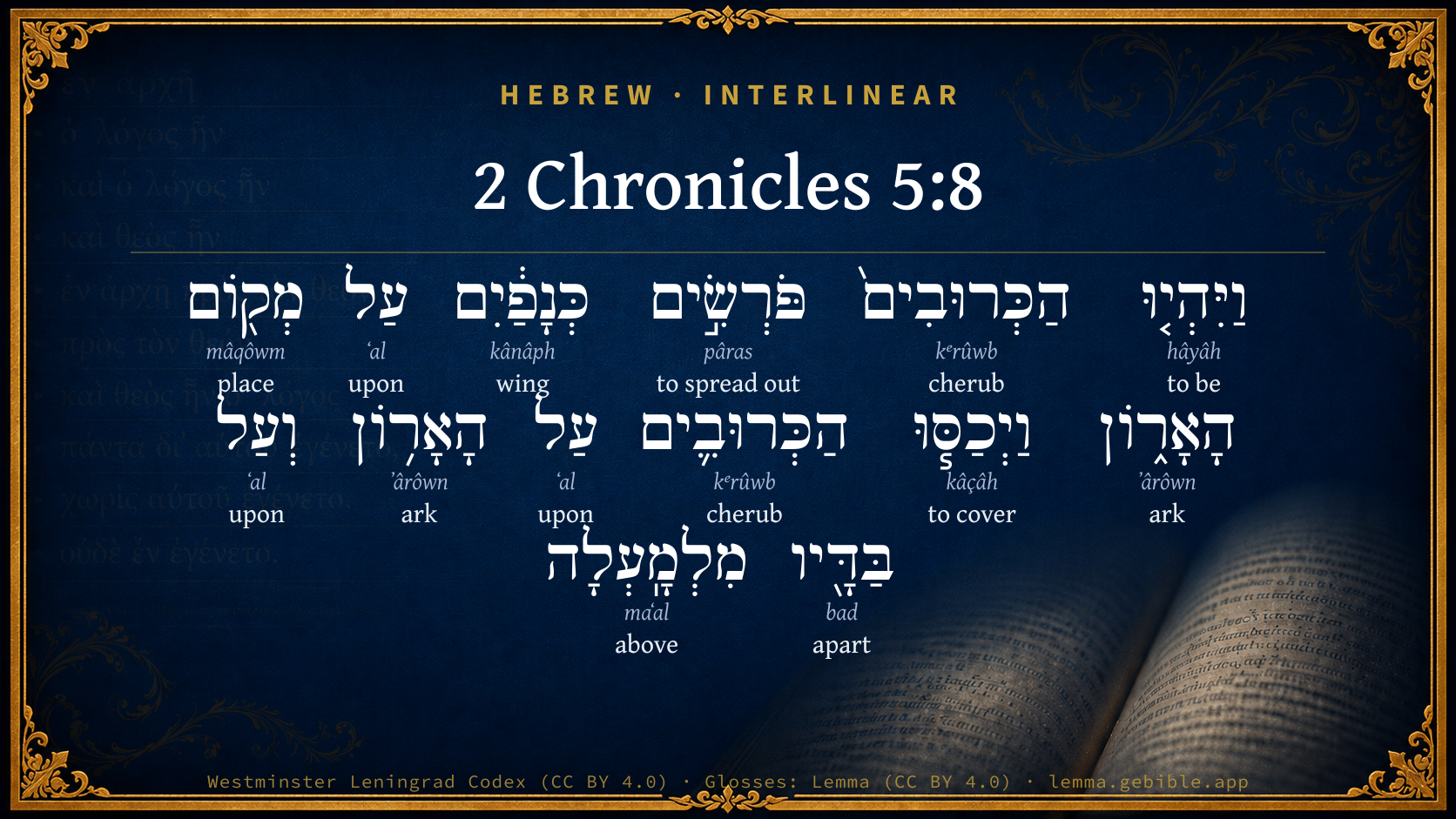
  1. וַיִּהְי֤וּ hâyâh H1961 “and · to be” Conjunction + Verb, Qal, Sequential Imperfect, 3rd Person, Masculine, Plural
  2. הַכְּרוּבִים֙ kᵉrûwb H3742 “the · cherubim” Particle, Definite Article + Noun, Common, Masculine, Plural, Absolute
  3. כְּנָפַ֔יִם kânâph H3671 “wings” Noun, Common, Feminine, Dual, Absolute
  4. עַל ʻal H5921 “upon” Preposition
  5. מְק֖וֹם mâqôwm H4725 “place of” Noun, Common, Masculine, Singular, Construct
  6. הָאָר֑וֹן ʼârôwn H727 “the · ark” Particle, Definite Article + Noun, Common, Both, Singular, Absolute
  7. וַיְכַסּ֧וּ kâçâh H3680 “and · to cover” Conjunction + Verb, Piel, Sequential Imperfect, 3rd Person, Masculine, Plural
  8. הַכְּרוּבִ֛ים kᵉrûwb H3742 “the · cherubim” Particle, Definite Article + Noun, Common, Masculine, Plural, Absolute
  9. עַל ʻal H5921 “upon” Preposition
  10. הָאָר֥וֹן ʼârôwn H727 “the · ark” Particle, Definite Article + Noun, Common, Both, Singular, Absolute
  11. וְעַל ʻal H5921 “and · upon” Conjunction + Preposition
  12. בַּדָּ֖יו bad H905 “poles · his” Noun, Common, Masculine, Plural, Construct + Suffix, Personal, 3rd Person, Masculine, Singular
  13. מִלְמָֽעְלָה maʻal H4605 “from · to/for · above · toward” Preposition + Preposition + Adverb + Suffix, Demonstrative

About this verse

These counts appear in no published source. They are computed here, from the morphology-tagged text and Lemma’s own curated glosses. What Lemma adds →

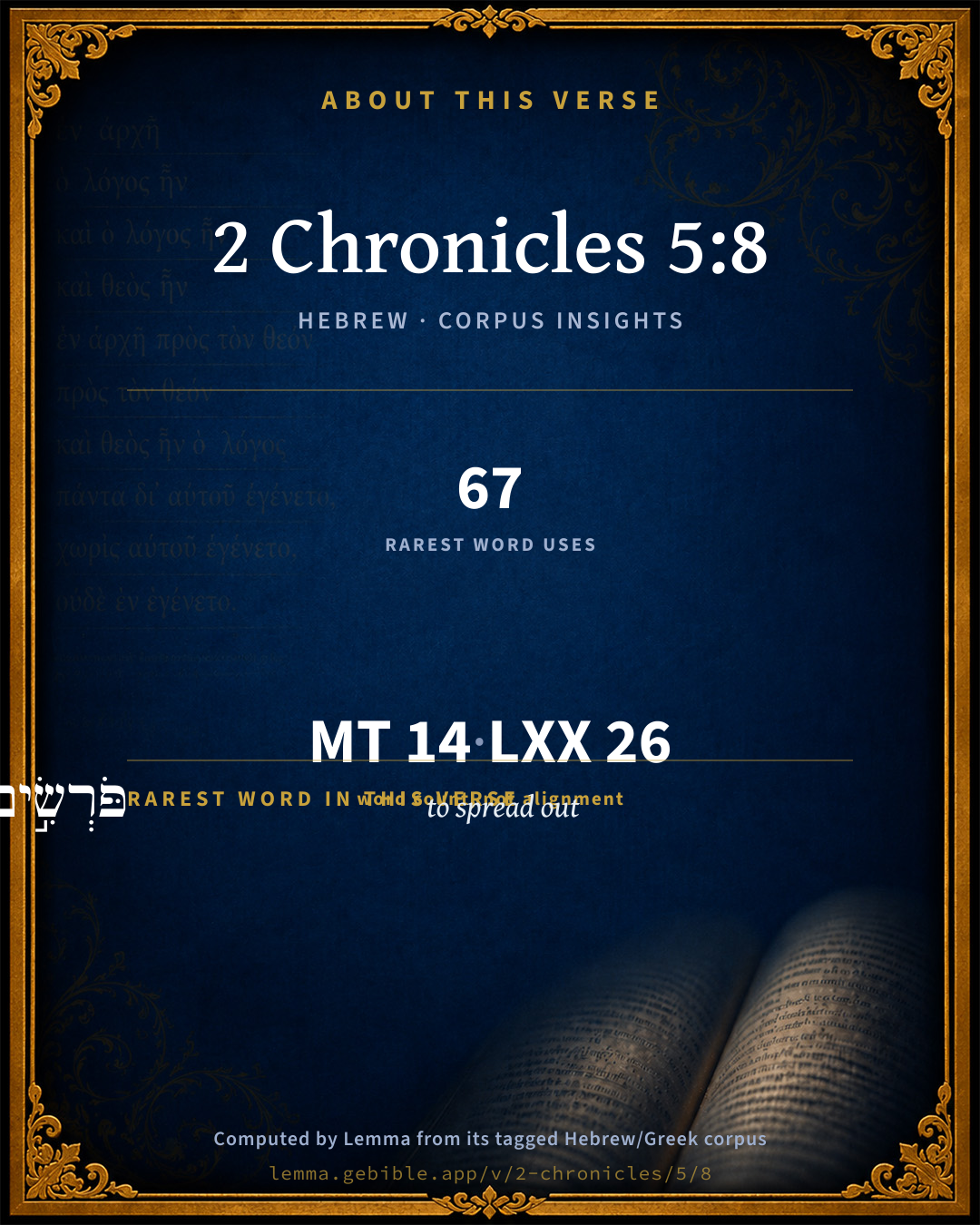
14
words
10
distinct lemmas
Historical
section

Grammatical profile

  • 3 verbs
  • 7 nouns
  • 3 prepositions
  • 1 adverb

Verb forms

  • וַיִּהְי֤וּ Qal · Sequential Imperfect
  • פֹּרְשִׂ֣ים Qal · Participle Active
  • וַיְכַסּ֧וּ Piel · Sequential Imperfect

Repetition

Words recur within this verse — often emphatic in Hebrew:

  • עַל upon H5921 ×3
  • הַכְּרוּבִים֙ cherub H3742 ×2
  • הָאָר֑וֹן ark H727 ×2

Hebrew & Septuagint length

In English translation the verse runs 25 words from the Hebrew and 23 from the Septuagint (LXX English) — closely comparable.

A rough comparison of the two English renderings, which tokenize alike — not a word-level alignment.

Word counts can differ between the Hebrew and the Greek without any difference in meaning — e.g. the Hebrew direct-object marker אֵת has no separate Greek word, and Greek often adds the article ὁ.

In the original languages it is 14 Hebrew tokens and 26 Greek tokens — but the two are counted differently (Hebrew bundles its prefixes and suffixes into one token; the Greek is in lemma form), so that isn’t a like-for-like length.

Cross-references

3

Topical passages linked to 2 Chronicles 5:8 in the Treasury of Scripture Knowledge — connected by theme and wording, ordered by reader-vote popularity; previews shown in the World English Bible.

  • Exodus 25:12–15 You shall cast four rings of gold for it, and put them in its four feet. Two rings shall be on the one side of it, and two rings on the other side of it.
  • Exodus 37:3–5 He cast four rings of gold for it, in its four feet; even two rings on its one side, and two rings on its other side.
  • Numbers 4:6 and shall put a covering of sealskin on it, and shall spread over it a cloth all of blue, and shall put in its poles.

Cross-references courtesy of OpenBible.info (CC BY 4.0).

Hebrew and Greek witnesses Masoretic Hebrew ↔ Greek Septuagint

The same verse in the two great witnesses to the Old Testament, shown verse-for-verse.

These are two independent witnesses, not word-aligned to each other, and the Septuagint is shown in lemma (dictionary) form.

Hebrew 2 Chronicles 5:8 Masoretic · Westminster Leningrad Codex

וַיִּהְי֤וּ הַכְּרוּבִים֙ פֹּרְשִׂ֣ים כְּנָפַ֔יִם עַל מְק֖וֹם הָאָר֑וֹן וַיְכַסּ֧וּ הַכְּרוּבִ֛ים עַל הָאָר֥וֹן וְעַל בַּדָּ֖יו מִלְמָֽעְלָה

For the cherubim spread forth their wings over the place of the ark, and the cherubim covered the ark and the poles of it above.

World English Bible · Public Domain

Greek LXX 2 Chronicles 5:8 Septuagint · lemma form

καί εἰμί ὁ χερουβιν διαπετάζω ὁ πτέρυξ αὐτός ἐπί ὁ τόπος ὁ κιβωτός καί συνκαλύπτω ὁ χερουβιν ἐπί ὁ κιβωτός καί ἐπί ὁ ἀναφορεύς αὐτός ἐπάνωθεν

And the cherubs stretched out their wings over the place of the ark, and the cherubs covered the ark, and its staves above.

LXX2012 (modern English Septuagint) · Public Domain

Hebrew: Westminster Leningrad Codex (CC BY 4.0). Greek: Septuagint (public domain); English from LXX2012 (modern English Septuagint) (Public Domain). How the Septuagint differs from the Hebrew →

Commentary

Notes on 2 Chronicles 5:8 from classic Christian and Jewish commentators (each source and its license shown beneath its notes). The classic Christian expositions comment on the surrounding passage and are grouped to its opening verse, so a note may address several verses; the Jewish commentaries on the Tanakh (Rashi and others) are per-verse, so they appear only where the commentator wrote on this verse.

Lemma curates 59 commentaries, every one of them public domain or Creative Commons licensed, each selected and text-cleaned for this edition rather than reprinted as found. About our sources →

Ellicott's Commentary for English Readers

(8) For the cherubims spread forth their wings.—Rather, And the cherubim were spreading forth wings. Kings has for (kî); making the sentence an explanation of the last clause of 2Ch_5:7.

Covered.—Kings has the technical term for the cherubim “covering” the ark (Exo_25:20; 1Ch_28:18). In Hebrew writing, the difference is marked by the transposition of a single letter. Perhaps, therefore, our present reading is a clerical error.

A Bible Commentary for English Readers, edited by Charles John Ellicott (1878–1897) — public domain. Text from a community e-Sword module.

Rashi

Rabbi Shlomo Yitzchaki (Rashi)

And the cherubim were spreading their wings over the place of the Ark in the place where the Ark was standing Therefore -

and the cherubim covered over the Ark and over its staves from above above the Ark. So were the staves standing, and they extended so far out toward the east, that the Ark could stand exactly beneath the cherubim without the hindrance of the staves. Therefore, “and the cherubim covered over the Ark.” And they also covered part of the staves adjacent to the Ark, but not all of them, because they reached until the east. But you cannot explain that the cherubim covered the entire staves. And also, because of this—And they extended the staves so that the ends of the staves were seen from the Ark before the Debir For if it were not so, but [if they were] the same; i.e., if they were extended with one measure one from the other, [i.e., the part of the staves extending eastward equaled the part extending westward]. The staves that Moses made were still there, and they stood in the Holy of Holies of the Tent of Meeting, which was only ten [cubits], whereas this was twenty [cubits], and it reached from wall to wall. With the cherubim of Moses, about which it is also written, “spreading and covering,” they did not have to move any part of the staves from their place, because the cherubim of Moses were standing over the Ark on the Ark cover, but as for the cherubim mentioned here-Solomon made them standing on their feet on the ground, but nevertheless, those of Moses were still attached to the Ark cover. This is how Rabbi Nathan explained it, (but our Rabbi explained) that the priests wished to bring the Ark into the Debir with its staves, but they were unable to do so, because the Cloud filled the House of the Lord, and they could not bring the cherubim up to the western wall. Therefore, they [the staves] protruded into the dividing curtain. To me, this poses a difficulty, however, because it is written (I Kings 8:10f.): “And it came to pass when the priests came out, etc.,” and afterwards, “the glory of the Lord filled the House of God (sic).” (Rabbi Joseph of blessed memory, however, explained) that it does not say וַיִּתְאָרְכוּ [in the reflexive conjugation], which would mean that they became elongated by themselves, but וַיַּאֲרִיכוּ [in the causative conjugation], which means that others elongated them, and he explained that the craftsmen elongated them to twenty cubits, and their two ends touched the eastern wall and their [other] two ends touched the western wall. It is, however, puzzling how they could spread out their wings and cover the Ark, which was ten cubits from them.

Rashi on the Tanakh — English translations: “The Judaica Press complete Tanach with Rashi, translated by A. J. Rosenberg” (CC BY 4.0); “Pentateuch with Rashi's commentary by M. Rosenbaum and A.M. Silbermann, 1929-1934” (public domain); “The Metsudah Tanach series, Lakewood, N.J” (CC BY 4.0); and “The Book of Joshua, Metsudah Publications, 1997” (CC BY 4.0). Text via Sefaria.

Lesson kit

Teaching starters — assembled from the data on this page, not authored interpretation. Every prompt links to the verse data it draws on. Edit before teaching.

2 Chronicles, in the Historical, opens this verse with 14 words (10 distinct Hebrew lemmas). Its most distinctive word is pâras (“to spread out”). A historical commentator’s framing appears above. Read the whole chapter for the surrounding context.

Discussion questions

  1. The word pâras carries the sense “to spread out.” How does it shape the verse?
  2. How does Exodus 25:12–15, which shares this passage’s theme, read alongside this verse?
  3. What does the repetition of “upon” (3× in this one verse) do in this verse?
  4. These translations render this verse differently; the difference is in the English rendering, not the original. What questions does that raise?
  5. «וַיִּהְי֤וּ» is a Qal Sequential Imperfect verb. How does that grammatical form shape the action described?
  6. Compare how Ellicott's Commentary for English Readers and Rashi read this verse. Where do they agree or differ?

Things to notice

Reading settings

Reading text

Shown beneath each verse's original-language words.

Old Testament
Old Testament edition

Read the OT as the Masoretic Hebrew (MT) or the Greek Septuagint (LXX).

English shown for the Greek Septuagint (in the Hebrew ↔ Greek comparison).

Comparing translations? Open the Compare panel on any verse page to stack up to four side by side.