
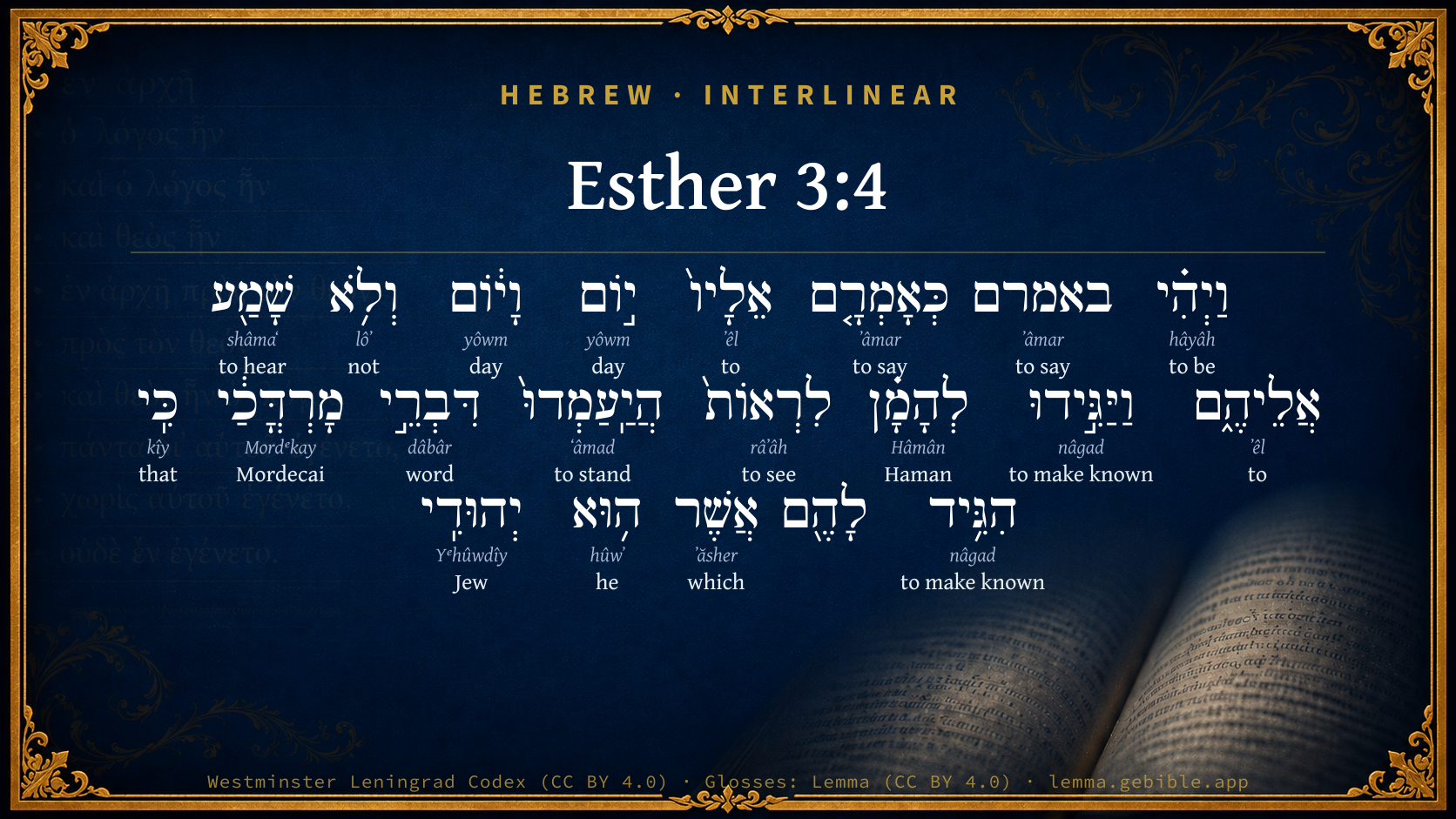
Esther 3:4

Hebrew (Westminster Leningrad Codex) Esther 3:4 appears in the Hebrew Old Testament. The text above is from the Westminster Leningrad Codex. Each word links to its Strong’s number, a concise gloss, and parsing drawn from the Open Scriptures Hebrew Bible morphology. Click any word for its full Brown-Driver-Briggs (BDB) entry.
Download image
Cite this verse

Esther 3:4 (World English Bible). Public Domain. Lemma interlinear Bible study tool, https://lemma.gebible.app/v/esther/3/4.

Show BibTeX & RIS
BibTeX
RIS
English Translation
Now it came to pass, when they spoke daily to him, and he didn't listen to them, that they told Haman, to see whether Mordecai's matters would stand: for he had told those who he was a Jew.
World English Bible · Public Domain
Download a study sheet

One document with this verse’s original text, its word-by-word gloss line, the meaning frame, cross-references with their text, attributed commentary, and full source and license credits — printable, and it pastes into notes with its structure intact.

This verse Autodidact and up

Study sheet (.html) Plain text (.txt)

A passage Seminary Student

Up to 50 verses in one chapter. A passage sheet keeps up to 6 commentary sources and 12 cross-references per verse, in the order this page ranks them, and says so on the sheet whenever that leaves anything out. Ask for a single verse and you get the Autodidact verse sheet above.

Everything on this page stays free to read, with no account — the sheet is a download of what is already on screen, not access to it.

Want to remove ads? Support Godless Engineer
Compare translations 3

The same verse in 3 English versions, stacked beneath the original-language interlinear above. Click any original word for its lexicon entry.

Each is an independent rendering of the whole verse — the interlinear is not word-aligned to these translations.

Highlighted words mark where these versions differ — a whole-verse word diff, not a word-by-word alignment.

  • World English Bible Public Domain
    Now it came to pass, when they spoke daily to him, and he didn't listen to them, that they told Haman, to see whether Mordecai's matters would stand: for he had told those who he was a Jew.
  • King James Version Public Domain
    Now it came to pass, when they spake daily unto him, and he hearkened not unto them, that they told Haman, to see whether Mordecai's matters would stand: for he had told them that he was a Jew.
  • unfoldingWord Literal Text CC BY-SA 4.0
    And it happened that, when they spoke to him day after day, he did not listen to them. So they told Haman to see if the words of Mordecai would stand, for he had told them that he was a Jew.

unfoldingWord Literal Text — © unfoldingWord, licensed CC BY-SA 4.0. Word-aligned USFM3 via Door43 (git.door43.org/unfoldingWord/en_ult).

Versions to compare (up to 4)

3 of 4 selected

Show all 18 translations

Every available English version of this verse, each an independent rendering of the whole verse.

  • World English Bible Public Domain
    Now it came to pass, when they spoke daily to him, and he didn't listen to them, that they told Haman, to see whether Mordecai's matters would stand: for he had told those who he was a Jew.
  • Berean Standard Bible Public Domain
    Day after day they warned him, but he would not comply. So they reported it to Haman to see whether Mordecai’s behavior would be tolerated, since he had told them he was a Jew.
  • Majority Standard Bible Public Domain
    Day after day they warned him, but he would not comply. So they reported it to Haman to see whether Mordecai’s behavior would be tolerated, since he had told them he was a Jew.
  • King James Version Public Domain
    Now it came to pass, when they spake daily unto him, and he hearkened not unto them, that they told Haman, to see whether Mordecai's matters would stand: for he had told them that he was a Jew.
  • American Standard Version (1901) Public Domain
    Now it came to pass, when they spake daily unto him, and he hearkened not unto them, that they told Haman, to see whether Mordecai's matters would stand: for he had told them that he was a Jew.
  • Revised Version (1885) Public Domain
    Now it came to pass, when they spake daily unto him, and he hearkened not unto them, that they told Haman, to see whether Mordecai’s matters would stand: for he had told them that he was a Jew.
  • Geneva Bible (1599) Public Domain
    And albeit they spake dayly vnto him, yet he would not heare them: therefore they tolde Haman, that they might see how Mordecais matters would stande: for he had tolde them, that he was a Iewe.
  • Douay-Rheims (1899) Public Domain
    And when they were saying this often, and he would not hearken to them; they told Aman, desirous to know whether he would continue in his resolution: for he had told them that he was a Jew.
  • Young's Literal Translation Public Domain
    And it cometh to pass, in their speaking unto him, day by day, and he hath not hearkened unto them, that they declare `it' to Haman, to see whether the words of Mordecai do stand, for he hath declared to them that he `is' a Jew.
  • Literal Standard Version CC BY-SA 4.0
    And it comes to pass, in their speaking to him, day by day, and he has not listened to them, that they declare [it] to Haman, to see whether the words of Mordecai stand, for he has declared to them that he [is] a Jew.
  • Unlocked Literal Bible CC BY-SA 4.0
    They spoke with him day after day, but he refused to comply with their demands. So they spoke with Haman to see if the matter about Mordecai would remain like that, for he had told them that he was a Jew.
  • unfoldingWord Literal Text CC BY-SA 4.0
    And it happened that, when they spoke to him day after day, he did not listen to them. So they told Haman to see if the words of Mordecai would stand, for he had told them that he was a Jew.
  • Darby Bible Public Domain
    And it came to pass as they spoke daily to him, and he hearkened not to them, that they informed Haman, to see whether Mordecai's matters would stand; for he had told them that he was a Jew.
  • World Messianic Bible Public Domain
    Now it came to pass, when they spoke daily to him, and he didn’t listen to them, that they told Haman, to see whether Mordecai’s reason would stand; for he had told them that he was a Jew.
  • Webster's Bible Public Domain
    Now it came to pass, when they spoke daily to him, and he hearkened not to them, that they told Haman, to see whether Mordecai's matters would stand: for he had told them that he was a Jew.
  • Free Bible Version CC BY-SA 4.0
    They talked to him about it day after day, but he refused to listen. So they told Haman about it to see if he would put up with what Mordecai was doing, for Mordecai had told them he was a Jew.
  • Bible in Basic English Public Domain
    Now when they had said this to him day after day and he gave no attention, they let Haman have news of it, to see if Mordecai's behaviour would be overlooked: for he had said to them that he was a Jew.
  • JPS Tanakh (1917) Public Domain
    Now it came to pass, when they spoke daily unto him, and he hearkened not unto them, that they told Haman, to see whether Mordecai's words would stand; for he had told them that he was a Jew.

Literal Standard Version (2020), Covenant Press — licensed CC BY-SA 4.0. Text via the HelloAO Bible API (eBible.org). Unlocked Literal Bible (unfoldingWord) — licensed CC BY-SA 4.0. Text via the HelloAO Bible API (eBible.org). unfoldingWord Literal Text — © unfoldingWord, licensed CC BY-SA 4.0. Word-aligned USFM3 via Door43 (git.door43.org/unfoldingWord/en_ult). Free Bible Version, Dr. Jonathan Gallagher — licensed CC BY-SA 4.0. Text via the HelloAO Bible API (eBible.org).

Word by word

More ways to search: Search by grammar → Find every occurrence → Compare this word →

Practice this passage: Drill this verse → Learn its vocabulary →

לְהָמָ֗ן
Hâmân
H2001
“to/for · Haman”
Preposition + Noun, Proper
Part of Speech
Preposition + Noun
Type
Proper
Full BDB Definition

Origin: of foreign derivation

TWOT: None

Haman = "magnificent" - chief minister of Ahasuerus, enemy of Mordecai and the Jews, who plotted to kill the Jews but, being foiled by Esther, was hanged, with his family, on the gallows he had made for Mordecai
  1. וַיְהִ֗י hâyâh H1961 “and · to be” Conjunction + Verb, Qal, Sequential Imperfect, 3rd Person, Masculine, Singular
  2. באמרם ʼâmar H559 “in/at · to say · them” Preposition + Verb, Qal, Infinitive Construct + Suffix, Personal, 3rd Person, Masculine, Plural
  3. כְּאָמְרָ֤ם ʼâmar H559 “like/as · to say · them” Preposition + Verb, Qal, Infinitive Construct + Suffix, Personal, 3rd Person, Masculine, Plural
  4. אֵלָיו֙ ʼêl H413 “to · him” Preposition + Suffix, Personal, 3rd Person, Masculine, Singular
  5. י֣וֹם yôwm H3117 “day” Noun, Common, Masculine, Singular, Absolute
  6. וָי֔וֹם yôwm H3117 “and · day” Conjunction + Noun, Common, Masculine, Singular, Absolute
  7. וְלֹ֥א lôʼ H3808 “and · not” Conjunction + Particle, Negative
  8. שָׁמַ֖ע shâmaʻ H8085 “to hear” Verb, Qal, Perfect, 3rd Person, Masculine, Singular
  9. אֲלֵיהֶ֑ם ʼêl H413 “to · them” Preposition + Suffix, Personal, 3rd Person, Masculine, Plural
  10. וַיַּגִּ֣ידוּ nâgad H5046 “and · to make known” Conjunction + Verb, Hiphil, Sequential Imperfect, 3rd Person, Masculine, Plural
  11. לִרְאוֹת֙ râʼâh H7200 “to see” Preposition + Verb, Qal, Infinitive Construct
  12. הֲיַֽעַמְדוּ֙ ʻâmad H5975 “to stand” Particle, Interrogative + Verb, Qal, Imperfect, 3rd Person, Masculine, Plural
  13. דִּבְרֵ֣י dâbâr H1697 “words of” Noun, Common, Masculine, Plural, Construct
  14. מָרְדֳּכַ֔י Mordᵉkay H4782 “Mordecai” Noun, Proper
  15. כִּֽי kîy H3588 “that” Conjunction
  16. הִגִּ֥יד nâgad H5046 “to make known” Verb, Hiphil, Perfect, 3rd Person, Masculine, Singular
  17. אֲשֶׁר ʼăsher H834 “which” Particle, Relative
  18. ה֥וּא hûwʼ H1931 “he” Pronoun, Personal, 3rd Person, Masculine, Singular
  19. יְהוּדִֽי Yᵉhûwdîy H3064 “Jew” Noun, Gentilic, Masculine, Singular, Absolute

About this verse

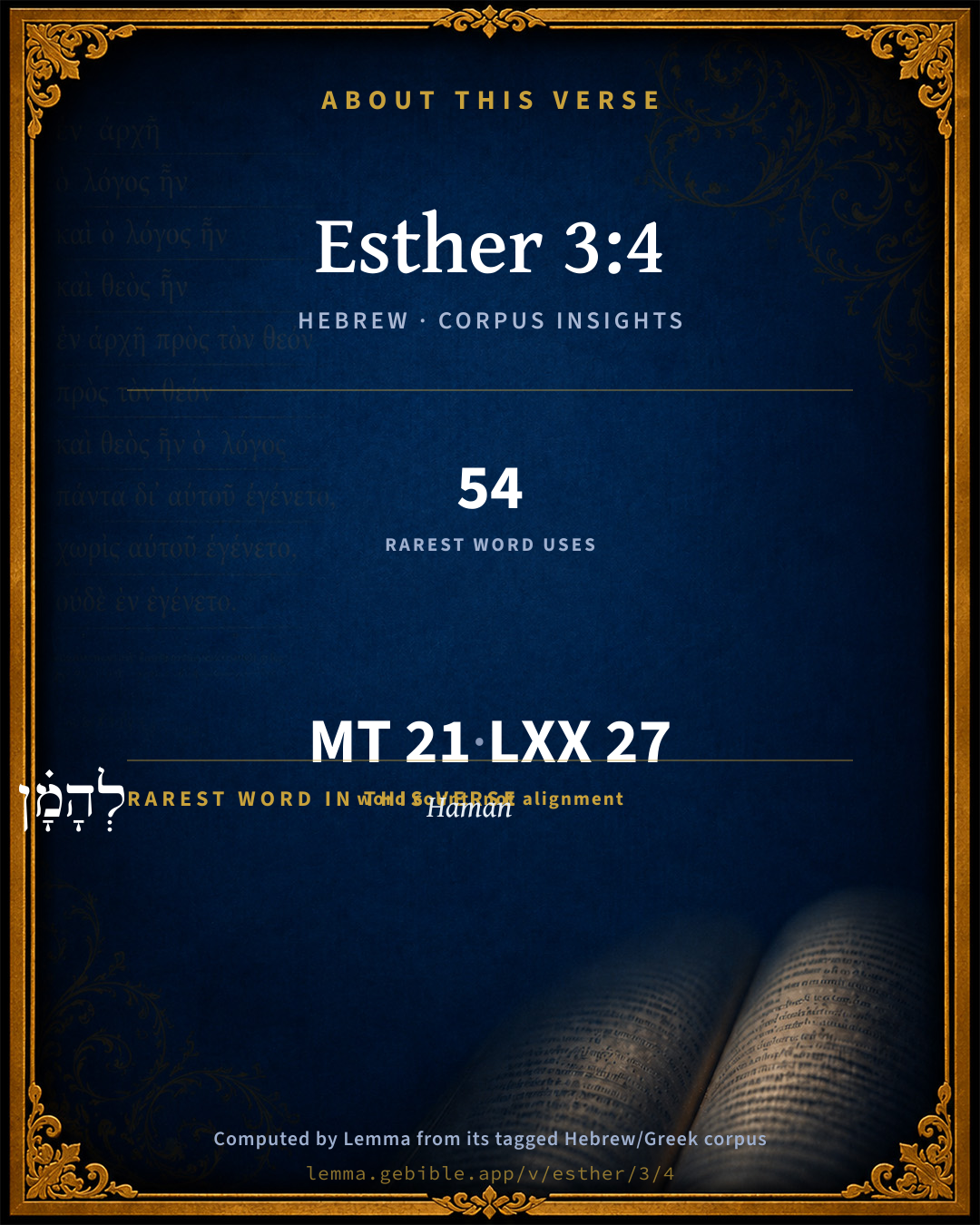
These counts appear in no published source. They are computed here, from the morphology-tagged text and Lemma’s own curated glosses. What Lemma adds →

21
words
16
distinct lemmas
Historical
section

Shared distinctive vocabulary

לְהָמָ֗ן Haman H2001 occurs in 45 verses of the Hebrew Bible. Also found in:

Grammatical profile

  • 8 verbs
  • 6 nouns
  • 1 pronoun
  • 3 prepositions
  • 1 conjunction
  • 2 particles

Verb forms

  • וַיְהִ֗י Qal · Sequential Imperfect
  • באמרם Qal · Infinitive Construct
  • כְּאָמְרָ֤ם Qal · Infinitive Construct
  • שָׁמַ֖ע Qal · Perfect
  • וַיַּגִּ֣ידוּ Hiphil · Sequential Imperfect
  • לִרְאוֹת֙ Qal · Infinitive Construct
  • הֲיַֽעַמְדוּ֙ Qal · Imperfect
  • הִגִּ֥יד Hiphil · Perfect

Repetition

Words recur within this verse — often emphatic in Hebrew:

  • באמרם to say H559 ×2
  • י֣וֹם day H3117 ×2
  • וַיַּגִּ֣ידוּ to make known H5046 ×2
  • אֵלָיו֙ to H413 ×2

Hebrew & Septuagint length

In English translation the verse runs 38 words from the Hebrew and 36 from the Septuagint (LXX English) — closely comparable.

A rough comparison of the two English renderings, which tokenize alike — not a word-level alignment.

Word counts can differ between the Hebrew and the Greek without any difference in meaning — e.g. the Hebrew direct-object marker אֵת has no separate Greek word, and Greek often adds the article ὁ.

In the original languages it is 21 Hebrew tokens and 27 Greek tokens — but the two are counted differently (Hebrew bundles its prefixes and suffixes into one token; the Greek is in lemma form), so that isn’t a like-for-like length.

Cross-references

9

Topical passages linked to Esther 3:4 in the Treasury of Scripture Knowledge — connected by theme and wording, ordered by reader-vote popularity; previews shown in the World English Bible.

  • Genesis 39:10 It happened that as she spoke to Joseph day by day, that he didn't listen to her, to lie by her, or to be with her.
  • Daniel 6:20–28 When he came near to the den to Daniel, he cried with a lamentable voice; the king spoke and said to Daniel, Daniel, servant of the living God, is your God, whom you serve continually, able to deliver you from the lions?
  • Jonah 1:9 He said to them, "I am a Hebrew, and I fear Yahweh, the God of heaven, who has made the sea and the dry land."
  • Daniel 6:13 Then answered they and said before the king, That Daniel, who is of the children of the captivity of Judah, doesn't regard you, O king, nor the interdict that you have signed, but makes his petition three times a day.
  • Ezra 1:3 Whoever there is among you of all his people, his God be with him, and let him go up to Jerusalem, which is in Judah, and build the house of Yahweh, the God of Israel (he is God), which is in Jerusalem.
  • Daniel 3:8–9 Therefore at that time certain Chaldeans came near, and brought accusation against the Jews.
  • Daniel 3:12 There are certain Jews whom you have appointed over the affairs of the province of Babylon: Shadrach, Meshach, and Abednego; these men, O king, have not regarded you: they don't serve your gods, nor worship the golden image which you have set up.
  • Daniel 3:16–18 Shadrach, Meshach, and Abednego answered the king, Nebuchadnezzar, we have no need to answer you in this matter.
  • Daniel 3:23–30 These three men, Shadrach, Meshach, and Abednego, fell down bound into the midst of the burning fiery furnace.

Cross-references courtesy of OpenBible.info (CC BY 4.0).

Hebrew and Greek witnesses Masoretic Hebrew ↔ Greek Septuagint

The same verse in the two great witnesses to the Old Testament, shown verse-for-verse.

These are two independent witnesses, not word-aligned to each other, and the Septuagint is shown in lemma (dictionary) form.

Hebrew Esther 3:4 Masoretic · Westminster Leningrad Codex

וַיְהִ֗י באמרם כְּאָמְרָ֤ם אֵלָיו֙ י֣וֹם וָי֔וֹם וְלֹ֥א שָׁמַ֖ע אֲלֵיהֶ֑ם וַיַּגִּ֣ידוּ לְהָמָ֗ן לִרְאוֹת֙ הֲיַֽעַמְדוּ֙ דִּבְרֵ֣י מָרְדֳּכַ֔י כִּֽי הִגִּ֥יד לָהֶ֖ם אֲשֶׁר ה֥וּא יְהוּדִֽי

Now it came to pass, when they spoke daily to him, and he didn't listen to them, that they told Haman, to see whether Mordecai's matters would stand: for he had told those who he was a Jew.

World English Bible · Public Domain

Greek LXX Esther 3:4 Septuagint · lemma form

κατά ἕκαστος ἡμέρα λαλέω αὐτός καί οὐ ὑποἀκούω αὐτός καί ὑποδεικνύω ὁ αμαν μαρδοχαῖος ὁ ὁ βασιλεύς λόγος ἀντιτάσσω καί ὑποδεικνύω αὐτός ὁ μαρδοχαῖος ὅτι ἰουδαῖος εἰμί

Thus they spoke daily to him, but he listened not to them; so they represented to Aman that Mardochaeus resisted the commands of the king: and Mardochaeus had shown to them that he was a Jew.

LXX2012 (modern English Septuagint) · Public Domain

Hebrew: Westminster Leningrad Codex (CC BY 4.0). Greek: Septuagint (public domain); English from LXX2012 (modern English Septuagint) (Public Domain). How the Septuagint differs from the Hebrew →

Commentary

Notes on Esther 3:4 from classic Christian and Jewish commentators (each source and its license shown beneath its notes). The classic Christian expositions comment on the surrounding passage and are grouped to its opening verse, so a note may address several verses; the Jewish commentaries on the Tanakh (Rashi and others) are per-verse, so they appear only where the commentator wrote on this verse.

Lemma curates 59 commentaries, every one of them public domain or Creative Commons licensed, each selected and text-cleaned for this edition rather than reprinted as found. About our sources →

Trapp's Complete Commentary

John Trapp

Est 3:4 Now it came to pass, when they spake daily unto him, and he hearkened not unto them, that they told Haman, to see whether Mordecai’s matters would stand: for he had told them that he [was] a Jew.

Ver. 4. Now it came to pass, when they spake daily unto him] This, if they did of good-will (as at first perhaps they did), it was a friendly office, and may shame many of us who are so backward to Christian admonition (see my common-places), that spiritual alms, that we are bound freely to distribute, Jdg 1:22-23. But it; as is likely, at length at least they did it to ingratiate with Haman, and out of envy to Mordecai, because he did not comply and comport with them, what did they else but act the devil’s part, and the rather, because they were importunate and impudent as not to take an answer?

And he hearkened not unto them] They did but surdo fabulam (as they say), beat upon cold iron; this matter was not malleable, this man not to be prevailed with, to do aught against his conscience. The heavens shall sooner fall than I will alter mine opinion, said that martyr. This the persecutors called obstinacy; seal pro hac obstinatione fidei morimur, saith Tertullian, but for this obstinacy of faith we gladly die; and the stronger any are in faith the more resolute in warrantable purposes. The strength of Israel repenteth not, 1Sa 15:29. Inconstancy comes from weakness.

That they told Haman] Purposely to pick a thank and curry favour. Go not about as a tale bearer, Lev 19:16. The word signifieth as a pedlar, that first filleth his pack with tales and slanders, and then venteth them to the hurt of others. Such are fitly joined with flatterers, Pro 20:19, and with murderers, Eze 22:9. Such a wretched pedlar was Doeg, and such were these evil instruments in the text, whose tongues were as sharp as the quills of a porcupine, the poison of asps was under their lips. And although it was truth they told Haman, yet because they did it not for any love to the truth, nor for respect to justice, nor for the bettering of either party, but only to undo the one, and to incense the other, they were no better than slanderers.

To see whether Mordecai’s matters would stand] Whether he would stick to his principles, and not start aside for any terror, Php 1:28.

For he had told them that he was a Jew] That is, by interpretation, a confesssor; yea, more, he was a stout professor of the truth; and though he had hitherto concealed himself, yet now (since they will needs have it so) he plainly tells them his country, and his conscience, the true cause of his peremptoriness, which they held and called pride and stubbornness.

John Trapp, A Commentary or Exposition upon All the Books of the Old and New Testament (1647–1656) — public domain. Text from a community e-Sword module.

Joseph Benson's Commentary

Est 3:4. To see whether Mordecai’s matters would stand — Whether he would persist in his refusal, and what the event of it would be; for he had told them that he was a Jew — And therefore did not deny this reverence to Haman out of pride, or any personal grudge against him, much less from a rebellious mind, and contempt of the king’s authority and command, but merely out of conscience, being obliged, as a Jew, to give such honour to God only.

Joseph Benson's Commentary on the Old and New Testaments (1811–1818) — public domain. Text from a community e-Sword module.

Geneva Bible (1599)

Geneva Bible translators

Thus we see that there is none so wicked, but they have their flatterers to accuse the godly.

Geneva Bible (1599) marginal notes — public domain. Text via Bolls.life.

Ellicott's Commentary for English Readers

(4) Whether Mordecai’s matters would stand.—This should be, his words: whether his statement that he belonged to a nation who might only pay such reverence to God, would hold good.

A Bible Commentary for English Readers, edited by Charles John Ellicott (1878–1897) — public domain. Text from a community e-Sword module.

The Cambridge Bible for Schools and Colleges

gen. ed. J. J. S. Perowne

4. whether Mordecai’s matters would stand] The Heb. expression signifies either matters or words. They desired to know whether his refusal would pass with impunity. In their eyes it was not only a breach of custom but a piece of unwarrantable presumption.

for he had told them that he was a Jew] The point of this clause is not clear. It may mean that they desired to see whether his nationality would exempt him from prostration, or, on the other hand that they expected him, as belonging to a captive race, to be treated with special severity.

The Cambridge Bible for Schools and Colleges (gen. ed. J. J. S. Perowne; Cambridge University Press, 1878–1918) — public domain. Text from a community e-Sword module.

John Gill's Exposition

Now it came to pass, when they spake daily unto him,.... Putting him in mind of his duty to obey the king's command, suggesting to him the danger he exposed himself to, pressing him to give the reasons of his conduct:

and he hearkened not unto them; regarded not what they said, and continued disobedient to the king's order, and disrespectful to Haman

that they told Haman, to see whether Mordecai's matters would stand; they informed Haman that Mordecai refused to give him reverence as the king had ordered; this they did to try whether such a conduct would be suffered and bore with, and whether Mordecai would persevere in it when taken notice of:

for he had told them that he was a Jew; which was all the reason he gave why he would not reverence Haman; and a reason sufficient, because, by a fundamental law of his religion, he was not to worship mere man, but God only: and this confirms what has been before observed; for this would have been no reason for refusing civil respect and honour, but was a strong one for denying religious worship and reverence; and no wonder that the Jews should refuse it, when even the Grecians, though Heathens, refused to give the Persian kings the divine honours they required (m); yea, the Athenians put Timagoras to death for prostrating himself in such a manner to Darius (n); for the Persian kings were, as Aristotle says (o), called Lord and God, and said to hear and see all things.

(m) Herodot. Polymnia, sive, l. 7. c. 136. Justin e Trogo. l. 6. c. 2. Aelian. Var. Hist. l. 1. 21. (n) Plutarch. in Artaxerxe, Valer. Maxim. l. 6. c. 3. (o) De Mundo, c. 6.

John Gill's Exposition of the Whole Bible (1746–1763) — public domain (CC PDM 1.0). Text via the HelloAO Bible API.

Albert Barnes' Notes on the Bible

Whether Mordecai’s matters would stand - Rather, “whether Mordecai’s words would hold good” - whether, that is, his excuse, that he was a Jew, would be allowed as a valid reason for his refusal.

Albert Barnes' Notes on the Bible (1834–1885) — public domain. Text from a community e-Sword/MySword module.

Haydock's Catholic Bible Commentary

Resolution. The did not mean to injure Mardochai, who had an employment at court, chap. xii. 5. (Calmet) --- Jew, and of course hindered by his religion from giving divine worship to any man. (Menochius)

George Leo Haydock (1774–1849), Haydock's Catholic Family Bible and Commentary, 1859 edition — public domain. Excludes Psalms (Douay-Rheims chapter numbering differs from Protestant) and Deuterocanonical books (Catholic canon only).

Matthew Poole's English Annotations

Whether Mordecai’s matters would stand, i.e. whether he would persist in his refusal, and what the event of it would be.

He had told them that he was a Jew; and therefore did not deny this reverence to Haman out of pride, or any personal grudge against him, much less out of a rebellious mind and contempt of the king’s authority and command; but merely out of conscience, because he was a Jew, who was obliged to give this honour to none but to God only.

Matthew Poole's English Annotations on the Holy Bible (1683–1685) — public domain. Text from a community e-Sword/MySword module.

Whedon's Commentary on the Bible

Daniel D. Whedon

4. He hearkened not unto them — He would not be persuaded from his purpose to remain true to the principles of his religion. His course was dictated, not by obstinacy, but by firmness of religious principle. Herodotus (vii, 136) relates the case of certain Spartans who visited Shushan in the time of Xerxes, and, when ushered into the royal presence, refused to prostrate themselves and worship the king, on the ground that it was contrary to their customs to worship a man.

They told Haman — Until they told him, Haman seems not to have noticed that Mordecai did not bow down to him.

Whether Mordecai’s matters would stand — Whether the religious scruples of a Jew would be tolerated in opposition to Persian laws and customs.

Daniel D. Whedon (gen. ed.), Commentary on the Old and New Testaments (1874–1909) — public domain. Text from a community e-Sword module.

The Pulpit Commentary

Vers. 4, 5.

A loyal disobedience.

Mordecai"s conduct was indeed striking. All the circumstances added to its impressiveness. The influences that ruled him must have been powerful. Why did he refuse to give homage to Haman? Why was he willing to disobey the king"s command?

I WAS HIS DISOBEDIENCE TO THE ROYAL WILL THE RESULT OF A DISLOYAL SPIRIT? That could not be; for he had recently given a most signal proof of his loyalty in discovering the plot of the conspirators against the king"s life. He was true to the king even when he disobeyed him.

II WAS HIS DISOBEDIENCE THE RESULT OF A VIRTUOUS DISLIKE OF THE WICKED FAVOURITE? Any amount of aversion for so worthless a creature would have been justified. But such an antipathy would hardly account for his disregard of the king"s command. Here duty would have stepped in and saved at once his conscience and his self-respect. It must be remembered that he braved the king as well as Haman.

III WAS HIS DISOBEDIENCE TO THE KING A RESULT AND EXPRESSION OF HIS OBEDIENCE TO THE KING OF KINGS? We now get near to the springs of his singular conduct. Nothing but this loyalty to the God of Israel will account for his calm and persistent daring. The unworthy character and the false eminence of Haman would no doubt have their effect on his mind. But it is only by considering the religious faith and principle of Mordecai that we can reach the true motive that actuated him. And here let us learn some things from the example of the heroic Jew.

1. A wise concession. So long as we can work honourably with those who differ from us in faith and opinion we should gladly co-operate with them. Religious differences should not interfere with civil duties ornational obligations. It is laid on both Jews and Gentiles to be loyal to the throne or government under which they live. A wise conduct is especially required in the followers of God whose lot is cast in heathen lands. While true to their faith in all things, they should avoid an inconsiderate and irritating obtrusiveness. Their aim should be to win by a holy guile, i.e. by "the meekness of wisdom", (Jam_3:13) rather than to repel by a crude and unsympathetic assumption of superior light. There are such things as casting pearls before swine, and swine turning and rending the foolish spendthrift.

2. A good confession. Whenever a time comes when silence as to our faithwould be a sin, we should speak, and speak plainly. There should be no hesitation in naming God, or in witnessing for Christ, when occasion demands a clear testimony. When Mordecai saw that his silence was misinterpreted he declared his Jewish origin and faith. He was an Israelite and a worshipper of the Jehovah of Israel, and as such he could not give worship to any creature of God, even though it should be a Haman. There is a time to be silent, and there is a time to speak.

3. An enduring steadfastness. It is often easier to begin than to continue afaithful witnessing for God. Some who readily acknowledge the truth begin to waver and lose steadfastness in presence of difficulty or danger. They cannot endure. But Mordecai, having once taken his stand on religious principle, remained firm against all temptations. He reminds us of the words of Luther in presence of Charles V: "Here I stand; I cannot do otherwise; God help me. Amen" (Mat_24:13; Jam_1:12)

4. A noble courage. It was not without sober calculation that Mordecairefused homage to Haman. He knew how much he risked. He had "the courage of his convictions." He was

(1) willing to stand alone amongst his companions in service. He could bear their sneers and threats. A hard thing in any position! He

(2) faced the probable anger of the king, to whom he had proved himself loyal. He

(3) braved the malignant wrath of the favourite, from whom he could expect no mercy. He

(4) put in peril the happiness and future guidance of his beloved Esther. He

(5) laid his own life on the altar of righteousness. He

(6) sacrificed every earthly interest to his allegiance to God. We think of Paul"s heroism of faith. (Php_3:8) Then we think of the words of Paul"s Master. D. (Mat_19:29)

HOMILIES BY D. ROWLANDS Ver. 4.

Profession and practice.

The favourites of fortune are generally remarkable for their pride. Especially is this the case with those whom despots delight to honour. Forgetting the worthlessness of the preference to which they owe their promotion being sometimes nothing more than a passing whim they rashly lay claim to universal homage. Haman is therefore the representative of a numerous class, which is not likely soon to become extinct. Mordecai in this instance resolves upon a manly course. He will not join the multitude in feeding the vanity of an inflated upstart. Neither threatening nor persuasion is able to overcome his steadfastness. What could have been Mordecai"s reason for his present conduct? We may well imagine that he had more reasons than one, and that the combined force of several had influenced his decision.

1. Haman possessed a despicable character. Mordecai could not have bowed to him without doing violence to his own nature. He knew the man his insolent bearing, his mean spirit, his cruel disposition and herecoiled from him with unconquerable loathing. And he was right. There are men whom to admire is a degradation, whom to serve involves the ruin of our manhood. They may possess brilliant parts, they may occupy high positions, they may enjoy popular favour; but in a moral point of view they are the pests of society.

2. Haman claimed Divine honours. The court officials prostrated themselves in the dust at his feet, and he regarded such obeisance as his due. How could Mordecai, a worshipper of the Most High, unite in such an extravagant demonstration of servility, even though the object of it had been the worthiest instead of the basest of mankind? To him it was a matter of conscience, and he calmly awaited the consequences. We have here a striking exemplification of PROFESSION AND PRACTICE in perfect harmony. Mordecai declared himself to be a Jew, and conducted himself as a Jew might be expected to do. Note

I MORDECAI"S BOLD PROFESSION. "For he had told them that he was a Jew." This was a brave thing to do; for the Jews were a conquered race. But it was the right thing to do; for to deny his people would have been the height of cowardice. What does profession involve at the present day? Is it simply a tacit avowal that we are Christians? Surely most people will go that length. It must, therefore, imply something more than that, if it is to serve as a distinction amongst us. It means, in fact, an open confession of our attachment to Christ, by identifying ourselves, in some way or other, with his Church. To the true Christian profession is a necessity.

1. It is a duty which he owes to himself. Secret discipleship may be possible under very exceptional circumstances; but it must be most disadvantageous for the development of spiritual power. A plant may grow in the dark, but it cannot attain its full proportions, or put on its robe of beauty, without the light of day. The surest way to overcome temptation is to declare your principles. By the very act you will add to your own strength and weaken the power of the tempter. It was the attempt to disguise himself that led Peter to his fall.

2. It is a duty which he owes to the world. He has found peace himself, and will he hide its source from the troubled hearts among whom he lives? The Divine light has been kindled within him, and will he place himself under a bushel? The misery, the darkness, the sinfulness of the world constitute the world"s claim upon his services, nor can he render the highest services except as a professed servant of Christ.

3. It is a duty which he owes to God. God requires it. No shame, or suffering, or loss should, therefore, make us hesitate in reference to this matter. Our Lord declared that whosoever was ashamed of him in his humiliation he would be ashamed to own when he came in his glory.

II MORDECAI"S CONSISTENT CONDUCT. The king"s servants endeavoured to persuade him to change his attitude, but he would not. "He hearkened not unto them." He was a witness-bearer, a martyr, and possessed a martyr"s courage. Having professed himself to be a Jew, he would make good his profession by adhering to the right. Profession alone is worse than worthless. It injures the professor himself, and the cause with which he claims connection. "Faith without works is dead.

1. To act is admittedly more difficult than to profess. Had Mordecai merely professed himself a Jew, while he behaved like a Gentile, he would probably have experienced no difficulty. Haman would have been satisfied with his homage, and his comrades would have commended his prudence. To say, "Lord, Lord," is one thing; but to do "the will of the Father" is another. There is no grandeur in magnificent words, except when they are backed up by noble deeds. Heroism consists not so much in declaring war as in fighting the enemy.

2. Men learn more easily by example than by precept. Hence the immense importance of consistent conduct, when we consider its influence upon others. If Christianity had never succeeded to produce Christians if it had set up a high ideal which no one ever attempted to approach it would have remained to this day a dead form; and no amount of learning, or reasoningi or eloquence could have persuaded the world to accept it. Men may argue against creeds, but the holy lives which those creeds help to fashion are unassailable. R.

The Pulpit Commentary (1880–1919), ed. H.D.M. Spence-Jones & Joseph S. Exell — public domain. Text from a community e-Sword module.

John Wesley's Explanatory Notes

To see - What the event of it would be. For, &c. - And therefore did not deny this reverence out of pride, but merely out of conscience.

John Wesley, Explanatory Notes Upon the Whole Bible (1754–1765) — public domain. Text via the GEBible commentary corpus.

Rashi

Rabbi Shlomo Yitzchaki (Rashi)

whether Mordecai’s words would stand up [i.e., the words of Mordecai,] who said that he would never prostrate himself because he was a Jew, and was warned against idolatry.

Rashi on the Tanakh — English translations: “The Judaica Press complete Tanach with Rashi, translated by A. J. Rosenberg” (CC BY 4.0); “Pentateuch with Rashi's commentary by M. Rosenbaum and A.M. Silbermann, 1929-1934” (public domain); “The Metsudah Tanach series, Lakewood, N.J” (CC BY 4.0); and “The Book of Joshua, Metsudah Publications, 1997” (CC BY 4.0). Text via Sefaria.

Lesson kit

Teaching starters — assembled from the data on this page, not authored interpretation. Every prompt links to the verse data it draws on. Edit before teaching.

Esther, in the Historical, opens this verse with 21 words (16 distinct Hebrew lemmas). Its most distinctive word is Hâmân (“Haman”). A historical commentator’s framing appears above. Read the whole chapter for the surrounding context.

Discussion questions

  1. How does “Haman” (Hâmân) shape what this verse is saying?
  2. Esther 3:1 shares the word «Haman» with this verse. How do the two illuminate each other?
  3. “to say” occurs 2× in this one verse. What is the effect of the repetition?
  4. These translations render this verse differently. What is at stake in choosing one wording over another?
  5. The verb «וַיְהִ֗י» is Qal Sequential Imperfect. How does its form color the action?
  6. Reading how Trapp's Complete Commentary and Joseph Benson's Commentary read this verse, where do the two commentators agree and where do they part?

Things to notice

Reading settings

Reading text

Shown beneath each verse's original-language words.

Old Testament
Old Testament edition

Read the OT as the Masoretic Hebrew (MT) or the Greek Septuagint (LXX).

English shown for the Greek Septuagint (in the Hebrew ↔ Greek comparison).

Comparing translations? Open the Compare panel on any verse page to stack up to four side by side.