
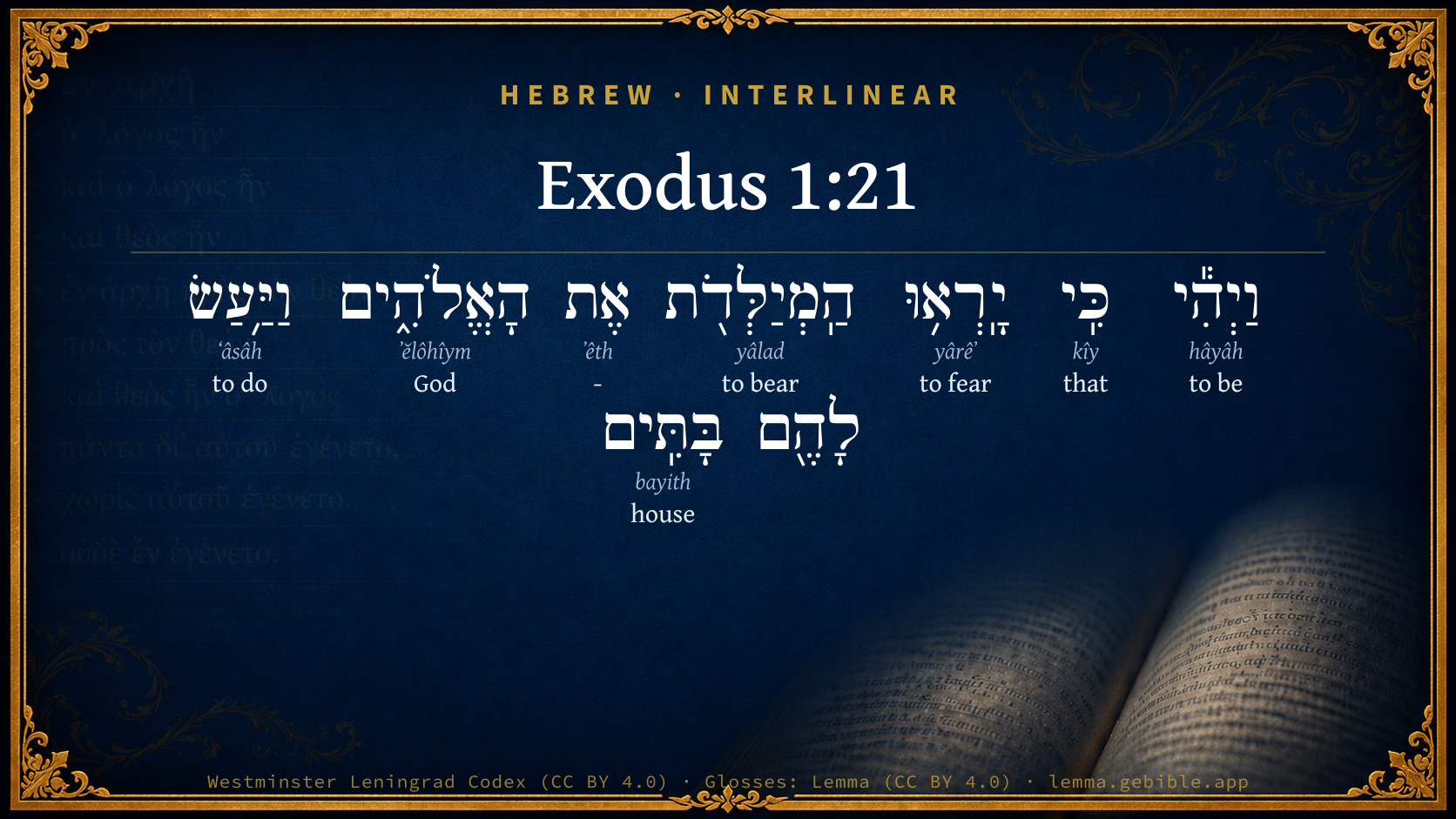
Exodus 1:21

Hebrew (Westminster Leningrad Codex) Exodus 1:21 appears in the Hebrew Old Testament. The text above is from the Westminster Leningrad Codex. Each word links to its Strong’s number, a concise gloss, and parsing drawn from the Open Scriptures Hebrew Bible morphology. Click any word for its full Brown-Driver-Briggs (BDB) entry.
Download image
Cite this verse

Exodus 1:21 (World English Bible). Public Domain. Lemma interlinear Bible study tool, https://lemma.gebible.app/v/exodus/1/21.

Show BibTeX & RIS
BibTeX
RIS
English Translation
It happened, because the midwives feared God, that he gave them families.
World English Bible · Public Domain
Download a study sheet

One document with this verse’s original text, its word-by-word gloss line, the meaning frame, cross-references with their text, attributed commentary, and full source and license credits — printable, and it pastes into notes with its structure intact.

This verse Autodidact and up

Study sheet (.html) Plain text (.txt)

A passage Seminary Student

Up to 50 verses in one chapter. A passage sheet keeps up to 6 commentary sources and 12 cross-references per verse, in the order this page ranks them, and says so on the sheet whenever that leaves anything out. Ask for a single verse and you get the Autodidact verse sheet above.

Everything on this page stays free to read, with no account — the sheet is a download of what is already on screen, not access to it.

Want to remove ads? Support Godless Engineer
Compare translations 3

The same verse in 3 English versions, stacked beneath the original-language interlinear above. Click any original word for its lexicon entry.

Each is an independent rendering of the whole verse — the interlinear is not word-aligned to these translations.

Highlighted words mark where these versions differ — a whole-verse word diff, not a word-by-word alignment.

  • World English Bible Public Domain
    It happened, because the midwives feared God, that he gave them families.
  • King James Version Public Domain
    And it came to pass, because the midwives feared God, that he made them houses.
  • unfoldingWord Literal Text CC BY-SA 4.0
    And it came about, since the midwives feared God, that he made houses for them.

unfoldingWord Literal Text — © unfoldingWord, licensed CC BY-SA 4.0. Word-aligned USFM3 via Door43 (git.door43.org/unfoldingWord/en_ult).

Versions to compare (up to 4)

3 of 4 selected

Show all 18 translations

Every available English version of this verse, each an independent rendering of the whole verse.

  • World English Bible Public Domain
    It happened, because the midwives feared God, that he gave them families.
  • Berean Standard Bible Public Domain
    And because the midwives feared God, He gave them families of their own.
  • Majority Standard Bible Public Domain
    And because the midwives feared God, He gave them families of their own.
  • King James Version Public Domain
    And it came to pass, because the midwives feared God, that he made them houses.
  • American Standard Version (1901) Public Domain
    And it came to pass, because the midwives feared God, that he made them households.
  • Revised Version (1885) Public Domain
    And it came to pass, because the midwives feared God, that he made them houses.
  • Geneva Bible (1599) Public Domain
    And because ye midwiues feared God, therefore he made them houses.
  • Douay-Rheims (1899) Public Domain
    And because the midwives feared God, he built them houses.
  • Young's Literal Translation Public Domain
    and it cometh to pass, because the midwives have feared God, that He maketh for them households;
  • Literal Standard Version CC BY-SA 4.0
    and it comes to pass, because the midwives have feared God, that He makes households for them;
  • Unlocked Literal Bible CC BY-SA 4.0
    Because the midwives feared God, he gave them families.
  • unfoldingWord Literal Text CC BY-SA 4.0
    And it came about, since the midwives feared God, that he made houses for them.
  • Darby Bible Public Domain
    And it came to pass, because the midwives feared God, that he made them houses.
  • World Messianic Bible Public Domain
    Because the midwives feared God, he gave them families.
  • Webster's Bible Public Domain
    And it came to pass, because the midwives feared God, that he made them houses.
  • Free Bible Version CC BY-SA 4.0
    Because the midwives revered God, he gave them families of their own.
  • Bible in Basic English Public Domain
    And because the women who took care of the Hebrew mothers had the fear of God, he gave them families.
  • JPS Tanakh (1917) Public Domain
    And it came to pass, because the midwives feared God, that He made them houses.

Literal Standard Version (2020), Covenant Press — licensed CC BY-SA 4.0. Text via the HelloAO Bible API (eBible.org). Unlocked Literal Bible (unfoldingWord) — licensed CC BY-SA 4.0. Text via the HelloAO Bible API (eBible.org). unfoldingWord Literal Text — © unfoldingWord, licensed CC BY-SA 4.0. Word-aligned USFM3 via Door43 (git.door43.org/unfoldingWord/en_ult). Free Bible Version, Dr. Jonathan Gallagher — licensed CC BY-SA 4.0. Text via the HelloAO Bible API (eBible.org).

Word by word

More ways to search: Search by grammar → Find every occurrence → Compare this word →

Practice this passage: Drill this verse → Learn its vocabulary →

יָֽרְא֥וּ
yârêʼ
H3372
“to fear”
Verb, Qal, Perfect, 3rd Person, Common, Plural
Part of Speech
Verb
Stem
Qal
Form
Perfect
Person
3rd Person
Gender
Common
Number
Plural
Full BDB Definition

Origin: a primitive root

TWOT: 907 , 908

to fear, revere, be afraid - (Qal) - to fear, be afraid - to stand in awe of, be awed - to fear, reverence, honour, respect - (Niphal) - to be fearful, be dreadful, be feared - to cause astonishment and awe, be held in awe - to inspire reverence or godly fear or awe - (Piel) to make afraid, terrify - (TWOT) to shoot, pour
  1. וַיְהִ֕י hâyâh H1961 “and · to be” Conjunction + Verb, Qal, Sequential Imperfect, 3rd Person, Masculine, Singular
  2. כִּֽי kîy H3588 “that” Conjunction
  3. הַֽמְיַלְּדֹ֖ת yâlad H3205 “the · bearing” Particle, Definite Article + Verb, Piel, Participle Active, Feminine, Plural, Absolute
  4. אֶת ʼêth H853 “-” Particle, Direct Object
  5. הָאֱלֹהִ֑ים ʼĕlôhîym H430 “the · God(s)” Particle, Definite Article + Noun, Common, Masculine, Plural, Absolute
  6. וַיַּ֥עַשׂ ʻâsâh H6213 “and · to do” Conjunction + Verb, Qal, Sequential Imperfect, 3rd Person, Masculine, Singular
  7. בָּתִּֽים bayith H1004 “houses” Noun, Common, Masculine, Plural, Absolute

About this verse

These counts appear in no published source. They are computed here, from the morphology-tagged text and Lemma’s own curated glosses. What Lemma adds →

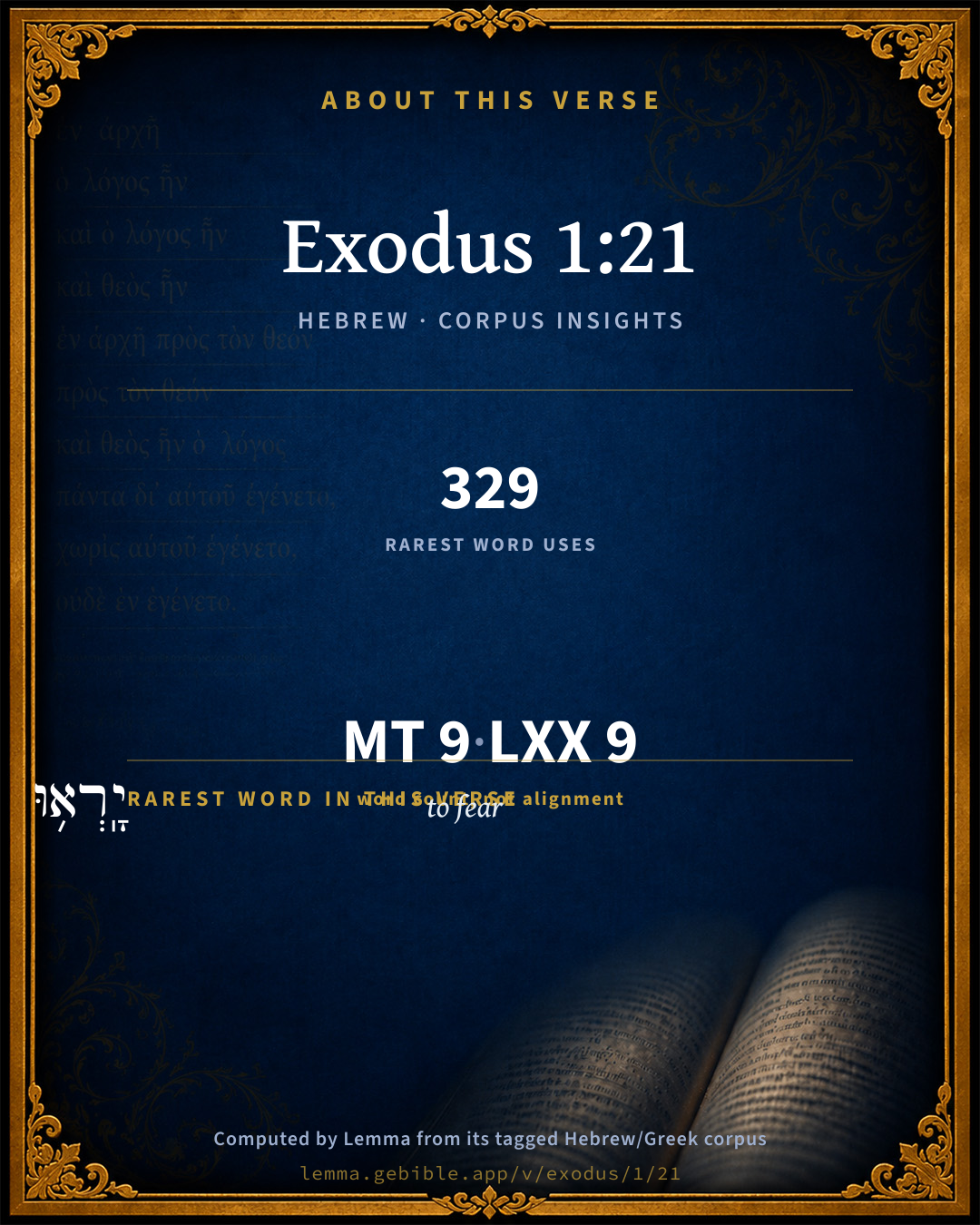
9
words
8
distinct lemmas
Pentateuch
section

Grammatical profile

  • 4 verbs
  • 2 nouns
  • 1 preposition
  • 1 conjunction
  • 1 particle

Verb forms

  • וַיְהִ֕י Qal · Sequential Imperfect
  • יָֽרְא֥וּ Qal · Perfect
  • הַֽמְיַלְּדֹ֖ת Piel · Participle Active
  • וַיַּ֥עַשׂ Qal · Sequential Imperfect

Hebrew & Septuagint length

In English translation the verse runs 12 words from the Hebrew and 11 from the Septuagint (LXX English) — closely comparable.

A rough comparison of the two English renderings, which tokenize alike — not a word-level alignment.

Word counts can differ between the Hebrew and the Greek without any difference in meaning — e.g. the Hebrew direct-object marker אֵת has no separate Greek word, and Greek often adds the article ὁ.

In the original languages it is 9 Hebrew tokens and 9 Greek tokens — but the two are counted differently (Hebrew bundles its prefixes and suffixes into one token; the Greek is in lemma form), so that isn’t a like-for-like length.

Cross-references

12

Topical passages linked to Exodus 1:21 in the Treasury of Scripture Knowledge — connected by theme and wording, ordered by reader-vote popularity; previews shown in the World English Bible.

  • 1 Kings 11:38 It shall be, if you will listen to all that I command you, and will walk in my ways, and do that which is right in my eyes, to keep my statutes and my commandments, as David my servant did; that I will be with you, and will build you a sure house, as I built for David, and will give Israel to you.
  • 1 Samuel 2:35 I will raise me up a faithful priest, that shall do according to that which is in my heart and in my mind: and I will build him a sure house; and he shall walk before my anointed forever.
  • Psalms 37:3 Trust in Yahweh, and do good. Dwell in the land, and enjoy safe pasture.
  • 2 Samuel 7:27–29 For you, Yahweh of Hosts, the God of Israel, have revealed to your servant, saying, I will build you a house: therefore has your servant found in his heart to pray this prayer to you.
  • Ecclesiastes 8:12 Though a sinner commits crimes a hundred times, and lives long, yet surely I know that it will be better with those who fear God, who are reverent before him.
  • 1 Kings 2:24 Now therefore as Yahweh lives, who has established me, and set me on the throne of David my father, and who has made me a house, as he promised, surely Adonijah shall be put to death this day.
  • 1 Samuel 25:28 Please forgive the trespass of your handmaid: for Yahweh will certainly make my lord a sure house, because my lord fights the battles of Yahweh; and evil shall not be found in you all your days.
  • 2 Samuel 7:11–13 and [as] from the day that I commanded judges to be over my people Israel; and I will cause you to rest from all your enemies. Moreover Yahweh tells you that Yahweh will make you a house.
  • Psalms 127:1 Unless Yahweh builds the house, They labor in vain who build it. Unless Yahweh watches over the city, The watchman guards it in vain.
  • Psalms 127:3 Behold, children are a heritage of Yahweh. The fruit of the womb is his reward.
  • Proverbs 24:3 Through wisdom a house is built; By understanding it is established;
  • Jeremiah 35:2 Go to the house of the Rechabites, and speak to them, and bring them into the house of Yahweh, into one of the chambers, and give them wine to drink.

Cross-references courtesy of OpenBible.info (CC BY 4.0).

Hebrew and Greek witnesses Masoretic Hebrew ↔ Greek Septuagint

The same verse in the two great witnesses to the Old Testament, shown verse-for-verse.

These are two independent witnesses, not word-aligned to each other, and the Septuagint is shown in lemma (dictionary) form.

Hebrew Exodus 1:21 Masoretic · Westminster Leningrad Codex

וַיְהִ֕י כִּֽי יָֽרְא֥וּ הַֽמְיַלְּדֹ֖ת אֶת הָאֱלֹהִ֑ים וַיַּ֥עַשׂ לָהֶ֖ם בָּתִּֽים

It happened, because the midwives feared God, that he gave them families.

World English Bible · Public Domain

Greek LXX Exodus 1:21 Septuagint · lemma form

ἐπειδή φοβέω ὁ μαῖα ὁ θεός ποιέω ἑαυτοῦ οἰκία

And as the midwives feared God, they established for themselves families.

LXX2012 (modern English Septuagint) · Public Domain

Hebrew: Westminster Leningrad Codex (CC BY 4.0). Greek: Septuagint (public domain); English from LXX2012 (modern English Septuagint) (Public Domain). How the Septuagint differs from the Hebrew →

Targum (Aramaic paraphrase)

2

The Targum is the ancient Jewish Aramaic paraphrase of the Hebrew Scriptures — an interpretive translation, not the Hebrew text itself. Onkelos (literal) and Pseudo-Jonathan (expansive) render the Torah, and Jonathan the Prophets. Coverage is partial: where no permissively-licensed English translation exists for a verse, only the Aramaic is shown. This is verse-level text, not a word-by-word alignment to the Hebrew.

  1. Targum Onkelos Torah (Genesis–Deuteronomy)
    וַהֲוָה כַּד דְחִילָא חַיָתָא מִן קֳדָם יְיָ וַעֲבַד לְהוֹן בָּתִּין:

    (no public-domain English translation for this verse)

    Targum Onkelos — Aramaic: “Onkelos Genesis” (public domain); “Onkelos Exodus” (public domain); “Onkelos Leviticus” (public domain); “Onkelos Numbers” (public domain); “Onkelos Deuteronomy” (public domain). English: “Sefaria Community Translation” (CC0 1.0 (public-domain dedication)); “J.W. Etheridge. The Targums of Onkelos and Jonathan Ben Uzziel on the Pentateuch. London: Longmans, Green, 1862” (public domain). Text via Sefaria.

  2. Targum Pseudo-Jonathan Torah (Genesis–Deuteronomy)
    וַהֲוָה כַּד דְחִילָא חַיְתָא מִן קֳדָם יְיָ וּקְנוּ לְהוֹן שׁוּם טַב לְדָרַיָא וּבְנָא לְהוֹן מֵימְרָא דַיְיָ בֵּית מַלְכוּתָא וּבֵית כְּהוּנְתָּא רַבְּתָא

    And forasmuch as the midwives feared before the Lord, they obtained for themselves a good name unto the ages; and the Word of the Lord up-builded for them a royal house, even the house of the high priesthood.

    Targum Pseudo-Jonathan — Aramaic: “Targum Jonathan on Genesis” (public domain); “Targum Jonathan on Exodus” (public domain); “Targum Jonathan on Leviticus” (public domain); “Targum Jonathan on Numbers” (public domain); “Targum Jonathan on Deuteronomy” (public domain). English: “The Targum of Jonathan ben Uzziel, trans. J. W. Etheridge, London, 1862” (public domain). Text via Sefaria.

Commentary

Notes on Exodus 1:21 from classic Christian and Jewish commentators (each source and its license shown beneath its notes). The classic Christian expositions comment on the surrounding passage and are grouped to its opening verse, so a note may address several verses; the Jewish commentaries on the Tanakh (Rashi and others) are per-verse, so they appear only where the commentator wrote on this verse.

Lemma curates 59 commentaries, every one of them public domain or Creative Commons licensed, each selected and text-cleaned for this edition rather than reprinted as found. About our sources →

Trapp's Complete Commentary

John Trapp

Exo 1:21 And it came to pass, because the midwives feared God, that he made them houses.

Ver. 21. Because the midwives feared God.] There is no necessity of granting that the midwives told the king a lie. {see Exo 1:19} But if they did, St Austin saith well, Non remunerata fuit iis fallacia, sed benevolentia; benignitas mentis, non iniquitas mentientis. Their lie was not rewarded, but their kind heartedness.

That he made them houses,] i.e., He gave them posterity. Thus he built David a house. {2Sa 7:18-19} And thus Rachel and Leah are said to have "built the house of Israel." {Rth 4:11} The parents are, as it were, the foundation of the house; the children as so many lively stones in the building. Hence the Hebrews call a son Ben, of Banah to build, quid sit edificium et structura parentum, quoad generationem et educationem.

John Trapp, A Commentary or Exposition upon All the Books of the Old and New Testament (1647–1656) — public domain. Text from a community e-Sword module.

Geneva Bible (1599)

Geneva Bible translators

That is, God increased the families of the Israelites by their means.

Geneva Bible (1599) marginal notes — public domain. Text via Bolls.life.

Adam Clarke's Commentary

Verse 21. He made them houses.] Dr. Shuckford thinks that there is something wrong both in the punctuation and translation of this place, and reads the passage thus, adding the 21st to the 20th verse: "And they multiplied and waxed mighty; and this happened (ויהי vayehi) because the midwives feared God; and he (Pharaoh) made (להם lahem, masc.) them (the Israelites) houses; and commanded all his people, saying, Every son that is born, c." The doctor supposes that previously to this time the Israelites had no fixed dwellings, but lived in tents, and therefore had a better opportunity of concealing their children but now Pharaoh built them houses, and obliged them to dwell in them, and caused the Egyptians to watch over them, that all the male children might be destroyed, which could not have been easily effected had the Israelites continued to live in their usual scattered manner in tents. That the houses in question were not made for the midwives, but for the Israelites in general, the Hebrew text seems pretty plainly to indicate, for the pronoun להם lahem, to them, is the masculine gender; had the midwives been meant, the feminine pronoun להן lahen would have been used. Others contend that by making them houses, not only the midwives are intended, but also that the words mark an increase of their families, and that the objection taken from the masculine pronoun is of no weight, because these pronouns are often interchanged; see 1Kg 22:17, where להם lahem is written, and in the parallel place, 2Ch 18:16, להן lahen is used. So בהם bahem, in 1Ch 10:7, is written בהן bahen, 1Sa 31:7, and in several other places. There is no doubt that God did bless the midwives, his approbation of their conduct is strictly marked; and there can be no doubt of his prospering the Israelites, for it is particularly said that the people multiplied and waxed very mighty. But the words most probably refer to the Israelites, whose houses or families were built up by an extraordinary in crease of children, notwithstanding the cruel policy of the Egyptian king. Vain is the counsel of man when opposed to the determinations of God! All the means used for the destruction of this people became in his hand instruments of their prosperity and increase. How true is the saying, If God be for us, who can be against us?

Adam Clarke's Commentary on the Bible (1810–1826) — public domain. Text from a community e-Sword/MySword module.

Ellicott's Commentary for English Readers

(21) He made them houses.—God rewarded those who had showed tenderness to young children, by giving them children of their own, who grew up, and became in their turn fathers and mothers of families. There is no indication that the “houses” spoken of were Hebrew ones.

A Bible Commentary for English Readers, edited by Charles John Ellicott (1878–1897) — public domain. Text from a community e-Sword module.

The Cambridge Bible for Schools and Colleges

gen. ed. J. J. S. Perowne

21. made them houses] i.e. gave them families, to perpetuate their names. Cf. 2Sa_7:11; 1Ki_2:24; Gen_16:2 (RVm.).

The Cambridge Bible for Schools and Colleges (gen. ed. J. J. S. Perowne; Cambridge University Press, 1878–1918) — public domain. Text from a community e-Sword module.

John Gill's Exposition

And it came to pass, because the midwives feared God,.... And regarded his command, and not that of the king, though they risked his displeasure, and their lives:

that he made them houses; which some understand of the Israelites making houses for them, being moved to it by the Lord, to preserve them from the insults of the Egyptians; others of Pharaoh building houses for them, in which he kept them, until the Hebrew women came to their time of delivery, who were ordered to be brought to these houses, that it might be known by others, as well as the midwives, whether they brought forth sons or daughters, neither of which is likely: but rather the sense is, that God made them houses, and hid them from Pharaoh, as Kimchi interprets it, that he might not hurt them, just as he hid Jeremiah and Baruch: though it seems best of all to understand it of his building up the families of these midwives, increasing their number, especially their substance and wealth, making them and their households prosperous in all worldly good; but because the word is in the masculine gender, some choose to interpret it either of the infants themselves, the male children the midwives preserved, and of their being built up families in Israel, or by means of whom they were built up; or of the Israelites themselves, whose houses were built up by their means: and others are of opinion that material houses or buildings are meant, built for the Israelites, that the midwives might know where to find them and their wives, when ready to lie in, who before lived up and down in fields and tents: but the sense of God's building up the families of the midwives is to be preferred, there being an enallage or change of the gender, which is not unusual; see Exo 15:21.

John Gill's Exposition of the Whole Bible (1746–1763) — public domain (CC PDM 1.0). Text via the HelloAO Bible API.

Albert Barnes' Notes on the Bible

Made them houses - i. e. they married Hebrews and became mothers in Israel. The expression is proverbial. See the margin reference.

Albert Barnes' Notes on the Bible (1834–1885) — public domain. Text from a community e-Sword/MySword module.

Haydock's Catholic Bible Commentary

Because the midwives feared God, &c. The midwives were rewarded, not for their lie, which was a venial sin; but for their fear of God, and their humanity: but this reward was only temporal, in building them houses, that is, in establishing and enriching their families. (Challoner) --- This alone the Scripture specifies, thought hey might also be filled with heavenly graces. (Worthington) --- Some conclude from this verse, that the midwives embraced the true religion. The Hebrew refers built them to the Hebrews, as if they multiplied in consequence of the humanity of these women; (Calmet) and the Vulgate may be explained in the same sense. (Haydock) --- De Muis supposes, that Pharao ordered houses to be built for the midwives, where the Hebrew women were forced to appear when they were to be delivered, in the presence of commissaries.

George Leo Haydock (1774–1849), Haydock's Catholic Family Bible and Commentary, 1859 edition — public domain. Excludes Psalms (Douay-Rheims chapter numbering differs from Protestant) and Deuterocanonical books (Catholic canon only).

Matthew Poole's English Annotations

i.e. God greatly increased their families both in children and posterity, and in wealth, and other outward blessings. So this phrase is used Gen 30:30; Deu 25:9; 1Sa 2:35; 1Ki 2:24; 11:38; Psa 127:1. As

houses are commonly put for families, so building is put for procreating of children, Gen 16:2; 30:3.

Matthew Poole's English Annotations on the Holy Bible (1683–1685) — public domain. Text from a community e-Sword/MySword module.

Whedon's Commentary on the Bible

Daniel D. Whedon

21. Made them houses — Built up their families, increased their posterity, in reward for their preservation of the posterity of Israel. This, in the Hebrew idiom, is to “build a house.” Comp. 2Sa_7:11; 2Sa_7:27.

Daniel D. Whedon (gen. ed.), Commentary on the Old and New Testaments (1874–1909) — public domain. Text from a community e-Sword module.

Rashi

Rabbi Shlomo Yitzchaki (Rashi)

ויעש להם בתים HE MADE THEM HOUSES — houses (dynasties) of the priesthood and the Levites and of royalty which are all termed בתים, “houses”, as it is said, (1 Kings 9:1) “and Solomon built the house of the Lord and the house of the king”: “the house of the Lord” i. e. a dynasty of priests and Levites — from Jochebed (Shifrah); and “the house of the king”, i. e. a royal dynasty — from Miriam (Puah), just as it is stated in Treatise Sotah 11b.

Rashi on the Tanakh — English translations: “The Judaica Press complete Tanach with Rashi, translated by A. J. Rosenberg” (CC BY 4.0); “Pentateuch with Rashi's commentary by M. Rosenbaum and A.M. Silbermann, 1929-1934” (public domain); “The Metsudah Tanach series, Lakewood, N.J” (CC BY 4.0); and “The Book of Joshua, Metsudah Publications, 1997” (CC BY 4.0). Text via Sefaria.

Lesson kit

Teaching starters — assembled from the data on this page, not authored interpretation. Every prompt links to the verse data it draws on. Edit before teaching.

Exodus, in the Pentateuch, opens this verse with 9 words (8 distinct Hebrew lemmas). Its most distinctive word is yârêʼ (“to fear”). A historical commentator’s framing appears above. Read the whole chapter for the surrounding context.

Discussion questions

  1. What does “to fear” (yârêʼ) contribute to the verse as a whole?
  2. 1 Kings 11:38 shares this passage’s theme. How do the two illuminate each other?
  3. The translations on this page render this verse differently — a whole-verse word diff, not a word-by-word alignment. What might account for the different wordings?
  4. The verb «וַיְהִ֕י» is Qal Sequential Imperfect. How does its form color the action?
  5. Reading how Trapp's Complete Commentary and Geneva Bible (1599) read this verse, where do the two commentators agree and where do they part?

Things to notice

Reading settings

Reading text

Shown beneath each verse's original-language words.

Old Testament
Old Testament edition

Read the OT as the Masoretic Hebrew (MT) or the Greek Septuagint (LXX).

English shown for the Greek Septuagint (in the Hebrew ↔ Greek comparison).

Comparing translations? Open the Compare panel on any verse page to stack up to four side by side.