Daniel 8:19

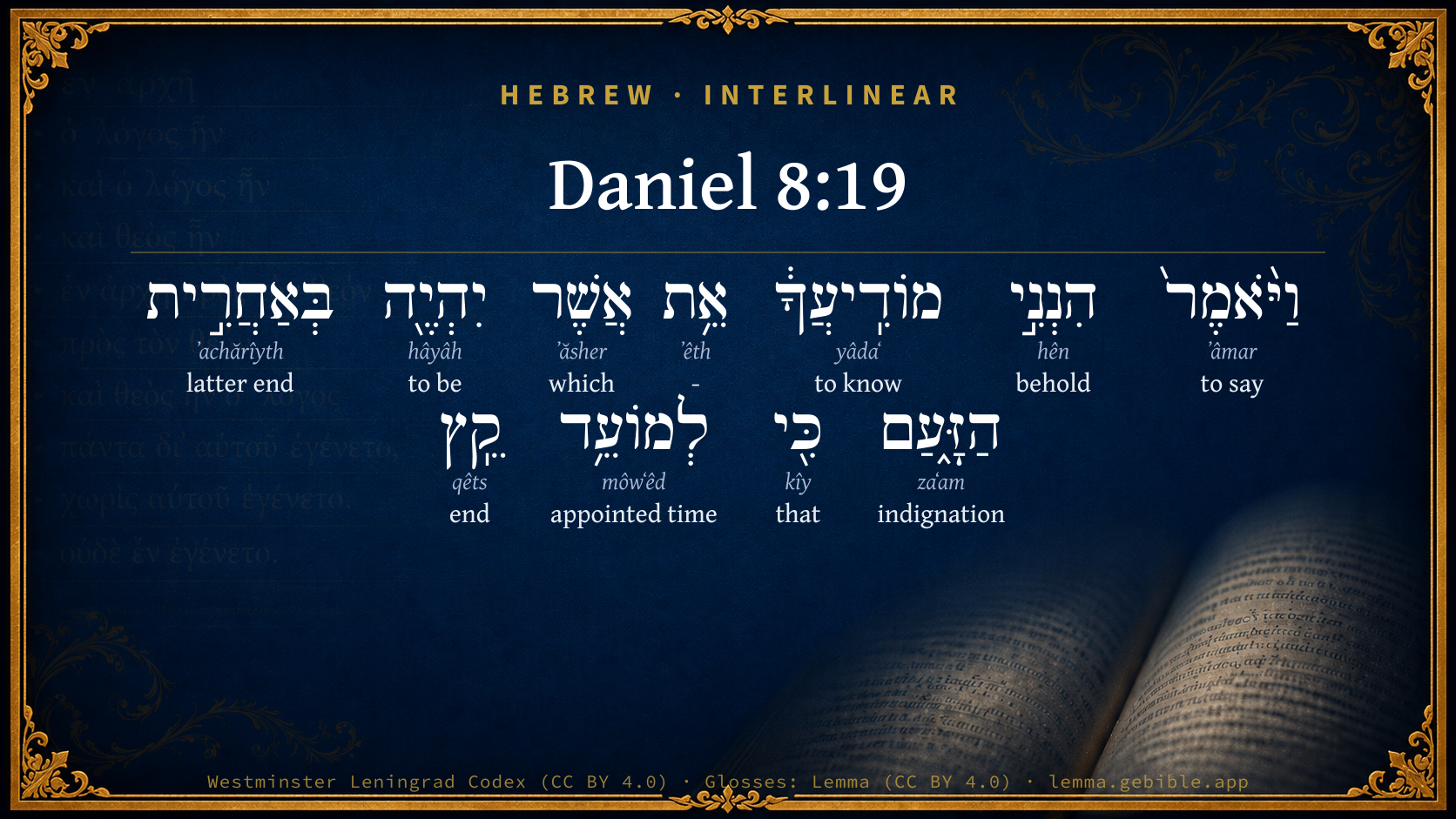
Hebrew (Westminster Leningrad Codex) Daniel 8:19 appears in the Hebrew Old Testament. The text above is from the Westminster Leningrad Codex. Each word links to its Strong’s number, a concise gloss, and parsing drawn from the Open Scriptures Hebrew Bible morphology. Click any word for its full Brown-Driver-Briggs (BDB) entry.
Download image
Cite this verse

Daniel 8:19 (World English Bible). Public Domain. Lemma interlinear Bible study tool, https://lemma.gebible.app/v/daniel/8/19.

Show BibTeX & RIS
BibTeX
RIS
English Translation
He said, Behold, I will make you know what shall be in the latter time of the indignation; for it belongs to the appointed time of the end.
World English Bible · Public Domain
Download a study sheet

One document with this verse’s original text, its word-by-word gloss line, the meaning frame, cross-references with their text, attributed commentary, and full source and license credits — printable, and it pastes into notes with its structure intact.

This verse Autodidact and up

Study sheet (.html) Plain text (.txt)

A passage Seminary Student

Up to 50 verses in one chapter. A passage sheet keeps up to 6 commentary sources and 12 cross-references per verse, in the order this page ranks them, and says so on the sheet whenever that leaves anything out. Ask for a single verse and you get the Autodidact verse sheet above.

Everything on this page stays free to read, with no account — the sheet is a download of what is already on screen, not access to it.

Want to remove ads? Support Godless Engineer
Compare translations 3

The same verse in 3 English versions, stacked beneath the original-language interlinear above. Click any original word for its lexicon entry.

Each is an independent rendering of the whole verse — the interlinear is not word-aligned to these translations.

Highlighted words mark where these versions differ — a whole-verse word diff, not a word-by-word alignment.

  • World English Bible Public Domain
    He said, Behold, I will make you know what shall be in the latter time of the indignation; for it belongs to the appointed time of the end.
  • King James Version Public Domain
    And he said, Behold, I will make thee know what shall be in the last end of the indignation: for at the time appointed the end shall be.
  • unfoldingWord Literal Text CC BY-SA 4.0
    He said, “Behold, I am going to make known to you what will happen at the latter end of the indignation, for it refers to the appointed time of the end.

unfoldingWord Literal Text — © unfoldingWord, licensed CC BY-SA 4.0. Word-aligned USFM3 via Door43 (git.door43.org/unfoldingWord/en_ult).

Versions to compare (up to 4)

3 of 4 selected

Show all 18 translations

Every available English version of this verse, each an independent rendering of the whole verse.

  • World English Bible Public Domain
    He said, Behold, I will make you know what shall be in the latter time of the indignation; for it belongs to the appointed time of the end.
  • Berean Standard Bible Public Domain
    and said, “Behold, I will make known to you what will happen in the latter time of wrath, because it concerns the appointed time of the end.
  • Majority Standard Bible Public Domain
    and said, “Behold, I will make known to you what will happen in the latter time of wrath, because it concerns the appointed time of the end.
  • King James Version Public Domain
    And he said, Behold, I will make thee know what shall be in the last end of the indignation: for at the time appointed the end shall be.
  • American Standard Version (1901) Public Domain
    And he said, Behold, I will make thee know what shall be in the latter time of the indignation; for it belongeth to the appointed time of the end.
  • Revised Version (1885) Public Domain
    And he said, Behold, I will make thee know what shall be in the latter time of the indignation: for it belongeth to the appointed time of the end.
  • Geneva Bible (1599) Public Domain
    And he sayde, Beholde, I will shewe thee what shalbe in the last wrath: for in the end of the time appointed it shall come.
  • Douay-Rheims (1899) Public Domain
    And he said to me: I will shew thee what things are to come to pass in the end of the malediction: for the time hath its end.
  • Young's Literal Translation Public Domain
    and saith: Lo, I -- I am causing thee to know that which is in the latter end of the indignation; for, at the appointed time `is' the end.
  • Literal Standard Version CC BY-SA 4.0
    and says: Behold, I am causing you to know that which is in the latter end of the indignation; for at the appointed time [is] the end.
  • Unlocked Literal Bible CC BY-SA 4.0
    He said, “See, I will show you what will happen later in the time of wrath, because the vision concerns the appointed time for the end.
  • unfoldingWord Literal Text CC BY-SA 4.0
    He said, “Behold, I am going to make known to you what will happen at the latter end of the indignation, for it refers to the appointed time of the end.
  • Darby Bible Public Domain
    And he said, Behold, I will make thee know what shall be at the end of the indignation: for at the set time the end shall be.
  • World Messianic Bible Public Domain
    He said, “Behold, I will make you know what will be in the latter time of the indignation, for it belongs to the appointed time of the end.
  • Webster's Bible Public Domain
    And he said, Behold, I will make thee know what shall be in the last end of the indignation: for at the time appointed the end shall be.
  • Free Bible Version CC BY-SA 4.0
    He told me, “Pay attention! I'm going to explain to you what's going to happen during the time of anger, which refers to the appointed time of the end.
  • Bible in Basic English Public Domain
    And he said, See, I will make clear to you what is to come in the later time of the wrath: for it has to do with the fixed time of the end.
  • JPS Tanakh (1917) Public Domain
    And he said: 'Behold, I will make thee know what shall be in the latter time of the indignation; for it belongeth to the appointed time of the end.

Literal Standard Version (2020), Covenant Press — licensed CC BY-SA 4.0. Text via the HelloAO Bible API (eBible.org). Unlocked Literal Bible (unfoldingWord) — licensed CC BY-SA 4.0. Text via the HelloAO Bible API (eBible.org). unfoldingWord Literal Text — © unfoldingWord, licensed CC BY-SA 4.0. Word-aligned USFM3 via Door43 (git.door43.org/unfoldingWord/en_ult). Free Bible Version, Dr. Jonathan Gallagher — licensed CC BY-SA 4.0. Text via the HelloAO Bible API (eBible.org).

Word by word

More ways to search: Search by grammar → Find every occurrence → Compare this word →

Practice this passage: Drill this verse → Learn its vocabulary →

הַזָּ֑עַם
zaʻam
H2195
“the · indignation”
Particle, Definite Article + Noun, Common, Masculine, Singular, Absolute
Part of Speech
Particle + Noun
Type
Common
Gender
Masculine
Number
Singular
State
Absolute
Full BDB Definition

Origin: from H2194

TWOT: 568a

anger, indignation
  1. וַיֹּ֨אמֶר֙ ʼâmar H559 “and · to say” Conjunction + Verb, Qal, Sequential Imperfect, 3rd Person, Masculine, Singular
  2. הִנְנִ֣י hên H2005 “behold · me” Particle, Demonstrative + Suffix, Personal, 1st Person, Common, Singular
  3. מוֹדִֽיעֲךָ֔ yâdaʻ H3045 “knowing · you” Verb, Hiphil, Participle Active, Masculine, Singular, Construct + Suffix, Personal, 2nd Person, Masculine, Singular
  4. אֵ֥ת ʼêth H853 “-” Particle, Direct Object
  5. אֲשֶׁר ʼăsher H834 “which” Particle, Relative
  6. יִהְיֶ֖ה hâyâh H1961 “to be” Verb, Qal, Imperfect, 3rd Person, Masculine, Singular
  7. בְּאַחֲרִ֣ית ʼachărîyth H319 “in/at · latter end of” Preposition + Noun, Common, Feminine, Singular, Construct
  8. כִּ֖י kîy H3588 “that” Conjunction
  9. לְמוֹעֵ֥ד môwʻêd H4150 “to/for · appointed time of” Preposition + Noun, Common, Masculine, Singular, Construct
  10. קֵֽץ qêts H7093 “end” Noun, Common, Masculine, Singular, Absolute

About this verse

These counts appear in no published source. They are computed here, from the morphology-tagged text and Lemma’s own curated glosses. What Lemma adds →

11
words
11
distinct lemmas
Prophets
section

Notable vocabulary

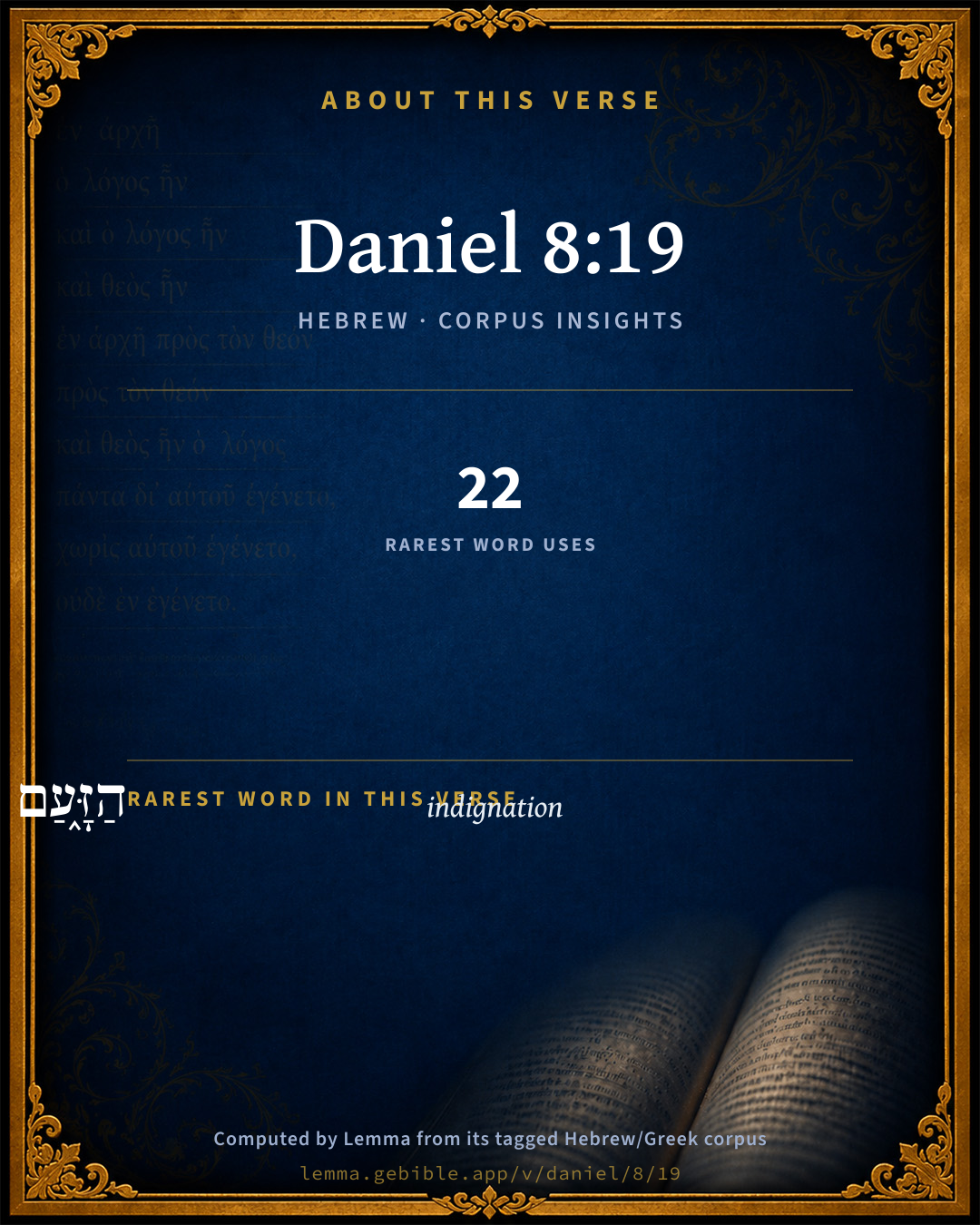
The rarest word here is הַזָּ֑עַם indignation H2195 — appearing just 22 times in the whole Hebrew Bible.

Shared distinctive vocabulary

הַזָּ֑עַם indignation H2195 occurs in 22 verses of the Hebrew Bible. Also found in:

Grammatical profile

  • 3 verbs
  • 4 nouns
  • 1 conjunction
  • 3 particles

Verb forms

  • וַיֹּ֨אמֶר֙ Qal · Sequential Imperfect
  • מוֹדִֽיעֲךָ֔ Hiphil · Participle Active
  • יִהְיֶ֖ה Qal · Imperfect

Hebrew & Septuagint length

In English translation the verse runs 28 words from the Hebrew and 30 from the Septuagint (LXX English) — closely comparable.

A rough comparison of the two English renderings, which tokenize alike — not a word-level alignment.

Word counts can differ between the Hebrew and the Greek without any difference in meaning — e.g. the Hebrew direct-object marker אֵת has no separate Greek word, and Greek often adds the article ὁ.

Cross-references

12

Topical passages linked to Daniel 8:19 in the Treasury of Scripture Knowledge — connected by theme and wording, ordered by reader-vote popularity; previews shown in the World English Bible.

  • Habakkuk 2:3 For the vision is yet for the appointed time, and it hurries toward the end, and won't prove false. Though it takes time, wait for it; because it will surely come. It won't delay.
  • Daniel 8:15–17 It happened, when I, even I Daniel, had seen the vision, that I sought to understand it; and, behold, there stood before me as the appearance of a man.
  • Daniel 11:27 As for both these kings, their hearts shall be to do mischief, and they shall speak lies at one table: but it shall not prosper; for yet the end shall be at the time appointed.
  • Revelation 17:17 For God has put in their hearts to do what he has in mind, and to be of one mind, and to give their kingdom to the beast, until the words of God should be accomplished.
  • Daniel 8:23 In the latter time of their kingdom, when the transgressors are come to the full, a king of fierce face, and understanding dark sentences, shall stand up.
  • Daniel 9:26–27 After the sixty-two weeks the Anointed One shall be cut off, and shall have nothing: and the people of the prince who shall come shall destroy the city and the sanctuary; and the end of it shall be with a flood, and even to the end shall be war; desolations are determined.
  • Daniel 11:35–36 Some of those who are wise shall fall, to refine them, and to purify, and to make them white, even to the time of the end; because it is yet for the time appointed.
  • Daniel 12:7–8 I heard the man clothed in linen, who was above the waters of the river, when he held up his right hand and his left hand to heaven, and swore by him who lives forever that it shall be for a time, times, and a half; and when they have made an end of breaking in pieces the power of the holy people, all these things shall be finished.
  • Revelation 1:1 This is the Revelation of Jesus Christ, which God gave him to show to his servants the things which must happen soon, which he sent and made known by his angel to his servant, John,
  • Revelation 10:7 but in the days of the voice of the seventh angel, when he is about to sound, then the mystery of God is finished, as he declared to his servants, the prophets.
  • Revelation 11:18 The nations were angry, and your wrath came, as did the time for the dead to be judged, and to give your bondservants the prophets, their reward, as well as to the saints, and those who fear your name, to the small and the great; and to destroy those who destroy the earth."
  • Revelation 15:1 I saw another great and marvelous sign in the sky: seven angels having the seven last plagues, for in them God's wrath is finished.

Cross-references courtesy of OpenBible.info (CC BY 4.0).

Hebrew and Greek witnesses Masoretic Hebrew ↔ Greek Septuagint

The same verse in the two great witnesses to the Old Testament, shown verse-for-verse.

These are two independent witnesses, not word-aligned to each other, and the Septuagint is shown in lemma (dictionary) form.

Hebrew Daniel 8:19 Masoretic · Westminster Leningrad Codex

וַיֹּ֨אמֶר֙ הִנְנִ֣י מוֹדִֽיעֲךָ֔ אֵ֥ת אֲשֶׁר יִהְיֶ֖ה בְּאַחֲרִ֣ית הַזָּ֑עַם כִּ֖י לְמוֹעֵ֥ד קֵֽץ

He said, Behold, I will make you know what shall be in the latter time of the indignation; for it belongs to the appointed time of the end.

World English Bible · Public Domain

Greek LXX Daniel 8:19 Septuagint · lemma form

καί εἶπον ἐγώ ἰδού ἐγώ ἀποἀγγέλλω σύ ὅς εἰμί ἐπί ἔσχατος ὁ ὀργή ὁ υἱός ὁ λαός σύ ἔτι γάρ εἰς ὥρα καιρός συντέλεια μένω

And he said, Behold, I make you know the things that shall come to pass at the end of the wrath: for the vision is yet for an appointed time.

LXX2012 (modern English Septuagint) · Public Domain

On this verse, The Pulpit Commentary discusses the Septuagint’s reading. Read the note in Commentary ↓

Hebrew: Westminster Leningrad Codex (CC BY 4.0). Greek: Septuagint (public domain); English from LXX2012 (modern English Septuagint) (Public Domain). How the Septuagint differs from the Hebrew →

Commentary

Notes on Daniel 8:19 from classic Christian and Jewish commentators (each source and its license shown beneath its notes). The classic Christian expositions comment on the surrounding passage and are grouped to its opening verse, so a note may address several verses; the Jewish commentaries on the Tanakh (Rashi and others) are per-verse, so they appear only where the commentator wrote on this verse.

Lemma curates 59 commentaries, every one of them public domain or Creative Commons licensed, each selected and text-cleaned for this edition rather than reprinted as found. About our sources →

Trapp's Complete Commentary

John Trapp

Dan 8:19 And he said, Behold, I will make thee know what shall be in the last end of the indignation: for at the time appointed the end [shall be].

Ver. 19. In the last end of the indignation.] In the final end of the Greek persecution, which shall not pass the Lord’s appointed time.

John Trapp, A Commentary or Exposition upon All the Books of the Old and New Testament (1647–1656) — public domain. Text from a community e-Sword module.

The Biblical Illustrator

Joseph S. Exell

Dan_8:19

At the time appointed the end shall be.

A Safe Prospective

Human nature anxiously desires to know something of the future. If we were told to-night that we could repair to a certain spot, where we might lift the veil of our own history, and foresee the course of our own lives during the next few years, I am afraid very few of us could be trusted to absent ourselves from such a place, or miss such an opportunity. Be persuaded, however, that with the exception of some grand feature, some magnificent outline which God has revealed, the future is absolutely shut from human eye; and as to the details which concern your life or mine, it is utterly impossible that we should over become acquainted with them by any manner of horoscope, or soothsaying, or bibliomancy. Why is it that the future is thus shut out from our view? Is it not because the present is enough to occupy our talents? Rightly to serve our God in this present hour will take all the strength we have, and all the strength we can obtain from God. Sufficient unto the day is not only the evil thereof, but the service thereof. Men who live too much in the past, and go beyond that which is rightly conservative, become of little service in the world; and men who are tempted to regulate their movements by forecasts of the future, will always become abstracted, speculative, empirical, full of sentiment, and void of assiduity, but certainly of no service whatever in the stern battle of to-day. God has concealed the future from us, probably, with a view to relieve our career through the world of dull monotony, and infuse into it new phases of stirring interest. Life would not wear such a lively aspect if it were all spread out in a map before us on the day of the commencement of our pilgrimage. Much of the pleasantness of a journey lies in unexpected views and scenes which burst upon the traveller as he climbs a hill or descends into a dale. If he could see all at once, one long, unvariegated avenue, it would become weary walking for him; but the very freshness and novelty of the events, adventures, and contingencies constantly occurrent, help to make life exciting, if not happy. Has not God also hid the future from us that we may not labour under the sense of being like dumb driven cattle, who have no will and no freedom, but both do and suffer what they are compelled by an agency irresistible? Moreover, is it not to be counted for a thousand mercies in one that all the future is concealed from us, since that future is of a very chequered character, casting, as one hath said, beams of hope and shadows of fear over the stage both of active and contemplative life? Some of it is bright with pleasure; much of it is dim with sorrow. What then if we knew the pleasure would come, should we not begin to reckon upon it? Surely the current of time would flow on heavily until the pleasant day arrived. Perhaps we should be really drawing bills at a very heavy discount upon the future if we knew it sufficiently to forestall the season of prosperity. And as for the troubles, the perils, and the afflictions that await us, if we knew of them beforehand, we should be pretty sure, with our natural tendency to graceless unbelief and morbid anxiety, to begin to carry the burden before the day came for us to carry it in. No, my Lord, it would be a fatal gift if thou wouldst bestow upon any one of us the power to know his own future.

I. First, then, it is well for us to remember that EVERYTHING IN THE FUTURE IS APPOINTED. Nothing shall happen to us which God has not foreseen. No unexpected event shall destroy His plans; no emergency shall transpire for which He has not provided; no peril shall occur against which He has not guarded. There shall come no remarkable event which shall take Him by surprise. He seeth the end from the beginning, and the things that are not, as though they were. To Gods eye there is no past and no future. We may derive no small comfort from this fact; for, suppose one goes to sea under the most skilful captain; that captain cannot possibly know what may occur during the voyage, and with the greatest foresight he can never promise an absolutely safe passage. There may be dangers which he has never yet encountered. But when you come into the ship of Providence, He who is at the helm is the Master of every wind that shall blow, and of every wave that shall break its force upon that ship; and He foresees as well the events that shall happen at the harbour for which we make, as those that happen at the port from which we start. How safe are we, then, when embarked in the good ship of Providence, with such a Captain who has fore-arranged and fore-ordained all things from the beginning even unto the end. And, furthermore, how much it becomes us to put implicit confidence in His guidance! It should always be remembered in connection with this subject that we are no believers in fate--seeing that fate is a different doctrine altogether from predestination. Fate says the thing is and must be; so it is decreed. But the true doctrine is--God has appointed this and that, not because it must be, but because it is best that it should be. Fate is blind, but the destiny of Scripture is full of eyes. Fate is stern and adamantine, and has no tears for human sorrow; but the arrangements of Providence are kind and good. The greatest good for the greatest number, and the glory of God above all, are the ends that are therein subserved. All the appointments of His providence, especially towards His people, are ruled in mercy, in tenderness, in love, and in wisdom, and all are conducive to their highest interest and their greatest happiness. Oh! but this is a blessed truth; oh! it is sweet, to be able to say, From this day forth, whatever happeneth to me, be it little or be it great, I am content. Though I am altogether unaware what it shall be, I am not sorry that I am unaware of it; for this one thing I know, there shall happen nothing but what God permits; I shall be left to no demons power; I shall not be cast away like an orphan; I shall not be beyond my Fathers eye, and my Fathers hand. If one could think that there was somewhere one grain of dust floating in the atmosphere that was not under Divine superintendence, one might wish to escape from it as from a plague. If one could believe that there was an hour of the night, or say a single second throughout the livelong year, in which the hand of God was withdrawn from nature, or a single event in which God was not concerned, and His will was not consulted, one might tremble till that black hour had passed, or till that dread event, like a vial full of evil, had been effectually poured out and put away. But now each hour is safe, for God has made it so. I would, with special earnestness, beg you to believe that God is in little things. It is the little troubles of life that annoy us the most. The little stones in the sandal make the traveller limp; while great stones do him little hurt, for he soon leaps over them. Believe that God arranges the littles. Take the little troubles as they come; remember them to your God, because they come frown God. Believe that nothing is little to God which concerns His people.

II. But now there is A SPECIAL APPOINTMENT WITH REGARD TO CERTAIN ENDS. I am not going to pursue the connection, but the text itself will suffice me, for it saith at the time appointed the end shall be. Now, there are certain ends to which you and I are looking forward with great expectancy. There is the end of the present trouble--let us think of that. Whatever submission we may have to the Divine will, it is not natural for us to love affliction; we desire to reach the end and come forth from the trial. At the time appointed the end shall be. You have been slandered in your character--a very frequent trial to Gods servants--and you are irritated and vexed, and in a great haste to answer it, to rebut the calumny and to vindicate your reputation. Be very quiet, and patient. Bear it all. Stand still and see the salvation of God, for light is sown for the righteous, and He will bring forth your righteousness like the light, and your judgment as the noonday. At the time appointed the end shall be. When the dogs are tired they will leave off barking, and when the Lord bids them be still, they shall not dare to move a tongue against you. You are in poverty. It is some time since you had a situation in which you could earn your dally tread. Are you a child of God? Have you learned to cast your burden upon the Lord? Then, At the time appointed the end shall be. There shall yet be deliverance for you. Trust in the Lord, and do good; so shalt thou dwell in the land, and verily thou shalt be fed. It may be that the end you are desiring is greater usefulness, and you have been panting after this for years. You keep to your work still, for At the time appointed the end shall be. God will not suffer the faithful worker to work in vain; your labour of love shall not be in vain in the Lord. You are looking forward, some of you, to the end of your lifes battle. Life is to the genuine Christian an incessant fight. The moment we are converted the battle begins. But, glory be to God, in the time appointed the end of this warfare shall be. So, too, with the service of our lives. I think no servant of God is tired of serving his Master; we may be tired in the service, though not tired of it. It shall be all finished. The topstone of your life-work shall be brought out with shouting of Grace, grace, unto it You shall lay your crown at His feet from whom you received it, and yon shall hear him say, Well done, good and faithful servant, enter thou into the joy of thy Lord. In the time appointed the end shall be. With many a child of God life is not merely a warfare spiritually, and a work for God outwardly, but it is attended with much of suffering. Ah! I know many servants of God whose every breath seems to be a pang; their poor bodies are in such a condition that life is like protracted death. Well, weary sufferer, in the time appoint the end shall be.

III. All things are appointed, and especially these sacred and blessed ends; but remember that besides the ends ALL THE MEANS TO THE ENDS are also appointed--all that intervenes is appointed too. Balance this thought with the other. My trouble appointed! Yes, but there is an appointed portion of grace that shall sustain me under it--grace exactly according to the measure of my necessity while under the tribulation. Temptation appointed! Yes, but there is appointed extraordinary help to deliver the soul from going down into the pit, and to pluck the foot out of the net, lost by any means one sheep of Christ should be devoured by the lion of hell. Thou fearest sickness, because that may be appointed, but it is also appointed, I will make all his bed in his sickness, and that appointment carries you over the other. And now, there is nothing in this truth that can give any comfort to those who are not reconciled to God. It is a great and terrible truth to those who are not Gods friends. At the time appointed the end shall be. What a winding up awaits those who will encounter the doom of the impenitent, no tongue can describe. Why rebel against the King of Heaven? Why set up thy will against the Divine will? (C. H. Spureon.)

The Biblical Illustrator, edited by Joseph S. Exell (c. 1880s–1900s) — public domain. Text from a community e-Sword module.

Tyndale Open Study Notes

Tyndale Open Resources

8:19-26 These verses provide the interpretation of the vision of 8:3-14.

8:19 the very end of time: There is an appointed time for the end of history.

Tyndale Open Study Notes — © Tyndale Open Resources, licensed CC BY-SA 4.0. Text via the HelloAO Bible API.

Geneva Bible (1599)

Geneva Bible translators

Meaning, that great rage which Antiochus should show against the Church.

Geneva Bible (1599) marginal notes — public domain. Text via Bolls.life.

Jamieson, Fausset & Brown

Robert Jamieson, A. R. Fausset & David Brown

the last end of the indignation--God's displeasure against the Jews for their sins. For their comfort they are told, the calamities about to come are not to be for ever. The "time" is limited (Dan 9:27; Dan 11:27, Dan 11:35-36; Dan 12:7; Hab 2:3).

Jamieson, Fausset & Brown — Commentary Critical and Explanatory on the Whole Bible (1871) — public domain (CC PDM 1.0). Text via the HelloAO Bible API.

John Calvin's Commentaries

Those who read the noun קף ketz, “end,” in the genitive case in Daniel 8:17, understand in this place the word “vision” again, as if the Prophet had said, “At the time of the end there shall be a vision.” But as מועד, meveged, or moed, signifies a “time fixed and settled beforehand,” there is nothing superfluous in that method of speech; then ketz, as I have said, is properly taken for the effect itself, and it would be harsh and far-fetched to say “at the time of the end there shall be a vision,” in the, sense of the filling up of the vision. For this word expresses all which such interpreters wish it to imply. Besides, all are agreed as to the matter itself, since the angel bears witness to his being the interpreter chosen by God, who explains futurity to the Prophet. Behold, therefore, says he, I will explain to thee He here acquires confidence for himself from his office, as he had accepted the commands divinely laid upon him. And we should remark this also, since our faith will never rest or become firm unless the authority on which it is founded be fixed. As then the angel declares himself to be executing an office divinely enjoined upon him, ought we to put confidence in men who conduct themselves with rashness, and, though they assume authority in God’s name, yet have no certain and lawful calling? We may learn, then, how neither angels nor men ought to be held in such honor as to induce us to receive whatever they bring forward, unless the Almighty has appointed them to be his ministers and interpreters.

He then says, I will announce to thee what shall happen even at the end of the wrath. Without doubt, the angel asserts by this phrase the suddenness of God’s wrath. We are aware how instantaneously on the return of the people their enemies attacked them in Judea, and never ceased to inflict upon them numberless troubles. Wherefore, as soon as the Jews had returned from exile, God began to exercise them in various ways, and not without sufficient reason. Every one privately studied his own interests, but without any regard for the temple and any desire for the worship of God, and thus they were given up to avarice and caprice. They also defrauded God himself in tithes and offerings, as is evident from the prophets Malachi and Haggai. (Haggai 1:12; Malachi 3:8.) From that period God began to punish them, but deferred his vengeance till the time of Antiochus. The angel, therefore, calls the end of the vengeance that severer punishment which God inflicted after the people had abused his forbearance. Therefore I will teach thee, or lay before time, what shall happen at the close of the vengeance, because, says he, it shall be the time of the end. He here repeats what he had said concerning the effect of the prophecy, meaning, the fulfillment should take place at its own appointed season. We must; now notice the noun moed, because it is here opposed to our fervor and intemperance. Haste in desiring anything leads, as they say, to delay; for as soon as God bears witness to anything, we wish it to be fulfilled at the very first moment, and if he suspend its execution only a very few days, we not only wonder but cry out with vexation. God, therefore, here admonishes us by his angel that he has a settled time, and thus we are to learn to put a bridle on ourselves, and not to be rash and unseasonably hasty, according to our usual habit. We ought, then, to remember the explanation given, and perceive how the effect of the vision is shewn here, and thus it will obtain from us its just reverence. It follows: —

John Calvin's Commentaries (1540-1563) — public domain. Text from the Calvin Translation Society English edition (1840s-50s) via the Christian Classics Ethereal Library (ccel.org). Calvin's coverage is partial (roughly two-thirds of the Bible); uncommented books and verses are honest gaps, never fabricated. The 19th-century editor's footnotes and remarks are omitted so the notes are faithfully Calvin's own voice.

Ellicott's Commentary for English Readers

(19) End of the indignation—i.e., the revelation of God’s wrath at the end of the time of the prophecy.

At the time appointed—i.e., the vision refers to the appointed time in the end.

A Bible Commentary for English Readers, edited by Charles John Ellicott (1878–1897) — public domain. Text from a community e-Sword module.

The Cambridge Bible for Schools and Colleges

gen. ed. J. J. S. Perowne

19. in the latter time (R.V.) of the indignation] The ‘indignation’ is the Divine wrath implied in Israel’s subjection to the nations: the persecution by Antiochus is the last stage of this indignation: when that is over, the kingdom of the saints will be set up. Cf. Dan_11:36, ‘and he (Antiochus) shall prosper till the indignation be accomplished;’ and 1Ma_1:64, ‘and there came exceeding great wrath upon Israel.’ The word may be suggested by Isa_10:25; Isa_26:20.

for it (i.e. the vision, Dan_8:17) belongeth to the appointed-time of the end] The sentence seems suggested by Hab_2:3 (quoted on Dan_8:17), though the word ‘end’ has not there the special sense which it has acquired in Daniel.

The Cambridge Bible for Schools and Colleges (gen. ed. J. J. S. Perowne; Cambridge University Press, 1878–1918) — public domain. Text from a community e-Sword module.

John Gill's Exposition

And he said, behold, I will make thee know,.... Or, "make known unto thee" (n); what he knew not, even things future: particularly

what shall be in the last end of the indignation; the indignation of God against the people of Israel, in the sore affliction and persecution of them by Antiochus, which he suffered to be; here the angel suggests that that should not remain always, but should have an end; and he would inform the prophet what should be at the close; or rather, as Noldius (o) renders it, "what shall be unto the last end of the indignation"; all that should come to pass from the beginning of the Persian monarchy, signified by the "ram", quite through the Grecian monarchy, designed by the "he goat", unto the end of the persecution by Antiochus; for, certain it is, the angel informed the prophet of more things than what concerned the last part and, closing scene of these sorrowful times; even of all the above said things, which intervened between the setting up of the Persian monarchy, and the sufferings of the Jews in the times of Antiochus; and so Aben Ezra interprets it, here

"is declared the wrath of God upon Israel in the days of wicked Greece, and in the days of Antiochus, until the Hasmonaeans cleansed the temple:''

for at the time appointed the end shall be; the end of that indignation or affliction, and so of this vision or prophecy: there was a time appointed by God for the fulfilment of the whole; and when that time was come all would be accomplished; the indignation would cease, and the persecution be at an end.

(n) "ego notum faciam tibi", Piscator; "indicaturus tibi sum", Michaelis. (o) Concord. Ebr. Partic. p. 180. No. 809.

John Gill's Exposition of the Whole Bible (1746–1763) — public domain (CC PDM 1.0). Text via the HelloAO Bible API.

Albert Barnes' Notes on the Bible

And he said, Behold, I will make thee know what shall be in the last end of the indignation - In the future time when the Divine indignation shall be manifest toward the Hebrew people; to wit, by suffering the evils to come upon them which Antiochus would inflict. It is everywhere represented that these calamities would occur as a proof of the Divine displeasure on account of their sins. Compare Dan 9:24; Dan 11:35; 2 Macc. 7:33.

For at the time appointed the end shall be - It shall not always continue. There is a definite period marked out in the Divine purpose, and when that period shall arrive, the end of all this will take place. See the notes at Dan 8:17.

Albert Barnes' Notes on the Bible (1834–1885) — public domain. Text from a community e-Sword/MySword module.

Haydock's Catholic Bible Commentary

Malediction. Hebrew: "wrath" against the people of God, and their enemies. (Calmet)

George Leo Haydock (1774–1849), Haydock's Catholic Family Bible and Commentary, 1859 edition — public domain. Excludes Psalms (Douay-Rheims chapter numbering differs from Protestant) and Deuterocanonical books (Catholic canon only).

Matthew Poole's English Annotations

In the last end of the indignation, i.e. that God will raise up Antiochus to execute his wrath against the Jews for their sins, and that yet there shall be an end of that

indignation; God will have the end of his intention, and the end of his execution, in all his severe providences relating to his people.

At the time appointed the end shall be: this he saith to make us wait patiently. He that believeth will not make haste.

Matthew Poole's English Annotations on the Holy Bible (1683–1685) — public domain. Text from a community e-Sword/MySword module.

Whedon's Commentary on the Bible

Daniel D. Whedon

19. “Behold, I will make thee know what shall be in the latter time of the indignation: for it belongeth to the appointed time of the end” (R.V.). See note Dan_8:17.

Daniel D. Whedon (gen. ed.), Commentary on the Old and New Testaments (1874–1909) — public domain. Text from a community e-Sword module.

The Pulpit Commentary

And he said, Behold, I will make thee know what shall be in the last end of the indignation: for at the time appointed the end shall be. The Septuagint here inserts a clause after "indignation." It reads, "on the children of thy people." It may have been inserted from Dan_12:1, only it is used in such a different sense that that does not seem very likely. It may have been in the original text, and dropped out not unlikely by homoioteleuton. The missing clause would be l, the last word of which is like two. On the other hand, its omission from Theodotion and the Peshitta is not so easily intelligible. Theodotion is in close agreement with the Massoretic text. The Peshitta is more brief, practically omitting the last clause. We have here the reference to the end, as in ver. 17 it is not the end of the world that is in the mind of the writer, but the "end of the indignation." The Jews, while maintaining their gallant struggle against Epiphanes, have need of being assured that the battle will have an end, and one determined before by God, The angel has to make Daniel know the end of the indignation. It may be said that the present time, when Israel has neither country nor city, is one of indignation; but the immediate reference is to the persecution against the Jews inaugurated by Epiphanes.

The Pulpit Commentary (1880–1919), ed. H.D.M. Spence-Jones & Joseph S. Exell — public domain. Text from a community e-Sword module.

John Wesley's Explanatory Notes

The indignation - God will raise up Antiochus to execute his wrath against the Jews for their sins, yet there shall be an end of that indignation.

John Wesley, Explanatory Notes Upon the Whole Bible (1754–1765) — public domain. Text via the GEBible commentary corpus.

Scofield Reference Notes

C. I. Scofield

end

Two "ends" are in view here:

(1) historically, the end of the third, or Grecian empire of Alexander out of one of the divisions of which the little horn of Dan 8:9 (Antiochus) arose;

(2) prophetically, the end of the times of the Gentiles Luk 21:24; Rev 16:14 when the "little horn" of Dan 7:8; Dan 7:24-26 the Beast, will arise--Daniel’s final time of the end. (See Scofield "Dan 12:4").

The Scofield Reference Bible (1917 edition), notes by C. I. Scofield — public domain. Text from a community e-Sword module.

Rashi

Rabbi Shlomo Yitzchaki (Rashi)

for it is the end of the time for it is at the time of the end of many days.

Rashi on the Tanakh — English translations: “The Judaica Press complete Tanach with Rashi, translated by A. J. Rosenberg” (CC BY 4.0); “Pentateuch with Rashi's commentary by M. Rosenbaum and A.M. Silbermann, 1929-1934” (public domain); “The Metsudah Tanach series, Lakewood, N.J” (CC BY 4.0); and “The Book of Joshua, Metsudah Publications, 1997” (CC BY 4.0). Text via Sefaria.

Lesson kit

Teaching starters — assembled from the data on this page, not authored interpretation. Every prompt links to the verse data it draws on. Edit before teaching.

Daniel, in the Prophets, opens this verse with 11 words (11 distinct Hebrew lemmas). Its most distinctive word is zaʻam (“indignation”). A historical commentator’s framing appears above. Read the whole chapter for the surrounding context.

Discussion questions

  1. The word zaʻam carries the sense “indignation.” How does it shape the verse?
  2. How does Psalms 38:3, which shares the word «indignation», read alongside this verse?
  3. These translations render this verse differently. What is at stake in choosing one wording over another?
  4. «וַיֹּ֨אמֶר֙» is a Qal Sequential Imperfect verb. How does that grammatical form shape the action described?
  5. Compare how Trapp's Complete Commentary and The Biblical Illustrator read this verse. Where do they agree or differ?

Things to notice

Reading settings

Reading text

Shown beneath each verse's original-language words.

Old Testament
Old Testament edition

Read the OT as the Masoretic Hebrew (MT) or the Greek Septuagint (LXX).

English shown for the Greek Septuagint (in the Hebrew ↔ Greek comparison).

Comparing translations? Open the Compare panel on any verse page to stack up to four side by side.