
2 Chronicles 7:21

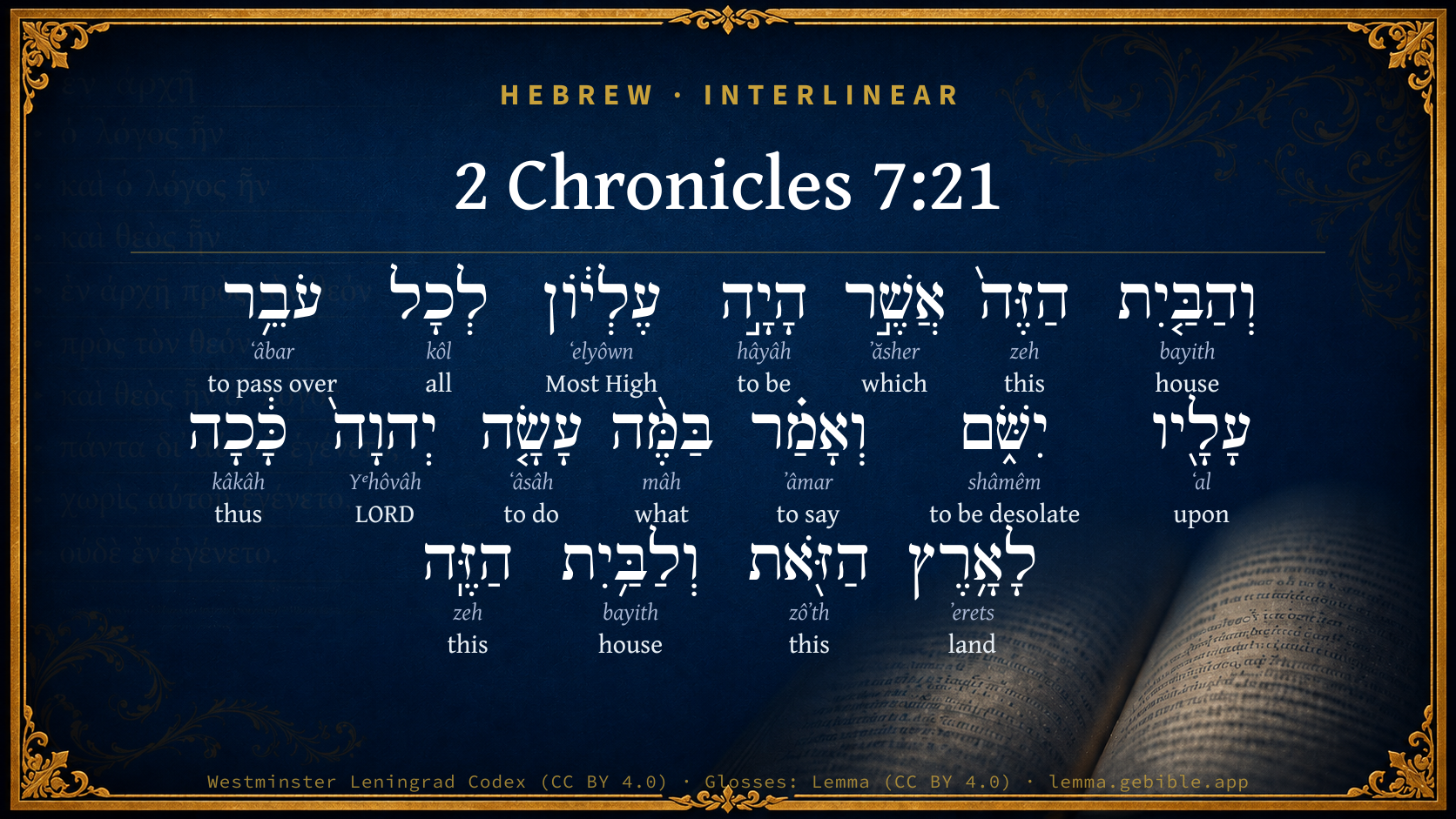
Hebrew (Westminster Leningrad Codex) 2 Chronicles 7:21 appears in the Hebrew Old Testament. The text above is from the Westminster Leningrad Codex. Each word links to its Strong’s number, a concise gloss, and parsing drawn from the Open Scriptures Hebrew Bible morphology. Click any word for its full Brown-Driver-Briggs (BDB) entry.
Download image
Cite this verse

2 Chronicles 7:21 (World English Bible). Public Domain. Lemma interlinear Bible study tool, https://lemma.gebible.app/v/2-chronicles/7/21.

Show BibTeX & RIS
BibTeX
RIS
English Translation
This house, which is so high, everyone who passes by it shall be astonished, and shall say, Why has Yahweh done thus to this land, and to this house?
World English Bible · Public Domain
Download a study sheet

One document with this verse’s original text, its word-by-word gloss line, the meaning frame, cross-references with their text, attributed commentary, and full source and license credits — printable, and it pastes into notes with its structure intact.

This verse Autodidact and up

Study sheet (.html) Plain text (.txt)

A passage Seminary Student

Up to 50 verses in one chapter. A passage sheet keeps up to 6 commentary sources and 12 cross-references per verse, in the order this page ranks them, and says so on the sheet whenever that leaves anything out. Ask for a single verse and you get the Autodidact verse sheet above.

Everything on this page stays free to read, with no account — the sheet is a download of what is already on screen, not access to it.

Want to remove ads? Support Godless Engineer
Compare translations 3

The same verse in 3 English versions, stacked beneath the original-language interlinear above. Click any original word for its lexicon entry.

Each is an independent rendering of the whole verse — the interlinear is not word-aligned to these translations.

Highlighted words mark where these versions differ — a whole-verse word diff, not a word-by-word alignment.

  • World English Bible Public Domain
    This house, which is so high, everyone who passes by it shall be astonished, and shall say, Why has Yahweh done thus to this land, and to this house?
  • King James Version Public Domain
    And this house, which is high, shall be an astonishment to every one that passeth by it; so that he shall say, Why hath the LORD done thus unto this land, and unto this house?
  • unfoldingWord Literal Text CC BY-SA 4.0
    And this house which was exalted to all who pass by it will be devastated, and they will say, ‘Why did Yahweh do thus to this land and to this house?’

unfoldingWord Literal Text — © unfoldingWord, licensed CC BY-SA 4.0. Word-aligned USFM3 via Door43 (git.door43.org/unfoldingWord/en_ult).

Versions to compare (up to 4)

3 of 4 selected

Show all 18 translations

Every available English version of this verse, each an independent rendering of the whole verse.

  • World English Bible Public Domain
    This house, which is so high, everyone who passes by it shall be astonished, and shall say, Why has Yahweh done thus to this land, and to this house?
  • Berean Standard Bible Public Domain
    And when this temple has become a heap of rubble, all who pass by it will be appalled and say, ‘Why has the LORD done such a thing to this land and to this temple?’
  • Majority Standard Bible Public Domain
    And when this temple has become a heap of rubble, all who pass by it will be appalled and say, ‘Why has the LORD done such a thing to this land and to this temple?’
  • King James Version Public Domain
    And this house, which is high, shall be an astonishment to every one that passeth by it; so that he shall say, Why hath the LORD done thus unto this land, and unto this house?
  • American Standard Version (1901) Public Domain
    And this house, which is so high, every one that passeth by it shall be astonished, and shall say, Why hath Jehovah done thus unto this land, and to this house?
  • Revised Version (1885) Public Domain
    And this house, which is so high, every one that passeth by it shall be astonished, and shall say, Why hath the LORD done thus unto this land, and to this house?
  • Geneva Bible (1599) Public Domain
    And this house which is most hie, shall be an astonishment to euery one that passeth by it, so that he shall say, Why hath the Lord done thus to this lande, and to this house?
  • Douay-Rheims (1899) Public Domain
    And this house shall be for a proverb to all that pass by, and they shall be astonished and say: Why hath the Lord done thus to this land, and to this house?
  • Young's Literal Translation Public Domain
    `And this house that hath been high, to every one passing by it, is an astonishment, and he hath said, Wherefore hath Jehovah done thus to this land, and to this house?
  • Literal Standard Version CC BY-SA 4.0
    And this house that has been high is an astonishment to everyone passing by it, and he has said, Why has YHWH done thus to this land and to this house?
  • Unlocked Literal Bible CC BY-SA 4.0
    Even though this temple is so lofty now, everyone who passes by it will be shocked and will hiss. They will ask, 'Why has Yahweh done this to this land and to this house?'
  • unfoldingWord Literal Text CC BY-SA 4.0
    And this house which was exalted to all who pass by it will be devastated, and they will say, ‘Why did Yahweh do thus to this land and to this house?’
  • Darby Bible Public Domain
    And this house, which is high, shall be an astonishment to every one that passes by it; so that he shall say, Why has Jehovah done thus to this land and to this house?
  • World Messianic Bible Public Domain
    This house, which is so high, everyone who passes by it will be astonished and say, ‘Why has the LORD done this to this land and to this house?’
  • Webster's Bible Public Domain
    And this house, which is high, shall be an astonishment to every one that passeth by it; so that he shall say, Why hath the LORD done thus to this land, and to this house?
  • Free Bible Version CC BY-SA 4.0
    This Temple that now is so respected will become so spoiled that passers-by will say, ‘Why has the Lord acted in such a way to this land and this Temple?’
  • Bible in Basic English Public Domain
    And this house will become a mass of broken walls, and everyone who goes by will be overcome with wonder, and will say, Why has the Lord done so to this land and to this house?
  • JPS Tanakh (1917) Public Domain
    And this house, which is so high, every one that passeth by it shall be astonished, and shall say: Why hath the LORD done thus unto this land, and to this house?

Literal Standard Version (2020), Covenant Press — licensed CC BY-SA 4.0. Text via the HelloAO Bible API (eBible.org). Unlocked Literal Bible (unfoldingWord) — licensed CC BY-SA 4.0. Text via the HelloAO Bible API (eBible.org). unfoldingWord Literal Text — © unfoldingWord, licensed CC BY-SA 4.0. Word-aligned USFM3 via Door43 (git.door43.org/unfoldingWord/en_ult). Free Bible Version, Dr. Jonathan Gallagher — licensed CC BY-SA 4.0. Text via the HelloAO Bible API (eBible.org).

Word by word

More ways to search: Search by grammar → Find every occurrence → Compare this word →

Practice this passage: Drill this verse → Learn its vocabulary →

כָּ֔כָה
kâkâh
  1. וְהַבַּ֤יִת bayith H1004 “and · the · house” Conjunction + Particle, Definite Article + Noun, Common, Masculine, Singular, Absolute
  2. הַזֶּה֙ zeh H2088 “the · this” Particle, Definite Article + Pronoun, Demonstrative, Masculine, Singular
  3. אֲשֶׁ֣ר ʼăsher H834 “which” Particle, Relative
  4. הָיָ֣ה hâyâh H1961 “to be” Verb, Qal, Perfect, 3rd Person, Masculine, Singular
  5. עֶלְי֔וֹן ʻelyôwn H5945 “Most High” Adjective, Adjective, Masculine, Singular, Absolute
  6. לְכָל kôl H3605 “to/for · all of” Preposition + Noun, Common, Masculine, Singular, Construct
  7. עֹבֵ֥ר ʻâbar H5674 “passing over” Verb, Qal, Participle Active, Masculine, Singular, Absolute
  8. עָלָ֖יו ʻal H5921 “upon · him” Preposition + Suffix, Personal, 3rd Person, Masculine, Singular
  9. יִשֹּׁ֑ם shâmêm H8074 “to be desolate” Verb, Qal, Imperfect, 3rd Person, Masculine, Singular
  10. וְאָמַ֗ר ʼâmar H559 “and · to say” Conjunction + Verb, Qal, Sequential Perfect, 3rd Person, Masculine, Singular
  11. בַּמֶּ֨ה mâh H4100 “in/at · what” Preposition + Particle, Interrogative
  12. עָשָׂ֤ה ʻâsâh H6213 “to do” Verb, Qal, Perfect, 3rd Person, Masculine, Singular
  13. יְהוָה֙ Yᵉhôvâh H3068 “LORD” Noun, Proper
  14. לָאָ֥רֶץ ʼerets H776 “to/for the · land” Preposition, Determined + Noun, Common, Both, Singular, Absolute
  15. הַזֹּ֖את zôʼth H2063 “the · this” Particle, Definite Article + Pronoun, Demonstrative, Feminine, Singular
  16. וְלַבַּ֥יִת bayith H1004 “and · to/for the · house” Conjunction + Preposition, Determined + Noun, Common, Masculine, Singular, Absolute
  17. הַזֶּֽה zeh H2088 “the · this” Particle, Definite Article + Pronoun, Demonstrative, Masculine, Singular

About this verse

These counts appear in no published source. They are computed here, from the morphology-tagged text and Lemma’s own curated glosses. What Lemma adds →

18
words
16
distinct lemmas
Historical
section

Shared distinctive vocabulary

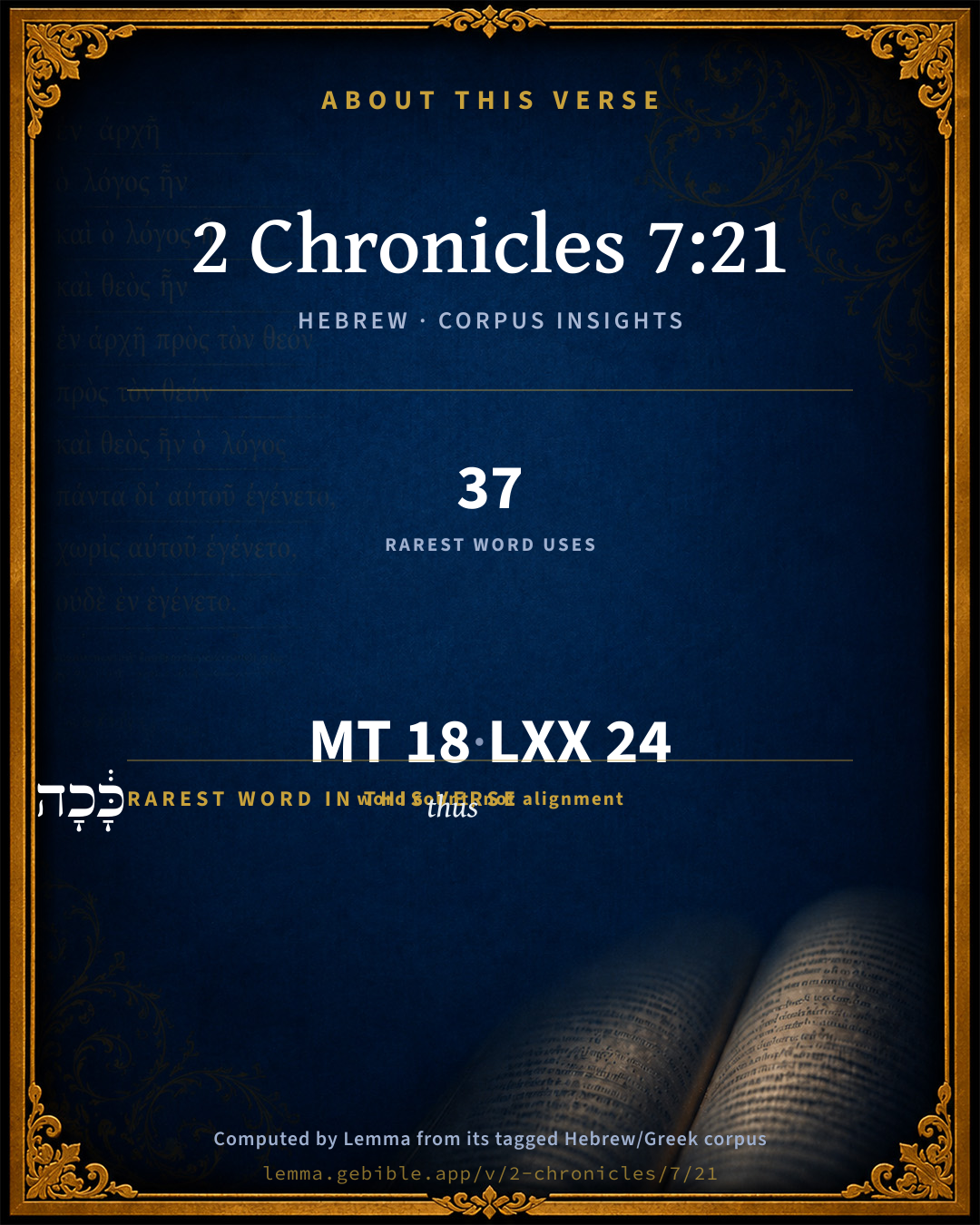
כָּ֔כָה thus H3602 occurs in 35 verses of the Hebrew Bible. Also found in:

Grammatical profile

  • 5 verbs
  • 5 nouns
  • 1 adjective
  • 3 pronouns
  • 1 preposition
  • 1 adverb
  • 2 particles

Verb forms

  • הָיָ֣ה Qal · Perfect
  • עֹבֵ֥ר Qal · Participle Active
  • יִשֹּׁ֑ם Qal · Imperfect
  • וְאָמַ֗ר Qal · Sequential Perfect
  • עָשָׂ֤ה Qal · Perfect

Repetition

Words recur within this verse — often emphatic in Hebrew:

  • וְהַבַּ֤יִת house H1004 ×2
  • הַזֶּה֙ this H2088 ×2

Hebrew & Septuagint length

In English translation the verse runs 29 words from the Hebrew and 31 from the Septuagint (LXX English) — closely comparable.

A rough comparison of the two English renderings, which tokenize alike — not a word-level alignment.

Word counts can differ between the Hebrew and the Greek without any difference in meaning — e.g. the Hebrew direct-object marker אֵת has no separate Greek word, and Greek often adds the article ὁ.

In the original languages it is 18 Hebrew tokens and 24 Greek tokens — but the two are counted differently (Hebrew bundles its prefixes and suffixes into one token; the Greek is in lemma form), so that isn’t a like-for-like length.

Cross-references

11

Topical passages linked to 2 Chronicles 7:21 in the Treasury of Scripture Knowledge — connected by theme and wording, ordered by reader-vote popularity; previews shown in the World English Bible.

  • Jeremiah 22:8–9 Many nations shall pass by this city, and they shall say every man to his neighbor, Why has Yahweh done thus to this great city?
  • Jeremiah 16:10–12 It shall happen, when you shall show this people all these words, and they shall tell you, Why has Yahweh pronounced all this great evil against us? or what is our iniquity? or what is our sin that we have committed against Yahweh our God?
  • Jeremiah 19:8 I will make this city an astonishment, and a hissing; everyone who passes thereby shall be astonished and hiss because of all the plagues of it.
  • Deuteronomy 29:24–28 even all the nations shall say, Why has Yahweh done thus to this land? what means the heat of this great anger?
  • 1 Kings 9:8–9 Though this house is so high, yet shall everyone who passes by it be astonished, and shall hiss; and they shall say, Why has Yahweh done thus to this land, and to this house?
  • 2 Chronicles 29:8 Therefore the wrath of Yahweh was on Judah and Jerusalem, and he has delivered them to be tossed back and forth, to be an astonishment, and a hissing, as you see with your eyes.
  • Jeremiah 5:19 It shall happen, when you shall say, Why has Yahweh our God done all these things to us? then shall you say to them, Like as you have forsaken me, and served foreign gods in your land, so shall you serve strangers in a land that is not yours.
  • Jeremiah 13:22 If you say in your heart, Why are these things come on me? for the greatness of your iniquity are your skirts uncovered, and your heels suffer violence.
  • Jeremiah 22:28 Is this man Coniah a despised broken vessel? is he a vessel in which none delights? why are they cast out, he and his seed, and are cast into the land which they don't know?
  • Jeremiah 49:17 Edom shall become an astonishment: everyone who passes by it shall be astonished, and shall hiss at all the plagues of it.
  • Jeremiah 50:13 Because of the wrath of Yahweh she shall not be inhabited, but she shall be wholly desolate: everyone who goes by Babylon shall be astonished, and hiss at all her plagues.

Cross-references courtesy of OpenBible.info (CC BY 4.0).

Hebrew and Greek witnesses Masoretic Hebrew ↔ Greek Septuagint

The same verse in the two great witnesses to the Old Testament, shown verse-for-verse.

These are two independent witnesses, not word-aligned to each other, and the Septuagint is shown in lemma (dictionary) form.

Hebrew 2 Chronicles 7:21 Masoretic · Westminster Leningrad Codex

וְהַבַּ֤יִת הַזֶּה֙ אֲשֶׁ֣ר הָיָ֣ה עֶלְי֔וֹן לְכָל עֹבֵ֥ר עָלָ֖יו יִשֹּׁ֑ם וְאָמַ֗ר בַּמֶּ֨ה עָשָׂ֤ה יְהוָה֙ כָּ֔כָה לָאָ֥רֶץ הַזֹּ֖את וְלַבַּ֥יִת הַזֶּֽה

This house, which is so high, everyone who passes by it shall be astonished, and shall say, Why has Yahweh done thus to this land, and to this house?

World English Bible · Public Domain

Greek LXX 2 Chronicles 7:21 Septuagint · lemma form

καί ὁ οἶκος οὗτος ὁ ὑψηλός πᾶς ὁ διαπορεύομαι αὐτός ἐκἵστημι καί εἶπον χάρις τίς ποιέω κύριος ὁ γῆ οὗτος καί ὁ οἶκος οὗτος

And as for this lofty house, every one that passes by it shall be amazed, and shall say, Therefore has the Lord done thus to this land, and to this house?

LXX2012 (modern English Septuagint) · Public Domain

On this verse, Ellicott's Commentary for English Readers discusses the Septuagint’s reading. Read the note in Commentary ↓

Hebrew: Westminster Leningrad Codex (CC BY 4.0). Greek: Septuagint (public domain); English from LXX2012 (modern English Septuagint) (Public Domain). How the Septuagint differs from the Hebrew →

Commentary

Notes on 2 Chronicles 7:21 from classic Christian and Jewish commentators (each source and its license shown beneath its notes). The classic Christian expositions comment on the surrounding passage and are grouped to its opening verse, so a note may address several verses; the Jewish commentaries on the Tanakh (Rashi and others) are per-verse, so they appear only where the commentator wrote on this verse.

Lemma curates 59 commentaries, every one of them public domain or Creative Commons licensed, each selected and text-cleaned for this edition rather than reprinted as found. About our sources →

Adam Clarke's Commentary

Verse 21. Shall be an astonishment] The manner in which these disobedient people have been destroyed is truly astonishing: no nation was ever so highly favoured, and none ever so severely and signally punished.

Adam Clarke's Commentary on the Bible (1810–1826) — public domain. Text from a community e-Sword/MySword module.

Ellicott's Commentary for English Readers

(21) And this house, which is high.—A correction of Kings: “and this house shall be high,” which appears meaningless in the context. But the Syriac (and Arabic) here and in Kings has, “And this house shall be laid waste” (nehwê hreb); and the Targum of Kings combines both readings thus: “And this house which is high shall be laid waste” (y’hê harîb). It appears, therefore, that the original reading of the Heb. text was, “And this house shall become ruinous heaps” (‘îyîn, “heaps,” not ‘elyôn, “high”). (Comp. Mic_3:12. The mistake is as old as the LXX., ύ οἶκος οὗτος ὁ ὑψηλός.)

Shall be an astonishment to every one that passeth by it.—Every one that passeth by it shall be astonished: πᾶς ὁ διαπορευόμενος αὐτὸν ἐκστήσεται, LXX. Syriac, “Every one that passeth by it shall stop and shake his head, and sway with his hand, and say “. . . Kings adds, “and shall hiss” (certainly original).

A Bible Commentary for English Readers, edited by Charles John Ellicott (1878–1897) — public domain. Text from a community e-Sword module.

The Cambridge Bible for Schools and Colleges

gen. ed. J. J. S. Perowne

21. which is high] Reader, which was high. The past tense is used by a kind of anticipation, as though the Speaker spoke from a later standpoint than the age of Solomon.

The Cambridge Bible for Schools and Colleges (gen. ed. J. J. S. Perowne; Cambridge University Press, 1878–1918) — public domain. Text from a community e-Sword module.

The Pulpit Commentary

The Hebrew text of the first sentence of this verse differs here from that in the parallel; but, in fact, neither text reads satisfactorily and smoothly. The parallel (1Ki_9:8) inserts the little word at," though without italics, and which" in italic type. The at" is no doubt intended to be condoned as supposed to belong to the word astonished; the following verb hiss also permitting, though not requiring, the appendage. Not leaning to the text of the parallel (which shows no rv,a) and which shows the substantive verb in the future tense hy,hyi), we need not find any particular difficulty in rendering our present text, And this house, which is most high (the word well favours this idea), shall be an astonishment to every passer by. The Septuagint reads simply, "This lofty house." Why hath the Lord done this? (see Deu_29:24; Jer_22:8, Jer_22:9) To the "astonishment" prophesied here the parallel adds, "shall hiss in a forcible expression found first in 2Ch_29:8, and afterwards inand (Mic_6:16) in Jeremiah (Jer_18:16 Jer_19:8 Jer_25:9; Lam_2:15, Lam_2:16)

The Pulpit Commentary (1880–1919), ed. H.D.M. Spence-Jones & Joseph S. Exell — public domain. Text from a community e-Sword module.

unfoldingWord translationNotes

Door43 World Missions Community

will be shocked

"will be amazed"

will hiss

This is how they would show that they are shocked by what happened to the temple (See: Symbolic Action)

they forsook Yahweh

"they were unfaithful to Yahweh" or "they did not obey Yahweh"

who had brought their ancestors out of the land of Egypt

This phrase tells why they should have worshiped God. (See: Distinguishing versus Informing or Reminding)

they laid hold of other gods

Here "laid hold of" represents choosing to be loyal to them. AT: "they chose to be loyal to other gods" (See: Metaphor)

bowed down to them and worshiped them

These two phrases mean the same thing. The phrase "bowed down to them" describes the posture that people used in worship. (See: Parallelism)

translationWords

temple

forsake

Yahweh

Egypt

bow

worship

unfoldingWord translationNotes — © Distant Shores Media and the Door43 World Missions Community, licensed CC BY-SA 4.0. Source: git.door43.org/Door43/en_tn.

Rashi

Rabbi Shlomo Yitzchaki (Rashi)

every passerby will be astounded i.e., The Temple will be destroyed, and every passerby will then be astounded (יִשֹּׁם), like (Job 18:20): “Concerning his day - the later people shall be astonished (נָשַׁמּוּ).”

Why has the Lord done בַּמֶּה, like (Deut. 29:23): “Why (עַל מֶה) has the Lord done thus,” and so it is written in I Kings (9:9).

Rashi on the Tanakh — English translations: “The Judaica Press complete Tanach with Rashi, translated by A. J. Rosenberg” (CC BY 4.0); “Pentateuch with Rashi's commentary by M. Rosenbaum and A.M. Silbermann, 1929-1934” (public domain); “The Metsudah Tanach series, Lakewood, N.J” (CC BY 4.0); and “The Book of Joshua, Metsudah Publications, 1997” (CC BY 4.0). Text via Sefaria.

Lesson kit

Teaching starters — assembled from the data on this page, not authored interpretation. Every prompt links to the verse data it draws on. Edit before teaching.

2 Chronicles, in the Historical, opens this verse with 18 words (16 distinct Hebrew lemmas). Its most distinctive word is kâkâh (“thus”). A historical commentator’s framing appears above. Read the whole chapter for the surrounding context.

Discussion questions

  1. How does “thus” (kâkâh) shape what this verse is saying?
  2. Exodus 12:11 shares the word «thus» with this verse. How do the two illuminate each other?
  3. “house” occurs 2× in this one verse. What is the effect of the repetition?
  4. These translations render this verse differently. What is at stake in choosing one wording over another?
  5. The verb «הָיָ֣ה» is Qal Perfect. How does its form color the action?
  6. Reading how Adam Clarke's Commentary and Ellicott's Commentary for English Readers read this verse, where do the two commentators agree and where do they part?

Things to notice

Reading settings

Reading text

Shown beneath each verse's original-language words.

Old Testament
Old Testament edition

Read the OT as the Masoretic Hebrew (MT) or the Greek Septuagint (LXX).

English shown for the Greek Septuagint (in the Hebrew ↔ Greek comparison).

Comparing translations? Open the Compare panel on any verse page to stack up to four side by side.