2 Chronicles 17:13

Hebrew (Westminster Leningrad Codex) 2 Chronicles 17:13 appears in the Hebrew Old Testament. The text above is from the Westminster Leningrad Codex. Each word links to its Strong’s number, a concise gloss, and parsing drawn from the Open Scriptures Hebrew Bible morphology. Click any word for its full Brown-Driver-Briggs (BDB) entry.
Download image
Cite this verse

2 Chronicles 17:13 (World English Bible). Public Domain. Lemma interlinear Bible study tool, https://lemma.gebible.app/v/2-chronicles/17/13.

Show BibTeX & RIS
BibTeX
RIS
English Translation
He had many works in the cities of Judah; and men of war, mighty men of valor, in Jerusalem.
World English Bible · Public Domain
Download a study sheet

One document with this verse’s original text, its word-by-word gloss line, the meaning frame, cross-references with their text, attributed commentary, and full source and license credits — printable, and it pastes into notes with its structure intact.

This verse Autodidact and up

Study sheet (.html) Plain text (.txt)

A passage Seminary Student

Up to 50 verses in one chapter. A passage sheet keeps up to 6 commentary sources and 12 cross-references per verse, in the order this page ranks them, and says so on the sheet whenever that leaves anything out. Ask for a single verse and you get the Autodidact verse sheet above.

Everything on this page stays free to read, with no account — the sheet is a download of what is already on screen, not access to it.

Want to remove ads? Support Godless Engineer
Compare translations 3

The same verse in 3 English versions, stacked beneath the original-language interlinear above. Click any original word for its lexicon entry.

Each is an independent rendering of the whole verse — the interlinear is not word-aligned to these translations.

Highlighted words mark where these versions differ — a whole-verse word diff, not a word-by-word alignment.

  • World English Bible Public Domain
    He had many works in the cities of Judah; and men of war, mighty men of valor, in Jerusalem.
  • King James Version Public Domain
    And he had much business in the cities of Judah: and the men of war, mighty men of valor, were in Jerusalem.
  • unfoldingWord Literal Text CC BY-SA 4.0
    And much work was to him in the cities of Judah, and men of battle, mighty ones of strength in Jerusalem.

unfoldingWord Literal Text — © unfoldingWord, licensed CC BY-SA 4.0. Word-aligned USFM3 via Door43 (git.door43.org/unfoldingWord/en_ult).

Versions to compare (up to 4)

3 of 4 selected

Show all 18 translations

Every available English version of this verse, each an independent rendering of the whole verse.

  • World English Bible Public Domain
    He had many works in the cities of Judah; and men of war, mighty men of valor, in Jerusalem.
  • Berean Standard Bible Public Domain
    and kept vast supplies in the cities of Judah. He also had warriors in Jerusalem who were mighty men of valor.
  • Majority Standard Bible Public Domain
    and kept vast supplies in the cities of Judah. He also had warriors in Jerusalem who were mighty men of valor.
  • King James Version Public Domain
    And he had much business in the cities of Judah: and the men of war, mighty men of valor, were in Jerusalem.
  • American Standard Version (1901) Public Domain
    And he had many works in the cities of Judah; and men of war, mighty men of valor, in Jerusalem.
  • Revised Version (1885) Public Domain
    And he had many works in the cities of Judah; and men of war, mighty men of valour, in Jerusalem.
  • Geneva Bible (1599) Public Domain
    And he had great workes in the cities of Iudah, and men of warre, and valiant men in Ierusalem.
  • Douay-Rheims (1899) Public Domain
    And he prepared many works in the cities of Juda: and he had warriors, and valiant men in Jerusalem.
  • Young's Literal Translation Public Domain
    and he hath much work in cities of Judah; and men of war, mighty of valour, `are' in Jerusalem.
  • Literal Standard Version CC BY-SA 4.0
    and he has much work in cities of Judah; and men of war, mighty men of valor, [are] in Jerusalem.
  • Unlocked Literal Bible CC BY-SA 4.0
    He had many supplies in the cities of Judah, and soldiers—strong, mighty men—in Jerusalem.
  • unfoldingWord Literal Text CC BY-SA 4.0
    And much work was to him in the cities of Judah, and men of battle, mighty ones of strength in Jerusalem.
  • Darby Bible Public Domain
    And he had much business in the cities of Judah; and men of war, strong and valiant, in Jerusalem.
  • World Messianic Bible Public Domain
    He had many works in the cities of Judah; and men of war, mighty men of valor, in Jerusalem.
  • Webster's Bible Public Domain
    And he had much business in the cities of Judah: and the men of war, mighty men of valor, were in Jerusalem.
  • Free Bible Version CC BY-SA 4.0
    He maintained a great deal of supplies in the towns of Judah. He also had troops, experienced warriors, in Jerusalem.
  • Bible in Basic English Public Domain
    He had much property in the towns of Judah; he had forces of armed men, great and strong, in Jerusalem.
  • JPS Tanakh (1917) Public Domain
    And he had many works in the cities of Judah; and men of war, mighty men of valour, in Jerusalem.

Literal Standard Version (2020), Covenant Press — licensed CC BY-SA 4.0. Text via the HelloAO Bible API (eBible.org). Unlocked Literal Bible (unfoldingWord) — licensed CC BY-SA 4.0. Text via the HelloAO Bible API (eBible.org). unfoldingWord Literal Text — © unfoldingWord, licensed CC BY-SA 4.0. Word-aligned USFM3 via Door43 (git.door43.org/unfoldingWord/en_ult). Free Bible Version, Dr. Jonathan Gallagher — licensed CC BY-SA 4.0. Text via the HelloAO Bible API (eBible.org).

Word by word

More ways to search: Search by grammar → Find every occurrence → Compare this word →

Practice this passage: Drill this verse → Learn its vocabulary →

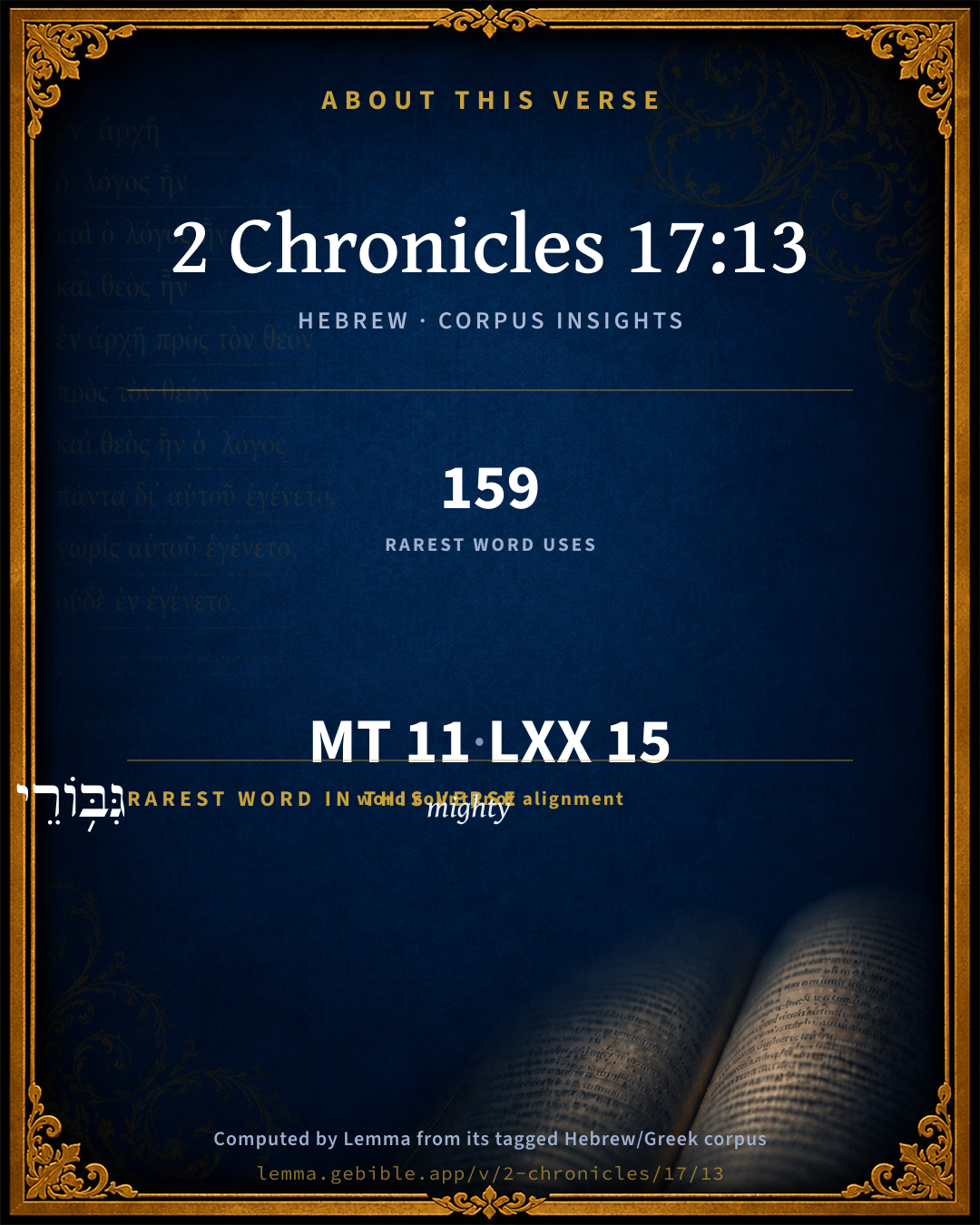
גִּבּ֥וֹרֵי
gibbôwr
H1368
“mighty of”
Adjective, Adjective, Masculine, Plural, Construct
Part of Speech
Adjective
Type
Adjective
Gender
Masculine
Number
Plural
State
Construct
Full BDB Definition

Origin: intensive from H1396

TWOT: 310b

strong, mighty (adjective) - strong man, brave man, mighty man (noun masculine)
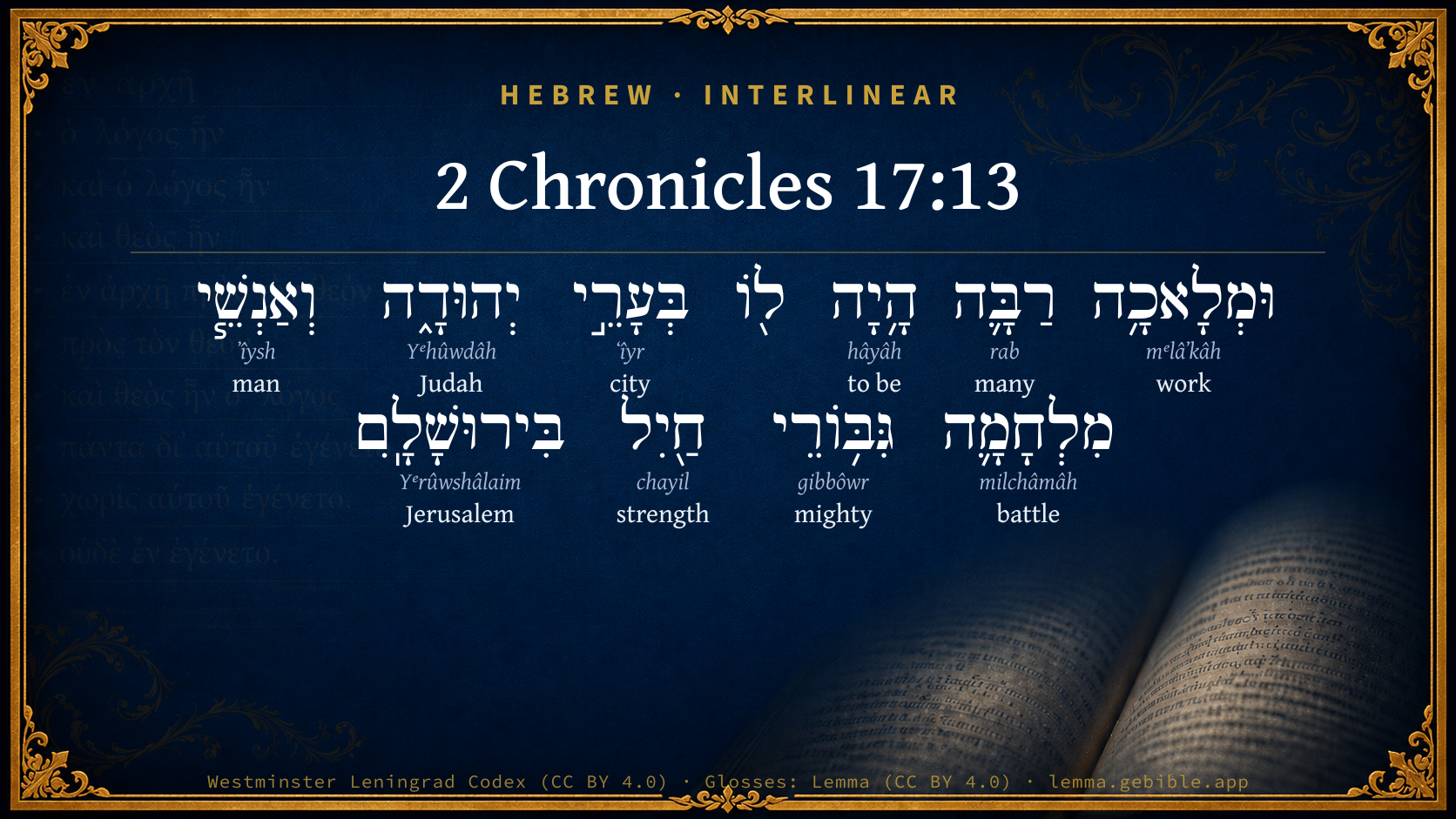
  1. וּמְלָאכָ֥ה mᵉlâʼkâh H4399 “and · work” Conjunction + Noun, Common, Feminine, Singular, Absolute
  2. רַבָּ֛ה rab H7227 “many” Adjective, Adjective, Feminine, Singular, Absolute
  3. הָ֥יָה hâyâh H1961 “to be” Verb, Qal, Perfect, 3rd Person, Masculine, Singular
  4. בְּעָרֵ֣י ʻîyr H5892 “in/at · cities of” Preposition + Noun, Common, Feminine, Plural, Construct
  5. יְהוּדָ֑ה Yᵉhûwdâh H3063 “Judah” Noun, Proper
  6. וְאַנְשֵׁ֧י ʼîysh H376 “and · men of” Conjunction + Noun, Common, Masculine, Plural, Construct
  7. מִלְחָמָ֛ה milchâmâh H4421 “battle” Noun, Common, Feminine, Singular, Absolute
  8. חַ֖יִל chayil H2428 “strength” Noun, Common, Masculine, Singular, Absolute
  9. בִּירוּשָׁלִָֽם Yᵉrûwshâlaim H3389 “in/at · Jerusalem” Preposition + Noun, Proper

About this verse

These counts appear in no published source. They are computed here, from the morphology-tagged text and Lemma’s own curated glosses. What Lemma adds →

11
words
10
distinct lemmas
Historical
section

Grammatical profile

  • 1 verb
  • 7 nouns
  • 2 adjectives
  • 1 preposition

Verb forms

  • הָ֥יָה Qal · Perfect

Hebrew & Septuagint length

In English translation the verse runs 19 words from the Hebrew and 20 from the Septuagint (LXX English) — closely comparable.

A rough comparison of the two English renderings, which tokenize alike — not a word-level alignment.

Word counts can differ between the Hebrew and the Greek without any difference in meaning — e.g. the Hebrew direct-object marker אֵת has no separate Greek word, and Greek often adds the article ὁ.

In the original languages it is 11 Hebrew tokens and 15 Greek tokens — but the two are counted differently (Hebrew bundles its prefixes and suffixes into one token; the Greek is in lemma form), so that isn’t a like-for-like length.

Cross-references

2

Topical passages linked to 2 Chronicles 17:13 in the Treasury of Scripture Knowledge — connected by theme and wording, ordered by reader-vote popularity; previews shown in the World English Bible.

  • 1 Chronicles 27:25–31 Over the king's treasures was Azmaveth the son of Adiel: and over the treasures in the fields, in the cities, and in the villages, and in the towers, was Jonathan the son of Uzziah:
  • 2 Chronicles 26:10–15 He built towers in the wilderness, and hewed out many cisterns, for he had much cattle; in the lowland also, and in the plain: [and he had] farmers and vineyard keepers in the mountains and in the fruitful fields; for he loved farming.

Cross-references courtesy of OpenBible.info (CC BY 4.0).

Hebrew and Greek witnesses Masoretic Hebrew ↔ Greek Septuagint

The same verse in the two great witnesses to the Old Testament, shown verse-for-verse.

These are two independent witnesses, not word-aligned to each other, and the Septuagint is shown in lemma (dictionary) form.

Hebrew 2 Chronicles 17:13 Masoretic · Westminster Leningrad Codex

וּמְלָאכָ֥ה רַבָּ֛ה הָ֥יָה ל֖וֹ בְּעָרֵ֣י יְהוּדָ֑ה וְאַנְשֵׁ֧י מִלְחָמָ֛ה גִּבּ֥וֹרֵי חַ֖יִל בִּירוּשָׁלִָֽם

He had many works in the cities of Judah; and men of war, mighty men of valor, in Jerusalem.

World English Bible · Public Domain

Greek LXX 2 Chronicles 17:13 Septuagint · lemma form

καί ἔργον πολύς γίγνομαι αὐτός ἐν ὁ ἰουδαία καί ἀνήρ πολεμιστής δυνατός ἰσχύω ἐν ἰερουσαλήμ

And he had many works in Judea: and the mighty men of war, the men of strength, were in Jerusalem.

LXX2012 (modern English Septuagint) · Public Domain

Hebrew: Westminster Leningrad Codex (CC BY 4.0). Greek: Septuagint (public domain); English from LXX2012 (modern English Septuagint) (Public Domain). How the Septuagint differs from the Hebrew →

Commentary

Notes on 2 Chronicles 17:13 from classic Christian and Jewish commentators (each source and its license shown beneath its notes). The classic Christian expositions comment on the surrounding passage and are grouped to its opening verse, so a note may address several verses; the Jewish commentaries on the Tanakh (Rashi and others) are per-verse, so they appear only where the commentator wrote on this verse.

Lemma curates 59 commentaries, every one of them public domain or Creative Commons licensed, each selected and text-cleaned for this edition rather than reprinted as found. About our sources →

Trapp's Complete Commentary

John Trapp

2Ch 17:13 And he had much business in the cities of Judah: and the men of war, mighty men of valour, [were] in Jerusalem.

Ver. 13. And he had much business.] Eργα πολλα, {a} Many works going forward at once; a negotious man he was. His business, say some, lay in beautifying and fortifying those cities. Augustus gloried at his death, that whereas he had found Rome built with brick, he had left it made of marble.

And the men of war … were in Jerusalem.] These were his Praetorian forces; his Praesidiaries were up and down in the various cities.

{a} Sept.

John Trapp, A Commentary or Exposition upon All the Books of the Old and New Testament (1647–1656) — public domain. Text from a community e-Sword module.

Joseph Benson's Commentary

2Ch 17:13. He had much business in the cities of Judah — To repair and fortify them, and furnish them with provisions; and to purge out all the relics of idolatry and injustice, which were more secretly and craftily managed in the cities than in the country, and which were first and most prevalent in the cities, and thence spread their infection into the country around them.

Joseph Benson's Commentary on the Old and New Testaments (1811–1818) — public domain. Text from a community e-Sword module.

Adam Clarke's Commentary

Verse 13. He had much business in the cities] He kept the people constantly employed; they had wages for their work; and by their labours the empire was both enriched and strengthened.

Adam Clarke's Commentary on the Bible (1810–1826) — public domain. Text from a community e-Sword/MySword module.

Ellicott's Commentary for English Readers

(13) Business.—Rather, much goods, or stores; literally, work (mĕlâkâh) and then produce. The Hebrew word is so used in Exo_22:7; Exo_22:10 (“His neighbour’s goods”). Stores of provisions and war material seem to be intended. (Comp. 2Ch_11:11.)

And the man of war . . . were in Jerusalem.—Rather, and (he had) men of war . . . in Jerusalem.

In Jerusalem.—Not the entire army corps whose numbers are given in 2Ch_17:14-18, but simply their chiefs.

A Bible Commentary for English Readers, edited by Charles John Ellicott (1878–1897) — public domain. Text from a community e-Sword module.

The Cambridge Bible for Schools and Colleges

gen. ed. J. J. S. Perowne

13. much business] R.V. many works.

The Cambridge Bible for Schools and Colleges (gen. ed. J. J. S. Perowne; Cambridge University Press, 1878–1918) — public domain. Text from a community e-Sword module.

John Gill's Exposition

And he had much business in the cities of Judah,.... Partly in fortifying them, and partly in reforming the inhabitants of them:

and the men of war, mighty men of valour, were in Jerusalem; or by or near unto it, so the particle is rendered, Jos 5:13, they encamped in places adjacent to it; for such a number of men as follows, even 1,160,000, could never be contained in Jerusalem, but must be disposed of in the territories of it; nor did they wait on the king together; but in course, see Ch2 17:19, by which it appears there is no need to suppose any mistake of the transcriber, in any or all of the following sums, as has been suggested (q).

(q) See Maitland's History of London, B. 3. ch. 2. p. 543.

John Gill's Exposition of the Whole Bible (1746–1763) — public domain (CC PDM 1.0). Text via the HelloAO Bible API.

Matthew Poole's English Annotations

He had much business in the cities of Judah; partly to repair and fortify them, and furnish them with all necessary provisions; and partly to purge out all the relies and seeds of idolatry and injustice, which were more secretly and subtlely managed in the cities than in the country, and which were first and most in the cities, and thence spread their infection into the country about them. See Jer 2:28.

Matthew Poole's English Annotations on the Holy Bible (1683–1685) — public domain. Text from a community e-Sword/MySword module.

The Pulpit Commentary

Much business; Hebrew, hk; al; m. The meaning of the word is "service?" "labour bestowed;" and the verse reads, "And there was to him much labour in the cities of Judah, and men of war, mighty men of valour, in Jerusalem;" i.e. He bestoweth much pains on the cities of Judah, and had, etc. The word "were," Authorized Version italics, is incorrectly inserted. The former half of this verse would better constitute the end of ver. 12. Keil, however, maintains the rendering "substance;" "property," for hkalm. (Exo_22:7, Exo_22:10)

The Pulpit Commentary (1880–1919), ed. H.D.M. Spence-Jones & Joseph S. Exell — public domain. Text from a community e-Sword module.

John Wesley's Explanatory Notes

Business - To repair and fortify them, and furnish them with provisions: and to purge out all their relicks of idolatry and injustice.

John Wesley, Explanatory Notes Upon the Whole Bible (1754–1765) — public domain. Text via the GEBible commentary corpus.

Lesson kit

Teaching starters — assembled from the data on this page, not authored interpretation. Every prompt links to the verse data it draws on. Edit before teaching.

2 Chronicles, in the Historical, opens this verse with 11 words (10 distinct Hebrew lemmas). Its most distinctive word is gibbôwr (“mighty”). A historical commentator’s framing appears above. Read the whole chapter for the surrounding context.

Discussion questions

  1. How does “mighty” (gibbôwr) shape what this verse is saying?
  2. 1 Chronicles 27:25–31 shares this passage’s theme. How do the two illuminate each other?
  3. These translations render this verse differently. What is at stake in choosing one wording over another?
  4. The verb «הָ֥יָה» is Qal Perfect. How does its form color the action?
  5. Reading how Trapp's Complete Commentary and Joseph Benson's Commentary read this verse, where do the two commentators agree and where do they part?

Things to notice

Reading settings

Reading text

Shown beneath each verse's original-language words.

Old Testament
Old Testament edition

Read the OT as the Masoretic Hebrew (MT) or the Greek Septuagint (LXX).

English shown for the Greek Septuagint (in the Hebrew ↔ Greek comparison).

Comparing translations? Open the Compare panel on any verse page to stack up to four side by side.