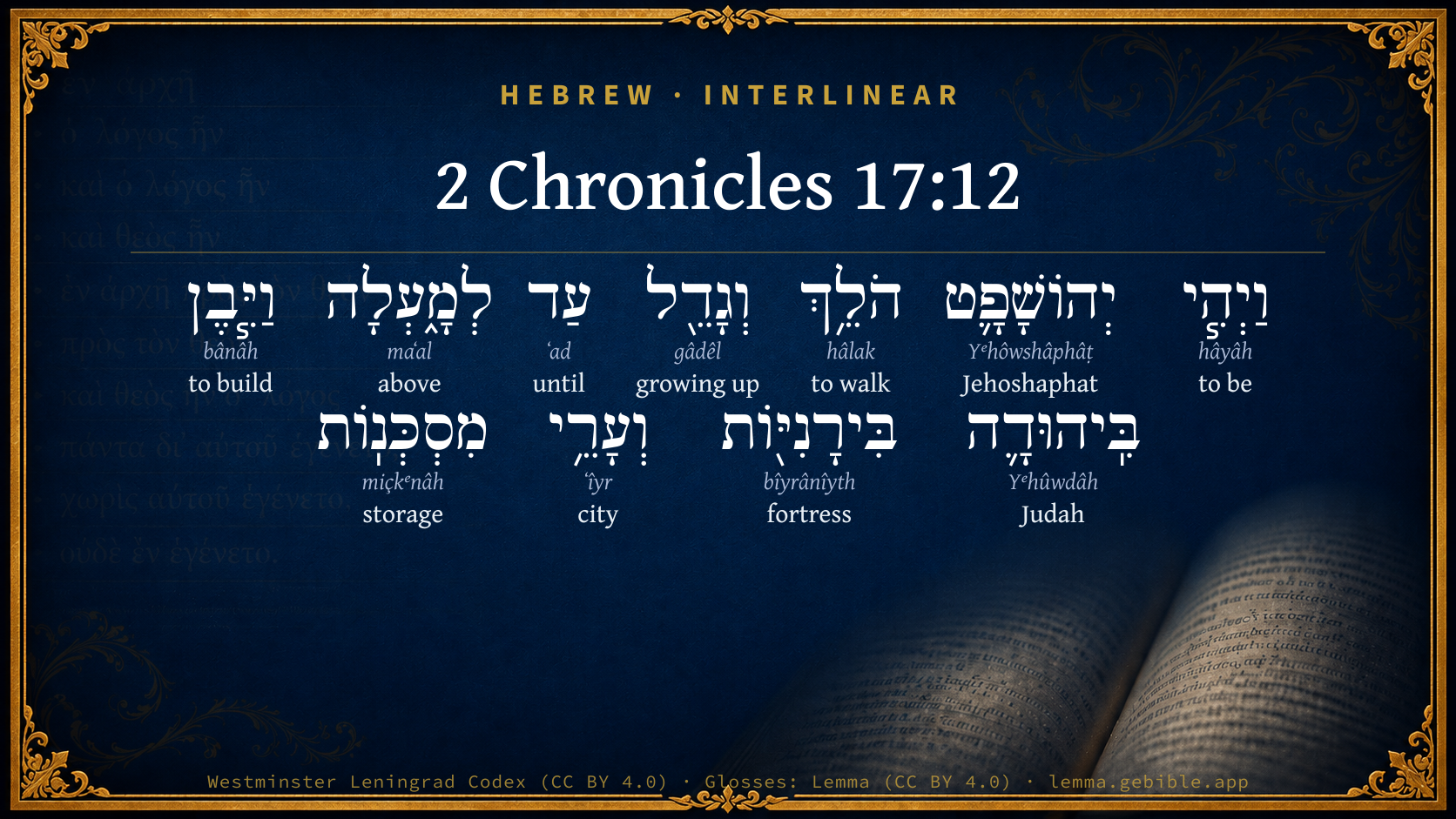
2 Chronicles 17:12

Hebrew (Westminster Leningrad Codex) 2 Chronicles 17:12 appears in the Hebrew Old Testament. The text above is from the Westminster Leningrad Codex. Each word links to its Strong’s number, a concise gloss, and parsing drawn from the Open Scriptures Hebrew Bible morphology. Click any word for its full Brown-Driver-Briggs (BDB) entry.
Download image
Cite this verse

2 Chronicles 17:12 (World English Bible). Public Domain. Lemma interlinear Bible study tool, https://lemma.gebible.app/v/2-chronicles/17/12.

Show BibTeX & RIS
BibTeX
RIS
English Translation
Jehoshaphat grew great exceedingly; and he built in Judah castles and cities of store.
World English Bible · Public Domain
Highlights
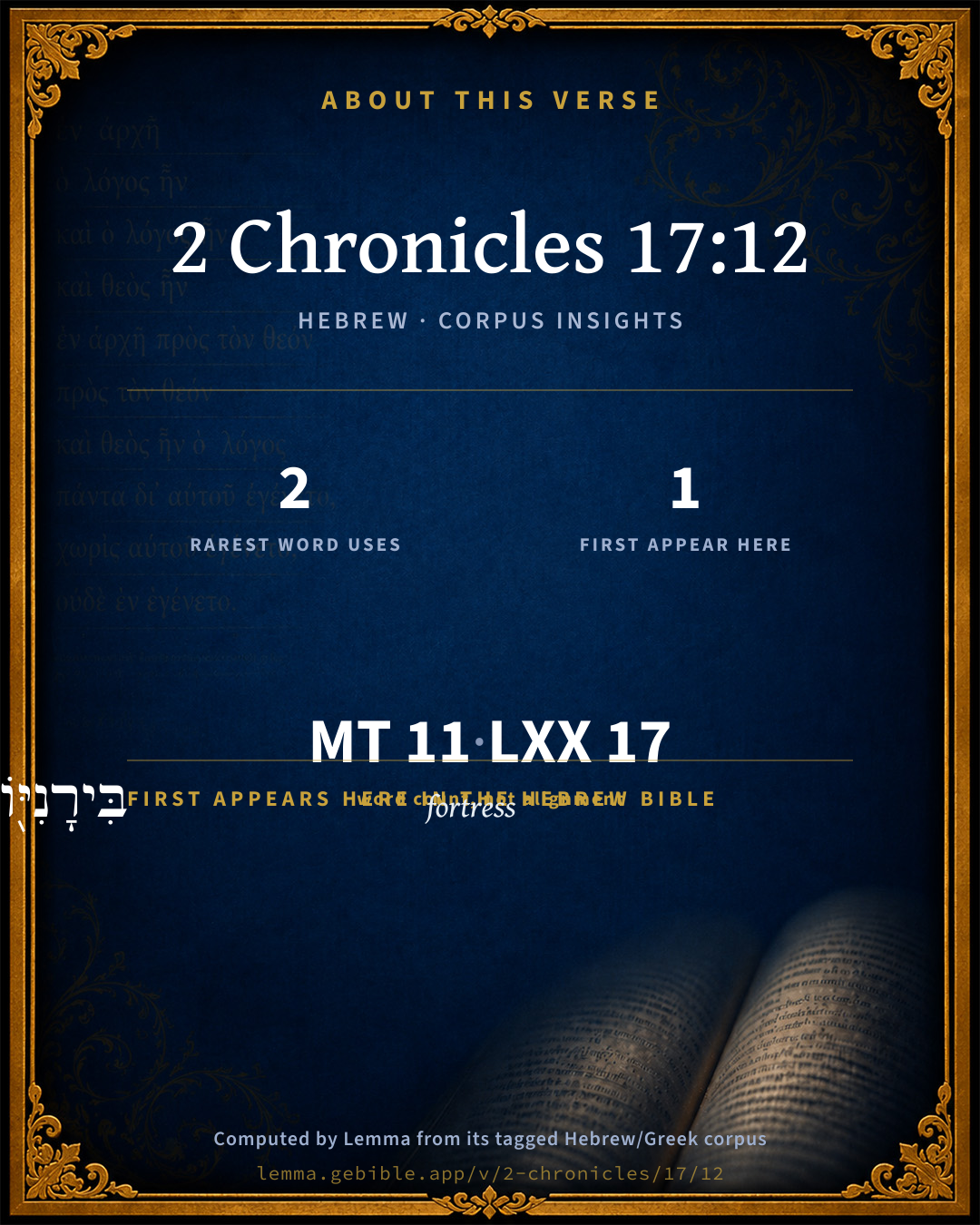
  • 1 first appearance in the Hebrew Bible
Full analysis ↓
Download a study sheet

One document with this verse’s original text, its word-by-word gloss line, the meaning frame, cross-references with their text, attributed commentary, and full source and license credits — printable, and it pastes into notes with its structure intact.

This verse Autodidact and up

Study sheet (.html) Plain text (.txt)

A passage Seminary Student

Up to 50 verses in one chapter. A passage sheet keeps up to 6 commentary sources and 12 cross-references per verse, in the order this page ranks them, and says so on the sheet whenever that leaves anything out. Ask for a single verse and you get the Autodidact verse sheet above.

Everything on this page stays free to read, with no account — the sheet is a download of what is already on screen, not access to it.

Want to remove ads? Support Godless Engineer
Compare translations 3

The same verse in 3 English versions, stacked beneath the original-language interlinear above. Click any original word for its lexicon entry.

Each is an independent rendering of the whole verse — the interlinear is not word-aligned to these translations.

Highlighted words mark where these versions differ — a whole-verse word diff, not a word-by-word alignment.

  • World English Bible Public Domain
    Jehoshaphat grew great exceedingly; and he built in Judah castles and cities of store.
  • King James Version Public Domain
    And Jehoshaphat waxed great exceedingly; and he built in Judah castles, and cities of store.
  • unfoldingWord Literal Text CC BY-SA 4.0
    And it happened Jehoshaphat was walking and becoming increasingly great. And he built in Judah palaces and cities of stores.

unfoldingWord Literal Text — © unfoldingWord, licensed CC BY-SA 4.0. Word-aligned USFM3 via Door43 (git.door43.org/unfoldingWord/en_ult).

Versions to compare (up to 4)

3 of 4 selected

Show all 18 translations

Every available English version of this verse, each an independent rendering of the whole verse.

  • World English Bible Public Domain
    Jehoshaphat grew great exceedingly; and he built in Judah castles and cities of store.
  • Berean Standard Bible Public Domain
    Jehoshaphat grew stronger and stronger, and he built fortresses and store cities in Judah
  • Majority Standard Bible Public Domain
    Jehoshaphat grew stronger and stronger, and he built fortresses and store cities in Judah
  • King James Version Public Domain
    And Jehoshaphat waxed great exceedingly; and he built in Judah castles, and cities of store.
  • American Standard Version (1901) Public Domain
    And Jehoshaphat waxed great exceedingly; and he built in Judah castles and cities of store.
  • Revised Version (1885) Public Domain
    And Jehoshaphat waxed great exceedingly; and he built in Judah castles and cities of store.
  • Geneva Bible (1599) Public Domain
    So Iehoshaphat prospered and grewe vp on hie: and he built in Iudah palaces and cities of store.
  • Douay-Rheims (1899) Public Domain
    And Josaphat grew, and became exceeding great: and he built in Juda houses like towers, and walled cities.
  • Young's Literal Translation Public Domain
    And Jehoshaphat is going on and becoming very great, and he buildeth in Judah palaces and cities of store,
  • Literal Standard Version CC BY-SA 4.0
    And Jehoshaphat is going on and becoming very great, and he builds palaces and cities of store in Judah,
  • Unlocked Literal Bible CC BY-SA 4.0
    Jehoshaphat became very powerful. He built fortresses and store cities in Judah.
  • unfoldingWord Literal Text CC BY-SA 4.0
    And it happened Jehoshaphat was walking and becoming increasingly great. And he built in Judah palaces and cities of stores.
  • Darby Bible Public Domain
    And Jehoshaphat waxed exceeding great; and he built in Judah castles and store-cities.
  • World Messianic Bible Public Domain
    Jehoshaphat grew great exceedingly; and he built fortresses and store cities in Judah.
  • Webster's Bible Public Domain
    And Jehoshaphat became exceedingly great; and he built in Judah castles, and cities of store.
  • Free Bible Version CC BY-SA 4.0
    Jehoshaphat grew increasingly powerful, and he built fortresses and storehouse towns in Judah.
  • Bible in Basic English Public Domain
    Jehoshaphat became greater and greater, and made strong towers and store-towns in Judah.
  • JPS Tanakh (1917) Public Domain
    And Jehoshaphat waxed great exceedingly; and he built in Judah castles and cities of store.

Literal Standard Version (2020), Covenant Press — licensed CC BY-SA 4.0. Text via the HelloAO Bible API (eBible.org). Unlocked Literal Bible (unfoldingWord) — licensed CC BY-SA 4.0. Text via the HelloAO Bible API (eBible.org). unfoldingWord Literal Text — © unfoldingWord, licensed CC BY-SA 4.0. Word-aligned USFM3 via Door43 (git.door43.org/unfoldingWord/en_ult). Free Bible Version, Dr. Jonathan Gallagher — licensed CC BY-SA 4.0. Text via the HelloAO Bible API (eBible.org).

Word by word

More ways to search: Search by grammar → Find every occurrence → Compare this word →

Practice this passage: Drill this verse → Learn its vocabulary →

בִּירָנִיּ֖וֹת
bîyrânîyth
H1003
“fortresses”
Noun, Common, Feminine, Plural, Absolute
Part of Speech
Noun
Type
Common
Gender
Feminine
Number
Plural
State
Absolute
Full BDB Definition

Origin: from H1002

TWOT: 240

fortress, fortified place
  1. וַיְהִ֧י hâyâh H1961 “and · to be” Conjunction + Verb, Qal, Sequential Imperfect, 3rd Person, Masculine, Singular
  2. יְהוֹשָׁפָ֛ט Yᵉhôwshâphâṭ H3092 “Jehoshaphat” Noun, Proper
  3. הֹלֵ֥ךְ hâlak H1980 “walking” Verb, Qal, Participle Active, Masculine, Singular, Absolute
  4. וְגָדֵ֖ל gâdêl H1432 “and · growing up” Conjunction + Verb, Qal, Participle Active, Masculine, Singular, Absolute
  5. עַד ʻad H5704 “until” Preposition
  6. לְמָ֑עְלָה maʻal H4605 “to/for · above · toward” Preposition + Adverb + Suffix, Demonstrative
  7. וַיִּ֧בֶן bânâh H1129 “and · to build” Conjunction + Verb, Qal, Sequential Imperfect, 3rd Person, Masculine, Singular
  8. בִּֽיהוּדָ֛ה Yᵉhûwdâh H3063 “in/at · Judah” Preposition + Noun, Proper
  9. וְעָרֵ֥י ʻîyr H5892 “and · cities of” Conjunction + Noun, Common, Feminine, Plural, Construct
  10. מִסְכְּנֽוֹת miçkᵉnâh H4543 “storehouses” Noun, Common, Feminine, Plural, Absolute

About this verse

These counts appear in no published source. They are computed here, from the morphology-tagged text and Lemma’s own curated glosses. What Lemma adds →

11
words
11
distinct lemmas
Historical
section

Notable vocabulary

The rarest word here is בִּירָנִיּ֖וֹת fortress H1003 — appearing just 2 times in the whole Hebrew Bible.

First appearance in Scripture

This word makes its first canonical appearance in the Hebrew Bible here:

  • בִּירָנִיּ֖וֹת fortress H1003

Shared distinctive vocabulary

בִּירָנִיּ֖וֹת fortress H1003 occurs in 2 verses of the Hebrew Bible. Also found in:

Grammatical profile

  • 4 verbs
  • 5 nouns
  • 1 preposition
  • 1 adverb

Verb forms

  • וַיְהִ֧י Qal · Sequential Imperfect
  • הֹלֵ֥ךְ Qal · Participle Active
  • וְגָדֵ֖ל Qal · Participle Active
  • וַיִּ֧בֶן Qal · Sequential Imperfect

Hebrew & Septuagint length

In English translation the verse runs 14 words from the Hebrew and 16 from the Septuagint (LXX English) — closely comparable.

A rough comparison of the two English renderings, which tokenize alike — not a word-level alignment.

Word counts can differ between the Hebrew and the Greek without any difference in meaning — e.g. the Hebrew direct-object marker אֵת has no separate Greek word, and Greek often adds the article ὁ.

In the original languages it is 11 Hebrew tokens and 17 Greek tokens — but the two are counted differently (Hebrew bundles its prefixes and suffixes into one token; the Greek is in lemma form), so that isn’t a like-for-like length.

Cross-references

9

Topical passages linked to 2 Chronicles 17:12 in the Treasury of Scripture Knowledge — connected by theme and wording, ordered by reader-vote popularity; previews shown in the World English Bible.

  • 2 Chronicles 8:2–6 that the cities which Huram had given to Solomon, Solomon built them, and caused the children of Israel to dwell there.
  • 2 Chronicles 14:6–7 He built fortified cities in Judah; for the land was quiet, and he had no war in those years, because Yahweh had given him rest.
  • 2 Chronicles 18:1 Now Jehoshaphat had riches and honor in abundance; and he joined affinity with Ahab.
  • 2 Chronicles 27:4 Moreover he built cities in the hill-country of Judah, and in the forests he built castles and towers.
  • 2 Chronicles 32:5 He took courage, and built up all the wall that was broken down, and raised [it] up to the towers, and the other wall outside, and strengthened Millo [in] the city of David, and made weapons and shields in abundance.
  • 2 Chronicles 32:27–29 Hezekiah had exceeding much riches and honor: and he provided him treasuries for silver, and for gold, and for precious stones, and for spices, and for shields, and for all manner of goodly vessels;
  • 2 Chronicles 26:6–9 He went forth and warred against the Philistines, and broke down the wall of Gath, and the wall of Jabneh, and the wall of Ashdod; and he built cities in [the country of] Ashdod, and among the Philistines.
  • 1 Chronicles 29:25 Yahweh magnified Solomon exceedingly in the sight of all Israel, and bestowed on him such royal majesty as had not been on any king before him in Israel.

Cross-references courtesy of OpenBible.info (CC BY 4.0).

Hebrew and Greek witnesses Masoretic Hebrew ↔ Greek Septuagint

The same verse in the two great witnesses to the Old Testament, shown verse-for-verse.

These are two independent witnesses, not word-aligned to each other, and the Septuagint is shown in lemma (dictionary) form.

Hebrew 2 Chronicles 17:12 Masoretic · Westminster Leningrad Codex

וַיְהִ֧י יְהוֹשָׁפָ֛ט הֹלֵ֥ךְ וְגָדֵ֖ל עַד לְמָ֑עְלָה וַיִּ֧בֶן בִּֽיהוּדָ֛ה בִּירָנִיּ֖וֹת וְעָרֵ֥י מִסְכְּנֽוֹת

Jehoshaphat grew great exceedingly; and he built in Judah castles and cities of store.

World English Bible · Public Domain

Greek LXX 2 Chronicles 17:12 Septuagint · lemma form

καί εἰμί ιωσαφατ πορεύομαι μέγας ἕως εἰς ὕψος καί οἰκοδομέω οἴκησις ἐν ὁ ἰουδαία καί πόλις ὀχυρός

And Josaphat increased in greatness exceedingly, and built in Judea places of abode, and strong cities.

LXX2012 (modern English Septuagint) · Public Domain

Hebrew: Westminster Leningrad Codex (CC BY 4.0). Greek: Septuagint (public domain); English from LXX2012 (modern English Septuagint) (Public Domain). How the Septuagint differs from the Hebrew →

Commentary

Notes on 2 Chronicles 17:12 from classic Christian and Jewish commentators (each source and its license shown beneath its notes). The classic Christian expositions comment on the surrounding passage and are grouped to its opening verse, so a note may address several verses; the Jewish commentaries on the Tanakh (Rashi and others) are per-verse, so they appear only where the commentator wrote on this verse.

Lemma curates 59 commentaries, every one of them public domain or Creative Commons licensed, each selected and text-cleaned for this edition rather than reprinted as found. About our sources →

Trapp's Complete Commentary

John Trapp

2Ch 17:12 And Jehoshaphat waxed great exceedingly; and he built in Judah castles, and cities of store.

Ver. 12. And Jehoshaphat waxed great exceedingly.] Heb., He was going and growing. "By humility and the fear of the Lord are riches, and honour, and life." {Pro 22:4}

And he built in Judah castles.] Bironeoth, πυργους, turres. So did the Burgundians, and thence had their names

And cities of store.] Granaries; in the Hebrew they have their name from their utility or usefulness.

John Trapp, A Commentary or Exposition upon All the Books of the Old and New Testament (1647–1656) — public domain. Text from a community e-Sword module.

Tyndale Open Study Notes

Tyndale Open Resources

17:12-19 Jehoshaphat’s international status, building enterprises, and army characterized his great rule. Archaeological excavations have revealed a line of highway forts in the Jordan Valley near the Dead Sea dating to his time. • The number of troops in his army—totaling more than a million in Jerusalem—seems unreasonably high. Because the leaders were based on tribal divisions (17:14), it is possible that the term translated as “thousand” (’elep) should instead be translated as “squad” or “platoon,” a much smaller military unit. The totals might also include reserve divisions that served on rotation (see 1 Chr 27:1-15). The number of troops credited to Jehoshaphat is approximately triple those of Abijah (2 Chr 13:3), Asa (14:8), Amaziah (25:5), and Uzziah (26:11-15). It is comparable to the number of warriors at the time of David’s census (1 Chr 21:5), when soldiers from the northern tribes were counted. A large army was an indication of God’s blessing.

Tyndale Open Study Notes — © Tyndale Open Resources, licensed CC BY-SA 4.0. Text via the HelloAO Bible API.

Ellicott's Commentary for English Readers

(12) And Jehoshaphat waxed great.—Literally, And Jehoshaphat was going on and waxing great, i.e., became greater and greater. (Comp. 1Ch_11:9.)

Exceedingly.—‘Ad lĕmà’lah. This phrase occurs again in 2Ch_16:12; 2Ch_26:8, and nowhere else in the Old Testament. (See on 1Ch_14:2.)

And he built.—Like his predecessors—Solomon, Rehoboam, Asa—he displayed his wealth and power in great public works. The records of the Assyrian and Babylonian sovereigns are largely taken up with similar accounts of temple and palace building.

Castles.—Biranîyôth, a derivative from birah (1Ch_29:1; 1Ch_29:19; comp. Syriac here, birôthô). It only recurs at 2Ch_27:4. It is an Aramaic term. (Comp. bîranyâthâ, which in the Targums means “palaces.”)

Cities of stores.—Comp. 2Ch_8:4; 2Ch_16:4; Exo_1:11.

A Bible Commentary for English Readers, edited by Charles John Ellicott (1878–1897) — public domain. Text from a community e-Sword module.

The Cambridge Bible for Schools and Colleges

gen. ed. J. J. S. Perowne

12. castles] Heb. bîrâniyyôth; cp. 2Ch_27:4 (same word); and 2Ch_26:10 (“towers”). Such small castles or towers lie scattered along the pilgrim-road from Damascus to Mecca at the present day to make the way safe.

cities of store] Cp. 2Ch_11:11-12.

The Cambridge Bible for Schools and Colleges (gen. ed. J. J. S. Perowne; Cambridge University Press, 1878–1918) — public domain. Text from a community e-Sword module.

John Gill's Exposition

And Jehoshaphat waxed great exceedingly,.... In wealth and riches, power and authority, in his forces and fortifications:

and he built in Judah castles, and cities of stores; castles for the defence of his kingdom, and store cities to lay up corn, and wine, and all provisions, in case of an invasion, or against a time of war.

John Gill's Exposition of the Whole Bible (1746–1763) — public domain (CC PDM 1.0). Text via the HelloAO Bible API.

Haydock's Catholic Bible Commentary

Houses. Prot. "castles." Heb. biraniyoth. Birah is properly a Chaldean word, and is added after susan, to imply that it was a royal castle, (C.) or palace. (H.) Esdras i. 1. --- Sept. often use baris in the same sense. C. --- It became a provincial word in Palestine, for a place shut up on all sides and built like a tower. S. Jerom ad Princep. --- David calls the temple a palace (habbirah) for God, 1 Paralipomenon xxix. 1. C. --- Josaphat employed his immense riches in beautifying the country, and erecting storehouses, v. 5. --- Walled. Prot. "cities of store." H. See C. xv. 4.

George Leo Haydock (1774–1849), Haydock's Catholic Family Bible and Commentary, 1859 edition — public domain. Excludes Psalms (Douay-Rheims chapter numbering differs from Protestant) and Deuterocanonical books (Catholic canon only).

The Pulpit Commentary

Castles. This rendering, better than palaces" (margin), wound bear improving to the rather stronger word "fortresses," Hebrew, twOYniryBi, found only here and in 2Ch_27:4, plur. of tyniryBi connected with the Chaldee and later Hebrew, hryBi, of Ezr_6:2; Neh_1:1; Est_1:2; Dan_8:2, Cities of store (see note 2Ch_8:4; see also 1Ki_9:19; Exo_1:11)

The Pulpit Commentary (1880–1919), ed. H.D.M. Spence-Jones & Joseph S. Exell — public domain. Text from a community e-Sword module.

unfoldingWord translationNotes

Door43 World Missions Community

He built fortresses and store cities

Jehoshaphat did not build these things himself, rather he commanded his workers to build them. AT: "His workers built fortresses and store cities" (See: Metonymy)

translationWords

power

stronghold

Jerusalem

unfoldingWord translationNotes — © Distant Shores Media and the Door43 World Missions Community, licensed CC BY-SA 4.0. Source: git.door43.org/Door43/en_tn.

Rashi

Rabbi Shlomo Yitzchaki (Rashi)

was becoming greater - Heb. וְגָדֵל. Scripture uses] a similar expression in reference to three people: Isaac, Samuel, and Jehoshaphat, but concerning Moses, David, and Mordecai, it says וְגָדוֹל. Concerning Isaac, Samuel, and Jehoshaphat, it says, וְגָדֵל because it is not proper to say וְגָדוֹל, great [in the context in which the word appears in the verse]. In regards to Samuel, it says, (I Sam. 2: 21): “And the lad Samuel grew up with the Lord.” God forbid that it should say, גָדוֹל עִם ה', he was great with the Lord. Here too, he [Jehoshaphat] became great to an unusual degree, גָדֵל עַד לְמָעְלָה. It is therefore improper to say וְגָדוֹל, great. The same applies to Isaac.

towers בִּירָנִיוֹת, derived from בִּירָה, huge towers for strength.

and store cities storage cities, to put in them wheat, wine and grain.

Rashi on the Tanakh — English translations: “The Judaica Press complete Tanach with Rashi, translated by A. J. Rosenberg” (CC BY 4.0); “Pentateuch with Rashi's commentary by M. Rosenbaum and A.M. Silbermann, 1929-1934” (public domain); “The Metsudah Tanach series, Lakewood, N.J” (CC BY 4.0); and “The Book of Joshua, Metsudah Publications, 1997” (CC BY 4.0). Text via Sefaria.

Lesson kit

Teaching starters — assembled from the data on this page, not authored interpretation. Every prompt links to the verse data it draws on. Edit before teaching.

2 Chronicles, in the Historical, opens this verse with 11 words (11 distinct Hebrew lemmas). Its most distinctive word is bîyrânîyth (“fortress”). A historical commentator’s framing appears above. Read the whole chapter for the surrounding context.

Discussion questions

  1. How does “fortress” (bîyrânîyth) shape what this verse is saying?
  2. This is the first place “fortress” appears in Scripture (first appears here). What does its debut here establish?
  3. How does 2 Chronicles 27:4, which shares the word «fortress», read alongside this verse?
  4. These translations render this verse differently; the difference is in the English rendering, not the original. What questions does that raise?
  5. «וַיְהִ֧י» is a Qal Sequential Imperfect verb. How does that grammatical form shape the action described?
  6. Compare how Trapp's Complete Commentary and Tyndale Open Study Notes read this verse. Where do they agree or differ?

Things to notice

Reading settings

Reading text

Shown beneath each verse's original-language words.

Old Testament
Old Testament edition

Read the OT as the Masoretic Hebrew (MT) or the Greek Septuagint (LXX).

English shown for the Greek Septuagint (in the Hebrew ↔ Greek comparison).

Comparing translations? Open the Compare panel on any verse page to stack up to four side by side.