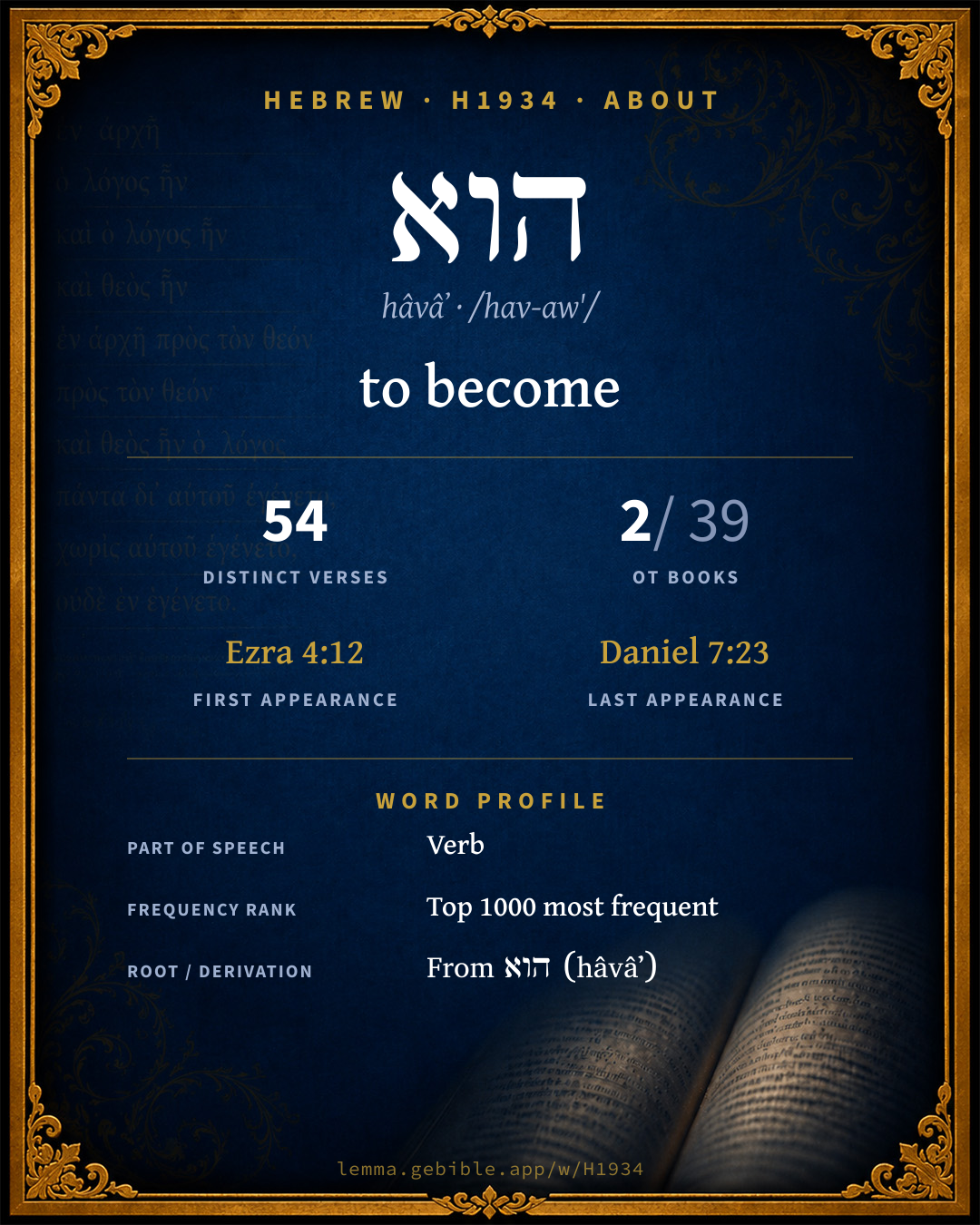
הֲוָא
to become
‘to become’ is one of 4 main senses fuller range ↓
Full lexicon entry — Brown-Driver-Briggs (BDB)
From Brown-Driver-Briggs (BDB)
Where this word appears
Grammar key — what these labels mean
Part of speech
- Verb
- An action or state-of-being word.
Stem
- Qal
- The basic, simple active stem — the plain form of the verb (“he wrote”).
Form
- Imperfect
- An incomplete, ongoing, or future action (“he will / would write”).
- Perfect
- A completed action or state — Hebrew marks aspect (completeness) more than strict tense (“he wrote”).
- Imperative
- A direct command (“write!”).
Person
- 3rd Person
- The one spoken about (“he / she / it / they”).
- 1st Person
- The speaker (“I / we”).
- 2nd Person
- The one addressed (“you”).
Gender
- Masculine
- Grammatically masculine.
- Common
- Either gender — not distinguished for this form.
- Feminine
- Grammatically feminine.
Number
- Singular
- One.
- Plural
- More than one (in Hebrew, generally three or more).
Grammatical forms 10 distinct
- Verb, Qal, Imperfect, 3rd Person, Masculine, Singular 17 times (24%)
- Verb, Qal, Perfect, 3rd Person, Masculine, Singular 14 times (20%)
- Verb, Qal, Perfect, 1st Person, Common, Singular 13 times (18%)
- Verb, Qal, Imperfect, 3rd Person, Feminine, Singular 7 times (10%)
- Verb, Qal, Imperfect, 3rd Person, Masculine, Plural 7 times (10%)
- Verb, Qal, Perfect, 3rd Person, Feminine, Singular 4 times (6%)
- Verb, Qal, Perfect, 3rd Person, Masculine, Plural 4 times (6%)
- Verb, Qal, Perfect, 2nd Person, Masculine, Singular 2 times (3%)
+2 more forms (3 occurrences)
Parsed forms decoded from the imported morphology (morphhb / Westminster Leningrad Codex — WLC text public domain, morphhb tagging CC BY 4.0), counted across 71 parsed occurrences — not distinct verses.
Every verse where H1934 appears — 54 distinct verses across 2 books. Click any verse to open its interlinear word-by-word view. Verse text shown in the World English Bible for context — . Each verse’s Hebrew form is shown with its reference; the English is not keyword-highlighted, since the data carries no word-level English alignment. Use “Compare translations” on any verse to read it across multiple English versions. This concordance covers the Hebrew Bible; Septuagint (Greek Old Testament) occurrences are not indexed here.
Ezra 15 verses
- Ezra 4:12 לֶהֱוֵ֣א Qal impf 3ms Be it known to the king, that the Jews who came up from you are come to us to Jerusalem; they are building the rebellious and the bad city, and have finished the walls, and repaired the foundations.
- Ezra 4:13 לֶהֱוֵ֣א Qal impf 3ms Be it known now to the king that if this city is built, and the walls finished, they will not pay tribute, custom, or toll, and in the end it will be hurtful to the kings.
- Ezra 4:20 הֲווֹ֙ Qal pf 3mp There have been mighty kings also over Jerusalem, who have ruled over all [the country] beyond the River; and tribute, custom, and toll, was paid to them.
- Ezra 4:22 הֱו֛וֹ Qal impv 2mp Take heed that you not be slack herein: why should damage grow to the hurt of the kings?
- Ezra 4:24 וַ/הֲוָת֙ conj + Qal pf 3fs Then ceased the work of the house of God which is at Jerusalem; and it ceased until the second year of the reign of Darius king of Persia.
- Ezra 5:5 הֲוָת֙ Qal pf 3fs But the eye of their God was on the elders of the Jews, and they did not make them cease, until the matter should come to Darius, and then answer should be returned by letter concerning it.
- Ezra 5:8 לֶהֱוֵ֣א Qal impf 3ms Be it known to the king, that we went into the province of Judah, to the house of the great God, which is built with great stones, and timber is laid in the walls; and this work goes on with diligence and prospers in their hands.
- Ezra 5:11 הֲוָ֨א Qal pf 3ms Thus they returned us answer, saying, We are the servants of the God of heaven and earth, and are building the house that was built these many years ago, which a great king of Israel built and finished.
- Ezra 6:6 הֲו֖וֹ Qal impv 2mp Now therefore, Tattenai, governor beyond the River, Shetharbozenai, and your companions the Apharsachites, who are beyond the River, be you far from there:
- Ezra 6:8 תֶּהֱוֵ֧א Qal impf 3fs Moreover I make a decree what you shall do to these elders of the Jews for the building of this house of God: that of the king's goods, even of the tribute beyond the River, expenses be given with all diligence to these men, that they be not hindered.
- Ezra 6:9 לֶהֱוֵ֨א Qal impf 3ms That which they have need of, both young bulls, and rams, and lambs, for burnt offerings to the God of heaven; [also] wheat, salt, wine, and oil, according to the word of the priests who are at Jerusalem, let it be given them day by day without fail;
- Ezra 6:10 לֶהֱוֺ֧ן Qal impf 3mp that they may offer sacrifices of sweet savor to the God of heaven, and pray for the life of the king, and of his sons.
- Ezra 7:23 לֶֽהֱוֵא֙ Qal impf 3ms Whatever is commanded by the God of heaven, let it be done exactly for the house of the God of heaven; for why should there be wrath against the realm of the king and his sons?
- Ezra 7:25 לֶהֱוֺ֤ן Qal impf 3mp You, Ezra, after the wisdom of your God who is in your hand, appoint magistrates and judges, who may judge all the people who are beyond the River, all such as know the laws of your God; and teach you him who doesn't know them.
- Ezra 7:26 לֶהֱוֵ֨א לֶהֱוֵ֥א Qal impf 3ms Qal impf 3ms Whoever will not do the law of your God, and the law of the king, let judgment be executed on him with all diligence, whether it be to death, or to banishment, or to confiscation of goods, or to imprisonment.
Daniel 39 verses
- Daniel 2:20 לֶהֱוֵ֨א Qal impf 3ms Daniel answered, Blessed be the name of God forever and ever; for wisdom and might are his.
- Daniel 2:28 לֶהֱוֵ֖א Qal impf 3ms but there is a God in heaven who reveals secrets, and he has made known to the king Nebuchadnezzar what shall be in the latter days. Your dream, and the visions of your head on your bed, are these:
- Daniel 2:29 לֶהֱוֵ֖א לֶהֱוֵֽא Qal impf 3ms Qal impf 3ms as for you, O king, your thoughts came [into your mind] on your bed, what should happen hereafter; and he who reveals secrets has made known to you what shall happen.
- Daniel 2:31 הֲוַ֨יְתָ֙ Qal pf 2ms You, O king, saw, and, behold, a great image. This image, which was mighty, and whose brightness was excellent, stood before you; and the aspect of it was awesome.
- Daniel 2:34 הֲוַ֗יְתָ Qal pf 2ms You saw until a stone was cut out without hands, which struck the image on its feet that were of iron and clay, and broke them in pieces.
- Daniel 2:35 וַ/הֲווֹ֙ הֲוָ֛ת conj + Qal pf 3mp Qal pf 3fs Then was the iron, the clay, the brass, the silver, and the gold, broken in pieces together, and became like the chaff of the summer threshing floors; and the wind carried them away, so that no place was found for them: and the stone that struck the image became a great mountain, and filled the whole earth.
- Daniel 2:40 תֶּהֱוֵ֥א Qal impf 3fs The fourth kingdom shall be strong as iron, because iron breaks in pieces and subdues all things; and as iron that crushes all these, shall it break in pieces and crush.
- Daniel 2:41 תֶּהֱוֵ֔ה לֶֽהֱוֵא Qal impf 3fs Qal impf 3ms Whereas you saw the feet and toes, part of potters' clay, and part of iron, it shall be a divided kingdom; but there shall be in it of the strength of the iron, because you saw the iron mixed with miry clay.
- Daniel 2:42 תֶּהֱוֵ֣ה תֶּהֱוֵ֥ה Qal impf 3fs Qal impf 3fs As the toes of the feet were part of iron, and part of clay, so the kingdom shall be partly strong, and partly broken.
- Daniel 2:43 לֶהֱוֺן֙ לֶהֱוֺ֥ן Qal impf 3mp Qal impf 3mp Whereas you saw the iron mixed with miry clay, they shall mingle themselves with the seed of men; but they shall not cling to one another, even as iron does not mingle with clay.
- Daniel 2:45 לֶהֱוֵ֖א Qal impf 3ms Because you saw that a stone was cut out of the mountain without hands, and that it broke in pieces the iron, the brass, the clay, the silver, and the gold; the great God has made known to the king what shall happen hereafter: and the dream is certain, and the interpretation of it sure.
- Daniel 3:18 לֶהֱוֵא Qal impf 3ms But if not, be it known to you, O king, that we will not serve your gods, nor worship the golden image which you have set up.
- Daniel 4:4 הֲוֵית֙ Qal pf 1cs I, Nebuchadnezzar, was at rest in my house, and flourishing in my palace.
- Daniel 4:10 הֲוֵ֔ית Qal pf 1cs Thus were the visions of my head on my bed: I saw, and, behold, a tree in the midst of the earth; and the height of it was great.
- Daniel 4:13 הֲוֵ֛ית Qal pf 1cs I saw in the visions of my head on my bed, and, behold, a watcher and a holy one came down from the sky.
- Daniel 4:25 לֶהֱוֵ֨ה Qal impf 3ms that you shall be driven from men, and your dwelling shall be with the animals of the field, and you shall be made to eat grass as oxen, and shall be wet with the dew of the sky, and seven times shall pass over you; until you know that the Most High rules in the kingdom of men, and gives it to whoever he will.
- Daniel 4:27 תֶּהֱוֵ֥א Qal impf 3fs Therefore, O king, let my counsel be acceptable to you, and break off your sins by righteousness, and your iniquities by showing mercy to the poor; if there may be a lengthening of your tranquillity.
- Daniel 4:29 הֲוָֽה Qal pf 3ms At the end of twelve months he was walking in the royal palace of Babylon.
- Daniel 5:17 לֶֽהֶוְיָ֔ן Qal impf 3fp Then Daniel answered before the king, Let your gifts be to yourself, and give your rewards to another; nevertheless I will read the writing to the king, and make known to him the interpretation.
- Daniel 5:19 הֲו֛וֹ הֲוָ֨ה הֲוָ֣א הֲוָ֤ה הֲוָ֣ה הֲוָ֤ה הֲוָ֣ה הֲוָ֥ה הֲוָ֥ה Qal pf 3mp Qal pf 3ms Qal pf 3ms Qal pf 3ms Qal pf 3ms Qal pf 3ms Qal pf 3ms Qal pf 3ms Qal pf 3ms and because of the greatness that he gave him, all the peoples, nations, and languages trembled and feared before him: whom he would he killed, and whom he would he kept alive; and whom he would he raised up, and whom he would he put down.
- Daniel 5:29 לֶהֱוֵ֥א Qal impf 3ms Then commanded Belshazzar, and they clothed Daniel with purple, and put a chain of gold about his neck, and made proclamation concerning him, that he should be the third ruler in the kingdom.
- Daniel 6:1 לֶהֱוֺ֖ן Qal impf 3mp It pleased Darius to set over the kingdom one hundred twenty satraps, who should be throughout the whole kingdom;
- Daniel 6:2 לֶהֱוֺ֞ן לֶהֱוֵ֥א Qal impf 3mp Qal impf 3ms and over them three presidents, of whom Daniel was one; that these satraps might give account to them, and that the king should have no damage.
- Daniel 6:3 הֲוָ֣א Qal pf 3ms Then this Daniel was distinguished above the presidents and the satraps, because an excellent spirit was in him; and the king thought to set him over the whole realm.
- Daniel 6:4 הֲו֨וֹ Qal pf 3mp Then the presidents and the satraps sought to find occasion against Daniel as touching the kingdom; but they could find no occasion nor fault, because he was faithful, neither was there any error or fault found in him.
- Daniel 6:10 הֲוָ֣א Qal pf 3ms When Daniel knew that the writing was signed, he went into his house (now his windows were open in his chamber toward Jerusalem) and he kneeled on his knees three times a day, and prayed, and gave thanks before his God, as he did before.
- Daniel 6:14 הֲוָ֥א Qal pf 3ms Then the king, when he heard these words, was sore displeased, and set his heart on Daniel to deliver him; and he labored until the going down of the sun to rescue him.
- Daniel 6:26 לֶהֱוֺ֤ן Qal impf 3mp I make a decree, that in all the dominion of my kingdom men tremble and fear before the God of Daniel; for he is the living God, and steadfast forever, His kingdom that which shall not be destroyed; and his dominion shall be even to the end.
- Daniel 7:2 הֲוֵ֛ית Qal pf 1cs Daniel spoke and said, I saw in my vision by night, and, behold, the four winds of the sky broke forth on the great sea.
- Daniel 7:4 הֲוֵ֡ית Qal pf 1cs The first was like a lion, and had eagle's wings: I saw until the wings of it were plucked, and it was lifted up from the earth, and made to stand on two feet as a man; and a man's heart was given to it.
- Daniel 7:6 הֲוֵ֗ית Qal pf 1cs After this I saw, and, behold, another, like a leopard, which had on its back four wings of a bird; the animal had also four heads; and dominion was given to it.
- Daniel 7:7 הֲוֵ֜ית Qal pf 1cs After this I saw in the night-visions, and, behold, a fourth animal, awesome and powerful, and strong exceedingly; and it had great iron teeth; it devoured and broke in pieces, and stamped the residue with its feet: and it was diverse from all the animals that were before it; and it had ten horns.
- Daniel 7:8 הֲוֵ֜ית Qal pf 1cs I considered the horns, and, behold, there came up among them another horn, a little one, before which three of the first horns were plucked up by the roots: and, behold, in this horn were eyes like the eyes of a man, and a mouth speaking great things.
- Daniel 7:9 הֲוֵ֗ית Qal pf 1cs I saw until thrones were placed, and one who was ancient of days sat: his clothing was white as snow, and the hair of his head like pure wool; his throne was fiery flames, [and] the wheels of it burning fire.
- Daniel 7:11 הֲוֵ֔ית הֲוֵ֡ית Qal pf 1cs Qal pf 1cs I saw at that time because of the voice of the great words which the horn spoke; I saw even until the animal was slain, and its body destroyed, and it was given to be burned with fire.
- Daniel 7:13 הֲוֵית֙ הֲוָ֑ה Qal pf 1cs Qal pf 3ms I saw in the night-visions, and, behold, there came with the clouds of the sky one like a son of man, and he came even to the ancient of days, and they brought him near before him.
- Daniel 7:19 הֲוָ֥ת Qal pf 3fs Then I desired to know the truth concerning the fourth animal, which was diverse from all of them, exceedingly terrible, whose teeth were of iron, and its nails of brass; which devoured, broke in pieces, and stamped the residue with its feet;
- Daniel 7:21 הֲוֵ֔ית Qal pf 1cs I saw, and the same horn made war with the saints, and prevailed against them;
- Daniel 7:23 תֶּהֱוֵ֣א Qal impf 3fs Thus he said, The fourth animal shall be a fourth kingdom on earth, which shall be diverse from all the kingdoms, and shall devour the whole earth, and shall tread it down, and break it in pieces.
About this entry
At a glance — auto-summarized from this page’s data, not written by a person. Every figure links to its source below. This summary describes the numbers; it doesn’t interpret them.
הוא (hâvâʼ) is a Hebrew verb most often rendered “to become.” Daniel dominates its distribution — 39 of 54 verses. Spanning 54 verses in 2 books, it ranks among the moderately common words of the Hebrew Bible. Its lexical range runs to 4 senses. Its English rendering has broadened — “shall be” classically, “he” (Berean Standard Bible) and “i was” (unfoldingWord Literal Text) in modern versions; see the renderings breakdown. The sections below give every sense, occurrence, and version rendering.
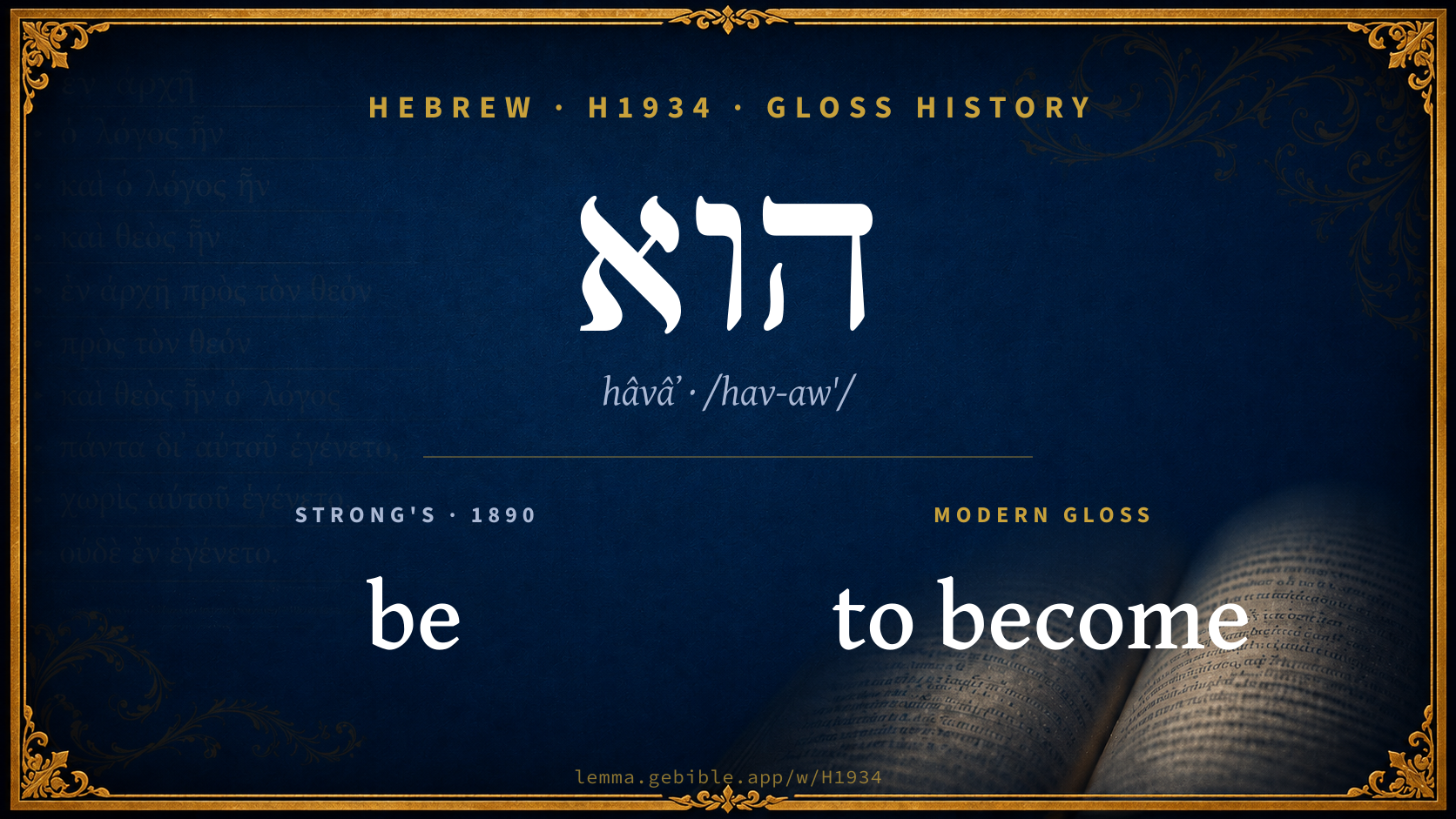
Gloss history
Strong's 1890 vs modern scholarship
About this word
Strong's H1934 catalogs a Hebrew word from the Hebrew Old Testament.
These counts are not copied from any lexicon or concordance. They are computed here, from the morphology-tagged Hebrew Old Testament. What Lemma adds →
- 54
- distinct verses
- The word appears in 54 distinct verses.
- 2 / 39
- OT books
- The word appears in 2 of 39 Old Testament books.
- #558
- by frequency
- Top 1000 most frequent Hebrew words (rank 558 of 8,640 Hebrew words by occurrence).
View all 54 occurrences in the concordance →
By traditional corpus
Conventional, traditional groupings — biblical authorship is debated, so this is a traditional corpus grouping, not an authorship claim. Each share is this word’s portion of its verses in that division of the Hebrew canon. Each figure is a share of the word’s 54 distinct verses.
- Writings (Ketuvim) 54 verses · 100%
How translations render this word
Counts come from each version’s own published word-to-Strong’s tagging or interlinear alignment — an approximate guide to how each version renders this word, not a word-level alignment the data otherwise carries. Because each total is that version’s own tagged count, the per-version totals vary from one another and need not match the appearance or distinct-verse counts above. These counts may also differ from a printed concordance because Lemma counts each distinctly tagged rendering and does not collapse phrase taggings into a single head-word total. This is a fixed set of word-tagged versions (KJV, ASV, BSB, ULT) and does not change with the reading translation you choose elsewhere. Each version’s license is shown beside its name below (and on Sources).
- King James Version: Shall be 7×, I beheld 6×, Was 5×
- American Standard Version: Shall be 7×, I beheld 6×, Was 5×
- Berean Standard Bible: He 5×, I 5×, Was 4×
- unfoldingWord Literal Text: I was 7×, Will be 7×, Was 6×
King James Version Public Domain
Renders H1934 across 66 tagged occurrences — most commonly:
Plus 30 renderings that appear only once — usually multi-word phrases or single function words the recovered tagging swept in, not distinct renderings. Not rendered by a distinct English word in 3 further occurrences.
American Standard Version Public Domain
Renders H1934 across 67 tagged occurrences — most commonly:
Plus 29 renderings that appear only once — usually multi-word phrases or single function words the recovered tagging swept in, not distinct renderings.
Berean Standard Bible Public Domain
Renders H1934 across 50 tagged occurrences — most commonly:
Plus 20 renderings that appear only once — usually multi-word phrases or single function words the recovered tagging swept in, not distinct renderings. Not rendered by a distinct English word in 19 further occurrences.
unfoldingWord Literal Text CC BY-SA 4.0
Renders H1934 across 75 tagged occurrences — most commonly:
Plus 24 renderings that appear only once — usually multi-word phrases or single function words the recovered tagging swept in, not distinct renderings.
Senses in BDB
The 4 senses BDB distinguishes for this word, in lexicon order (not ranked by frequency or importance). The full entry — with sub-senses — is in the Lexicon Entry tab.
- to come to pass, become, be
(Peal)
- to come to pass
- to come into being, arise, become, come to be
- to be
Word origin
הֲוָא, הֲוָה 71 vb. come to pass, become, be
— Brown-Driver-Briggs (Oxford 1906, public domain), digitized via Sefaria, supplemented by the OpenScriptures HebrewLexicon (CC BY 4.0). See Sources.
Derived from הוא (hâvâʼ) (H1933) — to be.
Jastrow Dictionary
A second Hebrew/Aramaic lexicon for comparison, covering Aramaic and post-biblical (Talmudic, Targumic, Midrashic) usage that the biblical-Hebrew BDB does not. Matched by lemma rather than by Strong’s number, so a lemma may carry more than one Jastrow headword (shown separately below), and the entries cover usage well beyond the Bible.
הוּא
- (b. h.) he, it; she; it is &c. Snh. III, 3 (24ᵇ) if he has no trade אלא הוא (Y. ed., Erub. 82ᵃ היא) except this (gambling &c.); יש לו אומנות שלא הוא (היא) if he has a trade besides this (v. Rabb. D. S. a. l. note 80).—הוא—הוא, היא—היא it is the same, i.e. there is no difference between the two. Y. Ber. I, 3ᵇ היא היא both are equally precious. Gen. R. s. 9, end הוא מאד הוא אדם the word מאד has the same letters as אדם. Ber. 2ᵇ דילמא ביאת אורו הוא perhaps it is (means) the arrival of his day, v. אוֹר II; a. v. fr.—[Shebi. III, 8 עושה הוא; IV, 5 מכסה הוא, Y. ed. עוֹשֵׂהוּ, מְכַסֵּהוּ; ib. X, 6 מזכה הוא; Ms. M., Gitt. 37ᵃ מְזַכֵּהוּ.]—ולא היא but it is not so (it has a different reason &c.). Ber. 57ᵃ; a. fr.—כל שהוא (כל שהיא) a) whosoever, whatsoever (is). Peah II, 4 כל ש׳ אוכל whatever is eatable &c.; a. fr.—b) whatever it may be, a minimum, v. כָּל. Shebi. X, 6 כל שהוא; Gitt. l. c. כל שֶׁהוּ; a. fr.—ספר היא the Book Hi, name of a Pentateuch scroll in the Temple in which היא occurs nine times (for the archaic הִוא), whereas in others it appears eleven times (v. Ab. d’R. N. ch. XXXIV, ed. Schechter). Sifré Deut. 356; Y. Taan. IV, 68ᵃ bot.—הַהוּא, הַהִיא, mostly in Chald. diction, v. next w.—Pl. הֵם m., הֵן c. Ber. 2ᵇ והלא כהנים … הם טובלים but do not priests bathe &c.?—Meg. 14ᵇ רהמניות הן are compassionate. Ḥull. 127ᵇ הרי הן וכ׳ they are to be treated as if &c.; a. v. fr.—הן … הן are the same. Y. Ab. Zar. II, end, 42ᵃ, v. אִסְטַגְיוֹת.—With prep. מֵהֶם, מֵהֶן, לָהֶם &c.
הוּא ²
- , ch. same. Targ. Ex. I, 16; a. v. fr.—היא הדא, v. דָּא.—Y. Shebi. VII, 37ᶜ top בהוא אתר (R. S. to Shebi. VII, 3 בההוא אתרא) in the same place.—כל דהו whatsoever, v. preced. Arakh. 2ᵃ נפשות כל דהו human beings of any nature, v. כָּל.—Y. Kil. VI, 31ᵇ top כהיא דאמר וכ׳ (in Babli כי הא) as (that which) R. … said.—Pl. הֵן (perhaps only in Hebr. phrases); הִינוּן, הִינִין. Targ. Y. Ex. I, 10; Ib. 19 (O. אינ׳); a. fr.—With prefix ה: הַהוּא, הַהִיא. Targ. Y. Ex. XXI, 20; a. fr.—In Talmud frequ. used to introduce a case. Pes. 3ᵇ ה׳ ארמאה ד־ it occurred that a gentile &c. Keth. 78ᵇ ה׳ איתתא ד־ the case came up of a woman that &c.; a. v. fr.—ה׳ גברא, ה׳ איתתא frequ. euphemistically for myself, thyself (to avoid ominous speech or curse). Y. Maas. Sh. IV, 55ᵇ bot. אביו דה׳ ג׳ thy father. Ib.ᶜ top חמית ה׳ א׳ I saw; בעלה דה׳ א׳ thy husband; a. v. fr.—With prefix ד־: דהוא, דהיא, contr. דּוּ, דִּי, v. דְּ־ a. דּוּ.—With prefixed prep. בְּהוֹן, בּוֹן, לְהוֹן, לוֹן.
הֲוָא
- , v. הוי
A Dictionary of the Targumim, the Talmud Babli and Yerushalmi, and the Midrashic Literature (Marcus Jastrow; London, Luzac, 1903) — Public Domain. Digitized via Sefaria. Digitized via Sefaria. Full attribution on Sources.
Forms in the corpus
The 49 distinct written forms H1934 takes in the Hebrew Bible, most frequent first — each parse links to that stem’s occurrences in the concordance. Hebrew forms include their vowel points and cantillation, so a single lemma takes many written forms.
| Form | Parsing | Example | Uses |
|---|---|---|---|
| הֲוֵ֔ית | Verb, Qal, Perfect, 1st Person, Common, Singular | Daniel 4:10 | 3 |
| הֲוָ֣א | Verb, Qal, Perfect, 3rd Person, Masculine, Singular | Daniel 5:19 | 3 |
| לֶהֱוֵ֖א | Verb, Qal, Imperfect, 3rd Person, Masculine, Singular | Daniel 2:28 | 3 |
| לֶהֱוֵ֣א | Verb, Qal, Imperfect, 3rd Person, Masculine, Singular | Ezra 4:12 | 3 |
| לֶהֱוֵ֥א | Verb, Qal, Imperfect, 3rd Person, Masculine, Singular | Daniel 5:29 | 3 |
| לֶהֱוֵ֨א | Verb, Qal, Imperfect, 3rd Person, Masculine, Singular | Daniel 2:20 | 3 |
| הֲוֵ֗ית | Verb, Qal, Perfect, 1st Person, Common, Singular | Daniel 7:6 | 2 |
| הֲוֵ֛ית | Verb, Qal, Perfect, 1st Person, Common, Singular | Daniel 4:13 | 2 |
| הֲוֵ֜ית | Verb, Qal, Perfect, 1st Person, Common, Singular | Daniel 7:7 | 2 |
| הֲוֵ֡ית | Verb, Qal, Perfect, 1st Person, Common, Singular | Daniel 7:4 | 2 |
| הֲוֵית֙ | Verb, Qal, Perfect, 1st Person, Common, Singular | Daniel 4:4 | 2 |
| הֲוָ֣ה | Verb, Qal, Perfect, 3rd Person, Masculine, Singular | Daniel 5:19 | 2 |
| הֲוָ֤ה | Verb, Qal, Perfect, 3rd Person, Masculine, Singular | Daniel 5:19 | 2 |
| הֲוָ֥ה | Verb, Qal, Perfect, 3rd Person, Masculine, Singular | Daniel 5:19 | 2 |
| לֶהֱוֺ֤ן | Verb, Qal, Imperfect, 3rd Person, Masculine, Plural | Daniel 6:26 | 2 |
| תֶּהֱוֵ֥א | Verb, Qal, Imperfect, 3rd Person, Feminine, Singular | Daniel 2:40 | 2 |
| הֱו֛וֹ | Verb, Qal, Imperative, 2nd Person, Masculine, Plural | Ezra 4:22 | 1 |
| הֲו֖וֹ | Verb, Qal, Imperative, 2nd Person, Masculine, Plural | Ezra 6:6 | 1 |
| הֲו֛וֹ | Verb, Qal, Perfect, 3rd Person, Masculine, Plural | Daniel 5:19 | 1 |
| הֲו֨וֹ | Verb, Qal, Perfect, 3rd Person, Masculine, Plural | Daniel 6:4 | 1 |
| הֲוַ֗יְתָ | Verb, Qal, Perfect, 2nd Person, Masculine, Singular | Daniel 2:34 | 1 |
| הֲוַ֨יְתָ֙ | Verb, Qal, Perfect, 2nd Person, Masculine, Singular | Daniel 2:31 | 1 |
| הֲוָ֑ה | Verb, Qal, Perfect, 3rd Person, Masculine, Singular | Daniel 7:13 | 1 |
| הֲוָ֛ת | Verb, Qal, Perfect, 3rd Person, Feminine, Singular | Daniel 2:35 | 1 |
| הֲוָ֥א | Verb, Qal, Perfect, 3rd Person, Masculine, Singular | Daniel 6:14 | 1 |
| הֲוָ֥ת | Verb, Qal, Perfect, 3rd Person, Feminine, Singular | Daniel 7:19 | 1 |
| הֲוָ֨א | Verb, Qal, Perfect, 3rd Person, Masculine, Singular | Ezra 5:11 | 1 |
| הֲוָ֨ה | Verb, Qal, Perfect, 3rd Person, Masculine, Singular | Daniel 5:19 | 1 |
| הֲוָֽה | Verb, Qal, Perfect, 3rd Person, Masculine, Singular | Daniel 4:29 | 1 |
| הֲוָת֙ | Verb, Qal, Perfect, 3rd Person, Feminine, Singular | Ezra 5:5 | 1 |
| הֲווֹ֙ | Verb, Qal, Perfect, 3rd Person, Masculine, Plural | Ezra 4:20 | 1 |
| וַ/הֲוָת֙ | Verb, Qal, Perfect, 3rd Person, Feminine, Singular | Ezra 4:24 | 1 |
| וַ/הֲווֹ֙ | Verb, Qal, Perfect, 3rd Person, Masculine, Plural | Daniel 2:35 | 1 |
| לֶֽהֱוֵא | Verb, Qal, Imperfect, 3rd Person, Masculine, Singular | Daniel 2:41 | 1 |
| לֶֽהֱוֵא֙ | Verb, Qal, Imperfect, 3rd Person, Masculine, Singular | Ezra 7:23 | 1 |
| לֶֽהֶוְיָ֔ן | Verb, Qal, Imperfect, 3rd Person, Feminine, Plural | Daniel 5:17 | 1 |
| לֶהֱוֵ֨ה | Verb, Qal, Imperfect, 3rd Person, Masculine, Singular | Daniel 4:25 | 1 |
| לֶהֱוֵֽא | Verb, Qal, Imperfect, 3rd Person, Masculine, Singular | Daniel 2:29 | 1 |
| לֶהֱוֵא | Verb, Qal, Imperfect, 3rd Person, Masculine, Singular | Daniel 3:18 | 1 |
| לֶהֱוֺ֖ן | Verb, Qal, Imperfect, 3rd Person, Masculine, Plural | Daniel 6:1 | 1 |
| לֶהֱוֺ֞ן | Verb, Qal, Imperfect, 3rd Person, Masculine, Plural | Daniel 6:2 | 1 |
| לֶהֱוֺ֥ן | Verb, Qal, Imperfect, 3rd Person, Masculine, Plural | Daniel 2:43 | 1 |
| לֶהֱוֺ֧ן | Verb, Qal, Imperfect, 3rd Person, Masculine, Plural | Ezra 6:10 | 1 |
| לֶהֱוֺן֙ | Verb, Qal, Imperfect, 3rd Person, Masculine, Plural | Daniel 2:43 | 1 |
| תֶּהֱוֵ֔ה | Verb, Qal, Imperfect, 3rd Person, Feminine, Singular | Daniel 2:41 | 1 |
| תֶּהֱוֵ֣א | Verb, Qal, Imperfect, 3rd Person, Feminine, Singular | Daniel 7:23 | 1 |
| תֶּהֱוֵ֣ה | Verb, Qal, Imperfect, 3rd Person, Feminine, Singular | Daniel 2:42 | 1 |
| תֶּהֱוֵ֥ה | Verb, Qal, Imperfect, 3rd Person, Feminine, Singular | Daniel 2:42 | 1 |
| תֶּהֱוֵ֧א | Verb, Qal, Imperfect, 3rd Person, Feminine, Singular | Ezra 6:8 | 1 |
Same root — word family
Other BDB entries built from the same root as H1934, grouped by Strong’s listed origin. These share a root / origin per the lexicon — not necessarily a shared meaning. Each links to that word’s own entry.
Derives from
Shares the same root
Compare all same-root words → They share a root, not necessarily a meaning.
Septuagint verse parallels
This word appears in 53 verses that also exist in the Greek Old Testament (Septuagint), out of the 54 Hebrew verses it occurs in. You can read those verses in Greek by switching the Old Testament edition to the Septuagint.
Read these verses in the Septuagint
This is a verse-level parallel only — the same verses exist in both the Hebrew and Greek Old Testaments. No word-level Hebrew↔Greek correspondence is claimed: the data carries no such alignment, so no Greek word is shown as this Hebrew word’s translation. Coverage is not total — the Septuagint omits the deuterocanon and renumbers the Psalms, so some Hebrew verses have no direct Greek parallel.