Genesis 3:5

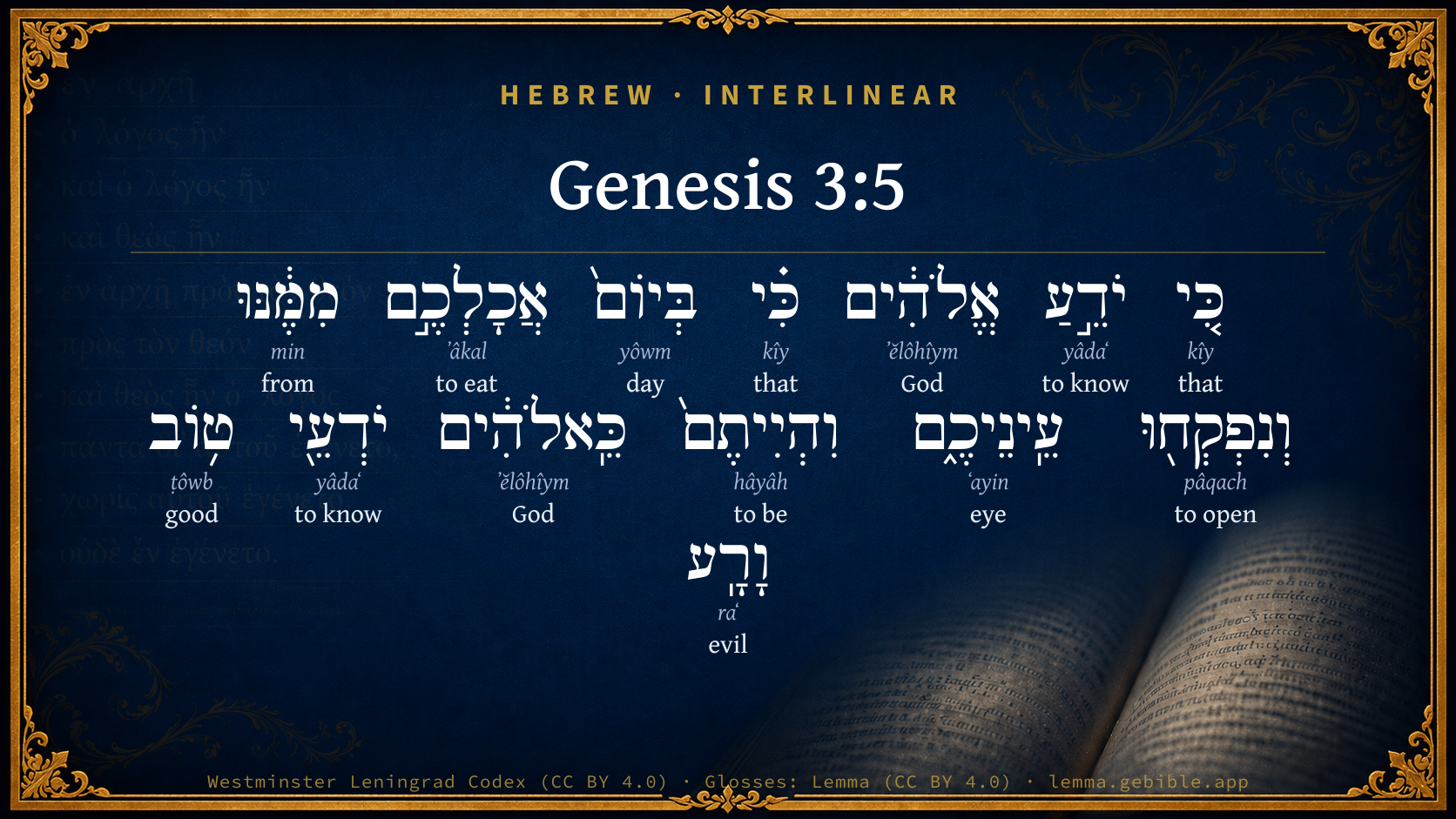
Hebrew (Westminster Leningrad Codex) Genesis 3:5 appears in the Hebrew Old Testament. The text above is from the Westminster Leningrad Codex. Each word links to its Strong’s number, a concise gloss, and parsing drawn from the Open Scriptures Hebrew Bible morphology. Click any word for its full Brown-Driver-Briggs (BDB) entry.
Download image
Cite this verse

Genesis 3:5 (World English Bible). Public Domain. Lemma interlinear Bible study tool, https://lemma.gebible.app/v/genesis/3/5.

Show BibTeX & RIS
BibTeX
RIS
English Translation
for God knows that in the day you eat it, your eyes will be opened, and you will be like God, knowing good and evil."
World English Bible · Public Domain
Highlights
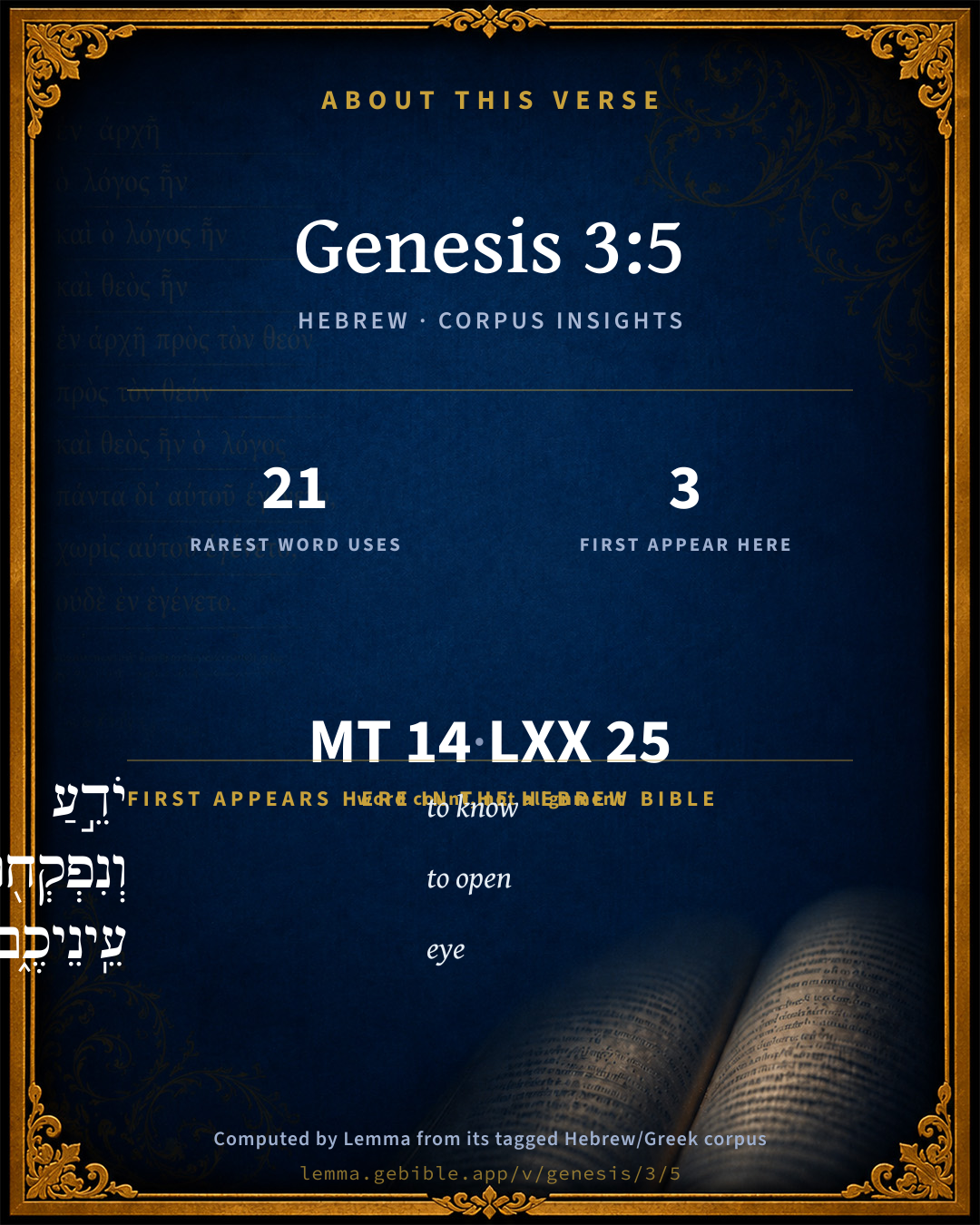
  • 3 first appearances in the Hebrew Bible
Full analysis ↓
Download a study sheet

One document with this verse’s original text, its word-by-word gloss line, the meaning frame, cross-references with their text, attributed commentary, and full source and license credits — printable, and it pastes into notes with its structure intact.

This verse Autodidact and up

Study sheet (.html) Plain text (.txt)

A passage Seminary Student

Up to 50 verses in one chapter. A passage sheet keeps up to 6 commentary sources and 12 cross-references per verse, in the order this page ranks them, and says so on the sheet whenever that leaves anything out. Ask for a single verse and you get the Autodidact verse sheet above.

Everything on this page stays free to read, with no account — the sheet is a download of what is already on screen, not access to it.

Want to remove ads? Support Godless Engineer
Compare translations 3

The same verse in 3 English versions, stacked beneath the original-language interlinear above. Click any original word for its lexicon entry.

Each is an independent rendering of the whole verse — the interlinear is not word-aligned to these translations.

Highlighted words mark where these versions differ — a whole-verse word diff, not a word-by-word alignment.

  • World English Bible Public Domain
    for God knows that in the day you eat it, your eyes will be opened, and you will be like God, knowing good and evil."
  • King James Version Public Domain
    For God doth know that in the day ye eat thereof, then your eyes shall be opened, and ye shall be as gods, knowing good and evil.
  • unfoldingWord Literal Text CC BY-SA 4.0
    For God knows that on the day you eat from it, then your eyes will be opened, and you will be like God in knowing good and evil.”

unfoldingWord Literal Text — © unfoldingWord, licensed CC BY-SA 4.0. Word-aligned USFM3 via Door43 (git.door43.org/unfoldingWord/en_ult).

Versions to compare (up to 4)

3 of 4 selected

Show all 18 translations

Every available English version of this verse, each an independent rendering of the whole verse.

  • World English Bible Public Domain
    for God knows that in the day you eat it, your eyes will be opened, and you will be like God, knowing good and evil."
  • Berean Standard Bible Public Domain
    “For God knows that in the day you eat of it, your eyes will be opened and you will be like God, knowing good and evil.”
  • Majority Standard Bible Public Domain
    “For God knows that in the day you eat of it, your eyes will be opened and you will be like God, knowing good and evil.”
  • King James Version Public Domain
    For God doth know that in the day ye eat thereof, then your eyes shall be opened, and ye shall be as gods, knowing good and evil.
  • American Standard Version (1901) Public Domain
    for God doth know that in the day ye eat thereof, then your eyes shall be opened, and ye shall be as God, knowing good and evil.
  • Revised Version (1885) Public Domain
    for God doth know that in the day ye eat thereof, then your eyes shall be opened, and ye shall be as God, knowing good and evil.
  • Geneva Bible (1599) Public Domain
    But God doeth knowe, that when ye shall eate thereof, your eyes shall be opened, and ye shall be as gods, knowing good and euill.
  • Douay-Rheims (1899) Public Domain
    For God doth know that in what day soever you shall eat thereof, your eyes shall be opened: and you shall be as Gods, knowing good and evil.
  • Young's Literal Translation Public Domain
    for God doth know that in the day of your eating of it -- your eyes have been opened, and ye have been as God, knowing good and evil.'
  • Literal Standard Version CC BY-SA 4.0
    for God knows that in the day of your eating of it—your eyes have been opened, and you have been as God, knowing good and evil.”
  • Unlocked Literal Bible CC BY-SA 4.0
    For God knows that the day you eat it your eyes will be opened, and you will be like God, knowing good and evil.”
  • unfoldingWord Literal Text CC BY-SA 4.0
    For God knows that on the day you eat from it, then your eyes will be opened, and you will be like God in knowing good and evil.”
  • Darby Bible Public Domain
    but God knows that in the day ye eat of it, your eyes will be opened, and ye will be as God, knowing good and evil.
  • World Messianic Bible Public Domain
    for God knows that in the day you eat it, your eyes will be opened, and you will be like God, knowing good and evil.”
  • Webster's Bible Public Domain
    For God doth know, that in the day ye eat of it, then your eyes shall be opened: and ye shall be as gods, knowing good and evil.
  • Free Bible Version CC BY-SA 4.0
    “It's because God knows that as soon as you eat it, you'll see things differently, and you'll be like God, knowing both what is good and what is evil.”
  • Bible in Basic English Public Domain
    For God sees that on the day when you take of its fruit, your eyes will be open, and you will be as gods, having knowledge of good and evil.
  • JPS Tanakh (1917) Public Domain
    for God doth know that in the day ye eat thereof, then your eyes shall be opened, and ye shall be as God, knowing good and evil.'

Literal Standard Version (2020), Covenant Press — licensed CC BY-SA 4.0. Text via the HelloAO Bible API (eBible.org). Unlocked Literal Bible (unfoldingWord) — licensed CC BY-SA 4.0. Text via the HelloAO Bible API (eBible.org). unfoldingWord Literal Text — © unfoldingWord, licensed CC BY-SA 4.0. Word-aligned USFM3 via Door43 (git.door43.org/unfoldingWord/en_ult). Free Bible Version, Dr. Jonathan Gallagher — licensed CC BY-SA 4.0. Text via the HelloAO Bible API (eBible.org).

Word by word

More ways to search: Search by grammar → Find every occurrence → Compare this word →

Practice this passage: Drill this verse → Learn its vocabulary →

וְנִפְקְח֖וּ
pâqach
H6491
“and · to open”
Conjunction + Verb, Niphal, Sequential Perfect, 3rd Person, Common, Plural
Part of Speech
Conjunction + Verb
Stem
Niphal
Form
Sequential Perfect
Person
3rd Person
Gender
Common
Number
Plural
Full BDB Definition

Origin: a primitive root

TWOT: 1803

to open (the eyes) - (Qal) - to open (the eyes) - to open (the ears) - (Niphal) to be opened
  1. כִּ֚י kîy H3588 “that” Conjunction
  2. יֹדֵ֣עַ yâdaʻ H3045 “knowing” Verb, Qal, Participle Active, Masculine, Singular, Absolute
  3. אֱלֹהִ֔ים ʼĕlôhîym H430 “God(s)” Noun, Common, Masculine, Plural, Absolute
  4. כִּ֗י kîy H3588 “that” Conjunction
  5. בְּיוֹם֙ yôwm H3117 “in/at · day of” Preposition + Noun, Common, Masculine, Singular, Construct
  6. אֲכָלְכֶ֣ם ʼâkal H398 “to eat · you” Verb, Qal, Infinitive Construct + Suffix, Personal, 2nd Person, Masculine, Plural
  7. מִמֶּ֔נּוּ min H4480 “from · him” Preposition + Suffix, Personal, 3rd Person, Masculine, Singular
  8. עֵֽינֵיכֶ֑ם ʻayin H5869 “eyes · your” Noun, Common, Both, Dual, Construct + Suffix, Personal, 2nd Person, Masculine, Plural
  9. וִהְיִיתֶם֙ hâyâh H1961 “and · to be” Conjunction + Verb, Qal, Sequential Perfect, 2nd Person, Masculine, Plural
  10. כֵּֽאלֹהִ֔ים ʼĕlôhîym H430 “like/as · God(s)” Preposition + Noun, Common, Masculine, Plural, Absolute
  11. יֹדְעֵ֖י yâdaʻ H3045 “knowing” Verb, Qal, Participle Active, Masculine, Plural, Construct
  12. ט֥וֹב ṭôwb H2896 “good” Adjective, Adjective, Masculine, Singular, Absolute
  13. וָרָֽע raʻ H7451 “and · evil” Conjunction + Adjective, Adjective, Masculine, Singular, Absolute

About this verse

These counts appear in no published source. They are computed here, from the morphology-tagged text and Lemma’s own curated glosses. What Lemma adds →

14
words
11
distinct lemmas
Pentateuch
section

Notable vocabulary

The rarest word here is וְנִפְקְח֖וּ to open H6491 — appearing just 21 times in the whole Hebrew Bible.

First appearance in Scripture

These words make their first canonical appearance in the Hebrew Bible here:

  • יֹדֵ֣עַ to know H3045
  • וְנִפְקְח֖וּ to open H6491
  • עֵֽינֵיכֶ֑ם eye H5869

Shared distinctive vocabulary

וְנִפְקְח֖וּ to open H6491 occurs in 18 verses of the Hebrew Bible. Also found in:

Grammatical profile

  • 5 verbs
  • 4 nouns
  • 2 adjectives
  • 1 preposition
  • 2 conjunctions

Verb forms

  • יֹדֵ֣עַ Qal · Participle Active
  • אֲכָלְכֶ֣ם Qal · Infinitive Construct
  • וְנִפְקְח֖וּ Niphal · Sequential Perfect
  • וִהְיִיתֶם֙ Qal · Sequential Perfect
  • יֹדְעֵ֖י Qal · Participle Active

Repetition

Words recur within this verse — often emphatic in Hebrew:

  • יֹדֵ֣עַ to know H3045 ×2
  • אֱלֹהִ֔ים God H430 ×2
  • כִּ֚י that H3588 ×2

Hebrew & Septuagint length

In English translation the verse runs 25 words from the Hebrew and 27 from the Septuagint (LXX English) — closely comparable.

A rough comparison of the two English renderings, which tokenize alike — not a word-level alignment.

Word counts can differ between the Hebrew and the Greek without any difference in meaning — e.g. the Hebrew direct-object marker אֵת has no separate Greek word, and Greek often adds the article ὁ.

In the original languages it is 14 Hebrew tokens and 25 Greek tokens — but the two are counted differently (Hebrew bundles its prefixes and suffixes into one token; the Greek is in lemma form), so that isn’t a like-for-like length.

Cross-references

27

Topical passages linked to Genesis 3:5 in the Treasury of Scripture Knowledge — connected by theme and wording, ordered by reader-vote popularity; previews shown in the World English Bible.

  • Ezekiel 28:2 Son of man, tell the prince of Tyre, Thus says the Lord Yahweh: Because your heart is lifted up, and you have said, I am a god, I sit in the seat of God, in the midst of the seas; yet you are man, and not God, though you did set your heart as the heart of God;-
  • 2 Thessalonians 2:4 he who opposes and exalts himself against all that is called God or that is worshiped; so that he sits as God in the temple of God, setting himself up as God.
  • 2 Corinthians 11:13–15 For such men are false apostles, deceitful workers, masquerading as Christ's apostles.
  • Genesis 2:17 but of the tree of the knowledge of good and evil, you shall not eat of it: for in the day that you eat of it you will surely die."
  • 2 Corinthians 4:4 in whom the god of this world has blinded the minds of the unbelieving, that the light of the Gospel of the glory of Christ, who is the image of God, should not dawn on them.
  • Exodus 20:7 "You shall not take the name of Yahweh your God in vain, for Yahweh will not hold him guiltless who takes his name in vain.
  • Matthew 6:23 But if your eye is evil, your whole body will be full of darkness. If therefore the light that is in you is darkness, how great is the darkness!
  • Acts 12:22–23 The people shouted, "The voice of a god, and not of a man!"
  • Acts 26:18 to open their eyes, that they may turn from darkness to light and from the power of Satan to God, that they may receive remission of sins and an inheritance among those who are sanctified by faith in me.'
  • 2 Corinthians 11:3 But I am afraid that somehow, as the serpent deceived Eve in his craftiness, so your minds might be corrupted from the simplicity that is in Christ.
  • Genesis 3:22 Yahweh God said, "Behold, the man has become like one of us, knowing good and evil. Now, lest he put forth his hand, and also take of the tree of life, and eat, and live forever..."
  • Genesis 3:7 Both of their eyes were opened, and they knew that they were naked. They sewed fig leaves together, and made themselves aprons.
  • Genesis 3:10 The man said, "I heard your voice in the garden, and I was afraid, because I was naked; and I hid myself."
  • Exodus 5:2 Pharaoh said, "Who is Yahweh, that I should listen to his voice to let Israel go? I don't know Yahweh, and moreover I will not let Israel go."
  • 1 Kings 22:6 Then the king of Israel gathered the prophets together, about four hundred men, and said to them, Shall I go against Ramoth-gilead to battle, or shall I forbear? They said, Go up; for the Lord will deliver it into the hand of the king.
  • Psalms 12:4 Who have said, "With our tongue we will prevail. Our lips are our own. Who is lord over us?"
  • Isaiah 14:14 I will ascend above the heights of the clouds; I will make myself like the Most High.
  • Jeremiah 14:13–14 Then said I, Ah, Lord Yahweh! behold, the prophets tell them, You shall not see the sword, neither shall you have famine; but I will give you assured peace in this place.
  • Ezekiel 13:2–6 Son of man, prophesy against the prophets of Israel who prophesy, and say you to those who prophesy out of their own heart, Hear you the word of Yahweh:
  • Ezekiel 28:9 Will you yet say before him who kills you, I am God? but you are man, and not God, in the hand of him who wounds you.
  • Daniel 4:30 The king spoke and said, Is not this great Babylon, which I have built for the royal dwelling-place, by the might of my power and for the glory of my majesty?
  • Revelation 13:4 They worshiped the dragon, because he gave his authority to the beast, and they worshiped the beast, saying, "Who is like the beast? Who is able to make war with him?"
  • Revelation 13:14 He deceives my own people who dwell on the earth because of the signs he was granted to do in front of the beast; saying to those who dwell on the earth, that they should make an image to the beast who had the sword wound and lived.
  • Jeremiah 28:2–3 Thus speaks Yahweh of Hosts, the God of Israel, saying, I have broken the yoke of the king of Babylon.
  • 2 Chronicles 32:15 Now therefore don't let Hezekiah deceive you, nor persuade you after this manner, neither believe you him; for no god of any nation or kingdom was able to deliver his people out of my hand, and out of the hand of my fathers: how much less shall your God deliver you out of my hand?
  • Ezekiel 29:3 speak, and say, Thus says the Lord Yahweh: Behold, I am against you, Pharaoh king of Egypt, the great monster that lies in the midst of his rivers, that has said, My river is my own, and I have made it for myself.
  • Daniel 6:7 All the presidents of the kingdom, the deputies and the satraps, the counselors and the governors, have consulted together to establish a royal statute, and to make a strong interdict, that whoever shall ask a petition of any god or man for thirty days, save of you, O king, he shall be cast into the den of lions.

Cross-references courtesy of OpenBible.info (CC BY 4.0).

Hebrew and Greek witnesses Masoretic Hebrew ↔ Greek Septuagint

The same verse in the two great witnesses to the Old Testament, shown verse-for-verse.

These are two independent witnesses, not word-aligned to each other, and the Septuagint is shown in lemma (dictionary) form.

Hebrew Genesis 3:5 Masoretic · Westminster Leningrad Codex

כִּ֚י יֹדֵ֣עַ אֱלֹהִ֔ים כִּ֗י בְּיוֹם֙ אֲכָלְכֶ֣ם מִמֶּ֔נּוּ וְנִפְקְח֖וּ עֵֽינֵיכֶ֑ם וִהְיִיתֶם֙ כֵּֽאלֹהִ֔ים יֹדְעֵ֖י ט֥וֹב וָרָֽע

for God knows that in the day you eat it, your eyes will be opened, and you will be like God, knowing good and evil."

World English Bible · Public Domain

Greek LXX Genesis 3:5 Septuagint · lemma form

οἶδα γάρ ὁ θεός ὅτι ἐν ὅς ἄν ἡμέρα ἐσθίω ἀπό αὐτός δια ἀναοἴγω σύ ὁ ὀφθαλμός καί εἰμί ὡς θεός γιγνώσκω καλός καί πονηρός

For God knew that in whatever day you⌃ should eat of it your eyes would be opened, and you⌃ would be as gods, knowing good and evil.

LXX2012 (modern English Septuagint) · Public Domain

On this verse, The Pulpit Commentary discusses the Septuagint’s reading. Read the note in Commentary ↓

Hebrew: Westminster Leningrad Codex (CC BY 4.0). Greek: Septuagint (public domain); English from LXX2012 (modern English Septuagint) (Public Domain). How the Septuagint differs from the Hebrew →

Targum (Aramaic paraphrase)

2

The Targum is the ancient Jewish Aramaic paraphrase of the Hebrew Scriptures — an interpretive translation, not the Hebrew text itself. Onkelos (literal) and Pseudo-Jonathan (expansive) render the Torah, and Jonathan the Prophets. Coverage is partial: where no permissively-licensed English translation exists for a verse, only the Aramaic is shown. This is verse-level text, not a word-by-word alignment to the Hebrew.

  1. Targum Onkelos Torah (Genesis–Deuteronomy)
    אֲרֵי גַּלֵּי קֳדָם יְיָ אֲרֵי בְּיוֹמָא דְּתֵיכְלוּן מִנֵּהּ וְיִתְפַּתְּחַן עֵינֵיכוֹן וּתְהוֹן כְּרַבְרְבִין חַכִּימִין בֵּין טַב לְבִישׁ

    (no public-domain English translation for this verse)

    Targum Onkelos — Aramaic: “Onkelos Genesis” (public domain); “Onkelos Exodus” (public domain); “Onkelos Leviticus” (public domain); “Onkelos Numbers” (public domain); “Onkelos Deuteronomy” (public domain). English: “Sefaria Community Translation” (CC0 1.0 (public-domain dedication)); “J.W. Etheridge. The Targums of Onkelos and Jonathan Ben Uzziel on the Pentateuch. London: Longmans, Green, 1862” (public domain). Text via Sefaria.

  2. Targum Pseudo-Jonathan Torah (Genesis–Deuteronomy)
    אֲרוּם גְלֵי קֳדָם יְיָ אֲרוּם בְּיוֹמָא דְתֵיכְלוּן מִנֵיהּ וְתֶהֱווֹן כְּמַלְאָכִין רַבְרְבִין דְחַכְּמִין לְמִנְדַע בֵּין טַב לְבִישׁ

    for it is manifest before the Lord, that in the day that you eat of it, you will be as the great angels, who are wise to know between good and evil.

    Targum Pseudo-Jonathan — Aramaic: “Targum Jonathan on Genesis” (public domain); “Targum Jonathan on Exodus” (public domain); “Targum Jonathan on Leviticus” (public domain); “Targum Jonathan on Numbers” (public domain); “Targum Jonathan on Deuteronomy” (public domain). English: “The Targum of Jonathan ben Uzziel, trans. J. W. Etheridge, London, 1862” (public domain). Text via Sefaria.

Commentary

Notes on Genesis 3:5 from classic Christian and Jewish commentators (each source and its license shown beneath its notes). The classic Christian expositions comment on the surrounding passage and are grouped to its opening verse, so a note may address several verses; the Jewish commentaries on the Tanakh (Rashi and others) are per-verse, so they appear only where the commentator wrote on this verse.

Lemma curates 59 commentaries, every one of them public domain or Creative Commons licensed, each selected and text-cleaned for this edition rather than reprinted as found. About our sources →

Trapp's Complete Commentary

John Trapp

Gen 3:5 For God doth know that in the day ye eat thereof, then your eyes shall be opened, and ye shall be as gods, knowing good and evil.

Ver. 5. For God doth know, &c.] It should take care of itself because nothing is hidden with God. {Id quod cum Deum non lateat, sibi cavet.} {a} It is remarkable that the devil here charges God with envy, which is his own proper disease; for ever since he himself fell from heaven, he cannot abide that any should come there; but of pure spite hindereth them all that may be. Here he envied that God should be served by man, and that man should be gifted and graced by God. So that he points out, and paints out himself, in saying that God envied man the gift of wisdom. There is nothing more usual with the wicked, than to muse as they use, and to suppose that evil to be in others that they find to be in themselves. Caligula, {b} that impure beast, would not believe there was any chaste person upon earth. And, I dare say, said Bonner to Hawks, the martyr, that Cranmer would recant, if he might have his living - so, judging others by himself, for Papists apply themselves, said our protomartyr, Mr Rogers, to the present state; yea, if the state should change ten times in the year, they would ever be ready at hand to change with it, and so follow the cry, and rather utterly forsake God, and be of no religion, than that they would forego lust, or living, for God or religion. {c}

Then your eyes shall be opened.] There is an opening of the eyes of the mind to contemplation and joy. There is also an opening of the eyes of the body to confusion and shame. He promised them the former, but intends the latter, and so cheats them, as he doth thousands now-a-days, by the cogging of a die, as St Paul hath it {εν τη κυβεια, Eph 4:14} giving them an apple in exchange for paradise. Thus of old he cheated Ahab and Croesus {d} with promises of victory; which, when it fell out otherwise, he had a hole to creep out, and save his credit by an equivocation. Thus of latter time he begiled Pope Sylvester II., assuring him that he should never die, till he came to say mass in Jerusalem; he, resolving never to come there, made no reckoning but to live a long time. But it fell out somewhat otherwise; for as he was saying mass in a certain church in Rome, called Jerusalem, fearing nothing, the devil claimed his due, and had it. For he was there and then taken with a strong fever, and lying on his deathbed, he sent for all his cardinals, and declaring before them what a wretched bargain he had made with the devil, selling his soul for the popedom, and deceived by him with promise of long life, he bitterly bewailed his own folly, and advised them to beware by his example. {e} And was not Leoline II., Prince of North Wales, as finely cheated? For, consulting with a witch, he was told that it was his destiny to ride through London with a crown on his head. Hereupon, he growing burthensome to the English Borders, was in a battle overthrown. His head fixed upon a stake, and adorned with a paper crown, was by a horseman triumphantly carried through London; and so the prophecy was fulfilled, A.D. 1282.

And ye shall be as gods.] The serpent’s grammar first taught, saith Damianus, "to bring down God to much; you will be as gods." {Deum pluraliter declinare; eritis sicut Dii.} This the woman understood of the Trinity, as appears, {Gen 3:22} but the devil might mean it of the angels (so the Chaldee Paraphrast translates it) which had sinned, and now had woeful experience of the good which they had lost, and the evil wherein they lay. "Lo, this only have I found," saith the wise man, "that God made man upright; but they have sought out many inventions". {Ecc 7:29} {Ipsi autem quaesiverunt cogitationes Magnatum (so some render it), sive angelorum; apostatarum scilicet.} But they soon sought out the tricks or devices of great ones, that is, of the angels, who, not content with their own station, "forsook it". {Jdg 1:6} So did our Protaplasts.

{a} Picherellus in Colmopaea.

{b} Dio in Calig.

{c} Act. et Mon., fol. 1441.

{d} Croesus Halyn penetrans magnam disperdet opum vim. - Herod.

{e} Funccius in Chronol. Intelligit se a diabolo, amphibolia vocis, circumventum animadvertit sibi moriendum esse, pensumq. Satanae reddendum, &c. - Heylin’s Geog., p. 493.

John Trapp, A Commentary or Exposition upon All the Books of the Old and New Testament (1647–1656) — public domain. Text from a community e-Sword module.

Geneva Bible (1599)

Geneva Bible translators

As though he should say, God doth not forbid you to eat of the fruit, save that he knoweth that if ye should eat thereof, ye should be like to him.

Geneva Bible (1599) marginal notes — public domain. Text via Bolls.life.

Jamieson, Fausset & Brown

Robert Jamieson, A. R. Fausset & David Brown

your eyes shall be opened--His words meant more than met the ear. In one sense her eyes were opened; for she acquired a direful experience of "good and evil"--of the happiness of a holy, and the misery of a sinful, condition. But he studiously concealed this result from Eve, who, fired with a generous desire for knowledge, thought only of rising to the rank and privileges of her angelic visitants.

Jamieson, Fausset & Brown — Commentary Critical and Explanatory on the Whole Bible (1871) — public domain (CC PDM 1.0). Text via the HelloAO Bible API.

Adam Clarke's Commentary

Verse 5. Your eyes shall be opened] Your understanding shall be greatly enlightened and improved; and ye shall be as gods, כאלהים kelohim, like God, so the word should be translated; for what idea could our first parents have of gods before idolatry could have had any being, because sin had not yet entered into the world? The Syriac has the word in the singular number, and is the only one of all the versions which has hit on the true meaning. As the original word is the same which is used to point out the Supreme Being, Ge 1:1, so it has here the same signification, and the object of the tempter appears to have been this: to persuade our first parents that they should, by eating of this fruit, become wise and powerful as God, (for knowledge is power,) and be able to exist for ever, independently of him.

Adam Clarke's Commentary on the Bible (1810–1826) — public domain. Text from a community e-Sword/MySword module.

John Calvin's Commentaries

5. For God doth know. There are those who think that God is here craftily praised by Satan, as if He never would prohibit men from the use of wholesome fruit. But they manifestly contradict themselves, for they at the some time confess that in the preceding member of the sentence he had already declared God to be unworthy of confidence, as one who had lied. Others suppose that he charges God with malignity and envy, as wishing to deprive man of his highest perfection; and this opinion is more probable than the other. Nevertheless, (according to my judgments) Satan attempts to prove what he had recently asserted, reasoning, however, from contraries: God, he says, has interdicted to you the tree, that he may not be compelled to admit you to the participation of his glory; therefore, the fear of punishment is quite needless. In short, he denies that a fruit which is useful and salutary can be injurious. When he says, God does know, he censures God as being moved by jealousy: and as having given the command concerning the tree, for the purpose of keeping man in an inferior rank.

Ye shall be as gods. Some translate it, ‘Ye shall be like angels.’ It might even be rendered in the singular number, ‘Ye shall be as God.’ I have no doubt that Satan promises them divinity ; as if he had said, For no other reason does God defraud you of the tree of knowledge, than because he fears to have you as companions. Moreover, it is not without some show of reason that he makes the Divine glory, or equality with God, to consist in the perfect knowledge of good and evil; but it is a mere pretense, for the purpose of ensnaring the miserable woman. Because the desire of knowledge is naturally inherent in and happiness is supposed to be placed in it; but Eve erred in not regulating the measure of her knowledge by the will of God. And we all daily suffer under the same disease, because we desire to know more than is right, and more than God allows; whereas the principal point of wisdom is a well-regulated sobriety in obedience to God.

John Calvin's Commentaries (1540-1563) — public domain. Text from the Calvin Translation Society English edition (1840s-50s) via the Christian Classics Ethereal Library (ccel.org). Calvin's coverage is partial (roughly two-thirds of the Bible); uncommented books and verses are honest gaps, never fabricated. The 19th-century editor's footnotes and remarks are omitted so the notes are faithfully Calvin's own voice.

Ellicott's Commentary for English Readers

(5) Ye shall be as gods.—Rather, as God, as Elohim himself, in the particular quality of knowing good and evil. It was a high bait which the tempter offered; and Eve, who at first had answered rightly, and who as yet knew nothing of falsehood, dallied with the temptation, and was lost. But we must not comment too severely upon her conduct. It was no mean desire which led her astray: she longed for more know ledge and greater perfection; she wished even to rise above the level of her nature; but the means she used were in violation of God’s command, and so she fell. And, as usual, the tempter kept the promise to the ear. Eve knew good and evil, but only by feeling evil within herself. It was by moral degradation, and not by intellectual insight, that her ambitious wish was fulfilled.

A Bible Commentary for English Readers, edited by Charles John Ellicott (1878–1897) — public domain. Text from a community e-Sword module.

The Cambridge Bible for Schools and Colleges

gen. ed. J. J. S. Perowne

5. for God doth know, &c.] Having denied the fact of the penalty, the serpent proceeds to suggest that there is an unjust motive for the threat. It is not, he says, for the good of the man and the woman, but in order to exclude them from their privilege and right. No reason had been assigned: the serpent suggests one, that of jealous fear, lest men should be as God. According to the story, there is a half-truth in each utterance of the tempter; (1) “ye shall not surely die”: and it is true that the penalty of Gen_2:17 was not literally carried out. The man did not die in the day that he ate of the fruit: (2) “in the day ye eat thereof your eyes shall be opened”; the prediction is verified in Gen_3:7 : (3) “Ye shall be as God, knowing good and evil”: the prediction is confirmed by the words of Jehovah Himself, Gen_3:22, “Behold the man is become as one of us, to know good and evil.” These three assertions, the denial of penalty, the promise of knowledge, and the prospect of independence, therefore, are not lies capable of direct refutation, but half-truths requiring explanation.

your eyes shall be opened] An expression denoting the sudden acquisition of discernment to apprehend that which before had been hidden from ordinary sight. Cf. Gen_21:19; 1Sa_14:29; 2Ki_6:17.

as God] or as gods. Both translations are possible, as in the Hebrew the word for God, Elohim, is plural; and consequently it is sometimes impossible to say whether “a god,” or “gods,” is the right translation: e.g. 1Sa_28:13, “and the woman said unto Saul, I see a god (or ‘gods’) coming up out of the earth.” In favour of the plural “gods” is the expression in Gen_3:22, “the man is become as one of us.” The word “Elohim” may be used of the Heavenly Beings, “Sons of God,” who living in the presence of God are spoken of as sharers in His Divinity; see note on Gen_1:26. But as the purpose of the serpent is to implant distrust of, and disaffection towards, the Lord who had made the man and woman, the singular, “as God,” is to be preferred.

The Cambridge Bible for Schools and Colleges (gen. ed. J. J. S. Perowne; Cambridge University Press, 1878–1918) — public domain. Text from a community e-Sword module.

John Gill's Exposition

For God doth know,.... Or "but (k) God doth know", who knows all things, and has foreknowledge of all future events; he foreknows what will be the consequence of this event, eating the fruit of this tree, that it would be so far from issuing in death, which he has threatened, that the effect of it would be a clearer understanding, and a greater degree of knowledge of things, which he is unwilling should be enjoyed, and therefore has endeavoured to prevent it by this prohibition; suggesting hereby, even in God, hatred of the creatures he had made, and unwilling they should be as happy as they might:

that in the day ye eat thereof then your eyes shall be opened; not the eyes of their bodies, as if they were now blind, but the eyes of their understanding; meaning, that their knowledge should be enlarged, and they should see things more clearly than they now did, and judge of them in a better manner; yea, even together with the light of their mind, the sight of their bodily eyes would receive some advantage; and particularly, that though they saw the nakedness of their bodies, yet it was as if they saw it not, and were unconcerned about it, and heedless of it; did not see it as unseemly and indecent, and so were not ashamed; but now they should see it as it was, and be filled with shame and confusion:

and ye shall be as gods, knowing good and evil: as "Elohim", which word is sometimes used of civil magistrates, sometimes of angels, and sometimes of God himself, and of the divine Persons in the Godhead: the Targum of Onkelos seems to respect the former, rendering it "as great personages", princes, judges, civil magistrates, who ought to know the difference between good and evil, or otherwise would be unfit for their office; but this cannot be the sense here, since there were no such persons in being, to whom the reference could be made; nor could it convey any proper idea to the mind of Eve, unless by them are meant principalities and powers, or "the mighty angels", as the Targum of Jonathan paraphrases the word; and so it intimates, that upon eating this fruit they should be as wise and as knowing as those intelligent creatures: though perhaps Satan might mean, such angels as himself and his were, and that they should by sad experience know the difference between good and evil, as they did: but rather it is to be understood of that Elohim that made the heavens and the earth, for as yet the word had never been used, but of the true God, and of the divine Persons in the Trinity: and this agrees with what is ironically said, Gen 3:22 "behold the man is become as one of us", as the devil told him he should, and as he believed he would: this was the bait laid for than, suited to his intellectual mind, and to the ambitious desires of it, not being content with finite knowledge, but aiming at omniscience, or something like it: now the temptation began to take place and operate.

(k) "sed", Piscator; "quin", Schmidt.

John Gill's Exposition of the Whole Bible (1746–1763) — public domain (CC PDM 1.0). Text via the HelloAO Bible API.

Haydock's Catholic Bible Commentary

God. The old serpent’s aim is, to make us think God envies our happiness. (Haydock) --- Or he would have Eve to suppose, she had not rightly understood her maker, who would surely never deprive her of a fruit which would give her such an increase of knowledge, as to make her conclude she was before comparatively blind. (Menochius) --- As gods, Hebrew Elohim, which means also princes, angels, or judges. It appears, that our first parents had flattered themselves with the hopes of attaining a divine knowledge of all things. (Calmet)

George Leo Haydock (1774–1849), Haydock's Catholic Family Bible and Commentary, 1859 edition — public domain. Excludes Psalms (Douay-Rheims chapter numbering differs from Protestant) and Deuterocanonical books (Catholic canon only).

Matthew Poole's English Annotations

If you would have the whole truth of the matter, and God's design in that prohibition, it is only this, He knoweth that you shall be so far from dying, that ye shall certainly be entered into a new and more noble kind of life; and the eyes of your minds, which are now shut as to the knowledge of a world of things, shall then be opened, and see things more fully and distinctly.

Ye shall be as gods, knowing good and evil, or, as God, like unto God himself in the largeness of your knowledge; the very name that God hath put upon the tree may teach you. But this is a privilege, of which, for divers causes best known to himself, some of which your own reason will easily guess at, he would not have you partake of.

Matthew Poole's English Annotations on the Holy Bible (1683–1685) — public domain. Text from a community e-Sword/MySword module.

Whedon's Commentary on the Bible

Daniel D. Whedon

5. For God doth know — The Satanic utterance here recorded is a specimen of blasphemously changing God’s truth into a lie. The deceiver would make the woman believe that God was keeping her in ignorance of some great good.

Your eyes shall be opened — “’Your eyes,’” says the voice of the tempter, ‘instead of closing in death, will be for the first time truly opened.’ Here it is to be remarked that the hour when unbelief is born is immediately the birth hour of superstition.… And so, in like manner, is every sin a senseless and superstitious belief in the salutary effects of sin.” — Lange.

Ye shall be as gods — Rather, as God. The tempter would pervert the image of God in man by inducing a false aspiration. Elohim has made you in his own image, and yet withholds from you the honour and glory of knowing good and evil. Break this bond, eat this forbidden fruit, and you will at once become like Elohim, your Maker.

Daniel D. Whedon (gen. ed.), Commentary on the Old and New Testaments (1874–1909) — public domain. Text from a community e-Sword module.

The Pulpit Commentary

For (yKi nam, gar, for because; assigning the reason

(1) for the devil"s, statement, and so,

(2) by implication, for the Divine prohibition)

God doth know. Thus the serpent practically charges the Deity with

(1) envy of his creatures" happiness, as if he meant to say, Depend upon it, it is not through any fear of your dying from its fruit that the tree has been interdicted, but through fear of your becoming rivals to your Master himself; and

(2) with falsehood

(a) in affirming that to be true which he knew to be false;

(b) in doing this while delivering his law;

(c) in pretending to be careful of man"s safety while in reality he was only jealous of his own honor.

That in the day ye eat thereof. Cf. the Divine prohibition, (Gen_2:17) the exact terms of which are again used a mark of growing aggressiveness towards the woman, and of special audacity towards God. The prohibition employs the singular number, being addressed to Adam only; the devil employs the plural, as his words were meant not for Eve alone, but for her husband with her. Your eyes shall be opened. "To open the eyes," the usual Biblical phrase for restoring sight to the blind. (2Ki_6:17, 2Ki_6:20; Psa_146:8; Isa_42:7) is also used to denotethe impartation of power to perceive (physically, mentally, spiritually) objects not otherwise discernible (cf. Gen_21:19; Isa_35:5) Here it was designed to be ambiguous; like all Satan"s oracles, suggesting to the hearer the attainment of higher wisdom, but meaning in the intention of the speaker only a discovery of their nakedness. The same ambiguity attaches to the devil"s exposition of his own text. And ye shall be as gods. Literally, as Elohim; not &c qeoi (LXX), ;sicut dii (Vulgate), as gods (A.V), as the angels (R. Jonathan), as the devils (Ainsworth), daemonibusque, diisve similes (Rosenm as princes (White); but as the supreme Deity (Calvin, Keil, Kalisch, et alia) ostensibly a promise of divinity. Knowing good and evil. As they knew this already from the prohibition, the language must imply a fullness and accuracy of understanding such as was competent only to Elohim (vide on ver. 22)

The Pulpit Commentary (1880–1919), ed. H.D.M. Spence-Jones & Joseph S. Exell — public domain. Text from a community e-Sword module.

Rashi

Rabbi Shlomo Yitzchaki (Rashi)

כי ידע FOR [GOD] KNOWS — Every artisan detests his fellow-artisans (“Two of a trade never agree”). The serpent suggested to her: God ate of the tree and created the world (Genesis Rabbah 19:4) so if you eat...

והייתם כאלהים YE WILL BE AS GOD — Creators of worlds.

Rashi on the Tanakh — English translations: “The Judaica Press complete Tanach with Rashi, translated by A. J. Rosenberg” (CC BY 4.0); “Pentateuch with Rashi's commentary by M. Rosenbaum and A.M. Silbermann, 1929-1934” (public domain); “The Metsudah Tanach series, Lakewood, N.J” (CC BY 4.0); and “The Book of Joshua, Metsudah Publications, 1997” (CC BY 4.0). Text via Sefaria.

Radak

Rabbi David Kimhi (Radak)

כי יודע...ונפקחו עיניכם He knows that your mental eyes will be opened to be like angel יודע טוב ורע, who know good and evil. The serpent had heard these words only from Chavah herself in her previous words. (verse 1)

Radak on the Tanakh — English translations: “Sefaria Community Translation” (CC0 1.0 (public-domain dedication)); “Eliyahu Munk, HaChut Hameshulash” (CC BY 4.0); “Rabbi Mike Feuer, Jerusalem Anthology” (CC BY 4.0); and “R. David Kimhi on the first book of Psalms, Translated by R.G. Finch, London, 1919” (public domain). Text via Sefaria.

Lesson kit

Teaching starters — assembled from the data on this page, not authored interpretation. Every prompt links to the verse data it draws on. Edit before teaching.

Genesis, in the Pentateuch, opens this verse with 14 words (11 distinct Hebrew lemmas). Its most distinctive word is pâqach (“to open”). A historical commentator’s framing appears above. Read the whole chapter for the surrounding context.

Discussion questions

  1. What does “to open” (pâqach) contribute to the verse as a whole?
  2. 3 words here appear for the first time in Scripture. What is being introduced at this debut?
  3. Genesis 3:7 shares the word «to open» with this verse. How do the two illuminate each other?
  4. “to know” occurs 2× in this one verse. What is the effect of the repetition?
  5. These translations render this verse differently; the difference is in the English rendering, not the original. What questions does that raise?
  6. The verb «יֹדֵ֣עַ» is Qal Participle Active. How does its form color the action?
  7. Reading how Trapp's Complete Commentary and Geneva Bible (1599) read this verse, where do the two commentators agree and where do they part?

Things to notice

Reading settings

Reading text

Shown beneath each verse's original-language words.

Old Testament
Old Testament edition

Read the OT as the Masoretic Hebrew (MT) or the Greek Septuagint (LXX).

English shown for the Greek Septuagint (in the Hebrew ↔ Greek comparison).

Comparing translations? Open the Compare panel on any verse page to stack up to four side by side.