
2 Chronicles 21:20

Hebrew (Westminster Leningrad Codex) 2 Chronicles 21:20 appears in the Hebrew Old Testament. The text above is from the Westminster Leningrad Codex. Each word links to its Strong’s number, a concise gloss, and parsing drawn from the Open Scriptures Hebrew Bible morphology. Click any word for its full Brown-Driver-Briggs (BDB) entry.
Download image
Cite this verse

2 Chronicles 21:20 (World English Bible). Public Domain. Lemma interlinear Bible study tool, https://lemma.gebible.app/v/2-chronicles/21/20.

Show BibTeX & RIS
BibTeX
RIS
English Translation
Thirty-two years old was he when he began to reign, and he reigned in Jerusalem eight years: and he departed without being desired; and they buried him in the city of David, but not in the tombs of the kings.
World English Bible · Public Domain
Download a study sheet

One document with this verse’s original text, its word-by-word gloss line, the meaning frame, cross-references with their text, attributed commentary, and full source and license credits — printable, and it pastes into notes with its structure intact.

This verse Autodidact and up

Study sheet (.html) Plain text (.txt)

A passage Seminary Student

Up to 50 verses in one chapter. A passage sheet keeps up to 6 commentary sources and 12 cross-references per verse, in the order this page ranks them, and says so on the sheet whenever that leaves anything out. Ask for a single verse and you get the Autodidact verse sheet above.

Everything on this page stays free to read, with no account — the sheet is a download of what is already on screen, not access to it.

Want to remove ads? Support Godless Engineer
Compare translations 3

The same verse in 3 English versions, stacked beneath the original-language interlinear above. Click any original word for its lexicon entry.

Each is an independent rendering of the whole verse — the interlinear is not word-aligned to these translations.

Highlighted words mark where these versions differ — a whole-verse word diff, not a word-by-word alignment.

  • World English Bible Public Domain
    Thirty-two years old was he when he began to reign, and he reigned in Jerusalem eight years: and he departed without being desired; and they buried him in the city of David, but not in the tombs of the kings.
  • King James Version Public Domain
    Thirty and two years old was he when he began to reign, and he reigned in Jerusalem eight years, and departed without being desired. Howbeit they buried him in the city of David, but not in the sepulchres of the kings.
  • unfoldingWord Literal Text CC BY-SA 4.0
    A son of 32 he was when he became king; and eight years he reigned in Jerusalem, and he went with no delight. And they buried him in the city of David, but not in the grave of the kings.

unfoldingWord Literal Text — © unfoldingWord, licensed CC BY-SA 4.0. Word-aligned USFM3 via Door43 (git.door43.org/unfoldingWord/en_ult).

Versions to compare (up to 4)

3 of 4 selected

Show all 18 translations

Every available English version of this verse, each an independent rendering of the whole verse.

  • World English Bible Public Domain
    Thirty-two years old was he when he began to reign, and he reigned in Jerusalem eight years: and he departed without being desired; and they buried him in the city of David, but not in the tombs of the kings.
  • Berean Standard Bible Public Domain
    Jehoram was thirty-two years old when he became king, and he reigned in Jerusalem eight years. He died, to no one’s regret, and was buried in the City of David, but not in the tombs of the kings.
  • Majority Standard Bible Public Domain
    Jehoram was thirty-two years old when he became king, and he reigned in Jerusalem eight years. He died, to no one’s regret, and was buried in the City of David, but not in the tombs of the kings.
  • King James Version Public Domain
    Thirty and two years old was he when he began to reign, and he reigned in Jerusalem eight years, and departed without being desired. Howbeit they buried him in the city of David, but not in the sepulchres of the kings.
  • American Standard Version (1901) Public Domain
    Thirty and two years old was he when he began to reign, and he reigned in Jerusalem eight years: and he departed without being desired; and they buried him in the city of David, but not in the sepulchres of the kings.
  • Revised Version (1885) Public Domain
    Thirty and two years old was he when he began to reign, and he reigned in Jerusalem eight years: and he departed without being desired; and they buried him in the city of David, but not in the sepulchres of the kings.
  • Geneva Bible (1599) Public Domain
    When he began to reigne, he was two and thirtie yeere olde, and reigned in Ierusalem eight yeere, and liued without being desired: yet they buryed him in the citie of Dauid, but not among the sepulchres of the Kings.
  • Douay-Rheims (1899) Public Domain
    He was two and thirty years old when he began his reign, and he reigned eight years in Jerusalem. And he walked not rightly, and they buried him in the city of David: but not in the sepulchres of the kings.
  • Young's Literal Translation Public Domain
    A son of thirty and two `years' was he in his reigning, and eight years he hath reigned in Jerusalem, and he goeth without desire, and they bury him in the city of David, and not in the graves of the kings.
  • Literal Standard Version CC BY-SA 4.0
    He was a son of thirty-two [years] in his reigning, and he has reigned eight years in Jerusalem, and he goes without desire, and they bury him in the City of David, and not in the graves of the kings.
  • Unlocked Literal Bible CC BY-SA 4.0
    He had begun to reign when he was thirty-two years old; he reigned in Jerusalem for eight years, and when he departed no one mourned him. They buried him in the city of David, but not in the royal tombs.
  • unfoldingWord Literal Text CC BY-SA 4.0
    A son of 32 he was when he became king; and eight years he reigned in Jerusalem, and he went with no delight. And they buried him in the city of David, but not in the grave of the kings.
  • Darby Bible Public Domain
    He was thirty-two years old when he began to reign, and he reigned in Jerusalem eight years, and departed without being regretted. And they buried him in the city of David, but not in the sepulchres of the kings.
  • World Messianic Bible Public Domain
    He was thirty-two years old when he began to reign, and he reigned in Jerusalem eight years. He departed with no one’s regret. They buried him in David’s city, but not in the tombs of the kings.
  • Webster's Bible Public Domain
    Thirty and two years old was he when he began to reign, and he reigned in Jerusalem, eight years, and departed without being desired: yet they buried him in the city of David, but not in the sepulchers of the kings.
  • Free Bible Version CC BY-SA 4.0
    Jehoram was thirty-two when he became king, and he reigned in Jerusalem for eight years. When he died, no one mourned him. He was buried in the City of David, but not in the royal tombs.
  • Bible in Basic English Public Domain
    He was thirty-two years old when he became king, and he was ruling in Jerusalem for eight years: and at his death he was not regretted; they put his body into the earth in the town of David, but not in the resting-place of the kings.
  • JPS Tanakh (1917) Public Domain
    Thirty and two years old was he when he began to reign, and he reigned in Jerusalem eight years; and he departed joyless; and they buried him in the city of David, but not in the sepulchres of the kings.

Literal Standard Version (2020), Covenant Press — licensed CC BY-SA 4.0. Text via the HelloAO Bible API (eBible.org). Unlocked Literal Bible (unfoldingWord) — licensed CC BY-SA 4.0. Text via the HelloAO Bible API (eBible.org). unfoldingWord Literal Text — © unfoldingWord, licensed CC BY-SA 4.0. Word-aligned USFM3 via Door43 (git.door43.org/unfoldingWord/en_ult). Free Bible Version, Dr. Jonathan Gallagher — licensed CC BY-SA 4.0. Text via the HelloAO Bible API (eBible.org).

Word by word

More ways to search: Search by grammar → Find every occurrence → Compare this word →

Practice this passage: Drill this verse → Learn its vocabulary →

חֶמְדָּ֔ה
chemdâh
H2532
“desirable”
Noun, Common, Feminine, Singular, Absolute
Part of Speech
Noun
Type
Common
Gender
Feminine
Number
Singular
State
Absolute
Full BDB Definition

Origin: from H2531

TWOT: 673b

desire, that which is desirable (noun feminine) - pleasant, precious (adjective)
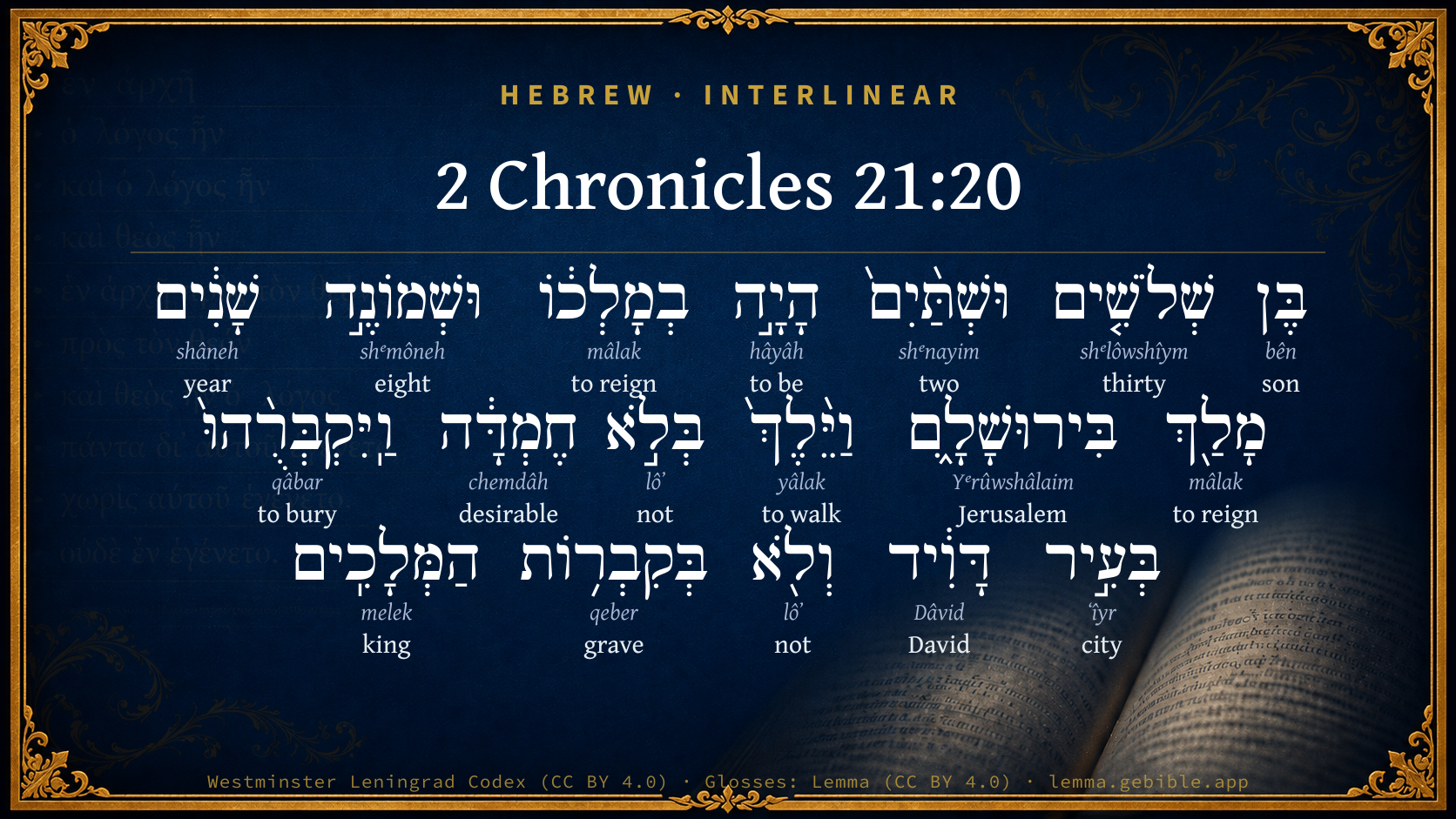
  1. בֶּן bên H1121 “son of” Noun, Common, Masculine, Singular, Construct
  2. שְׁלֹשִׁ֤ים shᵉlôwshîym H7970 “thirty” Adjective, Cardinal number, Both, Plural, Absolute
  3. וּשְׁתַּ֨יִם֙ shᵉnayim H8147 “and · two” Conjunction + Adjective, Cardinal number, Feminine, Dual, Absolute
  4. הָיָ֣ה hâyâh H1961 “to be” Verb, Qal, Perfect, 3rd Person, Masculine, Singular
  5. בְמָלְכ֔וֹ mâlak H4427 “in/at · to reign · him” Preposition + Verb, Qal, Infinitive Construct + Suffix, Personal, 3rd Person, Masculine, Singular
  6. וּשְׁמוֹנֶ֣ה shᵉmôneh H8083 “and · eight” Conjunction + Adjective, Cardinal number, Feminine, Singular, Absolute
  7. שָׁנִ֔ים shâneh H8141 “years” Noun, Common, Feminine, Plural, Absolute
  8. מָלַ֖ךְ mâlak H4427 “to reign” Verb, Qal, Perfect, 3rd Person, Masculine, Singular
  9. בִּירוּשָׁלִָ֑ם Yᵉrûwshâlaim H3389 “in/at · Jerusalem” Preposition + Noun, Proper
  10. וַיֵּ֨לֶךְ֙ yâlak H3212 “and · to walk” Conjunction + Verb, Qal, Sequential Imperfect, 3rd Person, Masculine, Singular
  11. בְּלֹ֣א lôʼ H3808 “in/at · not” Preposition + Particle, Negative
  12. וַֽיִּקְבְּרֻ֨הוּ֙ qâbar H6912 “and · to bury · him” Conjunction + Verb, Qal, Sequential Imperfect, 3rd Person, Masculine, Plural + Suffix, Personal, 3rd Person, Masculine, Singular
  13. בְּעִ֣יר ʻîyr H5892 “in/at · city of” Preposition + Noun, Common, Feminine, Singular, Construct
  14. דָּוִ֔יד Dâvid H1732 “David” Noun, Proper
  15. וְלֹ֖א lôʼ H3808 “and · not” Conjunction + Particle, Negative
  16. בְּקִבְר֥וֹת qeber H6913 “in/at · graves of” Preposition + Noun, Common, Masculine, Plural, Construct
  17. הַמְּלָכִֽים melek H4428 “the · kings” Particle, Definite Article + Noun, Common, Masculine, Plural, Absolute

About this verse

These counts appear in no published source. They are computed here, from the morphology-tagged text and Lemma’s own curated glosses. What Lemma adds →

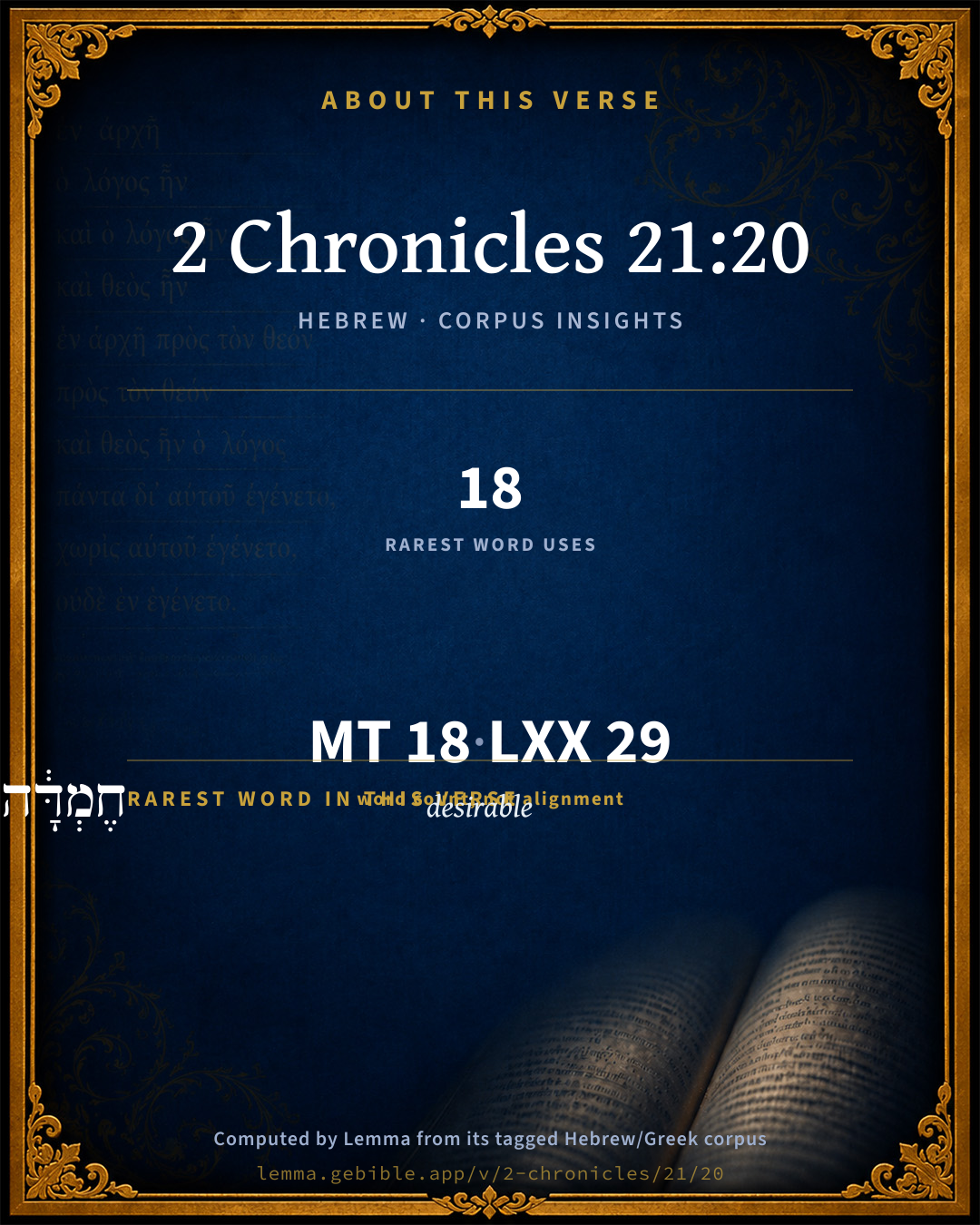
18
words
16
distinct lemmas
Historical
section

Notable vocabulary

The rarest word here is חֶמְדָּ֔ה desirable H2532 — appearing just 18 times in the whole Hebrew Bible.

Shared distinctive vocabulary

חֶמְדָּ֔ה desirable H2532 occurs in 18 verses of the Hebrew Bible. Also found in:

Grammatical profile

  • 5 verbs
  • 8 nouns
  • 3 adjectives
  • 2 particles

Verb forms

  • הָיָ֣ה Qal · Perfect
  • בְמָלְכ֔וֹ Qal · Infinitive Construct
  • מָלַ֖ךְ Qal · Perfect
  • וַיֵּ֨לֶךְ֙ Qal · Sequential Imperfect
  • וַֽיִּקְבְּרֻ֨הוּ֙ Qal · Sequential Imperfect

Repetition

Words recur within this verse — often emphatic in Hebrew:

  • בְמָלְכ֔וֹ to reign H4427 ×2
  • בְּלֹ֣א not H3808 ×2

Hebrew & Septuagint length

In English translation the verse runs 40 words from the Hebrew and 40 from the Septuagint (LXX English) — the same length.

A rough comparison of the two English renderings, which tokenize alike — not a word-level alignment.

Word counts can differ between the Hebrew and the Greek without any difference in meaning — e.g. the Hebrew direct-object marker אֵת has no separate Greek word, and Greek often adds the article ὁ.

In the original languages it is 18 Hebrew tokens and 29 Greek tokens — but the two are counted differently (Hebrew bundles its prefixes and suffixes into one token; the Greek is in lemma form), so that isn’t a like-for-like length.

Cross-references

6

Topical passages linked to 2 Chronicles 21:20 in the Treasury of Scripture Knowledge — connected by theme and wording, ordered by reader-vote popularity; previews shown in the World English Bible.

  • Jeremiah 22:18 Therefore thus says Yahweh concerning Jehoiakim the son of Josiah, king of Judah: they shall not lament for him, [saying], Ah my brother! or, Ah sister! They shall not lament for him, [saying] Ah lord! or, Ah his glory!
  • 2 Chronicles 24:25 When they were departed for him (for they left him very sick), his own servants conspired against him for the blood of the sons of Jehoiada the priest, and killed him on his bed, and he died; and they buried him in the city of David, but they didn't bury him in the tombs of the kings.
  • 2 Chronicles 28:27 Ahaz slept with his fathers, and they buried him in the city, even in Jerusalem; for they didn't bring him into the tombs of the kings of Israel: and Hezekiah his son reigned in his place.
  • Jeremiah 22:28 Is this man Coniah a despised broken vessel? is he a vessel in which none delights? why are they cast out, he and his seed, and are cast into the land which they don't know?
  • 2 Chronicles 23:21 So all the people of the land rejoiced, and the city was quiet. Athaliah they had slain with the sword.
  • Proverbs 10:7 The memory of the righteous is blessed, But the name of the wicked will rot.

Cross-references courtesy of OpenBible.info (CC BY 4.0).

Hebrew and Greek witnesses Masoretic Hebrew ↔ Greek Septuagint

The same verse in the two great witnesses to the Old Testament, shown verse-for-verse.

These are two independent witnesses, not word-aligned to each other, and the Septuagint is shown in lemma (dictionary) form.

Hebrew 2 Chronicles 21:20 Masoretic · Westminster Leningrad Codex

בֶּן שְׁלֹשִׁ֤ים וּשְׁתַּ֨יִם֙ הָיָ֣ה בְמָלְכ֔וֹ וּשְׁמוֹנֶ֣ה שָׁנִ֔ים מָלַ֖ךְ בִּירוּשָׁלִָ֑ם וַיֵּ֨לֶךְ֙ בְּלֹ֣א חֶמְדָּ֔ה וַֽיִּקְבְּרֻ֨הוּ֙ בְּעִ֣יר דָּוִ֔יד וְלֹ֖א בְּקִבְר֥וֹת הַמְּלָכִֽים

Thirty-two years old was he when he began to reign, and he reigned in Jerusalem eight years: and he departed without being desired; and they buried him in the city of David, but not in the tombs of the kings.

World English Bible · Public Domain

Greek LXX 2 Chronicles 21:20 Septuagint · lemma form

εἰμί τριάκοντα καί δύο ἔτος ὅτε βασιλεύω καί ὀκτώ ἔτος βασιλεύω ἐν ἰερουσαλήμ καί πορεύομαι ἐν οὐ ἔπαινος καί θάπτω ἐν πόλις δαυίδ καί οὐ ἐν τάφος ὁ βασιλεύς

He was thirty and two years old when he began to reign, and he reigned eight years in Jerusalem. And he departed without honor, and was buried in the city of David, but not in the tombs of the kings.

LXX2012 (modern English Septuagint) · Public Domain

On this verse, Ellicott's Commentary for English Readers discusses the Septuagint’s reading. Read the note in Commentary ↓

Hebrew: Westminster Leningrad Codex (CC BY 4.0). Greek: Septuagint (public domain); English from LXX2012 (modern English Septuagint) (Public Domain). How the Septuagint differs from the Hebrew →

Commentary

Notes on 2 Chronicles 21:20 from classic Christian and Jewish commentators (each source and its license shown beneath its notes). The classic Christian expositions comment on the surrounding passage and are grouped to its opening verse, so a note may address several verses; the Jewish commentaries on the Tanakh (Rashi and others) are per-verse, so they appear only where the commentator wrote on this verse.

Lemma curates 59 commentaries, every one of them public domain or Creative Commons licensed, each selected and text-cleaned for this edition rather than reprinted as found. About our sources →

Trapp's Complete Commentary

John Trapp

2Ch 21:20 Thirty and two years old was he when he began to reign, and he reigned in Jerusalem eight years, and departed without being desired. Howbeit they buried him in the city of David, but not in the sepulchres of the kings.

Ver. 20. Departed without being desired.] Ingloria vita recessit. As he lived wickedly, so he died wishedly. The like is reported of Tiberius the emperor; of Mohammed I; of Edwin, king of this land; of William Rufus, who died unlamented, as being a contemner of all religion, alieni appetens, sacrorum direptor, et avaritia et saevitia infamis, saith the historian.

John Trapp, A Commentary or Exposition upon All the Books of the Old and New Testament (1647–1656) — public domain. Text from a community e-Sword module.

The Biblical Illustrator

Joseph S. Exell

2Ch_21:20

And departed without being desired.

The undesirableness of a wicked mans life

I. Such life is not desirable on its own account. Two facts will show this.

1. His highest enjoyments are unsatisfactory and brief. It is impossible for us to be satisfied in any condition where we have not a consciousness of right, a sense of Divine favour, a hope of a bright future, and the pulsation of holy loves. Observe--

(1) How foolish to aim at such a life as this.

(2) How foolish to envy such a life as this.

2. That the longer it continues the greater becomes his responsibility.

II. Such a life is not desirable on account of others.

1. It renders no real good to others.

2. It produces incalculable mischief. In the spiritual, as in the material, like begets like. One sinner destroyeth much good. (Homilist.)

The Biblical Illustrator, edited by Joseph S. Exell (c. 1880s–1900s) — public domain. Text from a community e-Sword module.

Joseph Benson's Commentary

2Ch 21:20. And departed — Hebrew, went, namely, the way of all the earth, as it is more fully expressed Jos 23:14. Or, to the land of darkness, Job 10:21-22. Or, to his long home, Ecc 12:5. Or, went away, namely, out of this world, as the word הלךְ, halack, used here and Job 14:20; Ecc 5:15; Ecc 6:4, signifies. And there are many such phrases used concerning death, in the Old and New Testaments, which all signify that death is not an annihilation, but only a translation into another place and state. See Gen 15:15; Php 1:23. Without being desired — Hebrew, without desire, which may be referred, 1st, To himself. He had no desire of living longer, nor any pleasure in life, but was heartily weary of it, through his excessive pains. Or rather, it belongs, 2d, To his people, who did not desire that he should live longer, but oft and heartily wished that he had died sooner: which contempt of him they showed both by making no burning for him, as they used to do for good kings, and by denying him burial among the kings. The expression is emphatical: for it is usual with men to desire the death of some persons, whom afterward they lament, and heartily wish they were alive again. But for this ungodly and unhappy prince, his people did not only in his life-time wish his death, but afterward did not repent of those desires.

Joseph Benson's Commentary on the Old and New Testaments (1811–1818) — public domain. Text from a community e-Sword module.

Geneva Bible (1599)

Geneva Bible translators

That is, as some write, he was not regarded, but deposed for his wickedness, and idolatry: so that his son reigned 22 years (his father yet living) without honor, and after his father’s death he was confirmed to reign still, as 2 Chron. 22:2.

Geneva Bible (1599) marginal notes — public domain. Text via Bolls.life.

Adam Clarke's Commentary

Verse 20. Departed without being desired.] He was hated while he lived, and neglected when he died; visibly cursed of God, and necessarily execrated by the people whom he had lived only to corrupt and oppress. No annalist is mentioned as having taken the pains to write any account of his vile life. This summary mention of him consigns him to the execration of posterity, and holds in the view of every prudent governor, the rock on which he split and wrecked the state.

Adam Clarke's Commentary on the Bible (1810–1826) — public domain. Text from a community e-Sword/MySword module.

Ellicott's Commentary for English Readers

(20) Thirty and two years.—The word “years” has fallen out of the Hebrew text; but some MSS. contain it. The repetition of his age, &c, is curious. (See 2Ch_21:6.) It seems to indicate that the writer was here transcribing from another source.

And departed without being desired.—And he departed without regret, died unregretted. Hemdâh answers to the Latin desiderium. The LXX. and Vulg. render: “And he walked not in approbation,” or “rightly.” Comp. Jeremiah’s prophecy concerning the end of king Jehoiakim: “They shall not lament for him, saying, Ah, my brother!” &c. (Jer_22:18-19). So Syriac and Arabic.

Howbeit.—And.

They buried him.—LXX., Syriac, and Arabic: “He was buried.”

But not in the sepulchres of the kings.—2Ch_24:25; 2Ch_26:23. Another circumstance of dishonour. It is not mentioned in 2Ki_8:17. Thenius asserts that in these additions to the history of Jehoram there is traceable, not only a traditional or legendary element, but also pure embellishment on the part of the chronicler. The grounds he alleges, however, by no means necessitate his conclusion, being themselves misinterpretations of the statements of Kings.

A Bible Commentary for English Readers, edited by Charles John Ellicott (1878–1897) — public domain. Text from a community e-Sword module.

The Cambridge Bible for Schools and Colleges

gen. ed. J. J. S. Perowne

20. and departed without being desired] Render, he lived so that none desired him (or “delighted in him”). Cp. LXX., ἐπορεύθη οὐκ ἐν ἐπαίνῳ, lit. “he walked without praise.”

Howbeit] R.V. and.

but not in the sepulchres of the kings] According to Kings he “was buried with his fathers.” Cp. 2Ch_24:25.

The Cambridge Bible for Schools and Colleges (gen. ed. J. J. S. Perowne; Cambridge University Press, 1878–1918) — public domain. Text from a community e-Sword module.

Albert Barnes' Notes on the Bible

Not in the sepulchres of the kings - Compare the similar treatment of Joash 2Ch 24:25 and Ahaz 2Ch 28:27.

Albert Barnes' Notes on the Bible (1834–1885) — public domain. Text from a community e-Sword/MySword module.

Haydock's Catholic Bible Commentary

Rightly. Sept. "unpraised." Heb. "without any satisfaction;" or, "he departed unregretted," oppressed with illness, and odious to all. --- Kings. Joas, Achaz, Achab, and Manasses, were disgraced in like manner, after their death. The Hebrews then shewed their resentment, without fear. The like custom prevailed in Egypt, and kept many within bounds. No person could receive the usual honours of burial, if his accusers could maintain their charge against his character before a court of above forty people, assembled for the purpose. Calumny was severely punished. But the kings themselves were to stand their trial, while their corpse was placed in the porch of the monument, and the priest spoke their funeral oration. The people testified their approbation or discontent, "and many of the kings have been deprived of a glorious and legal burial, on account of the opposition of the multitude." Diodorus i. and ii. C.

George Leo Haydock (1774–1849), Haydock's Catholic Family Bible and Commentary, 1859 edition — public domain. Excludes Psalms (Douay-Rheims chapter numbering differs from Protestant) and Deuterocanonical books (Catholic canon only).

Matthew Poole's English Annotations

Departed, Heb. went, to wit, the way of all the earth, as it is more fully expressed, Jos 23:14. Or, to the land of darkness, as Job 10:21,22. Or, to his long home, Ecc 12:5. Or, went away, to wit, out of this world; as this word is used, Job 14:20; Ecc 5:15; 6:4; there being many such words and phrases used concerning death in the Old and New Testament, signifying that death is not an annihilation, but only a translation into another place and state. See Gen 15:15; Phi 1:23.

Without being desired, Heb. without desire; which may belong either,

1. To himself; he had no desire of living longer, nor any pleasure in life, but was heartily weary of it, through his excessive pains: or rather,

2. To his people, who did not desire that he should live longer, but oft and heartily wished that he had died sooner; which contempt of him they showed both by making no burning for him, as they used to do for good and laudable kings, 2Ch 16:14, and by denying him burial among the kings, as it here follows. Desire is here put for a person or thing whose life or continuance is desirable or desired by others, as Isa 2:16; Eze 24:16,18,21,25; Da 9:23; 10:11,19. And this is an emphatical expression, because it is usual with men to desire the deaths of some persons, whom afterward they lament and heartily wish that they were alive again, as they may have cause to do. But for this ungodly and unhappy prince, his people did not only in his lifetime wish his death, but afterwards they did not repent of those desires, nor wish him alive again, but rejoiced that they were delivered from so great a plague as he was to them.

Matthew Poole's English Annotations on the Holy Bible (1683–1685) — public domain. Text from a community e-Sword/MySword module.

Whedon's Commentary on the Bible

Daniel D. Whedon

20. Departed without being desired — That is, unregretted, unwept, unhonoured. His people were rather glad to be rid of such a king.

Not in the sepulchres of the kings — Those tombs, it was thought, would have been dishonoured and defiled by the burial there of one so abandoned and accursed of Jehovah.

Daniel D. Whedon (gen. ed.), Commentary on the Old and New Testaments (1874–1909) — public domain. Text from a community e-Sword module.

The Pulpit Commentary

Departed without being desired; literally, without desire. The closing commentary, so quietly written, becomes the more pathetically mournful The "desire" spoken of is the desiderium of Horace, of nearly nine centuries later ("Odes," L 24). But there was now no "desiderium tam cari capitis," for want of room for this latter description. They buried him in the city of David, but not in the sepulchres of the kings (see again our note on 2Ch_16:14; and comp. 2Ch_24:25 2Ch_28:27)

The Pulpit Commentary (1880–1919), ed. H.D.M. Spence-Jones & Joseph S. Exell — public domain. Text from a community e-Sword module.

John Wesley's Explanatory Notes

Desired - This is an emphatical expression, because it is usual with men to desire the deaths of some persons, whom afterward they lament, and heartily wish they were alive again. But for this ungodly and unhappy prince, his people did not only in his life time wish his death, but afterwards did not repent of those desires.

John Wesley, Explanatory Notes Upon the Whole Bible (1754–1765) — public domain. Text via the GEBible commentary corpus.

Keil & Delitzsch

C. F. Keil & F. Delitzsch

The repetition of his age and the length of his reign (cf. Ch2 21:6) is accounted for by the fact that the last section of this chapter is derived from a special source, wherein these notes likewise were contained. The peculiarity of the language and the want of the current expressions of our historian also favour the idea that some special authority has been used here. "And he departed, mourned by none." Luther erroneously translates, "and walked in a way which was not right" (und wandelt das nicht fein war), after the "ambulavit non recte" of the Vulg.; for חמדּה denotes, not a good walk, but desiderium, חמדּה בּלא, sine desiderio, i.e., a nemine desideratus. הלך, to depart, i.e., die, as Gen 15:2. Moreover, though he was buried in the city of David, yet he was not laid in the graves of the kings, by which act also a judgment was pronounced upon his reign; cf. Ch2 24:25 and Ch2 26:23.

Keil & Delitzsch — Biblical Commentary on the Old Testament (1861–1891) — public domain (CC PDM 1.0). Text via the HelloAO Bible API. (Old Testament only.)

Rashi

Rabbi Shlomo Yitzchaki (Rashi)

and he departed joyless The meaning is: all his life he was in distress and in illnesses, and with him was fulfilled (Deut. 30:15): “See, I have set before you today life, etc.” and (Job 14:1) “short of days and full of fear.”

Rashi on the Tanakh — English translations: “The Judaica Press complete Tanach with Rashi, translated by A. J. Rosenberg” (CC BY 4.0); “Pentateuch with Rashi's commentary by M. Rosenbaum and A.M. Silbermann, 1929-1934” (public domain); “The Metsudah Tanach series, Lakewood, N.J” (CC BY 4.0); and “The Book of Joshua, Metsudah Publications, 1997” (CC BY 4.0). Text via Sefaria.

Lesson kit

Teaching starters — assembled from the data on this page, not authored interpretation. Every prompt links to the verse data it draws on. Edit before teaching.

2 Chronicles, in the Historical, opens this verse with 18 words (16 distinct Hebrew lemmas). Its most distinctive word is chemdâh (“desirable”). A historical commentator’s framing appears above. Read the whole chapter for the surrounding context.

Discussion questions

  1. The word chemdâh carries the sense “desirable.” How does it shape the verse?
  2. How does Genesis 27:15, which shares the word «desirable», read alongside this verse?
  3. What does the repetition of “to reign” (2× in this one verse) do in this verse?
  4. These translations render this verse differently. What is at stake in choosing one wording over another?
  5. «הָיָ֣ה» is a Qal Perfect verb. How does that grammatical form shape the action described?
  6. Compare how Trapp's Complete Commentary and The Biblical Illustrator read this verse. Where do they agree or differ?

Things to notice

Reading settings

Reading text

Shown beneath each verse's original-language words.

Old Testament
Old Testament edition

Read the OT as the Masoretic Hebrew (MT) or the Greek Septuagint (LXX).

English shown for the Greek Septuagint (in the Hebrew ↔ Greek comparison).

Comparing translations? Open the Compare panel on any verse page to stack up to four side by side.