
Daniel 9:2

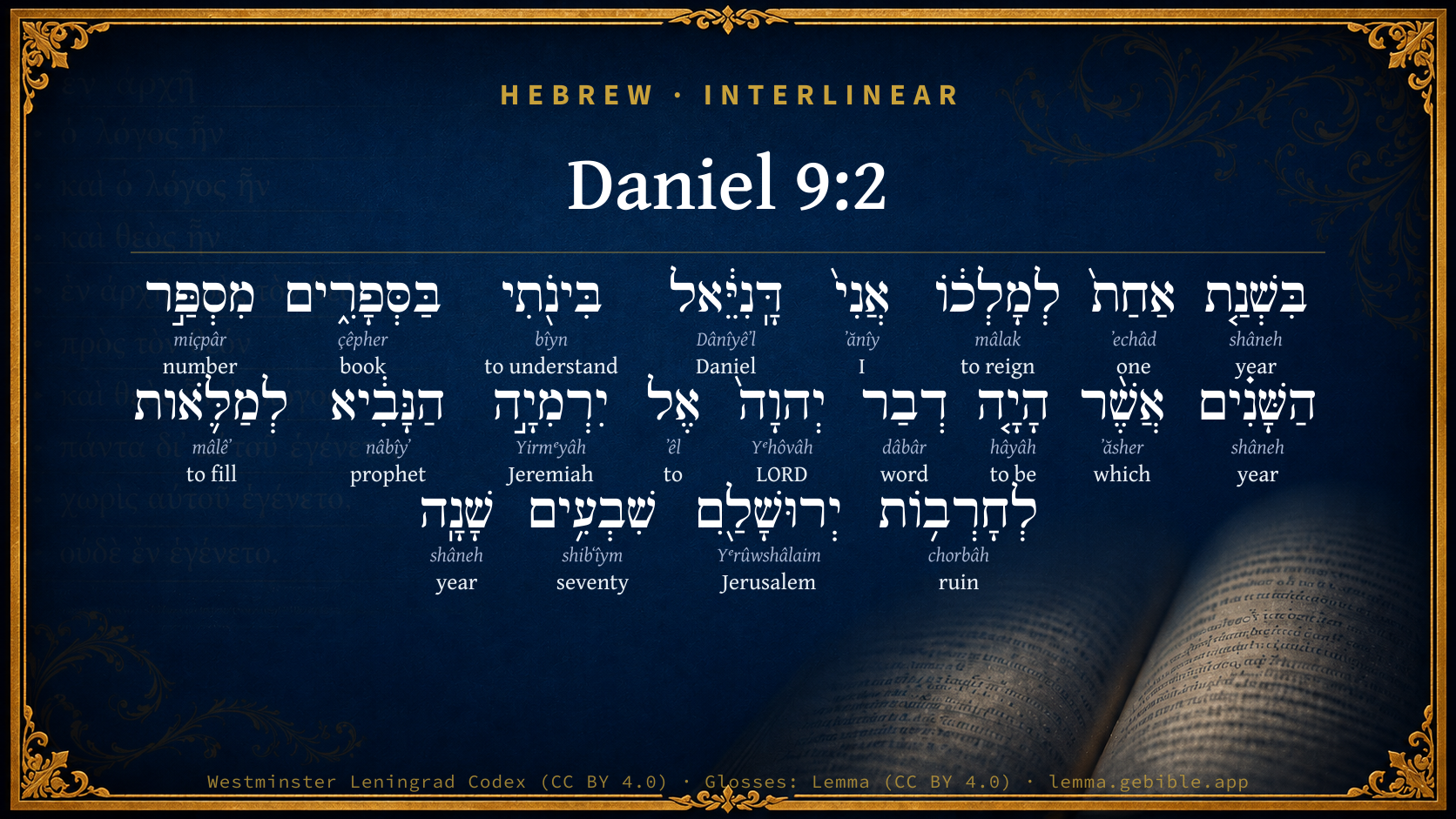
Hebrew (Westminster Leningrad Codex) Daniel 9:2 appears in the Hebrew Old Testament. The text above is from the Westminster Leningrad Codex. Each word links to its Strong’s number, a concise gloss, and parsing drawn from the Open Scriptures Hebrew Bible morphology. Click any word for its full Brown-Driver-Briggs (BDB) entry.
Download image
Cite this verse

Daniel 9:2 (World English Bible). Public Domain. Lemma interlinear Bible study tool, https://lemma.gebible.app/v/daniel/9/2.

Show BibTeX & RIS
BibTeX
RIS
English Translation
in the first year of his reign I, Daniel, understood by the books the number of the years about which the word of Yahweh came to Jeremiah the prophet, for the accomplishing of the desolations of Jerusalem, even seventy years.
World English Bible · Public Domain
Download a study sheet

One document with this verse’s original text, its word-by-word gloss line, the meaning frame, cross-references with their text, attributed commentary, and full source and license credits — printable, and it pastes into notes with its structure intact.

This verse Autodidact and up

Study sheet (.html) Plain text (.txt)

A passage Seminary Student

Up to 50 verses in one chapter. A passage sheet keeps up to 6 commentary sources and 12 cross-references per verse, in the order this page ranks them, and says so on the sheet whenever that leaves anything out. Ask for a single verse and you get the Autodidact verse sheet above.

Everything on this page stays free to read, with no account — the sheet is a download of what is already on screen, not access to it.

Want to remove ads? Support Godless Engineer
Compare translations 3

The same verse in 3 English versions, stacked beneath the original-language interlinear above. Click any original word for its lexicon entry.

Each is an independent rendering of the whole verse — the interlinear is not word-aligned to these translations.

Highlighted words mark where these versions differ — a whole-verse word diff, not a word-by-word alignment.

  • World English Bible Public Domain
    in the first year of his reign I, Daniel, understood by the books the number of the years about which the word of Yahweh came to Jeremiah the prophet, for the accomplishing of the desolations of Jerusalem, even seventy years.
  • King James Version Public Domain
    In the first year of his reign I Daniel understood by books the number of the years, whereof the word of the LORD came to Jeremiah the prophet, that he would accomplish seventy years in the desolations of Jerusalem.
  • unfoldingWord Literal Text CC BY-SA 4.0
    in the first year of his reign I, Daniel, perceived in the books the number of years which was revealed as the word of Yahweh to Jeremiah the prophet for the completion of the desolations of Jerusalem, namely, seventy years.

unfoldingWord Literal Text — © unfoldingWord, licensed CC BY-SA 4.0. Word-aligned USFM3 via Door43 (git.door43.org/unfoldingWord/en_ult).

Versions to compare (up to 4)

3 of 4 selected

Show all 18 translations

Every available English version of this verse, each an independent rendering of the whole verse.

  • World English Bible Public Domain
    in the first year of his reign I, Daniel, understood by the books the number of the years about which the word of Yahweh came to Jeremiah the prophet, for the accomplishing of the desolations of Jerusalem, even seventy years.
  • Berean Standard Bible Public Domain
    in the first year of his reign, I, Daniel, understood from the sacred books, according to the word of the LORD to Jeremiah the prophet, that the desolation of Jerusalem would last seventy years.
  • Majority Standard Bible Public Domain
    in the first year of his reign, I, Daniel, understood from the sacred books, according to the word of the LORD to Jeremiah the prophet, that the desolation of Jerusalem would last seventy years.
  • King James Version Public Domain
    In the first year of his reign I Daniel understood by books the number of the years, whereof the word of the LORD came to Jeremiah the prophet, that he would accomplish seventy years in the desolations of Jerusalem.
  • American Standard Version (1901) Public Domain
    in the first year of his reign I, Daniel, understood by the books the number of the years whereof the word of Jehovah came to Jeremiah the prophet, for the accomplishing of the desolations of Jerusalem, even seventy years.
  • Revised Version (1885) Public Domain
    in the first year of his reign I Daniel understood by the books the number of the years, whereof the word of the LORD came to Jeremiah the prophet, for the accomplishing of the desolations of Jerusalem, even seventy years.
  • Geneva Bible (1599) Public Domain
    Euen in the first yeere of his reigne, I Daniel vnderstood by bookes the nomber of the yeeres, whereof the Lord had spoken vnto Ieremiah the Prophet, that he would accomplish seuentie yeeres in the desolation of Ierusalem.
  • Douay-Rheims (1899) Public Domain
    The first year of his reign, I Daniel understood by books the number of the years, concerning which the word of the Lord came to Jeremias the prophet, that seventy years should be accomplished of the desolation of Jerusalem.
  • Young's Literal Translation Public Domain
    in the first year of his reign, I, Daniel, have understood by books the number of the years, (in that a word of Jehovah hath been unto Jeremiah the prophet,) concerning the fulfilling of the wastes of Jerusalem -- seventy years;
  • Literal Standard Version CC BY-SA 4.0
    in the first year of his reign, I, Daniel, have understood by scrolls the number of the years (in that a word of YHWH has been to Jeremiah the prophet), concerning the fulfilling of the desolations of Jerusalem—seventy years;
  • Unlocked Literal Bible CC BY-SA 4.0
    Now in the first year of Darius' reign I, Daniel, was studying the books containing Yahweh's word, the word that had come to Jeremiah the prophet. I observed that there would be seventy years until Jerusalem's abandonment would end.
  • unfoldingWord Literal Text CC BY-SA 4.0
    in the first year of his reign I, Daniel, perceived in the books the number of years which was revealed as the word of Yahweh to Jeremiah the prophet for the completion of the desolations of Jerusalem, namely, seventy years.
  • Darby Bible Public Domain
    in the first year of his reign, I Daniel understood by the books that the number of the years, whereof the word of Jehovah came to Jeremiah the prophet, for the accomplishment of the desolations of Jerusalem, was seventy years.
  • World Messianic Bible Public Domain
    in the first year of his reign I, Daniel, understood by the books the number of the years about which the LORD’s word came to Jeremiah the prophet for the accomplishing of the desolations of Jerusalem, even seventy years.
  • Webster's Bible Public Domain
    In the first year of his reign, I Daniel understood by books the number of the years, concerning which the word of the LORD came to Jeremiah the prophet, that he would accomplish seventy years in the desolations of Jerusalem.
  • Free Bible Version CC BY-SA 4.0
    During the first year of his reign, I, Daniel, understood from the Scriptures as given to the prophet Jeremiah that the time of seventy years for Jerusalem to lie desolate would soon be fulfilled.
  • Bible in Basic English Public Domain
    In the first year of his rule, I, Daniel, saw clearly from the books the number of years given by the word of the Lord to the prophet Jeremiah, in which the making waste of Jerusalem was to be complete, that is, seventy years.
  • JPS Tanakh (1917) Public Domain
    in the first year of his reign I Daniel meditated in the books, over the number of the years, whereof the word of the LORD came to Jeremiah the prophet, that He would accomplish for the desolations of Jerusalem seventy years.

Literal Standard Version (2020), Covenant Press — licensed CC BY-SA 4.0. Text via the HelloAO Bible API (eBible.org). Unlocked Literal Bible (unfoldingWord) — licensed CC BY-SA 4.0. Text via the HelloAO Bible API (eBible.org). unfoldingWord Literal Text — © unfoldingWord, licensed CC BY-SA 4.0. Word-aligned USFM3 via Door43 (git.door43.org/unfoldingWord/en_ult). Free Bible Version, Dr. Jonathan Gallagher — licensed CC BY-SA 4.0. Text via the HelloAO Bible API (eBible.org).

Word by word

More ways to search: Search by grammar → Find every occurrence → Compare this word →

Practice this passage: Drill this verse → Learn its vocabulary →

דָּֽנִיֵּ֔אל
Dânîyêʼl
H1840
“Daniel”
Noun, Proper
Part of Speech
Noun
Type
Proper
Full BDB Definition

Origin: from H1835 and H410

TWOT: None

Daniel = "God is my judge" - the 2nd son of David, by Abigail the Carmelitess - the 4th of the greater prophets, taken as hostage in the first deportation to Babylon, because of the gift of God of the interpretation of dreams, he became the 2nd in command of the Babylon empire and lasted through the end of the Babylonian empire and into the Persian empire. His prophecies are the key to the understanding of end time events. Noted for his purity and holiness by contemporary prophet, Ezekiel - a priest of the line of Ithamar who sealed the covenant with Nehemiah
  1. בִּשְׁנַ֤ת shâneh H8141 “in/at · year of” Preposition + Noun, Common, Feminine, Singular, Construct
  2. אַחַת֙ ʼechâd H259 “one” Adjective, Cardinal number, Feminine, Singular, Absolute
  3. לְמָלְכ֔וֹ mâlak H4427 “to reign · him” Preposition + Verb, Qal, Infinitive Construct + Suffix, Personal, 3rd Person, Masculine, Singular
  4. אֲנִי֙ ʼănîy H589 “I” Pronoun, Personal, 1st Person, Common, Singular
  5. בִּינֹ֖תִי bîyn H995 “to understand” Verb, Qal, Perfect, 1st Person, Common, Singular
  6. בַּסְּפָרִ֑ים çêpher H5612 “in/at the · books” Preposition, Determined + Noun, Common, Masculine, Plural, Absolute
  7. מִסְפַּ֣ר miçpâr H4557 “number of” Noun, Common, Masculine, Singular, Construct
  8. הַשָּׁנִ֗ים shâneh H8141 “the · years” Particle, Definite Article + Noun, Common, Feminine, Plural, Absolute
  9. אֲשֶׁ֨ר ʼăsher H834 “which” Particle, Relative
  10. הָיָ֤ה hâyâh H1961 “to be” Verb, Qal, Perfect, 3rd Person, Masculine, Singular
  11. דְבַר dâbâr H1697 “word of” Noun, Common, Masculine, Singular, Construct
  12. יְהוָה֙ Yᵉhôvâh H3068 “LORD” Noun, Proper
  13. אֶל ʼêl H413 “to” Preposition
  14. יִרְמִיָ֣ה Yirmᵉyâh H3414 “Jeremiah” Noun, Proper
  15. הַנָּבִ֔יא nâbîyʼ H5030 “the · prophet” Particle, Definite Article + Noun, Common, Masculine, Singular, Absolute
  16. לְמַלֹּ֛אות mâlêʼ H4390 “to fill” Preposition + Verb, Piel, Infinitive Construct
  17. לְחָרְב֥וֹת chorbâh H2723 “to/for · ruins of” Preposition + Noun, Common, Feminine, Plural, Construct
  18. יְרוּשָׁלִַ֖ם Yᵉrûwshâlaim H3389 “Jerusalem” Noun, Proper
  19. שִׁבְעִ֥ים shibʻîym H7657 “seventy” Adjective, Cardinal number, Both, Plural, Absolute
  20. שָׁנָֽה shâneh H8141 “year” Noun, Common, Feminine, Singular, Absolute

About this verse

These counts appear in no published source. They are computed here, from the morphology-tagged text and Lemma’s own curated glosses. What Lemma adds →

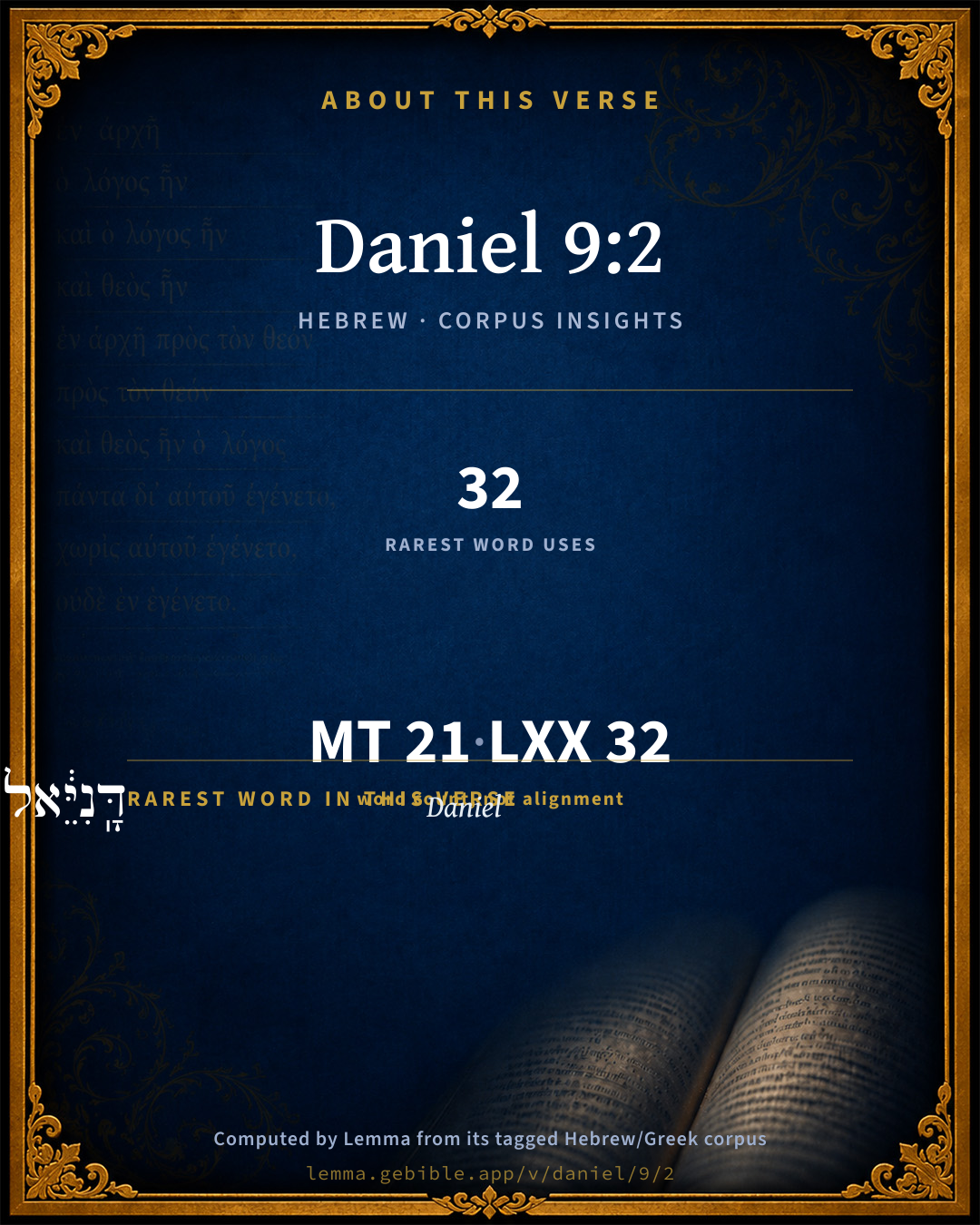
21
words
19
distinct lemmas
Prophets
section

Shared distinctive vocabulary

דָּֽנִיֵּ֔אל Daniel H1840 occurs in 28 verses of the Hebrew Bible. Also found in:

Grammatical profile

  • 4 verbs
  • 12 nouns
  • 2 adjectives
  • 1 pronoun
  • 1 preposition
  • 1 particle

Verb forms

  • לְמָלְכ֔וֹ Qal · Infinitive Construct
  • בִּינֹ֖תִי Qal · Perfect
  • הָיָ֤ה Qal · Perfect
  • לְמַלֹּ֛אות Piel · Infinitive Construct

Repetition

A word recurs within this verse — often emphatic in Hebrew:

  • בִּשְׁנַ֤ת year H8141 ×3

Hebrew & Septuagint length

In English translation the verse runs 40 words from the Hebrew and 32 from the Septuagint (LXX English) — closely comparable.

A rough comparison of the two English renderings, which tokenize alike — not a word-level alignment.

Word counts can differ between the Hebrew and the Greek without any difference in meaning — e.g. the Hebrew direct-object marker אֵת has no separate Greek word, and Greek often adds the article ὁ.

In the original languages it is 21 Hebrew tokens and 32 Greek tokens — but the two are counted differently (Hebrew bundles its prefixes and suffixes into one token; the Greek is in lemma form), so that isn’t a like-for-like length.

Cross-references

28

Topical passages linked to Daniel 9:2 in the Treasury of Scripture Knowledge — connected by theme and wording, ordered by reader-vote popularity; previews shown in the World English Bible.

  • Jeremiah 29:10 For thus says Yahweh, After seventy years are accomplished for Babylon, I will visit you, and perform my good word toward you, in causing you to return to this place.
  • Jeremiah 25:11–12 This whole land shall be a desolation, and an astonishment; and these nations shall serve the king of Babylon seventy years.
  • 2 Chronicles 36:21 to fulfill the word of Yahweh by the mouth of Jeremiah, until the land had enjoyed its Sabbaths: [for] as long as it lay desolate it kept Sabbath, to fulfill seventy years.
  • Zechariah 7:5 "Speak to all the people of the land, and to the priests, saying, 'When you fasted and mourned in the fifth and in the seventh month for these seventy years, did you at all fast to me, really to me?
  • Revelation 1:3 Blessed is he who reads and those who hear the words of the prophecy, and keep the things that are written in it, for the time is at hand.
  • Ezra 1:1 Now in the first year of Cyrus king of Persia, that the word of Yahweh by the mouth of Jeremiah might be accomplished, Yahweh stirred up the spirit of Cyrus king of Persia, so that he made a proclamation throughout all his kingdom, and [put it] also in writing, saying,
  • 2 Peter 1:19–21 We have the more sure word of prophecy; whereunto you do well that you take heed, as to a lamp shining in a dark place, until the day dawns, and the day star arises in your hearts:
  • Micah 3:12 Therefore Zion for your sake will be plowed like a field, And Jerusalem will become heaps of rubble, And the mountain of the temple like the high places of a forest.
  • Isaiah 6:11–12 Then I said, "Lord, how long?" He answered, "Until cities are waste without inhabitant, And houses without man, And the land becomes utterly waste,
  • Isaiah 64:10 Your holy cities are become a wilderness, Zion is become a wilderness, Jerusalem a desolation.
  • Jeremiah 7:34 Then will I cause to cease from the cities of Judah, and from the streets of Jerusalem, the voice of mirth and the voice of gladness, the voice of the bridegroom and the voice of the bride; for the land shall become a waste.
  • Jeremiah 25:18 [to wit], Jerusalem, and the cities of Judah, and the kings of it, and the princes of it, to make them a desolation, an astonishment, a hissing, and a curse, as it is this day;
  • Psalms 79:1–2 God, the nations have come into your inheritance. They have defiled your holy temple. They have laid Jerusalem in heaps.
  • Isaiah 24:10–12 The waste city is broken down; every house is shut up, that no man may come in.
  • Jeremiah 26:6 then will I make this house like Shiloh, and will make this city a curse to all the nations of the earth.
  • Jeremiah 27:7 All the nations shall serve him, and his son, and his son's son, until the time of his own land come: and then many nations and great kings shall make him their bondservant.
  • Lamentations 1:1 How does the city sit solitary, that was full of people! She has become as a widow, who was great among the nations! She who was a princess among the provinces is become tributary!
  • 2 Timothy 3:15–17 From infancy, you have known the sacred writings which are able to make you wise for salvation through faith, which is in Christ Jesus.
  • Psalms 119:24 Indeed your statutes are my delight, And my counselors.
  • 1 Peter 1:10–12 Concerning this salvation, the prophets sought and searched diligently, who prophesied of the grace that would come to you,
  • Psalms 74:3–7 Lift up your feet to the perpetual ruins, All the evil that the enemy has done in the sanctuary.
  • Psalms 119:99–100 I have more understanding than all my teachers, For your testimonies are my meditation.
  • Jeremiah 26:18 Micah the Morashtite prophesied in the days of Hezekiah king of Judah; and he spoke to all the people of Judah, saying, Thus says Yahweh of Hosts: Zion shall be plowed as a field, and Jerusalem shall become heaps, and the mountain of the house as the high places of a forest.
  • Daniel 8:15–16 It happened, when I, even I Daniel, had seen the vision, that I sought to understand it; and, behold, there stood before me as the appearance of a man.
  • Matthew 24:15 "When, therefore, you see the abomination of desolation, which was spoken of through Daniel the prophet, standing in the holy place (let the reader understand),
  • Mark 13:14 But when you see the abomination of desolation, spoken of by Daniel the prophet, standing where it ought not (let the reader understand), then let those who are in Judea flee to the mountains,
  • Acts 8:34 The eunuch answered Philip, "Who is the prophet talking about? About himself, or about someone else?"
  • 1 Timothy 4:13 Until I come, pay attention to reading, to exhortation, and to teaching.

Cross-references courtesy of OpenBible.info (CC BY 4.0).

Hebrew and Greek witnesses Masoretic Hebrew ↔ Greek Septuagint

The same verse in the two great witnesses to the Old Testament, shown verse-for-verse.

These are two independent witnesses, not word-aligned to each other, and the Septuagint is shown in lemma (dictionary) form.

Hebrew Daniel 9:2 Masoretic · Westminster Leningrad Codex

בִּשְׁנַ֤ת אַחַת֙ לְמָלְכ֔וֹ אֲנִי֙ דָּֽנִיֵּ֔אל בִּינֹ֖תִי בַּסְּפָרִ֑ים מִסְפַּ֣ר הַשָּׁנִ֗ים אֲשֶׁ֨ר הָיָ֤ה דְבַר יְהוָה֙ אֶל יִרְמִיָ֣ה הַנָּבִ֔יא לְמַלֹּ֛אות לְחָרְב֥וֹת יְרוּשָׁלִַ֖ם שִׁבְעִ֥ים שָׁנָֽה

in the first year of his reign I, Daniel, understood by the books the number of the years about which the word of Yahweh came to Jeremiah the prophet, for the accomplishing of the desolations of Jerusalem, even seventy years.

World English Bible · Public Domain

Greek LXX Daniel 9:2 Septuagint · lemma form

ὁ πρῶτος ἔτος ὁ βασιλεία αὐτός ἐγώ δανιηλ διανοέομαι ἐν ὁ βίβλος ὁ ἀριθμός ὁ ἔτος ὅτε γίγνομαι πρόσταγμα ὁ γῆ ἐπί ἰερεμίας ὁ προφήτης ἐγείρω εἰς ἀναπλήρωσις ὀνειδισμός ἰερουσαλήμ ἑβδομήκοντα ἔτος

I Daniel understood by books the number of the years which was the word of the Lord to the prophet Jeremias, even seventy years for the accomplishment of the desolation of Jerusalem.

LXX2012 (modern English Septuagint) · Public Domain

Hebrew: Westminster Leningrad Codex (CC BY 4.0). Greek: Septuagint (public domain); English from LXX2012 (modern English Septuagint) (Public Domain). How the Septuagint differs from the Hebrew →

Commentary

Notes on Daniel 9:2 from classic Christian and Jewish commentators (each source and its license shown beneath its notes). The classic Christian expositions comment on the surrounding passage and are grouped to its opening verse, so a note may address several verses; the Jewish commentaries on the Tanakh (Rashi and others) are per-verse, so they appear only where the commentator wrote on this verse.

Lemma curates 59 commentaries, every one of them public domain or Creative Commons licensed, each selected and text-cleaned for this edition rather than reprinted as found. About our sources →

Trapp's Complete Commentary

John Trapp

Dan 9:2 In the first year of his reign I Daniel understood by books the number of the years, whereof the word of the LORD came to Jeremiah the prophet, that he would accomplish seventy years in the desolations of Jerusalem.

Ver. 2. I Daniel understood by books.] Consideravi in libris. Daniel was a great student in the Scriptures, and well knew that there was no readier way to speed in heaven than by putting the promises in suit. The like also was done by Jacob; {Gen 32:9; Gen 32:12} {See Trapp on "Gen 32:9"} {See Trapp on "Gen 32:12"} {2Sa 7:19; 2Sa 7:25} by Eliah, {1Ki 18:42-44} and others. If we speak in our prayers no otherwise than the Lord doth in his promises, there shall be a sweet concert of voice, begun by the Spirit in the promises, seconded in the spirit of faith by the saints’ prayers, and answered by God in his gracious providences. Daniel here took this course; and had not only what he begged, but a revelation concerning the Lord Christ beyond expectation.

John Trapp, A Commentary or Exposition upon All the Books of the Old and New Testament (1647–1656) — public domain. Text from a community e-Sword module.

Tyndale Open Study Notes

Tyndale Open Resources

9:2 reading . . . Jeremiah: Daniel apparently had a copy of Jeremiah’s prophecies. • Jerusalem must lie desolate for seventy years: Jerusalem was destroyed in 586 BC (see 2 Kgs 25:8), and the first return occurred in 538 BC—about 48 years later. The rebuilding of the city began almost at once (see Ezra 3:1-13; Isa 44:28), and the rebuilt Temple was completed in 515 BC—about seventy-one years after it was destroyed (Ezra 6:15). Daniel might have thought of Jerusalem’s “destruction” as having begun with his own exile in 605 BC (see Jer 25:11-12), with sixty-seven years between 605 and 538 BC.

Tyndale Open Study Notes — © Tyndale Open Resources, licensed CC BY-SA 4.0. Text via the HelloAO Bible API.

Geneva Bible (1599)

Geneva Bible translators

For though he was an excellent Prophet, yet he daily increased in knowledge by reading of the Scriptures.

Geneva Bible (1599) marginal notes — public domain. Text via Bolls.life.

Jamieson, Fausset & Brown

Robert Jamieson, A. R. Fausset & David Brown

understood by books--rather, "letters," that is, Jeremiah's letter (Jer 29:10) to the captives in Babylon; also Jer 25:11-12; compare Ch2 36:21; Jer 30:18; Jer 31:38. God's promises are the ground on which we should, like Daniel, rest sure hope; not so as to make our prayers needless, but rather to encourage them.

Jamieson, Fausset & Brown — Commentary Critical and Explanatory on the Whole Bible (1871) — public domain (CC PDM 1.0). Text via the HelloAO Bible API.

Adam Clarke's Commentary

Verse 2. I Daniel understood by books] The prophecy referred to here is found Jer 25:12; Jer 29:10. The people must have been satisfied of the Divine inspiration of Jeremiah, or his prophecies would not have been so speedily collected nor so carefully preserved. It appears that there was a copy of them then in Daniel's hands.

Adam Clarke's Commentary on the Bible (1810–1826) — public domain. Text from a community e-Sword/MySword module.

John Calvin's Commentaries

We began to say yesterday, that the faithful do not so acquiesce in the promises of God as to grow torpid, and become idle and slothful through the certainty of their persuasion that God will perform his promises, but are rather stimulated to prayer. For the true proof of faith is the assurance when we pray that God will really perform what he has promised us. Daniel is here set before us as an example of this. For when he understood the time of deliverance to be at hand, this knowledge became a stimulus to him to pray more earnestly than he was accustomed to do. It is clear then, as we have already seen, that the Prophet was diligent and anxious in this particular. He did not deviate from his usual habit when he saw the greatest risk of being put to death; for while the king’s edict prohibited every one from praying to God, he still directed his face towards Jerusalem. This was the holy Prophet’s daily habit. But we shall perceive the extraordinary nature of his present prayer, when he says, he prayed in dust arid ashes. From this it appears, how God’s promise stirred him up to supplication, and hence we gather what I have lately touched upon, — that faith is no careless speculation, satisfied with simply assenting to God. For the stupid seem to assent by outward hearing, while true faith is something far more serious. When we really embrace the grace of God which he offers us, he meets us and precedes us with his goodness, and thus we in time respond to his offers, and bear witness to our expectation of his promises. Nothing, therefore, can be better for us, than to ask for what he has promised. Thus in the prayers of the saints these feelings are united, as they plead God’s promises wherein they entreat him. And we cannot possibly exercise true confidence in prayer, except by resting firmly on God’s word. An example of this kind is here presented to us in Daniel’s case. When he understood the number of the years to be at hand of which God had spoken by Jeremiah, he applied his mind to supplication. It is worth while to notice what I have mentioned: — Daniel is not here treating of his daily prayers. We may easily collect from the whole of his life, how Daniel had exercised himself in prayer before Jeremiah had spoken of the seventy years. Because he knew the time of redemption to be at hand, he was then stimulated to more than his usual entreaties. He expresses this, by saying, in fasting, and sackcloth, and ashes For the saints were not accustomed to throw ashes over their heads every day, nor yet to separate themselves for prayer, by either fasting or putting on sackcloth. This action was rare, used only when God gave some sign of his wrath, or when he held out some scarce and singular benefit. Daniel’s present prayer was not; after his usual habit, but when he put on sackcloth and sprinkled himself with ashes, and endured fasting, he prostrated himself suppliantly before God. He also pleaded for pardon, as we shall afterwards see, and begged the performance of what the Almighty had surely promised.

From this we should learn two lessons. First, we must perseveringly exercise our faith by prayers; next, when God promises us anything remarkable and valuable, we ought then to be the more stirred up, and to feel this expectation as a sharper stimulus. With reference to the fasting, and sackcloth, and ashes, we may shortly remark, how the holy fathers under the law were in the habit of adding extraordinary ceremonies to their prayers, especially when they wished to confess their sins to God, and to cast themselves before him as thoroughly guilty and convicted, and as placing their whole hope in their supplication for mercy. And in the present day the faithful are justified in adding certain external rites to their prayers; although no necessity either can, or ought to be laid down beforehand in this case. We know also, the, Orientals to be more devoted to ceremonies than we are ourselves. And this difference must be noticed between the ancient people and the new Church, since Christ by his advent abolished many ceremonies. For the fathers under the Law were, in this sense, like children, as Paul says. (Galatians 4:3.) The discipline which God had formerly instituted, involved the use of more ceremonies than were afterwards practiced. As there is this important difference between our position and theirs, whoever desires to copy them in all their actions, would rather become the ape than the imitator of antiquity. Meanwhile, we must notice that the reality remains for us, although external rites are abolished. Two kinds of prayer, therefore, exist; one which we ought to practice daily, in the morning, evening, and if possible, every moment; for we see how constancy in prayer is commended to us in Scripture. (Luke 18:1; Romans 12:12; 1 Thessalonians 5:17.) The second kind is used, when God denounces his wrath against us, or we have need of his special aid, or seek anything unusual from him. This was Daniel’s method of praying when he put on sackcloth, and sprinkled himself with ashes. But as I have treated this subject elsewhere, I now use greater brevity.

When Daniel perceived the period of deliverance at hand, he not only prayed as usual, but left all his other occupations for the purpose of being quite at ease and at leisure, and thus he applied his mind exclusively to prayer, and made use of other aids to devotion. For the sackcloth and the ashes availed far more than mere outward testimony; they are helps to increase our ardor in praying, when any one feels sluggish and languid. It is true, indeed, that when the fathers under the Law prayed with sackcloth and ashes, this appearance was useful as an outward mark of their profession. It testified before men, how they came before God as guilty suppliants, and placed their whole hope of salvation in pardon alone. Still this conduct was useful in another way, as it stirred them up more eagerly to the desire to pray. And both these points are to be noticed in Daniel’s case. For if the Prophet had such need of this assistance, what shall be said of our necessities? Every one ought surely to comprehend how dull and cold he is in this duty. Nothing else, therefore, remains, except for every one to become conscious of his infirmity, to collect all the aids he can command for the correction of his sluggishness, and thus stimulate himself to ardor in supplication. For when Daniel, according to his daily custom, prayed so as to run the risk of death on that very account, we ought to gather from this, how naturally alert he was in prayer to God. He was conscious of the want of sufficiency in himself, and hence he adds the use of sackcloth, and ashes, and fasting.

I pass by what might be treated more diffusely — -how fasting is often added to extraordinary prayers. We conclude also, how works by themselves fail to please the Almighty, according to the fictions of the Papists of these days, and also to the foolish imaginations of many others. For they think fasting a part of the worship of God, although Scripture always commends it to us for another purpose. By itself it is of no consequence whatever, but when mingled with prayers, with exhortations to penitence, and with the confession of sinfulness, then it is acceptable, but not otherwise. Thus, we observe Daniel to have made use of fasting correctly, not as wishing to appease God by this discipline, but to render him more earnest in his prayers.

We must next notice another point. Although Daniel was an interpreter of dreams, he was not so elated with confidence or pride as to despise the teaching delivered by other prophets. Jeremiah was then at Jerusalem, when Daniel was dragged into exile, where he discharged the office of teacher for a long period afterwards, so that Babylon became a kind of pulpit. And Ezekiel names him the third among the most excellent servants of God, (Ezekiel 14:14,) because Daniel’s piety, integrity, and holiness of life, were even then celebrated. As to Jeremiah, we know him to have been either just deceased in Egypt, or perhaps to be still living, when this vision was offered to Daniel, who had perused his prophecies previously to this occasion. We observe also, the great modesty of this holy man, because he exercised himself in reading the writings of Jeremiah; and was not ashamed to own how he profited by them. For he knew this prophet to have been appointed to instruct himself as well as the rest of the faithful. Thus he willingly submitted to the instruction of Jeremiah, and ranged himself among his disciples. And if he had not deigned to read those prophecies, he would have been unworthy to partake of the promised deliverance. As he was a member of the Church, he ought to have been a disciple of Jeremiah, so in like manner, Jeremiah would not have objected to profit in his turn, if any prophecy of Daniel’s had been presented to him. This spirit of modesty ought to flourish among the servants of God, even if they excel in the gift of prophecy, inducing them to learn from each other, while no one should raise himself above the common level. While we are teachers, we ought at the same time to continue learners. And Daniel teaches us this by saying, he understood the number of years in books, and the number was according to the word of Jehovah to the prophet Jeremiah. He shews why he exercised himself in the writings of Jeremiah, — because he was persuaded that God had spoken by his voice. Thus it caused him no trouble to read what he knew to have proceeded from God.

We must now remark The Time Of This Prophecy-the first year of Darius I will not dwell upon this point here, because I had rather discuss the years when we come to the second part; of the chapter. I stated yesterday that this chapter embraced two principal divisions. Daniel first records his own prayer, and then he adds the prediction which was brought to him by the hand of the angel. We shall next speak of the seventy years, because the discussion will then prove long enough. I will now touch but briefly upon one point — the time of redemption was at hand, as the Babylonian monarchy was changed and transferred to the Medes and Persians. In order to render the redemption of his people the more conspicuous, God desired to wake up the whole East after the Medes and Persians had conquered the Babylonians. Cyrus and Darius published their edict about the same time, by which the Jews were permitted to return to their native country. In that year, therefore, meaning the year in which Darius began his reign. Here it may be asked, Why does he name Darius alone, when Cyrus was far superior to him in military prowess, and prudence, and other endowments? ‘The ready answer is this, Cyrus set out immediately on other expeditions, for we know what an insatiable ambition had seized upon him. He was not stimulated by avarice but by an insane ambition, and never could rest quiet in one place. So, when he had acquired Babylon and the whole of that monarchy, he set out for Asia Minor, and harassed himself almost to death by continual restlessness. Some say he was slain in battle, while Xenophon describes his death as if he was reclining on his bed, and at his ease was instructing his sons in what he wished to have done. But whichever be the true account, all history testifies to his constant motion from place to place. Hence we are not surprised at the Prophet’s speaking here of Darius only, who was more advanced in age and slower in his movements through his whole life. It is sufficiently ascertained that he was not a man fond of war; Xenophon calls him Cyaxares, and asserts him to have been the son of Astyages. We know, again, that Astyages was the maternal grandfather of Cyrus; and thus this Darius was the uncle as well as father-in-law of Cyrus, as the mother of Cyrus was his sister. When the Prophet calls his father Ahasuerus, it need not occasion us any trouble, as the names vary very much when we compare the Greek with the Hebrew. Without the slightest doubt, Astyages was called Ahasuerus, or at least one was his name and the other his surname. All doubt is removed by the expression, Darius was of the seed of the Medes He distinguishes here between the Medes and Persians, because the Medes had seized upon rich and splendid territories, stretching far and wide on all sides, while the Persians were shut up within their own mountains, and were more austere in their manner of life. But the Prophet here states of this Darius his Median origin, and adds another circumstance, namely, his obtaining the kingdom of the Chaldees For Cyrus allowed him to be called king, not only on account of his age and of his being both his uncle and father-in-law, but because he would not attempt anything against his authority. He knew he had no heir who might in future become troublesome to him. Cyrus therefore yielded the empty title to his father-in-law, while the whole power and influence remained completely within his own grasp.

He says, then, When I understood in books the number of the years for filling up the desolation of Jerusalem, namely, seventy years This prophecy is found in the 25th chapter of Jeremiah, (Jeremiah 25), and is repeated in the 29th, (Jeremiah 29). God fixed beforehand seventy years for the captivity of his people, as it was a grievous trial to be cast out of the land of Canaan, which had been granted them as a perpetual inheritance. They remembered those celebrated sentences,

“This shall be my rest for ever,” and “Ye shall possess the land for ever.” (Psalm 132:14.)

John Calvin's Commentaries (1540-1563) — public domain. Text from the Calvin Translation Society English edition (1840s-50s) via the Christian Classics Ethereal Library (ccel.org). Calvin's coverage is partial (roughly two-thirds of the Bible); uncommented books and verses are honest gaps, never fabricated. The 19th-century editor's footnotes and remarks are omitted so the notes are faithfully Calvin's own voice.

Ellicott's Commentary for English Readers

(2) Understood.—He gave special attention to Jeremiah’s prophecy of the seventy years of the Captivity. Two passages occur in that prophet’s writings where the duration of the Captivity is mentioned (Jer_25:11; Jer_29:10), to the former of which Daniel refers (see especially Dan_9:9; Dan_9:11-12). It will be observed that there existed at this time a collection of sacred books, consisting of what had been already admitted into the Canon.

Seventy years.—It appears from Hag_1:2, Zec_1:12, that considerable uncertainty prevailed as to the time whence the seventy years were to be reckoned. It has been pointed out (Professor Leathes’ Old Testament Prophecy, p. 179) that three periods of seventy years occur in connection with the Captivity:—(1) from B.C. 606, the date of Jeremiah’s prophecy, to B.C. 536, the edict of Cyrus; (2) from B.C. 598, Jehoiachin’s captivity, to B.C. 528, the period of Ezr_4:6; (3) from B.C. 588, the destruction of the Temple, to B.C. 518, the edict of Darius (Ezr_6:1). In the first year of Cyrus, seventy years had elapsed since the captivity of Daniel, but to him it was a question of melancholy importance whether his computation had begun at the right date.

A Bible Commentary for English Readers, edited by Charles John Ellicott (1878–1897) — public domain. Text from a community e-Sword module.

The Cambridge Bible for Schools and Colleges

gen. ed. J. J. S. Perowne

2. by the books] i.e. the sacred books, the Scriptures. The neglect of the Heb. article in the A.V. obscures here an important point; for ‘the books’ can only be naturally understood as implying that, at the time when the passage was written, some definite collection of sacred writings already existed (comp. Ryle, Canon of the Old Test., p. 112). We do not however learn more respecting its contents except that it included the prophecies of Jeremiah. The phrase might also be rendered (Hitz., Keil, Behrm.) observed in the books.

which the word of Jehovah came to Jeremiah the prophet that he would accomplish for the desolations of Jerusalem, (even) seventy years] See Jer_25:12, and especially Jer_29:10, which, being followed by promises of restoration, addressed to Israel, seems to have been particularly in the writer’s mind. Cf. 2Ch_36:21.

The Cambridge Bible for Schools and Colleges (gen. ed. J. J. S. Perowne; Cambridge University Press, 1878–1918) — public domain. Text from a community e-Sword module.

John Gill's Exposition

In the first year of his reign,.... Which was also the first of Cyrus, who was partner with him in the kingdom; in which year ended the seventy years' captivity of the Jews, and proclamation was made to have their liberty to go up to Jerusalem, and build the temple, Ezr 1:1, reckoning from the third, or the beginning of the fourth, of Jehoiakim king of Judah, when the desolation of the land began, and Daniel himself was carried captive; and which was the first year of Nebuchadnezzar king of Babylon, during whose reign, and that of his son, and son's son, the Jews were to be detained captives, Dan 1:1.

I Daniel understood by books; the sacred Scriptures, which, though a prophet, he was not above reading; and, though a prime minister of state, yet found time to look into these divine oracles; which he read, studied, thoroughly considered, and well weighed in his mind; whereby he came to have knowledge of

the number of the years whereof the word of the Lord came to Jeremiah the prophet, that he would accomplish seventy years in the desolations of Jerusalem; Daniel might possibly have heard this prophecy of Jeremiah from his own mouth, before he went to Babylon; since the first intimation of it was in the first year of Jehoiakim, Jer 27:1, and after this the prophecy might be sent to Babylon for the use of the captive Jews there; and indeed a copy of all his prophecies was no doubt brought thither at the last captivity of the people; so that it is easy to account for it how Daniel came by it; and it is plain it was now before him; for he uses the very word, "desolations", which Jeremiah does, Jer 25:9, the prophecy of the seventy years' captivity, and of deliverance from it at the expiration of that term, stands in Jer 25:12, which Daniel carefully read over, thoroughly considered, and as he full well knew what was the epoch of them, or when they begun, he found that they were just ready to expire; and this set him to the work of prayer, as in the following verses. From hence it is manifest that the law was not burnt, nor the Scriptures lost, in the Babylonish captivity; so that none knew what were or would be done by the Lord, as is falsely asserted in the Apocrypha:

"For thy law is burnt, therefore no man knoweth the things that are done of thee, or the work that shall begin. &c.'' (2 Esdras 14:21)

John Gill's Exposition of the Whole Bible (1746–1763) — public domain (CC PDM 1.0). Text via the HelloAO Bible API.

Albert Barnes' Notes on the Bible

I Daniel understood by books - By the sacred books, and especially by the writings of Jeremiah. It has been made a ground of objection to the genuineness of Daniel that he mentions “books” in this place (ספרים sephârı̂ym) as if there were at that time a collection of the sacred books, or as if they had been enrolled together in a volume. The objection is, that the writer speaks as if the canon of the Scriptures was completed, or that he uses such language as the Hebrews did when the canon of the Scriptures was finished, and thus betrays himself. See Bertholdt, “Commentary” p. 78. Compare DeWette, “Einl.” Section 13. This objection has been examined by Hengstenberg, “Beitrag.” pp. 32-35. It is sufficient to reply to it, that there is every probability that the Jews in Babylon would be in possession of the sacred books of their nation, and that, though the canon of the Scriptures was not yet completed, there would exist private collections of those writings. The word used here by Daniel is just such as he would employ on the supposition that he referred to a private collection of the writings of the prophets. Compare Lengerke, in loc. See the Introduction, where the objection is examined.

The number of the years, whereof the word of the Lord came to Jeremiah - The number of the years in respect to which the word of the Lord came to Jeremiah; that is, which he had revealed to Jeremiah. The “books” referred to, therefore, were evidently a collection of the writings of Jeremiah, or a collection which embraced his writings.

That he would accomplish seventy years in the desolations of Jerusalem - That Jerusalem would so long lie waste. This was expressly declared by Jeremiah Jer 25:11-12 : “And this whole land shall be a desolation and an astonishment; and these nations shall serve the king of Babylon seventy years. And it shall come to pass, when seventy years are accomplished, that I will punish the king of Babylon, and that nation, saith the Lord, for their iniquity,” etc. So also Jer 29:10 : “For thus saith the Lord, That after seventy years be accomplished at Babylon, I will visit you, and perform my good word toward you, in causing you to return to this place.” The time of the desolation and of the captivity, therefore, was fixed and positive, and the only difficulty in determining when it would “close,” was in ascertaining the exact year when it “commenced.” There were several occurrences which might, perhaps, be regarded as the beginning of the desolations and the captivity - the “terminus a quo” - and, according as one or another of them was fixed on, the close would be regarded as nearer or more remote.

Daniel, it seems, by close study, had satisfied his own mind on that subject, and had been able to fix upon some period that was undoubtedly the proper beginning, and hence, compute the time when it would close. The result showed that his calculation was correct, for, at the time he expected, the order was given by Cyrus to rebuild the city and temple. When he instituted this inquiry, and engaged in this solemn act of prayer, it would have been impossible to have conjectured in what way this could be brought about. The reigning monarch was Cyaxares II, or, as he is here called, Darius, and there was nothing in “his” character, or in anything that he had done, that could have been a basis of calculation that he would favor the return of the Jews and the rebuilding of the city, and there was then no probability that Cyrus would so soon come to the throne, and nothing in his character, as known, that could be a ground of hope that he would voluntarily interpose, and accomplish the Divine purposes and promises in regard to the holy city. It was probably such circumstances as these which produced the anxiety in the mind of Daniel, and which led him to offer this fervent prayer; and his fervent supplications should lead us to trust in God that he will accomplish his purposes, and should induce us to pray with fervour and with faith when we see no way in which he will do it. In all cases he can as easily devise a way in answer to prayer, as he could remove Cyaxares from the throne, and incline the heart of Cyrus to undertake the rebuilding of Jerusalem and the temple.

Albert Barnes' Notes on the Bible (1834–1885) — public domain. Text from a community e-Sword/MySword module.

Haydock's Catholic Bible Commentary

Jerusalem. He read attentively the sacred volumes, particularly the prophecy of Jeremias xxv. 11. and xxix. 10. Knowing that many predictions were conditional, he was afraid lest this might be so; notwithstanding a part of it seemed to be verified by the death of Baltassar. (Calmet) --- Darius had reigned in Persia before. He only ruled part of a year, at Babylon, the 70th of the captivity. (2 Paralipomenon xxxvi. 22.) Daniel perceiving that the time of the Jews’ deliverance was at hand, prayed with great zeal and confidence. (Worthington)

George Leo Haydock (1774–1849), Haydock's Catholic Family Bible and Commentary, 1859 edition — public domain. Excludes Psalms (Douay-Rheims chapter numbering differs from Protestant) and Deuterocanonical books (Catholic canon only).

Matthew Poole's English Annotations

Understood by books; by sacred books, both of Jeremiah the prophet, Jer 25:11,12; 29:10; so also the Pentateuch, which he had, as is plain, Dan 9:10-13, &c.; by which we see this great prophet did not disdain to study the word of God, and the state of the church of God, though he had the converse and revelation of angels, and though he was in a heathen court, and in high office, which required great attendance.

That he would accomplish seventy years in the desolations of Jerusalem: see Jer 7:1,3; 22:5; 25:18.

Matthew Poole's English Annotations on the Holy Bible (1683–1685) — public domain. Text from a community e-Sword/MySword module.

Whedon's Commentary on the Bible

Daniel D. Whedon

2. By the books (or, rolls) of Jeremiah’s prophecies, which Daniel possessed, he understood the number of years which the Lord had decreed “for the accomplishing of the desolations of Jerusalem, even seventy years” (R.V.; compare Jer_25:11-12; Jer_29:10).

Daniel D. Whedon (gen. ed.), Commentary on the Old and New Testaments (1874–1909) — public domain. Text from a community e-Sword module.

John Wesley's Explanatory Notes

By books - By the sacred books.

John Wesley, Explanatory Notes Upon the Whole Bible (1754–1765) — public domain. Text via the GEBible commentary corpus.

Scofield Reference Notes

C. I. Scofield

seventy years

Cf. Jer 25:11; Jer 25:12. (See Scofield "Jer 25:11").

The Scofield Reference Bible (1917 edition), notes by C. I. Scofield — public domain. Text from a community e-Sword module.

Rashi

Rabbi Shlomo Yitzchaki (Rashi)

Contemplated the calculations Heb. בִּינֹתִי בַּסְפָרִים.

the number of the years, etc. I contemplated the calculation of the years, for I thought about what Jeremiah (29:10) prophesied: “For at the completion of seventy years of Babylon I will remember you,” and I thought that this remembrance is the building of the Temple, and that the seventy years end in the first year of Darius the Mede, since the kingdom of Babylon stretched forth a hand upon Israel, when Nebuchadnezzar vanquished Jehoiakim to be his slave. Now that was in the second year of Nebuchadnezzar’s reign, as the master said (Meg. 11b): “In the first year he conquered Nineveh; in the second year he went up and vanquished Jehoiakim.” Figure from that year until now, and you will find them [the 70 years]. This calculation is found also in the Mishnah of Seder Olam (ch. 28), and we learned there that in the year of Belshazzar’s death were 70 years from the day that Nebuchadnezzar ascended the throne: seventy minus one since the day that he conquered Jehoiakim, and yet one more year for Babylon, which Darius completed. And when I [Daniel] saw that the redemption was not hastening to come, I contemplated and put my heart to the calculation, and I knew that I should not have counted according to the conquest of Jehoiakim but [according] to the destruction of Jerusalem, when 70 years will be complete from the exile of Zedekiah, when Jerusalem was destroyed. And there are yet 18 years to come, for this exile was in the eighteenth year counting from the conquest of Jehoiakim, as we learned in Seder Olam: “They were exiled in the seventh year; they were exiled in the eighth year; they were exiled in the eighteenth year; they were exiled in the nineteenth year.” Our Sages in Tractate Megillah (11b) explained that they were exiled in the exile of Jeconiah in the seventh year, counting from the conquest of Jehoiakim, which is the eighth year of Nebuchadnezzar’s reign. They were exiled a second time in the eighteenth year, counting from the conquest of Jehoiakim, which is the nineteenth year of Nebuchadnezzar’s reign.

Rashi on the Tanakh — English translations: “The Judaica Press complete Tanach with Rashi, translated by A. J. Rosenberg” (CC BY 4.0); “Pentateuch with Rashi's commentary by M. Rosenbaum and A.M. Silbermann, 1929-1934” (public domain); “The Metsudah Tanach series, Lakewood, N.J” (CC BY 4.0); and “The Book of Joshua, Metsudah Publications, 1997” (CC BY 4.0). Text via Sefaria.

Lesson kit

Teaching starters — assembled from the data on this page, not authored interpretation. Every prompt links to the verse data it draws on. Edit before teaching.

Daniel, in the Prophets, opens this verse with 21 words (19 distinct Hebrew lemmas). Its most distinctive word is Dânîyêʼl (“Daniel”). A historical commentator’s framing appears above. Read the whole chapter for the surrounding context.

Discussion questions

  1. The word Dânîyêʼl carries the sense “Daniel.” How does it shape the verse?
  2. 1 Chronicles 3:1 shares the word «Daniel» with this verse. How do the two illuminate each other?
  3. “year” occurs 3× in this one verse. What is the effect of the repetition?
  4. These translations render this verse differently; the difference is in the English rendering, not the original. What questions does that raise?
  5. The verb «לְמָלְכ֔וֹ» is Qal Infinitive Construct. How does its form color the action?
  6. Reading how Trapp's Complete Commentary and Tyndale Open Study Notes read this verse, where do the two commentators agree and where do they part?

Things to notice

Reading settings

Reading text

Shown beneath each verse's original-language words.

Old Testament
Old Testament edition

Read the OT as the Masoretic Hebrew (MT) or the Greek Septuagint (LXX).

English shown for the Greek Septuagint (in the Hebrew ↔ Greek comparison).

Comparing translations? Open the Compare panel on any verse page to stack up to four side by side.