Nehemiah 2:15

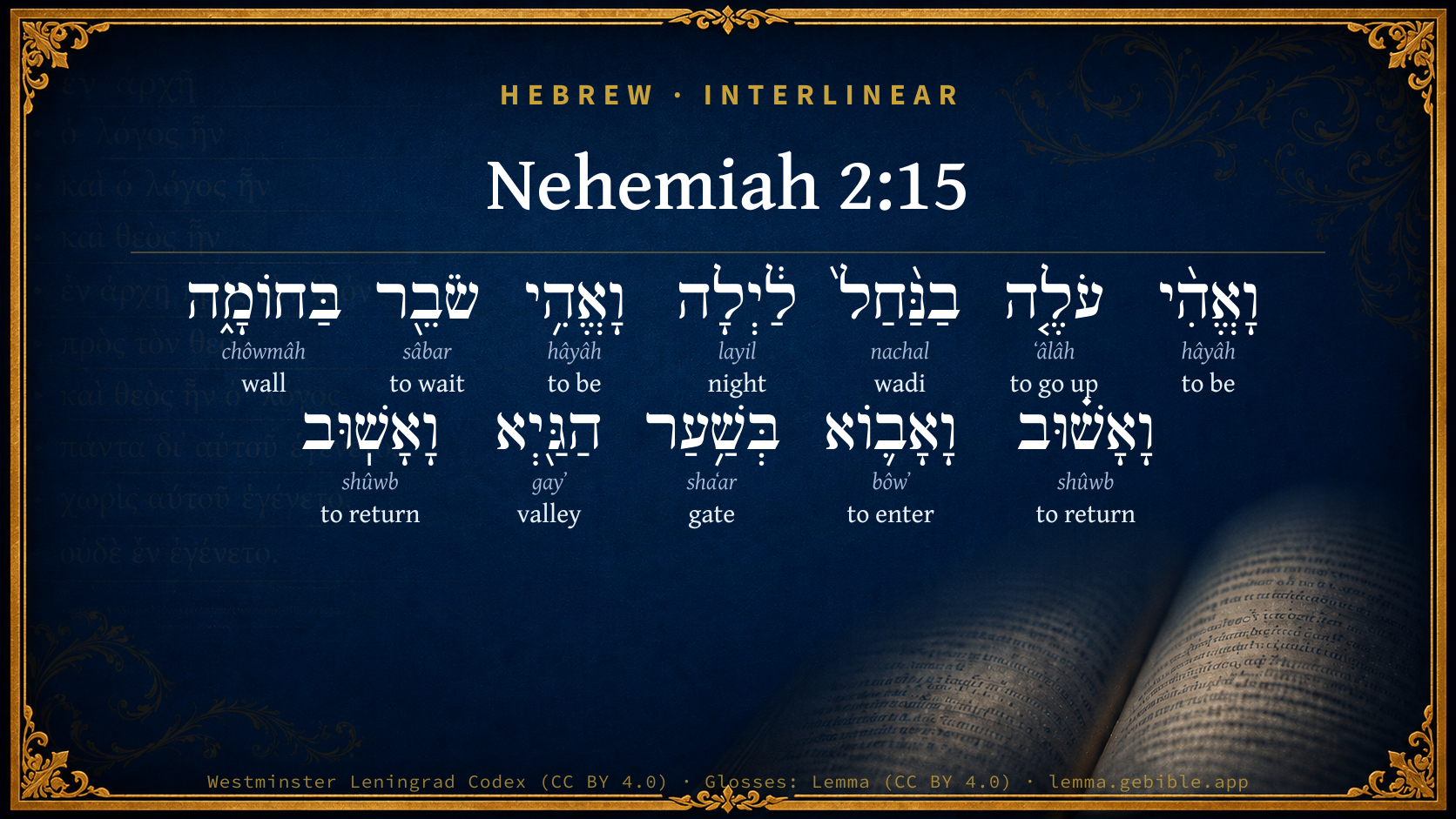
Hebrew (Westminster Leningrad Codex) Nehemiah 2:15 appears in the Hebrew Old Testament. The text above is from the Westminster Leningrad Codex. Each word links to its Strong’s number, a concise gloss, and parsing drawn from the Open Scriptures Hebrew Bible morphology. Click any word for its full Brown-Driver-Briggs (BDB) entry.
Download image
Cite this verse

Nehemiah 2:15 (World English Bible). Public Domain. Lemma interlinear Bible study tool, https://lemma.gebible.app/v/nehemiah/2/15.

Show BibTeX & RIS
BibTeX
RIS
English Translation
Then went I up in the night by the brook, and viewed the wall; and I turned back, and entered by the valley gate, and so returned.
World English Bible · Public Domain
Download a study sheet

One document with this verse’s original text, its word-by-word gloss line, the meaning frame, cross-references with their text, attributed commentary, and full source and license credits — printable, and it pastes into notes with its structure intact.

This verse Autodidact and up

Study sheet (.html) Plain text (.txt)

A passage Seminary Student

Up to 50 verses in one chapter. A passage sheet keeps up to 6 commentary sources and 12 cross-references per verse, in the order this page ranks them, and says so on the sheet whenever that leaves anything out. Ask for a single verse and you get the Autodidact verse sheet above.

Everything on this page stays free to read, with no account — the sheet is a download of what is already on screen, not access to it.

Want to remove ads? Support Godless Engineer
Compare translations 3

The same verse in 3 English versions, stacked beneath the original-language interlinear above. Click any original word for its lexicon entry.

Each is an independent rendering of the whole verse — the interlinear is not word-aligned to these translations.

Highlighted words mark where these versions differ — a whole-verse word diff, not a word-by-word alignment.

  • World English Bible Public Domain
    Then went I up in the night by the brook, and viewed the wall; and I turned back, and entered by the valley gate, and so returned.
  • King James Version Public Domain
    Then went I up in the night by the brook, and viewed the wall, and turned back, and entered by the gate of the valley, and so returned.
  • unfoldingWord Literal Text CC BY-SA 4.0
    And I was going up by the wadi at night, and I was looking intently at the wall. And I turned back, and I came in at the gate of the valley, and I returned.

unfoldingWord Literal Text — © unfoldingWord, licensed CC BY-SA 4.0. Word-aligned USFM3 via Door43 (git.door43.org/unfoldingWord/en_ult).

Versions to compare (up to 4)

3 of 4 selected

Show all 18 translations

Every available English version of this verse, each an independent rendering of the whole verse.

  • World English Bible Public Domain
    Then went I up in the night by the brook, and viewed the wall; and I turned back, and entered by the valley gate, and so returned.
  • Berean Standard Bible Public Domain
    so I went up the valley by night and inspected the wall. Then I headed back and reentered through the Valley Gate.
  • Majority Standard Bible Public Domain
    so I went up the valley by night and inspected the wall. Then I headed back and reentered through the Valley Gate.
  • King James Version Public Domain
    Then went I up in the night by the brook, and viewed the wall, and turned back, and entered by the gate of the valley, and so returned.
  • American Standard Version (1901) Public Domain
    Then went I up in the night by the brook, and viewed the wall; and I turned back, and entered by the valley gate, and so returned.
  • Revised Version (1885) Public Domain
    Then went I up in the night by the brook, and viewed the wall; and I turned back, and entered by the valley gate, and so returned.
  • Geneva Bible (1599) Public Domain
    Then went I vp in ye night by the brooke, and viewed the wall, and turned backe, and comming backe, I entred by the gate of the valley and returned.
  • Douay-Rheims (1899) Public Domain
    And I went up in the night by the torrent, and viewed the wall, and going back I came to the gate of the valley, and returned.
  • Young's Literal Translation Public Domain
    and I am going up through the brook by night, and am measuring about the wall, and turn back, and come in through the gate of the valley, and turn back.
  • Literal Standard Version CC BY-SA 4.0
    and I am going up through the brook by night, and am inspecting the wall, and turn back, and come in through the Valley Gate, and turn back.
  • Unlocked Literal Bible CC BY-SA 4.0
    So I went up that night by the valley and inspected the wall, and I turned back and entered by the Valley Gate, and so returned.
  • unfoldingWord Literal Text CC BY-SA 4.0
    And I was going up by the wadi at night, and I was looking intently at the wall. And I turned back, and I came in at the gate of the valley, and I returned.
  • Darby Bible Public Domain
    And I went up in the night through the valley, and viewed the wall, and turned back, and entered by the valley-gate and returned.
  • World Messianic Bible Public Domain
    Then I went up in the night by the brook and inspected the wall; and I turned back, and entered by the valley gate, and so returned.
  • Webster's Bible Public Domain
    Then I went up in the night by the brook, and viewed the wall, and turned back, and entered by the gate of the valley, and so returned.
  • Free Bible Version CC BY-SA 4.0
    So I went up along the valley in the dark and inspected the wall. Then I returned, going back through the Valley Gate.
  • Bible in Basic English Public Domain
    Then in the night, I went up by the stream, viewing the wall; then turning back, I went in by the door in the valley, and so came back.
  • JPS Tanakh (1917) Public Domain
    Then went I up in the night in the valley, and viewed the wall; and I turned back, and entered by the valley gate, and so returned.

Literal Standard Version (2020), Covenant Press — licensed CC BY-SA 4.0. Text via the HelloAO Bible API (eBible.org). Unlocked Literal Bible (unfoldingWord) — licensed CC BY-SA 4.0. Text via the HelloAO Bible API (eBible.org). unfoldingWord Literal Text — © unfoldingWord, licensed CC BY-SA 4.0. Word-aligned USFM3 via Door43 (git.door43.org/unfoldingWord/en_ult). Free Bible Version, Dr. Jonathan Gallagher — licensed CC BY-SA 4.0. Text via the HelloAO Bible API (eBible.org).

Word by word

More ways to search: Search by grammar → Find every occurrence → Compare this word →

Practice this passage: Drill this verse → Learn its vocabulary →

שֹׂבֵ֖ר
sâbar
H7663
“waiting”
Verb, Qal, Participle Active, Masculine, Singular, Absolute
Part of Speech
Verb
Stem
Qal
Form
Participle Active
Gender
Masculine
Number
Singular
State
Absolute
Full BDB Definition

Origin: a primitive root

TWOT: 2232

to inspect, examine, wait, hope, wait upon - (Qal) examined (participle) - (Piel) - to wait (for), wait upon - to hope (for)
  1. וָאֱהִ֨י hâyâh H1961 “and · to be” Conjunction + Verb, Qal, Sequential Imperfect, 1st Person, Common, Singular
  2. עֹלֶ֤ה ʻâlâh H5927 “going up” Verb, Qal, Participle Active, Masculine, Singular, Absolute
  3. בַנַּ֨חַל֙ nachal H5158 “in/at the · wadi” Preposition, Determined + Noun, Common, Masculine, Singular, Absolute
  4. לַ֔יְלָה layil H3915 “night” Noun, Common, Masculine, Singular, Absolute
  5. וָאֱהִ֥י hâyâh H1961 “and · to be” Conjunction + Verb, Qal, Sequential Imperfect, 1st Person, Common, Singular
  6. בַּחוֹמָ֑ה chôwmâh H2346 “in/at the · wall” Preposition, Determined + Noun, Common, Feminine, Singular, Absolute
  7. וָאָשׁ֗וּב shûwb H7725 “and · to return” Conjunction + Verb, Qal, Sequential Imperfect, 1st Person, Common, Singular
  8. וָאָב֛וֹא bôwʼ H935 “and · to enter” Conjunction + Verb, Qal, Sequential Imperfect, 1st Person, Common, Singular
  9. בְּשַׁ֥עַר shaʻar H8179 “in/at · gate of” Preposition + Noun, Common, Masculine, Singular, Construct
  10. הַגַּ֖יְא gayʼ H1516 “the · valley” Particle, Definite Article + Noun, Common, Both, Singular, Absolute
  11. וָאָשֽׁוּב shûwb H7725 “and · to return” Conjunction + Verb, Qal, Sequential Imperfect, 1st Person, Common, Singular

About this verse

These counts appear in no published source. They are computed here, from the morphology-tagged text and Lemma’s own curated glosses. What Lemma adds →

12
words
10
distinct lemmas
Historical
section

Notable vocabulary

The rarest word here is שֹׂבֵ֖ר to wait H7663 — appearing just 8 times in the whole Hebrew Bible.

Shared distinctive vocabulary

שֹׂבֵ֖ר to wait H7663 occurs in 8 verses of the Hebrew Bible. Also found in:

Grammatical profile

  • 7 verbs
  • 5 nouns

Verb forms

  • וָאֱהִ֨י Qal · Sequential Imperfect
  • עֹלֶ֤ה Qal · Participle Active
  • וָאֱהִ֥י Qal · Sequential Imperfect
  • שֹׂבֵ֖ר Qal · Participle Active
  • וָאָשׁ֗וּב Qal · Sequential Imperfect
  • וָאָב֛וֹא Qal · Sequential Imperfect
  • וָאָשֽׁוּב Qal · Sequential Imperfect

Repetition

Words recur within this verse — often emphatic in Hebrew:

  • וָאֱהִ֨י to be H1961 ×2
  • וָאָשׁ֗וּב to return H7725 ×2

Cross-references

3

Topical passages linked to Nehemiah 2:15 in the Treasury of Scripture Knowledge — connected by theme and wording, ordered by reader-vote popularity; previews shown in the World English Bible.

  • 2 Samuel 15:23 All the country wept with a loud voice, and all the people passed over: the king also himself passed over the brook Kidron, and all the people passed over, toward the way of the wilderness.
  • Jeremiah 31:38–40 Behold, the days come, says Yahweh, that the city shall be built to Yahweh from the tower of Hananel to the gate of the corner.
  • John 18:1 When Jesus had spoken these words, he went out with his disciples over the brook Kidron, where was a garden, into which he and his disciples entered.

Cross-references courtesy of OpenBible.info (CC BY 4.0).

Hebrew and Greek witnesses Masoretic Hebrew ↔ Greek Septuagint

The same verse in the two great witnesses to the Old Testament, shown verse-for-verse.

These are two independent witnesses, not word-aligned to each other, and the Septuagint is shown in lemma (dictionary) form.

Hebrew Nehemiah 2:15 Masoretic · Westminster Leningrad Codex

וָאֱהִ֨י עֹלֶ֤ה בַנַּ֨חַל֙ לַ֔יְלָה וָאֱהִ֥י שֹׂבֵ֖ר בַּחוֹמָ֑ה וָאָשׁ֗וּב וָאָב֛וֹא בְּשַׁ֥עַר הַגַּ֖יְא וָאָשֽׁוּב

Then went I up in the night by the brook, and viewed the wall; and I turned back, and entered by the valley gate, and so returned.

World English Bible · Public Domain

Greek LXX Structure differs

The Septuagint has no separate book of Nehemiah. Its Greek text is the second half of Esdras B (2 Esdras), chapters 11–23; Ezra is the first half (1–10).

A verse-for-verse comparison isn’t shown here because the chapters and verses don’t line up. Switch to the LXX edition with the MT / LXX toggle above to read the Greek directly.

Hebrew: Westminster Leningrad Codex (CC BY 4.0). Greek: Septuagint (public domain); English from a public-domain English Septuagint. How the Septuagint differs from the Hebrew →

Commentary

Notes on Nehemiah 2:15 from classic Christian and Jewish commentators (each source and its license shown beneath its notes). The classic Christian expositions comment on the surrounding passage and are grouped to its opening verse, so a note may address several verses; the Jewish commentaries on the Tanakh (Rashi and others) are per-verse, so they appear only where the commentator wrote on this verse.

Lemma curates 59 commentaries, every one of them public domain or Creative Commons licensed, each selected and text-cleaned for this edition rather than reprinted as found. About our sources →

Trapp's Complete Commentary

John Trapp

Neh 2:15 Then went I up in the night by the brook, and viewed the wall, and turned back, and entered by the gate of the valley, and [so] returned.

Ver. 15. Then went I up in the night] sc. By moonlight; for the moon is mistress of the night, Psa 136:9, by the brightness she borroweth from the body of the sun, which the moon receiveth and reflecteth, like a lookingglass.

And viewed the wall] That which was left of it, τα λειψανα, as Scaliger’s epitaph is, Scaligeri quod reliquum est, Scaliger’s relics.

And entered by the gate of the valley] Where he first went out; so he walked the round, not caring to observe that rule of Pythagoras, Eadem via qua progressus fueris ne regrediare, Go not back the same way you came out.

John Trapp, A Commentary or Exposition upon All the Books of the Old and New Testament (1647–1656) — public domain. Text from a community e-Sword module.

Jamieson, Fausset & Brown

Robert Jamieson, A. R. Fausset & David Brown

Then went I up . . . by the brook--that is, Kedron.

and entered by the gate of the valley, and so returned--the gate leading to the valley of Jehoshaphat, east of the city. He went out by this gate, and having made the circuit of the city, went in by it again [BARCLAY, City of the Great King].

Jamieson, Fausset & Brown — Commentary Critical and Explanatory on the Whole Bible (1871) — public domain (CC PDM 1.0). Text via the HelloAO Bible API.

Adam Clarke's Commentary

Verse 15. By the brook] Kidron.

By the gate of the Valley] The valley through which the brook Kidron flowed. It was by this gate he went out; so he went all round the city, and entered by the same gate from which he had gone out.

Adam Clarke's Commentary on the Bible (1810–1826) — public domain. Text from a community e-Sword/MySword module.

Ellicott's Commentary for English Readers

(15) By the gate of the valley, and so returned.—The itineration seems to have completed the circuit of the walls.

A Bible Commentary for English Readers, edited by Charles John Ellicott (1878–1897) — public domain. Text from a community e-Sword module.

The Cambridge Bible for Schools and Colleges

gen. ed. J. J. S. Perowne

15. Then went I up] The tense in the original denotes the gradual progress.

by the brook] i.e. the ‘nakhal’ or ‘brook’ (χείμαρρος) of Kedron. Leaving the ruined line of wall, he goes down to the hollow of the Kedron valley, and proceeds northward ‘up’ the stream, surveying the remains of the walls that crowned the steep declivity on his left.

and turned back] R.V. and I turned back. This word has been taken to mean not a retracing of his steps, but the turn westward in his route, which would lead eventually in the direction from which he had started. After leaving the Kedron valley the journey would not be so difficult, being probably on the more level ground where the ruins had been cleared; or where less destruction had been wrought. The absence of mention of any spot on the N. or N.W. wall has caused others to suppose that Nehemiah ‘turned back,’ having seen enough, without completing his circuit of the walls. More probably we have here an instance of condensation on the part of the compiler who at this point passes at once to the return journey, without giving us sufficient material to judge whether the complete circuit of the walls was made.

The Cambridge Bible for Schools and Colleges (gen. ed. J. J. S. Perowne; Cambridge University Press, 1878–1918) — public domain. Text from a community e-Sword module.

John Gill's Exposition

And the rulers knew not whither I went, or what I did..... The rulers of the city of Jerusalem, who seem to be officers of the king of Persia, since they are distinguished from Jewish rulers in the next clause:

neither had I as yet told it to the Jews; what he came about and designed to do:

nor to the priests, nor to the nobles, nor to the rulers; the principal men among the Jews, both ecclesiastical and civil:

nor to the rest that did the work; of building and repairing; neither those that were employed in it, nor those that overlooked it.

John Gill's Exposition of the Whole Bible (1746–1763) — public domain (CC PDM 1.0). Text via the HelloAO Bible API.

Albert Barnes' Notes on the Bible

The brook - The Kidron watercourse, which skirted the city on the east.

Turned back - i. e. he turned westward, and having made the circuit of the city, re-entered by the valley-gate.

Albert Barnes' Notes on the Bible (1834–1885) — public domain. Text from a community e-Sword/MySword module.

Haydock's Catholic Bible Commentary

Torrent of Cedron, having gone round the city. (Calmet)

George Leo Haydock (1774–1849), Haydock's Catholic Family Bible and Commentary, 1859 edition — public domain. Excludes Psalms (Douay-Rheims chapter numbering differs from Protestant) and Deuterocanonical books (Catholic canon only).

Matthew Poole's English Annotations

By the brook of Kidron; of which See Poole "2Sa 15:23". And so returned; having gone round about the city.

Matthew Poole's English Annotations on the Holy Bible (1683–1685) — public domain. Text from a community e-Sword/MySword module.

Whedon's Commentary on the Bible

Daniel D. Whedon

15. Then went I up… by the brook — He probably left his beast by the king’s pool, and went on foot up the brook, or valley of the Kedron, and viewed the wall on the east side of the city; then he turned back, walking down the brook Kedron again to the place where he left his beast, and then rode back around the southern and western walls, and again entered the city by the same gate of the valley through which he had gone out.

Daniel D. Whedon (gen. ed.), Commentary on the Old and New Testaments (1874–1909) — public domain. Text from a community e-Sword module.

The Pulpit Commentary

By the brook. "The brook Kidron," which skirted the city on the east. From this he would be able to "look up at the eastern wall" along its whole length, and see its condition. Following the brook, he was brought to the north-eastern angle of the city; on reaching which he seems to have "turned back" towards the point from which he had started, and skirting the northern wall, to have re-entered by the gate of the valley.

The Pulpit Commentary (1880–1919), ed. H.D.M. Spence-Jones & Joseph S. Exell — public domain. Text from a community e-Sword module.

Keil & Delitzsch

C. F. Keil & F. Delitzsch

Then I (went on) ascending the valley and viewing the wall, and so entered by the valley-gate, and returned. ואהי with the participle expresses the continuance of an action, and hence in this place the continuous ascent of the valley and survey of the wall. The נחל which he ascended was doubtless the valley of Kidron (קדרון נחל, Sa2 20:23; Kg1 2:37, and elsewhere). ואבוא ואשׁוּב are connected, שׁוּב expressing merely the idea of repetition (Gesenius, heb. Gram. 142, 3): I came again into the valley-gate. Older expositors incorrectly explain these words to mean, I turned round, traversing again the road by which I had come; Bertheau: I turned to go farther in a westerly direction, and after making the circuit of the entire city, I re-entered by the valley-gate. This sense is correct as to fact, but inadmissible, as requiring too much to complete it. If we take אשׁוּב adverbially, these completions are unnecessary. Nehemiah does not give the particulars of the latter portion of his circuit, but merely tells us that after having ascended the valley of Kidron, he re-entered by the valley-gate, and returned to his residence, obviously assuming, that from the upper part of the vale of Kidron he could only return to the valley-gate at the west by passing along the northern part of the wall.

Keil & Delitzsch — Biblical Commentary on the Old Testament (1861–1891) — public domain (CC PDM 1.0). Text via the HelloAO Bible API. (Old Testament only.)

unfoldingWord translationNotes

Door43 World Missions Community

So I went up ... and I turned back

The other men with Nehemiah also followed him. AT: "So we went up ... and we turned back" (See: Synecdoche)

by the Valley Gate

"through the Valley Gate"

the rest who did the work

This refers to the men who would later rebuild the walls. AT: "the others who would later do the work of rebuilding the walls" (See: Assumed Knowledge and Implicit Information)

translationWords

gate

rule

Jew

priest

noble

works

unfoldingWord translationNotes — © Distant Shores Media and the Door43 World Missions Community, licensed CC BY-SA 4.0. Source: git.door43.org/Door43/en_tn.

Rashi

Rabbi Shlomo Yitzchaki (Rashi)

And I ascended And I was ascending from one side at night, and I was breaking the wall with the men who were with me.

and I returned and came And when I returned, I came by way of the Gate of the Valley.

Rashi on the Tanakh — English translations: “The Judaica Press complete Tanach with Rashi, translated by A. J. Rosenberg” (CC BY 4.0); “Pentateuch with Rashi's commentary by M. Rosenbaum and A.M. Silbermann, 1929-1934” (public domain); “The Metsudah Tanach series, Lakewood, N.J” (CC BY 4.0); and “The Book of Joshua, Metsudah Publications, 1997” (CC BY 4.0). Text via Sefaria.

Lesson kit

Teaching starters — assembled from the data on this page, not authored interpretation. Every prompt links to the verse data it draws on. Edit before teaching.

Nehemiah, in the Historical, opens this verse with 12 words (10 distinct Hebrew lemmas). Its most distinctive word is sâbar (“to wait”). A historical commentator’s framing appears above. Read the whole chapter for the surrounding context.

Discussion questions

  1. What does “to wait” (sâbar) contribute to the verse as a whole?
  2. How does Ruth 1:13, which shares the word «to wait», read alongside this verse?
  3. What does the repetition of “to be” (2× in this one verse) do in this verse?
  4. These translations render this verse differently; the difference is in the English rendering, not the original. What questions does that raise?
  5. «וָאֱהִ֨י» is a Qal Sequential Imperfect verb. How does that grammatical form shape the action described?
  6. Compare how Trapp's Complete Commentary and Jamieson, Fausset & Brown read this verse. Where do they agree or differ?

Things to notice

Reading settings

Reading text

Shown beneath each verse's original-language words.

Old Testament
Old Testament edition

Read the OT as the Masoretic Hebrew (MT) or the Greek Septuagint (LXX).

English shown for the Greek Septuagint (in the Hebrew ↔ Greek comparison).

Comparing translations? Open the Compare panel on any verse page to stack up to four side by side.