
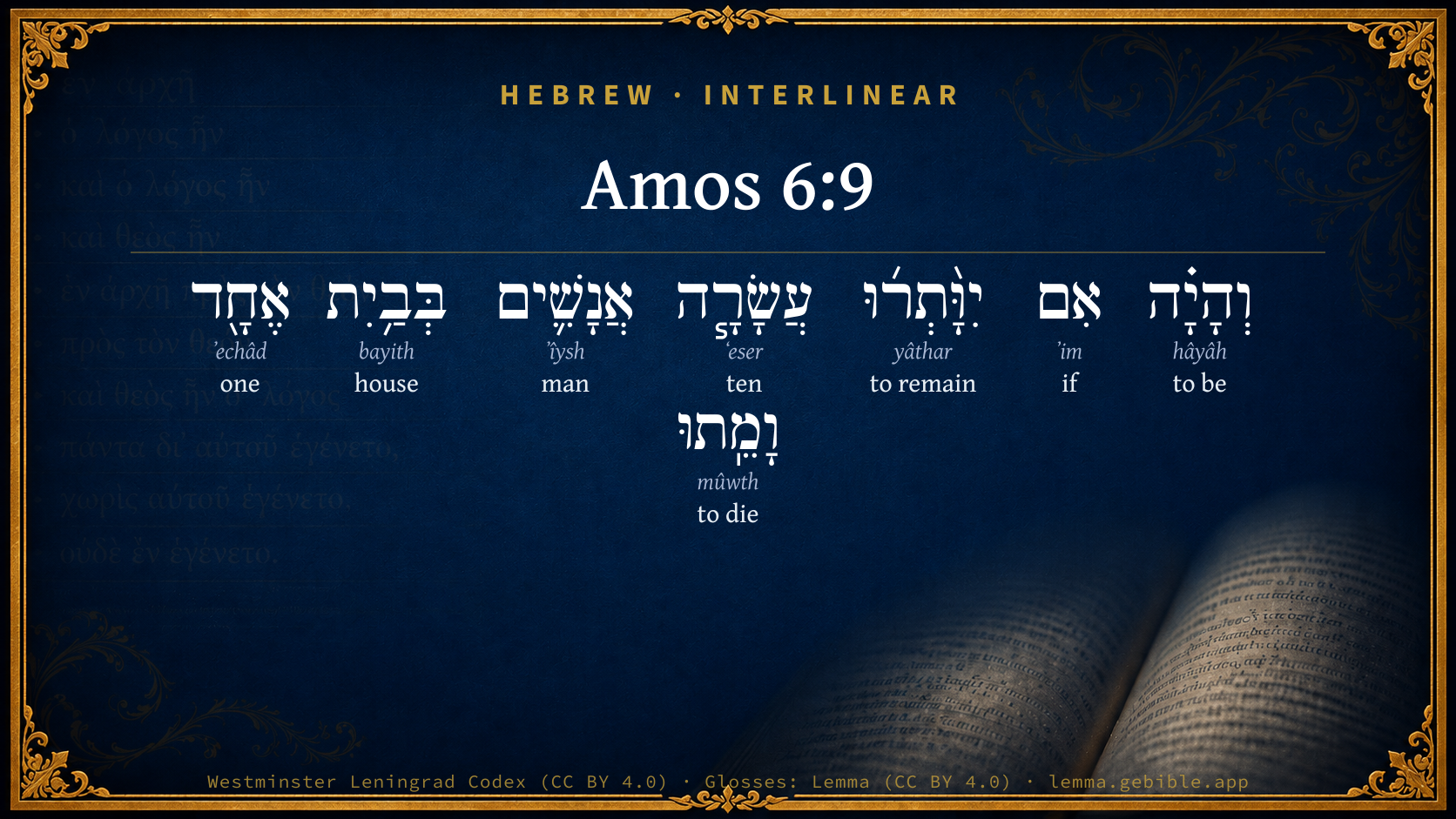
Amos 6:9

Hebrew (Westminster Leningrad Codex) Amos 6:9 appears in the Hebrew Old Testament. The text above is from the Westminster Leningrad Codex. Each word links to its Strong’s number, a concise gloss, and parsing drawn from the Open Scriptures Hebrew Bible morphology. Click any word for its full Brown-Driver-Briggs (BDB) entry.
Download image
Cite this verse

Amos 6:9 (World English Bible). Public Domain. Lemma interlinear Bible study tool, https://lemma.gebible.app/v/amos/6/9.

Show BibTeX & RIS
BibTeX
RIS
English Translation
It will happen, if there remain ten men in one house, That they shall die.
World English Bible · Public Domain
Download a study sheet

One document with this verse’s original text, its word-by-word gloss line, the meaning frame, cross-references with their text, attributed commentary, and full source and license credits — printable, and it pastes into notes with its structure intact.

This verse Autodidact and up

Study sheet (.html) Plain text (.txt)

A passage Seminary Student

Up to 50 verses in one chapter. A passage sheet keeps up to 6 commentary sources and 12 cross-references per verse, in the order this page ranks them, and says so on the sheet whenever that leaves anything out. Ask for a single verse and you get the Autodidact verse sheet above.

Everything on this page stays free to read, with no account — the sheet is a download of what is already on screen, not access to it.

Want to remove ads? Support Godless Engineer
Compare translations 3

The same verse in 3 English versions, stacked beneath the original-language interlinear above. Click any original word for its lexicon entry.

Each is an independent rendering of the whole verse — the interlinear is not word-aligned to these translations.

Highlighted words mark where these versions differ — a whole-verse word diff, not a word-by-word alignment.

  • World English Bible Public Domain
    It will happen, if there remain ten men in one house, That they shall die.
  • King James Version Public Domain
    And it shall come to pass, if there remain ten men in one house, that they shall die.
  • unfoldingWord Literal Text CC BY-SA 4.0
    It will come about that if there are ten men left in one house, they will all die.

unfoldingWord Literal Text — © unfoldingWord, licensed CC BY-SA 4.0. Word-aligned USFM3 via Door43 (git.door43.org/unfoldingWord/en_ult).

Versions to compare (up to 4)

3 of 4 selected

Show all 18 translations

Every available English version of this verse, each an independent rendering of the whole verse.

  • World English Bible Public Domain
    It will happen, if there remain ten men in one house, That they shall die.
  • Berean Standard Bible Public Domain
    And if there are ten men left in one house, they too will die.
  • Majority Standard Bible Public Domain
    And if there are ten men left in one house, they too will die.
  • King James Version Public Domain
    And it shall come to pass, if there remain ten men in one house, that they shall die.
  • American Standard Version (1901) Public Domain
    And it shall come to pass, if there remain ten men in one house, that they shall die.
  • Revised Version (1885) Public Domain
    And it shall come to pass, if there remain ten men in one house, that they shall die.
  • Geneva Bible (1599) Public Domain
    And if there remaine ten men in one house, they shall die.
  • Douay-Rheims (1899) Public Domain
    And if there remain ten men in one house, they also shall die.
  • Young's Literal Translation Public Domain
    And if there are left ten persons in one house, It hath come to pass -- that they have died.
  • Literal Standard Version CC BY-SA 4.0
    And if there are left ten persons in one house, || It has come to pass—that they have died.
  • Unlocked Literal Bible CC BY-SA 4.0
    It will come about that if there are ten men left in one house, they will all die.
  • unfoldingWord Literal Text CC BY-SA 4.0
    It will come about that if there are ten men left in one house, they will all die.
  • Darby Bible Public Domain
    And it shall come to pass, if there remain ten men in one house, that they shall die.
  • World Messianic Bible Public Domain
    It will happen that if ten men remain in one house, they will die.
  • Webster's Bible Public Domain
    And it shall come to pass, if there remain ten men in one house, they shall die.
  • Free Bible Version CC BY-SA 4.0
    If there are ten people in a house, they will die.
  • Bible in Basic English Public Domain
    Then it will come about that if there are still ten men in a house, death will overtake them.
  • JPS Tanakh (1917) Public Domain
    And it shall come to pass, if there remain ten men in one house, that they shall die.

Literal Standard Version (2020), Covenant Press — licensed CC BY-SA 4.0. Text via the HelloAO Bible API (eBible.org). Unlocked Literal Bible (unfoldingWord) — licensed CC BY-SA 4.0. Text via the HelloAO Bible API (eBible.org). unfoldingWord Literal Text — © unfoldingWord, licensed CC BY-SA 4.0. Word-aligned USFM3 via Door43 (git.door43.org/unfoldingWord/en_ult). Free Bible Version, Dr. Jonathan Gallagher — licensed CC BY-SA 4.0. Text via the HelloAO Bible API (eBible.org).

Word by word

More ways to search: Search by grammar → Find every occurrence → Compare this word →

Practice this passage: Drill this verse → Learn its vocabulary →

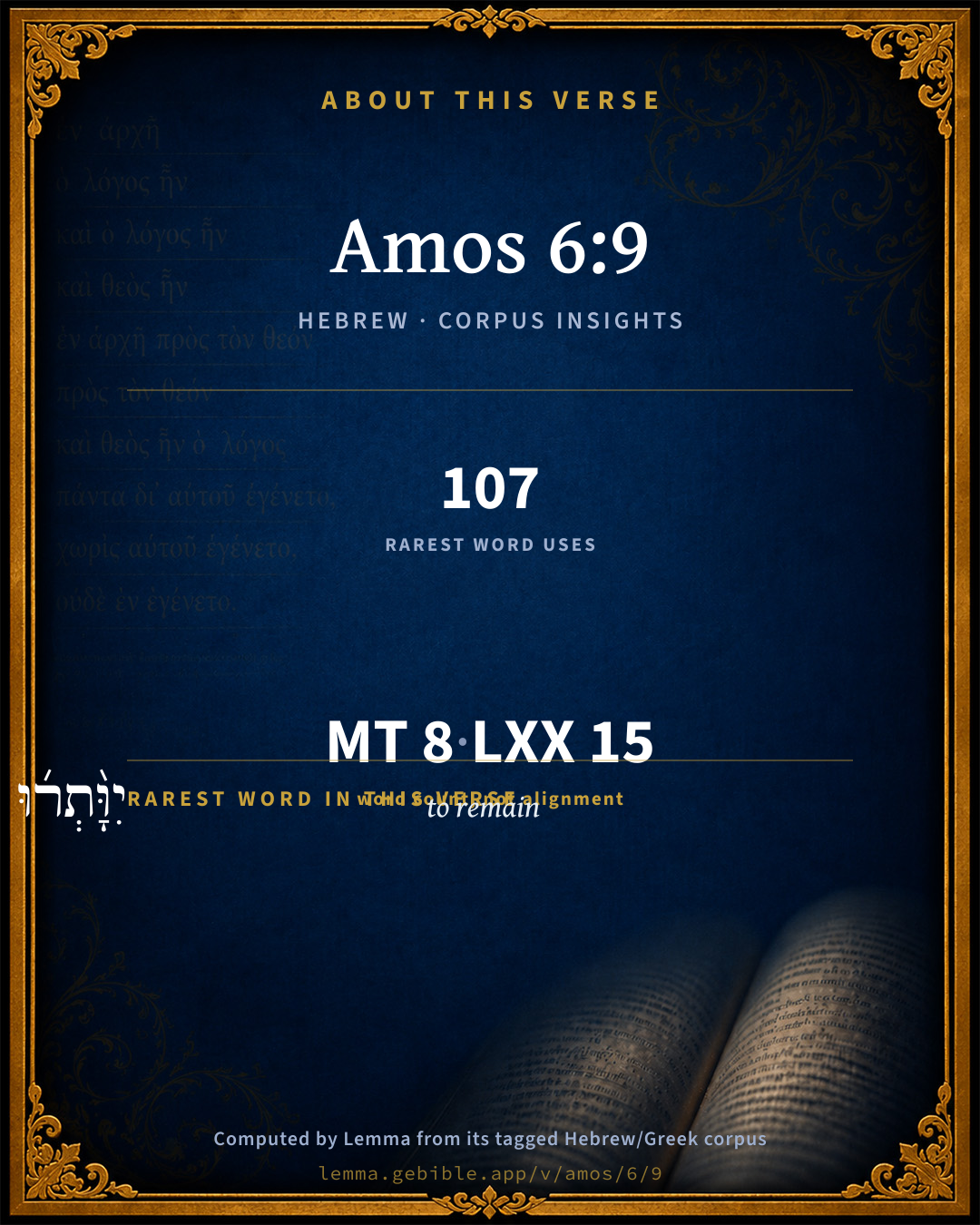
יִוָּ֨תְר֜וּ
yâthar
H3498
“to remain”
Verb, Niphal, Imperfect, 3rd Person, Masculine, Plural
Part of Speech
Verb
Stem
Niphal
Form
Imperfect
Person
3rd Person
Gender
Masculine
Number
Plural
Full BDB Definition

Origin: a primitive root

TWOT: 936

to be left over, remain, remain over, leave - (Qal) remainder (participle) - (Niphal) to be left over, remain over, be left behind - (Hiphil) - to leave over, leave - to save over, preserve alive - to excel, show pre-eminence - to show excess, have more than enough, have an excess
  1. וְהָיָ֗ה hâyâh H1961 “and · to be” Conjunction + Verb, Qal, Sequential Perfect, 3rd Person, Masculine, Singular
  2. אִם ʼim H518 “if” Conjunction
  3. עֲשָׂרָ֧ה ʻeser H6235 “ten” Adjective, Cardinal number, Masculine, Singular, Absolute
  4. אֲנָשִׁ֛ים ʼîysh H376 “men” Noun, Common, Masculine, Plural, Absolute
  5. בְּבַ֥יִת bayith H1004 “in/at · house” Preposition + Noun, Common, Masculine, Singular, Absolute
  6. אֶחָ֖ד ʼechâd H259 “one” Adjective, Cardinal number, Masculine, Singular, Absolute
  7. וָמֵֽתוּ mûwth H4191 “and · to die” Conjunction + Verb, Qal, Sequential Perfect, 3rd Person, Common, Plural

About this verse

These counts appear in no published source. They are computed here, from the morphology-tagged text and Lemma’s own curated glosses. What Lemma adds →

8
words
8
distinct lemmas
Prophets
section

Grammatical profile

  • 3 verbs
  • 2 nouns
  • 2 adjectives
  • 1 conjunction

Verb forms

  • וְהָיָ֗ה Qal · Sequential Perfect
  • יִוָּ֨תְר֜וּ Niphal · Imperfect
  • וָמֵֽתוּ Qal · Sequential Perfect

Hebrew & Septuagint length

In English translation the verse runs 15 words from the Hebrew and 19 from the Septuagint (LXX English) — closely comparable.

A rough comparison of the two English renderings, which tokenize alike — not a word-level alignment.

Word counts can differ between the Hebrew and the Greek without any difference in meaning — e.g. the Hebrew direct-object marker אֵת has no separate Greek word, and Greek often adds the article ὁ.

In the original languages it is 8 Hebrew tokens and 15 Greek tokens — but the two are counted differently (Hebrew bundles its prefixes and suffixes into one token; the Greek is in lemma form), so that isn’t a like-for-like length.

Cross-references

9

Topical passages linked to Amos 6:9 in the Treasury of Scripture Knowledge — connected by theme and wording, ordered by reader-vote popularity; previews shown in the World English Bible.

  • Amos 5:3 For thus says the Lord Yahweh: "The city that went forth a thousand shall have a hundred left, And that which went forth one hundred shall have ten left to the house of Israel."
  • 1 Samuel 2:33 The man of yours, [whom] I shall not cut off from my altar, [shall be] to consume your eyes, and to grieve your heart; and all the increase of your house shall die in the flower of their age.
  • Esther 5:11 Haman recounted to them the glory of his riches, and the multitude of his children, and all the things in which the king had promoted him, and how he had advanced him above the princes and servants of the king.
  • Esther 9:10 the ten sons of Haman the son of Hammedatha, the Jew's enemy, killed they; but they didn't lay their hand on the spoil.
  • Job 1:2 There were born to him seven sons and three daughters.
  • Job 1:19 and, behold, there came a great wind from the wilderness, and struck the four corners of the house, and it fell on the young men, and they are dead. I alone have escaped to tell you."
  • Job 20:28 The increase of his house shall depart; They shall rush away in the day of his wrath.
  • Psalms 109:13 Let his posterity be cut off. In the generation following let their name be blotted out.
  • Isaiah 14:21 Prepare slaughter for his children for the iniquity of their fathers, that they not rise up, and possess the earth, and fill the surface of the world with cities.

Cross-references courtesy of OpenBible.info (CC BY 4.0).

Hebrew and Greek witnesses Masoretic Hebrew ↔ Greek Septuagint

The same verse in the two great witnesses to the Old Testament, shown verse-for-verse.

These are two independent witnesses, not word-aligned to each other, and the Septuagint is shown in lemma (dictionary) form.

Hebrew Amos 6:9 Masoretic · Westminster Leningrad Codex

וְהָיָ֗ה אִם יִוָּ֨תְר֜וּ עֲשָׂרָ֧ה אֲנָשִׁ֛ים בְּבַ֥יִת אֶחָ֖ד וָמֵֽתוּ

It will happen, if there remain ten men in one house, That they shall die.

World English Bible · Public Domain

Greek LXX Amos 6:9 Septuagint · lemma form

καί εἰμί ἐάν ὑπολείπω δέκα ἀνήρ ἐν οἰκία εἷς καί ἀποθνήσκω καί ὑπολείπω ὁ κατάλοιπος

And it shall come to pass, if there be ten men left in one house, that they shall die.

LXX2012 (modern English Septuagint) · Public Domain

On this verse, The Pulpit Commentary discusses the Septuagint’s reading. Read the note in Commentary ↓

Hebrew: Westminster Leningrad Codex (CC BY 4.0). Greek: Septuagint (public domain); English from LXX2012 (modern English Septuagint) (Public Domain). How the Septuagint differs from the Hebrew →

Targum (Aramaic paraphrase)

1

The Targum is the ancient Jewish Aramaic paraphrase of the Hebrew Scriptures — an interpretive translation, not the Hebrew text itself. Onkelos (literal) and Pseudo-Jonathan (expansive) render the Torah, and Jonathan the Prophets. Coverage is partial: where no permissively-licensed English translation exists for a verse, only the Aramaic is shown. This is verse-level text, not a word-by-word alignment to the Hebrew.

  1. Targum Jonathan Prophets (Joshua–Malachi)
    וִיהֵי אִם יִשְׁתָּאֲרוּן עַסְרָא גַבְרִין בְּבֵיתָא חַד וִימוּתוּן:

    (no public-domain English translation for this verse)

    Targum Jonathan — Aramaic: “Mikraot Gedolot” (public domain). English: “Sefaria Community Translation” (CC0 1.0 (public-domain dedication)); “London "Chaldee Paraphrase," 1871” (public domain). Text via Sefaria.

Commentary

Notes on Amos 6:9 from classic Christian and Jewish commentators (each source and its license shown beneath its notes). The classic Christian expositions comment on the surrounding passage and are grouped to its opening verse, so a note may address several verses; the Jewish commentaries on the Tanakh (Rashi and others) are per-verse, so they appear only where the commentator wrote on this verse.

Lemma curates 59 commentaries, every one of them public domain or Creative Commons licensed, each selected and text-cleaned for this edition rather than reprinted as found. About our sources →

Trapp's Complete Commentary

John Trapp

Amo 6:9 And it shall come to pass, if there remain ten men in one house, that they shall die.

Ver. 9. And it shall come to pass, if there remain ten men, &c.] That is, many, as Zec 8:23 Lev 26:26, because ten is the utmost of single number: q.d. though a considerable company escape the enemy, yet pestilence or some other destruction shall put an end to them.

They shall die] See this fulfilled 2Ki 17:5. In which common calamity what a happiness had they, that belonging to the election of grace, could confidently say, as Hab 1:12, "Art thou not from everlasting, O Lord my God, mine Holy One? We shall not die" (or if we do, death may kill us, but cannot hurt us, Occidere potest, non laedere). "O Lord, thou hast ordained them for judgment; and, O mighty God, thou hast established them for correction." The wicked are killed with death, Rev 2:23, undone by it; to them it is no other but a trap door to hell, as to the saints it is as the valley of Achor, a door of hope, the very daybreak of eternal brightness, Hos 2:15.

John Trapp, A Commentary or Exposition upon All the Books of the Old and New Testament (1647–1656) — public domain. Text from a community e-Sword module.

Joseph Benson's Commentary

Amo 6:9-11. If there remain ten men in one house, &c. — Those that escape the hands of the enemy shall die by the pestilence. And a man’s uncle (or kinsman) shall take him up — Some friend or relation, whose duty it is to perform the last offices for the deceased, shall take him up directly and burn him: for so it should be rendered, and not, AND HE THAT burneth him. The meaning is, that he should not stay to perfume the body with rich ointments, as was the usual custom; nor should he bury it, but burn it to ashes, to prevent infection. To bring out the bones out of the house, &c. — Or rather, that he may bring out, &c., that is, that he may, as soon as possible, cleanse the house by the removal of the body. All that is said here, is strongly expressive of what is the case where a deadly pestilence rages. And shall say unto him that is by the sides of the house — Or near the house, out of which the bones are carried; Is there any yet with thee — Is there any yet living besides thyself belonging to this house? And he shall say, No — All the inhabitants of the house are dead. Then shall he say, Hold thy tongue; for we may not make mention of the name of the Lord — As this clause has no immediate connection with, or relation to, the negative answer contained in the preceding clause, it is to be supposed that when the person has given that answer, and said that there was none left alive in the house, he utters, as is natural, some prayer to God for mercy or deliverance; on which the other speaks to him in this manner: as much as to say, It is in vain now to pray, or make supplication; for God will not now hear us, but we also shall be cut off by this dreadful pestilence, as the rest have been. Archbishop Newcome puts a different sense on the last clause, thus: “Solitude shall reign in the house; and if one is left, he must be silent (see Amo 8:3) and retired, lest he be plundered of his scanty provisions.” For behold, the Lord commandeth — Gives forth his commands to the enemy, namely, the Assyrians, to come against Israel. And he will smite the great house, and the little house, &c. — People of all ranks, high and low, shall be sufferers in the common calamities.

Joseph Benson's Commentary on the Old and New Testaments (1811–1818) — public domain. Text from a community e-Sword module.

The Expositor's Bible

4. A FRAGMENT FROM THE PLAGUE

In the above exposition we have omitted two very curious verses, Amo_6:9-10, which are held by some critics to interrupt the current of the chapter, and to reflect an entirely different kind of calamity from that which it predicts. I do not think these critics right, for reasons I am about to give; but the verses are so remarkable that it is most convenient to treat them by themselves apart from the rest of the chapter. Here they are, with the verse immediately in front of them.

"I am loathing the pride of Jacob, and his palaces I hate. And I will give up a city and its fullness" to (perhaps "siege" or "pestilence"?). "And it shall come to pass, if there be left ten men in one house, and. they die, that his cousin and the man to burn him shall lift him to bring the body t out of the house, and they shall say to one who is in the recesses of the house. Are there any more with thee? And he Shall say, Not one and they shall say, Hush! (for one must not make mention of the name of Jehovah)."

This grim fragment is obscure in its relation to the context. But the death of even so large a household as ten-the funeral left to a distant relation -the disposal of the bodies by burning instead of the burial customary among the Hebrews-sufficiently reflect the kind of calamity. It is a weird little bit of memory, the recollection of an eye-witness, from one of those great pestilences which, during the first half of the eighth century, happened not seldom in Western Asia. But what does it do here? Wellhausen says that there is nothing to lead up to the incident; that before it the chapter speaks, not of pestilence, but only of political destruction by an enemy. This is not accurate. The phrase immediately preceding may mean either "I will shut up a city and its fullness," in which case a siege is meant, and a siege was the possibility both of famine and pestilence; or "I will give up the city and its fullness" in which case a word or two may have been dropped, as words have undoubtedly been dropped at the end of the next verse, and one ought perhaps to add "to the pestilence." The latter alternative is the more probable, and this may be one of the passages, already alluded to, in which the want of connection with the preceding verses is to be explained, not upon the favorite theory-that there has been a violent intrusion into the text, but upon the too much neglected hypothesis that some words have been lost.

The uncertainty of the text, however, does not weaken the impression of its ghastly realism: the unclean and haunted he use: the kinsman and the body-burner afraid to search through the infected rooms, and calling in muffled voice to the single survivor crouching in some far corner of them, "Are there any more with thee?" his reply, "None"-himself the next! Yet these details are not the most weird. Over all hangs a terror darker than the pestilence. "Shall there be evil in a city and Jehovah not have done it?" Such, as we have heard from Amos, was the settled faith of the age. But in times of woe it was held with an awful and a craven superstition. The whole of life was believed to be overhung with loose accumulations of Divine anger. And as in some fatal hollow in the high Alps, where any noise may bring down the impending masses of snow, and the fearful traveler hurries along in silence, so the men of that superstitious age feared, When an evil like the plague was imminent, even to utter the Deitys name, lest it should loosen some avalanche of His wrath. "And he said, Hush! for," adds the comment, one "must not make mention of the name of Jehovah."

This reveals another side of the popular religion which Amos has been attacking. We have seen it as the sheer superstition of routine; but we now know that it was a routine broken by panic. The God who in times of peace was propitiated by regular supplies of savoury sacrifice and flattery, is conceived, when His wrath is roused and imminent, as kept quiet only by the silence of its miserable objects. The false peace of ritual is tempered by panic.

William Robertson Nicoll, ed., The Expositor's Bible (London: Hodder & Stoughton, 1887–1910) — public domain. 65 of 66 books (1 Corinthians is not separately keyed, as that volume carries no machine-parseable verse references); section-level commentary keyed to the opening verse. Introductory and overview sections not keyed to a specific passage are excluded.

Tyndale Open Study Notes

Tyndale Open Resources

6:9-10 These verses graphically picture the wholesale slaughter by military conquest promised in 6:8.

Tyndale Open Study Notes — © Tyndale Open Resources, licensed CC BY-SA 4.0. Text via the HelloAO Bible API.

unfoldingWord translationNotes

Door43 World Missions Community

General Information:

In Amo 6:9-10 Amos describes a hypothetical situation of what it will be like when Yahweh hands the people of Israel over to their enemies. (See: Hypothetical Situations)

if there are ten men left in one house, they will all die

This seems to imply that something terrible is happening, and these ten men go into the house to hide. AT: "if ten men are hiding inside of a house, they will all still die" (See: Assumed Knowledge and Implicit Information)

a man's relative comes to take their bodies up—the one who is to cremate them after bringing the corpses out of the house—if he says to the person in the house, "Is ... you?"

The meaning of these words is not clear. Possible meanings are 1) the "man's relative" is the one who will "take their bodies up" and "cremate ... the corpses," and he speaks to a person who hid in the house after the ten family members died or 2) the "man's relative" who "comes to take their bodies up" is a different person from "the one who is to cremate ... the corpses," and they talk to each other in the house. AT: "a man's relative comes to take their bodies up, and the one who will burn the corpses after they have been brought out of the house is with him—if while they are in the house the relative says to the burner of the corpses, 'Is ... you?'"

cremate

to burn a dead body

bringing the corpses

"bringing the dead bodies"

Then he will say, "Be quiet, for we must not mention Yahweh's name."

The meaning of this is not clear. It seems to imply that the one who asked the question is afraid the one answering will mention Yahweh's name carelessly. If he does this, it may draw Yahweh's attention to them, and he may kill them too. (See: Assumed Knowledge and Implicit Information)

translationWords

die

unfoldingWord translationNotes — © Distant Shores Media and the Door43 World Missions Community, licensed CC BY-SA 4.0. Source: git.door43.org/Door43/en_tn.

Jamieson, Fausset & Brown

Robert Jamieson, A. R. Fausset & David Brown

If as many as ten (Lev 26:26; Zac 8:23) remain in a house (a rare case, and only in the scattered villages, as there will be scarcely a house in which the enemy will leave any), they shall all, to a man, die of the plague, a frequent concomitant of war in the East (Jer 24:10; Jer 44:13; Eze 6:11).

Jamieson, Fausset & Brown — Commentary Critical and Explanatory on the Whole Bible (1871) — public domain (CC PDM 1.0). Text via the HelloAO Bible API.

Adam Clarke's Commentary

Verse 9. Ten men - they shall die.] ALL shall be cut off by the sword, or by captivity, or by famine.

Adam Clarke's Commentary on the Bible (1810–1826) — public domain. Text from a community e-Sword/MySword module.

John Calvin's Commentaries

The Prophet here amplifies the calamity, which was nigh the people; as though he had said, that God would not now take moderate vengeance on that reprobate people, for he did nothing by dealing moderately with them: there was therefore nigh at hand the heaviest vengeance, which would reduce the people to nothing. This is the import of the Prophet’s words when he says, that ten, if remaining in the same house, would die But in naming ten survivors, he intimates that a slaughter had preceded, which had taken away either the half or at least some part of the family, since ten remained. At the same time this number shows how severe and dreadful a judgment of God awaited that people, that ten would be taken away together. But it rarely happens, even when a direful pestilence prevails, that so numerous a family entirely perishes; when three out of four, or six or five out of eight, are taken away, it is a diminution which usually greatly terrifies men: but when ten are taken away together, and no one is left, it is an evidence of an awful vengeance.

We see then that the Prophet here denounces on the people utter ruin, for they could not be reformed by milder punishments: when God tried to recall them to a sane mind, he effected nothing. There was therefore no remedy for their desperate diseases: it was hence necessary entirely to take away those who were thus incurable. Perish then shall the ten, who shall remain in one house It follows —

John Calvin's Commentaries (1540-1563) — public domain. Text from the Calvin Translation Society English edition (1840s-50s) via the Christian Classics Ethereal Library (ccel.org). Calvin's coverage is partial (roughly two-thirds of the Bible); uncommented books and verses are honest gaps, never fabricated. The 19th-century editor's footnotes and remarks are omitted so the notes are faithfully Calvin's own voice.

Ellicott's Commentary for English Readers

(9, 10) Ten . . . uncle.—In some large house it might be that ten are left remaining, but even these are devoured by the pestilence which hovers in the track of war. Nine have fallen victims. Fathers and brothers are all gone, and the uncle comes in as the funereal burner, to carry out the corpse to the pyre, and finds in the innermost parts of the house the tenth victim of the fell disease yet alive. A hurried word or two passes between them: “Is there yet another with thee?” and the answer comes, “Not one.” Then shall he say “Hush!” The lonely sufferer begins to curse the Lord for His judgments, or it may be he begins to call upon the Name of the Lord when it is too late, when, as a finishing touch of darkest gloom and despair, he is interrupted by a warning not to stir up Jehovah’s wrath in this day of His visitation by even mentioning His name. This and one other passage (1Sa_31:12) imply that under special circumstances the Hebrews burned their dead. In this case pestilence made cremation a necessity. The references in 2Ch_16:14; 2Ch_21:19; Jer_34:5, are to honorific burning of spices in memory of the dead.

A Bible Commentary for English Readers, edited by Charles John Ellicott (1878–1897) — public domain. Text from a community e-Sword module.

The Cambridge Bible for Schools and Colleges

gen. ed. J. J. S. Perowne

9. A house in which ten men were left, surviving the casualties and privations of a siege, must have been a fairly large one: no doubt, Amos has still in view the palaces of the wealthy (cf. Amo_3:15). Those, however, who in such a house have escaped other dangers, shall nevertheless die, viz. by the pestilence, which the prophet pictures tacitly as raging in the city at the time.

9–10. The terrible consequences of the siege.

The Cambridge Bible for Schools and Colleges (gen. ed. J. J. S. Perowne; Cambridge University Press, 1878–1918) — public domain. Text from a community e-Sword module.

John Gill's Exposition

And it shall come to pass,.... When the city is delivered up and taken:

if there remain; who are not carried captive, or destroyed by the sword:

ten men in one house; that is, many, a certain number for an uncertain:

that they shall die; either with famine, or by the pestilence, though they have escaped the other calamities; so general shall the destruction be, by one means or another.

John Gill's Exposition of the Whole Bible (1746–1763) — public domain (CC PDM 1.0). Text via the HelloAO Bible API.

Albert Barnes' Notes on the Bible

If there shall remain ten men - He probably still denounces the punishment of the rich inhabitants of the palaces, since in these only, of old, would there be found “ten men.” They died, it seems, at once, and so probably through the plague, the common companion. of the siege. The prophet had before compared them to Sodom. It may be, that, in this mention of “ten men,” he tacitly refers to the history of that destruction. Then God promised, not to destroy the city, if there were ten righteous in it Gen 18:32. Here were “ten left,” not in one city, but in one house. Had God forgotten His loving-kindness? No! but, in Samaria, not even ten who “remained over,” and so had survived after the chastisement had begun, turned to God. All then were to be taken or destroyed. The miseries of its three years’ siege by Shalmanezer may be filled up from those of its earlier siege by Benhadad 2Ki 6:24-29, or from those of Jerusalem. The sufferings of a siege are in proportion to the obstinacy of the defense; and Samaria resisted for twice the time in which Jerusalem was reduced by famine at its first captivity.

Albert Barnes' Notes on the Bible (1834–1885) — public domain. Text from a community e-Sword/MySword module.

Haydock's Catholic Bible Commentary

Die. Their numbers will not protect them from the plague.

George Leo Haydock (1774–1849), Haydock's Catholic Family Bible and Commentary, 1859 edition — public domain. Excludes Psalms (Douay-Rheims chapter numbering differs from Protestant) and Deuterocanonical books (Catholic canon only).

Matthew Poole's English Annotations

It shall come to pass; the thing is decreed, and shall take effect.

If there remain, or escape the enemies’ sword, or the famine of Samaria, besieged three years.

Ten men in one house; many men, for it is a certain number expressed, though an uncertain be understood.

They shall die, either of pestilence, or by some other stroke of God’s hand; though they escape a while they shall not finally escape, 2Ki 17:5.

Matthew Poole's English Annotations on the Holy Bible (1683–1685) — public domain. Text from a community e-Sword/MySword module.

The Pulpit Commentary

If there remain ten men in one house. If these escape death in war, they shall die of famine and pestilence in the three years" siege of Samaria. (2Ki_17:5) If the prophet is still referring to the rich chieftains, ten would be only a poor remnant of the inhabitants of their palaces. The LXX adds, very unnecesarily, Kaisontai oiJ kataloipoi, "And those remaining shall be left behind."

The Pulpit Commentary (1880–1919), ed. H.D.M. Spence-Jones & Joseph S. Exell — public domain. Text from a community e-Sword module.

John Wesley's Explanatory Notes

Remain - Escaping the enemies sword. Ten men - Many men, a certain number for an uncertain. They shall die - Tho' they escape a while, they shall not finally escape.

John Wesley, Explanatory Notes Upon the Whole Bible (1754–1765) — public domain. Text via the GEBible commentary corpus.

Rashi

Rabbi Shlomo Yitzchaki (Rashi)

if... are left—from the pestilence and the sword, in one house, they shall die—for the enemies shall burn the house upon them when they take the city.

Rashi on the Tanakh — English translations: “The Judaica Press complete Tanach with Rashi, translated by A. J. Rosenberg” (CC BY 4.0); “Pentateuch with Rashi's commentary by M. Rosenbaum and A.M. Silbermann, 1929-1934” (public domain); “The Metsudah Tanach series, Lakewood, N.J” (CC BY 4.0); and “The Book of Joshua, Metsudah Publications, 1997” (CC BY 4.0). Text via Sefaria.

Lesson kit

Teaching starters — assembled from the data on this page, not authored interpretation. Every prompt links to the verse data it draws on. Edit before teaching.

Amos, in the Prophets, opens this verse with 8 words (8 distinct Hebrew lemmas). Its most distinctive word is yâthar (“to remain”). A historical commentator’s framing appears above. Read the whole chapter for the surrounding context.

Discussion questions

  1. How does “to remain” (yâthar) shape what this verse is saying?
  2. How does Amos 5:3, which shares this passage’s theme, read alongside this verse?
  3. These translations render this verse differently; the difference is in the English rendering, not the original. What questions does that raise?
  4. «וְהָיָ֗ה» is a Qal Sequential Perfect verb. How does that grammatical form shape the action described?
  5. Compare how Trapp's Complete Commentary and Joseph Benson's Commentary read this verse. Where do they agree or differ?

Things to notice

Reading settings

Reading text

Shown beneath each verse's original-language words.

Old Testament
Old Testament edition

Read the OT as the Masoretic Hebrew (MT) or the Greek Septuagint (LXX).

English shown for the Greek Septuagint (in the Hebrew ↔ Greek comparison).

Comparing translations? Open the Compare panel on any verse page to stack up to four side by side.