Nehemiah 6:13

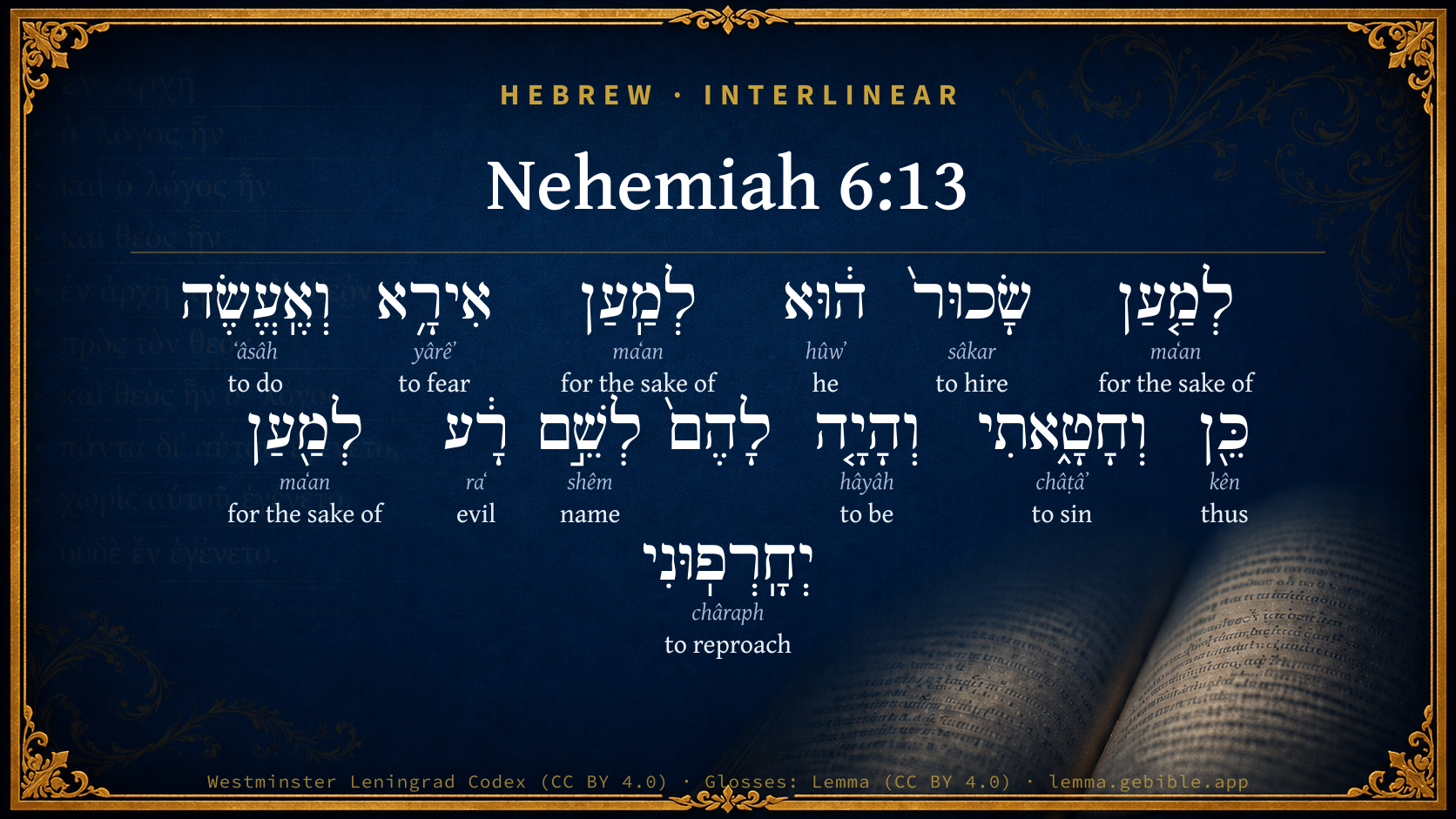
Hebrew (Westminster Leningrad Codex) Nehemiah 6:13 appears in the Hebrew Old Testament. The text above is from the Westminster Leningrad Codex. Each word links to its Strong’s number, a concise gloss, and parsing drawn from the Open Scriptures Hebrew Bible morphology. Click any word for its full Brown-Driver-Briggs (BDB) entry.
Download image
Cite this verse

Nehemiah 6:13 (World English Bible). Public Domain. Lemma interlinear Bible study tool, https://lemma.gebible.app/v/nehemiah/6/13.

Show BibTeX & RIS
BibTeX
RIS
English Translation
For this cause was he hired, that I should be afraid, and do so, and sin, and that they might have matter for an evil report, that they might reproach me.
World English Bible · Public Domain
Download a study sheet

One document with this verse’s original text, its word-by-word gloss line, the meaning frame, cross-references with their text, attributed commentary, and full source and license credits — printable, and it pastes into notes with its structure intact.

This verse Autodidact and up

Study sheet (.html) Plain text (.txt)

A passage Seminary Student

Up to 50 verses in one chapter. A passage sheet keeps up to 6 commentary sources and 12 cross-references per verse, in the order this page ranks them, and says so on the sheet whenever that leaves anything out. Ask for a single verse and you get the Autodidact verse sheet above.

Everything on this page stays free to read, with no account — the sheet is a download of what is already on screen, not access to it.

Want to remove ads? Support Godless Engineer
Compare translations 3

The same verse in 3 English versions, stacked beneath the original-language interlinear above. Click any original word for its lexicon entry.

Each is an independent rendering of the whole verse — the interlinear is not word-aligned to these translations.

Highlighted words mark where these versions differ — a whole-verse word diff, not a word-by-word alignment.

  • World English Bible Public Domain
    For this cause was he hired, that I should be afraid, and do so, and sin, and that they might have matter for an evil report, that they might reproach me.
  • King James Version Public Domain
    Therefore was he hired, that I should be afraid, and do so, and sin, and that they might have matter for an evil report, that they might reproach me.
  • unfoldingWord Literal Text CC BY-SA 4.0
    For this purpose he was hired, so that I would be afraid, and I would do thus and sin. And it might become an evil name to them, so that they could reproach me.

unfoldingWord Literal Text — © unfoldingWord, licensed CC BY-SA 4.0. Word-aligned USFM3 via Door43 (git.door43.org/unfoldingWord/en_ult).

Versions to compare (up to 4)

3 of 4 selected

Show all 18 translations

Every available English version of this verse, each an independent rendering of the whole verse.

  • World English Bible Public Domain
    For this cause was he hired, that I should be afraid, and do so, and sin, and that they might have matter for an evil report, that they might reproach me.
  • Berean Standard Bible Public Domain
    He had been hired to intimidate me so that I would sin by doing as he suggested, so they could give me a bad name in order to discredit me.
  • Majority Standard Bible Public Domain
    He had been hired to intimidate me so that I would sin by doing as he suggested, so they could give me a bad name in order to discredit me.
  • King James Version Public Domain
    Therefore was he hired, that I should be afraid, and do so, and sin, and that they might have matter for an evil report, that they might reproach me.
  • American Standard Version (1901) Public Domain
    For this cause was he hired, that I should be afraid, and do so, and sin, and that they might have matter for an evil report, that they might reproach me.
  • Revised Version (1885) Public Domain
    For this cause was he hired, that I should be afraid, and do so, and sin, and that they might have matter for an evil report, that they might reproach me.
  • Geneva Bible (1599) Public Domain
    Therefore was he hyred, that I might be afrayde, and doe thus, and sinne, and that they might haue an euill report that they might reproche me.
  • Douay-Rheims (1899) Public Domain
    For he had taken money, that I being afraid should do this thing, and sin, and they might have some evil to upbraid me withal.
  • Young's Literal Translation Public Domain
    so that he `is' an hireling, that I may fear and do so, and I had sinned, and it had been to them for an evil name that they may reproach me.
  • Literal Standard Version CC BY-SA 4.0
    so that he [is] a hired worker, that I may fear and do so, and I had sinned, and it had been to them for an evil name that they may reproach me.
  • Unlocked Literal Bible CC BY-SA 4.0
    They hired him to make me afraid, so that I might do what he said and sin, so they could give me a bad name in order to humiliate me.
  • unfoldingWord Literal Text CC BY-SA 4.0
    For this purpose he was hired, so that I would be afraid, and I would do thus and sin. And it might become an evil name to them, so that they could reproach me.
  • Darby Bible Public Domain
    Therefore was he hired, that I should be afraid, and do so, and sin, and that they might have wherewith to spread an evil report, that they might reproach me.
  • World Messianic Bible Public Domain
    He was hired so that I would be afraid, do so, and sin, and that they might have material for an evil report, that they might reproach me.
  • Webster's Bible Public Domain
    Therefore was he hired, that I should be afraid, and do so, and sin, and that they might have matter for an evil report, that they might reproach me.
  • Free Bible Version CC BY-SA 4.0
    They'd hired him thinking I'd be scared into doing something wrong. Then they'd be able to point the finger and ruin my reputation.
  • Bible in Basic English Public Domain
    For this reason they had given him money, in order that I might be overcome by fear and do what he said and do wrong, and so they would have reason to say evil about me and put shame on me.
  • JPS Tanakh (1917) Public Domain
    For this cause was he hired, that I should be afraid, and do so, and sin, and that they might have matter for an evil report, that they might taunt me.

Literal Standard Version (2020), Covenant Press — licensed CC BY-SA 4.0. Text via the HelloAO Bible API (eBible.org). Unlocked Literal Bible (unfoldingWord) — licensed CC BY-SA 4.0. Text via the HelloAO Bible API (eBible.org). unfoldingWord Literal Text — © unfoldingWord, licensed CC BY-SA 4.0. Word-aligned USFM3 via Door43 (git.door43.org/unfoldingWord/en_ult). Free Bible Version, Dr. Jonathan Gallagher — licensed CC BY-SA 4.0. Text via the HelloAO Bible API (eBible.org).

Word by word

More ways to search: Search by grammar → Find every occurrence → Compare this word →

Practice this passage: Drill this verse → Learn its vocabulary →

שָׂכוּר֙
sâkar
H7936
“hired”
Verb, Qal, Participle Passive, Masculine, Singular, Absolute
Part of Speech
Verb
Stem
Qal
Form
Participle Passive
Gender
Masculine
Number
Singular
State
Absolute
Full BDB Definition

Origin: a primitive root [apparently akin (by prosthesis) to H3739 through the idea of temporary purchase]

TWOT: 2264 . 1

to hire - (Qal) to hire - (Niphal) to hire oneself out - (Hithpael) to earn wages
  1. לְמַ֤עַן maʻan H4616 “for the sake of” Preposition
  2. ה֔וּא hûwʼ H1931 “he” Pronoun, Personal, 3rd Person, Masculine, Singular
  3. לְמַֽעַן maʻan H4616 “for the sake of” Preposition
  4. אִירָ֥א yârêʼ H3372 “to fear” Verb, Qal, Imperfect, 1st Person, Common, Singular
  5. וְאֶֽעֱשֶׂה ʻâsâh H6213 “and · to do” Conjunction + Verb, Qal, Imperfect, 1st Person, Common, Singular
  6. כֵּ֖ן kên H3651 “thus” Particle, Demonstrative
  7. וְחָטָ֑אתִי châṭâʼ H2398 “and · to sin” Conjunction + Verb, Qal, Sequential Perfect, 1st Person, Common, Singular
  8. וְהָיָ֤ה hâyâh H1961 “and · to be” Conjunction + Verb, Qal, Sequential Perfect, 3rd Person, Masculine, Singular
  9. לְשֵׁ֣ם shêm H8034 “to/for · name” Preposition + Noun, Common, Masculine, Singular, Absolute
  10. רָ֔ע raʻ H7451 “evil” Adjective, Adjective, Masculine, Singular, Absolute
  11. לְמַ֖עַן maʻan H4616 “for the sake of” Preposition
  12. יְחָֽרְפֽוּנִי châraph H2778 “to reproach · me” Verb, Piel, Imperfect, 3rd Person, Masculine, Plural + Suffix, Personal, 1st Person, Common, Singular

About this verse

These counts appear in no published source. They are computed here, from the morphology-tagged text and Lemma’s own curated glosses. What Lemma adds →

14
words
11
distinct lemmas
Historical
section

Notable vocabulary

The rarest word here is שָׂכוּר֙ to hire H7936 — appearing just 21 times in the whole Hebrew Bible.

Shared distinctive vocabulary

שָׂכוּר֙ to hire H7936 occurs in 18 verses of the Hebrew Bible. Also found in:

Grammatical profile

  • 6 verbs
  • 1 noun
  • 1 adjective
  • 1 pronoun
  • 4 prepositions
  • 1 particle

Verb forms

  • שָׂכוּר֙ Qal · Participle Passive
  • אִירָ֥א Qal · Imperfect
  • וְאֶֽעֱשֶׂה Qal · Imperfect
  • וְחָטָ֑אתִי Qal · Sequential Perfect
  • וְהָיָ֤ה Qal · Sequential Perfect
  • יְחָֽרְפֽוּנִי Piel · Imperfect

Repetition

A word recurs within this verse — often emphatic in Hebrew:

  • לְמַ֤עַן for the sake of H4616 ×3

Cross-references

23

Topical passages linked to Nehemiah 6:13 in the Treasury of Scripture Knowledge — connected by theme and wording, ordered by reader-vote popularity; previews shown in the World English Bible.

  • Jeremiah 20:10 For I have heard the defaming of many, terror on every side. Denounce, and we will denounce him, [say] all my familiar friends, those who watch for my fall; peradventure he will be persuaded, and we shall prevail against him, and we shall take our revenge on him.
  • Nehemiah 6:6 in which was written, It is reported among the nations, and Gashmu says it, that you and the Jews think to rebel; for which cause you are building the wall: and you would be their king, according to these words.
  • Proverbs 29:5 A man who flatters his neighbor, Spreads a net for his feet.
  • 2 Corinthians 11:12 But what I do, that I will do, that I may cut off occasion from them that desire an occasion, that in which they boast, they may be found even as we.
  • 2 Timothy 1:7 For God didn't give us a spirit of fear, but of power, love, and self-control.
  • James 4:17 To him therefore who knows to do good, and doesn't do it, to him it is sin.
  • Isaiah 57:11 Of whom have you been afraid and in fear, that you lie, and have not remembered me, nor laid it to your heart? Haven't I held my peace even of long time, and you don't fear me?
  • Jeremiah 18:18 Then said they, Come, and let us devise devices against Jeremiah; for the law shall not perish from the priest, nor counsel from the wise, nor the word from the prophet. Come, and let us strike him with the tongue, and let us not give heed to any of his words.
  • Matthew 10:28 Don't be afraid of those who kill the body, but are not able to kill the soul. Rather, fear him who is able to destroy both soul and body in Gehenna.
  • Matthew 22:15 Then the Pharisees went and took counsel how they might entrap him in his talk.
  • Matthew 26:59 Now the chief priests, the elders, and the whole council sought false testimony against Jesus, that they might put him to death;
  • Acts 6:13 and set up false witnesses who said, "This man never stops speaking blasphemous words against this holy place and the law.
  • 1 Timothy 5:14 I desire therefore that the younger widows marry, bear children, rule the household, and give no occasion to the adversary for reviling.
  • Revelation 21:8 But for the cowardly, unbelieving, sinners, abominable, murderers, sexually immoral, sorcerers, idolaters, and all liars, their part is in the lake that burns with fire and sulfur, which is the second death."
  • Proverbs 22:1 A good name is more desirable than great riches, And loving favor is better than silver and gold.
  • Ecclesiastes 7:1 A good name is better than fine perfume; and the day of death better than the day of one's birth.
  • Isaiah 51:7 Listen to me, you who know righteousness, the people in whose heart is my law; don't you fear the reproach of men, neither be you dismayed at their insults.
  • Isaiah 51:12–13 I, even I, am he who comforts you: who are you, that you are afraid of man who shall die, and of the son of man who shall be made as grass;
  • Jeremiah 1:17 You therefore gird up your loins, and arise, and speak to them all that I command you: don't be dismayed at them, lest I dismay you before them.
  • Ezekiel 2:6 You, son of man, don't be afraid of them, neither be afraid of their words, though briers and thorns are with you, and you do dwell among scorpions: don't be afraid of their words, nor be dismayed at their looks, though they are a rebellious house.
  • Ezekiel 13:17–23 You, son of man, set your face against the daughters of your people, who prophesy out of their own heart; and prophesy you against them,
  • Titus 2:8 and soundness of speech that can't be condemned; that he who opposes you may be ashamed, having no evil thing to say about us.
  • Daniel 6:4–5 Then the presidents and the satraps sought to find occasion against Daniel as touching the kingdom; but they could find no occasion nor fault, because he was faithful, neither was there any error or fault found in him.

Cross-references courtesy of OpenBible.info (CC BY 4.0).

Hebrew and Greek witnesses Masoretic Hebrew ↔ Greek Septuagint

The same verse in the two great witnesses to the Old Testament, shown verse-for-verse.

These are two independent witnesses, not word-aligned to each other, and the Septuagint is shown in lemma (dictionary) form.

Hebrew Nehemiah 6:13 Masoretic · Westminster Leningrad Codex

לְמַ֤עַן שָׂכוּר֙ ה֔וּא לְמַֽעַן אִירָ֥א וְאֶֽעֱשֶׂה כֵּ֖ן וְחָטָ֑אתִי וְהָיָ֤ה לָהֶם֙ לְשֵׁ֣ם רָ֔ע לְמַ֖עַן יְחָֽרְפֽוּנִי

For this cause was he hired, that I should be afraid, and do so, and sin, and that they might have matter for an evil report, that they might reproach me.

World English Bible · Public Domain

Greek LXX Structure differs

The Septuagint has no separate book of Nehemiah. Its Greek text is the second half of Esdras B (2 Esdras), chapters 11–23; Ezra is the first half (1–10).

A verse-for-verse comparison isn’t shown here because the chapters and verses don’t line up. Switch to the LXX edition with the MT / LXX toggle above to read the Greek directly.

On this verse, The Cambridge Bible for Schools and Colleges discusses the Septuagint’s reading. Read the note in Commentary ↓

Hebrew: Westminster Leningrad Codex (CC BY 4.0). Greek: Septuagint (public domain); English from a public-domain English Septuagint. How the Septuagint differs from the Hebrew →

Commentary

Notes on Nehemiah 6:13 from classic Christian and Jewish commentators (each source and its license shown beneath its notes). The classic Christian expositions comment on the surrounding passage and are grouped to its opening verse, so a note may address several verses; the Jewish commentaries on the Tanakh (Rashi and others) are per-verse, so they appear only where the commentator wrote on this verse.

Lemma curates 59 commentaries, every one of them public domain or Creative Commons licensed, each selected and text-cleaned for this edition rather than reprinted as found. About our sources →

Trapp's Complete Commentary

John Trapp

Neh 6:13 Therefore [was] he hired, that I should be afraid, and do so, and sin, and [that] they might have [matter] for an evil report, that they might reproach me.

Ver. 13. Therefore was he hired, that I should be afraid] But they were much mistaken in their aims: this matter was not malleable. Nehemiah was a man of another spirit, of a Caleb-like spirit; he was fide armatus, Deo armatus, soldier by faith and for God, and therefore undaunted; he was full of spiritual mettle, for he knew whom he had trusted.

And do so, and sin] Nehemiah feared nothing but sin, and the fruit thereof, shame and reproach, so great was his spirit, so right set were both his judgment and affections. But if anything would have drawn him aside from the straight ways of the Lord, base fear was the likeliest; as we see in David at Gath, and Peter in the high priest’s hall. See Zep 3:13, {See Trapp on "Zep 3:13"} Pessimus in dubiis augur Timor.

And that they might have matter for an evil report] This wicked men watch for, as a dog doth for a bone; and if they get but the least hint, oh how happy do they hold themselves! what wide mouths do they open! &c. It is our part, therefore (by a Nehemiah-like conversation), to put to silence the ignorance of foolish men, who, like blackamoors, despise beauty; like dogs, bark at the shining of the moon. Of Luther it was said by Erasmus, Nec hostes reperiant quod calumnientur. Of Bishop Hooper it is said, that his life was so good that no kind of slander (although divers went about to reprove it) could fasten any fault upon him (Act. and Mon. 1366). The like is reported of Bradford and Bucer. We should so carry ourselves, ut nemo de nobis maleloqui absque mendacio possit, as Jerome hath it, that none might speak evil of us without a manifest lie.

John Trapp, A Commentary or Exposition upon All the Books of the Old and New Testament (1647–1656) — public domain. Text from a community e-Sword module.

The Biblical Illustrator

Joseph S. Exell

Neh_6:13

Therefore was he hired.

Bribery

I. Its existence and varieties.

1. In statecraft.

2. In trade.

3. In morals and religion.

II. Its effects.

1. Personal degradation.

2. General disorganisation.

3. Hindrance of all good.

III. Its cure.

1. Self-denial.

2. Resolute unmercifulness to the briber.

3. Trust in God and faith in right. (Homiletic Commentary.)

The Biblical Illustrator, edited by Joseph S. Exell (c. 1880s–1900s) — public domain. Text from a community e-Sword module.

Joseph Benson's Commentary

Neh 6:13. That I should be afraid, and do so, and sin — By going into a place forbidden to me, and that in such a manner, which would have been both sinful and shameful. That they might reproach me — As a coward, and conscious of my own guilt, that they might make me contemptible and odious, both to my own people and to the king of Persia.

Joseph Benson's Commentary on the Old and New Testaments (1811–1818) — public domain. Text from a community e-Sword module.

Ellicott's Commentary for English Readers

(13) An evil report.—Nehemiah perceived that not God, but Shemaiah himself, had uttered the prophecy “against me,” and that he was hired to bring the governor into discredit as a violator of law.

A Bible Commentary for English Readers, edited by Charles John Ellicott (1878–1897) — public domain. Text from a community e-Sword module.

The Cambridge Bible for Schools and Colleges

gen. ed. J. J. S. Perowne

13. Therefore] R.V. For this cause.

and sin] i.e. by transgressing ‘the law,’ by violating the sanctity of the House of God.

matter for an evil report] Literally, ‘and that it might be to them for an evil name.’ The Vulgate gives the sense generally ‘et haberent malum quod exprobrarent mihi.’ The LXX. goes wrong, καὶ γένωμαι αὐτοῖς εἰς ὄνομα πονηρόν. The phrase ‘an evil name’ occurs also in Deu_22:14; Deu_22:19 in the sense ‘an evil report.’

Nehemiah would incur ‘an evil name’ with the priestly class and the strict Jews for consulting his personal safety rather than the sanctity of the law. Such conduct would weaken his hold upon the best people of the nation. Cf. Psa_38:16, ‘For I said, Lest they rejoice over me: when my foot slippeth, they magnify themselves against me.’

The Cambridge Bible for Schools and Colleges (gen. ed. J. J. S. Perowne; Cambridge University Press, 1878–1918) — public domain. Text from a community e-Sword module.

John Gill's Exposition

Therefore was he hired, that I should be afraid, and do so,

and sin,.... By distrusting the power and providence of God to protect him, and by going into such a part of the temple, which he, being no priest, had no right to go into:

and that they might have matter for an evil report, that they might reproach me; as a rebel and traitor against the king, which had been reported of him, and which would be strengthened by such a step.

John Gill's Exposition of the Whole Bible (1746–1763) — public domain (CC PDM 1.0). Text via the HelloAO Bible API.

Haydock's Catholic Bible Commentary

Sin, by taking any false step, so as to offend the people.

George Leo Haydock (1774–1849), Haydock's Catholic Family Bible and Commentary, 1859 edition — public domain. Excludes Psalms (Douay-Rheims chapter numbering differs from Protestant) and Deuterocanonical books (Catholic canon only).

Matthew Poole's English Annotations

That I should do so, and sin, by going into a place forbidden to me, and that in such a time and manner, and upon such an occasion; which would have been both sinful and shameful: See Poole "Neh 6:11".

That they might reproach me as a coward, and conscious of my own guilt, that so they might make me contemptible and odious, both to my own people, and to the king of Persia.

Matthew Poole's English Annotations on the Holy Bible (1683–1685) — public domain. Text from a community e-Sword/MySword module.

The Pulpit Commentary

Therefore was he hired, etc. Their motive for bribing him was, that I might be induced by-fear to do as Shemaiah suggested, and so to commit sin; whereby they would have a just ground for spreading an evil report concerning me, and making my misconduct a constant reproach to me. Nehemiah"s influence depended greatly on the weight of his moral character. One false step, and he would have been lost; his influence would have been gone; and the work on which his heart was set would have come to nought.

The Pulpit Commentary (1880–1919), ed. H.D.M. Spence-Jones & Joseph S. Exell — public domain. Text from a community e-Sword module.

John Wesley's Explanatory Notes

And sin - By going into a place forbidden to me, and that in such a manner, which would have been both sinful and shameful. Reproach - As a coward, and conscious of my own guilt, that they might make me contemptible and odious both to my own people, and to the king of Persia.

John Wesley, Explanatory Notes Upon the Whole Bible (1754–1765) — public domain. Text via the GEBible commentary corpus.

Rashi

Rabbi Shlomo Yitzchaki (Rashi)

Because he was hired he told me these things.

in order that I fear in order that I fear them, to do this to enter the Temple and sin.

so that they should have this for a scandal in order that they should have this as a scandal to reproach me with this sin.

Rashi on the Tanakh — English translations: “The Judaica Press complete Tanach with Rashi, translated by A. J. Rosenberg” (CC BY 4.0); “Pentateuch with Rashi's commentary by M. Rosenbaum and A.M. Silbermann, 1929-1934” (public domain); “The Metsudah Tanach series, Lakewood, N.J” (CC BY 4.0); and “The Book of Joshua, Metsudah Publications, 1997” (CC BY 4.0). Text via Sefaria.

Lesson kit

Teaching starters — assembled from the data on this page, not authored interpretation. Every prompt links to the verse data it draws on. Edit before teaching.

Nehemiah, in the Historical, opens this verse with 14 words (11 distinct Hebrew lemmas). Its most distinctive word is sâkar (“to hire”). A historical commentator’s framing appears above. Read the whole chapter for the surrounding context.

Discussion questions

  1. How does “to hire” (sâkar) shape what this verse is saying?
  2. How does Genesis 30:16, which shares the word «to hire», read alongside this verse?
  3. What does the repetition of “for the sake of” (3× in this one verse) do in this verse?
  4. These translations render this verse differently; the difference is in the English rendering, not the original. What questions does that raise?
  5. «שָׂכוּר֙» is a Qal Participle Passive verb. How does that grammatical form shape the action described?
  6. Compare how Trapp's Complete Commentary and The Biblical Illustrator read this verse. Where do they agree or differ?

Things to notice

  • These translations choose different wording for 12 words in this verse.
  • “for the sake of” occurs 3× in this single verse.
  • 11 distinct Hebrew lemmas span 14 words in this verse.

Reading settings

Reading text

Shown beneath each verse's original-language words.

Old Testament
Old Testament edition

Read the OT as the Masoretic Hebrew (MT) or the Greek Septuagint (LXX).

English shown for the Greek Septuagint (in the Hebrew ↔ Greek comparison).

Comparing translations? Open the Compare panel on any verse page to stack up to four side by side.