
Exodus 12:6

Hebrew (Westminster Leningrad Codex) Exodus 12:6 appears in the Hebrew Old Testament. The text above is from the Westminster Leningrad Codex. Each word links to its Strong’s number, a concise gloss, and parsing drawn from the Open Scriptures Hebrew Bible morphology. Click any word for its full Brown-Driver-Briggs (BDB) entry.
Download image
Cite this verse

Exodus 12:6 (World English Bible). Public Domain. Lemma interlinear Bible study tool, https://lemma.gebible.app/v/exodus/12/6.

Show BibTeX & RIS
BibTeX
RIS
English Translation
and you shall keep it until the fourteenth day of the same month; and the whole assembly of the congregation of Israel shall kill it at evening.
World English Bible · Public Domain
Download a study sheet

One document with this verse’s original text, its word-by-word gloss line, the meaning frame, cross-references with their text, attributed commentary, and full source and license credits — printable, and it pastes into notes with its structure intact.

This verse Autodidact and up

Study sheet (.html) Plain text (.txt)

A passage Seminary Student

Up to 50 verses in one chapter. A passage sheet keeps up to 6 commentary sources and 12 cross-references per verse, in the order this page ranks them, and says so on the sheet whenever that leaves anything out. Ask for a single verse and you get the Autodidact verse sheet above.

Everything on this page stays free to read, with no account — the sheet is a download of what is already on screen, not access to it.

Want to remove ads? Support Godless Engineer
Compare translations 3

The same verse in 3 English versions, stacked beneath the original-language interlinear above. Click any original word for its lexicon entry.

Each is an independent rendering of the whole verse — the interlinear is not word-aligned to these translations.

Highlighted words mark where these versions differ — a whole-verse word diff, not a word-by-word alignment.

  • World English Bible Public Domain
    and you shall keep it until the fourteenth day of the same month; and the whole assembly of the congregation of Israel shall kill it at evening.
  • King James Version Public Domain
    And ye shall keep it up until the fourteenth day of the same month: and the whole assembly of the congregation of Israel shall kill it in the evening.
  • unfoldingWord Literal Text CC BY-SA 4.0
    And it shall be to you to reserve until the fourteenth day of this month. And all the assembly of the congregation of Israel shall slaughter it between the evenings.

unfoldingWord Literal Text — © unfoldingWord, licensed CC BY-SA 4.0. Word-aligned USFM3 via Door43 (git.door43.org/unfoldingWord/en_ult).

Versions to compare (up to 4)

3 of 4 selected

Show all 18 translations

Every available English version of this verse, each an independent rendering of the whole verse.

  • World English Bible Public Domain
    and you shall keep it until the fourteenth day of the same month; and the whole assembly of the congregation of Israel shall kill it at evening.
  • Berean Standard Bible Public Domain
    You must keep it until the fourteenth day of the month, when the whole assembly of the congregation of Israel will slaughter the animals at twilight.
  • Majority Standard Bible Public Domain
    You must keep it until the fourteenth day of the month, when the whole assembly of the congregation of Israel will slaughter the animals at twilight.
  • King James Version Public Domain
    And ye shall keep it up until the fourteenth day of the same month: and the whole assembly of the congregation of Israel shall kill it in the evening.
  • American Standard Version (1901) Public Domain
    and ye shall keep it until the fourteenth day of the same month; and the whole assembly of the congregation of Israel shall kill it at even.
  • Revised Version (1885) Public Domain
    and ye shall keep it up until the fourteenth day of the same month: and the whole assembly of the congregation of Israel shall kill it at even.
  • Geneva Bible (1599) Public Domain
    And yee shall keepe it vntill the fourteenth day of this moneth: then al the multitude of the Congregation of Israel shall kill it at euen.
  • Douay-Rheims (1899) Public Domain
    And you shall keep it until the fourteenth day of this month: and the whole multitude of the children of Israel shall sacrifice it in the evening.
  • Young's Literal Translation Public Domain
    `And it hath become a charge to you, until the fourteenth day of this month, and the whole assembly of the company of Israel have slaughtered it between the evenings;
  • Literal Standard Version CC BY-SA 4.0
    And it has become a charge to you, until the fourteenth day of this month, and the whole assembly of the congregation of Israel has slaughtered it between the evenings;
  • Unlocked Literal Bible CC BY-SA 4.0
    You must keep it until the fourteenth day of that month. Then the whole assembly of Israel must kill these animals at twilight.
  • unfoldingWord Literal Text CC BY-SA 4.0
    And it shall be to you to reserve until the fourteenth day of this month. And all the assembly of the congregation of Israel shall slaughter it between the evenings.
  • Darby Bible Public Domain
    And ye shall keep it until the fourteenth day of this month; and the whole congregation of the assembly of Israel shall kill it between the two evenings.
  • World Messianic Bible Public Domain
    You shall keep it until the fourteenth day of the same month; and the whole assembly of the congregation of Israel shall kill it at evening.
  • Webster's Bible Public Domain
    And ye shall keep it until the fourteenth day of the same month: and the whole assembly of the congregation of Israel shall kill it in the evening.
  • Free Bible Version CC BY-SA 4.0
    Keep it until the fourteenth day of the month, when all the Israelites will slaughter the animals after sunset and before it gets dark.
  • Bible in Basic English Public Domain
    Keep it till the fourteenth day of the same month, when everyone who is of the children of Israel is to put it to death between sundown and dark.
  • JPS Tanakh (1917) Public Domain
    and ye shall keep it unto the fourteenth day of the same month; and the whole assembly of the congregation of Israel shall kill it at dusk.

Literal Standard Version (2020), Covenant Press — licensed CC BY-SA 4.0. Text via the HelloAO Bible API (eBible.org). Unlocked Literal Bible (unfoldingWord) — licensed CC BY-SA 4.0. Text via the HelloAO Bible API (eBible.org). unfoldingWord Literal Text — © unfoldingWord, licensed CC BY-SA 4.0. Word-aligned USFM3 via Door43 (git.door43.org/unfoldingWord/en_ult). Free Bible Version, Dr. Jonathan Gallagher — licensed CC BY-SA 4.0. Text via the HelloAO Bible API (eBible.org).

Word by word

More ways to search: Search by grammar → Find every occurrence → Compare this word →

Practice this passage: Drill this verse → Learn its vocabulary →

לְמִשְׁמֶ֔רֶת
mishmereth
H4931
“to/for · guard”
Preposition + Noun, Common, Feminine, Singular, Absolute
Part of Speech
Preposition + Noun
Type
Common
Gender
Feminine
Number
Singular
State
Absolute
Full BDB Definition

Origin: from H4929

TWOT: 2414g

guard, charge, function, obligation, service, watch - guard, watch, house of detention or confinement - keeping, preserving - charge, injunction - office, function (ceremonial)
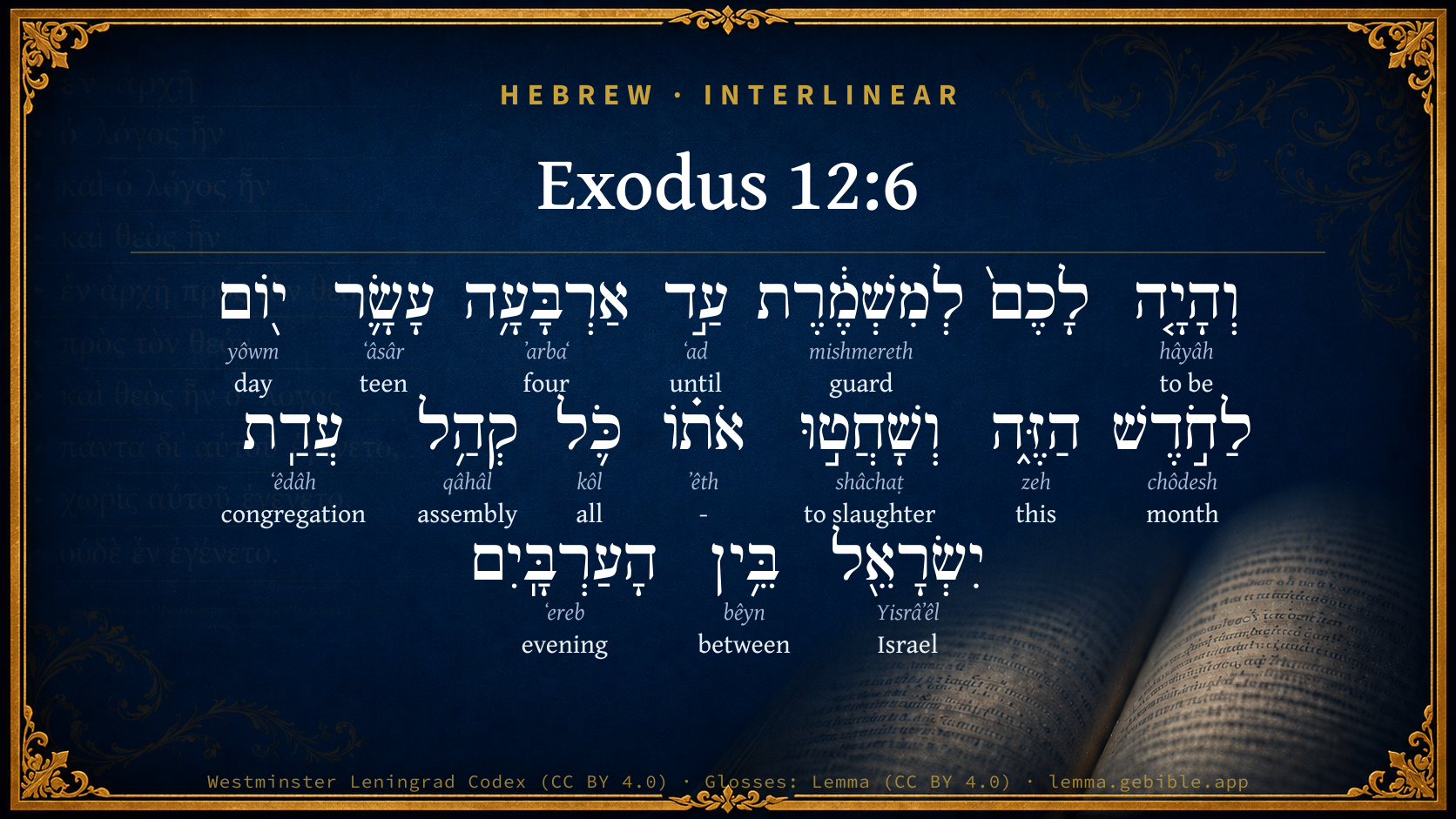
  1. וְהָיָ֤ה hâyâh H1961 “and · to be” Conjunction + Verb, Qal, Sequential Perfect, 3rd Person, Masculine, Singular
  2. עַ֣ד ʻad H5704 “until” Preposition
  3. אַרְבָּעָ֥ה ʼarbaʻ H702 “four” Adjective, Cardinal number, Masculine, Singular, Absolute
  4. עָשָׂ֛ר ʻâsâr H6240 “teen” Adjective, Cardinal number, Masculine, Singular, Absolute
  5. י֖וֹם yôwm H3117 “day” Noun, Common, Masculine, Singular, Absolute
  6. לַחֹ֣דֶשׁ chôdesh H2320 “to/for the · month” Preposition, Determined + Noun, Common, Masculine, Singular, Absolute
  7. הַזֶּ֑ה zeh H2088 “the · this” Particle, Definite Article + Pronoun, Demonstrative, Masculine, Singular
  8. וְשָׁחֲט֣וּ shâchaṭ H7819 “and · to slaughter” Conjunction + Verb, Qal, Sequential Perfect, 3rd Person, Common, Plural
  9. אֹת֗וֹ ʼêth H853 “- · him” Particle, Direct Object + Suffix, Personal, 3rd Person, Masculine, Singular
  10. כֹּ֛ל kôl H3605 “all of” Noun, Common, Masculine, Singular, Construct
  11. קְהַ֥ל qâhâl H6951 “assembly of” Noun, Common, Masculine, Singular, Construct
  12. עֲדַֽת ʻêdâh H5712 “congregation of” Noun, Common, Feminine, Singular, Construct
  13. יִשְׂרָאֵ֖ל Yisrâʼêl H3478 “Israel” Noun, Proper
  14. בֵּ֥ין bêyn H996 “between” Preposition
  15. הָעַרְבָּֽיִם ʻereb H6153 “the · evenings” Particle, Definite Article + Noun, Common, Masculine, Dual, Absolute

About this verse

These counts appear in no published source. They are computed here, from the morphology-tagged text and Lemma’s own curated glosses. What Lemma adds →

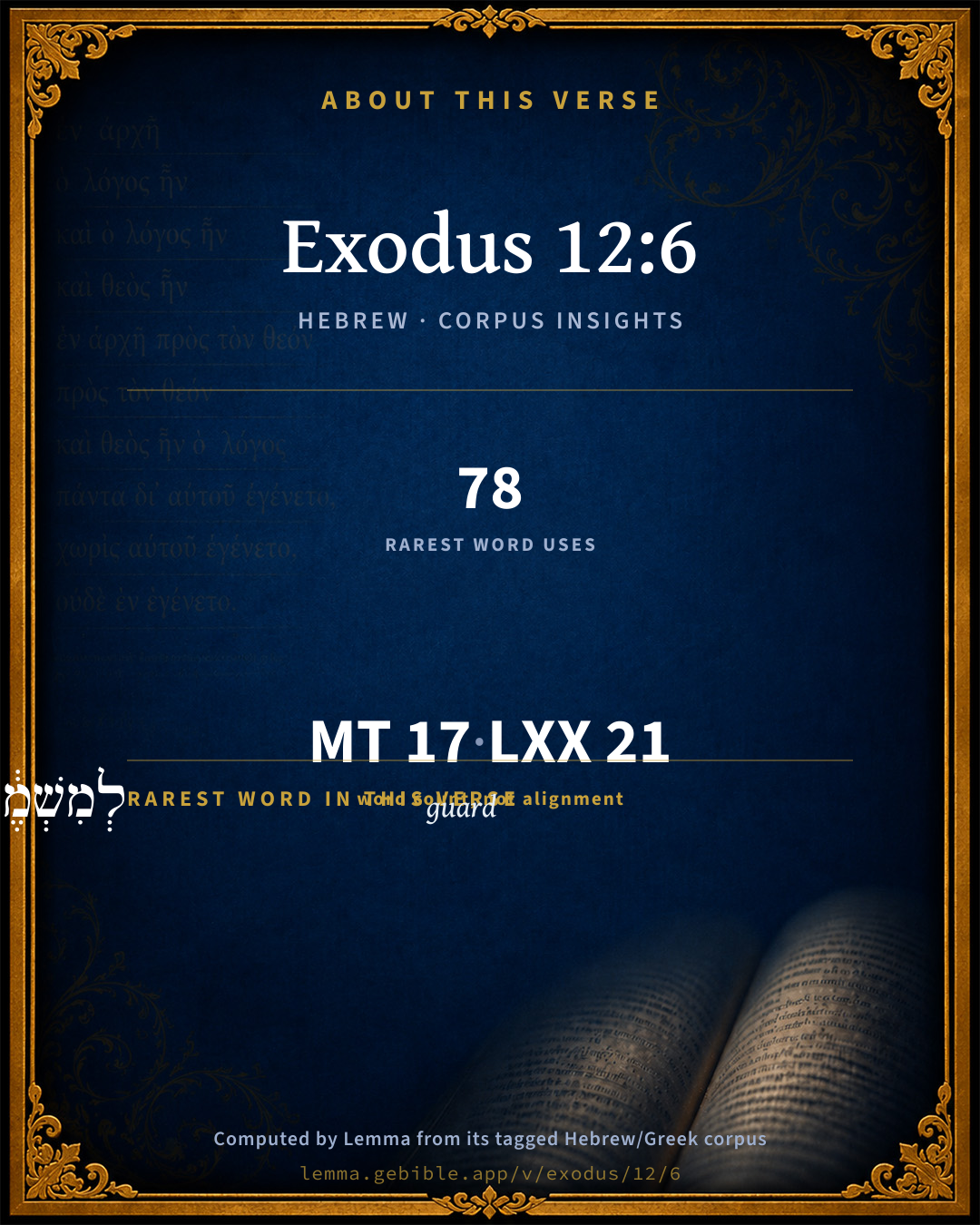
17
words
16
distinct lemmas
Pentateuch
section

Grammatical profile

  • 2 verbs
  • 8 nouns
  • 2 adjectives
  • 1 pronoun
  • 3 prepositions
  • 1 particle

Verb forms

  • וְהָיָ֤ה Qal · Sequential Perfect
  • וְשָׁחֲט֣וּ Qal · Sequential Perfect

Hebrew & Septuagint length

In English translation the verse runs 27 words from the Hebrew and 30 from the Septuagint (LXX English) — closely comparable.

A rough comparison of the two English renderings, which tokenize alike — not a word-level alignment.

Word counts can differ between the Hebrew and the Greek without any difference in meaning — e.g. the Hebrew direct-object marker אֵת has no separate Greek word, and Greek often adds the article ὁ.

In the original languages it is 17 Hebrew tokens and 21 Greek tokens — but the two are counted differently (Hebrew bundles its prefixes and suffixes into one token; the Greek is in lemma form), so that isn’t a like-for-like length.

Cross-references

24

Topical passages linked to Exodus 12:6 in the Treasury of Scripture Knowledge — connected by theme and wording, ordered by reader-vote popularity; previews shown in the World English Bible.

  • Leviticus 23:5 In the first month, on the fourteenth day of the month in the evening, is Yahweh's Passover.
  • Numbers 28:16 In the first month, on the fourteenth day of the month, is Yahweh's Passover.
  • 2 Chronicles 30:15–18 Then they killed the Passover on the fourteenth [day] of the second month: and the priests and the Levites were ashamed, and sanctified themselves, and brought burnt offerings into the house of Yahweh.
  • Exodus 12:18 In the first month, on the fourteenth day of the month at evening, you shall eat unleavened bread, until the twenty first day of the month at evening.
  • Numbers 9:1–3 Yahweh spoke to Moses in the wilderness of Sinai, in the first month of the second year after they had come out of the land of Egypt, saying,
  • Numbers 9:11 In the second month, on the fourteenth day at evening they shall keep it; they shall eat it with unleavened bread and bitter herbs.
  • Exodus 16:12 "I have heard the murmurings of the children of Israel. Speak to them, saying, 'At evening you shall eat meat, and in the morning you shall be filled with bread: and you shall know that I am Yahweh your God.'"
  • Deuteronomy 16:1–6 Observe the month of Abib, and keep the Passover to Yahweh your God; for in the month of Abib Yahweh your God brought you forth out of Egypt by night.
  • Ezekiel 45:21 In the first [month], in the fourteenth day of the month, you shall have the Passover, a feast of seven days; unleavened bread shall be eaten.
  • Acts 4:27 For truly, in this city against your holy servant, Jesus, whom you anointed, both Herod and Pontius Pilate, with the Gentiles and the people of Israel, were gathered together
  • Numbers 28:18 In the first day shall be a holy convocation: you shall do no servile work;
  • Matthew 27:20 Now the chief priests and the elders persuaded the multitudes to ask for Barabbas, and destroy Jesus.
  • Matthew 27:25 All the people answered, "May his blood be on us, and on our children!"
  • Matthew 27:46–50 About the ninth hour Jesus cried with a loud voice, saying, "Eli, Eli, lima sabachthani?" That is, "My God, my God, why have you forsaken me?"
  • Mark 15:1 Immediately in the morning the chief priests, with the elders and scribes, and the whole council, held a consultation, and bound Jesus, and carried him away, and delivered him up to Pilate.
  • Mark 15:8 The multitude, crying aloud, began to ask him to do as he always did for them.
  • Mark 15:11 But the chief priests stirred up the multitude, that he should release Barabbas to them instead.
  • Mark 15:25 It was the third hour, and they crucified him.
  • Mark 15:33–34 When the sixth hour had come, there was darkness over the whole land until the ninth hour.
  • Luke 23:1 The whole company of them rose up and brought him before Pilate.
  • Luke 23:18 But they all cried out together, saying, "Away with this man! Release to us Barabbas!" --
  • Isaiah 53:6 All we like sheep have gone astray; everyone has turned to his own way; and Yahweh has laid on him the iniquity of us all.
  • Acts 2:23 him, being delivered up by the determined counsel and foreknowledge of God, you have taken by the hand of lawless men, crucified and killed;
  • Acts 3:14 But you denied the Holy and Righteous One, and asked for a murderer to be granted to you,

Cross-references courtesy of OpenBible.info (CC BY 4.0).

Hebrew and Greek witnesses Masoretic Hebrew ↔ Greek Septuagint

The same verse in the two great witnesses to the Old Testament, shown verse-for-verse.

These are two independent witnesses, not word-aligned to each other, and the Septuagint is shown in lemma (dictionary) form.

Hebrew Exodus 12:6 Masoretic · Westminster Leningrad Codex

וְהָיָ֤ה לָכֶם֙ לְמִשְׁמֶ֔רֶת עַ֣ד אַרְבָּעָ֥ה עָשָׂ֛ר י֖וֹם לַחֹ֣דֶשׁ הַזֶּ֑ה וְשָׁחֲט֣וּ אֹת֗וֹ כֹּ֛ל קְהַ֥ל עֲדַֽת יִשְׂרָאֵ֖ל בֵּ֥ין הָעַרְבָּֽיִם

and you shall keep it until the fourteenth day of the same month; and the whole assembly of the congregation of Israel shall kill it at evening.

World English Bible · Public Domain

Greek LXX Exodus 12:6 Septuagint · lemma form

καί εἰμί σύ διατηρέω ἕως ὁ οςτεσσαρεσκαιδέκατ ὁ μήν οὗτος καί σφάζω αὐτός πᾶς ὁ πλῆθος συναγωγή υἱός ἰσραήλ πρός ἑσπέρα

And it shall be kept by you till the fourteenth of this month, and all the multitude of the congregation of the children of Israel shall kill it toward evening.

LXX2012 (modern English Septuagint) · Public Domain

Hebrew: Westminster Leningrad Codex (CC BY 4.0). Greek: Septuagint (public domain); English from LXX2012 (modern English Septuagint) (Public Domain). How the Septuagint differs from the Hebrew →

Targum (Aramaic paraphrase)

2

The Targum is the ancient Jewish Aramaic paraphrase of the Hebrew Scriptures — an interpretive translation, not the Hebrew text itself. Onkelos (literal) and Pseudo-Jonathan (expansive) render the Torah, and Jonathan the Prophets. Coverage is partial: where no permissively-licensed English translation exists for a verse, only the Aramaic is shown. This is verse-level text, not a word-by-word alignment to the Hebrew.

  1. Targum Onkelos Torah (Genesis–Deuteronomy)
    וִיהֵי לְכוֹן לְמַטְרָא עַד אַרְבְּעָא עַסְרָא יוֹמָא לְיַרְחָא הָדֵין וְיִכְּסוּן יָתֵהּ כֹּל קְהָלָא כְנִשְׁתָּא דְיִשְׂרָאֵל בֵּין שִׁמְשַּׁיָא:

    (no public-domain English translation for this verse)

    Targum Onkelos — Aramaic: “Onkelos Genesis” (public domain); “Onkelos Exodus” (public domain); “Onkelos Leviticus” (public domain); “Onkelos Numbers” (public domain); “Onkelos Deuteronomy” (public domain). English: “Sefaria Community Translation” (CC0 1.0 (public-domain dedication)); “J.W. Etheridge. The Targums of Onkelos and Jonathan Ben Uzziel on the Pentateuch. London: Longmans, Green, 1862” (public domain). Text via Sefaria.

  2. Targum Pseudo-Jonathan Torah (Genesis–Deuteronomy)
    וִיהֵי לְכוֹן קָטִיר וְנָטִיר עַד אַרְבֵּיסַר יוֹמָא לְיַרְחָא הָדֵין דְּתִנְדְּעוּן דְּלֵיתֵיכוֹן מִסְתַּפְיַן מִמִּצְרָאֵי דְחַמְיָין יָתֵיהּ וְיִכְסוֹן יָתֵיהּ כְּהִילְכָתָא כָּל קְהַל כְּנִישְׁתָּא דְיִשְרָאֵל בֵּינֵי שִׁמְשָׁתָא

    And it shall be bound and reserved for you until the fourteenth day of this month, that you may not know the fear of the Mizraee when they see it; and ye shall kill him according to the rite of all to congregation of the assembly of Israel, between the suns.

    Targum Pseudo-Jonathan — Aramaic: “Targum Jonathan on Genesis” (public domain); “Targum Jonathan on Exodus” (public domain); “Targum Jonathan on Leviticus” (public domain); “Targum Jonathan on Numbers” (public domain); “Targum Jonathan on Deuteronomy” (public domain). English: “The Targum of Jonathan ben Uzziel, trans. J. W. Etheridge, London, 1862” (public domain). Text via Sefaria.

Commentary

Notes on Exodus 12:6 from classic Christian and Jewish commentators (each source and its license shown beneath its notes). The classic Christian expositions comment on the surrounding passage and are grouped to its opening verse, so a note may address several verses; the Jewish commentaries on the Tanakh (Rashi and others) are per-verse, so they appear only where the commentator wrote on this verse.

Lemma curates 59 commentaries, every one of them public domain or Creative Commons licensed, each selected and text-cleaned for this edition rather than reprinted as found. About our sources →

Trapp's Complete Commentary

John Trapp

Exo 12:6 And ye shall keep it up until the fourteenth day of the same month: and the whole assembly of the congregation of Israel shall kill it in the evening.

Ver. 6. Until the fourteenth day.] {See Trapp on "Exo 12:3"}

In the evening.] Christ came in the evening of the world; {Heb 1:2} in "the last hour" (εσχατη ωρα, 1Jn 2:11); when all lay buried in darkness; in the eventide of our sin and death.

John Trapp, A Commentary or Exposition upon All the Books of the Old and New Testament (1647–1656) — public domain. Text from a community e-Sword module.

Joseph Benson's Commentary

Exo 12:6. Ye shall keep it up — Keep it apart from the rest of the flock. The whole assembly, shall kill it — That is, any man of the whole assembly might kill it. For slaying the passover was not appropriated to the priests.

Joseph Benson's Commentary on the Old and New Testaments (1811–1818) — public domain. Text from a community e-Sword module.

Tyndale Open Study Notes

Tyndale Open Resources

12:6 the whole assembly of the community: Both the benefits and the responsibility of a relationship with God are realized in community.

Tyndale Open Study Notes — © Tyndale Open Resources, licensed CC BY-SA 4.0. Text via the HelloAO Bible API.

Geneva Bible (1599)

Geneva Bible translators

Everyone his house.

Hebrew, between the two evenings, or twilight.

Geneva Bible (1599) marginal notes — public domain. Text via Bolls.life.

Jamieson, Fausset & Brown

Robert Jamieson, A. R. Fausset & David Brown

keep it up until the fourteenth day, &c.--Being selected from the rest of the flock, it was to be separated four days before sacrifice; and for the same length of time was Christ under examination and His spotless innocence declared before the world.

kill it in the evening--that is, the interval between the sun's beginning to decline, and sunset, corresponding to our three o'clock in the afternoon.

Jamieson, Fausset & Brown — Commentary Critical and Explanatory on the Whole Bible (1871) — public domain (CC PDM 1.0). Text via the HelloAO Bible API.

Adam Clarke's Commentary

Verse 6. Ye shall keep it up until the fourteenth day] The lamb or kid was to be taken from the flock on the tenth day, and kept up and fed by itself till the fourteenth day, when it was to be sacrificed. This was never commanded nor practised afterwards. The rabbins mark four things that were required in the first passover that were never required afterwards:

1. The eating of the lamb in their houses dispersed through Goshen.

2. The taking the lamb on the tenth day.

3. The striking of its blood on the door posts and lintels of their houses. And,

4. Their eating it in haste. These things were not required of the succeeding generations.

The whole assembly - shall kill it] Any person might kill it, the sacrificial act in this case not being confined to the priests.

In the evening] בין הערבים beyn haarbayim, "between the two evenings." The Jews divided the day into morning and evening: till the sun passed the meridian all was morning or fore-noon; after that, all was afternoon or evening. Their first evening began just after twelve o'clock, and continued till sunset; their second evening began at sunset and continued till night, i.e., during the whole time of twilight; between twelve o'clock, therefore, and the termination of twilight, the passover was to be offered.

"The day among the Jews had twelve hours, Joh 11:9. Their first hour was about six o'clock in the morning with us. Their sixth hour was our noon. Their ninth hour answered to our three o'clock in the afternoon. By this we may understand that the time in which Christ was crucified began at the third hour, that is, at nine o'clock in the morning, the ordinary time for the daily morning sacrifice, and ended at the ninth hour, that is, three o'clock in the afternoon, the time of the evening sacrifice, Mr 15:25; Mr 15:33; Mr 15:34-37. Wherefore their ninth hour was their hour of prayer, when they used to go into the temple at the daily evening sacrifice, Ac 3:1; and this was the ordinary time for the passover. It is worthy of remark that God sets no particular hour for the killing of the passover: any time between the two evenings, i.e., between twelve o'clock in the day and the termination of twilight, was lawful. The daily sacrifice (see Ex 29:38-39) was killed at half past the eighth hour, that is, half an hour BEFORE three in the afternoon; and it was offered up at half past the ninth hour, that is, half an hour AFTER three. In the evening of the passover it was killed at half past the seventh hour, and offered at half past the eighth, that is, half an hour BEFORE three: and if the evening of the passover fell on the evening of the Sabbath, it was killed at half past the SIXTH hour, and offered at half past the SEVENTH, that is, half an hour BEFORE two in the afternoon. The reason of this was, they were first obliged to kill the daily sacrifice, and then to kill and roast the paschal lamb, and also to rest the evening before the passover. Agreeably to this Maimonides says 'the killing of the passover is after mid-day, and if they kill it before it is not lawful; and they do not kill it till after the daily evening sacrifice, and burning of incense: and after they have trimmed the lamps they begin to kill the paschal lambs until the end of the day.' By this time of the day God foreshowed the sufferings of Christ in the evening of times or in the last days, Heb 1:2; 1Pe 1:19-20: and about the same time of the day, when the paschal lamb ordinarily died, HE died also, viz., at the ninth hour; Mt 27:46-50." See Ainsworth.

Adam Clarke's Commentary on the Bible (1810–1826) — public domain. Text from a community e-Sword/MySword module.

Ellicott's Commentary for English Readers

(6) Ye shall keep it up.—Heb., ye shall have it in custody: separate it, i.e., from the flock, and keep it in or near your house for four days. During this time it could be carefully and thoroughly inspected. (Comp. Exo_12:3.)

The whole assembly of the congregation . . . shall kill it.—Every head of a family belonging to the “congregation” was to make the necessary arrangements, to have the victim ready, and to kill it on the fourteenth day, the day of the full moon, at a time described as that “between the two evenings.” There is some doubt as to the meaning of this phrase. According to Onkelos and Aben Ezra, the first evening was at sunset, the second about an hour later, when the twilight ended and the stars came out. With this view agrees the direction in Deu_16:6 :—“Thou shalt sacrifice the passover at even, at the going down of the sun.” It is objected that, according to Josephus (Bell. Jud., vi. 9, § 3), the actual time of the sacrifice was “from the ninth to the eleventh hour”—i.e., from three o’clock to five—and that there would not have been time for the customary ceremonies during the short twilight of Palestine. The ceremonies consisted in the slaughter of the lambs at the tabernacle door, and the conveyance of the blood in basins to the altar, in order that it might be sprinkled upon it. For this operation a period of several hours’ duration would seem to have been necessary: hence the time came gradually to be extended; and when this had been done, a new interpretation of the phrase “between the evenings” grew up. The first evening was explained to begin with the decline of the sun from the zenith, and the second with the sunset; but this can scarcely have been the original idea.

A Bible Commentary for English Readers, edited by Charles John Ellicott (1878–1897) — public domain. Text from a community e-Sword module.

The Cambridge Bible for Schools and Colleges

gen. ed. J. J. S. Perowne

6. ye shall keep it up] Heb. it shall be to you for a keeping: cf. Exo_16:23; Exo_16:32-34, Num_17:10 [Heb. 25], Exo_19:9.

the whole assembly of the congregation of Israel] Cf. for the pleonasm Num_14:5.

between the two evenings] one of P’s technical expressions: of the Passover, as here, Lev_23:5, Num_9:3; Num_9:5; Num_9:11; of the time for offering the evening burnt-offering, Exo_29:39; Exo_29:41, Num_28:4; Num_28:8; of the time for lighting the lamps in the Tabernacle, Exo_30:8; and Exo_16:12†. The meaning is disputed. (1) Onkelos renders בין שמשיא ‘between the two suns,’ which is explained in the Talm. to mean the time between sunset and the stars becoming visible; cf. Ibn Ezra (as cited by Kalisch), ‘We have two evenings; the first, sunset, the second, the ceasing of the light which is reflected in the clouds; and the interval between them is about an hour and 20 minutes’ (so Ges. Keil). The Italian astronomer, Schiaparelli (Astronomy in the O.T., 1905, p. 92 f.), arrives at nearly the same explanation. He supposes that the expression arose out of the custom of watching for the first appearance of the crescent moon to mark the beginning of the new month; and thinks that the ‘first’ evening would be the half-hour between sunset and the average time at which in the latitude of Palestine the crescent moon would appear, and that the ‘second’ evening would be the hour afterwards, from the appearance of the crescent to complete darkness: ‘between the two evenings’ would thus mark the time about half-an-hour after sunset. Cf. Deu_16:6, where the Passover is to be sacrificed ‘at the going down of the sun,’ i.e. at sunset. (2) Saadiah (d. a.d. 942), Rashi and Kimchi understand the ‘first’ evening to be the time when the sun first begins to decline to the west, and the shadows begin to lengthen, and the ‘second’ evening to be the beginning of night. But this interpretation gives a very forced sense to the ‘first’ evening. (3) The traditional explanation, adopted by the Pharisees and the Talmudists (Pesâḥim 61a) was that the ‘first’ evening was when the heat of the sun begins to decrease, about 3 p.m., and that the ‘second’ evening began with sunset. So Josephus (BJ. vi. 9. 3) says that in his day the Passover was sacrificed ‘from the 9th to the 11th hour’ (i.e. from 3 to 5 p.m.). The Mishna (Pesâḥim v. 1) seems to imply that the Passover was usually killed half-an-hour after the 8th hour, i.e. at 2.30 p.m.1[128]: the time however appears to have been variable; for ibid. § 3 it is merely said that if offered ‘before noon,’ it was not valid. (1) is the most natural explanation of the Heb. expression, and has also the support of Deu_16:6 : but (3) is certainly the sense that was traditionally attached to it.

[128] In Exo_29:39; Exo_29:41 ‘between the two evenings’ is also assigned as the time at which the daily burnt-offering was to be offered: when the two collided, the daily burnt-offering was offered an hour earlier (slaughtered, half-an-hour after the 7th hour, and sacrificed half-an-hour after the 8th hour). Pes. v. 1.

The Cambridge Bible for Schools and Colleges (gen. ed. J. J. S. Perowne; Cambridge University Press, 1878–1918) — public domain. Text from a community e-Sword module.

John Gill's Exposition

And ye shall keep it up until the fourteenth day of the same month,.... In their houses; this may denote the preservation of Christ in his infancy, and to the appointed time of his sufferings and death; and it is remarkable, that on this very day, the tenth of Nisan, four days before the passover, and so as many days before his sufferings and death, he made his entry into Jerusalem, near to which he was to be offered up, Joh 12:1,

and the whole assembly of the congregation shall kill it in the evening; that is, of the fourteenth of Nisan; not between the two suns, as the Targum of Jonathan, between the sun setting and the sun rising; nor between the setting of the sun, and the entire disappearance of its rays of light reflecting in the air and clouds after it, as Aben Ezra; so it is said in the Talmud (k), after the sun is set, all the time that the face of the east is red; others say as long as a man can walk half a mile after sun setting; and others, the twinkling of an eye; but "between the two evening's" (l), as it may be rendered; which respects that space of time after the sun begins to decline, and the entire setting of it; when the sun begins to decline, as it does after noon, that is the first evening, and when it is set, that is the second; and the middle space between the one and the other is about the nineth hour of the day, according to the Jewish computation, and, with us, about three o'clock in the afternoon, about which time the passover used to be killed; for they say (m),"the daily sacrifice was slain at eight and a half, and offered at the nineth; but on the evening of the passover it was slain at seven and a half, and offered at eight and a half, whether on a common day, or on a sabbath; and if the evening of the passover happened to be on the evening of the sabbath, it was slain at six and a half, and offered up at seven and a half, and after that the passover;''which was done, that there might be time before the last evening for the slaying of the passover lamb. Josephus (n) says, at the passover they slew the sacrifice from the nineth hour to the eleventh; See Gill on Mat 26:17, and it being at the nineth hour that our Lord was crucified, the agreement between him and the paschal lamb in this circumstance very manifestly appears, Mat 27:46 though it may also in general denote Christ's appearing in the last days, in the end of the world, to put away sin by the sacrifice of himself: the slaying of the paschal lamb is ascribed to the "whole assembly of the congregation", because it was to be slain by their order, and in their name, for their use, and they present; and thus the crucifixion of Christ, his sufferings and death, are attributed to the men of Israel, and all the house of Israel, Act 2:22.

(k) T. Bab. Sabbat, fol. 34. 2. (l) "inter duas vesperas", Pagninus, Montanus, Junius & Tremellius, Piscator, Ainsworth. (m) Misn. Pesach. c. 5. sect. 1. (n) De Bello Jud. l. 6. c. 9. sect. 3.

John Gill's Exposition of the Whole Bible (1746–1763) — public domain (CC PDM 1.0). Text via the HelloAO Bible API.

Albert Barnes' Notes on the Bible

Until the fourteenth day - It should be observed that the offering of our Lord on the self-same day is an important point in determining the typical character of the transaction. A remarkable passage in the Talmud says: “It was a famous and old opinion among the ancient Jews that the day of the new year which was the beginning of the Israelites’ deliverance out of Egypt should in future time be the beginning of the redemption by the Messiah.”

In the evening - The Hebrew has between the two evenings. The meaning of the expression is disputed. The most probable explanation is that it includes the time from afternoon, or early eventide, until sunset. This accords with the ancient custom of the Hebrews, who killed the paschal lamb immediately after the offering of the daily sacrifice, which on the day of the Passover took place a little earlier than usual, between two and three p.m. This would allow about two hours and a half for slaying and preparing all the lambs. It is clear that they would not wait until sunset, at which time the evening meal would take place. The slaying of the lamb thus coincides exactly with the death of our Saviour, at the ninth hour of the day Mat 27:46.

Albert Barnes' Notes on the Bible (1834–1885) — public domain. Text from a community e-Sword/MySword module.

Haydock's Catholic Bible Commentary

Sacrifice, not simply kill, as the Protestants would have it. (Worthington) --- Evening. Hebrew, "between the two evenings," or "suns," according to the Chaldean, alluding to the sun when it declines and when it sets, including about the space of two hours. This time belonged to the evening of the 14th [of Nisan], at which time the lamb was to be sacrificed, though it was to be eaten in the night, which pertained to the 15th. (Menochius) --- The Jews began the day at sun-set, and some began the first evening soon after mid-day. (Matthew xiv. 15, and seq.[following]) (Calmet)

George Leo Haydock (1774–1849), Haydock's Catholic Family Bible and Commentary, 1859 edition — public domain. Excludes Psalms (Douay-Rheims chapter numbering differs from Protestant) and Deuterocanonical books (Catholic canon only).

Matthew Poole's English Annotations

Ye shall keep it up; separate it from the rest of the flock, and keep it in a safe place; the reasons of which, Exo 12:3.

The whole assembly; or rather, every assembly, to wit, every such society as meet together for eating of the lamb. And the assembly is said to kill it, because one person did it in their name, and by their appointment; in which manner, and upon which reason, the whole congregation is said to stone a man, Lev 24:14,16; Num 15:35; Deu 22:21. It is probable it was killed by the master of the family, who was a priest in his own family, &c.

In the evening; Heb. between the evenings, or the two evenings, i.e. between the beginning and end of the evening. The evening is one third part of the day, and one of the appointed and usual times of devotion, as appears from Psa 55:17; Dan 6:10; and it begun at their ninth or our third hour, as may be gathered from Act 3:1; for then the sun began more sensibly to decline, whence that time is fitly called by the Jews the first evening, and that was the time of the evening sacrifice; the second evening was when the sun was setting or set. Between these it was to be killed. This had a respect both to the time of the world’s age when Christ came, which was its evening, or declining time, or end, Heb 1:2; 9:26; 1Pe 1:20; and the time of the day in which Christ our Passover was killed, Mat 27:46-50; Mar 15:25,33,34.

Matthew Poole's English Annotations on the Holy Bible (1683–1685) — public domain. Text from a community e-Sword/MySword module.

Whedon's Commentary on the Bible

Daniel D. Whedon

6. Until the fourteenth day — For three days, which were, as we suppose, the days of darkness in the land of Egypt, the devoted lamb was kept for the sacrifice — in each family the centre of prayerful and grateful meditations as they talked together of the great morning of deliverance that was about to dawn on them.

The whole assembly — Each family in its own house, that the sacrifice might be simultaneous in all the land.

In the evening — Literally, Between the two evenings; the time which was afterward specified for the evening sacrifice, Num_28:4, and described in Deu_16:6, as the time of the “going down of the sun.” The Rabbies understand that the first of the “two evenings” is when the sun begins to decline and the heat to decrease, or about three o’clock, and that the second is sunset, so that “between the two evenings” would be, at the fourteenth of Abib, between three and six. Kimchi, Rashi, and others, interpret the period of the declining sun as the first evening, and that of twilight as the second; so that the moment of sunset is the point “between the two evenings.” Whichever view be adopted, “about sunset” is the time fixed, allowing some latitude on both sides, as became necessary afterwards when the lambs were offered in the temple.

The Lamb of God was offered at the time of the paschal feast, and at the paschal hour, for “at the ninth hour,” three in the afternoon, he “cried with a loud voice, and gave up the ghost.” Mar_15:34; Mar_15:37.

Daniel D. Whedon (gen. ed.), Commentary on the Old and New Testaments (1874–1909) — public domain. Text from a community e-Sword module.

The Pulpit Commentary

Ye shall keep it up until the fourteenth day. The interval of four days (see ver. 3) was probably intended to give ample time for the thorough inspection of the lamb, and for obtaining another, if any defect was discovered. The precept is not observed by the modern Jews; and the later Targum (which belongs to the sixth century after Christ) teaches that it was only intended to apply to the first institution; but the text of Exodus is wholly against this. The whole assembly of the congregation of Israel shall kill it. One of the main peculiarities of the Paschal sacrifice was this that the head of each family was entitled in the early times wasrequired to offer the sacrifice for himself. In it no one intervened between the individual and God. Thus it was recognised that the whole nation was a nation of priests, as are Christians also, according to St. John (Rev_1:6) and St. Peter. (1Pe_2:5) The intervention of Levites at a late date (2Ch_30:17 2Ch_35:5, etc.) was contrary to the original institution. In the evening. Litterally, "between the two evenings." This phrase has been explained in two ways. Some regard the first evening as commencing when the sun begins visibly to decline from the zenith, i.e. about two or three o"clock; and the second as following the sunset. Others say, that the sunset introduces the first evening, and that the second begins when the twilight ends, which they consider to have been "an hour and twenty minutes later" (Ebn Ezra, quoted by Kalisch). The use of the phrase in Exo_16:12, and the command in Deu_16:6 shalt sacrifice the passover at even, at the going down of the sun," seem to be decisive in favour of the second explanation. The first arose out of the later practice. When the lambs were sacrificed in the temple by a continual succession of offerers, it became impossible to complete the sacrifices in the short time originally allowed. Of necessity the work of killing the victims was commenced pretty early in the afternoon, and continued till after sunset. The interpretation of the direction was then altered, to bring it into accord with the altered practice.

The Pulpit Commentary (1880–1919), ed. H.D.M. Spence-Jones & Joseph S. Exell — public domain. Text from a community e-Sword module.

Rashi

Rabbi Shlomo Yitzchaki (Rashi)

והיה לכם למשמרת AND IT SHALL BE IN YOUR KEEPING (or watching) — This expresses the idea of examining, and the text therefore implies that it requires examination against any blemish during the four days before slaughter (Pesachim 96a). And why did He order that it should be taken from the flock four days before its slaughter, something which He did not command in respect to the paschal-lamb that was offered by succeeding generations? Rabbi Mathia, the son of Cheresh, said, in answer: Behold, it (Scripture) says, (Ezekiel 16:8) “And I passed over thee (an allusion to God’s passing over the Israelites in Egypt) and looked upon thee, and behold, thy time was the time of love” — there had arrived the time to fulfil the oath which I had sworn to Abraham to redeem his children. They, however, possessed no divine commands in which to engage in order that they should merit to be redeemed — as it is said (Ezekiel 16:7) “thou wast naked and bare” (i. e. bare of all merit earned through the fulfilment of God’s commands). He therefore gave them two commands, relating respectively to the blood of the paschal-lamb and the blood of the circumcision — for that night they circumcised themselves, as it is said (Ezekiel 16:6) “[When I passed over thee] I saw thee wallowing in thy bloods (בְּדָמַיִךְ is plural)” i. e. in two kinds of blood. Further it states, (Zechariah 9:11) “As for thee, also, because of the blood of the covenant I released thy prisoners out of the pit wherin there is no water”. And yet another reply to this question is, that because they were sunk in idolatry and had no merit gained by the practice of a divine command, He said unto them, (v. 21) משכו “Draw” — withdraw your hands from idols; וקחו לכם צאן “and take unto yourselves a lamb” to fulfil a divine command (Mekhilta).

ושחטו אתו וגו׳ AND THEY SHALL SLAUGHTER IT etc. — But did they all slaughter it (one alone did this on behalf of the company formed to eat that particular lamb; cf. Chullin 29b)? But we derive from this statement the legal principle that a man’s agent is as himself (this is derived from the fact that although one alone slaughtered the lamb on behalf of many, Scripture still states: they shall slaughter it) (Mekhilta; Kiddushin 41b).

קהל עדת ישראל it speaks here of קהל assembly, עדה congregation, ישראל Israel, whilst one of these terms alone would have sufficed; hence they (the Rabbis) said: the paschal-lambs of the congregation (a term used in contrast to that which was sacrificed by an individual on the 14th of the second month; cf. Numbers 9:9—14) are to be slaughtered in three groups, one after the other — the first group entered and the doors of the court were closed, etc. as is to be found in the Talmud, Treatise Pesachim (64a).

בין הערבים AT EVENTIDE — The period beginning at six hours (reckoning from six o’clock in the morning) and hence forward is called בין הערבים (Mekhilta), because the sun then inclines in the direction of the place of its setting to become darkened. The expression בין הערבים appears to me to denote those hours which are between the darkening of the day and the darkening of the night. The darkening of the day is at the beginning of the seventh hour in the day, from when the shadows of evening decline; and the darkening of the night is at the commencement of the night (this period is therefore from noon until the beginning of night). The word ערב is an expression for gloom and darkness, as in (Isaiah 24:11). “All joy is darkened".

Rashi on the Tanakh — English translations: “The Judaica Press complete Tanach with Rashi, translated by A. J. Rosenberg” (CC BY 4.0); “Pentateuch with Rashi's commentary by M. Rosenbaum and A.M. Silbermann, 1929-1934” (public domain); “The Metsudah Tanach series, Lakewood, N.J” (CC BY 4.0); and “The Book of Joshua, Metsudah Publications, 1997” (CC BY 4.0). Text via Sefaria.

Ramban (Nachmanides)

Rabbi Moshe ben Nachman (Ramban / Nachmanides)

BEIN HA’ARBAYIM’ (AT EVENTIDE). “The period beginning at the sixth hour and onward, [counted from the beginning of the day, which in Torah-law is always divided into twelve hours], is called bein ha’arbayim (at eventide), because the sun inclines in the direction of its setting there to become darkened. It appears to me that the expression bein ha’arbayim denotes those hours which are between the beginning of the darkening of the day and the final darkening at night. The darkening of the day is at the beginning of the seventh hour of the day, from the time the shadows of the evening are stretched out, and the darkening of the night is at the beginning of the night. The word erev (night) is an expression of gloom and darkness, just as in the verse, All joy is ‘arbah’ (darkened).” Thus the language of Rashi.Rabbi Abraham ibn Ezra refuted [this explanation of Rashi] by pointing to the verse which says, And when Aaron lighteth the lamps ‘bein ha’arbayim’ [‘There is no doubt that he lights the lamps at sundown”], as it is written there, Aaron and his sons shall set it in order from evening to morning., 27:21. [Thus it proves that bein ha’arbayim does not begin with the seventh hour of the day as Rashi would have it, but at sundown near night.] Besides, the verse regarding the paschal offering itself states: There thou shalt sacrifice the Passover-offering at even, at the going down of the sun, at the time thou camest forth out of Egypt, and “the going down of the sun” occurs at sunset. [How then could Rashi explain bein ha’arbayim mentioned here as commencing at the seventh hour of the day?]But this is no refutation of the Rabbi’s [Rashi’s] explanation. Our Rabbis have already said that the meaning of the verse is as follows: “At even, you slaughter [the Passover-offering]; at the going down of the sun, you eat it; at the time thou camest forth out of Egypt, [i.e., in the morning of the fifteenth day of Nisan, it becomes nothar] on a Festival day. and you burn it.” The Rabbi [Rashi] has already so commented [in his commentary to Deuteronomy 16:6].The correct interpretation on this matter appears to me to be that the night is called erev, as it is said, ‘ba’erev’ ye shall eat unleavened bread, and this is at night, as it clearly states, And they shall eat the flesh in that night, roast with fire, and unleavened bread., Verse 8. Similarly, And there was ‘erev’ and there was morning, means the beginning of night when the stars do come forth. The same applies to the verse, In the twilight, ‘ba’erev’ of the day, in the blackness of night and the darkness, [where the word ba’erev, coming after “the twilight,” must signify the night]. Now the end of the day is also called erev, as the verses indicate: And the two angels came to Sodom ‘ba’erev,’ and Lot sat in the gate of Sodom; must mean at the end of the day. And it came to pass ‘ba’erev’ that the quails came up, and the quails did not come at night., Verse 12: At eventide ye shall eat flesh. This clearly indicates that the quails came before the night. The word ba’erev in the verse, And it came to pass ‘ba’erev’ that the quails came up, must therefore mean at the end of the day. There are many other such cases.It is further written: ‘Erev,’ and morning, and at noonday, I will sigh and moan. Now these three periods include the whole day [of twenty-four hours. Therefore, if we interpret erev as meaning actual night, the hours from noonday to night will be missing here. We must] thus conclude that [the period] immediately after noonday is called erev, [which lasts from the latter part of the day till morning. Thus the verse encompasses the whole day of twenty-four hours].Morning is so called from sunrise and thence onward as long as the sun remains in the east. This period lasts four hours, just as the Rabbis testified that the morning Daily Whole-offering [for the entire congregation of Israel] may be offered in the [first] four hours of the day [but not later].After morning, the time is called tzohorayim (noonday), just as it is said, from morning until ‘tzohorayim’ (noon). It consists of two hours: the fifth and the sixth hours of the day. The word tzohorayim is of the root ‘tzohar’ (A light) shalt thou make to the ark, and implies brightness. It is written in the plural [tzohorayim] because it is the two [brightest parts of the day] which, so to speak, make two tzohorayim. It may be that it is written in the plural because light is then disseminated on all sides. In the morning the light is centered in the east, and towards evening it is in the west, but in the middle of the day when it is high in the sky, it gives light on all sides.When tzohorayim (noonday) passes and the sun departs from shining upon two sides, the time of the day is called arbayim — [from the root erev (darkness)] - because the sun has darkened from [its state of shining on] those two sides. This period [of arbayim] lasts as long as the sun shines in the sky [and is permissible for the slaughtering of the Passover-offering]. But beginning with sundown, which is about an hour and a quarter [before the day terminates with the coming out of the stars], it is no longer the time for the slaughtering thereof according to the opinion of our Rabbis,. I might understand this to mean at the evening twilight. Scripture therefore says, etc.” for that period of time is no longer arbayim but rather erev yom (the evening of the day). (in the evening of the day) (Proverbs 7:9).The reason it is called bein ha’arbayim [in the Torah, and not just arbayim], is not that the word bein signifies here “between,” [as Rashi above explained that the expression bein ha’arbayim denotes that time-period which is “between” the beginning of those hours, etc.], but it is something like “in their midst,” similar to these verses: Let there now be an oath ‘beinotheinu beineinu ubeinecha';. But according to Ramban, the meaning thereof would be: “let there be an oath in our midst, even in us and in thee.” A piece of land worth four hundred shekels of silver, what is that ‘beini ubeincha’?;, 23:15. It is generally translated: between me and thee. Ramban understands it: “in the midst of me and you, the value of the land is not worth discussing.” And her stature was exalted ‘al bein’ (among) the thick branches; Take fire ‘mibeinoth’ the wheelwork, 10:6. It is generally translated: “from ‘between’ the wheelwork.” which means from “within their midst”; Take up their fire-pans ‘mibein’ the burning, which means “from the midst thereof,” similar to the expression, She rises also ‘be’od’ night, which means in the midst of the night. And so is the expression bein ha’arbayim, [which signifies “in the midst of that part of the day called arbayim,” as explained above]. It does not state ba’arbayim, for that might have indicated the erev of many days. Thus Scripture is saying that we should slaughter the Passover-offering in the midst of the arbayim, since the time prescribed by the Torah for the slaughtering of the Passover-offering is from after the sixth hour of the day till the commencement of sunset. And Scripture also says, In the first month, on the fourteenth day of the month ‘bein ha’arbayim’ (at eventide) is the Passover of the Eternal, which refers to the time of the slaughtering [of the Passover-offering]. Similarly, the verse, In the fourteenth day of this month ‘bein ha’arbayim’ ye shall observe it, refers to the beginning of the observance, which is the slaughtering, [while the eating of the Passover-offering takes place on the following night]. The verse stating [in connection with the quails], ‘bein ha’arbayim’ ye shall eat flesh, also refers to the hours mentioned, [i.e., from after the sixth hour of the day till the start of sunset], since they had extensive time for the eating of meat. The following verse there which states, And it came to pass ‘ba’erev’ (at even), that the quails came up, Verse 13. is [so stated] because on the first day, the quails came up for one hour within that period called erev. which, as explained above, extends from immediately after tzohorayim until the end of the day — making a period of six hours — the quails came up for a time. See my Hebrew commentary, p. 327, for further discussion of this text. [Therefore it does not say, “and it came to pass bein ha’arbayim that the quails came up,” for that would have signified that the quails came up during the whole stretch of time from after the sixth hour of the day till sundown.]It is possible to explain the expression bein ha’arbayim in accordance with the explanation of Rashi, suggests two kinds of erev, and the word bein signifies “between.” Thus bein ha’arbayim denotes those hours which are between the darkening of the day and the darkening of the night. Thus is the explanation of Rashi. Ramban proceeds to confirm Rashi’s explanation that the word bein means “between,” but adds that the plural form of arbayim denotes two different periods of the day, unlike Rashi who wrote that it is between the darkening of the day and the darkening of the night, as will be explained. i.e., that there are two kinds of erev, an erev of the morning and an erev of the day, for Scripture so calls them: the ‘minchah’ of the morning,. and the ‘minchah’ of the evening, as it is said, And it came to pass in the morning, about the time of making the ‘minchah’, 3:20. and it further says, And I sat appalled until the ‘minchah’ of the evening. And at the evening ‘minchah’ I arose up from my fasting. Now the word minchah is an expression denoting the resting of the sun and the diminution of its great light, just as the Targum rendered [l’ruach hayom] l’manach yoma (where the day comes to rest). [Adam and Eve] heard the voice of the Eternal G-d walking in the garden of Eden ‘l’ruach hayom,’ which Rashi interpreted: “in that direction towards which the sun travels, which is the west.” Onkelos rendered it: l’manach yoma, “in the afternoon,” or literally, “when the day comes to rest.” Thus it is seen that the word minchah denotes rest. And the plural form of arbayim connotes the two afternoons: “the greater afternoon,” [i.e., the time from six and a half hours after the beginning of the day], and “the smaller afternoon,” [i.e., from nine and a half hours after the start of the day until sunset], which the Sages have mentioned. Now during this entire period [of bein ha’arbayim], it is permissible to kindle the lamps of the candelabrum [in the Sanctuary] and to burn the incense, both of which are not permissible to be done at night but only at the time of the Daily Whole-offering of the eventide, and in fact their performance precedes the actual offering of the sacrifice upon the altar.Onkelos’ opinion seems to incline towards this explanation [that the plural form of arbayim denotes two different parts of the day], for he translated bein ha’arbayim as bein shimshaya (between the suns), meaning the times when the sun is in the east and the sun is in the west. The verse stating, Aaron and his sons shall set it in order from evening to morning, means [that it be given its due measure of oil] so that it may burn a whole night [although the actual kindling thereof could be done anytime in the bein ha’arbayim. It does not mean, as Ibn Ezra explained, that this verse teaches that the kindling of the candelabrum took place at sundown].Thus we can explain the verse, There thou shalt sacrifice the Passover-offering ‘ba’erev’ (at even), also means the afternoon, etc. Ramban’s own explanation of this verse is yet to follow. to mean at the above-mentioned time, [i.e., the afternoon], for that is called erev [as explained]. The following expression there, at the going down of the sun, is connected with the following verse, And thou shalt roast and eat it., Verse 7. There are many such cases in Scripture [where an expression in one verse is connected with the following verse]. In my opinion however, the verse, There thou shalt sacrifice the Passover-offering, does not at all refer to the time of the slaughtering thereof, [which took place on the afternoon of the fourteenth day of Nisan]. Rather, the purport thereof is to state that at the place which the Eternal thy G-d chose to establish His name in, there thou shalt observe [the commandment concerning] the Passover-offering at night, at the going down of the sun, which is the time thou camest forth out of Egypt. It is concerning this performance that Scripture says [in the following verse], And thou shalt roast and eat it in the place, Verse 7. mentioned. The sacrifice itself is called zevach, — does not mean “slaughter,” in which case it would necessarily be referring to the afternoon of the fourteenth day of Nisan. Instead, Ramban proceeds to show that the word zevach refers to the sacrifice itself, and the verse therefore refers to the eating thereof which takes place on the following night of the fifteenth day. All this, however, is from the standpoint of the plain meaning of Scripture. Ramban has already noted that the Rabbis in the Talmud (see Note 125), as well as Rashi in his commentary to Deuteronomy 16:6, have explained tizbach as “slaughter.” as Scripture says, Thou shalt not offer the blood of ‘zivchi’ (My sacrifice) upon leaven, which means “My Passover-offering.”This then is the purport of the whole chapter [in Deuteronomy]: Observe the month of Aviv, and observe the Passover unto the Eternal thy G-d; for in the month of Aviv the Eternal thy G-d brought thee forth out of Egypt by night, etc. Thou shalt eat no leavened bread with it. Thus He mentioned the observance of the Passover-offering and the night, [clearly indicating that in those verses, He refers only to the time of the eating of the Passover-offering, which occurs on the night of the fifteenth day, and not to the slaughtering thereof which takes place in the afternoon of the fourteenth day]. Commanding how they are to eat it, He then mentioned that [we must eat no leavened bread] for seven days., Verse 3. But in this entire chapter, there is not a single reference to the fourteenth day of Nisan on which the slaughtering of the Passover-offering takes place. Similarly He said there, Neither shall any of the flesh which thou sacrificest the first day at even, remain all night until the morning, Verse 4. Now the expression, the first day at even, [definitely] means the fifteenth day of Nisan, the first of the seven days mentioned, Verse 3. since the fourteenth day is not mentioned here at all. So also, the verse stating, On the fourteenth day of the month at even, ye shall eat unleavened bread, means the night of the fifteenth day. Thus the intent of the expression, which thou sacrificest the first day at even, Verse 4. is that neither shall any of the flesh of the offering which you are eating on the night of the first day [of the seven-day festival] remain until the morning.

Ramban (Nachmanides) on the Tanakh — English translation: “Commentary on the Torah by Ramban (Nachmanides). Translated and annotated by Charles B. Chavel. New York, Shilo Pub. House, 1971-1976” (CC BY 4.0). Text via Sefaria.

Lesson kit

Teaching starters — assembled from the data on this page, not authored interpretation. Every prompt links to the verse data it draws on. Edit before teaching.

Exodus, in the Pentateuch, opens this verse with 17 words (16 distinct Hebrew lemmas). Its most distinctive word is mishmereth (“guard”). A historical commentator’s framing appears above. Read the whole chapter for the surrounding context.

Discussion questions

  1. What does “guard” (mishmereth) contribute to the verse as a whole?
  2. How does Leviticus 23:5, which shares this passage’s theme, read alongside this verse?
  3. The translations on this page render this verse differently — a whole-verse word diff, not a word-by-word alignment. What might account for the different wordings?
  4. «וְהָיָ֤ה» is a Qal Sequential Perfect verb. How does that grammatical form shape the action described?
  5. Compare how Trapp's Complete Commentary and Joseph Benson's Commentary read this verse. Where do they agree or differ?

Things to notice

Reading settings

Reading text

Shown beneath each verse's original-language words.

Old Testament
Old Testament edition

Read the OT as the Masoretic Hebrew (MT) or the Greek Septuagint (LXX).

English shown for the Greek Septuagint (in the Hebrew ↔ Greek comparison).

Comparing translations? Open the Compare panel on any verse page to stack up to four side by side.