
2 Chronicles 20:14

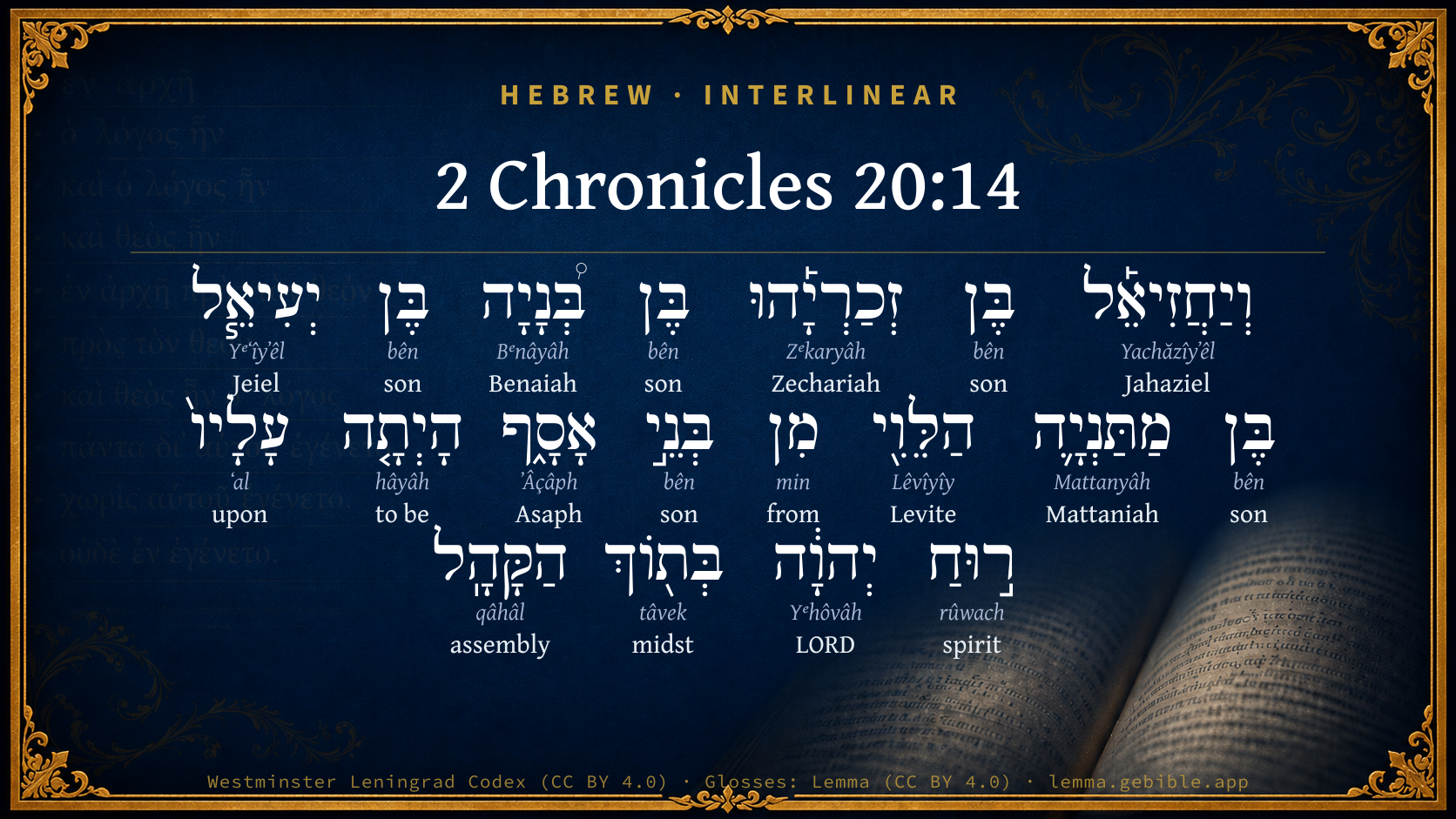
Hebrew (Westminster Leningrad Codex) 2 Chronicles 20:14 appears in the Hebrew Old Testament. The text above is from the Westminster Leningrad Codex. Each word links to its Strong’s number, a concise gloss, and parsing drawn from the Open Scriptures Hebrew Bible morphology. Click any word for its full Brown-Driver-Briggs (BDB) entry.
Download image
Cite this verse

2 Chronicles 20:14 (World English Bible). Public Domain. Lemma interlinear Bible study tool, https://lemma.gebible.app/v/2-chronicles/20/14.

Show BibTeX & RIS
BibTeX
RIS
English Translation
Then on Jahaziel the son of Zechariah, the son of Benaiah, the son of Jeiel, the son of Mattaniah, the Levite, of the sons of Asaph, came the Spirit of Yahweh in the midst of the assembly;
World English Bible · Public Domain
Download a study sheet

One document with this verse’s original text, its word-by-word gloss line, the meaning frame, cross-references with their text, attributed commentary, and full source and license credits — printable, and it pastes into notes with its structure intact.

This verse Autodidact and up

Study sheet (.html) Plain text (.txt)

A passage Seminary Student

Up to 50 verses in one chapter. A passage sheet keeps up to 6 commentary sources and 12 cross-references per verse, in the order this page ranks them, and says so on the sheet whenever that leaves anything out. Ask for a single verse and you get the Autodidact verse sheet above.

Everything on this page stays free to read, with no account — the sheet is a download of what is already on screen, not access to it.

Want to remove ads? Support Godless Engineer
Compare translations 3

The same verse in 3 English versions, stacked beneath the original-language interlinear above. Click any original word for its lexicon entry.

Each is an independent rendering of the whole verse — the interlinear is not word-aligned to these translations.

Highlighted words mark where these versions differ — a whole-verse word diff, not a word-by-word alignment.

  • World English Bible Public Domain
    Then on Jahaziel the son of Zechariah, the son of Benaiah, the son of Jeiel, the son of Mattaniah, the Levite, of the sons of Asaph, came the Spirit of Yahweh in the midst of the assembly;
  • King James Version Public Domain
    Then upon Jahaziel the son of Zechariah, the son of Benaiah, the son of Jeiel, the son of Mattaniah, a Levite of the sons of Asaph, came the Spirit of the LORD in the midst of the congregation;
  • unfoldingWord Literal Text CC BY-SA 4.0
    And Jahaziel, the son of Zechariah, the son of Benaiah, the son of Jeiel, the son of Mattaniah, the Levite from the sons of Asaph, the Spirit of Yahweh was on him in the midst of the assembly.

unfoldingWord Literal Text — © unfoldingWord, licensed CC BY-SA 4.0. Word-aligned USFM3 via Door43 (git.door43.org/unfoldingWord/en_ult).

Versions to compare (up to 4)

3 of 4 selected

Show all 18 translations

Every available English version of this verse, each an independent rendering of the whole verse.

  • World English Bible Public Domain
    Then on Jahaziel the son of Zechariah, the son of Benaiah, the son of Jeiel, the son of Mattaniah, the Levite, of the sons of Asaph, came the Spirit of Yahweh in the midst of the assembly;
  • Berean Standard Bible Public Domain
    Then the Spirit of the LORD came upon Jahaziel son of Zechariah, the son of Benaiah, the son of Jeiel, the son of Mattaniah, a Levite from Asaph’s descendants, as he stood in the midst of the assembly.
  • Majority Standard Bible Public Domain
    Then the Spirit of the LORD came upon Jahaziel son of Zechariah, the son of Benaiah, the son of Jeiel, the son of Mattaniah, a Levite from Asaph’s descendants, as he stood in the midst of the assembly.
  • King James Version Public Domain
    Then upon Jahaziel the son of Zechariah, the son of Benaiah, the son of Jeiel, the son of Mattaniah, a Levite of the sons of Asaph, came the Spirit of the LORD in the midst of the congregation;
  • American Standard Version (1901) Public Domain
    Then upon Jahaziel the son of Zechariah, the son of Benaiah, the son of Jeiel, the son of Mattaniah, the Levite, of the sons of Asaph, came the Spirit of Jehovah in the midst of the assembly;
  • Revised Version (1885) Public Domain
    Then upon Jahaziel the son of Zechariah, the son of Benaiah, the son of Jeiel, the son of Mattaniah, the Levite, of the sons of Asaph, came the spirit of the LORD in the midst of the congregation;
  • Geneva Bible (1599) Public Domain
    And Iahaziel the sonne of Zechariah the sonne of Benaiah, the sonne of Ieiel, the sonne of Mattaniah, a Leuite of the sonnes of Asaph was there, vpon whome came the Spirite of ye Lord, in the middes of the Congregation.
  • Douay-Rheims (1899) Public Domain
    And Jahaziel the son of Zacharias, the son of Banaias, the son of Jehiel, the son of Mathanias, a Levite of the sons of Asaph, was there, upon whom the spirit of the Lord came in the midst of the multitude,
  • Young's Literal Translation Public Domain
    And upon Jahaziel, son of Zechariah, son of Benaiah, son of Jeiel, son of Mattaniah, the Levite, of the sons of Asaph, hath the Spirit of Jehovah been, in the midst of the assembly,
  • Literal Standard Version CC BY-SA 4.0
    And the Spirit of YHWH has been on Jahaziel, son of Zechariah, son of Benaiah, son of Jeiel, son of Mattaniah, the Levite, of the sons of Asaph, in the midst of the assembly,
  • Unlocked Literal Bible CC BY-SA 4.0
    Then in the middle of the assembly, the Spirit of Yahweh came on Jahaziel, son of Zechariah, son of Benaiah, son of Jeiel, son of Mattaniah, the Levite, one of the sons of Asaph.
  • unfoldingWord Literal Text CC BY-SA 4.0
    And Jahaziel, the son of Zechariah, the son of Benaiah, the son of Jeiel, the son of Mattaniah, the Levite from the sons of Asaph, the Spirit of Yahweh was on him in the midst of the assembly.
  • Darby Bible Public Domain
    And upon Jahaziel the son of Zechariah, the son of Benaiah, the son of Jeiel, the son of Mattaniah, a Levite of the sons of Asaph, upon him came the Spirit of Jehovah, in the midst of the congregation;
  • World Messianic Bible Public Domain
    Then the LORD’s Spirit came on Jahaziel the son of Zechariah, the son of Benaiah, the son of Jeiel, the son of Mattaniah, the Levite, of the sons of Asaph, in the middle of the assembly;
  • Webster's Bible Public Domain
    Then upon Jehaziel the son of Zechariah, the son of Benaiah, the son of Jeiel, the son of Mattaniah, a Levite of the sons of Asaph, came the Spirit of the LORD in the midst of the congregation;
  • Free Bible Version CC BY-SA 4.0
    Then the Spirit of the Lord came over Jahaziel while he was standing there in the assembly. He was the son of Zechariah, the son of Benaiah, the son of Jeiel, the son of Mattaniah, a Levite from the descendants of Asaph.
  • Bible in Basic English Public Domain
    Then, before all the meeting, the spirit of the Lord came on Jahaziel, the son of Zechariah, son of Benaiah, son of Jeiel, son of Mattaniah, a Levite and one of the family of Asaph;
  • JPS Tanakh (1917) Public Domain
    Then upon Jahaziel the son of Zechariah, the son of Benaiah, the son of Jeiel, the son of Mattaniah, the Levite, of the sons of Asaph, came the spirit of the LORD in the midst of the congregation;

Literal Standard Version (2020), Covenant Press — licensed CC BY-SA 4.0. Text via the HelloAO Bible API (eBible.org). Unlocked Literal Bible (unfoldingWord) — licensed CC BY-SA 4.0. Text via the HelloAO Bible API (eBible.org). unfoldingWord Literal Text — © unfoldingWord, licensed CC BY-SA 4.0. Word-aligned USFM3 via Door43 (git.door43.org/unfoldingWord/en_ult). Free Bible Version, Dr. Jonathan Gallagher — licensed CC BY-SA 4.0. Text via the HelloAO Bible API (eBible.org).

Word by word

More ways to search: Search by grammar → Find every occurrence → Compare this word →

Practice this passage: Drill this verse → Learn its vocabulary →

וְיַחֲזִיאֵ֡ל
Yachăzîyʼêl
H3166
“and · Jahaziel”
Conjunction + Noun, Proper
Part of Speech
Conjunction + Noun
Type
Proper
Full BDB Definition

Origin: from H2372 and H410

TWOT: None

Jahaziel = "beheld of God" - a Benjamite warrior who joined David at Ziklag - a priest in the reign of David who helped move the ark - a Kohathite Levite, 3rd son of Hebron - a Levite, son of Zechariah, of the sons of Asaph, in the reign of Jehoshaphat - an ancestor of one of the families who returned from exile with Ezra
  1. בֶּן bên H1121 “son of” Noun, Common, Masculine, Singular, Construct
  2. זְכַרְיָ֡הוּ Zᵉkaryâh H2148 “Zechariah” Noun, Proper
  3. בֶּן bên H1121 “son of” Noun, Common, Masculine, Singular, Construct
  4. בְּ֠נָיָה Bᵉnâyâh H1141 “Benaiah” Noun, Proper
  5. בֶּן bên H1121 “son of” Noun, Common, Masculine, Singular, Construct
  6. יְעִיאֵ֧ל Yᵉʻîyʼêl H3273 “Jeiel” Noun, Proper
  7. בֶּן bên H1121 “son of” Noun, Common, Masculine, Singular, Construct
  8. מַתַּנְיָ֛ה Mattanyâh H4983 “Mattaniah” Noun, Proper
  9. הַלֵּוִ֖י Lêvîyîy H3881 “the · Levite” Particle, Definite Article + Noun, Gentilic, Masculine, Singular, Absolute
  10. מִן min H4480 “from” Preposition
  11. בְּנֵ֣י bên H1121 “sons of” Noun, Common, Masculine, Plural, Construct
  12. אָסָ֑ף ʼÂçâph H623 “Asaph” Noun, Proper
  13. הָיְתָ֤ה hâyâh H1961 “to be” Verb, Qal, Perfect, 3rd Person, Feminine, Singular
  14. עָלָיו֙ ʻal H5921 “upon · him” Preposition + Suffix, Personal, 3rd Person, Masculine, Singular
  15. ר֣וּחַ rûwach H7307 “spirit of” Noun, Common, Both, Singular, Construct
  16. יְהוָ֔ה Yᵉhôvâh H3068 “LORD” Noun, Proper
  17. בְּת֖וֹךְ tâvek H8432 “in/at · midst of” Preposition + Noun, Common, Masculine, Singular, Construct
  18. הַקָּהָֽל qâhâl H6951 “the · assembly” Particle, Definite Article + Noun, Common, Masculine, Singular, Absolute

About this verse

These counts appear in no published source. They are computed here, from the morphology-tagged text and Lemma’s own curated glosses. What Lemma adds →

19
words
15
distinct lemmas
Historical
section

Notable vocabulary

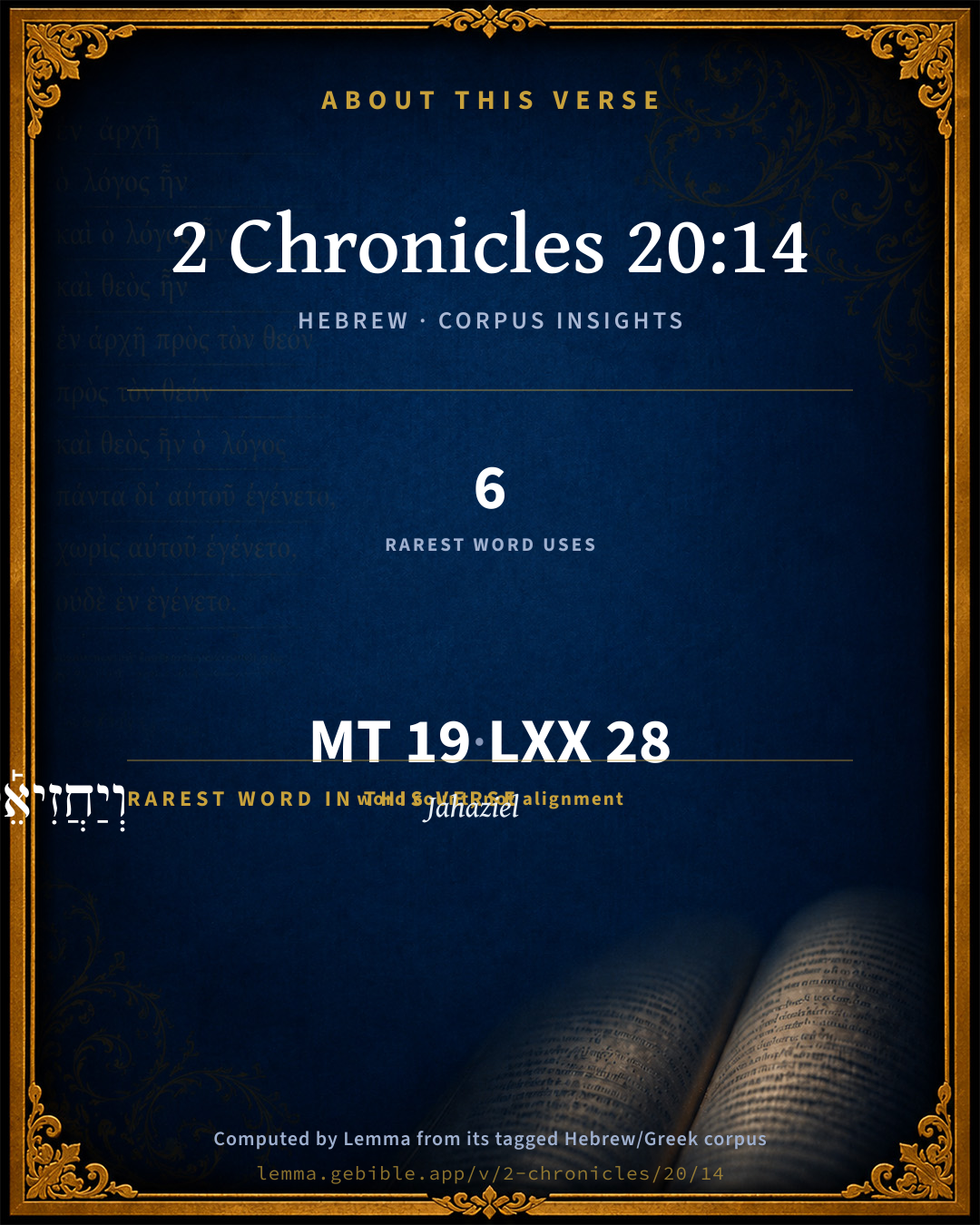
The rarest word here is וְיַחֲזִיאֵ֡ל Jahaziel H3166 — appearing just 6 times in the whole Hebrew Bible.

Shared distinctive vocabulary

וְיַחֲזִיאֵ֡ל Jahaziel H3166 occurs in 6 verses of the Hebrew Bible. Also found in:

Grammatical profile

  • 1 verb
  • 16 nouns
  • 2 prepositions

Verb forms

  • הָיְתָ֤ה Qal · Perfect

Repetition

A word recurs within this verse — often emphatic in Hebrew:

Hebrew & Septuagint length

In English translation the verse runs 37 words from the Hebrew and 38 from the Septuagint (LXX English) — closely comparable.

A rough comparison of the two English renderings, which tokenize alike — not a word-level alignment.

Word counts can differ between the Hebrew and the Greek without any difference in meaning — e.g. the Hebrew direct-object marker אֵת has no separate Greek word, and Greek often adds the article ὁ.

In the original languages it is 19 Hebrew tokens and 28 Greek tokens — but the two are counted differently (Hebrew bundles its prefixes and suffixes into one token; the Greek is in lemma form), so that isn’t a like-for-like length.

Cross-references

9

Topical passages linked to 2 Chronicles 20:14 in the Treasury of Scripture Knowledge — connected by theme and wording, ordered by reader-vote popularity; previews shown in the World English Bible.

  • 2 Chronicles 15:1 The Spirit of God came on Azariah the son of Oded:
  • 2 Chronicles 24:20 The Spirit of God came on Zechariah the son of Jehoiada the priest; and he stood above the people, and said to them, Thus says God, Why disobey you the commandments of Yahweh, so that you can't prosper? because you have forsaken Yahweh, he has also forsaken you.
  • Numbers 11:25–26 Yahweh came down in the cloud, and spoke to him, and took of the Spirit that was on him, and put it on the seventy elders: and it happened that when the Spirit rested on them, they prophesied, but they did so no more.
  • Numbers 24:2 Balaam lifted up his eyes, and he saw Israel dwelling according to their tribes; and the Spirit of God came on him.
  • Isaiah 58:9 Then shall you call, and Yahweh will answer; you shall cry, and he will say, Here I am. If you take away from the midst of you the yoke, the putting forth of the finger, and speaking wickedly;
  • Isaiah 65:24 It shall happen that, before they call, I will answer; and while they are yet speaking, I will hear.
  • Daniel 9:20–21 While I was speaking, and praying, and confessing my sin and the sin of my people Israel, and presenting my supplication before Yahweh my God for the holy mountain of my God;
  • Acts 10:4 He, fastening his eyes on him, and being frightened, said, "What is it, Lord?" He said to him, "Your prayers and your gifts to the needy have gone up for a memorial before God.
  • Acts 10:31 and said, 'Cornelius, your prayer is heard, and your gifts to the needy are remembered in the sight of God.

Cross-references courtesy of OpenBible.info (CC BY 4.0).

Hebrew and Greek witnesses Masoretic Hebrew ↔ Greek Septuagint

The same verse in the two great witnesses to the Old Testament, shown verse-for-verse.

These are two independent witnesses, not word-aligned to each other, and the Septuagint is shown in lemma (dictionary) form.

Hebrew 2 Chronicles 20:14 Masoretic · Westminster Leningrad Codex

וְיַחֲזִיאֵ֡ל בֶּן זְכַרְיָ֡הוּ בֶּן בְּ֠נָיָה בֶּן יְעִיאֵ֧ל בֶּן מַתַּנְיָ֛ה הַלֵּוִ֖י מִן בְּנֵ֣י אָסָ֑ף הָיְתָ֤ה עָלָיו֙ ר֣וּחַ יְהוָ֔ה בְּת֖וֹךְ הַקָּהָֽל

Then on Jahaziel the son of Zechariah, the son of Benaiah, the son of Jeiel, the son of Mattaniah, the Levite, of the sons of Asaph, came the Spirit of Yahweh in the midst of the assembly;

World English Bible · Public Domain

Greek LXX 2 Chronicles 20:14 Septuagint · lemma form

καί ὁ οζιηλ ὁ ὁ ζαχαριας ὁ υἱός βαναιας ὁ υἱός ελεηλ ὁ μανθανιας ὁ λευείτης ἀπό ὁ υἱός ασαφ γίγνομαι ἐπί αὐτός πνεῦμα κύριος ἐν ὁ ἐκκλησία

And Oziel the son of Zacharias, of the children of Banaias, of the sons of Eleiel, the sons of Matthanias the Levite, of the sons of Asaph, —upon him came the Spirit of the Lord in the assembly:

LXX2012 (modern English Septuagint) · Public Domain

On this verse, Keil & Delitzsch discusses the Septuagint’s reading. Read the note in Commentary ↓

Hebrew: Westminster Leningrad Codex (CC BY 4.0). Greek: Septuagint (public domain); English from LXX2012 (modern English Septuagint) (Public Domain). How the Septuagint differs from the Hebrew →

Commentary

Notes on 2 Chronicles 20:14 from classic Christian and Jewish commentators (each source and its license shown beneath its notes). The classic Christian expositions comment on the surrounding passage and are grouped to its opening verse, so a note may address several verses; the Jewish commentaries on the Tanakh (Rashi and others) are per-verse, so they appear only where the commentator wrote on this verse.

Lemma curates 59 commentaries, every one of them public domain or Creative Commons licensed, each selected and text-cleaned for this edition rather than reprinted as found. About our sources →

Matthew Henry's Commentary

We have here God's gracious answer to Jehoshaphat's prayer; and it was a speedy answer. While he was yet speaking God heard: before the congregation was dismissed they had assurance given them that they should be victorious; for it is never in vain to seek God. 1. The spirit of prophecy came upon a Levite that was present, not in any place of eminency, but in the midst of the congregation, Ch2 20:14. The Spirit, like the wind, blows where and on whom he listeth. He was of the sons of Asaph, and therefore one of the singers; on that office God would put an honour. Whether he was a prophet before this or no is uncertain, most probably he was, which would make him the more regarded. There needed no sign, the thing itself was to be performed the very next day, and that would be confirmation enough to his prophecy. 2. He encouraged them to trust in God, though the danger was very threatening (Ch2 20:15): "Be not afraid; you have admitted fear enough to bring you to God, do not now admit that which will drive you to God, do not now admit that which will drive you from him again. The battle is not yours; it is not in your own strength, not for your own cause, that you engage; the battle is God's: he does and will, as you have desired, interest himself in the cause." 3. He gives them intelligence of the motions of the enemy, and orders them to march towards them, with particular directions where they should find them. Tomorrow (the day after the fast) go you down against them, Ch2 20:16, Ch2 20:17. It is fit that he who commands the deliverance should command those for whom the deliverance is to be wrought, and give the necessary orders, both for time and place. 4. He assures them that they should be, not the glorious instruments, but the joyful spectators, of the total defeat of the enemy: "You shall not need to strike a stroke; the work shall be done to your hands; only stand still and see it," Ch2 20:17. As Moses said to Israel at the Red Sea (Exo 14:13), "God is with you, who is able to do his work himself, and will do it. If the battle be his, the victory shall be his too." Let but the Christian soldier go out against his spiritual enemies, and the God of peace will tread them under his feet and make him more than a conqueror. 5. Jehoshaphat and his people received these assurances with faith, reverence, and thankfulness. (1.) They bowed their heads, Jehoshaphat first, and then all the people, fell before the Lord, and worshipped, receiving with a holy awe and fear of God this token of his favour, and saying with faith, Be it unto us according to thy word. (2.) They lifted up their voices in praise to God, Ch2 20:19. An active faith can give thanks for a promise though it be not yet performed, knowing that God's bonds are as good as ready money. God hath spoken in his holiness; I will rejoice, Psa 60:5.

Matthew Henry's Commentary on the Whole Bible (1708–1710) — public domain (CC PDM 1.0). Text via the HelloAO Bible API.

Trapp's Complete Commentary

John Trapp

2Ch 20:14 Then upon Jahaziel the son of Zechariah, the son of Benaiah, the son of Jeiel, the son of Mattaniah, a Levite of the sons of Asaph, came the Spirit of the LORD in the midst of the congregation;

Ver. 14. Came the Spirit of the Lord.] He was suddenly overcome by a prophetic inspiration, and moved by the Holy Ghost to utter it.

John Trapp, A Commentary or Exposition upon All the Books of the Old and New Testament (1647–1656) — public domain. Text from a community e-Sword module.

Joseph Benson's Commentary

2Ch 20:14. Upon Jahaziel came the Spirit of the Lord — It seems he was not a prophet before this time, but was now suddenly inspired by God with the following message, to comfort this great assembly with an assured hope of deliverance, before they stirred from the place where they had prayed. For it is never in vain to seek God; while they were yet speaking, God heard.

Joseph Benson's Commentary on the Old and New Testaments (1811–1818) — public domain. Text from a community e-Sword module.

Keil & Delitzsch

C. F. Keil & F. Delitzsch

The Lord's answer by the prophet Jahaziel. - Ch2 20:14. In the midst of the assembly the Spirit of the Lord came upon Jahaziel, a Levite of the sons of Asaph, and promised miraculous assistance to king and people. Jahaziel's descent is traced back for five generations to the Levite Mattaniah of the sons of Asaph. This Mattaniah is not the same person as the Mattaniah in Ch1 25:4, Ch1 25:16, who lived in David's time, for he belonged to the sons of Heman; but perhaps (as Movers conjectures, S. 112) he is identical with the Asaphite Nethaniah, Ch1 25:2, Ch1 25:12, since מ and נ might easily be confounded.

Ch2 20:15

Jehaziel announced to the king and people that they need not fear before the great multitude of their foes; "for the war is not yours, but Jahve's," i.e., you have not to make war upon them, for the Lord will do it; cf. Sa1 17:47.

Ch2 20:16

"To-morrow go ye down against them: behold, they come up by the height Hazziz; and ye will find them at the end of the valley, before the desert Jeruel." The wilderness Jeruel was, without doubt, the name of a part of the great stretch of flat country, bounded on the south by the Wady el Ghr, and extending from the Dead Sea to the neighbourhood of Tekoa, which is now called el Hasasah, after a wady on its northern side. The whole country along the west side of the Dead Sea, "where it does not consist of mountain ridges or deep valley, is a high table-land, sloping gradually towards the east, wholly waste, merely covered here and there with a few bushes, and without the slightest trace of having ever been cultivated" (Robinson's Pal. sub voce). The name הצּיץ מעלה, ascent or height of Hazziz, has perhaps remained attached to the Wady el Hasasah. lxx have rendered הצּיץ by Ἀσσεῖς; Josephus (Antt. ix. 1. 2) has ἀναβάσεως λεγομένης ἐξοχῆς, in accordance with which Robinson (loc. cit.) takes the way "upwards from Ziz" to be the pass which at present leads from Ain Jidy to the table-land. Yet it is described by him as a "fearful pass,"

(Note: He remarks: "The path winds up in zig-zags, often at the steepest gradient which horses could ascend, and runs partly along projecting walls of rock on the perpendicular face of the cliff, and then down the heaps of dbris, which are almost as steep. When one looks back at this part from below, it seems quite impossible that there could be any pathway; but by skilful windings the path has been carried down without any unconquerable difficulties, so that even loaded camels often go up and down.")

and it can hardly be thought of here, even if the enemy, like the Bedouins now when on their forays, may be supposed to have marched along the shore of the sea, and ascended to the table-land only at Engedi; for the Israelites did not meet the enemy in this ascent, but above upon the table-land. Josephus' translation of הצּיץ by ἐξοχή is also very questionable, for it is not necessary that the ה should be the article (Ew. Gesch. iii. S. 475, der 2 Aufl.).

Ch2 20:17

Ye have not to fight therein (בּזאת); only come hither, stand and see the help of the Lord (who is) with you. You need do nothing more, and therefore need not fear.

Ch2 20:18-19

For this comforting assurance the king and people thanked the Lord, falling down in worship before Him, whereupon the Levites stood up to praise God with a loud voice. Levites "of the sons of Kohath, yea, of the Korahites," for they were descended from Kohath (Ch1 6:22).

Keil & Delitzsch — Biblical Commentary on the Old Testament (1861–1891) — public domain (CC PDM 1.0). Text via the HelloAO Bible API. (Old Testament only.)

Tyndale Open Study Notes

Tyndale Open Resources

20:14-17 Following Jehoshaphat’s lament, Jahaziel’s proclamation of rescue fulfilled the requirements for the speech that a priest was to give before battle (Deut 20:2-4).

Tyndale Open Study Notes — © Tyndale Open Resources, licensed CC BY-SA 4.0. Text via the HelloAO Bible API.

Geneva Bible (1599)

Geneva Bible translators

Which was moved by the Spirit of God to prophesy.

Geneva Bible (1599) marginal notes — public domain. Text via Bolls.life.

Jamieson, Fausset & Brown

Robert Jamieson, A. R. Fausset & David Brown

Then upon Jahaziel . . . came the Spirit of the Lord--This prophet is not elsewhere mentioned, but his claim to the inspiration of a prophetic spirit was verified by the calm and distinct announcement he gave, both of the manner and the completeness of the deliverance he predicted.

Jamieson, Fausset & Brown — Commentary Critical and Explanatory on the Whole Bible (1871) — public domain (CC PDM 1.0). Text via the HelloAO Bible API.

Ellicott's Commentary for English Readers

(14) Then upon.—Literally, and Jahaziel . . . there fell upon him the spirit, &c, as in 2Ch_15:1, “The spirit of courage from the Lord.” This Levitical musician is not mentioned elsewhere. His pedigree is traced back for five generations to Mattaniah, which should probably be Nethaniah, a “son of Asaph,” who was contemporary with David (1Ch_25:2; 1Ch_25:12).

A Bible Commentary for English Readers, edited by Charles John Ellicott (1878–1897) — public domain. Text from a community e-Sword module.

The Cambridge Bible for Schools and Colleges

gen. ed. J. J. S. Perowne

14–19 (no parallel in Kings). The Prophecy of Jahaziel

14. Jahaziel] Nothing is known of him beyond that which is recorded of him in this chapter. His name is significant (“God giveth visions”).

The Cambridge Bible for Schools and Colleges (gen. ed. J. J. S. Perowne; Cambridge University Press, 1878–1918) — public domain. Text from a community e-Sword module.

John Gill's Exposition

Then upon Jahaziel, the son of Zechariah, the son of Benaiah,

the son of Jehiel, the son of Mattaniah, a Levite, of the sons of Asaph,.... Being a man of some note, though a Levite, his genealogy is given:

came the Spirit of the Lord in the midst of the congregation; the spirit of prophecy from the Lord, as the Targum, as it was; for he foretold the victory that should be obtained over the enemy, and that without fighting, yea, the particular place where they should meet them; and this came upon him suddenly, while he was in the midst of the congregation, while he and they were waiting upon the Lord, and perhaps had never prophesied before; or if he had, prophecy did not come according to the will of man, but by the will of God; the Spirit of God in that, as in other instances, is like the wind that blows when and where it listeth.

John Gill's Exposition of the Whole Bible (1746–1763) — public domain (CC PDM 1.0). Text via the HelloAO Bible API.

Albert Barnes' Notes on the Bible

“Mattaniah” is thought to be a corrupt reading for “Nethaniah,” who is mentioned among the sons of Asaph in 1Ch 25:2, 1Ch 25:12.

Albert Barnes' Notes on the Bible (1834–1885) — public domain. Text from a community e-Sword/MySword module.

Haydock's Catholic Bible Commentary

Spirit of prophecy. M. --- Jahaziel is known only by this event. C.

George Leo Haydock (1774–1849), Haydock's Catholic Family Bible and Commentary, 1859 edition — public domain. Excludes Psalms (Douay-Rheims chapter numbering differs from Protestant) and Deuterocanonical books (Catholic canon only).

Matthew Poole's English Annotations

He was suddenly inspired by God with the following message.

Matthew Poole's English Annotations on the Holy Bible (1683–1685) — public domain. Text from a community e-Sword/MySword module.

Whedon's Commentary on the Bible

Daniel D. Whedon

14. Jahaziel… of Mattaniah — This Mattaniah is generally supposed to be the same as Nethaniah, mentioned in 1Ch_25:2; 1Ch_25:12. By the gift of the Spirit on this occasion Jahaziel became immortal in the history of Israel, and so the chronicler was careful to register his genealogy. He was lifted from the rank of a mere singer to that of a most distinguished prophet of Jehovah.

Daniel D. Whedon (gen. ed.), Commentary on the Old and New Testaments (1874–1909) — public domain. Text from a community e-Sword module.

The Pulpit Commentary

Jahaziel. This Jahaziel, a Levite of the sons of Asaph, is not mentioned elsewhere. His genealogy is traced to Mat-taniah, i.e. Nethaniah, (1Ch_25:2) who is parallel with Amariah of 1Ch_6:11. It is very possible that Psalm 83., which is a psalm of Asaph, and which mentions the enmity of Moab, Ammon, and Edom, may be synchronous with this history.

Vers. 14-19.

Before the battle: lessons.

Having made their appeal to the Lord God of their fathers, Judah now waited for God. Nor had the king and his subjects to wait long. We have here an instance of

I GOD"S READINESS TO ANSWER THE PRAYER OF HIS PEOPLE. "In the midst of the congregation," while they were still before the Lord, in the very act and attitude of prayer, an answer was vouchsafed to them. While they were yet speaking, God heard. (Isa_65:24) Though hedoes not constantly grant us so speedy a response, yet we may be quite sure that he always hearkens and heeds; and if there be such reverence and faith as there were on this occasion, we may be sure that God always purposes at once to send us the best kind of deliverance, even if he does not at once start the train of events or forces that will bring it to pass.

II THAT WE NEED NOT BE GREATLY AFFECTED BY MERE MAGNITUDE. "Be not afraid by reason of this great multitude" (ver. 15). We are in no little danger of overestimating the worth of numbers, whether they be on our side or against us. It is a great mistake to imagine we are safe because we are in a large majority. There is no king and there is no cause "saved by the multitude of a host". (Psa_33:16) History has shown again and again that the presence of a vast number of people (soldiers or supporters) often begets confidence, and confidence begets carelessness and negligence, and these lead down to defeat and ruin. Besides, it is never quantity but quality, never size but spirit, never numbers but character, that decides the day. Better the small band of fearless men under Gideon"s command, than the large numbers of the fainthearted who were left behind, or even than the innumerable host of the Midianites. We may not trust in the number of our friends, and we need not fear the hosts of our enemies. If the "battle is not to the strong," it certainly is not to the multitudinous.

III THAT IT IS EVERYTHING TO HAVE GOD ON OUR SIDE. We may be sure that when the people of Judah had this assurance from Jahaziel, they were not only calmed and comforted, but they had a sense that all would be well with them.

1. That God had made their cause his own. "The battle is not yours, butGod"s" (ver. 15).

2. That God"s presence would be granted to them. "The Lord will be withyou" (ver. 17).

3. That God had promised them his salvation, and would therefore workon their behalf. "The salvation of the Lord" (ver. 17). This was enough even for the timid and the fearful-hearted. This should be enough for us. Conscious that the battle we fight is that of the Lord himself, and is not ours only or chiefly; knowing that he will be with us, and assured that he will work out a blessed issue, we may be calm, and even confident, though the enemy is advancing.

IV THAT WE MUST BE READY TO TAKE OUR PART AND TO DO OUR WORK, whatever that may be. "Go ye down against them" (ver. 16); "Set yourselves, stand ye still" (ver. 17). To do this may have been too much for the inclination of the cowardly or the indulgent; it may have been too little for the active and the militant among the people; but it was enough for the obedient and the trustful. God will have us bring our contribution of activity as well as devotion to the great spiritual campaign. But it may not be just that kind or just that measure which we should select if we had our choice. We must let him choose our service as well as our inheritance (Psa_47:4) for us; and whether that be high or humble, greater or smaller, we should be more than content that he is calling us to the field in which Christ is our Captain.

V THAT A SPIRIT OF REVERENT GRATITUDE IS ALWAYS BECOMING. (Vers. 18, 19.) Before the shouts of victory are in the air, while we are going forth to the battle in which God is leading us, while we are serving under a Divine Saviour, while we are anticipating the issue, so long as we are trustful in him and not confident in ourselves, we do well to let our hearts be filled and to let our songs be heard with reverent joy. C.

The Pulpit Commentary (1880–1919), ed. H.D.M. Spence-Jones & Joseph S. Exell — public domain. Text from a community e-Sword module.

Kretzmann's Popular Commentary

Paul E. Kretzmann

The Miraculous Overthrow of the Enemies

v. 14. Then upon Jehaziel, the son of Zechariah, the son of Benaiah, the son of Jeiel, the son of Mattaniah, a Levite of the sons of Asaph, came the Spirit of the Lord in the midst of the congregation, putting a wonderful prophecy into his mouth;

v. 15. and he said, Hearken ye, all Judah, and ye inhabitants of Jerusalem, and thou, King Jehoshaphat, Thus saith the Lord unto you, Be not afraid nor dismayed by reason of this great multitude; for the battle is not yours, but God’s; it was He whose honor was at stake, and who would take steps to defend it.

v. 16. Tomorrow go ye down against them; behold, they come up by the cliff of Ziz, the ascent of Haziz, the pass which led from the lowlands of the Dead Sea to the valley near Tekoa, southeast of Bethlehem; and ye shall find them at the end of the brook, before the wilderness of Jeruel, for to that point this large, flat valley extends.

v. 17. Ye shall not need to fight in this battle, it would be fought and won without their swords and bows; set yourselves, stand ye still, and see the salvation of the Lord with you, O Judah and Jerusalem, the deliverance which they would experience. Fear not nor be dismayed; tomorrow go out against them, for the Lord will be with you.

v. 18. And Jehoshaphat bowed his head with his face to the ground, in grateful acknowledgment of the announcement made by God through His prophet; and all Judah and the inhabitants of Jerusalem fell before the Lord, worshiping the Lord, joining the king in his act of thanksgiving.

v. 19. And the Levites of the children of the Kohathites and of the children of the Korhites stood up to praise the Lord God of Israel with a loud voice on high, in an anthem of praise flowing from the conviction of faith that the victory was even new gained.

v. 20. And they rose early in the morning and went forth into the Wilderness of Tekoa; and as they went forth, Jehoshaphat stood and said, in an address delivered to the people at some convenient place, probably near the gate of the city from which they set forth, Hear me, O Judah and ye inhabitants of Jerusalem! Believe in the Lord, your God, placing their trust in Him in unwavering faith, so shall ye be established; believe His prophets, as the bearers of His messages, so shall ye prosper.

v. 21. And when he had consulted with the people, advised them, exhorted them to confidence in God, he appointed singers unto the Lord, to lead the procession as it was led forth to the valley, and that should praise the beauty of holiness, the holy beauty and glory of Jehovah as the one true God and Savior, as they went out before the army, and to say, Praise the Lord, for His mercy endureth forever, probably Psalms 136, which sets forth the great deeds of God.

v. 22. And when they began to sing and to praise, in a singular service of worship based upon faith in the victory promised to them, the Lord set ambushments against the children of Ammon, Moab, and Mount Seir which were come against Judah, and they were smitten. It seems that certain divisions of the invading hordes, eager for booty, had determined to waylay any forces that might come along. When these attacked their own confederates, however, the result was a wild self-slaughter of the invading army, every man regarding his neighbor as a traitor and an enemy.

v. 23. For the children of Ammon and Moab stood up against the inhabitants of Mount Seir, the Meunites, utterly to slay and destroy them; and when they had made an end of the inhabitants of Seir, when practically the entire force of the Meunites was annihilated, everyone helped to destroy another, the wild slaughter continued, because they were all crazed with the lust of blood.

v. 24. And when Judah, the procession which had left Jerusalem in the morning, came toward the watch-tower in the wilderness, on a rise of ground not far from Tekoa, where they could overlook the entire valley, they looked unto the multitude, they watched for the approaching hordes, and, behold, they were dead bodies fallen to the earth and none escaped, the entire hostile army was exterminated.

v. 25. And when Jehoshaphat and his people came to take away the spoil of them, they found among them in abundance both riches with the dead bodies, costly dress-goods and garments, and precious jewels, which they stripped off for themselves, more than they could carry away, an immense booty, for the nomadic tribes carried all their costly possessions with them. And they were three days in gathering of the spoil, it was so much. Thus the victory came to Jehoshaphat without the use of arms, as a gift of God’s goodness, in return for the simple trust which he and the people had placed in Him alone. The same almighty God is the Refuge of His children today.

Paul E. Kretzmann, Popular Commentary of the Bible (1921–1924) — public domain. Text from a community e-Sword module.

unfoldingWord translationNotes

Door43 World Missions Community

the Spirit of Yahweh came on

This is an idiom which means that the spirit of God influenced Jahaziel and enabled him to prophesy. See how you translated this in 2 Chronicles 15:1 (See: Idiom)

Jahaziel ... Zechariah ... Benaiah ... Jeiel ... Mattaniah ... Asaph

These are the names of men. (See: How to Translate Names)

all Judah and you inhabitants of Jerusalem

Here "Judah" refers to the people who live there. AT: "all you who live in Judah and Jerusalem" (See: Metonymy)

for the battle does not belong to you, but to God

This means that God is in control of the battle and of what happens.

translationWords

assembly

spirit

Zechariah (OT)

Levi

Jerusalem

unfoldingWord translationNotes — © Distant Shores Media and the Door43 World Missions Community, licensed CC BY-SA 4.0. Source: git.door43.org/Door43/en_tn.

Lesson kit

Teaching starters — assembled from the data on this page, not authored interpretation. Every prompt links to the verse data it draws on. Edit before teaching.

2 Chronicles, in the Historical, opens this verse with 19 words (15 distinct Hebrew lemmas). Its most distinctive word is Yachăzîyʼêl (“Jahaziel”). A historical commentator’s framing appears above. Read the whole chapter for the surrounding context.

Discussion questions

  1. What does “Jahaziel” (Yachăzîyʼêl) contribute to the verse as a whole?
  2. How does 1 Chronicles 12:4, which shares the word «Jahaziel», read alongside this verse?
  3. What does the repetition of “son” (5× in this one verse) do in this verse?
  4. These translations render this verse differently. What is at stake in choosing one wording over another?
  5. «הָיְתָ֤ה» is a Qal Perfect verb. How does that grammatical form shape the action described?
  6. Compare how Matthew Henry's Commentary and Trapp's Complete Commentary read this verse. Where do they agree or differ?

Things to notice

Reading settings

Reading text

Shown beneath each verse's original-language words.

Old Testament
Old Testament edition

Read the OT as the Masoretic Hebrew (MT) or the Greek Septuagint (LXX).

English shown for the Greek Septuagint (in the Hebrew ↔ Greek comparison).

Comparing translations? Open the Compare panel on any verse page to stack up to four side by side.