Deuteronomy 4:20

Hebrew (Westminster Leningrad Codex) Deuteronomy 4:20 appears in the Hebrew Old Testament. The text above is from the Westminster Leningrad Codex. Each word links to its Strong’s number, a concise gloss, and parsing drawn from the Open Scriptures Hebrew Bible morphology. Click any word for its full Brown-Driver-Briggs (BDB) entry.
Download image
Cite this verse

Deuteronomy 4:20 (World English Bible). Public Domain. Lemma interlinear Bible study tool, https://lemma.gebible.app/v/deuteronomy/4/20.

Show BibTeX & RIS
BibTeX
RIS
English Translation
But Yahweh has taken you, and brought you forth out of the iron furnace, out of Egypt, to be to him a people of inheritance, as at this day.
World English Bible · Public Domain
Highlights
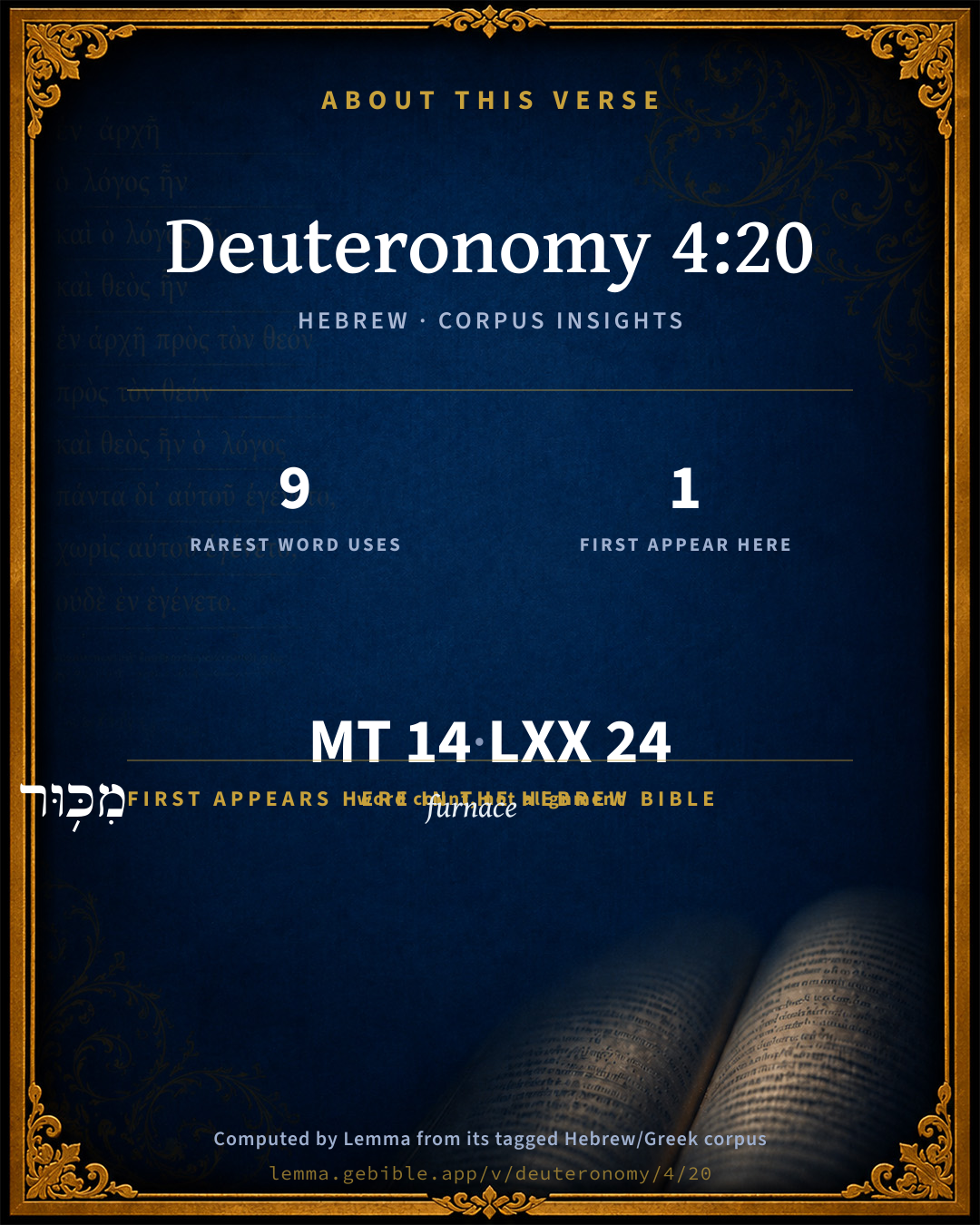
  • 1 first appearance in the Hebrew Bible
Full analysis ↓
Download a study sheet

One document with this verse’s original text, its word-by-word gloss line, the meaning frame, cross-references with their text, attributed commentary, and full source and license credits — printable, and it pastes into notes with its structure intact.

This verse Autodidact and up

Study sheet (.html) Plain text (.txt)

A passage Seminary Student

Up to 50 verses in one chapter. A passage sheet keeps up to 6 commentary sources and 12 cross-references per verse, in the order this page ranks them, and says so on the sheet whenever that leaves anything out. Ask for a single verse and you get the Autodidact verse sheet above.

Everything on this page stays free to read, with no account — the sheet is a download of what is already on screen, not access to it.

Want to remove ads? Support Godless Engineer
Compare translations 3

The same verse in 3 English versions, stacked beneath the original-language interlinear above. Click any original word for its lexicon entry.

Each is an independent rendering of the whole verse — the interlinear is not word-aligned to these translations.

Highlighted words mark where these versions differ — a whole-verse word diff, not a word-by-word alignment.

  • World English Bible Public Domain
    But Yahweh has taken you, and brought you forth out of the iron furnace, out of Egypt, to be to him a people of inheritance, as at this day.
  • King James Version Public Domain
    But the LORD hath taken you, and brought you forth out of the iron furnace, even out of Egypt, to be unto him a people of inheritance, as ye are this day.
  • unfoldingWord Literal Text CC BY-SA 4.0
    And Yahweh has taken you and brought you out of the furnace of iron, from Egypt, to be a people of his inheritance, as this day.

unfoldingWord Literal Text — © unfoldingWord, licensed CC BY-SA 4.0. Word-aligned USFM3 via Door43 (git.door43.org/unfoldingWord/en_ult).

Versions to compare (up to 4)

3 of 4 selected

Show all 18 translations

Every available English version of this verse, each an independent rendering of the whole verse.

  • World English Bible Public Domain
    But Yahweh has taken you, and brought you forth out of the iron furnace, out of Egypt, to be to him a people of inheritance, as at this day.
  • Berean Standard Bible Public Domain
    Yet the LORD has taken you and brought you out of the iron furnace, out of Egypt, to be the people of His inheritance, as you are today.
  • Majority Standard Bible Public Domain
    Yet the LORD has taken you and brought you out of the iron furnace, out of Egypt, to be the people of His inheritance, as you are today.
  • King James Version Public Domain
    But the LORD hath taken you, and brought you forth out of the iron furnace, even out of Egypt, to be unto him a people of inheritance, as ye are this day.
  • American Standard Version (1901) Public Domain
    But Jehovah hath taken you, and brought you forth out of the iron furnace, out of Egypt, to be unto him a people of inheritance, as at this day.
  • Revised Version (1885) Public Domain
    But the LORD hath taken you, and brought you forth out of the iron furnace, out of Egypt, to be unto him a people of inheritance, as at this day.
  • Geneva Bible (1599) Public Domain
    But the Lord hath taken you and brought you out of the yron fornace: out of Egypt to be vnto him a people and inheritance, as appeareth this day.
  • Douay-Rheims (1899) Public Domain
    But the Lord hath taken you and brought you out of the iron furnace of Egypt, to make you his people of inheritance, as it is this present day.
  • Young's Literal Translation Public Domain
    `And you hath Jehovah taken, and He is bringing you out from the iron furnace, from Egypt, to be to Him for a people -- an inheritance, as `at' this day.
  • Literal Standard Version CC BY-SA 4.0
    And YHWH has taken you, and He is bringing you out from the iron furnace, from Egypt, to be to Him for a people, an inheritance, as [at] this day.
  • Unlocked Literal Bible CC BY-SA 4.0
    But Yahweh has taken you and brought you out of the iron furnace, out of Egypt, to be to him a people of his own inheritance, as you are today.
  • unfoldingWord Literal Text CC BY-SA 4.0
    And Yahweh has taken you and brought you out of the furnace of iron, from Egypt, to be a people of his inheritance, as this day.
  • Darby Bible Public Domain
    But you hath Jehovah taken, and hath brought you forth out of the iron furnace, out of Egypt, that ye might be to him a people of inheritance, as it is this day.
  • World Messianic Bible Public Domain
    But the LORD has taken you, and brought you out of the iron furnace, out of Egypt, to be to him a people of inheritance, as it is today.
  • Webster's Bible Public Domain
    But the LORD hath taken you, and brought you out of the iron furnace, even from Egypt, to be to him a people of inheritance, as ye are this day.
  • Free Bible Version CC BY-SA 4.0
    Remember that the Lord took you and led you out of the iron furnace which was in Egypt to be his own people, just as you are today.
  • Bible in Basic English Public Domain
    But the Lord has taken you out of the flaming fire, out of Egypt, to be to him the people of his heritage, as you are today.
  • JPS Tanakh (1917) Public Domain
    But you hath the LORD taken and brought forth out of the iron furnace, out of Egypt, to be unto Him a people of inheritance, as ye are this day.

Literal Standard Version (2020), Covenant Press — licensed CC BY-SA 4.0. Text via the HelloAO Bible API (eBible.org). Unlocked Literal Bible (unfoldingWord) — licensed CC BY-SA 4.0. Text via the HelloAO Bible API (eBible.org). unfoldingWord Literal Text — © unfoldingWord, licensed CC BY-SA 4.0. Word-aligned USFM3 via Door43 (git.door43.org/unfoldingWord/en_ult). Free Bible Version, Dr. Jonathan Gallagher — licensed CC BY-SA 4.0. Text via the HelloAO Bible API (eBible.org).

Word by word

More ways to search: Search by grammar → Find every occurrence → Compare this word →

Practice this passage: Drill this verse → Learn its vocabulary →

מִכּ֥וּר
kûwr
H3564
“from · furnace of”
Preposition + Noun, Common, Masculine, Singular, Construct
Part of Speech
Preposition + Noun
Type
Common
Gender
Masculine
Number
Singular
State
Construct
Full BDB Definition

Origin: from an unused root meaning properly, to dig through

TWOT: 967b , 968

furnace, forge, smelting furnace or pot (noun masculine) - (Qal) to bore, pierce, dig, hew (verb)
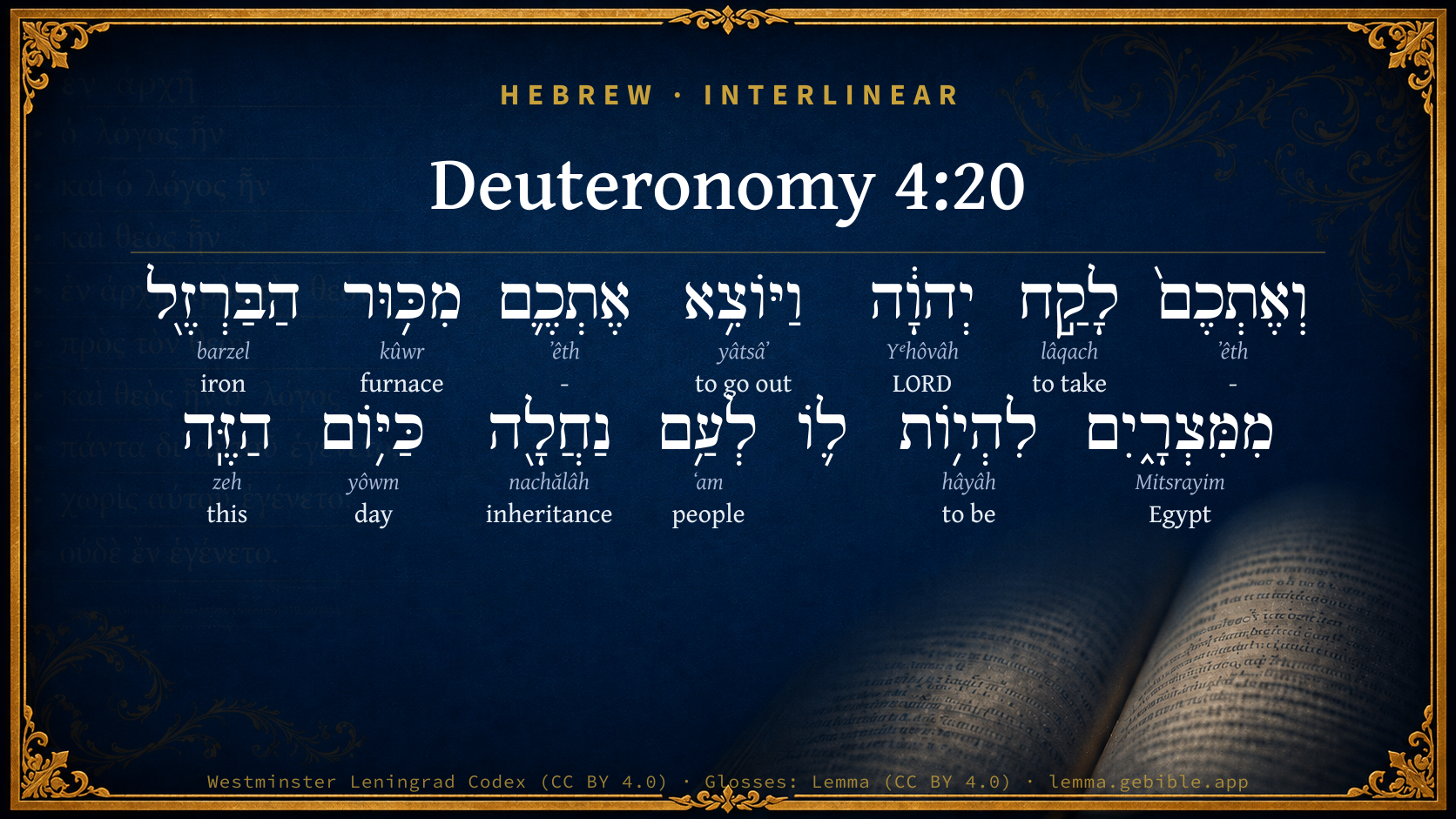
  1. וְאֶתְכֶם֙ ʼêth H853 “and · - · you” Conjunction + Particle, Direct Object + Suffix, Personal, 2nd Person, Masculine, Plural
  2. לָקַ֣ח lâqach H3947 “to take” Verb, Qal, Perfect, 3rd Person, Masculine, Singular
  3. יְהוָ֔ה Yᵉhôvâh H3068 “LORD” Noun, Proper
  4. וַיּוֹצִ֥א yâtsâʼ H3318 “and · to go out” Conjunction + Verb, Hiphil, Sequential Imperfect, 3rd Person, Masculine, Singular
  5. אֶתְכֶ֛ם ʼêth H853 “- · you” Particle, Direct Object + Suffix, Personal, 2nd Person, Masculine, Plural
  6. הַבַּרְזֶ֖ל barzel H1270 “the · iron” Particle, Definite Article + Noun, Common, Masculine, Singular, Absolute
  7. מִמִּצְרָ֑יִם Mitsrayim H4714 “from · Egypt” Preposition + Noun, Proper
  8. לִהְי֥וֹת hâyâh H1961 “to be” Preposition + Verb, Qal, Infinitive Construct
  9. לְעַ֥ם ʻam H5971 “to/for · people of” Preposition + Noun, Common, Masculine, Singular, Construct
  10. נַחֲלָ֖ה nachălâh H5159 “inheritance” Noun, Common, Feminine, Singular, Absolute
  11. כַּיּ֥וֹם yôwm H3117 “like/as the · day” Preposition, Determined + Noun, Common, Masculine, Singular, Absolute
  12. הַזֶּֽה zeh H2088 “the · this” Particle, Definite Article + Pronoun, Demonstrative, Masculine, Singular

About this verse

These counts appear in no published source. They are computed here, from the morphology-tagged text and Lemma’s own curated glosses. What Lemma adds →

14
words
12
distinct lemmas
Pentateuch
section

Notable vocabulary

The rarest word here is מִכּ֥וּר furnace H3564 — appearing just 9 times in the whole Hebrew Bible.

First appearance in Scripture

This word makes its first canonical appearance in the Hebrew Bible here:

  • מִכּ֥וּר furnace H3564

Shared distinctive vocabulary

מִכּ֥וּר furnace H3564 occurs in 9 verses of the Hebrew Bible. Also found in:

Grammatical profile

  • 3 verbs
  • 7 nouns
  • 1 pronoun
  • 1 preposition
  • 2 particles

Verb forms

  • לָקַ֣ח Qal · Perfect
  • וַיּוֹצִ֥א Hiphil · Sequential Imperfect
  • לִהְי֥וֹת Qal · Infinitive Construct

Hebrew & Septuagint length

In English translation the verse runs 29 words from the Hebrew and 34 from the Septuagint (LXX English) — closely comparable.

A rough comparison of the two English renderings, which tokenize alike — not a word-level alignment.

Word counts can differ between the Hebrew and the Greek without any difference in meaning — e.g. the Hebrew direct-object marker אֵת has no separate Greek word, and Greek often adds the article ὁ.

In the original languages it is 14 Hebrew tokens and 24 Greek tokens — but the two are counted differently (Hebrew bundles its prefixes and suffixes into one token; the Greek is in lemma form), so that isn’t a like-for-like length.

Cross-references

13

Topical passages linked to Deuteronomy 4:20 in the Treasury of Scripture Knowledge — connected by theme and wording, ordered by reader-vote popularity; previews shown in the World English Bible.

  • 1 Kings 8:51 (for they are your people, and your inheritance, which you brought forth out of Egypt, from the midst of the furnace of iron);
  • Jeremiah 11:4 which I commanded your fathers in the day that I brought them forth out of the land of Egypt, out of the iron furnace, saying, Obey my voice, and do them, according to all which I command you: so shall you be my people, and I will be your God;
  • Exodus 19:5–6 Now therefore, if you will indeed obey my voice, and keep my covenant, then you shall be my own possession from among all peoples; for all the earth is mine;
  • Deuteronomy 9:29 Yet they are your people and your inheritance, which you brought out by your great power and by your outstretched arm.
  • Deuteronomy 32:9 For Yahweh's portion is his people; Jacob is the lot of his inheritance.
  • Psalms 135:4 For Yah has chosen Jacob for himself; Israel for his own possession.
  • Isaiah 63:17–18 O Yahweh, why do you make us to err from your ways, and harden our heart from your fear? Return for your servants' sake, the tribes of your inheritance.
  • Titus 2:14 who gave himself for us, that he might redeem us from all iniquity, and purify for himself a people for his own possession, zealous for good works.
  • 1 Peter 2:9 But you are a chosen race, a royal priesthood, a holy nation, a people for God's own possession, that you may show forth the excellencies of him who called you out of darkness into his marvelous light:
  • Deuteronomy 9:26 I prayed to Yahweh, and said, Lord Yahweh, don't destroy your people and your inheritance, that you have redeemed through your greatness, that you have brought forth out of Egypt with a mighty hand.
  • Psalms 28:9 Save your people, And bless your inheritance. Be their shepherd also, And bear them up forever.
  • Psalms 33:12 Blessed is the nation whose God is Yahweh, The people whom he has chosen for his own inheritance.
  • Ephesians 1:18 having the eyes of your hearts enlightened, that you may know what is the hope of his calling, and what are the riches of the glory of his inheritance in the saints,

Cross-references courtesy of OpenBible.info (CC BY 4.0).

Hebrew and Greek witnesses Masoretic Hebrew ↔ Greek Septuagint

The same verse in the two great witnesses to the Old Testament, shown verse-for-verse.

These are two independent witnesses, not word-aligned to each other, and the Septuagint is shown in lemma (dictionary) form.

Hebrew Deuteronomy 4:20 Masoretic · Westminster Leningrad Codex

וְאֶתְכֶם֙ לָקַ֣ח יְהוָ֔ה וַיּוֹצִ֥א אֶתְכֶ֛ם מִכּ֥וּר הַבַּרְזֶ֖ל מִמִּצְרָ֑יִם לִהְי֥וֹת ל֛וֹ לְעַ֥ם נַחֲלָ֖ה כַּיּ֥וֹם הַזֶּֽה

But Yahweh has taken you, and brought you forth out of the iron furnace, out of Egypt, to be to him a people of inheritance, as at this day.

World English Bible · Public Domain

Greek LXX Deuteronomy 4:20 Septuagint · lemma form

σύ δέ λαμβάνω ὁ θεός καί ἐκἄγω σύ ἐκ ὁ κάμινος ὁ σιδηροῦς ἐκ αἴγυπτος εἰμί αὐτός λαός ἔγκληρος ὡς ἐν ὁ ἡμέρα οὗτος

But God took you, and led you forth out of the land of Egypt, out of the iron furnace, out of Egypt, to be to him a people of inheritance, as at this day.

LXX2012 (modern English Septuagint) · Public Domain

Hebrew: Westminster Leningrad Codex (CC BY 4.0). Greek: Septuagint (public domain); English from LXX2012 (modern English Septuagint) (Public Domain). How the Septuagint differs from the Hebrew →

Targum (Aramaic paraphrase)

2

The Targum is the ancient Jewish Aramaic paraphrase of the Hebrew Scriptures — an interpretive translation, not the Hebrew text itself. Onkelos (literal) and Pseudo-Jonathan (expansive) render the Torah, and Jonathan the Prophets. Coverage is partial: where no permissively-licensed English translation exists for a verse, only the Aramaic is shown. This is verse-level text, not a word-by-word alignment to the Hebrew.

  1. Targum Onkelos Torah (Genesis–Deuteronomy)
    וְיָתְכוֹן קָרִיב יְיָ לְדַחַלְתֵּהּ וְאַפֵּק יָתְכוֹן מִכּוּרָא דְפַרְזְלָא מִמִצְרָיִם לְמֶהֱוֵי לֵהּ לְעַמָא אַחֲסָנָא כְּיוֹמָא הָדֵין

    (no public-domain English translation for this verse)

    Targum Onkelos — Aramaic: “Onkelos Genesis” (public domain); “Onkelos Exodus” (public domain); “Onkelos Leviticus” (public domain); “Onkelos Numbers” (public domain); “Onkelos Deuteronomy” (public domain). English: “Sefaria Community Translation” (CC0 1.0 (public-domain dedication)); “J.W. Etheridge. The Targums of Onkelos and Jonathan Ben Uzziel on the Pentateuch. London: Longmans, Green, 1862” (public domain). Text via Sefaria.

  2. Targum Pseudo-Jonathan Torah (Genesis–Deuteronomy)
    וְיַתְכוֹן נְסִיב מֵימְרָא דַיְיָ לְחוּלְקֵיהּ וְאַנְפֵּיק יַתְכוֹן מִנִיר פַּרְזְלָא מִמִּצְרַיִם מְטוֹל לְמֶהֱוֵי לֵיהּ לְעַם אַחֲסָנָא כְּיוֹמָא הָדֵין

    For you hath the Word of the Lord taken for His portion, and hath brought you out from the iron furnace of Mizraim to be unto Him a people of inheritance as at this day.

    Targum Pseudo-Jonathan — Aramaic: “Targum Jonathan on Genesis” (public domain); “Targum Jonathan on Exodus” (public domain); “Targum Jonathan on Leviticus” (public domain); “Targum Jonathan on Numbers” (public domain); “Targum Jonathan on Deuteronomy” (public domain). English: “The Targum of Jonathan ben Uzziel, trans. J. W. Etheridge, London, 1862” (public domain). Text via Sefaria.

Commentary

Notes on Deuteronomy 4:20 from classic Christian and Jewish commentators (each source and its license shown beneath its notes). The classic Christian expositions comment on the surrounding passage and are grouped to its opening verse, so a note may address several verses; the Jewish commentaries on the Tanakh (Rashi and others) are per-verse, so they appear only where the commentator wrote on this verse.

Lemma curates 59 commentaries, every one of them public domain or Creative Commons licensed, each selected and text-cleaned for this edition rather than reprinted as found. About our sources →

Trapp's Complete Commentary

John Trapp

Deu 4:20 But the LORD hath taken you, and brought you forth out of the iron furnace, [even] out of Egypt, to be unto him a people of inheritance, as [ye are] this day.

Ver. 20. But the Lord.] Deliverance commands obedience: Servati sumus ut serviamus,

John Trapp, A Commentary or Exposition upon All the Books of the Old and New Testament (1647–1656) — public domain. Text from a community e-Sword module.

The Biblical Illustrator

Joseph S. Exell

Deu_4:20

The Lord hath taken you.

, to be unto Him a people of inheritance.

The chosen of the Lord

I. The people alluded to.

1. The title they may claim. The chosen of God.

2. The mercy shown. The Lord hath taken you.

3. The practical result. Hath brought you forth.

(1) A wonderful work.

(2) Miraculous.

(3) Wise.

(4) All-sufficient.

(5) Complete.

II. The place whence removed. The iron furnace.

1. The rigour of the imprisonment.

2. The bitterness of the position. The land of Egypt is always used in Scripture to represent the kingdom of Satan. And so the idea here developed is the deliverance of Gods Church

(1) from the dominion of the devil, the power he exercises over the soul, and the rigour of his exactions;

(2) from the servitude of sin, and its cruel, unremitting slavery of toil;

(3) from the alienation of a distant land--a country which is not our home. Gods grace and power has accomplished all this on our behalf.

III. The position provided. It is worthy of notice that this position is not one of mere selfish gratification. It is one that promoted first and chiefly the glory of God. There are two particulars given.

1. God selected and delivered His people that they may be His people. This is a condition of high honour--to be the people of the Most High is worthy of an archangel. It is a condition of blessed security. The people of God are as the apple of His eye. He will guide and protect them as the most precious treasures. It is a position of glorious anticipation.

2. God selects His people that they may be His inheritance. (Preachers Analyst.)

Gods heritage

Israel was the only people on earth chosen by God of old. This came to pass because of the faith of Abraham. God was the God of Abrahams posterity. The choice was absolute and universal. All might go forth from Egypt. Young and old, man and wife, sick and sound, etc., etc. In brief, all that pertained to the people might go forth over the Red Sea and sing Gods praise. How great, then, was the Divine mercy! And what hope does this give us in view of the thought that there will be many received into the kingdom of heaven--a number greater and more comprehensive, it may be, than men sometimes think.

I. Israel was Gods heritage.

1. He calls them His heritage. He desired at least to have one spot on earth whilst as yet all earth was subject to the prince of this world. Such could only come through a faithful man, who had become free from this servitude. Such was Abraham, who was commanded to sojourn in Canaan. This land God chose as His own; and the people to whom He gave it were to be inheritors of the land, and therefore a people of inheritance unto Him.

2. Thus Moses warned them that in this land, which was a consecrated land, no idolatry must find place. It was to be separated from all lands in which the prince of this world had sway. The land remained consecrated to God, His peculiar possession even when defiled by the people, i.e. when it took on the character of a heathen land, and because of this was, for a time, forsaken, as during the Exile.

II. The whole earth is now Gods.

1. Since Christ died Canaan ceased to be the especially holy land consecrated to God. Now the whole earth belongs to Him, for now the prince of the world has been ousted. Every spot is now Gods holy land, where Gods children gather together--where the true God and Jesus Christ whom He hath sent are worshipped. Humanity is now Gods heritage, purchased by the blood of Christ.

2. The idea, therefore, that Israel will again have to occupy Canaan as Gods inheritance has no support, for the whole earth is the Lords, all is equally His, as once Canaan was. God will have Himself to be acknowledged everywhere as once He was in Canaan. Wherefore, then, now a holy land in opposition to other lands? Now we sing with the angels, Holy, etc., the whole earth is full of His glory, i.e. the glory of God is to be extolled now everywhere as once in Canaan. Therefore the Lord said to His disciples: Blessed are the meek, etc.

not only citizens of the erstwhile holy land only, but of the whole world.

3. May we, through our faith and our reliance on God and Him whom He has sent, make every place holy ground, as the possession of Gods inheritance. For He fills all with the fulness of His Divine glory, or will yet fill all. (J. C. Blumhardt.)

Gods deliverance of Israel out of the iron furnace

First, for the terms of their deliverance, to speak of them, which are here propounded two manner of ways, in the general and in the particular. The general, Egypt. The particular, the furnace of iron.

I. We begin first of all with the general proposition, which, though it be last in order of Scripture, yet is first in order of nature, and that is Egypt. This was the place which they were delivered from, which when we have considered how miserable a place it was, and especially to them, we shall see the greatness of their deliverance. The place, I say, in general was Egypt, which we find these Israelites to be very often put in mind of in Scripture upon all occasions (Deu_5:15; Deu_16:12; Deu_24:18; Deu_24:22).

1. It was a place of exile or peregrination. This the Scripture does very much insist on. That they were strangers in the land of Egypt (Psa_114:1). The world to the children of God is but as the land of strangers. It is heaven which is their proper home and their Fathers house. It should make them the more willing to go when God calls them by seasonable dissolution, in that here they are but in a land of strangers. That was not all, nor the main thing, which was considerable in Egypt.

2. It was, moreover, a land of idolaters. There is matter of pollution. It was hard for Israel to be long in Egypt, and not in a great measure to partake with them in their idolatries. Oh, it is a great mercy to be kept from sinful allurements, especially considering what inclinations are in ourselves to the closing with them, we have a nature in us which is like dry tinder to these sparks. And therefore to be prevented from the occasion is so much the greater advantage. As there is pollution in these things in regard of nature, so there is offensiveness in regard of grace. Evil examples and temptations, if they do not defile us, yet they cannot but offend and grieve us and expose us more to sin, so they trouble us and expose us more to grief, prove wearisome and tedious to us. There is also danger in them, too, in regard to the consequents. Danger both to body and soul. For ourselves, let us bless God that He has graciously given us the opportunities of knowledge, and delivered us from the Egypt both of Paganism and Popery.

II. The second is as it is laid down in particular, and that is the iron furnace (1Ki_8:51; Jer_11:4).

1. First, here is affliction in general compared to a furnace (Isa_48:10). Afflictions are the fiery trial to test Gods people, and purge away the dross (1Pe_4:12).

2. For this affliction in particular which now happened to Israel, it is called the iron furnace. Both in the letter and in the moral. In the letter. First, because those furnaces which they wrought in were such as in which iron was melted. And so from the work they were employed in, furnaces of iron. But then secondly, of iron in the moral. First, an hard and laborious employment. Iron is an emblem of severity. Then, secondly, as from the sharpness of it, so from the continuance of it likewise (Psalm evil. 20). The use which we are to make of this observation to ourselves is therefore, first, not to wonder at it, or to think much of it, but to expect it. The refiner puts the gold into the furnace, and the potter puts the clay into the fire, and both of them to very good purpose; and so does God. Again, we should be careful to find afflictions to have this efficacy upon us, to wit, of refining us.

III. The Author of their deliverance, and that is expressed here to be God himself the Lord.

1. First, it is He alone hath the bowels, it is He alone that hath the strength. Deliverance of others out of trouble is an act of pity and compassion. Now, none but only God has so much of this in them towards the Church; we shall see in the book of the Lamentations the complaining of the want of commiseration in others towards her; but this God hath in Him abundance.

2. Secondly, none but He hath the strength. The adversaries of the Church are potent, and therefore need to have one of power to deal with them. And this is God Himself; the Almighty and All-sufficient. Therefore still let Him be both repaired to, as also acknowledged in such providences as these are.

IV. The manner of it. This we have expressed in two words, Taken you and brought you forth. Though one might have served the turn for the signification of the deliverance, yet two are made use of to make it so much the more emphatical.

1. First, an emphasis of appropriation, taken you, that is, laid claim unto you, as a man that seizes upon that which is his own when it is in the hand of strangers.

2. Secondly, as there is in it an emphasis of appropriation, so likewise an emphasis of affection. He hath taken you, that is, with a great deal of tenderness and regard unto you (Deu_22:11).

Hath brought you, and this, as well as the other, hath a double force in it.

1. First, there is power in it. Bring you forth, that is, forced you forth, whether your enemies would or no.

2. Secondly, there is also solemnity in it. He brought them forth, i.e. in triumph, as with a strong hand so with a stretched-out arm, as the Scripture also expresses it (Deu_5:15). Now, from both these expressions together we see the thing itself sufficiently declared, that God did at last deliver His people out of captivity (Psa_81:6; Psa_81:8; Psa_81:13). Though God suffers His servants sometimes to fall into the hand of their enemies, yet He does at length free them from them. This He doth upon divers considerations. First, out of His own compassion (Psa_103:9; Isa_57:16). Secondly, out of respect to His people, lest they should be discouraged and provoked to evil (Psa_125:3). Thirdly, out of regard to the enemies, lest they should insult (Deu_32:26-27). Let this, therefore, be the use which we make of it to ourselves. First, to expect it, whereas yet it is not. Secondly, to acknowledge it, and to improve it there where it is. And so much may suffice to have spoken of the first general part of the text, namely, the deliverance itself.

V. The end or consequent of this deliverance, and that we have in these words, To be unto Him a people of inheritance as ye are this day. In which passage we have again two particulars. First, the design itself, and secondly, the amplification of it. The design itself, To be unto Him a people of inheritance. The amplification of it. As ye are this day. I begin with the first, namely, the design itself, To be unto Him a people of inheritance, This is that which God aimed at concerning Israel. Now, this may again admit of a double interpretation, either so as for Him to be their inheritance, or else so as for them to be His. The Scripture makes mention of either in sundry places. First, for Him to be theirs. This is the privilege of Gods people. That the Lord Himself is their portion and inheritance and so expresses Himself to be to them (Psa_16:5). David, speaking of himself, The Lord is the portion of mine inheritance, and of my cup: Thou maintainest the lot. And so of Levi it is said, that the Lord is his inheritance (Deu_10:9). And the Church, (Lam_3:24) The Lord is my portion, etc. This is a great comfort to the godly, and to those which are most destitute amongst them, to live upon the power of this truth, what though they have none of the great inheritance of the world. Yet as long as they have a portion in God they have that which may abundantly satisfy them, and keep them from dejection, forasmuch as from henceforth no good thing shall be wanting unto them, He that overcometh shall inherit all things. How so? It follows in the next words, And I will be his God, etc. (Rev_21:7). The second is for them to be His. This is another thing which the Scripture makes mention of (Psa_33:12; Deu_32:9; Psa_28:9). An inheritance contains three things in it. First, some good and advantage. Secondly, peculiarity and propriety of interest. Thirdly, succession and derivation of it to posterity. Now, according to all these notions of it does God make choice of His people to be an inheritance to Himself. This, therefore, first of all teaches us what we ourselves should be, namely, such as are wholly devoted and consecrated to Him (1Co_6:20). We are the inheritance of God, therefore we should not suffer Satan to get possession of us, nor any evil to prevail upon us. Secondly, here is matter of comfort to the true Church and people of God, that being His inheritance He will therefore take care of them and protect them, and keep them from evil. I desire now, further, to enforce it as a duty which is belonging to you to take care of it especially; we should all in our several opportunities endeavour the continuance of the Church in succeeding time. That God may have to Himself a portion and people of inheritance, even when we are in our graves. This is done, first of all, by being good in our own generation. Secondly, by taking care of others, and educating them in His fear. Now, further, we may look upon it also as a consequent, and so see the connection of these two both together. How did God, bringing His people forth out of Egypt, make them to be to Him a people of inheritance, namely, thus far, as they had now larger opportunities for the serving of Him afforded unto them than while they were in Egypt, they were there restrained in regard of the idolatrous people, which they were mingled withal, but now being escaped they were more at liberty. This, therefore, is the advantage which we should still make of such opportunities (Luk_1:74-75). And so much of the first particular observable in this second general, namely, the design itself to be, etc. The second is the amplification of it. As ye are this day. In which clause we have three things especially hinted to us concerning God. First, the accomplishment of His purposes. Secondly, the certainty of His promises. Thirdly, the continuance of His performances. Now, from hence will follow another point as our duty, which is here also to be observed, and that is, that we are accordingly to call them to our minds, and so from thence make them fresh unto us, as if done at this present time. It is that which Moses endeavours to make these Israelites do here in the text, who reminds them of a mercy which was done many years ago for them, as if it had been done for them just at that time. This is the scope of this narration, and this also hath been the practice of the saints of God in other places (Psa_78:1; Psa_78:6). (T. Herren, D. D.)

The Biblical Illustrator, edited by Joseph S. Exell (c. 1880s–1900s) — public domain. Text from a community e-Sword module.

Joseph Benson's Commentary

Deu 4:20. The Lord hath taken you — Of his own free mercy, unmerited by you; and brought you forth out of the iron furnace — The furnace wherein iron and other metals are melted, to which Egypt is compared, from the torment and misery which the Israelites there endured. To be unto him a people of inheritance — His peculiar possession from generation to generation; and therefore for you to forsake God, and worship idols, would be wickedness and ingratitude to the highest degree.

Joseph Benson's Commentary on the Old and New Testaments (1811–1818) — public domain. Text from a community e-Sword module.

Tyndale Open Study Notes

Tyndale Open Resources

4:20 An iron-smelting furnace was used to refine metal ores and separate the pure metal from the dross. Israel’s trials in Egypt made the Israelites more spiritually and morally pure. • special possession (literally people of inheritance): Israel itself was God’s inheritance. This concept is confirmed by the parallel phrase describing Israel as his very own people. As such, the Israelites were now fit to enter, conquer, and occupy the land (cp. 1 Pet 2:9-12).

Tyndale Open Study Notes — © Tyndale Open Resources, licensed CC BY-SA 4.0. Text via the HelloAO Bible API.

Geneva Bible (1599)

Geneva Bible translators

He hath delivered you out of most miserable slavery and freely chosen you for his.

Geneva Bible (1599) marginal notes — public domain. Text via Bolls.life.

Jamieson, Fausset & Brown

Robert Jamieson, A. R. Fausset & David Brown

But the Lord hath taken you, and brought you forth out of the iron furnace--that is, furnace for smelting iron. A furnace of this kind is round, sometimes thirty feet deep, and requiring the highest intensity of heat. Such is the tremendous image chosen to represent the bondage and affliction of the Israelites [ROSENMULLER].

to be unto him a people of inheritance--His peculiar possession from age to age; and therefore for you to abandon His worship for that of idols, especially the gross and debasing system of idolatry that prevails among the Egyptians, would be the greatest folly--the blackest ingratitude.

Jamieson, Fausset & Brown — Commentary Critical and Explanatory on the Whole Bible (1871) — public domain (CC PDM 1.0). Text via the HelloAO Bible API.

Adam Clarke's Commentary

Verse 20. Out of the iron furnace] From this mention of the word iron furnace there can be little doubt that the Israelites were employed in Egypt in the most laborious works of metallurgy. Digging, smelting, and forging of iron in so hot a climate must have been oppressive work indeed.

Adam Clarke's Commentary on the Bible (1810–1826) — public domain. Text from a community e-Sword/MySword module.

The Cambridge Bible for Schools and Colleges

gen. ed. J. J. S. Perowne

20. But, etc.] Heb. But you, emphatic, hath Jehovah taken. Israel, so taken and redeemed, must worship Him alone.

out of the iron furnace, out of Egypt] Cp. the deuteronomic 1Ki_8:51 and Jer_11:4. The increase of references to iron-smelting from the 8th cent, onwards is noteworthy; Jerusalem, i. 332.

a people of inheritance] cp. Deu_32:9; elsewhere in D a peculiar people, cp. Deu_7:6.

as at this day] See Deu_2:30.

The Cambridge Bible for Schools and Colleges (gen. ed. J. J. S. Perowne; Cambridge University Press, 1878–1918) — public domain. Text from a community e-Sword module.

John Gill's Exposition

But the Lord hath taken you, and brought you forth out of the iron furnace,.... The allusion is to the trying and melting of metals, and fleeing them from dross, by putting them into furnaces strongly heated, some of which are of earth, others of iron; the word, as the Jewish writers (g) observe, signifies such an one in which gold and silver and other things are melted; see Psa 12:6 even "out of Egypt"; which is here compared to an iron furnace, because of the cruelty with which the Israelites were used in it, the hardships they were put under, and the misery and bondage they were kept in; but out of all the Lord brought them, as he does all his people sooner or later out of their afflictions, sometimes called the furnace of affliction, Isa 48:10 where their graces are tried, and they are purged, purified, and refined from their dross and tin. This the Lord did to Israel, he brought them out of their distressed state and condition:

to be unto him a people of inheritance, as ye are this day: to be the Lord's inheritance, as they now were, Deu 32:9 as well as they were quickly to inherit the land of Canaan, for which they were brought out of the land of Egypt; and indeed they were already, even that day, entered on their inheritance, the kingdom of the Amorites being delivered into their hands.

(g) Maimon. & Bartenora in Misn. Celim. c. 8. sect. 9. & Jarchi in loc.

John Gill's Exposition of the Whole Bible (1746–1763) — public domain (CC PDM 1.0). Text via the HelloAO Bible API.

Haydock's Catholic Bible Commentary

Furnace. This expression gives us some idea of the cruelties to which the Hebrews had been exposed, 3 Kings viii. 41. Iron and other metals were melted in furnaces: Hebrew cur, Ezechiel xxii. 20. In the countries of the East, workmen have them in the middle of their shops, and sit round them to work. (Bellon., iii. 45.) (Calmet)

George Leo Haydock (1774–1849), Haydock's Catholic Family Bible and Commentary, 1859 edition — public domain. Excludes Psalms (Douay-Rheims chapter numbering differs from Protestant) and Deuterocanonical books (Catholic canon only).

Matthew Poole's English Annotations

i.e. The furnace wherein iron and other metals are melted, to which Egypt is fitly compared, not only for the torment and misery which they there endured, but also because they were thoroughly tried and purged thereby, as metals are by the fire.

A people of inheritance; his peculiar possession from generation to generation. See Exo 19:5 Deu 7:6; Tit 2:14. And therefore for you to forsake God, and worship idols, will be not only wickedness and madness, but most abominable ingratitude.

Matthew Poole's English Annotations on the Holy Bible (1683–1685) — public domain. Text from a community e-Sword/MySword module.

Whedon's Commentary on the Bible

Daniel D. Whedon

20. Out of the iron furnace — A furnace for smelting iron is the figure descriptive of the terrible sufferings Israel endured in Egypt.

Daniel D. Whedon (gen. ed.), Commentary on the Old and New Testaments (1874–1909) — public domain. Text from a community e-Sword module.

The Pulpit Commentary

Iron furnace furnace for smelting iron: "figure of burning torment in Egypt" (Herxheimer). This reference to the smelting of iron shows that, though the implements of the ancient Egyptians were mostly of copper, iron must also have been in extensive use among them. Other references to the use of iron are to be found in the Pentateuch; see Gen_4:22; Lev_26:19; Num_35:16; Deu_3:11 Deu_8:9 Deu_19:5 Deu_27:5 (Goguet, "Origine des Lois," 1:172; Wilkinson, "Ancient Egypt," 1:169; 2:155). To be unto him a people, etc. (Exo_19:4-6; Deu_7:6)

The iron furnace.

God had passed his people through a hot furnace in the terrible sufferings they endured in Egypt, but with the gracious purpose of ultimately delivering them, and giving them an inheritance in Canaan. We learn

I THAT GOD"S PEOPLE ARE SOMETIMES SUBJECTED TO SUFFERINGS OF INCREDIBLE SEVERITY. The expression an "iron furnace," i.e. a furnace for smelting iron, conveys no weaker an idea. We know that in fact it sometimes is so. Bodily anguish mental anguish stroke after stroke of heaviest trial. An instance in the history of Job. Shakes faith to its foundations seems to argue that God has utterly forsaken them.

II THAT THESE SUFFERINGS ARE APPOINTED, AND SERVE DISCIPLINARY ENDS. The use of the figure of a furnace implies a purpose in the sufferings. Iron is put into the furnace deliberately, and with a design. Trials, difficult enough to bear in the faith that God sends them, would ofttimes be absolutely intolerable without that faith. The furnace acts on the tough, hard, impure iron to separate it from dross, and make it soft and workable. The severe sufferings through which God passes believers:

1. Purify character.

2. Make the nature plastic to God"s will, and subdue it to meekness.

3. Fit the man thus sanctified for new and higher uses.

III GOD HAS AN INHERITANCE IN STORE FOR THOSE WHO ENDURE THE FURNACE SUCCESSFULLY.

1. Their sufferings fit them to be God"s inheritance. "To be unto him a people of inheritance." He has to melt, mold, and spiritually prepare for his own indwelling those whom he chooses.

2. Their sufferings fit them for the inheritance which God gives them. (1Pe_1:3-10) By creating a pure, chastened, heavenly disposition. By strengthening faith, brightening hope, and increasing love. By subduing pride, rebellion, and impatience; and making the will absolutely pliant in the hands of the Divine. J.O.

The Pulpit Commentary (1880–1919), ed. H.D.M. Spence-Jones & Joseph S. Exell — public domain. Text from a community e-Sword module.

Keil & Delitzsch

C. F. Keil & F. Delitzsch

The Israelites were not to imitate the heathen in this respect, because Jehovah, who brought them out of the iron furnace of Egypt, had taken them (לקח) to Himself, i.e., had drawn them out or separated them from the rest of the nations, to be a people of inheritance. They were therefore not to seek God and pray to Him in any kind of creature, but to worship Him without image and form, in a manner corresponding to His own nature, which had been manifested in no form, and therefore could not be imitated. בּרזל כּוּר, an iron furnace, or furnace for smelting iron, is a significant figure descriptive of the terrible sufferings endured by Israel in Egypt. נחלה עם (a people of inheritance) is synonymous with סגלּה עם (a special people, Deu 7:6 : see at Exo 19:5, "a peculiar treasure"). "This day:" as in Deu 2:30.

Keil & Delitzsch — Biblical Commentary on the Old Testament (1861–1891) — public domain (CC PDM 1.0). Text via the HelloAO Bible API. (Old Testament only.)

Rashi

Rabbi Shlomo Yitzchaki (Rashi)

מכור — a כור is a vessel in which one refines gold.

Rashi on the Tanakh — English translations: “The Judaica Press complete Tanach with Rashi, translated by A. J. Rosenberg” (CC BY 4.0); “Pentateuch with Rashi's commentary by M. Rosenbaum and A.M. Silbermann, 1929-1934” (public domain); “The Metsudah Tanach series, Lakewood, N.J” (CC BY 4.0); and “The Book of Joshua, Metsudah Publications, 1997” (CC BY 4.0). Text via Sefaria.

Lesson kit

Teaching starters — assembled from the data on this page, not authored interpretation. Every prompt links to the verse data it draws on. Edit before teaching.

Deuteronomy, in the Pentateuch, opens this verse with 14 words (12 distinct Hebrew lemmas). Its most distinctive word is kûwr (“furnace”). A historical commentator’s framing appears above. Read the whole chapter for the surrounding context.

Discussion questions

  1. What does “furnace” (kûwr) contribute to the verse as a whole?
  2. This is the first place “furnace” appears in Scripture (first appears here). What does its debut here establish?
  3. How does 1 Kings 8:51, which shares the word «furnace», read alongside this verse?
  4. The translations on this page render this verse differently — a whole-verse word diff, not a word-by-word alignment. What might account for the different wordings?
  5. «לָקַ֣ח» is a Qal Perfect verb. How does that grammatical form shape the action described?
  6. Compare how Trapp's Complete Commentary and The Biblical Illustrator read this verse. Where do they agree or differ?

Things to notice

Reading settings

Reading text

Shown beneath each verse's original-language words.

Old Testament
Old Testament edition

Read the OT as the Masoretic Hebrew (MT) or the Greek Septuagint (LXX).

English shown for the Greek Septuagint (in the Hebrew ↔ Greek comparison).

Comparing translations? Open the Compare panel on any verse page to stack up to four side by side.