Genesis 2:18

Hebrew (Westminster Leningrad Codex) Genesis 2:18 appears in the Hebrew Old Testament. The text above is from the Westminster Leningrad Codex. Each word links to its Strong’s number, a concise gloss, and parsing drawn from the Open Scriptures Hebrew Bible morphology. Click any word for its full Brown-Driver-Briggs (BDB) entry.
Download image
Cite this verse

Genesis 2:18 (World English Bible). Public Domain. Lemma interlinear Bible study tool, https://lemma.gebible.app/v/genesis/2/18.

Show BibTeX & RIS
BibTeX
RIS
English Translation
Yahweh God said, "It is not good that the man should be alone; I will make him a helper suitable for him."
World English Bible · Public Domain
Highlights
  • 3 first appearances in the Hebrew Bible
Full analysis ↓
Download a study sheet

One document with this verse’s original text, its word-by-word gloss line, the meaning frame, cross-references with their text, attributed commentary, and full source and license credits — printable, and it pastes into notes with its structure intact.

This verse Autodidact and up

Study sheet (.html) Plain text (.txt)

A passage Seminary Student

Up to 50 verses in one chapter. A passage sheet keeps up to 6 commentary sources and 12 cross-references per verse, in the order this page ranks them, and says so on the sheet whenever that leaves anything out. Ask for a single verse and you get the Autodidact verse sheet above.

Everything on this page stays free to read, with no account — the sheet is a download of what is already on screen, not access to it.

Want to remove ads? Support Godless Engineer
Compare translations 3

The same verse in 3 English versions, stacked beneath the original-language interlinear above. Click any original word for its lexicon entry.

Each is an independent rendering of the whole verse — the interlinear is not word-aligned to these translations.

Highlighted words mark where these versions differ — a whole-verse word diff, not a word-by-word alignment.

  • World English Bible Public Domain
    Yahweh God said, "It is not good that the man should be alone; I will make him a helper suitable for him."
  • King James Version Public Domain
    And the LORD God said, It is not good that the man should be alone; I will make him an help meet for him.
  • unfoldingWord Literal Text CC BY-SA 4.0
    Then Yahweh God said, “ not good the man to be alone. I will make a suitable helper for him.”

unfoldingWord Literal Text — © unfoldingWord, licensed CC BY-SA 4.0. Word-aligned USFM3 via Door43 (git.door43.org/unfoldingWord/en_ult).

Versions to compare (up to 4)

3 of 4 selected

Show all 18 translations

Every available English version of this verse, each an independent rendering of the whole verse.

  • World English Bible Public Domain
    Yahweh God said, "It is not good that the man should be alone; I will make him a helper suitable for him."
  • Berean Standard Bible Public Domain
    The LORD God also said, “It is not good for the man to be alone. I will make for him a suitable helper.”
  • Majority Standard Bible Public Domain
    The LORD God also said, “It is not good for the man to be alone. I will make for him a suitable helper.”
  • King James Version Public Domain
    And the LORD God said, It is not good that the man should be alone; I will make him an help meet for him.
  • American Standard Version (1901) Public Domain
    And Jehovah God said, It is not good that the man should be alone; I will make him a help meet for him.
  • Revised Version (1885) Public Domain
    And the LORD God said, It is not good that the man should be alone; I will make him an help meet for him.
  • Geneva Bible (1599) Public Domain
    Also the Lord God saide, It is not good that the man should be himself alone: I wil make him an helpe meete for him.
  • Douay-Rheims (1899) Public Domain
    And the Lord God said: It is not good for man to be alone: let us make him a help like unto himself.
  • Young's Literal Translation Public Domain
    And Jehovah God saith, `Not good for the man to be alone, I do make to him an helper -- as his counterpart.'
  • Literal Standard Version CC BY-SA 4.0
    And YHWH God says, “[It is] not good for the man to be alone; I make him a helper as his counterpart.”
  • Unlocked Literal Bible CC BY-SA 4.0
    Then Yahweh God said, “It is not good that the man should be alone. I will make him a helper suitable for him.”
  • unfoldingWord Literal Text CC BY-SA 4.0
    Then Yahweh God said, “ not good the man to be alone. I will make a suitable helper for him.”
  • Darby Bible Public Domain
    And Jehovah Elohim said, It is not good that Man should be alone; I will make him a helpmate, his like.
  • World Messianic Bible Public Domain
    The LORD God said, “It is not good for the man to be alone. I will make him a helper comparable to him.”
  • Webster's Bible Public Domain
    And the LORD God said, It is not good that the man should be alone: I will make him a help meet for him.
  • Free Bible Version CC BY-SA 4.0
    Then the Lord God said, “It's not good for Adam to be alone. I will make someone to help him, someone that's like him.”
  • Bible in Basic English Public Domain
    And the Lord God said, It is not good for the man to be by himself: I will make one like himself as a help to him
  • JPS Tanakh (1917) Public Domain
    And the LORD God said: 'It is not good that the man should be alone; I will make him a help meet for him.'

Literal Standard Version (2020), Covenant Press — licensed CC BY-SA 4.0. Text via the HelloAO Bible API (eBible.org). Unlocked Literal Bible (unfoldingWord) — licensed CC BY-SA 4.0. Text via the HelloAO Bible API (eBible.org). unfoldingWord Literal Text — © unfoldingWord, licensed CC BY-SA 4.0. Word-aligned USFM3 via Door43 (git.door43.org/unfoldingWord/en_ult). Free Bible Version, Dr. Jonathan Gallagher — licensed CC BY-SA 4.0. Text via the HelloAO Bible API (eBible.org).

Word by word

More ways to search: Search by grammar → Find every occurrence → Compare this word →

Practice this passage: Drill this verse → Learn its vocabulary →

עֵ֖זֶר
ʻêzer
H5828
“helper”
Noun, Common, Masculine, Singular, Absolute
Part of Speech
Noun
Type
Common
Gender
Masculine
Number
Singular
State
Absolute
Full BDB Definition

Origin: from H5826

TWOT: 1598a

help, succour - help, succour - one who helps
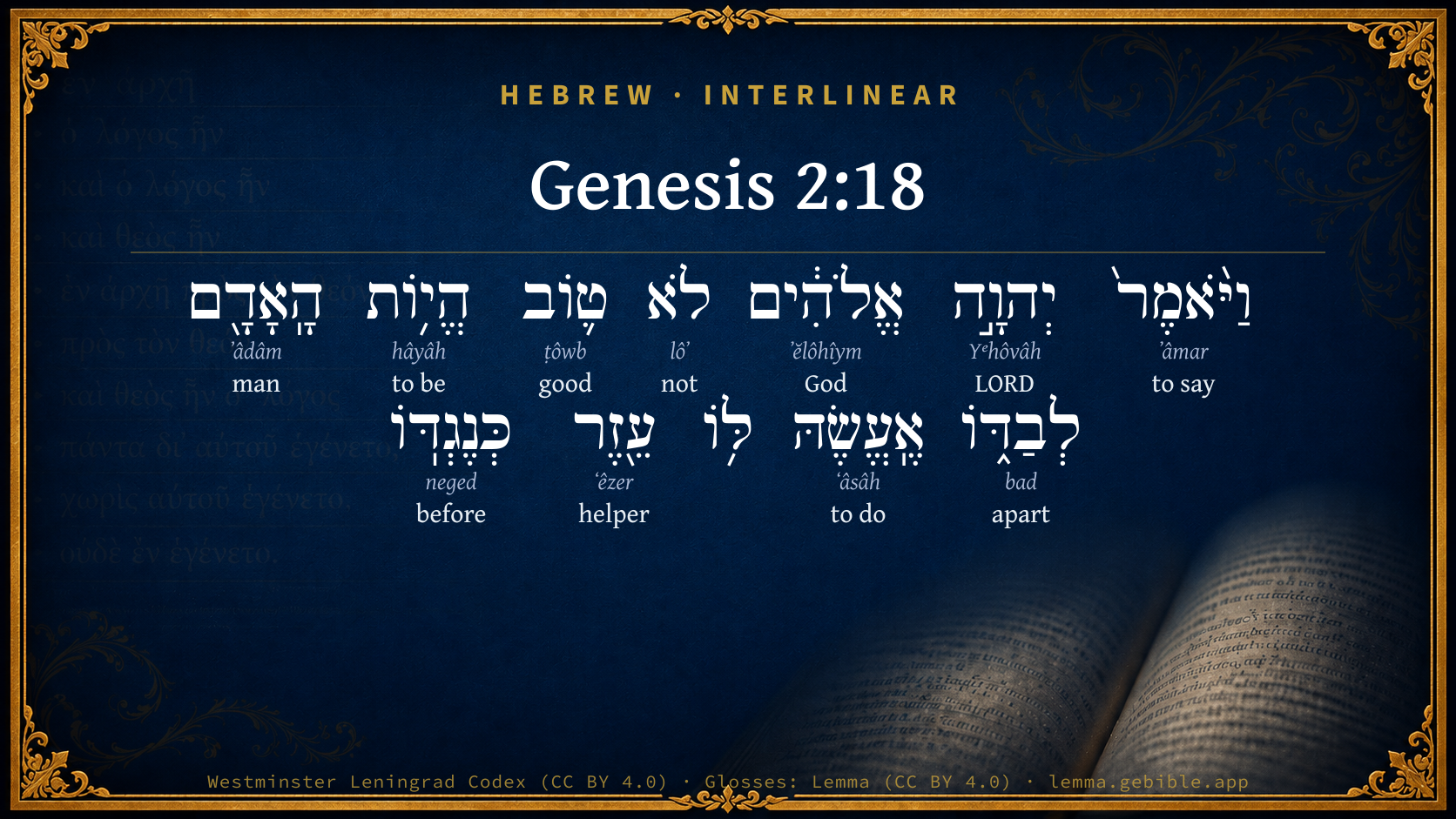
  1. וַיֹּ֨אמֶר֙ ʼâmar H559 “and · to say” Conjunction + Verb, Qal, Sequential Imperfect, 3rd Person, Masculine, Singular
  2. יְהוָ֣ה Yᵉhôvâh H3068 “LORD” Noun, Proper
  3. אֱלֹהִ֔ים ʼĕlôhîym H430 “God(s)” Noun, Common, Masculine, Plural, Absolute
  4. לֹא lôʼ H3808 “not” Particle, Negative
  5. ט֛וֹב ṭôwb H2896 “good” Adjective, Adjective, Masculine, Singular, Absolute
  6. הֱי֥וֹת hâyâh H1961 “to be” Verb, Qal, Infinitive Construct
  7. הָֽאָדָ֖ם ʼâdâm H120 “the · man” Particle, Definite Article + Noun, Common, Masculine, Singular, Absolute
  8. לְבַדּ֑וֹ bad H905 “to/for · apart · his” Preposition + Noun, Common, Masculine, Singular, Construct + Suffix, Personal, 3rd Person, Masculine, Singular
  9. אֶֽעֱשֶׂהּ ʻâsâh H6213 “to do” Verb, Qal, Imperfect, 1st Person, Common, Singular
  10. כְּנֶגְדּֽוֹ neged H5048 “like/as · before · him” Preposition + Preposition + Suffix, Personal, 3rd Person, Masculine, Singular

About this verse

These counts appear in no published source. They are computed here, from the morphology-tagged text and Lemma’s own curated glosses. What Lemma adds →

12
words
11
distinct lemmas
Pentateuch
section

Notable vocabulary

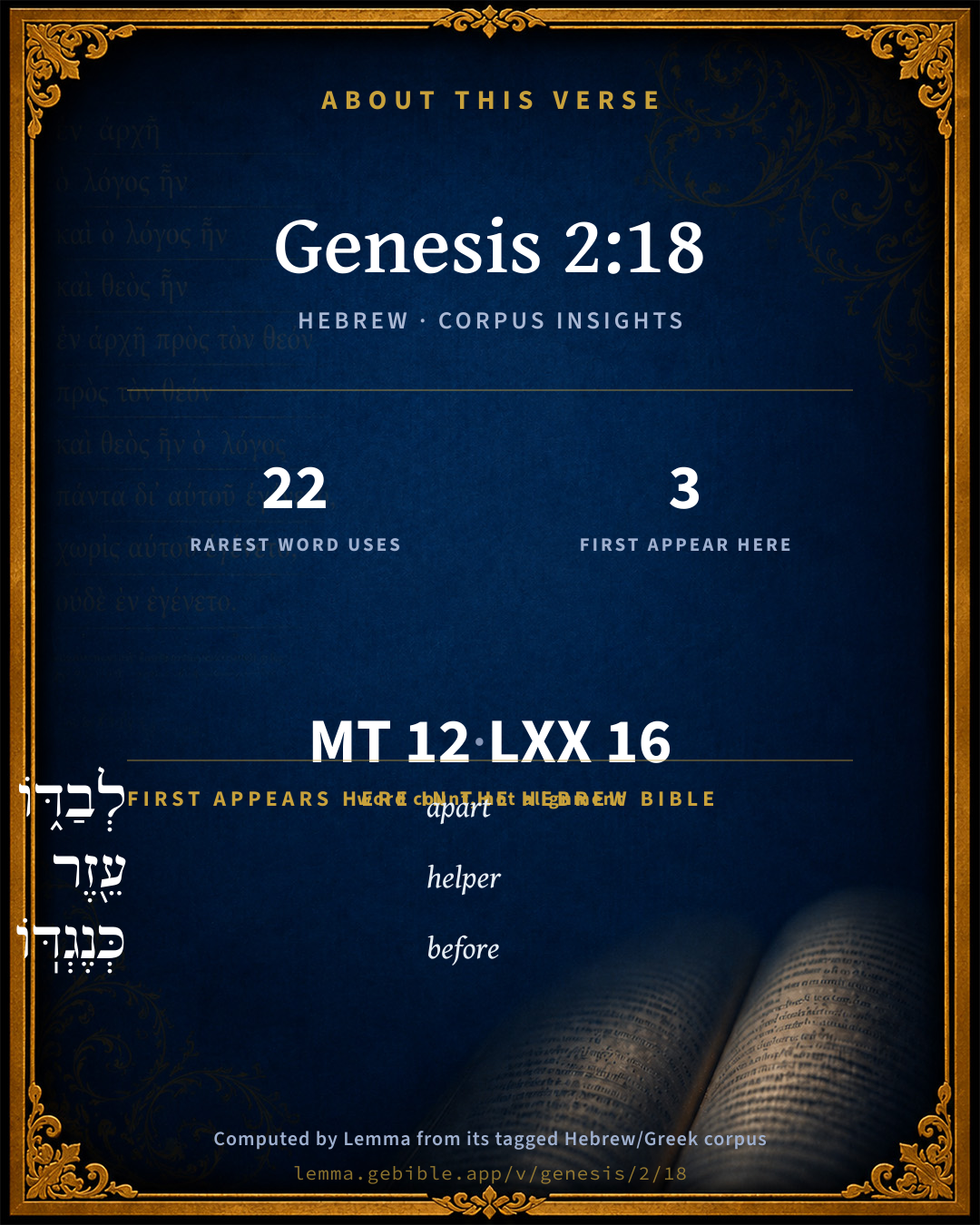
The rarest word here is עֵ֖זֶר helper H5828 — appearing just 22 times in the whole Hebrew Bible.

First appearance in Scripture

These words make their first canonical appearance in the Hebrew Bible here:

  • לְבַדּ֑וֹ apart H905
  • עֵ֖זֶר helper H5828
  • כְּנֶגְדּֽוֹ before H5048

Shared distinctive vocabulary

עֵ֖זֶר helper H5828 occurs in 21 verses of the Hebrew Bible. Also found in:

Grammatical profile

  • 3 verbs
  • 5 nouns
  • 1 adjective
  • 2 prepositions
  • 1 particle

Verb forms

  • וַיֹּ֨אמֶר֙ Qal · Sequential Imperfect
  • הֱי֥וֹת Qal · Infinitive Construct
  • אֶֽעֱשֶׂהּ Qal · Imperfect

Hebrew & Septuagint length

In English translation the verse runs 22 words from the Hebrew and 25 from the Septuagint (LXX English) — closely comparable.

A rough comparison of the two English renderings, which tokenize alike — not a word-level alignment.

Word counts can differ between the Hebrew and the Greek without any difference in meaning — e.g. the Hebrew direct-object marker אֵת has no separate Greek word, and Greek often adds the article ὁ.

In the original languages it is 12 Hebrew tokens and 16 Greek tokens — but the two are counted differently (Hebrew bundles its prefixes and suffixes into one token; the Greek is in lemma form), so that isn’t a like-for-like length.

Cross-references

9

Topical passages linked to Genesis 2:18 in the Treasury of Scripture Knowledge — connected by theme and wording, ordered by reader-vote popularity; previews shown in the World English Bible.

  • Ecclesiastes 4:9–12 Two are better than one, because they have a good reward for their labor.
  • Proverbs 18:22 Whoever finds a wife finds a good thing, And obtains favor of Yahweh.
  • 1 Peter 3:7 You husbands, in like manner, live with your wives according to knowledge, giving honor to the woman, as to the weaker vessel, as being also joint heirs of the grace of life; that your prayers may not be hindered.
  • 1 Corinthians 11:7–12 For a man indeed ought not to have his head covered, because he is the image and glory of God, but the woman is the glory of the man.
  • Ruth 3:1 Naomi her mother-in-law said to her, My daughter, shall I not seek rest for you, that it may be well with you?
  • 1 Timothy 2:11–13 Let a woman learn in quietness with all subjection.
  • Genesis 1:31 God saw everything that he had made, and, behold, it was very good. There was evening and there was morning, the sixth day.
  • Genesis 3:12 The man said, "The woman whom you gave to be with me, she gave me of the tree, and I ate."
  • 1 Corinthians 7:36 But if any man thinks that he is behaving inappropriately toward his virgin, if she is past the flower of her age, and if need so requires, let him do what he desires. He doesn't sin. Let them marry.

Cross-references courtesy of OpenBible.info (CC BY 4.0).

Hebrew and Greek witnesses Masoretic Hebrew ↔ Greek Septuagint

The same verse in the two great witnesses to the Old Testament, shown verse-for-verse.

These are two independent witnesses, not word-aligned to each other, and the Septuagint is shown in lemma (dictionary) form.

Hebrew Genesis 2:18 Masoretic · Westminster Leningrad Codex

וַיֹּ֨אמֶר֙ יְהוָ֣ה אֱלֹהִ֔ים לֹא ט֛וֹב הֱי֥וֹת הָֽאָדָ֖ם לְבַדּ֑וֹ אֶֽעֱשֶׂהּ לּ֥וֹ עֵ֖זֶר כְּנֶגְדּֽוֹ

Yahweh God said, "It is not good that the man should be alone; I will make him a helper suitable for him."

World English Bible · Public Domain

Greek LXX Genesis 2:18 Septuagint · lemma form

καί εἶπον κύριος ὁ θεός οὐ καλός εἰμί ὁ ἄνθρωπος μόνον ποιέω αὐτός βοηθός κατά αὐτός

And the Lord God said, It is not good that the man should be alone, let us make for him a help suitable to him.

LXX2012 (modern English Septuagint) · Public Domain

On this verse, The Pulpit Commentary discusses the Septuagint’s reading. Read the note in Commentary ↓

Hebrew: Westminster Leningrad Codex (CC BY 4.0). Greek: Septuagint (public domain); English from LXX2012 (modern English Septuagint) (Public Domain). How the Septuagint differs from the Hebrew →

Targum (Aramaic paraphrase)

2

The Targum is the ancient Jewish Aramaic paraphrase of the Hebrew Scriptures — an interpretive translation, not the Hebrew text itself. Onkelos (literal) and Pseudo-Jonathan (expansive) render the Torah, and Jonathan the Prophets. Coverage is partial: where no permissively-licensed English translation exists for a verse, only the Aramaic is shown. This is verse-level text, not a word-by-word alignment to the Hebrew.

  1. Targum Onkelos Torah (Genesis–Deuteronomy)
    וַאֲמַר יְיָ אֱלֹהִים לָא תַקִּין לְמֶהֱוֵי אָדָם בִּלְחוֹדוֹהִי אַעֲבֵד לֵהּ סְמַךְ לְקִבְלֵהּ

    (no public-domain English translation for this verse)

    Targum Onkelos — Aramaic: “Onkelos Genesis” (public domain); “Onkelos Exodus” (public domain); “Onkelos Leviticus” (public domain); “Onkelos Numbers” (public domain); “Onkelos Deuteronomy” (public domain). English: “Sefaria Community Translation” (CC0 1.0 (public-domain dedication)); “J.W. Etheridge. The Targums of Onkelos and Jonathan Ben Uzziel on the Pentateuch. London: Longmans, Green, 1862” (public domain). Text via Sefaria.

  2. Targum Pseudo-Jonathan Torah (Genesis–Deuteronomy)
    וַאֲמַר יְיָ אֱלהִים לָא תַקִין דִיהֵי אָדָם דָמִיךְ בִּלְחוֹדוֹהִי אַעֲבֵיד לֵיהּ אִתָּא דִתְהֵי סְמִיךְ כְּקִבְלֵיהּ

    And the Lord God said, It is not right that Adam should be sleeping alone: I will make unto him a wife who may be a helper before him.

    Targum Pseudo-Jonathan — Aramaic: “Targum Jonathan on Genesis” (public domain); “Targum Jonathan on Exodus” (public domain); “Targum Jonathan on Leviticus” (public domain); “Targum Jonathan on Numbers” (public domain); “Targum Jonathan on Deuteronomy” (public domain). English: “The Targum of Jonathan ben Uzziel, trans. J. W. Etheridge, London, 1862” (public domain). Text via Sefaria.

Commentary

Notes on Genesis 2:18 from classic Christian and Jewish commentators (each source and its license shown beneath its notes). The classic Christian expositions comment on the surrounding passage and are grouped to its opening verse, so a note may address several verses; the Jewish commentaries on the Tanakh (Rashi and others) are per-verse, so they appear only where the commentator wrote on this verse.

Lemma curates 59 commentaries, every one of them public domain or Creative Commons licensed, each selected and text-cleaned for this edition rather than reprinted as found. About our sources →

Matthew Henry's Commentary

Here we have, I. An instance of the Creator's care of man and his fatherly concern for his comfort, Gen 2:18. Though God had let him know that he was a subject, by giving him a command, (Gen 2:16, Gen 2:17), yet here he lets him know also, for his encouragement in his obedience, that he was a friend, and a favourite, and one whose satisfaction he was tender of. Observe,

1. How God graciously pitied his solitude: It is not good that man, this man, should be alone. Though there was an upper world of angels and a lower world of brutes, and he between them, yet there being none of the same nature and rank of beings with himself, none that he could converse familiarly with, he might be truly said to be alone. Now he that made him knew both him and what was good for him, better than he did himself, and he said, "It is not good that he should continue thus alone." (1.) It is not for his comfort; for man is a sociable creature. It is a pleasure to him to exchange knowledge and affection with those of his own kind, to inform and to be informed, to love and to be beloved. What God here says of the first man Solomon says of all men (Ecc 4:9, etc.), that two are better than one, and woe to him that is alone. If there were but one man in the world, what a melancholy man must he needs be! Perfect solitude would turn a paradise into a desert, and a palace into a dungeon. Those therefore are foolish who are selfish and would be place alone in the earth. (2.) It is not for the increase and continuance of his kind. God could have made a world of men at first, to replenish the earth, as he replenished heaven with a world of angels: but the place would have been too strait for the designed number of men to live together at once; therefore God saw fit to make up that number by a succession of generations, which, as God had formed man, must be from two, and those male and female; one will be ever one.

2. How God graciously resolved to provide society for him. The result of this reasoning concerning him was this kind resolution, I will make a help-meet for him; a help like him (so some read it), one of the same nature and the same rank of beings; a help near him (so others), one to cohabit with him, and to be always at hand; a help before him (so others), one that he should look upon with pleasure and delight. Note hence, (1.) In our best state in this world we have need of one another's help; for we are members one of another, and the eye cannot say to the hand, I have no need of thee, Co1 12:21. We must therefore be glad to receive help from others, and give help to others, as there is occasion. (2.) It is God only who perfectly knows our wants, and is perfectly able to supply them all, Phi 4:19. In him alone our help is, and from him are all our helpers. (3.) A suitable wife is a help-meet, and is from the Lord. The relation is then likely to be comfortable when meetness directs and determines the choice, and mutual helpfulness is the constant care and endeavour, Co1 7:33, Co1 7:34. (4.) Family-society, if it is agreeable, is a redress sufficient for the grievance of solitude. He that has a good God, a good heart, and a good wife, to converse with, and yet complains he wants conversation, would not have been easy and content in paradise; for Adam himself had no more: yet, even before Eve was created, we do not find that he complained of being alone, knowing that he was not alone, for the Father was with him. Those that are most satisfied in God and his favour are in the best way, and in the best frame, to receive the good things of this life, and shall be sure of them, as far as Infinite Wisdom sees good.

II. An instance of the creatures' subjection to man, and his dominion over them (Gen 2:19, Gen 2:20): Every beast of the field and every fowl of the air God brought to Adam, either by the ministry of angels, or by a special instinct, directing them to come to man as their master, teaching the ox betimes to know his owner. Thus God gave man livery and seisin of the fair estate he had granted him, and put him in possession of his dominion over the creatures. God brought them to him, that he might name them, and so might give, 1. A proof of his knowledge, as a creature endued with the faculties both of reason and speech, and so taught more than the beasts of the earth and made wiser than the fowls of the heaven, Job 35:11. And, 2. A proof of his power. It is an act of authority to impose names (Dan 1:7), and of subjection to receive them. The inferior creatures did now, as it were, do homage to their prince at his inauguration, and swear fealty and allegiance to him. If Adam had continued faithful to his God, we may suppose the creatures themselves would so well have known and remembered the names Adam now gave them as to have come at his call, at any time, and answered to their names. God gave names to the day and night, to the firmament, to the earth, and to the sea; and he calleth the stars by their names, to show that he is the supreme Lord of these. But he gave Adam leave to name the beasts and fowls, as their subordinate lord; for, having made him in his own image, he thus put some of his honour upon him.

III. An instance of the creatures' insufficiency to be a happiness for man: But (among them all) for Adam there was not found a help meet for him. Some make these to be the words of Adam himself; observing all the creatures come to him by couples to be named, he thus intimates his desire to his Maker: - "Lord, these have all helps meet for them; but what shall I do? Here is never a one for me." It is rather God's judgment upon the review. He brought them all together, to see if there were ever a suitable match for Adam in any of the numerous families of the inferior creatures; but there was none. Observe here, 1. The dignity and excellency of the human nature. On earth there was not its like, nor its peer to be found among all visible creatures; they were all looked over, but it could not be matched among them all. 2. The vanity of this world and the things of it; put them all together, and they will not make a help-meet for man. They will not suit the nature of his soul, nor supply its needs, nor satisfy its just desires, nor run parallel with its never-failing duration. God creates a new thing to be a help-meet for man - not so much the woman as the seed of the woman.

Matthew Henry's Commentary on the Whole Bible (1708–1710) — public domain (CC PDM 1.0). Text via the HelloAO Bible API.

Jamieson, Fausset & Brown

Robert Jamieson, A. R. Fausset & David Brown

THE MAKING OF WOMAN, AND INSTITUTION OF MARRIAGE. (Gen 2:18-25)

it is not good for the man to be alone--In the midst of plenty and delights, he was conscious of feelings he could not gratify. To make him sensible of his wants,

Jamieson, Fausset & Brown — Commentary Critical and Explanatory on the Whole Bible (1871) — public domain (CC PDM 1.0). Text via the HelloAO Bible API.

Trapp's Complete Commentary

John Trapp

Gen 2:18 And the LORD God said, [It is] not good that the man should be alone; I will make him an help meet for him.

Ver. 18. And the Lord God said.] Had said; to wit, on the sixth day when he made man, and there was not a meet help found for him. Then God said, "It is not good," &c., and so created the woman by deliberate counsel, as before he had done the man. Only there it was in the plural, "Let us make," here, "I will make"; to show the unity of the essence of the Trinity of persons.

It is not good for man to be alone.] It is neither for his profit, nor his comfort. {Optimum solatium sodalitium.} The Hebrews, in their bigger Genesis, say, He who wanteth a wife, wanteth a help, a joy, a blessing, an expiation: R. Josua saith, he wants a name: R. Levi addeth, he wants life: R. Hija, the son of Gamri, saith, he is no perfect man who is unmarried: R. Iose saith, such a one is without a wall, without glory, riches, a crown, favour. {a}

I will make him a help meet for him.] Or, such another as himself, of the same form for perfection of nature, and for gifts inward and outward; one in whom he may see himself, and that may be to him as an alter-ego, a second self. {Eph 5:28} Such a one as may be a help to him - both for this life, (1.) by continual society and cohabitation; (2.) for procreation and education of children; - and for the life to come, (1.) as a remedy against sin; {1Co 7:2} (2.) as a companion in God’s service. {1Pe 3:7} Nazianzen {b} saith, that his mother was not only a meet help to his father in matters of piety, but also a doctress and a governess; and yet he was no baby, but an able minister of the gospel. Budaeus, that learned Frenchman, had a great help of his wife in points of learning; she would be as busy in his study as about her housewifery. Placilla, the Empress, was a singular help to her husband, Theodosius, in things both temporal and spiritual. And so was our King Edward III’s Queen, a lady of excellent virtue, the same that built Queen’s College in Oxford. She drew evenly, saith the historian, {c} with the king her husband in all the courses of honour that appertained to her side, and seemed a piece so just cut for him, as answered him rightly in every joint.

{a} εφυγον κοκον ευρον αμεινον - Athenis in nuptiis dici solitun. Zenod. Proverb.

{b} ου συνεργος μονον αλλακι αρχηγος εγενετο - Naz. in Pat. Epitaph.

{c} Non tractat negligentius libros meos quam liberos. - Daniel’s Chron. fol. 262.

John Trapp, A Commentary or Exposition upon All the Books of the Old and New Testament (1647–1656) — public domain. Text from a community e-Sword module.

Albert Barnes' Notes on the Bible

- XIII. The Naming of the Animals

Here man’s intellectual faculties proceed from the passive and receptive to the active and communicative stage. This advance is made in the review and designation of the various species of animals that frequent the land and skies.

A new and final need of man is stated in Gen 2:18. The Creator himself, in whose image he was made, had revealed himself to him in language. This, among many other effects, awakened the social affection. This affection was the index of social capacity. The first step towards communication between kindred spirits was accomplished when Adam heard and understood spoken language. Beyond all this God knew what was in the man whom he had formed. And he expresses this in the words, “It is not good for the man to be alone.” He is formed to be social, to hold converse, not only with his superior, but also with his equal. As yet he is but a unit, an individual. He needs a mate, with whom he may take sweet counsel. And the benevolent Creator resolves to supply this want. “I will make him a helpmeet for him” - one who may not only reciprocate his feelings, but take an intelligent and appropriate part in his active pursuits.

Albert Barnes' Notes on the Bible (1834–1885) — public domain. Text from a community e-Sword/MySword module.

The Biblical Illustrator

Joseph S. Exell

Gen_2:18-25

I will make him an help meet for him

The creation of woman

I.

WOMAN WAS BROUGHT TO MAN IN ORDER THAT SHE MIGHT RELIEVE HIS SOLITUDE BY INTELLIGENT COMPANIONSHIP.

II. WOMAN WAS BROUGHT TO MAN THAT SHE MIGHT BE HIS HELPMEET IN THE STRUGGLES OF LIFE.

1. To develop his intellectual thinkings.

2. To culture his moral sympathies.

3. To aid him in the daily needs of life.

4. To join him in his worship of God.

III. WOMAN WAS BROUGHT TO MAN THAT SHE MIGHT RECEIVE HIS LOVE, PROTECTION, AND CARE. LESSONS:

1. The Divine compassion for a lonely man.

2. That marriage is to furnish man with true companionship of soul.

3. That marriage is to aid man in all the exigencies of life. (J. S.Exell, M. A.)

The creation of woman

1. The occasion.

2. The resolution.

3. The preparation.

4. The presentation. (J. S. Exell, M. A.)

Loneliness is not good

1. For intellectual development.

2. For moral culture.

3. For true enjoyment. (J. S. Exell, M. A.)

Loneliness not good

1. For mans comfort.

2. For mans employment.

3. For posterity. (J. S. Exell, M. A.)

The woman a help

1. For assistance in family government.

2. For the comfort of society.

3. For the continuance of the race. (J. S. Exell, M. A.)

Complete solitude

I. ADAMS LONELINESS WAS COMPLETE.

II. This complete loneliness was A MARK OF IMPERFECTNESS OF LIFE.

III. This complete loneliness, marking an imperfect life, was THOROUGHLY UNIQUE. (Urijah R. Thomas.)

Genesis of woman

I. EXPLANATION OF THE PASSAGE.

1. A Divine parable.

2. Panorama of emergent woman. It is the golden hour for Divine instruction; for it is in dreams, in visions of the night, when deep sleep falleth upon men, that God openeth their ear, and sealeth up their instruction (Job_33:15-16). Wrapped in his deep sleep, Edens dreamer beholds the vision of his second self. He sees his Maker taking from out of him one of his own ribs, forming it into a woman, and presenting her in all her glorious beauty to himself, to be to him henceforth that blessed mate for whom he has unconsciously sighed. And so his God has in very truth given to His beloved in his sleep (Psa_127:2). Nor is it altogether a dream. Awaking from his sleep, he beholds still standing by him the fair blissful vision. Instinctively recognizing the community of nature, he joyously exclaims; This, now, is bone of my bones and flesh of my flesh; this shall be called woman, Isha because from man, Ish, was she taken.

II. MORAL MEANING.

1. Womans formal inferiority to man. Woman, in the matter of outward, formal, scenic authority, is to yield to man. For every kind of organization, whatever it may be, political, military, financial, ecclesiastical, domestic, must have some kind of nominal head, or index finger--e.g., king, president, general, chairman, bishop, pastor, husband. Look at grand old fatherland. According to her theory of Government, England must have a monarch. And who sits on Englands throne today? A woman--a pure, noble, true-hearted woman. But, because Victoria wears a crown as her nations emblazoned figurehead, does it necessarily follow that she is intellectually superior to the Disraeli who holds her helm of state; or morally superior to the Spurgeon who preaches that there is another Sovereign, even one Jesus? Quite so is it with woman in her relation to man. According to Holy Scripture, she is subordinate to him. But this subordination implies in no sense whatever any essential inferiority. Woman is mans peer in all essential capacities--in capacities of sensibility, intellect, moral worth, humanhood. Woman is mans inferior simply in the matter of scenic, symbolic, formal authority.

2. Womans essential equality. Man and woman, considered in their essence, are a unity. But, observe, unity implies complexity; that is to say, unity implies likeness and unlikeness, sameness and difference, community and diversity.

(1) Community of man and woman. Woman is mans essential peer, his Alter Ego, his second self. There is nothing, then, in the essential nature of woman which should exclude her from the rights, privileges, activities, or duties, which inherently belong to the genus Homo. Whatever is legitimately open to man, not indeed as a man, but as a human being, is equally open to woman: for both are equally human. Woman as well as man can feel, think, reason, imagine, observe, classify, generalize, deduce. Woman as well as man can sell goods, plan buildings, make statues, resolve nebulae, discover elements, diagnosticate diseases, construct philosophies, write epics. There is nothing in the nature of woman as woman which should forbid her having a specific employment or vocation as distinctively as the brother brought up by her side. True, there are some things which woman cannot do as well as man: not because she is inferior in any of the essential attributes of humanity, but simply because she is inferior in the accidental element of physical strength.

(2) Diversity of man and woman. Woman is something more than a supplement or appendix to man; woman is mans complement. Man and woman are the two poles of the sphere of humanity, opposite and complemental, complemental because opposite. And the one pole implies the other. Legislate as much as you please, you cannot abolish the fact of the sexes. Constituently, elementally the same, man and woman are organized on different bases. Like the stars, they differ in their glory (1Co_15:41). Each has certain excellences which are peculiar to each, and distinctive of each. Mans excellences are virtues; womans excellences are graces; and I suspect that, in the judgment of Him who seeth in secret, the graces are diviner than the virtues.

3. Marriage a Divine institution.

4. The earthly marriage a type of the heavenly. (G. D. Boardman.)

Gods provision for mans needs

I. GOD KNOWS AND CONSIDERS ALL OUR WANTS, AND OUT OR HIS OWN GOODNESS MAKES PROVISION TO SUPPLY THEM. And this--

1. He must do, or else we should often perish.

2. And it is fit He should do so to magnify His free mercies. Let Gods dealing with us move us to deal in like manner with our brethren, considering the poor and needy (Psa_41:1) after the example of the disciples of Antioch (Act_11:29).

II. GODS PROVIDENCE AND ABUNDANT GOODNESS FAILS US NOT TILL IT HATH SUPPLIED US WITH ALL THAT WE NEED THAT IS FIT FOR US. Let it quiet all our hearts in the consideration of our present condition, when our inordinate lusts provoke us sometimes to causeless complaints and murmurings upon supposed but mistaken grounds. Whereas--

1. Either we have that which we conceive we want, as Hagar wept for want of water when she saw not the well which was fast by her Gen_21:19). Or--

2. That which we want would do us hurt and no good if we had it, as the Israelites found by experience when they murmured for want of flesh Num_11:33).

III. A SOLITARY LIFE IS AN UNCOMFORTABLE AND AN UNPROFITABLE LIFE. From whence, then, came the affecting and admiring of a monastical life which crosseth--

1. The very law of nature by which men are inclined to society; and--

2. Gods ordinance who hath appointed us--

(1) To cause our light to shine before men that they might glorify Him Mat_5:16). And to serve one another through love (Gal_5:13). So that a solitary life--

(a) Deprives God of His honour;

(b) Men, and the Church especially, both of that increase of an holy seed, which they might have of the fruit of their bodies, of the comfort of their fellowship, the service of love which they owe, and of the examples of their godly lives;

(c) Themselves in present, of many sweet comforts and needful helps, and hereafter of the increase of their reward enlarged according to the proportion of their present improving of their talents in advancing Gods honour, and seeking and procuring the good of His children.

IV. GOD TAKES NOT NOTICE OF OUR WANTS AS AN IDLE SPECTATORS BUT, AS A FAITHFUL HELPER, PUTS FORTH HIS HAND TO HELP US IN WHAT WE NEED. Let us do likewise--observe, take pity, and relieve.

1. Otherwise our brethren have no benefit by us if we express our compassion in words only, and not in deeds (Jam_2:16), but provelike clouds and wind without rain (Pro_25:14).

2. We make our own thoughts or words evidences against ourselves when we know what our brother needs and help him not, and provoke God to neglect us as we neglect Him. See what He threateneth in such a case Pro_24:11-12).

V. GOD MAKES NOTHING BUT FOR SOME NECESSARY USE AND UNTO SOME PROFITABLE END.

VI. A WIFE IS NOT GOOD TILL IT BE NOT GOOD TO BE WITHOUT A WIFE. VII. A MAN MAY, AND IT IS GODS WILL THAT HE SHOULD, BE THE BETTER FOR HIS WIFE.

1. Woe be to those foolish wives that pluck down the house which they should build (Pro_14:1), proving moths in their husbands estates by their idleness and wastefulness; and thorns in their sides, vexing those whom they should comfort, with their continual dropping; perverting those whom they should advise.

2. Let every man labour to be the better for his wife, and to that end--

(1) Let him labour to be good in the sight of God.

(2) Let him look well to his choice, that he may take a godly wife, and a wife fit both for his condition and disposition.

(3) Let him dwell with his wife as a man of knowledge, governing her with all meekness, instructing her, and bearing with her infirmities (1Pe_3:7).

VIII. IT IS ONLY GOD HIMSELF THAT MUST SUPPLY US WITH THAT WHICH WE STAND IN NEED OF.

IX. NOTHING MOVES GOD TO TAKE COMPASSION ON US, TO SUPPLY US IN WHAT WE NEED, BUT HIS OWN BOUNTY AND GOODNESS.

X. A WIFE IS BUT AN HELPER TO HER HUSBAND. Not his guide, for she was created for the man, not the man for her (1Co_11:9), and that too, inferior unto him, both in dignity, and usually in abilities. So that she is truly and worthily called the weaker vessel (1Pe_3:7).

XI. A WIFE CANNOT BE A GOOD WIFE UNLESS SHE BE A MEET AND A FIT WIFE. Answerable, if it may be--

1. In blood and parentage (see 1Sa_23:1-29.).

2. In estate.

3. Education.

4. Especially in the temper of her disposition.

5. But above all the rest, in religion; seeing there can be no fellowship of righteousness with unrighteousness, nor of light with darkness (2Co_6:14). Least of all between married persons. (J. White, M. A.)

Gods provision to remedy mans loneliness

God has always been thinking what would be for the mans good. How, then, does God propose to meet loneliness? By making another man? Why, when He made a man to keep Cain company, Cain killed him! It would seem to be one of the deepest laws of human nature that man must kill man, and that the only chance of keeping society together is by the marvellous influence of woman. For man to be alone means suicide; for two men to be together means homicide; woman alone can keep society moving and healthful. The woman and the little child are the saviours of social order at this day all over the world. For woman to be alone is as bad as for man to be alone. Safety is in contrast, and in mutual complement. Reverence for womanhood will save any civilization from decay. Beautiful and very tender is this notion of throwing man into a deep sleep to take a rib from him as the starting point of a blessed companionship. So much is always being done for us when we are in states of unconsciousness! We do not get our best blessings by our own fussiness and clever contrivance: they come we know not how. They are sweet surprises; they are born of the spirit, and are as untraceable as the veerings of the wind. This is the course of true love, and of marriages that are made in heaven. You cannot by searching, and advertising, and scheming find out a companion for the lonely soul. She will come upon you unconsciously. You will know her by a mark in the forehead which none but yourself can read. (J. Parker, D. D.)

The creation of woman

I. The Creators care of man, and His fatherly concern for his comfort.

1. Gods pity for his solitude.

2. His resolve to provide society for him.

II. The creatures subjection to man, and his dominion over them. God brought the animals to Adam that he might name them, and so give a proof of--

1. His knowledge.

2. His power.

III. The creatures insufficiency to be a happiness for man. Observe--

1. The dignity and excellency of human nature.

2. The vanity of the things of this world. (M. Henry, D. D.)

Eve

Let us speak of--

I. The woman.

1. Her creation.

2. The purpose God had in view in creating her.

II. The wonderful institution by which man and woman are made one. It is wonderful that this institution should be found so early in human history.

III. The glorious union of which this institution is a type. Adam is a type of Christ; and since Christ was the spouse of the Church, then Eve was a type of the Church. And our conclusion therefore is that the marriage of Adam and Eve, and the marriage institute altogether, is typical of the union between Christ and the Church. (T. W. Richards, M. A.)

Lessons

1. How it is not said by God that it was not good for Adam to be alone, but for man to be alone; thereby in wisdom enlarging the good of marriage to man in general, that is, to some of all sorts, and not tying it to Adam alone, or to any sort only. Again, in saying it is not good, you see what the Lord regardeth in His actions and works, to wit, goodness and profit to the users, how good it may be, how comfortable: which is a good lesson for all such as regard in their deeds, their wills, their pleasures. Sis volo, sic iubeo, So will I, so command I; not respecting at all the good of any other. Shall sinful flesh disdain to do what the Lord of lords doth? He, though He have all power and authority, yet will not do only according to that, but He looketh how good it may be that He doth; and shall sinful flesh, dust and earth, upon a little authority be so proud, that their will must rule all actions?

2. Mark it with all your heart, how God doth consider before ever man see the want himself, what may be good for man, and entereth into purpose to make for him, and prepare for him what yet he wanted and had need of, saying, Let us make man a helper like himself. Oh, how may we cleave and cling to the providence of this God in all comfort of our minds, that thus thinketh of what may be good for us before ever we think of it ourselves, and not only thinketh of it, but provideth it and prepareth it for us, saying in all matters as in this, Yet my servant such an one wanteth such a help, it is not good for him to be without it; come, therefore, let us prepare it for him, etc.

3. That woman is honoured with the title of a helper, not only showeth the goodness of the institution, as was noted before, but teacheth also how dear and beloved she should be to her husband, for whose good she was ordained and given. Who will not cherish, foster, and love what is given him for a help, not by man, but by God Himself? Her help chiefly consisteth in three things, in bearing him children, the comforts of his life, and stays of his age, which he cannot have without her. In keeping his body holy to the Lord from filthy pollution which the Lord abhorreth. The apostle so teaching when he speaketh thus, For the avoiding of fornication, let every man have his own wife. And, thirdly, in governing his house, children, and family, and many ways tending his own person both in sickness and health. These all and everyone are great helps, and therefore the woman justly to be regarded for them.

4. But whereupon was woman made? Surely not of an outward but of an inward part of man, that she might be dear to him even as his inwards. Not of the head of man, lest she should be proud and look for superiority. Not of the foot of man, lest she should be contemned and used as for his inferior; but of his side, that she might be used as his fellow, cleaving to his side as an inseparable companion of all his haps whilst they two live. And as the rib receiveth strength from the breast of man, so doth the woman from her husband: his counsel is her strength, his breast should she account of to be ruled and governed by in all her ways, and seek to please him and ease him from all griefs as she any way can, knowing ever that she is most weak without her husbands breast, from which cometh all her strength and good comfort at all times. No creature had his mate made of his own flesh but man, and therefore no creature under heaven should be like man in the love of his mate, but man above them all.

5. It is, if you mark it, not only said that God made woman, but that He brought her to man: and thereby we are taught, that marriage is not every meeting of man and woman together upon their own heads, but when God bringeth them together, either to other: and God bringeth not together, except in His fear they meet with consent of parents and such as are interested in them. (Bp. Babington.)

Gods ordinance of marriage

Let us pay particular attention to this language. Probably we have imagined the statement to mean that God would provide for man one who should be a helper to him, and whose nature and character would be suitable to his. Well, the words do mean this; but they mean also something more. Correctly rendered they would run thus: I will make him a help as over against him; or, so as to meet him: that is to say, I will create for him one who shall tally and correspond with him as his counterpart. And the expression seems to point to that oneness in diversity, to that moral, intellectual, and spiritual adaptation of one to the other,--which exists between the woman and the man. Why were the man and the woman not created apart, as the animals were, and afterwards brought together? Because Adam was to be the inclusive head of the human race: all were to be derived from him; he was to be the fountain from which every stream should flow. Therefore it was necessary that woman should not have an independent, but a derived existence--an existence derived from the federal head of the human race. As St. Paul says, Man is the image and glory of God: but the woman is the glory of the man. For the man is not of the woman; but the woman of the man.

I. Now in commenting upon the passage, let us take this as the thought which rises first before the mind--THAT IT WERE WELL IF THE RELATION BETWEEN THE TWO SEXES, AND EVERYTHING BEARING UPON THE MARRIAGE TIE, WERE LOOKED UPON AS BEING SOMEWHAT SERIOUS MATTERS. Of course no sensible man would speak in an unnaturally solemn tone about them. He would throw bright and cheerful colours upon the subject of courtship and marriage. He knows that this entrance into life ought to be characterized by joyousness. But yet, underlying the joyousness, there should be, we venture to think, for Christian people, a sense of seriousness and responsibility. Young women, for instance, should understand and value the influence which they exert in the world; whereas, too often, in their intercourse with the other sex, they condone worthlessness of character for the sake of showy and attractive qualities. And as to men, if they would see the relation of the sexes in the light which this narrative of Genesis throws upon it, the), would be more characterized than perhaps they are by chivalrous respect for womankind. They would honour a woman because she is a woman.

II. Our second thought CONNECTS ITSELF WITH THE SUBJECT OF WHAT IS COMMONLY CALLED WOMENS RIGHTS. Now let us see our way clear in this matter. We do not suppose that the great end of woman is to get married: many say so and think so; but so do not we. Still less do we wish to be understood as implying that a woman is justified in regarding herself, or that others are justified in regarding her, as having in any considerable degree failed of the object of her existence, if circumstances should lead her to remain in a single condition. Yet whilst holding the view of the essential and independent dignity of womanhood, we lament over that mismanagement of human affairs, which necessitates in so many human beings a life of celibacy; and we trace up to the fact of the immense and most disproportionate preponderance of women in our modern civilization, the existence of many of the evils which are sapping the foundations of our social prosperity. Well, you may say, there is the fact: you cannot alter it. No: I know that we cannot alter it; but we can try to make the best of it. Recognizing that there are, and that as matters now stand there ever must be amongst us large numbers of unmarried women, we would do all we could to make it possible for them, or at least for many of them (for some do not require it), to attain to a position of independence by means of their own honest exertions. This, at the very least, is our duty. But do we fulfil it? Of course we do not. I need not say that in the case of the educated classes, and in the case of those who come immediately below them, the way to independent subsistence for women is barred and blocked up by innumerable obstacles, that the sleepless dragon of popular prejudice guards most of the avenues of access to the golden fruit of honourable success, and that those few women who, as the pioneers of the advance of their sex, contrive by persistent energy to break through the circle of iron that encompasses them, are only too likely to acquire an unattractive and unfeminine hardness, from the very strength of the effort which enables them to force their way. There is something here which is wrong, and wants amending. Our social arrangements necessitate celibacy for hundreds of thousands who, probably, would not embrace that condition by choice. And then we frown upon their efforts if they struggle to maintain--might they be permitted to do so--an independent foothold upon our common earth. One last thing more let me say, and this of the same general character with what I have already ventured to advance. I have no manner of sympathy with the cackle and clatter we sometimes hear about the relative excellencies of the two sexes--about the superiority of one or the inferiority of the other. To me the idea that a woman wants only a clear stage and no favour, wants training, and education, and suitable circumstances, in order to develop as big a brain and as vigorous a muscle as man, and so to be able to cope with him in the struggle of life--to me such a thought is unutterably repulsive. The great charm of a woman is that she is diverse from man: not a man in a lower stage of development. She is the complement of the man: her nature, her disposition, her powers, supply what is lacking in his. The two together make a completed orb: apart they are only segments of the circle. But in order to stand in this relation to each other, it is obvious that they must not be alike, but diverse. I believe with our great modern poet, that woman is not undeveloped man, but diverse. Nay, and I believe that the sexual differences of character, and disposition, and faculty, and nature generally which exist upon earth, will be found--of course in a certain modified form--to exist in the kingdom of heaven. (G. Calthrop, M. A.)

Eve

God does nothing without a purpose: and therefore the rib, which the Lord God had taken from man, made He a woman. We can readily understand that, had Eve been builded of the earth as Adam was, there would have been a relationship between them which was never intended. They might have been regarded as bearing towards each other in some degree the tie of a brother and sister, springing from the earth as the parent of both. But the love that was to exist between them was not designed to be the love of relationship, not the love of consanguinity, not the love of a brother and sister. Adam was to love Eve as being essentially a part of himself, as a friend that sticketh closer than a brother, as one that originated in himself, and actually derived her existence from his own body. And the great purpose which the Almighty had in view in this formation of woman was the institution of marriage. So that you are not to regard the formation of Eve simply as a creation of the woman, just as the formation of Adam was the creation of the man; but you must consider it as the production of Adams wife, and as having involved in it the Divine purpose of the institution of marriage. And then you see at once why the peculiar process of creation was employed in taking the rib of Adam. And all this shows us and teaches us that marriage is a Divine institution of no ordinary import, and that its vows and obligations are to be regarded as in a high degree sacred. It should never be entered upon inconsiderately, nor should its festivity ever go on to such extent as to blot out its sacred character. If we fail to recognize its Divine appointment, and give it not the reverence which it claims by virtue of its Divinity, how shall we look for the Divine blessing? It should be all love--love from the beginning to the close of the compact; like the ring, which belongs to our ceremony, having no end, emblematic of eternal love. And this is a mystical love: it is not the love which nature plants and nourishes wherever she has established kinsmanship, or where she has joined soul to soul in the bonds of friendship. It is a mystic love, which takes its stand upon Divine institution, and can be traced only to the recorded circumstance of creation--The rib, which the Lord God had taken from man, made He a woman. And it strikes us as a wonderful thing, that this institution should be found so early and so prominently placed among the brief records of creation. We should, perhaps, have rather expected that it would have had its position among the Levitical appointments. It behoves us, then, to inquire whether there was any special purpose of the Almighty, whether there was any hidden mystery involved in the institution. There appears to be something so remarkable in the creation of the woman, and there is something so expressive in Adams remark: This is now bone of my bone and flesh of my flesh; and the appointment is altogether so wonderful, that there must be some meaning in the history beyond that which appears upon the surface, and beyond that which our remarks have hitherto included. Now, we know that in many particulars Adam was a type of Christ our Redeemer. Husbands, says the apostle, love your wives, even as Christ also loved the Church, and gave Himself for it. And, after speaking and exhorting concerning marriage, he quotes the very words employed by Adam at its first institution, and adds, This is a great mystery, but I speak concerning Christ and the Church. If, then, Adam was the type of Christ, and Christ is the spouse of the Church, it follows as a logical deduction that Eve was a type of the Church. And our conclusion therefore is this, that the marriage of Adam and Eve, and the marriage institute altogether, is typical and emblematical of the union between Christ and His Church. And thus, in the very first page almost of the Bible (and there is hardly a page or a letter that has not reference to the same wonderful subject), we find redemption hinted at, and a Redeemer pointed out, and a Church suggested. Here is the gospel, here is the glad tidings of mediation in the very alpha of Divine revelation, and it is never lost sight of, even to the omega. And here, then, we arrive at the deep mystery of the marriage institute: here we learn why its appointment is such a prominent feature in the concise history of creation. If, then, we have reasoned correctly, and Eve be thus a type of the Church, then it would prove a matter of profitable investigation to observe how the position and the directions of Adam and Eve apply in their fulfilment to Christ and the Church. But we can only hint at these things, and leave this wonderful subject for private meditation. There can be no question but that the opening of Adams side for the formation of Eve had had reference to that opening of the side of the second Adam for the formation of His Church, which took place upon the cross at Calvary; for the Church, the ransomed of Sion, owes all its existence and all its salvation to the water and the blood which issued upon the spear stroke of the soldier, and without which, we are told, there could have been no remission. And this opening of the side also was effected during a deep sleep; for, when the soldiers came to Him, they found that He was dead already: it was a deep sleep, the deep sleep of death. Let us, then, be true to ourselves and to our profession; so that, after having taken upon us the vows of marriage to Christ, we may never be spoken of as a wicked and adulterous generation. (T. W. Richards, M. A.)

The family: its scriptural ideal and its modern assailants

I. THE FOUNDATION OF THE FAMILY IN NATURE.

II. THE IDEAL OF THE FAMILY. The family is one of natures combinations, being composed of several constituent parts; and it shows the same properties as are usually found in the other combinations of nature. In such combinations we find two things: first, a natural affinity or attraction of the parts to each other; and second, harmony and repose when the combination is effected, as if some invisible cement has been made use of to bind the whole into one. Harsh, frictional combinations are foreign to nature. The oxygen and hydrogen that combine to form water have a natural affinity to each other, and the product is so beautifully harmonious that no one could have fancied beforehand that water was not a simple substance. The most striking instance of harmonious combination in nature is that of light, where the seven colours of the rainbow give birth to a product in which the faintest trace of discord can never be found. Nature, in arranging her forces, makes a similar provision in that combination which we call the family. The intention of nature, or rather of the Creator, seems obvious here, although that intention is often frustrated by the perversity of man. In the first place, a natural affinity draws the man and woman together. There is not only the natural affinity of the sexes, but there is the individual attraction between one man and one woman, the desire to be closely related to each other, which is the true and natural foundation of marriage. It would be a very low view of the marriage relation that would make it flow from instinct alone. Man is surely much more than an animal. Has he not a spiritual nature that allies him to the higher orders of being, as really as his animal nature allies him to the lower? And when one human being is drawn to another with a view to the closest relation it is possible to form, surely this is not merely an attraction of the animal; the higher nature has a share in it too. We speak, at present, of what seems to be the purpose of the institution. We say that the law of affinity that governs all natures combinations leads us to expect that the foundation of marriage should lie in an affinity or attraction, not of one part of mans nature merely, and not of the lower part of it merely, but of the whole. And when we turn to the Bible we find this view amply confirmed, for it is said, Therefore shall a man leave his father and his mother, and shall cleave unto his wife, and they twain shall be one flesh. There must be some attraction of the higher nature to draw a man from his father and mother, to whom his best affections would naturally induce him to cling. In other words, true marriage has its foundation in the attractive power of love. And as love is its foundation, so also it is the cement designed to bind the two beings into unity, and give rise to that harmony which we have seen to characterize all natures combinations. Differences of temperament, varieties of taste, diversities of will, diverse forms of natural weakness and natural temptation tend naturally to friction and discord. What provision is there in nature to counteract this tendency and secure harmony? Love is the moral cement of nature. By its magi¢ power, different temperaments become the complements of each other, opposing tastes find a method of reconciliation, and even contradictory wills, by learning to take and give, to bear and forbear, become like one. Perhaps it will be asked, Are you serious in affirming that marriage should always be founded on mutual love? Is not such an idea utterly Utopian? It may be: but Utopianism is not always the opposite of truth or of duty. If we were to lay it down as a proper rule of life that men should always speak the truth, it would seem utterly impracticable and Utopian; and yet it is a right and proper rule. When we speak of love we do not mean necessarily the state of ecstatic fervour which is commonly delineated in novels and which is sometimes found in actual life. That real affinity of hearts to each other which is the true foundation of marriage, may be, and often is, much more calm and undemonstrative. There is another important element that enters into the idea of a complete family, and in connection with which, too, provision is made in nature for harmonious combination with the other elements--namely, children. It is not difficult to see, either in theory or in practice, that children may very readily become a most discordant element. To bring about the needful and desirable harmony, the parents are furnished with two things, strength and affection. They have strength of body if not also of mind to enforce what they deem right; but the employment of sheer strength would only stir up the spirit of rebellion, and while producing a temporary submission, make the discord deeper in the end. Hence love, parental love, is supplied, to make the application of strength more smooth and more effective. The two must work together, otherwise evil ensues. Thus we see how, in the case of families, the great law of nature is exemplified which aims at making all combinations harmonious and efficient. If in the case of any family the combination is discordant, it is because the working out of the plan is abused in the hands of frail human beings. For it is a painful fact in this worlds history that nothing so often frustrates the plans of providence as the intervention of man. When Divine arrangements fall to be carried into effect by the blind forces of nature, they are carried out with precision and certainty; but when they are dependent on the intervention of man, bungling and defeat are too often the result.

III. THE PURPOSE OF THE FAMILY.

1. As regards the fellowship of husband and wife. It is to be remarked that the reason which is given in the second chapter of Genesis why God made woman is, that He might furnish the man with a suitable companion; it is not till afterwards that she is named Eve, in token of her motherhood, because she was the mother of all living. Scripture views the relation of the married man and woman, therefore, as having an important end to serve in the Divine purpose, even apart from the continuation of the race. Man and woman come into this remarkable relation of unity in order to promote each others welfare. True, there is often discord instead of unity. But unity is certainly attained in quite a sufficient number of cases to vindicate the wisdom of the arrangement. One thing is very certain: if this unity be not realized, the relation of husband and wife, instead of being beneficial, must be irksome and even disastrous to both. To be forced to live, eat, sleep, and worship together, while their hearts are at open discord, is simply awful. On the other hand, where there is substantial unity, the necessary interlacing of all the events of their life makes the unity the greater, and invests the relation with a more tender interest and a profounder sanctity. To bear the same name: to spend their days and nights in the same house and chamber; to share the same worldly goods; to be parents of the same children; to be partners of one anothers joys and sorrows, cares and anxieties, perplexities and deliverances; to look to one another for counsel and cheer; to mingle their prayers and thanksgivings as none else can; to look back along the line of their lives, and think of all they have shared; to look forward, and think of the inevitable parting that is coming, and then of the reunion which faith expects; who shall deny that such experiences are fitted not only to deepen the unity which lies at the foundation of the relation, but to elevate the tone of life, purify the character, and sweeten the current of existence, as no other earthly influences can? Where the two are one flesh, there must be no contact with other flesh. And here, too, nature provides an abundant reward for those who are faithful to her order. Nothing keeps the fountain of conjugal love so pure and fresh as absolute faithfulness to the marriage bond. Even in pagan nations, there have been beautiful instances of a happy unity and the highest esteem between man and wife. Joseph Cook, in his Boston lectures, finds much in this connection to vindicate marriage on natural grounds. He instances the case of the wife of Phocion, the great reformer, who, when her husband was refused burial in Attic soil, went by night to burn the body, brought back his bones to Athens, buried them beneath her hearth, and blessed the place that thus afforded protection to the remains of a good and great man, until the Athenians, returning to their right minds, should restore them to the sepulchre of his fathers. More striking is the story told by Cyrus of Panthea, the wife of Abradatus. She loved her husband with a supreme affection. When taken captive by Cyrus, he asked her where her home was. On the bosom of my husband, was in substance her reply; and when offered a dazzling position at the Court of Cyrus, she besought them to send her swiftly home. If ever there was a woman that regarded her husband more than her own soul, she was that woman. Encouraging him to fight for Cyrus to show his gratitude, she sent him with her blessing to the battle in which he fell. Again she had offers of this worlds glory; again her purpose was declared to be with her husband. I cannot justify Panthea in everything, says Mr. Cook. She had been brought up to the stern opinions which justified suicide. She told her maid to cover her in the same mantle with her husband. Then she smote herself; put her head upon his breast, and fell asleep. Great nature is in that! You wish me to teach what science proclaims respecting family life. I must ask you to go back to the deepest springs of human experience. These women, Phocions wife and the wife of Abradatus are sisters to us all, helpers to every age. They are crystalline water bursting up from the innermost rifts of human nature and society, and one in its purity with that rain which falls on all the hills, and is the real source, after all, of every one of these crystalline springs. Even under Paganism there were thus influences strong enough to realize in at least some instances the true unity of husband and wife, and show to the world what kind of relation it was designed to be. Christianity has brought new influences into the field. A new pattern has been furnished of conjugal unity, and a new force for developing conjugal love (Eph_5:25; Eph_5:30).

2. The relation of parents and children. Now let us observe that the provision of nature for the bringing up of children is to place them under the charge of their two parents, both possessed of affection towards them, though in somewhat different proportions, and this provision for their upbringing is most essential. An essential desideratum for a child is moral training. Is this too hard and too heavy a task for parents? So it is affirmed by those who disparage the family institute, and who would gather children into barracks or other large establishments, where they would be brought up by the wisest and most experienced of the race, under the best conditions of efficient training. To commit such work to parents of average character, is objected to on two grounds; first, because where it is attempted, the work will be done ill, in consequence of the folly and ignorance of the parents; and second, because in a vast multitude of cases, it will not be attempted at all. That the qualifications needed for the right upbringing of children are within the reach of the ordinary run of parents, is sufficiently clear from the fact, that many a parent, in the humblest ranks of life, has discharged the duty with admirable success. When Dr. Livingstone composed a simple epitaph to be placed on the tombstone of his father and mother, the one thing which he desired to commemorate was the gratitude of their children to God for poor and pious parents. He refused to change the expression into poor but pious, because he believed in the beneficial influences of poverty, in the nobility of character which it had fostered in them, and in the good he had got from it himself. Had he been brought up in luxury and splendour he would not have learned the habits that enabled him to open Africa at a cost of painful endurance and unflinching perseverance seldom equalled in the annals of mankind. It is not great intellect nor ample means that enables a parent to give a good upbringing to his children, but conscientious devotion to duty, the spirit of love, and a good example. These are qualities within the reach of every class. Much stress is to be laid on the last point--the good example. In estimating the moral value of the family as a whole, we must not lose sight of the influence which the children often have on the parents. What I learned from my children might often be the subject of as interesting a narrative as What I learned from my parents. What father has not found occasion to search deeper into truth from the strange questions which children so often put respecting things which older minds are apt to take for granted? The present writer, in his early ministry, had once occasion to hear the spiritual history of an afflicted woman, who was lying in bed, awaiting the last messenger. For many years, she said, I did not see that I was a sinner, I did not think that I had seriously broken any of the commandments of God.

But I had the misfortune to have an only son who ran away from me, and never wrote to me, or seemed to care to hear of me or from me. Then it flashed upon me that I had been just as unmindful of my heavenly Father, as my son had been of me. Though I had not been guilty of open sins, I had utterly neglected my duty to my heavenly Father. The words came into my mind, The ox knoweth his owner, and the ass his masters crib; but Israel doth not know, My people doth not consider. I got a new light on the whole of my life; I saw myself to be a great sinner; and I got no rest until I came to the cross, and was there sprinkled with the blood that cleanseth from all sin. The presence of children in a house softens the heart, makes it more human and sympathetic. It brings men down from the stiff and serious attitude of business. It evokes the gentler and the more playful elements of our nature. It keeps the heart young and its affections fresh. But more powerful than anything yet noticed, is the effect on a right-minded man of the thought of his children in reference to his own temptations and dangers. There are evil pleasures whose attraction might prove too strong for some men, if the thought of their children did not come to check them. What would they think if these children were to do the same?

3. We note then, next, the relation of brothers and sisters. In a well-regulated family this is a very important factor. The ideal of the Christian home suggests the thought of Miltons Comus, where pure-minded brothers, admiring a dear sisters purity, are concerned lest, alone in the world, she should fall in the way of any of those bloated monsters that would drag even an angel into their filthy sty. But apart from this painful subject, what a blessed provision we have for the spread of mutual benefit in the contrasted qualities of brothers and sisters attached to each other, and deeply interested in each others welfare! A great charm in the relation of brothers and sisters comes from the difference in their ages. The power to help on the part of the older is designed to develop the sense of responsibility, and when duly exercised, gives them some share in the parental government, and facilitates the work of the parents themselves. Moreover, there is a development of that tender spirit which intercourse with the weak stirs in the hearts of the strong.

4. In many families, besides brothers and sisters, there are also servants.

5. The friends and acquaintances of a family extend the horizon of interest, affection, and sympathy. (W. G. Blaikie, D. D.)

Marriage

I. THE MARRIAGE TIE. This is really what it comes to. It is needless to discuss the question whether marriage ought to be dissoluble not only on the ground of adultery, but on that of cruelty, or of habitual drunkenness, or of insanity. The opponents of marriage as it now is, would be satisfied with no such enactments. The contract of marriage must be brought down to the level of a contract between partners in business, and the one must be rendered voidable precisely in the same way as the other. Is this, let us ask, apart altogether from Scripture, a fair or reasonable method of treating the contract of marriage?

1. Does it not overlook the very delicate and solemn nature of the relation established in marriage between man and wife? That contract is indeed without a parallel. It places the parties in a relation of intimacy and delicacy unapproached in any other.

2. This view of marriage subverts the provision of nature for the welfare of the young. What is to become of the children when a marriage is broken up on the ground that the father and mother are tired of each other?

3. An arrangement which would terminate the union of husband and wife whenever they happened to tire of it, would greatly discourage the exercise of forbearance toward each other when differences unfortunately did arise.

4. Such a policy would, moreover, leave little opportunity for repentance and reconciliation. Once the tie was severed, severed it must remain. But it may be contended, that what is called the arrangement of nature is a faulty arrangement, and in practice gives rise to evils so great that in order to remedy them you must have recourse to easy divorces. Are we to exalt into a plan of nature, an arrangement which is so painfully fruitful of contention and misery? Yes, it is still the plan of nature; but it is the plan of nature perverted, frustrated, made abortive by some evil habit or vile indulgence which hinders the intention of nature from being fulfilled, as really and as wholly as a nail driven into the works of a watch hinders it from indicating the proper time. First among these perverting influences we must place the habit of drunkenness. Hitherto we have been dealing with the objection on grounds common to the Secularist and the Christian. But we cannot leave the subject without examining it also on the ground of Scripture. Let us remember that, according to Scripture, marriage and the family constitution were instituted while the human race was yet unfallen, and while the relation between God and man existed in all its fulness of blessing. The Fall did not abrogate the institution, but it made a great change in the conditions under which it existed. Discord ensued between man and God, discord in mans own soul between passion and conscience, discord in his social relations, discord between man and wife. Admitting, then, that in a vast number of cases marriage is the parent of discord and misery, which of two policies is the more worthy of support with a view to remedy this grievous evil? Are we to change the marriage bond as it has hitherto been, make the relation of married persons slack and easy, tie the knot so loosely that a very slight pull will undo it, and place what has hitherto been the most sacred of human obligations at the mercy of the whim of either party? Or shall we try to get this relation penetrated by the love of Christ, to bring the spirit of forbearance and forgiveness to bear on actual divergences, to exalt mens sense of the dignity and sacredness of the conjugal relation,--symbol as it is of the union of Christ and His Church; shall we try to quicken the consciences of parents in regard to the welfare of their children, to induce them to extend their view beyond the horizon of the present life, and to think of the momentous consequences for evermore of faithfulness on the one hand and neglect on the other?

II. THE NURTURE OF CHILDREN. Another common objection to the family has reference to the best arrangement for bringing up children to be orderly, respectable, and useful citizens. We say it is family life. But in how many instances is the upbringing they get in their homes worse than useless--an education of blows and curses, of drunkenness and debauchery, ofsin and misery. In such cases, no doubt, you must supersede the family. But this is an extreme remedy, applicable only to the very worst case. And before this course is resorted to, every effort should be made to stimulate the sense of parental responsibility. To many it appears not only a simpler but a more efficient remedy for the evils of parental neglect, to take neglected children wholesale from their parents and bring them up elsewhere. But to make a promiscuous practice of this would be to do infinite harm. When Dr. Guthrie instituted his Ragged Schools, he provided no sleeping accommodation for his children; at night they returned to their parents; because of all things he was most anxious to preserve the interest of the parents in their children, and the interest of the children in their parents. We are not warranted to separate the children wholly from their parents except under two conditions: first, When it is certain that the children would he ruined if they should continue to live with them; and, second, when the parents are willing to give them up, let us say for emigration. (W. G. Blaikie, D. D.)

Meaning of wife

And now let us see whether the word wife has not a lesson. It literally means a weaver. The wife is the person who weaves. Before our great cotton and cloth factories arose, one of the principal employments in every house was the fabrication of clothing: every family made its own. The wool was spun into thread by the girls, who were therefore called spinsters; the thread was woven into cloth by their mother, who, accordingly was called the weaver, or the wife; and another remnant of this old truth we discover in the word heirloom, applied to any old piece of furniture which has come down to us from our ancestors, and which, though it may be a chair or bed, shows that a loom was once an important article in every house. Thus the word wife means weaver: and, as Trench well remarks, in the word itself is wrapped up a hint of earnest, indoor, stay-at-home occupations, as being fitted for her who bears this name. (Dictionary of Illustrations.)

Woman, a helpmeet

Joshua Reynolds met Flaxman the day after his marriage, and said: You are a happy man, but you are ruined for an artist. He told his bride of it in great despondency. I wanted to be a great artist. And, John, said Annie, with the fire in her eye, a great artist you shall be! He always said that was what made an artist of him. There was a young man in Switzerland, engaged in observing and classifying the Hymenoptera of his native land, when he was suddenly smitten with blindness. The calamity was so hopeless that marriage was absolutely forbidden by the father of his beloved. She waited, like a dutiful child, until she was twenty-one years of age; then, without concealment, and, in great sorrow, but honouring her father in disobeying him, she married the scientist, and immediately persuaded him to resume his studies. She carried on his experiments under his direction. She soon became more skilful than he had ever been in watching the operation of the curious creatures. And he became more exact in his generalization, in consequence of being shut up to his own reflections. The result was a work which astonished the world, and remains a classic and the first authority on the subject--the immortal treasure of Huber on bees! What will not the faithful love of a wife accomplish! God in heaven looks down upon nothing on earth so like the paradise above as trustful and helpful married love.

Society in the family

Family society, says Henry, if that be agreeable, is a redress sufficient for the grievance of solitude. He that has a good God, a good heart, and a good wife to converse with, and yet complains that he wants conversation, would not have been easy and content in paradise, for Adam himself had no more.

The Biblical Illustrator, edited by Joseph S. Exell (c. 1880s–1900s) — public domain. Text from a community e-Sword module.

Joseph Benson's Commentary

Gen 2:18. God said — Had said on the sixth day, when the woman was made. It is not good that man should be alone — Though there was an upper world of angels and lower world of brutes, yet, there being none of the same rank of beings with himself, he might be truly said to be alone. It is not good: it was neither for man’s comfort, who was formed for society, and not for solitude nor for the accomplishment of God’s purpose in the increase of mankind. A help meet for him — כנגדו, chenegdo, a most significant phrase; one as before him, or correspondent to him, his counterpart, suitable to his nature and his need, one like himself in shape, constitution, and disposition, a second self: one to be at hand, or near to him, to converse familiarly with him, to be always ready to succour and comfort him, and whose care and business it should be to please and help him.

Joseph Benson's Commentary on the Old and New Testaments (1811–1818) — public domain. Text from a community e-Sword module.

The Pulpit Commentary

CHAPTER 2:18-25

In anticipation of the ensuing narrative of the temptation and the fall, the historian, having depicted man"s settlement in Eden, advances to complete his dramatis personae by the introduction upon the scene of the animals and woman. In the preliminary creation record (7-27) it is simply stated that God created man, male and female; there is a complete absence of details as to the Divine modus operandi in the execution of these, his last and greatest works. It is one object, among others, of the second portion of the history to supply those details. With regard to man (Adam), an account of his formation, at once minute and exhaustive, has been given in the preceding verses (7-17); now, with like attention to antecedent and concomitant circumstances and events, the sacred penman adds a description of the time, reason, manner, and result of the formation of woman. And the Lord God said, It is not good for man to be alone. While the animals were produced either in swarms (as the fishes) or in pairs (as the birds and beasts), man was created as an individual; his partner, by a subsequent operation of creative power, being produced from himself. With the wild phantasies and gross speculations of some theosophists, as to whether, prior to the creation of Eve, Adam was androgynic (Bohme), or simply vir in potentia, out of which state he passed the moment the woman stood by his side (Ziegler), a devout exegesis is not required to intermeddle. Neither is it needful to wonder how God should pronounce that to be not good which he had previously (Gen_1:31) affirmed was good. The Divine judgment of which the preceding chapter speaks was expressed at the completion of man"s creation; this, while that creation was in progress. For the new-made man to have been left without a partner would, in the estimation of Jehovah Elohim, have been for him a condition of being which, if not necessarily bad in itself, yet, considering his intellectual and social nature, "would eventually have passed over from the negative not good, or a manifest want, into the positive not good, or a hurtful impropriety (Lange). "It was not good for man to be alone; not, as certain foolish Rabbis conceited, lest he should imagine himself to be the lord of the world, or as though no man could live without a woman, which is contrary to Scripture; but in respect of

(1) mutual society and comfort,

(2) the propagation of the race,

(3) the increase and generation of the Church of God, and

(4) the promised seed of the woman (Willet).

Accordingly, Jehovah Elohim, for whom (seeing that his nature is to dispense happiness to his creatures) no more than for Adam would it have been good that man, being what he was, should remain alone, said, I will provide a help meet for him; literally, a helper, as over against him, i.e. corresponding to him, bohqon; ver. 20, omoiov aujtw, LXX The expression indicates that the forthcoming helper was to be of similar nature to the man himself, corresponding by way of supplement to the incompleteness of his lonely being, and in every way adapted to be his copartner and companion. All that Adam"s nature demanded for its completion, physically, intellectually, socially, was to be included in this altera ego who was soon to stand by his side. Thus in man s need, and woman"s power to satisfy that need, is laid the foundation for the Divine institution of marriage, which was afterwards prescribed not for the first pair alone, but for all their posterity.

HOMILIES BY R.A. REDFORD

Vers. 18-25.

The true life of man.

The commencement of human society. First we see man surrounded by cattle, fowl, and beast of the field, which were brought to him by God as to their lord and ruler, that he might name them as from himself. "What he called every living creature was the name thereof." Nothing could better represent the organization of the earthly life upon the basis of man"s supremacy. But there is no helpmeet for man ("as before him," the reflection of himself) in all the lower creation.

I HUMAN SOCIETY MUST SPRING OUT OF SOMETHING HIGHER THAN ANIMAL LIFE AND MAN"S MERE EARTHLY POSITION. The deep sleep, the Divine manipulation of maws fleshly frame, the formation of the new creature, not out of the ground, but out of man, the exclamation of Adam, This is another self, my bone and my flesh, therefore she shall be called woman, because so closely akin to man all this, whatever physical interpretation we give to it, represents the fact that companionship, family life, mail"s intercourse with his fellow, all the relations which spring from the fleshly unity of the race, are of the most sacred character. As they are from God, and specially of God"s appointment, so they should be for God.

II There, in home life, torn off, as it were, from the larger sphere, that it may be THE NEW BEGINNING OF THE NEW WORLD TO US, should be the special recognition of God, the family altar, the house of man a house of God.

III The Divine beginning of human life is the foundation on which we build up society. THE RELATIONS OF THE SEXES WILL BE PUREST AND NOBLEST the more the heart of man unfolds itself in the element of the heavenly love. R.

The Pulpit Commentary (1880–1919), ed. H.D.M. Spence-Jones & Joseph S. Exell — public domain. Text from a community e-Sword module.

The Preacher's Complete Homiletical Commentary

Joseph S. Exell (gen. ed.)

CRITICAL NOTES.—

Gen_2:18. Help meet] Prob. “according to his front” (Dav.) or “corresponding to him” (Ges., Fürst, Dav.).

Gen_2:19. To see what He would call them] Or: “that he [Adam] might see what he should call them.” Either rendering is valid.

Gen_2:21. Deep sleep] Sept. extasis = “trance.”

Gen_2:23. This] An exclamation of joyful satisfaction. Prob. no Eng. trans. can give out the striking threefold repetition of the feminine pronoun zoth: “THIS (fem.)—NOW—is bone of my bones, and flesh of my flesh: THIS (fem.) shall be called Woman; because out of Man was she taken—this (fem.)” Woman] Heb., ishah, fem. of ish. Man] Heb., ish: perh. a prim. word (Ges. Dav.); but more probably = strong (Fürst, Dav.):—to be distinguished from, âdhâm (“Adam,” “man”) as Lat. vir from homo, and Gr. anêr from anthropos. This distinction, with the idioms growing out of it, will be found worth constant attention.

MAIN HOMILETICS OF THE PARAGRAPH.—Gen_2:18-25

THE CREATION OF WOMAN

I. Woman was brought to man in order that she might relieve his solitude by intelligent companionship.—“And the Lord God said, It is not good that the man should be alone.” When we thus state that man was lonely we do not mean to imply that the world in which he lived was a desolate waste, but simply that it was destitute of proper companionship for him. The beasts of the field were created, and were divinely presented to Adam that he might recognize them, that he might name them, that they might awaken his intellectual energies, and that their departure might awaken within him the thought of loneliness. But the brutes are not companions for man, they cannot enter into the high enjoyments of his intellectual life, nor can they join him in his devotional moods. He is separated from them by a wide abyss; he is their lord, they are unknowingly his servants. Then if man could not find a companion in the earth beneath, could he not in the heaven above? Was not God his companion and friend. God was his frequent visitant, but nothing more. The finite mind of Adam could not have found the rest it needed in the infinite problem and presence of God. As in the case of the brutes, Adam was too much their superior to find in them companionship. So the Divine Being was too much superior to Adam for the terrestrial companionship he needed. In order to true and happy companionship there must be a fair equality of intellectual power, of moral sympathy, and a real community of daily life, existing between the parties. Hence there was a deep necessity, in order to relieve the loneliness of Adam, that another human being should be created to keep him constant company. Man to-day can have no idea of the loneliness of Adam, as he first stepped out into life. He was the first man. He stood in a great silence. There were none to whom he could express the deep feeling of his heart. Things are altered now. The world is crowded. Instead of solitude, there are crowds. Instead of silence, there is uproar. Instead of loneliness, there are far too many companionships inviting the truant attention of man. And this condition of the world is more adapted to the number and strength of man’s mental capacities and moral energies. It is more likely to develop both. It is more conducive to his happiness. It may be likewise more conducive to temptation. Companionship may be a curse, as it often is a blessing.

II. Woman was brought to man that she might be his helpmeet in the struggles of life. “I will make him a help-meet for him.” Adam needed a help-meet:—

1. To develop his intellectual thinkings. When Adam was created he would have but few ideas, which would be very crude, more characterized by wonder than by settled conviction. His mind would need development. Eve would encourage this development; instigated by curiosity, and by a desire to know the meaning of the things around, they would together pursue the study of the material universe. Thus their minds would expand, and with this expansion they would attain mental sympathy, through being unitedly employed in the same research. They would have common themes of thought and conversation. Wives should aid and encourage the mental development of their husbands, together they should inquire into the mysteries of the universe, and they would find glad employment in so doing, healthful exercise as well as definite result.

2. To culture his moral sympathies. Adam was strong in manhood, and it is not often that strength combines pathos. Hence there was need that one of loving heart, and tender disposition should subdue by unspoken influence the lord of creation, and by awakening within his soul feelings of gentleness, should strengthen the sceptre which God had put into his hand. The influence of woman should make men sympathetic, should give them a heart to feel the world’s pain and enable them to manifest to those who need it, a patient love.

3. To aid him in the daily needs of life. Even in Eden man had certain physical wants, and though we never read of Eve as engaged in the very necessary pursuits of ordinary female life, yet no doubt they were not forgotten by her. In harmony with the early times she no doubt provided for the daily wants of her husband. Wives show their true womanhood by so doing. A wife who will neglect the temporal wants of her family and home, is unworthy the name.

4. To join him in his worship of God. We can imagine that the souls of Adam and Eve would be full of devotion and praise. They had been immediately created by God. They were the sole proprietors of the soil. They were to be the progenitors of humanity. Their lives were full of spiritual joy. Their souls were pure. God came to them in glorious vision. Together they would worship him. Let husbands and wives throughout the world join together in their prayers and praises. Thus woman is man’s help-meet, to rejoice in his joy, to share his sorrow, to minister to his comfort, and to aid his religious life and worship.

III. Woman was brought to man that she might receive his love, protection, and care. Eve was taken from the side of Adam, that she might be equal with him; from near his heart that she might be loved by him; from under his arm that she might be protected by him. Woman was not intended to be man’s slave. In many heathen nations this is the case, but wherever the Bible is taken, it teaches the moral elevation of woman. How intimate is the marriage relationship. The two become one flesh. They forsake all other relationship, comparatively, for the new one assumed. A man never shows more respect for himself than when he manifests love and respect for his wife. It is a great sin to violate this holy relationship, either by brutality or neglect. LESSONS:—

1. The Divine compassion for a lonely man.

2. That marriage is to furnish man with true companionship of soul.

3. That marriage is to aid man in all the exigencies of life.

SUGGESTIVE COMMENTS ON THE VERSES

Gen_2:18. This complete loneliness, marking an imperfect life, was thoroughly unique. Whatever exileship or bereavement may effect, whatever selfishness, or misanthropy, or great grief for the dead may make you feel for the time, you can never have reproduced in you Adam’s loneliness. The world around teems with human life that wants your blessing; and there are in the biographies of men, in your memories of the departed, in the presence still on earth of the good and the noble, helpers to the heart and mind such as Adam could not know in his solitude. Even the “last man” will have interwoven with his very being memories of human companions, and have upon him uneffaceable impressions of them such as were impossible to the first man [Homilist].

The creation of woman:—

1. The occasion.

2. The resolution.

3. The preparation.

4. The presentation.

Loneliness is not good:—

1. For intellectual development.

2. For moral culture.

3. For true enjoyment.

4. A rebuke to monks.

Loneliness not good:—

1. For man’s comfort.

2. For man’s employment.

3. For posterity.

The woman a help:—

1. For assistance in family government.

2. For the comfort of society.

3. For the continuance of the race.

God knows all the wants of man and graciously makes arrangements to supply them:—

1. The sabbath for rest.

2. The garden for pleasure and work.

3. The wife for companionship.

A wife is not good, till it be not good to be without a wife.

A man may, and it is God’s will that he should, be the better for his wife:—

1. She builds up the House (Pro_14:1).

2. She profits him in his estate (Pro_31:12).

3. She easeth him of his cares in looking to the ways of her family (Pro_31:27).

4. She adviseth him by her counsels (Gen_21:10).

5. She comforts him in his sorrows.

6. She helps to foresee and prevent danger (1Sa_25:18; 1Sa_25:33).

7. She furthers him in piety, by seasonable encouragements, reverent admonitions, and by joining with him in holy prayers.

Only the wife brought by God is likely to be good.

A wife the helper of her husband:—

1. Not his guide.

2. Not his ruler.

3. Not his slave.

4. But his counsellor.

A wife cannot be a good wife unless she be a meet and fit wife:—

1. In parentage.

2. In estate.

3. In education.

4. In disposition.

5. In religion.

Jehovah Elohim, man’s Creator, knows what in every kind is good for man.

The judgment of the great God is, that it is in no way good for man, in respect of natural, civil, or spiritual relations, to abide alone.

Man was not made for a solitary, but for a sociable life, and to commune with God.

God in goodness makes that good for man which he stands in need of.

The woman is God’s workmanship as well as the man.

The woman created last:—

1. The ground of her inferiority.

2. The reason of her subjection.

3. Her plea for protection.

The woman a help to man:—

1. God given.

2. Ready.

3. Willing.

4. Welcome.

Gen_2:19. If man had been formed out of the ground, the ground could not give him a companion.

God brought the beasts to Adam before he created Eve, in order that the unserviceableness of other things should enhance the worth of the truly good.

God can order the creature to do what he wishes:—

1. The ravens to feed Elijah.

2. The she bears to destroy the scoffing children.

3. The lion to meet the prophet.

4. The sparrows. God is pleased to honour man so far, to employ them in many things which of right belong unto Himself:—

1. To encourage men to His service.

2. To unite men in love.

3. To increase their reward and talents.

Jehovah is maker, and will have Adam be the namer of all the creatures in the earth:—

1. A token of sovereignty.

2. A token of ownership.

3. A token of power.

“To see what he would call them.” If he had been permitted to name himself, it should have been, probably, the Son of God, as he is called by St. Luke (Chapter Luk_3:38) in regard of his creation. But God, to humble him, calls him first, Adam, and after the fall, Enosh, that is, frail, sorry man. [Trapp.]

Gen_2:20. As the beasts were no companion for man, we observe that no creature ought to be applied to any other use than God at first designed for it:—

1. God hath made all his works in Wisdom

2. That God’s sovereignty may be acknowledged.

3. That confusion may be avoided.

Brutes no companions for man:—

1. They have not common speech.

2. They have not common employments.

3. Their lives are not guided by common rules.

4. They do not live for common ends.

Gen_2:21. “A deep sleep to fall upon Adam.” Whether it was a sleep or a trance cannot be gathered from the text. It was such a sleep, questionless, that took from Adam the power of observation till the work was ended. Some conceive that he was cast into this sleep:—

1. To take from him the sense of pain, which the taking out of his rib would involve.

2. That the work might be wholly of God.

3. That the Divine Providence might be the more apparent in providing a helpmeet for him when he was asleep.

4. To hide the operation from man.

The rib was probably taken for its situation in the body:—

1. Not from the head or foot, to manifest that the place of the wife was to be neither above nor far below her husband.

2. That it was taken from a place near the heart, to indicate the true affection with which man must regard his wife.

3. Because this part of the body is covered with the arms, it denotes the protection the wife should receive. Perhaps the rib was taken because it could be the best spared from the body of man without deforming it. The bone was also taken, not so much to indicate the moral stiffness of woman as her firmness in help and need.

God does not shew men how He works, He only manifests the product of his toil.

God takes care of us, and provides for our good even while we are asleep.

God takes nothing from us but He takes care to recompense it to us again.

He that marrieth in the Lord, marrieth also with the Lord; and he cannot be absent from his own marriage. A good wife was one of the first real and royal gifts bestowed upon Adam; and God consults not with him to make him happy. As he was ignorant while himself was made, so shall he not know while a second self is made out of him; both that the comfort might be greater than was expected, as also that he might not upbraid his wife with any great dependence or obligation; he neither willing the work, nor suffering any pain to have it done. The rib cannot challenge no more of her than the earth can of him” [Trapp].

The woman was only made of one bone lest she should be stiff and stubborn [B. King].

Gen_2:22. Man’s first sight of woman:—

1. One of admiration.

2. One of gratitude.

3. One of love.

God hath allowed but one wife to one man.

Every child of God must desire to receive his wife from God’s hand:—

1. That God, who looks at the heart, is only able rightly to direct their choice.

2. It implies an obligation to make a right use of marriage.

3. It sweetens all the crosses of life.

Gen_2:23. True marriage:—

1. Of God’s making.

2. Of woman’s consenting.

3. Of man’s reception.

Man and wife are one flesh and bone.

The woman’s flesh was from man, not her soul.

Marriage is an emblem of spiritual union between Christ and his church.

Marriage is of God’s institution.

The happiest marriage is between souls stamped with God’s image.

Gen_2:24. God hath not only instituted marriage, but given law also to rule it.

The union between parents and children is less than between man and wife, and therefore must give place.

God’s law warrants the children’s desertion of their fathers to contract marriage in a lawful way. No honour due is to be denied to parents.

Cleaving in mutual love to each other is the great conjugal law:—

1. Such cleaving must be sincere.

2. Such cleaving must be reciprocal.

3. Such cleaving must be without end.

ILLUSTRATIONS

BY THE

REV. WM. ADAMSON

Helpmeet! Gen_2:18. “For Adam was not found an helpmeet.” This was an anomalous position. All the beings with whom hitherto he had come in contact were either above him or below him. No one was his equal—he was alone. Around him were innumerable servants; but the wide circle of his empire did not contain one with whom he could reciprocate affection—with whom he could in all points sympathise. To supply this blank a new creation had to take place—a fairer form was to enrich the earth than any which it yet contained.

For there’s that sweetness in a female mind,

Which in a man, we cannot hope to find.—Pomfret.

Home Duties! Gen_2:18. The duties of domestic life—exercised as they must be in retirement, and calling forth all the sensibilities of the female—are perhaps as necessary to the full development of her charms as the shades and shadows are to the rose; confirming its beauty, and increasing its fragrance:—

For nothing lovelier can be found

In woman, than to study household good,

And good works in her husband to promote.—Milton.

Feminine Solace! Gen_2:18. Washington Irving likens such a woman to the vine. As the vine, which has long twined its graceful foliage about the oak, and been lifted by it in sunshine, will, when the hardy plant is rifted by the thunderbolt, cling round it with its caressing tendrils, and bind up its shattered boughs; so it is beautifully ordered by Providence that woman should be man’s stay and solace when smitten with sudden calamity—binding up the broken heart.

“’Tis woman’s to bind up the broken heart,

And soften the bending spirit’s smart;

And to light in this world of sin and pain,

The lamp of love, and of joy again.”—Anon.

Wife-help! Gen_2:19. Guelph, the Duke of Bavaria, was besieged in his castle, and compelled to capitulate to the Emperor Conrad. His lady demanded for herself and the other ladies safe conduct to a place of safety, with whatever they could carry. This was granted; and to the astonishment of all, the ladies appeared, carrying their husbands on their backs. Thus wives aided their husbands: and never in the gayest moods in tournament or court did those fair dames look more lovely.

“Tis beauty that doth oft make women proud;

’Tis virtue that doth make them most admired.”—Shakespeare.

Woman! Gen_2:19. Hargrave says that women are the poetry of the world in the same sense as the stars are the poetry of heaven. Clear, light-giving harmonies, women are the terrestrial planets that rule the destinies of mankind.

“Ye are stars of the night, ye are gems of the morn,

Ye are dewdrops, whose lustrue illumines the thorn.”—Moore.

Adam’s Sleep! Gen_2:21. When we look at Adam cast into a deep sleep, we take courage in the prospect of that change which all of us must undergo; for is not the first man’s trance or slumber an emblem of death? And may not God enable the believer to yield up his spirit at last, as easily as Adam did his rib? It was Jehovah who cast him into a deep sleep, and it is Jehovah Jesus who leads the saint down into the valley of the shadow of death for a little while. Of Stephen we read that he fell asleep. The execrations of his enemies were yet ringing in his ears, when God caused a deep and tranquil repose to fall upon him.

“Softly within that resting-place

We lay their wearied limbs, and bid the clay

Press lightly on them till the night be past,

And the far east give note of coming DAY.

The Preacher's Complete Homiletical Commentary (gen. ed. Joseph S. Exell; Funk & Wagnalls, c. 1892) — public domain (pre-1929). A full-Bible homiletical/sermon-outline anthology covering 65 of 66 books (2 John is absent from the source module). Text from a community e-Sword module.

Tyndale Open Study Notes

Tyndale Open Resources

2:18-23 As human creation was the climax of ch 1, so human intimacy is the high point of ch 2. God’s concern for mutual human support and companionship finds no parallel in ancient Near Eastern literature.

2:18 It is not good: This is God’s first negative assessment of an otherwise excellent creation (1:31). The Lord God is portrayed as a father who obtains a bride for his son (cp. ch 24). • The answer to the man’s need is a helper who is just right for him; she is his perfect complement, made in the same image of God (1:26-27), given the same commission (1:28; 2:15), and obligated by the same prohibition (2:17). The man cannot fulfill his created purpose alone.

Tyndale Open Study Notes — © Tyndale Open Resources, licensed CC BY-SA 4.0. Text via the HelloAO Bible API.

Geneva Bible (1599)

Geneva Bible translators

Hebrew, before him.

Geneva Bible (1599) marginal notes — public domain. Text via Bolls.life.

Adam Clarke's Commentary

Verse 18. It is not good that the man should be alone] לבדו lebaddo; only himself. I will make him a help meet for him; עזר כנגדו ezer kenegdo, a help, a counterpart of himself, one formed from him, and a perfect resemblance of his person. If the word be rendered scrupulously literally, it signifies one like, or as himself, standing opposite to or before him. And this implies that the woman was to be a perfect resemblance of the man, possessing neither inferiority nor superiority, but being in all things like and equal to himself. As man was made a social creature, it was not proper that he should be alone; for to be alone, i.e. without a matrimonial companion, was not good. Hence we find that celibacy in general is a thing that is not good, whether it be on the side of the man or of the woman. Men may, in opposition to the declaration of God, call this a state of excellence and a state of perfection; but let them remember that the word of God says the reverse.

Adam Clarke's Commentary on the Bible (1810–1826) — public domain. Text from a community e-Sword/MySword module.

John Calvin's Commentaries

18. It is not good that the man should be alone Moses now explains the design of God in creating the woman; namely, that there should be human beings on the earth who might cultivate mutual society between themselves. Yet a doubt may arise whether this design ought to be extended to progeny, for the words simply mean that since it was not expedient for man to be alone, a wife must be created, who might be his helper. I, however, take the meaning to be this, that God begins, indeed, at the first step of human society, yet designs to include others, each in its proper place. The commencement, therefore, involves a general principle, that man was formed to be a social animal. Now, the human race could not exist without the woman; and, therefore, in the conjunction of human beings, that sacred bond is especially conspicuous, by which the husband and the wife are combined in one body, and one soul; as nature itself taught Plato, and others of the sounder class of philosophers, to speak. But although God pronounced, concerning Adam, that it would not be profitable for him to be alone, yet I do not restrict the declaration to his person alone, but rather regard it as a common law of man’s vocation, so that every one ought to receive it as said to himself, that solitude is not good, excepting only him whom God exempts as by a special privilege. Many think that celibacy conduces to their advantage, and therefore, abstain from marriage, lest they should be miserable. Not only have heathen writers defined that to be a happy life which is passed without a wife, but the first book of Jerome, against Jovinian, is stuffed with petulant reproaches, by which he attempts to render hallowed wedlock both hateful and infamous. To these wicked suggestions of Satan let the faithful learn to oppose this declaration of God, by which he ordains the conjugal life for man, not to his destruction, but to his salvation.

I will make him an help It may be inquired, why this is not said in the plural number, Let us make, as before in the creation of man. Some suppose that a distinction between the two sexes is in this manner marked, and that it is thus shown how much the man excels the woman. But I am better satisfied with an interpretation which, though not altogether contrary, is yet different; namely, since in the person of the man the human race had been created, the common dignity of our whole nature was without distinction, honored with one eulogy, when it was said, Let us make man; nor was it necessary to be repeated in creating the woman, who was nothing else than an accession to the man. Certainly, it cannot be denied, that the woman also, though in the second degree, was created in the image of God; whence it follows, that what was said in the creation of the man belongs to the female sex. Now, since God assigns the woman as a help to the man, he not only prescribes to wives the rule of their vocation to instruct them in their duty, but he also pronounces that marriage will really prove to men the best support of life. We may therefore conclude, that the order of nature implies that the woman should be the helper of the man. The vulgar proverb, indeed, is, that she is a necessary evil; but the voice of God is rather to be heard, which declares that woman is given as a companion and an associate to the man, to assist him to live well. I confess, indeed, that in this corrupt state of mankind, the blessing of God, which is here described, is neither perceived nor flourishes; but the cause of the evil must be considered, namely, that the order of nature, which God had appointed, has been inverted by us. For if the integrity of man had remained to this day such as it was from the beginning, that divine institution would be clearly discerned, and the sweetest harmony would reign in marriage; because the husband would look up with reverence to God; the woman in this would be a faithful assistant to him; and both, with one consent, would cultivate a holy, as well as friendly and peaceful intercourse. Now, it has happened by our fault, and by the corruption of nature, that this happiness of marriage has, in a great measure, perished, or, at least, is mixed and infected with many inconveniences. Hence arise strifes, troubles, sorrows, dissensions, and a boundless sea of evils; and hence it follows, that men are often disturbed by their wives, and suffer through them many discouragements. Still, marriage was not capable of being so far vitiated by the depravity of men, that the blessing which God has once sanctioned by his word should be utterly abolished and extinguished. Therefore, amidst many inconveniences of marriage, which are the fruits of degenerate nature, some residue of divine good remains; as in the fire apparently smothered, some sparks still glitter. On this main point hangs another, that women, being instructed in their duty of helping their husbands, should study to keep this divinely appointed order. It is also the part of men to consider what they owe in return to the other half of their kind, for the obligation of both sexes is mutual, and on this condition is the woman assigned as a help to the man, that he may fill the place of her head and leader. One thing more is to be noted, that, when the woman is here called the help of the man, no allusion is made to that necessity to which we are reduced since the fall of Adam; for the woman was ordained to be the man’s helper, even although he had stood in his integrity. But now, since the depravity of appetite also requires a remedy, we have from God a double benefit: but the latter is accidental.

Meet for him In the Hebrew it is כנגדו (kenegedo,) “as if opposite to,” or “over against him.” כ (Caph) in that language is a note of similitude. But although some of the Rabbies think it is here put as an affirmative, yet I take it in its general sense, as though it were said that she is a kind of counterpart, (ἀντίστοικον, or ἀντίστροφον;) for the woman is said to be opposite to or over against the man, because she responds to him. But the particle of similitude seems to me to be added because it is a form of speech taken from common usage. The Greek translators have faithfully rendered the sense, Κατ᾿’ αὐτόν; and Jerome, “Which may be like him,” for Moses intended to note some equality. And hence is refitted the error of some, who think that the woman was formed only for the sake of propagation, and who restrict the word “good,” which had been lately mentioned, to the production of offspring. They do not think that a wife was personally necessary for Adam, because he was hitherto free from lust; as if she had been given to him only for the companion of his chamber, and not rather that she might be the inseparable associate of his life. Wherefore the particle כ (caph) is of importance, as intimating that marriage extends to all parts and usages of life. The explanation given by others, as if it were said, Let her be ready to obedience, is cold; for Moses intended to express more, as is manifest from what follows.

John Calvin's Commentaries (1540-1563) — public domain. Text from the Calvin Translation Society English edition (1840s-50s) via the Christian Classics Ethereal Library (ccel.org). Calvin's coverage is partial (roughly two-thirds of the Bible); uncommented books and verses are honest gaps, never fabricated. The 19th-century editor's footnotes and remarks are omitted so the notes are faithfully Calvin's own voice.

Ellicott's Commentary for English Readers

(18) It is not good . . . —In these words we have the Divine appointment of marriage, and also the declaration that the female is subsequent in order of production to the male, and formed from him. In Gen_1:27; Gen_5:2, the creation of male and female is represented as having been simultaneous. She is described as “a help meet for him:” Heb., a help as his front, his reflected image, or, as the Syriac translates it, a helper similar to him. The happiness of marriage is based, not upon the woman being just the same thing as the man, but upon her being one in whom he sees his image and counterpart.

A Bible Commentary for English Readers, edited by Charles John Ellicott (1878–1897) — public domain. Text from a community e-Sword module.

The Cambridge Bible for Schools and Colleges

gen. ed. J. J. S. Perowne

18–25. The Creation of Animals and of Woman

18. It is not good, &c.] Man is created a social animal. His full powers cannot be developed by physical and mental work alone; nor his moral being by self-discipline in solitude. His faculties and his character require to be expanded and beautified by the duties of domestic and social life, as a member of a family, as a friend, as a fellow-worker, as a citizen. To be alone is not “good”; it does not promote his fullest life, or his best service.

an help meet for him] “meet”: or answering to. The word “meet” means “suitable,” or “adapted to.” The Lord God will make for man a “help” corresponding to his moral and intellectual nature, supplying what he needs, the counterpart of his being.

“Help meet,” which has become a recognized English word, fails to give the full sense of this passage from which it is derived. Man will find help from that which is in harmony with his own nature, and, therefore, able adequately to sympathise with him in thought and interests. It is not identity, but harmony, of character which is suggested. The word “help” in the Hebrew is ‘êzer, the same as is found in Ebenezer (1Sa_7:12): LXX βοηθόν: Lat. adjutorium.

“Meet for him” is lit. “as over against him.” LXX κατʼ αὐτόν, Vulg. simile sibi.

Observe that the versions have “let us make,” LXX ποιήσωμεν, Lat. faciamus, in imitation of Gen_1:26, but inaccurately.

The Cambridge Bible for Schools and Colleges (gen. ed. J. J. S. Perowne; Cambridge University Press, 1878–1918) — public domain. Text from a community e-Sword module.

John Gill's Exposition

And the Lord God said,.... Not at the same time he gave the above direction and instruction to man, how to behave according to his will, but before that, even at the time of the formation of Adam and which he said either to him, or with himself: it was a purpose or determination in his own mind, and may be rendered, as it is by many, he "had said" (b), on the sixth day, on which man was created:

it is not good that man should be alone; not pleasant and comfortable to himself, nor agreeable to his nature, being a social creature; nor useful to his species, not being able to propagate it; nor so much for the glory of his Creator:

I will made him an help meet for him; one to help him in all the affairs of life, not only for the propagation of his species, but to provide things useful and comfortable for him; to dress his food, and take care of the affairs of the family; one "like himself" (c), in nature, temper, and disposition, in form and shape; or one "as before him" (d), that would be pleasing to his sight, and with whom he might delightfully converse, and be in all respects agreeable to him, and entirely answerable to his case and circumstances, his wants and wishes.

(b) "dixerat", Vatablus, Drusius, Junius & Tremellius, Piscator. (c) "simile sibi", V. L. Sam. Syr. (d) "Tanquam coram eo", Montanus.

John Gill's Exposition of the Whole Bible (1746–1763) — public domain (CC PDM 1.0). Text via the HelloAO Bible API.

Matthew Poole's English Annotations

The Lord God said, or, had said, to wit, upon the sixth day, on which the woman was made, Gen 1:27-28.

Not good; not convenient either for my purpose of the increase of mankind, or for man’s personal comfort, or for the propagation of his kind.

Meet for him; a most emphatical phrase, signifying thus much, one correspondent to him, suitable both to his nature and necessity, one

altogether like to him in shape and constitution, disposition and affection; a second self; or one to be at hand and near to him, to stand continually before him, familiarly to converse with him, to be always ready to succour, serve, and comfort him; or one whose eye, respect, and care, as well as desire, Gen 3:16, should be to him, whose business it shall be to please and help him.

Matthew Poole's English Annotations on the Holy Bible (1683–1685) — public domain. Text from a community e-Sword/MySword module.

Whedon's Commentary on the Bible

Daniel D. Whedon

18. Not good that the man should be alone — He was designed to be a social being, capable of holding intercourse with other beings like himself, as well as with God and angels.

Help meet — Hebrews, I will make for him a helper as over against him, כנגדו, corresponding to him — that is, a suitable companion; one who can assist him in his labours, share his counsels, and reciprocate his feelings.

Daniel D. Whedon (gen. ed.), Commentary on the Old and New Testaments (1874–1909) — public domain. Text from a community e-Sword module.

John Wesley's Explanatory Notes

It is not good that man - This man, should be alone - Though there was an upper world of angels, and a lower world of brutes, yet there being none of the same rank of beings with himself, he might be truly said to be alone. And every beast of the field, and every fowl of the air God brought to Adam-Either by the ministry of angels, or by a special instinct that he might name them, and so might give a proof of his knowledge, the names he gave them being expressive of their inmost natures. See note at "ver. 18"

John Wesley, Explanatory Notes Upon the Whole Bible (1754–1765) — public domain. Text via the GEBible commentary corpus.

Keil & Delitzsch

C. F. Keil & F. Delitzsch

Creation of the Woman. - As the creation of the man is introduced in Gen 1:26-27, with a divine decree, so here that of the woman is preceded by the divine declaration, It is not good that the man should be alone; I will make him כּנגדּו עזר, a help of his like: "i.e., a helping being, in which, as soon as he sees it, he may recognise himself" (Delitzsch). Of such a help the man stood in need, in order that he might fulfil his calling, not only to perpetuate and multiply his race, but to cultivate and govern the earth. To indicate this, the general word כנגדו עזר is chosen, in which there is an allusion to the relation of the sexes. To call out this want, God brought the larger quadrupeds and birds to the man, "to see what he would call them (לו lit., each one); and whatsoever the man might call every living being should be its name." The time when this took place must have been the sixth day, on which, according to Gen 1:27, the man and woman were created: and there is no difficulty in this, since it would not have required much time to bring the animals to Adam to see what he would call them, as the animals of paradise are all we have to think of; and the deep sleep into which God caused the man to fall, till he had formed the woman from his rib, need not have continued long. In Gen 1:27 the creation of the woman is linked with that of the man; but here the order of sequence is given, because the creation of the woman formed a chronological incident in the history of the human race, which commences with the creation of Adam. The circumstance that in Gen 2:19 the formation of the beasts and birds is connected with the creation of Adam by the imperf. c. ו consec., constitutes to objection to the plan of creation given in Gen 1. The arrangement may be explained on the supposition, that the writer, who was about to describe the relation of man to the beasts, went back to their creation, in the simple method of the early Semitic historians, and placed this first instead of making it subordinate; so that our modern style of expressing the same thought would be simply this: "God brought to Adam the beasts which He had formed."

(Note: A striking example of this style of narrative we find in Kg1 7:13. First of all, the building and completion of the temple are noticed several times in 1 Kings 6, and the last time in connection with the year and month (Kg1 6:9, Kg1 6:14, Kg1 6:37-38); after that, the fact is stated, that the royal palace was thirteen years in building; and then the writer proceeds thus: "And king Solomon sent and fetched Hiram from Tyre...and he came to king Solomon, and did all his work; and made the two pillars," etc. Now, if we were to understand the historical preterite with consec., here, as giving the order of sequence, Solomon would be made to send for the Tyrian artist, thirteen years after the temple was finished, to come and prepare the pillars for the porch, and all the vessels needed for the temple. But the writer merely expresses in Semitic style the simple thought, that "Hiram, whom Solomon fetched from Tyre, made the vessels," etc. Another instance we find in Jdg 2:6.)

Moreover, the allusion is not to the creation of all the beasts, but simply to that of the beasts living in the field (game and tame cattle), and of the fowls of the air-to beasts, therefore, which had been formed like man from the earth, and thus stood in a closer relation to him than water animals or reptiles. For God brought the animals to Adam, to show him the creatures which were formed to serve him, that He might see what he would call them. Calling or naming presupposes acquaintance. Adam is to become acquainted with the creatures, to learn their relation to him, and by giving them names to prove himself their lord. God does not order him to name them; but by bringing the beasts He gives him an opportunity of developing that intellectual capacity which constitutes his superiority to the animal world. "The man sees the animals, and thinks of what they are and how they look; and these thoughts, in themselves already inward words, take the form involuntarily of audible names, which he utters to the beasts, and by which he places the impersonal creatures in the first spiritual relation to himself, the personal being" (Delitzsch). Language, as W. v. Humboldt says, is "the organ of the inner being, or rather the inner being itself as it gradually attains to inward knowledge and expression." It is merely thought cast into articulate sounds or words. The thoughts of Adam with regard to the animals, to which he gave expression in the names that he gave them, we are not to regard as the mere results of reflection, or of abstraction from merely outward peculiarities which affected the senses; but as a deep and direct mental insight into the nature of the animals, which penetrated far deeper than such knowledge as is the simple result of reflecting and abstracting thought. The naming of the animals, therefore, led to this result, that there was not found a help meet for man. Before the creation of the woman we must regard the man (Adam) as being "neither male, in the sense of complete sexual distinction, nor androgynous as though both sexes were combined in the one individual created at the first, but as created in anticipation of the future, with a preponderant tendency, a male in simple potentiality, out of which state he passed, the moment the woman stood by his side, when the mere potentia became an actual antithesis" (Ziegler).

Then God caused a deep sleep to fall upon the man (Gen 2:21). תּרדּמּה, a deep sleep, in which all consciousness of the outer world and of one's own existence vanishes. Sleep is an essential element in the nature of man as ordained by God, and is quite as necessary for man as the interchange of day and night for all nature besides. But this deep sleep was different from natural sleep, and God caused it to fall upon the man by day, that He might create the woman out of him. "Everything out of which something new is to spring, sinks first of all into such a sleep" (Ziegler). צלע means the side, and, as a portion of the human body, the rib. The correctness of this meaning, which is given by all the ancient versions, is evident from the words, "God took one of his צלעות," which show that the man had several of them. "And closed up flesh in the place thereof;" i.e., closed the gap which had been made, with flesh which He put in the place of the rib. The woman was created, not of dust of the earth, but from a rib of Adam, because she was formed for an inseparable unity and fellowship of life with the man, and the mode of her creation was to lay the actual foundation for the moral ordinance of marriage. As the moral idea of the unity of the human race required that man should not be created as a genus or plurality,

(Note: Natural science can only demonstrate the unity of the human race, not the descent of all men from one pair, though many naturalists question and deny even the former, but without any warrant from anthropological facts. For every thorough investigation leads to the conclusion arrived at by the latest inquirer in this department, Th. Waitz, that not only are there no facts in natural history which preclude the unity of the various races of men, and fewer difficulties in the way of this assumption than in that of the opposite theory of specific diversities; but even in mental respects there are no specific differences within the limits of the race. Delitzsch has given an admirable summary of the proofs of unity. "That the races of men," he says, "are not species of one genus, but varieties of one species, is confirmed by the agreement in the physiological and pathological phenomena in them all, by the similarity in the anatomical structure, in the fundamental powers and traits of the mind, in the limits to the duration of life, in the normal temperature of the body and the average rate of pulsation, in the duration of pregnancy, and in the unrestricted fruitfulness of marriages between the various races.")

so the moral relation of the two persons establishing the unity of the race required that man should be created first, and then the woman from the body of the man. By this the priority and superiority of the man, and the dependence of the woman upon the man, are established as an ordinance of divine creation. This ordinance of God forms the root of that tender love with which the man loves the woman as himself, and by which marriage becomes a type of the fellowship of love and life, which exists between the Lord and His Church (Eph 5:32). If the fact that the woman was formed from a rib, and not from any other part of the man, is significant; all that we can find in this is, that the woman was made to stand as a helpmate by the side of the man, not that there was any allusion to conjugal love as founded in the heart; for the text does not speak of the rib as one which was next the heart. The word בּנה is worthy of note: from the rib of the man God builds the female, through whom the human race is to be built up by the male (Gen 16:2; Gen 30:3).

Keil & Delitzsch — Biblical Commentary on the Old Testament (1861–1891) — public domain (CC PDM 1.0). Text via the HelloAO Bible API. (Old Testament only.)

Kretzmann's Popular Commentary

Paul E. Kretzmann

The Lack of Companionship for Man

v. 18. And the Lord God said, It is not good that man should be alone; I will make him an help meet for him. A divine decree introduced the creation of man, a divine declaration precedes that of woman. It is a fundamental truth: It is not good for a man to be by himself, without companionship. The life of the anchorite, of the hermit, of the monk, of the nun, is not in agreement with the principle which governs the world. The normal adult person should seek the companionship of marriage, as the Lord stated that He would make for man a help, or helper, that would correspond to himself, be a counterpart of himself. In further explanation it is stated:

v. 19. And out of the ground the Lord formed every beast of the field, and every fowl of the air; and brought them unto Adam to see what he would call them; and whatsoever Adam called every living creature, that was the name thereof.

v. 20. And Adam gave names to all cattle and to the fowl of the air and to every beast of the field; but for Adam there was not found an help meet for him. This is a parenthetical remark, preparing for the next paragraph. This the Lord had done after the creation of man: He had taken the beasts of the field and the birds of the air as they had been called into being from the earth by His almighty word and brought them to man, in order to give to the latter the proper opportunity to exercise his brilliant mind by giving to each animal the name which fitted it, which properly applied to it according to its structure and manner of living. And so great was Adam’s understanding, so keen was his mind in penetrating into the marvels of God’s creation that he gave to all animals, to the birds as well as to the game animals of the field, the names which distinguished them with the greatest exactness. But among all these there was not one that was his converse, that corresponded to him, that supplemented him. No animal was fit for intimate companionship with man, owing to the entire dissimilarity of body and spirit.

Paul E. Kretzmann, Popular Commentary of the Bible (1921–1924) — public domain. Text from a community e-Sword module.

unfoldingWord translationNotes

Door43 World Missions Community

I will make him a helper suitable for him

"I will make a helper who is just right for him"

every animal of the field and every bird of the sky

The phrases "of the field" and "of the sky" tell where the animals and birds are usually found. AT: "all kinds of animals and birds"

all the livestock

"all the animals that people look after"

there was found no helper suitable for him

This can be stated in active form. AT: "there was no companion that was right for him" (See: Active or Passive)

translationWords

Lord Yahweh

unfoldingWord translationNotes — © Distant Shores Media and the Door43 World Missions Community, licensed CC BY-SA 4.0. Source: git.door43.org/Door43/en_tn.

Rashi

Rabbi Shlomo Yitzchaki (Rashi)

'לא טוב היות וגו IT IS NOT GOOD etc. — I shall make an help meet for him in order that people may not say that there are two Deities, the Holy One, blessed be He, the only One among the celestial Beings without a mate, and this one (Adam), the only one among the terrestrial beings, without a mate (Pirkei D'Rabbi Eliezer 12).

עזר כנגדו A HELP MEET FOR HIM — (כנגדו literally, opposite, opposed to him) If he is worthy she shall be a help to him; if he is unworthy she shall be opposed to him, to fight him (Yevamot 63a).

Rashi on the Tanakh — English translations: “The Judaica Press complete Tanach with Rashi, translated by A. J. Rosenberg” (CC BY 4.0); “Pentateuch with Rashi's commentary by M. Rosenbaum and A.M. Silbermann, 1929-1934” (public domain); “The Metsudah Tanach series, Lakewood, N.J” (CC BY 4.0); and “The Book of Joshua, Metsudah Publications, 1997” (CC BY 4.0). Text via Sefaria.

Ramban (Nachmanides)

Rabbi Moshe ben Nachman (Ramban / Nachmanides)

IT IS NOT GOOD THAT THE MAN SHOULD BE ALONE. It does not appear likely that man was created to be alone in the world and not beget children since all created beings — male and female of all flesh — were created to raise seed. The herb and trees also have their seed in them. But it is possible to say that it was in accordance with the opinion of the Rabbi who says: “Adam was created with two faces [i.e., male and female persons combined],” and they were so made that there should be in them an impulse causing the organs of generation to produce a generative force from male to female, or you may say “seed,” in accordance with the known controversy concerning pregnancy, Thazria concerning the opinion of the doctors and the Greek philosophers. and the second face was a help to the first in the procreative process. And the Holy One, blessed be He, saw that it is good that “the help” stand facing him, and that he should see and be separated from it or joined to it at his will. This is the meaning of what He said in the verse, I will make him a helper opposite him.The meaning of the expression, it is not good, is that it cannot be said of man that “it is good” when he is alone for he will not be able to so exist. In the work of creation, “the good” means existence, as I have explained on the text, And G-d saw that it was good.

Ramban (Nachmanides) on the Tanakh — English translation: “Commentary on the Torah by Ramban (Nachmanides). Translated and annotated by Charles B. Chavel. New York, Shilo Pub. House, 1971-1976” (CC BY 4.0). Text via Sefaria.

Radak

Rabbi David Kimhi (Radak)

ויאמר ה' אלוקים, G’d did not utter these words audibly, as is the meaning of the word when applied to human beings, but He “spoke” to Himself. Alternatively, G’d did utter words to that effect without directly addressing Adam, but Adam happened to hear these words. When the Torah speaks of “G’d speaking,” we must understand this as a sound created especially for that particular occasion. Seeing that Adam overheard the words אעשה לו עזר כנגדו, “I shall make for him a suitable companion,” he had entertained the hope that when all the animals paraded before him that he would encounter among them the helpmate, companion, G’d had spoken of. This is how we must understand the words in verse 20 ולאדם לא מצא עזר כנגדו, that he had not found a suitable helpmate when reviewing all the animals and naming them. The Torah inserted these words between reporting on the commandment not to eat from the tree of knowledge and the sin, in order to make plain that man’s sin was due to the influence of the woman, as he had not eaten from this tree before she had been formed and been given to him as a mate, companion. Clearly, also when G’d gave Adam the commandments and forbade him to eat from that tree, seeing that the woman had not been created yet, she could not have heard this commandment from the mouth of G’d, but only from the mouth of her husband. The woman was clever enough to know that G’d had created both her husband and her. She presumed that communication from G’d took place by means of both her and her husband’s intellect, seeing that they were the only creatures who had been endowed with superior intellect.

לא טוב היות האדם לבדו, it is not good that he has no partner seeing that among the beasts he cannot find a partner, as none of them is on a par with him.

אעשה לו עזר, an assistant when the need should arise. Solomon, in Kohelet 4,9, paraphrased this when he wrote: טובים השנים מן האחד, “two are better than one alone.” Furthermore, woman was a necessity if man was to leave offspring behind to insure the continuity of his species.

כנגדו, she should be constantly present to attend to his needs; the prefix letter כ is to be understood as in Samuel I 9,13 כהיום, and as in Numbers 11,1 כמתאוננים, and as in Hoseah 5,10 כמסיגי גבול, in all of which instances the letter כ serves to emphasise what follows. (compare Genesis 25,31 where Yaakov insists that the sale of the birthright be effective immediately with the words כיום, “as of today”) Other explanations of the word כנגדו are that if and when her husband would embark on a sinful path of action, it would be woman’s task to prevent him from doing so by opposing it; these are familiar to all my readers, I am sure. The basic difference between man the species and woman his mate who were not initially created as two separate individuals as opposed to all the other living creatures, is to distinguish him favourably from all those other creatures. It draws attention to the fact that man is made from superior raw materials, and that as opposed to the other creatures among whom the male does not enjoy an advantage over the female, man, i.e. the male of the human species, does enjoy such an advantage. The male of the human species enjoys a position of authority vis a vis his female counterpart. The reason that he enjoys this right is the fact that woman is –after all- one of his own original limbs, and a person does have control over the various parts of his body. Seeing that the male of the human species had been the principal creation, woman became an adjunct to him, so that it is logical that man possesses superior strength to woman, and that also the power of his intellect is more manifest than that of his female counterpart.

Radak on the Tanakh — English translations: “Sefaria Community Translation” (CC0 1.0 (public-domain dedication)); “Eliyahu Munk, HaChut Hameshulash” (CC BY 4.0); “Rabbi Mike Feuer, Jerusalem Anthology” (CC BY 4.0); and “R. David Kimhi on the first book of Psalms, Translated by R.G. Finch, London, 1919” (public domain). Text via Sefaria.

Lesson kit

Teaching starters — assembled from the data on this page, not authored interpretation. Every prompt links to the verse data it draws on. Edit before teaching.

Genesis, in the Pentateuch, opens this verse with 12 words (11 distinct Hebrew lemmas). Its most distinctive word is ʻêzer (“helper”). A historical commentator’s framing appears above. Read the whole chapter for the surrounding context.

Discussion questions

  1. What does “helper” (ʻêzer) contribute to the verse as a whole?
  2. 3 words make their first appearance in Scripture here. What does this debut establish?
  3. How does Genesis 2:20, which shares the word «helper», read alongside this verse?
  4. These translations render this verse differently. What is at stake in choosing one wording over another?
  5. «וַיֹּ֨אמֶר֙» is a Qal Sequential Imperfect verb. How does that grammatical form shape the action described?
  6. Compare how Matthew Henry's Commentary and Jamieson, Fausset & Brown read this verse. Where do they agree or differ?

Things to notice

Reading settings

Reading text

Shown beneath each verse's original-language words.

Old Testament
Old Testament edition

Read the OT as the Masoretic Hebrew (MT) or the Greek Septuagint (LXX).

English shown for the Greek Septuagint (in the Hebrew ↔ Greek comparison).

Comparing translations? Open the Compare panel on any verse page to stack up to four side by side.