
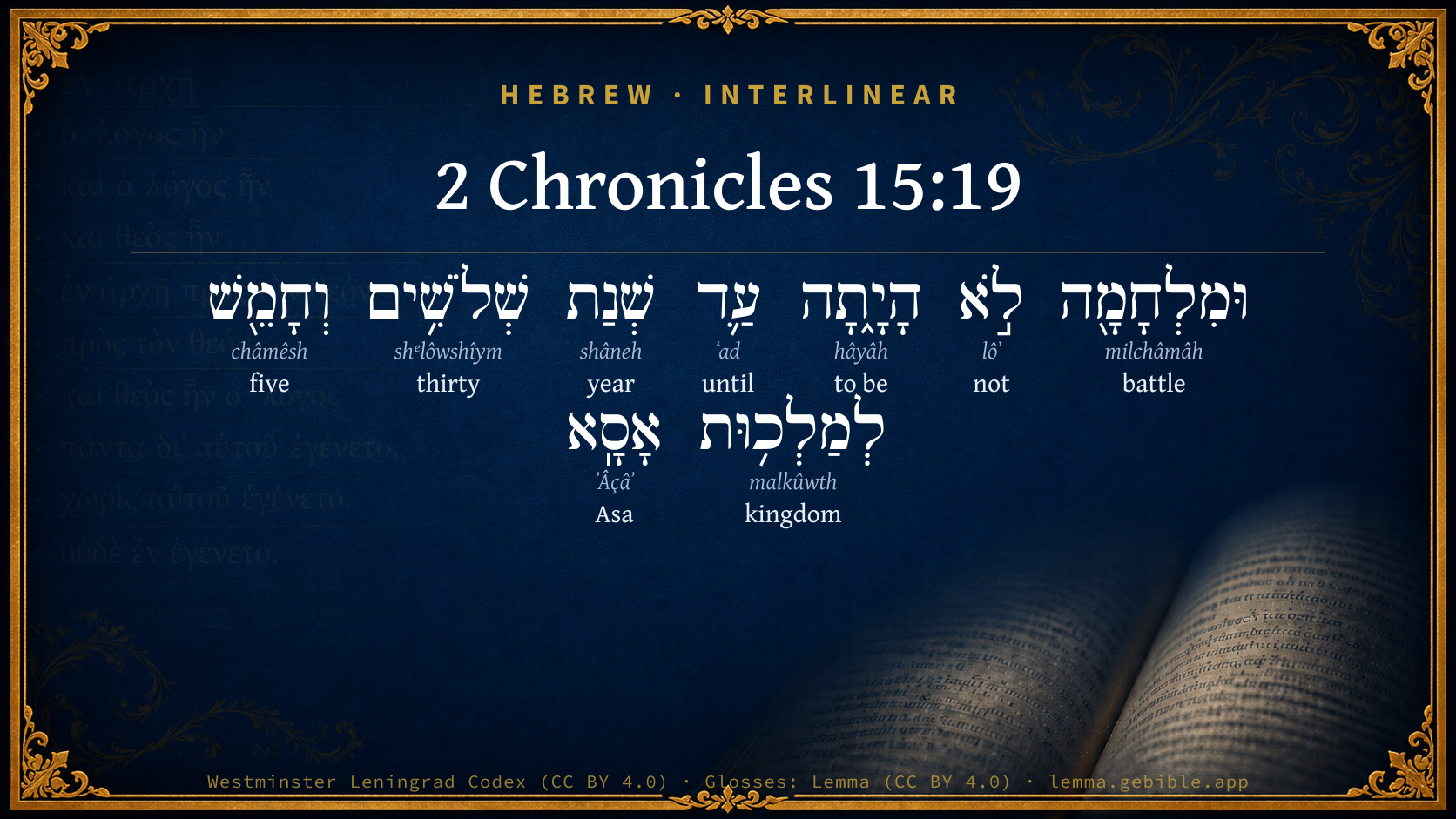
2 Chronicles 15:19

Hebrew (Westminster Leningrad Codex) 2 Chronicles 15:19 appears in the Hebrew Old Testament. The text above is from the Westminster Leningrad Codex. Each word links to its Strong’s number, a concise gloss, and parsing drawn from the Open Scriptures Hebrew Bible morphology. Click any word for its full Brown-Driver-Briggs (BDB) entry.
Download image
Cite this verse

2 Chronicles 15:19 (World English Bible). Public Domain. Lemma interlinear Bible study tool, https://lemma.gebible.app/v/2-chronicles/15/19.

Show BibTeX & RIS
BibTeX
RIS
English Translation
There was no more war to the five and thirtieth year of the reign of Asa.
World English Bible · Public Domain
Download a study sheet

One document with this verse’s original text, its word-by-word gloss line, the meaning frame, cross-references with their text, attributed commentary, and full source and license credits — printable, and it pastes into notes with its structure intact.

This verse Autodidact and up

Study sheet (.html) Plain text (.txt)

A passage Seminary Student

Up to 50 verses in one chapter. A passage sheet keeps up to 6 commentary sources and 12 cross-references per verse, in the order this page ranks them, and says so on the sheet whenever that leaves anything out. Ask for a single verse and you get the Autodidact verse sheet above.

Everything on this page stays free to read, with no account — the sheet is a download of what is already on screen, not access to it.

Want to remove ads? Support Godless Engineer
Compare translations 3

The same verse in 3 English versions, stacked beneath the original-language interlinear above. Click any original word for its lexicon entry.

Each is an independent rendering of the whole verse — the interlinear is not word-aligned to these translations.

Highlighted words mark where these versions differ — a whole-verse word diff, not a word-by-word alignment.

  • World English Bible Public Domain
    There was no more war to the five and thirtieth year of the reign of Asa.
  • King James Version Public Domain
    And there was no more war unto the five and thirtieth year of the reign of Asa.
  • unfoldingWord Literal Text CC BY-SA 4.0
    And war was not until the 35th year of the reign of Asa.

unfoldingWord Literal Text — © unfoldingWord, licensed CC BY-SA 4.0. Word-aligned USFM3 via Door43 (git.door43.org/unfoldingWord/en_ult).

Versions to compare (up to 4)

3 of 4 selected

Show all 18 translations

Every available English version of this verse, each an independent rendering of the whole verse.

  • World English Bible Public Domain
    There was no more war to the five and thirtieth year of the reign of Asa.
  • Berean Standard Bible Public Domain
    And there was no war until the thirty-fifth year of Asa’s reign.
  • Majority Standard Bible Public Domain
    And there was no war until the thirty-fifth year of Asa’s reign.
  • King James Version Public Domain
    And there was no more war unto the five and thirtieth year of the reign of Asa.
  • American Standard Version (1901) Public Domain
    And there was no more war unto the five and thirtieth year of the reign of Asa.
  • Revised Version (1885) Public Domain
    And there was no more war unto the five and thirtieth year of the reign of Asa.
  • Geneva Bible (1599) Public Domain
    And there was no warre vnto the fiue and thirtieth yeere of the reigne of Asa.
  • Douay-Rheims (1899) Public Domain
    And there was no war unto the five and thirtieth year of the kingdom of Asa.
  • Young's Literal Translation Public Domain
    And war hath not been till the thirty and fifth year of the reign of Asa.
  • Literal Standard Version CC BY-SA 4.0
    And war has not been until the thirty-fifth year of the reign of Asa.
  • Unlocked Literal Bible CC BY-SA 4.0
    There was no more war until the thirty-fifth year of Asa's reign.
  • unfoldingWord Literal Text CC BY-SA 4.0
    And war was not until the 35th year of the reign of Asa.
  • Darby Bible Public Domain
    And there was no war until the thirty-fifth year of the reign of Asa.
  • World Messianic Bible Public Domain
    There was no more war to the thirty-fifth year of Asa’s reign.
  • Webster's Bible Public Domain
    And there was no more war until the five and thirtieth year of the reign of Asa.
  • Free Bible Version CC BY-SA 4.0
    There was no more war until the thirty-fifth year of Asa's reign.
  • Bible in Basic English Public Domain
    And there was no more war till the thirty-fifth year of the rule of Asa.
  • JPS Tanakh (1917) Public Domain
    And there was no more war unto the five and thirtieth year of the reign of Asa.

Literal Standard Version (2020), Covenant Press — licensed CC BY-SA 4.0. Text via the HelloAO Bible API (eBible.org). Unlocked Literal Bible (unfoldingWord) — licensed CC BY-SA 4.0. Text via the HelloAO Bible API (eBible.org). unfoldingWord Literal Text — © unfoldingWord, licensed CC BY-SA 4.0. Word-aligned USFM3 via Door43 (git.door43.org/unfoldingWord/en_ult). Free Bible Version, Dr. Jonathan Gallagher — licensed CC BY-SA 4.0. Text via the HelloAO Bible API (eBible.org).

Word by word

More ways to search: Search by grammar → Find every occurrence → Compare this word →

Practice this passage: Drill this verse → Learn its vocabulary →

About this verse

These counts appear in no published source. They are computed here, from the morphology-tagged text and Lemma’s own curated glosses. What Lemma adds →

9
words
9
distinct lemmas
Historical
section

Shared distinctive vocabulary

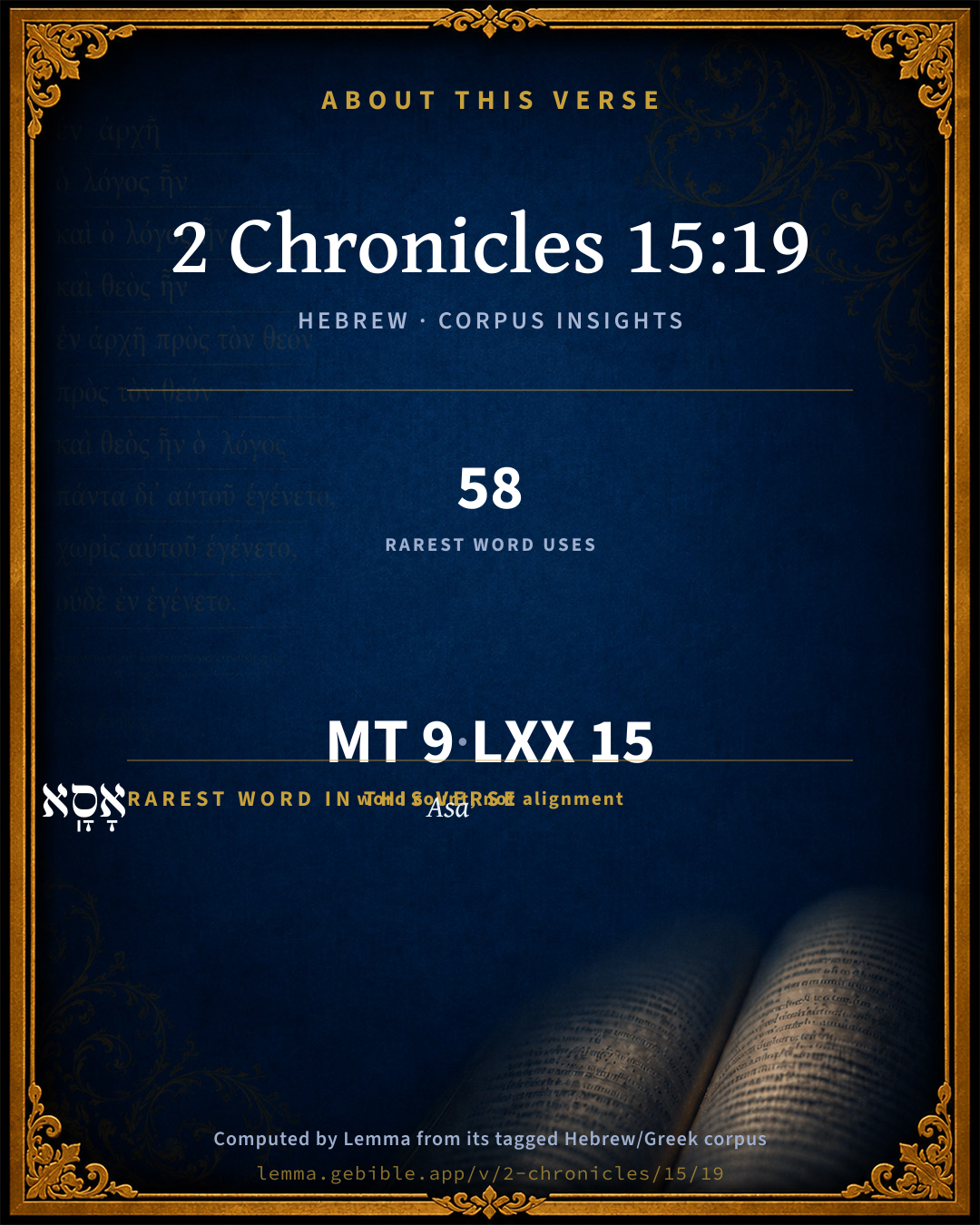
אָסָֽא Asa H609 occurs in 52 verses of the Hebrew Bible. Also found in:

Grammatical profile

  • 1 verb
  • 4 nouns
  • 2 adjectives
  • 1 preposition
  • 1 particle

Verb forms

  • הָיָ֑תָה Qal · Perfect

Hebrew & Septuagint length

In English translation the verse runs 16 words from the Hebrew and 17 from the Septuagint (LXX English) — closely comparable.

A rough comparison of the two English renderings, which tokenize alike — not a word-level alignment.

Word counts can differ between the Hebrew and the Greek without any difference in meaning — e.g. the Hebrew direct-object marker אֵת has no separate Greek word, and Greek often adds the article ὁ.

In the original languages it is 9 Hebrew tokens and 15 Greek tokens — but the two are counted differently (Hebrew bundles its prefixes and suffixes into one token; the Greek is in lemma form), so that isn’t a like-for-like length.

Cross-references

4

Topical passages linked to 2 Chronicles 15:19 in the Treasury of Scripture Knowledge — connected by theme and wording, ordered by reader-vote popularity; previews shown in the World English Bible.

  • 1 Kings 15:16–17 There was war between Asa and Baasha king of Israel all their days.
  • 1 Kings 15:31 Now the rest of the acts of Nadab, and all that he did, aren't they written in the book of the chronicles of the kings of Israel?
  • 1 Kings 15:33 In the third year of Asa king of Judah began Baasha the son of Ahijah to reign over all Israel in Tirzah, [and reigned] twenty-four years.
  • 2 Chronicles 16:1 In the six and thirtieth year of the reign of Asa, Baasha king of Israel went up against Judah, and built Ramah, that he might not allow anyone to go out or come in to Asa king of Judah.

Cross-references courtesy of OpenBible.info (CC BY 4.0).

Hebrew and Greek witnesses Masoretic Hebrew ↔ Greek Septuagint

The same verse in the two great witnesses to the Old Testament, shown verse-for-verse.

These are two independent witnesses, not word-aligned to each other, and the Septuagint is shown in lemma (dictionary) form.

Hebrew 2 Chronicles 15:19 Masoretic · Westminster Leningrad Codex

וּמִלְחָמָ֖ה לֹ֣א הָיָ֑תָה עַ֛ד שְׁנַת שְׁלֹשִׁ֥ים וְחָמֵ֖שׁ לְמַלְכ֥וּת אָסָֽא

There was no more war to the five and thirtieth year of the reign of Asa.

World English Bible · Public Domain

Greek LXX 2 Chronicles 15:19 Septuagint · lemma form

καί πόλεμος οὐ εἰμί μετά αὐτός ἕως ὁ πέμπτος καί τριακοστός ἔτος ὁ βασιλεία ασα

And there was no war waged with him until the thirty-fifth year of the reign of Asa.

LXX2012 (modern English Septuagint) · Public Domain

On this verse, Trapp's Complete Commentary discusses the Septuagint’s reading. Read the note in Commentary ↓

Hebrew: Westminster Leningrad Codex (CC BY 4.0). Greek: Septuagint (public domain); English from LXX2012 (modern English Septuagint) (Public Domain). How the Septuagint differs from the Hebrew →

Commentary

Notes on 2 Chronicles 15:19 from classic Christian and Jewish commentators (each source and its license shown beneath its notes). The classic Christian expositions comment on the surrounding passage and are grouped to its opening verse, so a note may address several verses; the Jewish commentaries on the Tanakh (Rashi and others) are per-verse, so they appear only where the commentator wrote on this verse.

Lemma curates 59 commentaries, every one of them public domain or Creative Commons licensed, each selected and text-cleaned for this edition rather than reprinted as found. About our sources →

Ellicott's Commentary for English Readers

(19) And there was no more war unto the five and thirtieth year of the reign of Asa.—Literally, and war arose not until, etc. This statement appears to refer back to 2Ch_15:15 : “And the Lord gave them rest round about;” and so to assign the limit of that period of peace, which ensued after the defeat of Zeran.

In 1Ki_15:16 we find a different statement: “And war continued between Asa and Baasha king of Israel all their days,” a statement which is repeated in 1Ki_15:32 of the same chapter.

The chronicler has evidently modified the older text, in order to assign a precise date to the outbreak of active hostilities between the two monarchs. (Both 1Ki_15:16 and the present 2Ch_15:19 begin with the same two Hebrew words, meaning “and war was,” but the chronicler inserts a not).

The verse of Kings need not imply more than that no amicable relations were ever established between the two sovereigns. They had inherited a state of war, although neither was in a condition to make an open attack upon the other for some years.

The five and thirtieth year of the reign of Asa.—This limit does not agree with the data of Kings (seo on 2Ch_16:1). Thenius suggests that the letter l, denoting 30, got into the text originally, through some transcriber, who inadvertently wrote the l with which the next Hebrew word begins twice over. Later on, some other copyist naturally corrected 2Ch_16:1, to agree with this. Assuming thus that the right readings here were originally the fifth and sixth years of the reign of Asa, Thenius concludes that in 2Ch_16:1 the letter v (i.e., 6) has been shortened into y (10); and that Baasha’s attempt preceded the invasion of Zerah. The false dates probably existed already in the source which the chronicler followed.

A Bible Commentary for English Readers, edited by Charles John Ellicott (1878–1897) — public domain. Text from a community e-Sword module.

Trapp's Complete Commentary

John Trapp

2Ch 15:19 And there was no [more] war unto the five and thirtieth year of the reign of Asa.

Ver. 19. Unto the five and thirtieth year,] sc., From the revolt of the ten tribes. See 2Ch 16:8. The Septuagint corruptly here render, Unto the thirtieth year.

John Trapp, A Commentary or Exposition upon All the Books of the Old and New Testament (1647–1656) — public domain. Text from a community e-Sword module.

Joseph Benson's Commentary

2Ch 15:19. There was no more war unto the five and thirtieth year of Asa — No open, general war, though there were constant bickerings between Judah and Israel upon the frontiers, 1Ki 15:16. National piety procures national blessings.

Joseph Benson's Commentary on the Old and New Testaments (1811–1818) — public domain. Text from a community e-Sword module.

Keil & Delitzsch

C. F. Keil & F. Delitzsch

Ch2 15:19 is different from Kg1 15:16. In the latter passage it is said: war was between Asa and Baasha the king of Israel כּל־ימיהם, i.e., so long as both reigned contemporaneously; while in the Chronicle it is said: war was not until the thirty-fifth year of Asa's reign. This discrepancy is partly got rid of by taking מלחמה in the book of Kings to denote the latent hostility or inimical attitude of the two kingdoms towards each other, and in the Chronicle to denote a war openly declared. The date, until the thirty-fifth year, causes a greater difficulty; but this has been explained in Ch2 16:1 by the supposition that in the thirty-sixth year of Asa's reign war broke out between Asa and Baasha, when the meaning of our 16th verse would be: It did not come to war with Baasha until the thirty-sixth year of Asa's rule. For further remarks on this, see on Ch2 16:1.

Keil & Delitzsch — Biblical Commentary on the Old Testament (1861–1891) — public domain (CC PDM 1.0). Text via the HelloAO Bible API. (Old Testament only.)

Tyndale Open Study Notes

Tyndale Open Resources

15:19 no more war: Literally no war. Most translations, including the NLT, add “more” to assist in conveying the probable meaning. But if “no war” is in fact the better reading, the thirty-fifth year might refer to the thirty-fifth year since the division of the northern and southern kingdoms. That would have been around the time when Zerah the Ethiopian invaded Judah and was defeated by Asa (14:9-15). But see the study note on 16:1. • The Chronicler inserts chronological notes into his account to divide Asa’s reign into periods that show the consequences of his decisions (see 14:1; 15:10; 16:1, 12, 13). The early battles with the north were seen as inconsequential for that period, though the Chronicler was fully aware of them (see 15:8). The first years of Asa’s reign were characterized by divine favor to an obedient king.

Tyndale Open Study Notes — © Tyndale Open Resources, licensed CC BY-SA 4.0. Text via the HelloAO Bible API.

Adam Clarke's Commentary

Verse 19. The five and thirtieth year of the reign of Asa] Archbishop Usher thinks that this should be counted from the separation of the kingdom, and that this fell on the fifteenth year of Asa's reign. To settle in every respect these chronologies is a most difficult undertaking; and the difficulty does not belong to the sacred books alone, all other chronological tables of all the nations in the world, are in the same predicament. With those of our own history I have often been puzzled, even while I had access to all the archives of the nation. Probably we should read here the five and twentieth year. See the margin, and 1Kg 15:16.

Adam Clarke's Commentary on the Bible (1810–1826) — public domain. Text from a community e-Sword/MySword module.

The Cambridge Bible for Schools and Colleges

gen. ed. J. J. S. Perowne

19. there was no more war] This statement can be reconciled with 1Ki_15:16; 1Ki_15:32 only by interpreting it broadly to mean that nothing serious occurred until the war with Baasha had been going on for several years.

The Cambridge Bible for Schools and Colleges (gen. ed. J. J. S. Perowne; Cambridge University Press, 1878–1918) — public domain. Text from a community e-Sword module.

John Gill's Exposition

And there was no more war unto the thirty fifth year of the reign of Asa. That is, from the Ethiopian war to that time; after that there was no war with any foreign enemy; there were animosities and discords, bickerings and hostilities of some sort continually between Asa and Baasha king of Israel, as long as he lived, see Kg1 15:16.

Next: 2 Chronicles Chapter 16

John Gill's Exposition of the Whole Bible (1746–1763) — public domain (CC PDM 1.0). Text via the HelloAO Bible API.

Albert Barnes' Notes on the Bible

The five and thirtieth year of the reign of Asa - This cannot be reconciled with the chronqlogy of Kings 1Ki 16:8 : and the suggestion in the marg. implies the adoption of a mode of marking time unknown either to himself or any other Scriptural writer. It is supposed that the figures here and in 2Ch 16:1 are corrupt, and that in both verses “twentieth” should replace “thirtieth.” The attack of Baasha would then have been made in the last year of Asa’s reign; and ten years of peace would have followed Asa’s victory over Zerah.

Albert Barnes' Notes on the Bible (1834–1885) — public domain. Text from a community e-Sword/MySword module.

Haydock's Catholic Bible Commentary

Year. Usher dates from the separation of the two kingdoms; and this year corresponds with the 15th of Asa, ver. 10. See 3 Kings xv. 16. (Calmet) (Torniel, the year of the world 3094.)

George Leo Haydock (1774–1849), Haydock's Catholic Family Bible and Commentary, 1859 edition — public domain. Excludes Psalms (Douay-Rheims chapter numbering differs from Protestant) and Deuterocanonical books (Catholic canon only).

Matthew Poole's English Annotations

For though there were continual skirmishes between Asa and Baasha and their people all their days, 1Ki 15:16, yet it did not break forth into an open war till Asa’s thirty-fifth year, i.e. till that was ended. But how this thirty-fifth year is to be computed, See Poole "2Ch 16:1".

Matthew Poole's English Annotations on the Holy Bible (1683–1685) — public domain. Text from a community e-Sword/MySword module.

Whedon's Commentary on the Bible

Daniel D. Whedon

19. No more war unto the five and thirtieth year of… Asa — This date, and also that of the next verse, (2Ch_16:1,) is undoubtedly erroneous, for in the twenty-sixth year of Asa Baasha was dead, and his son Elah began to reign. 1Ki_16:8. We think, with Rawlinson, that the simplest emendation is to substitute twentieth for thirtieth in both verses. Then we may suppose that previous to the war with Zerah Asa had ten years of peace, (2Ch_14:1,) and after that war he had peace again until the last year of Baasha’s reign, when the latter undertook the war against Judah mentioned in 2Ch_16:1.

Daniel D. Whedon (gen. ed.), Commentary on the Old and New Testaments (1874–1909) — public domain. Text from a community e-Sword module.

The Pulpit Commentary

There was no more war. The Hebrew text should be adhered to, which simply says, there was not war unto, etc The five and thirtieth year. There can be little doubt that the text originally said "twentieth," not "thirtieth". (see also 2Ch_16:1) The parallel, after the identical words Of the previous verse already noted, goes on emphatically to speak of the fact that "there was war between Asa and Baasha all their days;" and the same statement is repeated in the thirty-second verse of the same chapter. (1Ki_15:16, 1Ki_15:32) The following verse (33) says that Baasha"s twenty-four-year reign began in Asa"s third year. Putting the various and apparently somewhat varying statements together, they must be held to say, first, that a state of war was, indeed, chronic between Asa and Baasha (which way of putting need not disturb the correctness of 2Ch_14:5, 2Ch_14:6, and of the fifteenth verse of our chapter) but that in the six and twentieth year of Asa, which would be the last or last but one of Baasha"s life, latent war gave place to active hostilities, and Baasha (2Ch_16:1) came up to Judah to invade it, and to build Ramah a course of conduct which was the beginning of the end for him. (comp. 1Ki_16:8; our ver. 10; and 2Ch_16:1, 2Ch_16:9)

The Pulpit Commentary (1880–1919), ed. H.D.M. Spence-Jones & Joseph S. Exell — public domain. Text from a community e-Sword module.

Rashi

Rabbi Shlomo Yitzchaki (Rashi)

And there was no war, etc. We learned in Seder Olam (ch. 16): “In the thirty-sixth year of Asa’s kingdom, Baasha, the king of Israel, advanced.” Is it possible to say so? Had not Baasha already died in the twenty-sixth year of Asa’s reign, as it is written (I Kings 16:8): “In the twenty-sixth year of Asa, king of Judah, Elah the son of Baasha reigned”? What then is the meaning of “In the thirty-sixth year of Asa’s kingdom”? This corresponds to the thirty-six years from the time that Solomon married Pharaoh’s daughter, for so it is written (I Kings 2:39-46): “and two of Shimei’s slaves ran away... And the king commanded Benaiah etc. and he smote (Sic) and fell upon him,” and immediately following this Scripture writes about Solomon’s marriage to Pharaoh’s daughter, i.e., immediately after those three years, and in the fourth year he married her, and he reigned forty years. We find that she was with him thirty-six years, and corresponding to them were the thirty-six years that the decree was issued upon the kings of Aram to be adversaries to Israel and finally to fall into the hand[s] of David’s sons. Therefore, it is stated: “In the thirty-sixth year of Asa’s kingdom.” In the sixteenth year of his reign, after Zerah the Cushite fell into his hand[s], that is the thirty-sixth year from Solomon’s death, and in the sixteenth [year] of Asa, the king of Israel and the king of Aram made a treaty to advance and provoke Asa. Asa sinned, as it is stated (16:2f.): “And Asa brought out silver and gold... saying, ‘Make (sic) a treaty between me and you...’ And Ben Hadad heeded.” And the kings of Aram did not cease being adversaries to Israel until Ahaz died, and in the third year of Ahaz, the king of Israel and the king of Aram made a treaty to advance and provoke Ahaz, and Ahaz had no merit that they should fall into his hand[s]; so they both fell into the hand [s] of Tiglath-Pileser, the king of Assyria.

Rashi on the Tanakh — English translations: “The Judaica Press complete Tanach with Rashi, translated by A. J. Rosenberg” (CC BY 4.0); “Pentateuch with Rashi's commentary by M. Rosenbaum and A.M. Silbermann, 1929-1934” (public domain); “The Metsudah Tanach series, Lakewood, N.J” (CC BY 4.0); and “The Book of Joshua, Metsudah Publications, 1997” (CC BY 4.0). Text via Sefaria.

Lesson kit

Teaching starters — assembled from the data on this page, not authored interpretation. Every prompt links to the verse data it draws on. Edit before teaching.

2 Chronicles, in the Historical, opens this verse with 9 words (9 distinct Hebrew lemmas). Its most distinctive word is ʼÂçâʼ (“Asa”). A historical commentator’s framing appears above. Read the whole chapter for the surrounding context.

Discussion questions

  1. How does “Asa” (ʼÂçâʼ) shape what this verse is saying?
  2. 1 Kings 15:8 shares the word «Asa» with this verse. How do the two illuminate each other?
  3. These translations render this verse differently. What is at stake in choosing one wording over another?
  4. The verb «הָיָ֑תָה» is Qal Perfect. How does its form color the action?
  5. Reading how Ellicott's Commentary for English Readers and Trapp's Complete Commentary read this verse, where do the two commentators agree and where do they part?

Things to notice

Reading settings

Reading text

Shown beneath each verse's original-language words.

Old Testament
Old Testament edition

Read the OT as the Masoretic Hebrew (MT) or the Greek Septuagint (LXX).

English shown for the Greek Septuagint (in the Hebrew ↔ Greek comparison).

Comparing translations? Open the Compare panel on any verse page to stack up to four side by side.