
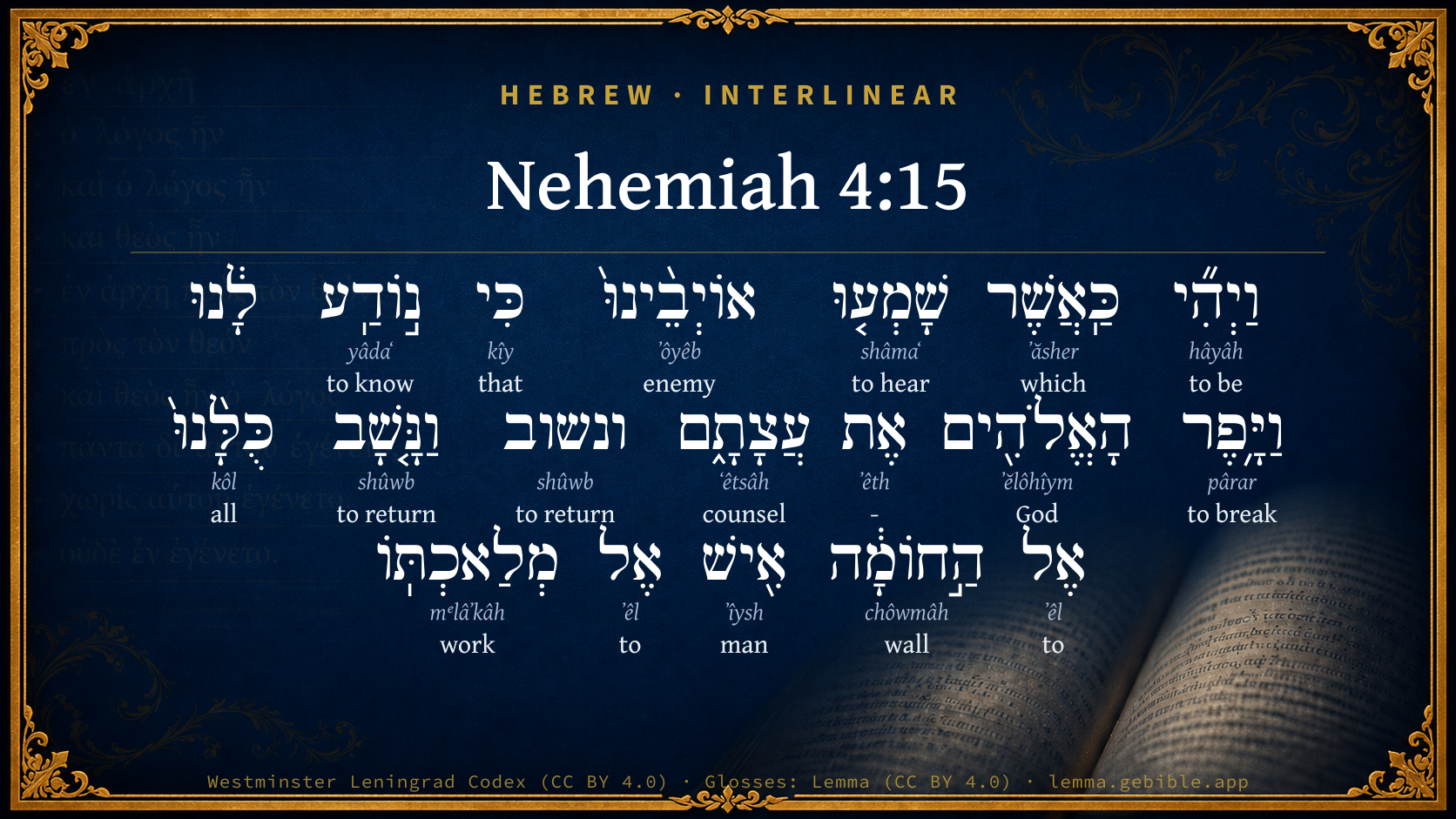
Nehemiah 4:15

Hebrew (Westminster Leningrad Codex) Nehemiah 4:15 appears in the Hebrew Old Testament. The text above is from the Westminster Leningrad Codex. Each word links to its Strong’s number, a concise gloss, and parsing drawn from the Open Scriptures Hebrew Bible morphology. Click any word for its full Brown-Driver-Briggs (BDB) entry.
Download image
Cite this verse

Nehemiah 4:15 (World English Bible). Public Domain. Lemma interlinear Bible study tool, https://lemma.gebible.app/v/nehemiah/4/15.

Show BibTeX & RIS
BibTeX
RIS
English Translation
It happened, when our enemies heard that it was known to us, and God had brought their counsel to nothing, that we returned all of us to the wall, everyone to his work.
World English Bible · Public Domain
Download a study sheet

One document with this verse’s original text, its word-by-word gloss line, the meaning frame, cross-references with their text, attributed commentary, and full source and license credits — printable, and it pastes into notes with its structure intact.

This verse Autodidact and up

Study sheet (.html) Plain text (.txt)

A passage Seminary Student

Up to 50 verses in one chapter. A passage sheet keeps up to 6 commentary sources and 12 cross-references per verse, in the order this page ranks them, and says so on the sheet whenever that leaves anything out. Ask for a single verse and you get the Autodidact verse sheet above.

Everything on this page stays free to read, with no account — the sheet is a download of what is already on screen, not access to it.

Want to remove ads? Support Godless Engineer
Compare translations 3

The same verse in 3 English versions, stacked beneath the original-language interlinear above. Click any original word for its lexicon entry.

Each is an independent rendering of the whole verse — the interlinear is not word-aligned to these translations.

Highlighted words mark where these versions differ — a whole-verse word diff, not a word-by-word alignment.

  • World English Bible Public Domain
    It happened, when our enemies heard that it was known to us, and God had brought their counsel to nothing, that we returned all of us to the wall, everyone to his work.
  • King James Version Public Domain
    And it came to pass, when our enemies heard that it was known unto us, and God had brought their counsel to nought, that we returned all of us to the wall, every one unto his work.
  • unfoldingWord Literal Text CC BY-SA 4.0
    And it happened that, when our enemies heard that it was known to us, and God had frustrated their counsels, all of us returned to the wall, a man to his work.

unfoldingWord Literal Text — © unfoldingWord, licensed CC BY-SA 4.0. Word-aligned USFM3 via Door43 (git.door43.org/unfoldingWord/en_ult).

Versions to compare (up to 4)

3 of 4 selected

Show all 18 translations

Every available English version of this verse, each an independent rendering of the whole verse.

  • World English Bible Public Domain
    It happened, when our enemies heard that it was known to us, and God had brought their counsel to nothing, that we returned all of us to the wall, everyone to his work.
  • Berean Standard Bible Public Domain
    When our enemies heard that we were aware of their scheme and that God had frustrated it, each of us returned to his own work on the wall.
  • Majority Standard Bible Public Domain
    When our enemies heard that we were aware of their scheme and that God had frustrated it, each of us returned to his own work on the wall.
  • King James Version Public Domain
    And it came to pass, when our enemies heard that it was known unto us, and God had brought their counsel to nought, that we returned all of us to the wall, every one unto his work.
  • American Standard Version (1901) Public Domain
    And it came to pass, when our enemies heard that it was known unto us, and God had brought their counsel to nought, that we returned all of us to the wall, every one unto his work.
  • Revised Version (1885) Public Domain
    And it came to pass, when our enemies heard that it was known unto us, and God had brought their counsel to nought, that we returned all of us to the wall, every one unto his work.
  • Geneva Bible (1599) Public Domain
    And when our enemies heard that it was knowen vnto vs, then God brought their counsell to nought, and we turned all againe to the wall, euery one vnto his worke.
  • Douay-Rheims (1899) Public Domain
    And it came to pass, when our enemies heard that the thing had been told us, that God defeated their counsel. And we returned all of us to the walls, every man to his work.
  • Young's Literal Translation Public Domain
    And it cometh to pass, when our enemies have heard that it hath been known to us, and God doth frustrate their counsel, and we turn back, all of us, unto the wall, each unto his work;
  • Literal Standard Version CC BY-SA 4.0
    And it comes to pass, when our enemies have heard that it has been known to us, and God frustrates their counsel, and we return, all of us, to the wall, each to his work;
  • Unlocked Literal Bible CC BY-SA 4.0
    It came about when our enemies heard that their plans were known to us, and God had frustrated their plans, all of us returned to the wall, each one to his work.
  • unfoldingWord Literal Text CC BY-SA 4.0
    And it happened that, when our enemies heard that it was known to us, and God had frustrated their counsels, all of us returned to the wall, a man to his work.
  • Darby Bible Public Domain
    And it came to pass that when our enemies heard that it was known to us, and that God had defeated their counsel, we returned all of us to the wall, every one to his work.
  • World Messianic Bible Public Domain
    When our enemies heard that it was known to us, and God had brought their counsel to nothing, all of us returned to the wall, everyone to his work.
  • Webster's Bible Public Domain
    And it came to pass, when our enemies heard that it was known to us, and God had brought their counsel to naught, that we returned all of us to the wall, every one to his work.
  • Free Bible Version CC BY-SA 4.0
    When our enemies discovered that we knew about their plan, and that God had foiled it, we all went back to our work on the wall.
  • Bible in Basic English Public Domain
    And when it came to the ears of those who were against us, that we had knowledge of their designs and that God had made their purpose come to nothing, we all went back to the wall, everyone to his work
  • JPS Tanakh (1917) Public Domain
    (4-9) And it came to pass, when our enemies heard that it was known unto us, and God had brought their counsel to nought, that we returned all of us to the wall, every one unto his work.

Literal Standard Version (2020), Covenant Press — licensed CC BY-SA 4.0. Text via the HelloAO Bible API (eBible.org). Unlocked Literal Bible (unfoldingWord) — licensed CC BY-SA 4.0. Text via the HelloAO Bible API (eBible.org). unfoldingWord Literal Text — © unfoldingWord, licensed CC BY-SA 4.0. Word-aligned USFM3 via Door43 (git.door43.org/unfoldingWord/en_ult). Free Bible Version, Dr. Jonathan Gallagher — licensed CC BY-SA 4.0. Text via the HelloAO Bible API (eBible.org).

Word by word

More ways to search: Search by grammar → Find every occurrence → Compare this word →

Practice this passage: Drill this verse → Learn its vocabulary →

וַיָּ֥פֶר
pârar
H6565
“and · to break”
Conjunction + Verb, Hiphil, Sequential Imperfect, 3rd Person, Masculine, Singular
Part of Speech
Conjunction + Verb
Stem
Hiphil
Form
Sequential Imperfect
Person
3rd Person
Gender
Masculine
Number
Singular
Full BDB Definition

Origin: a primitive root

TWOT: 1829 , 1830 , 1831

to break, frustrate - (Hiphil) - to break, violate - to frustrate, make ineffectual - (Hophal) - to be frustrated - to be broken - to break - (Pilpel) to break to bits, shatter - to split, divide - (Qal) to split, crack through - (Poel) to break apart - (Hithpoel) to be split, be cracked through
  1. וַיְהִ֞י hâyâh H1961 “and · to be” Conjunction + Verb, Qal, Sequential Imperfect, 3rd Person, Masculine, Singular
  2. כַּֽאֲשֶׁר ʼăsher H834 “like/as · which” Preposition + Particle, Relative
  3. שָׁמְע֤וּ shâmaʻ H8085 “to hear” Verb, Qal, Perfect, 3rd Person, Common, Plural
  4. אוֹיְבֵ֨ינוּ֙ ʼôyêb H341 “enemy · us” Verb, Qal, Participle Active, Masculine, Plural, Construct + Suffix, Personal, 1st Person, Common, Plural
  5. כִּי kîy H3588 “that” Conjunction
  6. נ֣וֹדַֽע yâdaʻ H3045 “to know” Verb, Niphal, Perfect, 3rd Person, Masculine, Singular
  7. הָאֱלֹהִ֖ים ʼĕlôhîym H430 “the · God(s)” Particle, Definite Article + Noun, Common, Masculine, Plural, Absolute
  8. אֶת ʼêth H853 “-” Particle, Direct Object
  9. עֲצָתָ֑ם ʻêtsâh H6098 “counsel · their” Noun, Common, Feminine, Singular, Construct + Suffix, Personal, 3rd Person, Masculine, Plural
  10. ונשוב shûwb H7725 “and · to return” Conjunction + Verb, Qal, Sequential Imperfect, 1st Person, Common, Plural
  11. וַנָּ֤שָׁב shûwb H7725 “and · to return” Conjunction + Verb, Qal, Sequential Imperfect, 1st Person, Common, Plural
  12. כֻּלָּ֨נוּ֙ kôl H3605 “all · our” Noun, Common, Masculine, Singular, Construct + Suffix, Personal, 1st Person, Common, Plural
  13. אֶל ʼêl H413 “to” Preposition
  14. הַ֣חוֹמָ֔ה chôwmâh H2346 “the · wall” Particle, Definite Article + Noun, Common, Feminine, Singular, Absolute
  15. אִ֖ישׁ ʼîysh H376 “man” Noun, Common, Masculine, Singular, Absolute
  16. אֶל ʼêl H413 “to” Preposition
  17. מְלַאכְתּֽוֹ mᵉlâʼkâh H4399 “work · his” Noun, Common, Feminine, Singular, Construct + Suffix, Personal, 3rd Person, Masculine, Singular

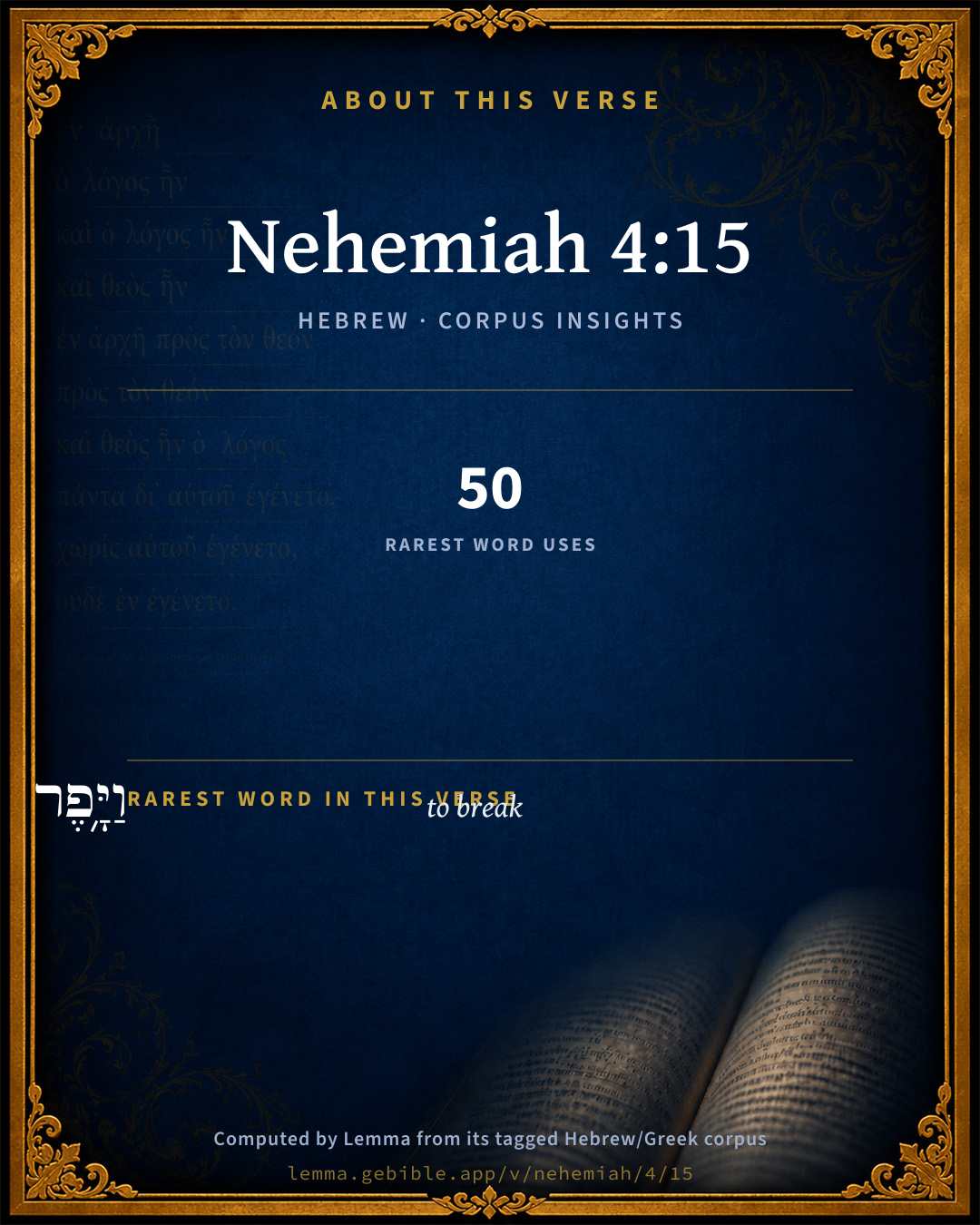
About this verse

These counts appear in no published source. They are computed here, from the morphology-tagged text and Lemma’s own curated glosses. What Lemma adds →

19
words
16
distinct lemmas
Historical
section

Shared distinctive vocabulary

וַיָּ֥פֶר to break H6565 occurs in 46 verses of the Hebrew Bible. Also found in:

Grammatical profile

  • 7 verbs
  • 6 nouns
  • 3 prepositions
  • 1 conjunction
  • 2 particles

Verb forms

  • וַיְהִ֞י Qal · Sequential Imperfect
  • שָׁמְע֤וּ Qal · Perfect
  • אוֹיְבֵ֨ינוּ֙ Qal · Participle Active
  • נ֣וֹדַֽע Niphal · Perfect
  • וַיָּ֥פֶר Hiphil · Sequential Imperfect
  • ונשוב Qal · Sequential Imperfect
  • וַנָּ֤שָׁב Qal · Sequential Imperfect

Repetition

Words recur within this verse — often emphatic in Hebrew:

  • ונשוב to return H7725 ×2
  • אֶל to H413 ×2

Cross-references

12

Topical passages linked to Nehemiah 4:15 in the Treasury of Scripture Knowledge — connected by theme and wording, ordered by reader-vote popularity; previews shown in the World English Bible.

  • 2 Samuel 17:14 Absalom and all the men of Israel said, The counsel of Hushai the Archite is better than the counsel of Ahithophel. For Yahweh had ordained to defeat the good counsel of Ahithophel, to the intent that Yahweh might bring evil on Absalom.
  • Romans 12:11 not lagging in diligence; fervent in spirit; serving the Lord;
  • Job 5:12–13 He frustrates the devices of the crafty, So that their hands can't perform their enterprise.
  • Psalms 33:10–11 Yahweh brings the counsel of the nations to nothing. He makes the thoughts of the peoples to be of no effect.
  • Isaiah 44:25 who frustrates the signs of the liars, and makes diviners mad; who turns wise men backward, and makes their knowledge foolish;
  • 2 Samuel 15:31 One told David, saying, Ahithophel is among the conspirators with Absalom. David said, Yahweh, please turn the counsel of Ahithophel into foolishness.
  • Proverbs 21:30 There is no wisdom nor understanding Nor counsel against Yahweh.
  • Isaiah 8:10 Take counsel together, and it shall be brought to nothing; speak the word, and it shall not stand: for God is with us.
  • Lamentations 3:37–38 Who is he who says, and it comes to pass, when the Lord doesn't command it?
  • Mark 13:34 "It is like a man, traveling to another country, having left his house, and given authority to his servants, and to each one his work, and also commanded the doorkeeper to keep watch.
  • 1 Corinthians 3:19–20 For the wisdom of this world is foolishness with God. For it is written, "He has taken the wise in their craftiness."
  • 1 Thessalonians 4:11 and that you make it your ambition to lead a quiet life, and to do your own business, and to work with your own hands, even as we charged you;

Cross-references courtesy of OpenBible.info (CC BY 4.0).

Hebrew and Greek witnesses Masoretic Hebrew ↔ Greek Septuagint

The same verse in the two great witnesses to the Old Testament, shown verse-for-verse.

These are two independent witnesses, not word-aligned to each other, and the Septuagint is shown in lemma (dictionary) form.

Hebrew Nehemiah 4:15 Masoretic · Westminster Leningrad Codex

וַיְהִ֞י כַּֽאֲשֶׁר שָׁמְע֤וּ אוֹיְבֵ֨ינוּ֙ כִּי נ֣וֹדַֽע לָ֔נוּ וַיָּ֥פֶר הָאֱלֹהִ֖ים אֶת עֲצָתָ֑ם ונשוב וַנָּ֤שָׁב כֻּלָּ֨נוּ֙ אֶל הַ֣חוֹמָ֔ה אִ֖ישׁ אֶל מְלַאכְתּֽוֹ

It happened, when our enemies heard that it was known to us, and God had brought their counsel to nothing, that we returned all of us to the wall, everyone to his work.

World English Bible · Public Domain

Greek LXX Structure differs

The Septuagint has no separate book of Nehemiah. Its Greek text is the second half of Esdras B (2 Esdras), chapters 11–23; Ezra is the first half (1–10).

A verse-for-verse comparison isn’t shown here because the chapters and verses don’t line up. Switch to the LXX edition with the MT / LXX toggle above to read the Greek directly.

Hebrew: Westminster Leningrad Codex (CC BY 4.0). Greek: Septuagint (public domain); English from a public-domain English Septuagint. How the Septuagint differs from the Hebrew →

Commentary

Notes on Nehemiah 4:15 from classic Christian and Jewish commentators (each source and its license shown beneath its notes). The classic Christian expositions comment on the surrounding passage and are grouped to its opening verse, so a note may address several verses; the Jewish commentaries on the Tanakh (Rashi and others) are per-verse, so they appear only where the commentator wrote on this verse.

Lemma curates 59 commentaries, every one of them public domain or Creative Commons licensed, each selected and text-cleaned for this edition rather than reprinted as found. About our sources →

Trapp's Complete Commentary

John Trapp

Neh 4:15 And it came to pass, when our enemies heard that it was known unto us, and God had brought their counsel to nought, that we returned all of us to the wall, every one unto his work.

Ver. 15. And it came to pass, when our enemies heard] This rumour was enough to frighten these no less now timorous than before temerarious Samaritans; great brags they made at first what they would do, but now that they see they are defeated of their purpose, they are crest fallen, and have no mind at all to advance. So that to these may be fitly applied that which Guicciardine saith of Charles VIII, king of France, in his expedition against Naples, that he came into the field like thunder and lightning, but went out like a snuff; more than a man at first, and less than a woman at last.

And God had brought their counsel to nought] According to that of the psalmist, "The Lord bringeth the counsel of the heathen to nought: he maketh the devices of the people of none effect. The counsel of the Lord standeth for ever, the thoughts of his heart to all generations," Psa 33:10-11. Here good men may learn, saith one, not to go nakedly, without weapons for their own necessary defence; and much less, said I, without their spiritual weapons, whether defensive, as the shield of faith, the breastplate of righteousness, &c., or offensive, as the sword of the Spirit, the word, and the darts of prayer, lest they be surprised and subjugated by that old manslayer, Eph 6:13-18.

That we returned all of us to the wall] Not to the tavern, to toss pots, saith one, and boast of their great victory; but in the fear of God they return to the walls, and every man falleth to his work again. All histories declare that the greatest kingdoms, when they fell to idleness and luxury, then they lost their former glory faster than they won it. The Turkish Empire is thought to be on the declining hand, because their late emperors do far degenerate from their warlike progenitors, their soldiers generally give themselves to unwonted pleasures, their ancient discipline of war is neglected, rebellions raised, &c.

John Trapp, A Commentary or Exposition upon All the Books of the Old and New Testament (1647–1656) — public domain. Text from a community e-Sword module.

The Biblical Illustrator

Joseph S. Exell

Neh_4:15

Every one unto his work.

Specialty of work for each man

There is something beautiful to me in the thought that there is a specialty of work for each man. In work, as in character, disposition, history, and destiny, there is a specialty; and when the Church arises to the New Jerusalem, it will not be to sit there as one vast photographic likeness, nor shall one be able to say of its members, I have heard their history, when the story of one has been told. The history of the Church will be made up of individual histories; and each one shall possess its own peculiar interest. Your history will be none the less interesting when mine has been told, nor mine when you have related yours. Your head and heart will not be as mine, nor mine as yours; we shall not be mere fragments of a universal Church; but we shall be fully, roundly, and conspicuously ourselves, in the Church of which we make a whole, and perfect, and unexampled individual. (H. W. Beecher.)

Every man at his place

In that fearful national catastrophe which befell England, i.e., the loss of the ironclad Victoria, the staunch steadfastness of our British sailors was grandly illustrated. When the crash came, instead of a wild rush on deck of all below, every man remained true to his post. All knew that a serious collision had occurred, yet the most perfect order was maintained. The engineers kept their eyes on the indicator and moved their levers as directed, in spite of the fact that their lives were in imminent danger. Even when it was seen that the vessel was settling down, and all were called on deck, the men ranged themselves in line, and the order, Right about face, was obeyed, though while in the act the vessel heeled over, and all were precipitated into the sea. Our personal duty:--The only way to regenerate the world is to do the duty which lies nearest to us, and not to hunt after grand, far-fetched ones for ourselves. If each drop of rain chose where it should fall, Gods showers would not fall as they do now on the evil and the good alike. (Charles Kingsley.)

Our own duty to be attended to

There is a story with which many of the present generation have been made familiar in our reading books which has an important application to Christian life. The story is that a German, with an ear sensitive to music, one day entered a church, and, being distressed by the discords of the singing, put his fingers in his ears; but there penetrated through them a single clear, rich soprano, singing in such perfect tune, that he was moved to listen. The singer never faltered because of the jarring notes, nor increased the volume of her voice to drown them. She kept steadily on till one after another came into accord with her sweet tones, till she brought the entire body of singers into harmony.

The Biblical Illustrator, edited by Joseph S. Exell (c. 1880s–1900s) — public domain. Text from a community e-Sword module.

Joseph Benson's Commentary

Neh 4:15. When our enemies heard that it was known unto us — When they heard that their plot was discovered, and they had no hope to surprise us, but found that we were ready to receive them, they laid aside their designs, and we went on with our work.

Joseph Benson's Commentary on the Old and New Testaments (1811–1818) — public domain. Text from a community e-Sword module.

Keil & Delitzsch

C. F. Keil & F. Delitzsch

Thus was the design of the enemy circumvented, and the Jews returned to their work on the wall, which they had forsaken to betake themselves to their weapons. The manner in which they resumed their building work was, that one half held weapons, and the other half laboured with weapons in hand.

Neh 4:15

When our enemies heard that it (their intention) was known to us, and (that) God had brought their counsel to nought (through the measures with which we had met it), we returned all of us to the wall, every one to his work. The conclusion does not begin till ונּשׁוב, האל ויּפר belonging to the premiss, in continuation of נודא כּי.

Neh 4:16-18

From that day the half of my servants wrought at the work, and the other half of them held the spears and shields, the bows and the armour, i.e., carried the arms. The servants of Nehemiah are his personal retinue, Neh 4:17, Neh 5:10, Neh 5:16, namely, Jews placed at his disposal as Pechah for official purposes. The ו before הרמחים was probably placed before this word, instead of before the המּגנּים following, by a clerical error; for if it stood before the latter also, it might be taken in the sense of et - et. מצזיקים, instead of being construed with בּ, is in the accusative, as also in Neh 4:11, and even in Jer 6:23 and Isa 41:9, Isa 41:13. Unnecessary and unsuitable is the conjecture of Bertheau, that the word בּרמחים originally stood after מצזיקים, and that a fresh sentence begins with והרמחים: and the other half held the spears; and the spears, the shields, and the bows, and the armour, and the rulers, were behind the whole house of Judah, - a strange combination, which places the weapons and rulers behind the house of Judah. Besides, of the circumstance of the weapons being placed behind the builders, so that they might at any moment seize them, we not only read nothing in the text; but in Neh 4:11 and Neh 4:12 just the contrary, viz., that the builders wrought with one hand, and with the other held a weapon. "The rulers were behind all the house of Judah," i.e., each was behind his own people who were employed on the work, to encourage them in their labour, and, in case of attack, to lead them against the enemy. - In Neh 4:11 בּחומה הבּונים is prefixed after the manner of a title. With respect to those who built the wall, both the bearers of burdens were lading with the one hand of each workman, and holding a weapon with the other, and the builders were building each with his sword girt on his side. The ו prefixed to הנּשׂאים and הבּנים means both; and בסּבל נשׂא, bearers of burdens, who cleared away the rubbish, and worked as labourers. These, at all events, could do their work with one hand, which would suffice for emptying rubbish into baskets, and for carrying material in handle baskets. ידו בּעחת, literally, with the one (namely) of his hands that was doing the work. The suffix of ידו points to the genitive following. ואחת אחת, the one and the other hand. השּׁלח, not a missile, but a weapon that was stretched out, held forth, usually a sword or some defensive weapon: see rem. on Jos 2:8; Ch2 32:5. The builders, on the contrary, needed both hands for their work: hence they had swords girt to their sides. "And he that sounded the trumpet was beside me." Nehemiah, as superintendent of the work, stood at the head of his servants, ready to ward off any attack; hence the trumpeter was beside him, to be able to give to those employed on the wall the signal for speedy muster in case danger should threaten.

Neh 4:19-21

Hence he said to the nobles, the rulers, and the rest of the people, i.e., all employed in building, "The work is much (great) and wide, and we are separated upon the wall one far from another; in what place ye hear the sound of the trumpet, assemble yourselves to me: our God will fight for us." - In Neh 4:15 the whole is summed up, and for this purpose the matter of Neh 4:10 is briefly repeated, to unite with it the further statement that they so laboured from early morning till late in the evening. "We (Nehemiah and his servants) laboured in the work, and half of them (of the servants) held the spears from the grey of dawn till the stars appeared."

Neh 4:22

He took moreover, a further precaution: he said to the people (i.e., to the labourers on the wall, and not merely to the warriors of the community, as Bertheau supposes): Let every one with his servant lodge within Jerusalem, i.e., to remain together during the night also, and not be scattered through the surrounding district, "that they may be guardianship for us by night and labour by day." The abstracts, guardianship and labour, stand for the concretes, guards and labourers. As לנוּ, to us, refers to the whole community separated on the walls, so is ונערו אישׁ to be understood of all the workers, and not of the fighting men only. From ונערו אישׁ it only appears that the fathers of families and master builders had servants with them as labourers.

Neh 4:23

Nehemiah, moreover, and his brethren (his kinsmen and the members of his house), and his servants, and the men of the guard in his retinue, were constantly in their clothes ("not putting off our clothes" to rest). The last words, המּים שׁלחו אישׁ are very obscure, and give no tolerable sense, whether we explain המּים of water for drinking or washing. Luther translates, Every one left off washing; but the words, Every one's weapon was water, can never bear this sense. Roediger, in Gesen. Thes. s.v. שׁלח, seeks to alter המים into בידו, to which Bttcher (N. krit. Aehrenl. iii. p. 219) rightly objects: "how could בידו have been altered into המּים, or המּים have got into the text at all, if some portion of it had not been originally there? What this בידו expresses, would be far more definitely given with the very slight correction of changing the closing ם of המּים, and reading המינו = המינוּ (comp. Sa2 14:19); thus each had taken his missile on the right (in his right hand), naturally that he might be ready to discharge it in case of a hostile attack." This conjecture seems to us a happy emendation of the unmeaning text, since נוּ might easily have been changed into ם; and we only differ in this matter from Bttcher, by taking שׁלח in its only legitimate meaning of weapon, and translating the words: And each laid his weapon on the right, viz., when he laid himself down at night to rest in his clothes, to be ready for fighting at the first signal from the watch.

Keil & Delitzsch — Biblical Commentary on the Old Testament (1861–1891) — public domain (CC PDM 1.0). Text via the HelloAO Bible API. (Old Testament only.)

Tyndale Open Study Notes

Tyndale Open Resources

4:15 Nehemiah gave the credit to God (see also 2:20; 6:16), who had frustrated them through the prayers of the people, the 24-hour patrol, the open display of force, and the confidence in God’s protection.

Tyndale Open Study Notes — © Tyndale Open Resources, licensed CC BY-SA 4.0. Text via the HelloAO Bible API.

Adam Clarke's Commentary

Verse 15. Their counsel to naught] The word counsel used here countenances the emendation in the 12th verse.

Adam Clarke's Commentary on the Bible (1810–1826) — public domain. Text from a community e-Sword/MySword module.

Ellicott's Commentary for English Readers

(15) We returned.—This verse remarkably condenses the frustration of the attempt and the cessation of the special guard.

A Bible Commentary for English Readers, edited by Charles John Ellicott (1878–1897) — public domain. Text from a community e-Sword module.

The Cambridge Bible for Schools and Colleges

gen. ed. J. J. S. Perowne

15. Success of Nehemiah’s precautions.

our enemies] a different word in the original from that rendered ‘adversaries’ in Neh_4:11.

that it was known unto us] i.e. their project of a sudden attack.

God had brought their counsel to nought] i.e. through the precautionary measures taken by Nehemiah. The words ‘brought their counsel to nought’ are the same as those rendered ‘frustrate their purpose’ in Ezr_4:5.

we returned … work] This clause implies what is not definitely stated. The enemy, on hearing that Nehemiah was prepared to meet their attack, seem to have abandoned their intention of an immediate assault. Nehemiah and his companions were able to resume the work upon the wall, although precautions were still necessary.

The Cambridge Bible for Schools and Colleges (gen. ed. J. J. S. Perowne; Cambridge University Press, 1878–1918) — public domain. Text from a community e-Sword module.

John Gill's Exposition

And it came to pass, when our enemies heard it was known unto us,.... What they intended, as might be reported to them from the preparations made by the Jews to receive them, and defend themselves:

and God had brought their counsel to naught; which was to come upon them secretly and unawares; but being discovered, they dropped their design, and their scheme came to nothing:

so that we returned all of us to the wall, every man to his work; to that part of it where he wrought, in order to finish it.

John Gill's Exposition of the Whole Bible (1746–1763) — public domain (CC PDM 1.0). Text via the HelloAO Bible API.

Matthew Poole's English Annotations

Our enemies being frustrated in their hopes, which were wholly built upon the secrecy and suddenness of their attempt, we knowing this, returned to our business.

Matthew Poole's English Annotations on the Holy Bible (1683–1685) — public domain. Text from a community e-Sword/MySword module.

Whedon's Commentary on the Bible

Daniel D. Whedon

15. God had brought their counsel to nought — Observe the doctrine of Providence here. The betrayal of the enemies’ designs, and the preparations for defence, though all wrought out by human instrumentalities, are attributed to God.

We returned all of us to the wall — That is, as is immediately explained, every one unto his work. For a time they merely watched, and stood in readiness to resist the enemy that proposed to assail them unawares, (Neh_4:11;) but now they return to their work again, not, however, without some change in their manner of procedure, as the next verse tells.

Daniel D. Whedon (gen. ed.), Commentary on the Old and New Testaments (1874–1909) — public domain. Text from a community e-Sword module.

unfoldingWord translationNotes

Door43 World Missions Community

It came about

"It happened that"

their plans were known to us

This can be stated in active form. AT: "we knew about their plans" (See: Active or Passive)

my servants worked

"my young men worked"

half of my servants ... half of them

"Half" means one part out of two equal parts. (See: Fractions)

the leaders stood behind all the people

"the leaders positioned themselves behind all the people"

translationWords

adversary

know

God

works

servant

spear

shield

bow and arrow

armor

people group

kingdom of Judah

unfoldingWord translationNotes — © Distant Shores Media and the Door43 World Missions Community, licensed CC BY-SA 4.0. Source: git.door43.org/Door43/en_tn.

Lesson kit

Teaching starters — assembled from the data on this page, not authored interpretation. Every prompt links to the verse data it draws on. Edit before teaching.

Nehemiah, in the Historical, opens this verse with 19 words (16 distinct Hebrew lemmas). Its most distinctive word is pârar (“to break”). A historical commentator’s framing appears above. Read the whole chapter for the surrounding context.

Discussion questions

  1. How does “to break” (pârar) shape what this verse is saying?
  2. How does Genesis 17:14, which shares the word «to break», read alongside this verse?
  3. What does the repetition of “to return” (2× in this one verse) do in this verse?
  4. These translations render this verse differently. What is at stake in choosing one wording over another?
  5. «וַיְהִ֞י» is a Qal Sequential Imperfect verb. How does that grammatical form shape the action described?
  6. Compare how Trapp's Complete Commentary and The Biblical Illustrator read this verse. Where do they agree or differ?

Things to notice

Reading settings

Reading text

Shown beneath each verse's original-language words.

Old Testament
Old Testament edition

Read the OT as the Masoretic Hebrew (MT) or the Greek Septuagint (LXX).

English shown for the Greek Septuagint (in the Hebrew ↔ Greek comparison).

Comparing translations? Open the Compare panel on any verse page to stack up to four side by side.