
Deuteronomy 11:17

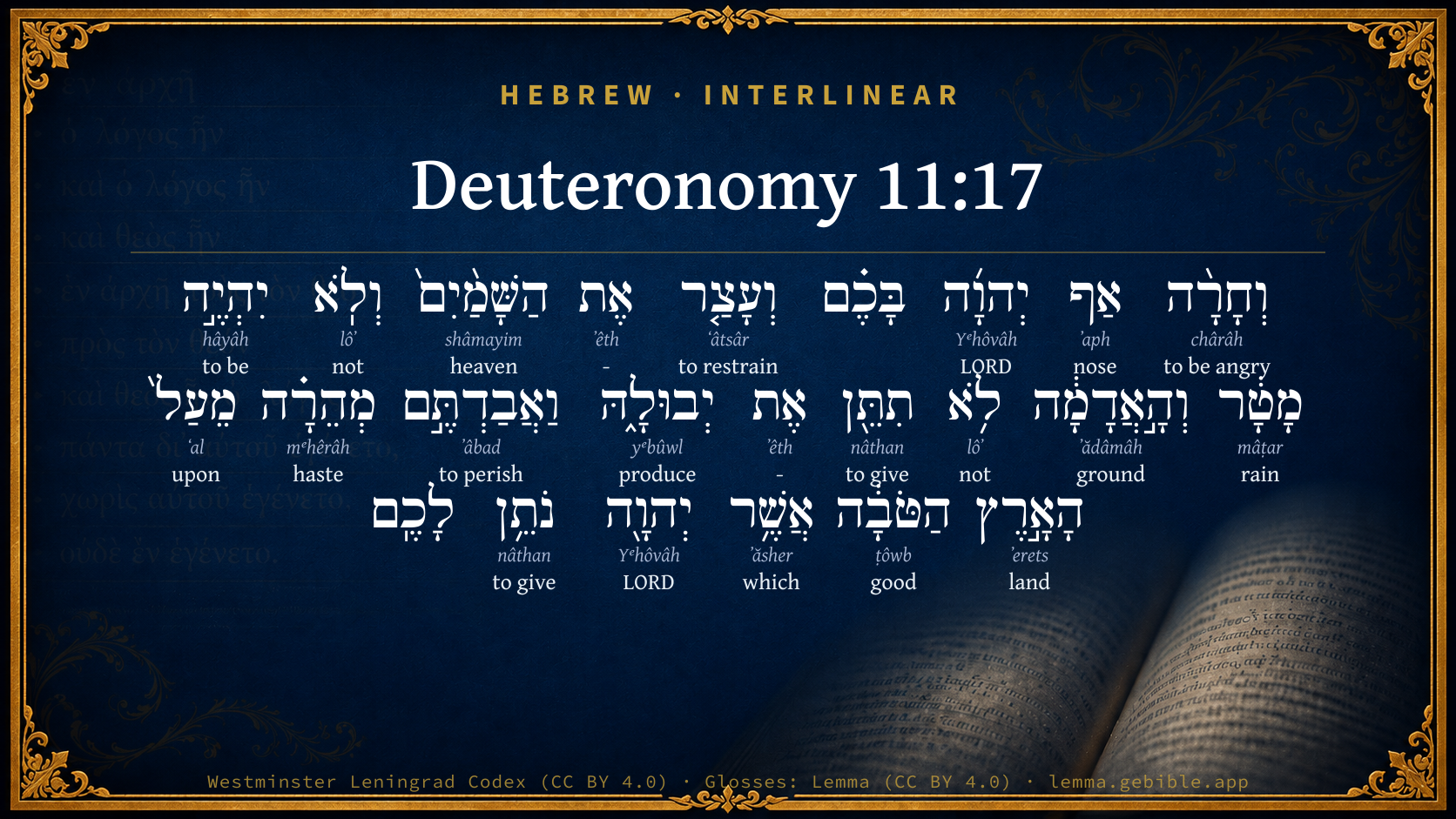
Hebrew (Westminster Leningrad Codex) Deuteronomy 11:17 appears in the Hebrew Old Testament. The text above is from the Westminster Leningrad Codex. Each word links to its Strong’s number, a concise gloss, and parsing drawn from the Open Scriptures Hebrew Bible morphology. Click any word for its full Brown-Driver-Briggs (BDB) entry.
Download image
Cite this verse

Deuteronomy 11:17 (World English Bible). Public Domain. Lemma interlinear Bible study tool, https://lemma.gebible.app/v/deuteronomy/11/17.

Show BibTeX & RIS
BibTeX
RIS
English Translation
and the anger of Yahweh be kindled against you, and he shut up the sky, so that there shall be no rain, and the land shall not yield its fruit; and you perish quickly from off the good land which Yahweh gives you.
World English Bible · Public Domain
Download a study sheet

One document with this verse’s original text, its word-by-word gloss line, the meaning frame, cross-references with their text, attributed commentary, and full source and license credits — printable, and it pastes into notes with its structure intact.

This verse Autodidact and up

Study sheet (.html) Plain text (.txt)

A passage Seminary Student

Up to 50 verses in one chapter. A passage sheet keeps up to 6 commentary sources and 12 cross-references per verse, in the order this page ranks them, and says so on the sheet whenever that leaves anything out. Ask for a single verse and you get the Autodidact verse sheet above.

Everything on this page stays free to read, with no account — the sheet is a download of what is already on screen, not access to it.

Want to remove ads? Support Godless Engineer
Compare translations 3

The same verse in 3 English versions, stacked beneath the original-language interlinear above. Click any original word for its lexicon entry.

Each is an independent rendering of the whole verse — the interlinear is not word-aligned to these translations.

Highlighted words mark where these versions differ — a whole-verse word diff, not a word-by-word alignment.

  • World English Bible Public Domain
    and the anger of Yahweh be kindled against you, and he shut up the sky, so that there shall be no rain, and the land shall not yield its fruit; and you perish quickly from off the good land which Yahweh gives you.
  • King James Version Public Domain
    And then the LORD's wrath be kindled against you, and he shut up the heaven, that there be no rain, and that the land yield not her fruit; and lest ye perish quickly from off the good land which the LORD giveth you.
  • unfoldingWord Literal Text CC BY-SA 4.0
    And the nose of Yahweh will burn against you. And he will restrain the heavens and there will be no rain, and the land will not give its fruit, and you will perish quickly from off the good land that Yahweh is giving to you.

unfoldingWord Literal Text — © unfoldingWord, licensed CC BY-SA 4.0. Word-aligned USFM3 via Door43 (git.door43.org/unfoldingWord/en_ult).

Versions to compare (up to 4)

3 of 4 selected

Show all 18 translations

Every available English version of this verse, each an independent rendering of the whole verse.

  • World English Bible Public Domain
    and the anger of Yahweh be kindled against you, and he shut up the sky, so that there shall be no rain, and the land shall not yield its fruit; and you perish quickly from off the good land which Yahweh gives you.
  • Berean Standard Bible Public Domain
    or the anger of the LORD will be kindled against you. He will shut the heavens so that there will be no rain, nor will the land yield its produce, and you will soon perish from the good land that the LORD is giving you.
  • Majority Standard Bible Public Domain
    or the anger of the LORD will be kindled against you. He will shut the heavens so that there will be no rain, nor will the land yield its produce, and you will soon perish from the good land that the LORD is giving you.
  • King James Version Public Domain
    And then the LORD's wrath be kindled against you, and he shut up the heaven, that there be no rain, and that the land yield not her fruit; and lest ye perish quickly from off the good land which the LORD giveth you.
  • American Standard Version (1901) Public Domain
    and the anger of Jehovah be kindled against you, and he shut up the heavens, so that there shall be no rain, and the land shall not yield its fruit; and ye perish quickly from off the good land which Jehovah giveth you.
  • Revised Version (1885) Public Domain
    and the anger of the LORD be kindled against you, and he shut up the heaven, that there be no rain, and that the land yield not her fruit; and ye perish quickly from off the good land which the LORD giveth you.
  • Geneva Bible (1599) Public Domain
    And so the anger of the Lord be kindled against you, and he shut vp the heauen, that there be no raine, and that your lande yeelde not her fruit, and yee perish quickly from the good land, which the Lord giueth you.
  • Douay-Rheims (1899) Public Domain
    Beware lest perhaps your heart be deceived, and you depart from the Lord, and serve strange gods, and adore them:
  • Young's Literal Translation Public Domain
    and the anger of Jehovah hath burned against you, and He hath restrained the heavens, and there is no rain, and the ground doth not give her increase, and ye have perished hastily from off the good land which Jehovah is giving to you.
  • Literal Standard Version CC BY-SA 4.0
    and the anger of YHWH has burned against you, and He has restrained the heavens and there is no rain, and the ground does not give her increase, and you have perished quickly from off the good land which YHWH is giving to you.
  • Unlocked Literal Bible CC BY-SA 4.0
    so that the anger of Yahweh is not kindled against you; and so that he does not shut up the heavens so that there will be no rain, and the land will not yield its fruit, and so that you perish quickly from off the good land that Yahweh is giving you.
  • unfoldingWord Literal Text CC BY-SA 4.0
    And the nose of Yahweh will burn against you. And he will restrain the heavens and there will be no rain, and the land will not give its fruit, and you will perish quickly from off the good land that Yahweh is giving to you.
  • Darby Bible Public Domain
    and Jehovah's wrath kindle against you, and he shut up the heavens, that there be no rain, and that the ground yield not its produce, and ye perish quickly from off the good land which Jehovah is giving you.
  • World Messianic Bible Public Domain
    and the LORD’s anger be kindled against you, and he shut up the sky so that there is no rain, and the land doesn’t yield its fruit; and you perish quickly from off the good land which the LORD gives you.
  • Webster's Bible Public Domain
    And then the LORD'S wrath shall be kindled against you, and he shall shut up the heaven, that there shall be no rain, and the land shall not yield her fruit; and lest ye perish quickly from off the good land which the LORD giveth you.
  • Free Bible Version CC BY-SA 4.0
    or the Lord will become angry with you. He won't send any rain, and the land won't produce any crops, and you will soon die, even in the good land that the Lord is giving you.
  • Bible in Basic English Public Domain
    For if you do so, the wrath of the Lord will be burning against you, and the heaven will be shut up so that there is no rain and the land will give no fruit; and in a very little time you will be cut off from the good land which the Lord is giving you.
  • JPS Tanakh (1917) Public Domain
    and the anger of the LORD be kindled against you, and He shut up the heaven, so that there shall be no rain, and the ground shall not yield her fruit; and ye perish quickly from off the good land which the LORD giveth you.

Literal Standard Version (2020), Covenant Press — licensed CC BY-SA 4.0. Text via the HelloAO Bible API (eBible.org). Unlocked Literal Bible (unfoldingWord) — licensed CC BY-SA 4.0. Text via the HelloAO Bible API (eBible.org). unfoldingWord Literal Text — © unfoldingWord, licensed CC BY-SA 4.0. Word-aligned USFM3 via Door43 (git.door43.org/unfoldingWord/en_ult). Free Bible Version, Dr. Jonathan Gallagher — licensed CC BY-SA 4.0. Text via the HelloAO Bible API (eBible.org).

Word by word

More ways to search: Search by grammar → Find every occurrence → Compare this word →

Practice this passage: Drill this verse → Learn its vocabulary →

יְבוּלָ֑הּ
yᵉbûwl
H2981
“produce · her”
Noun, Common, Masculine, Singular, Construct + Suffix, Personal, 3rd Person, Feminine, Singular
Part of Speech
Noun
Type
Common
Gender
Masculine
Number
Singular
State
Construct
Full BDB Definition

Origin: from H2986

TWOT: 835c

produce, fruit, produce (of the soil)
  1. וְחָרָ֨ה chârâh H2734 “and · to be angry” Conjunction + Verb, Qal, Sequential Perfect, 3rd Person, Masculine, Singular
  2. אַף ʼaph H639 “nose” Particle, Accusative
  3. יְהוָ֜ה Yᵉhôvâh H3068 “LORD” Noun, Proper
  4. וְעָצַ֤ר ʻâtsâr H6113 “and · to restrain” Conjunction + Verb, Qal, Sequential Perfect, 3rd Person, Masculine, Singular
  5. אֶת ʼêth H853 “-” Particle, Direct Object
  6. הַשָּׁמַ֨יִם֙ shâmayim H8064 “the · heaven(s)” Particle, Definite Article + Noun, Common, Masculine, Plural, Absolute
  7. וְלֹֽא lôʼ H3808 “and · not” Conjunction + Particle, Negative
  8. יִהְיֶ֣ה hâyâh H1961 “to be” Verb, Qal, Imperfect, 3rd Person, Masculine, Singular
  9. מָטָ֔ר mâṭar H4306 “rain” Noun, Common, Masculine, Singular, Absolute
  10. וְהָ֣אֲדָמָ֔ה ʼădâmâh H127 “and · the · ground” Conjunction + Particle, Definite Article + Noun, Common, Feminine, Singular, Absolute
  11. לֹ֥א lôʼ H3808 “not” Particle, Negative
  12. תִתֵּ֖ן nâthan H5414 “to give” Verb, Qal, Imperfect, 3rd Person, Feminine, Singular
  13. אֶת ʼêth H853 “-” Particle, Direct Object
  14. וַאֲבַדְתֶּ֣ם ʼâbad H6 “and · to perish” Conjunction + Verb, Qal, Sequential Perfect, 2nd Person, Masculine, Plural
  15. מְהֵרָ֗ה mᵉhêrâh H4120 “haste” Noun, Common, Feminine, Singular, Absolute
  16. מֵעַל֙ ʻal H5921 “from · upon” Preposition + Preposition
  17. הָאָ֣רֶץ ʼerets H776 “the · land” Particle, Definite Article + Noun, Common, Both, Singular, Absolute
  18. הַטֹּבָ֔ה ṭôwb H2896 “the · good” Particle, Definite Article + Adjective, Adjective, Feminine, Singular, Absolute
  19. אֲשֶׁ֥ר ʼăsher H834 “which” Particle, Relative
  20. יְהוָ֖ה Yᵉhôvâh H3068 “LORD” Noun, Proper
  21. נֹתֵ֥ן nâthan H5414 “giving” Verb, Qal, Participle Active, Masculine, Singular, Absolute

About this verse

These counts appear in no published source. They are computed here, from the morphology-tagged text and Lemma’s own curated glosses. What Lemma adds →

24
words
18
distinct lemmas
Pentateuch
section

Notable vocabulary

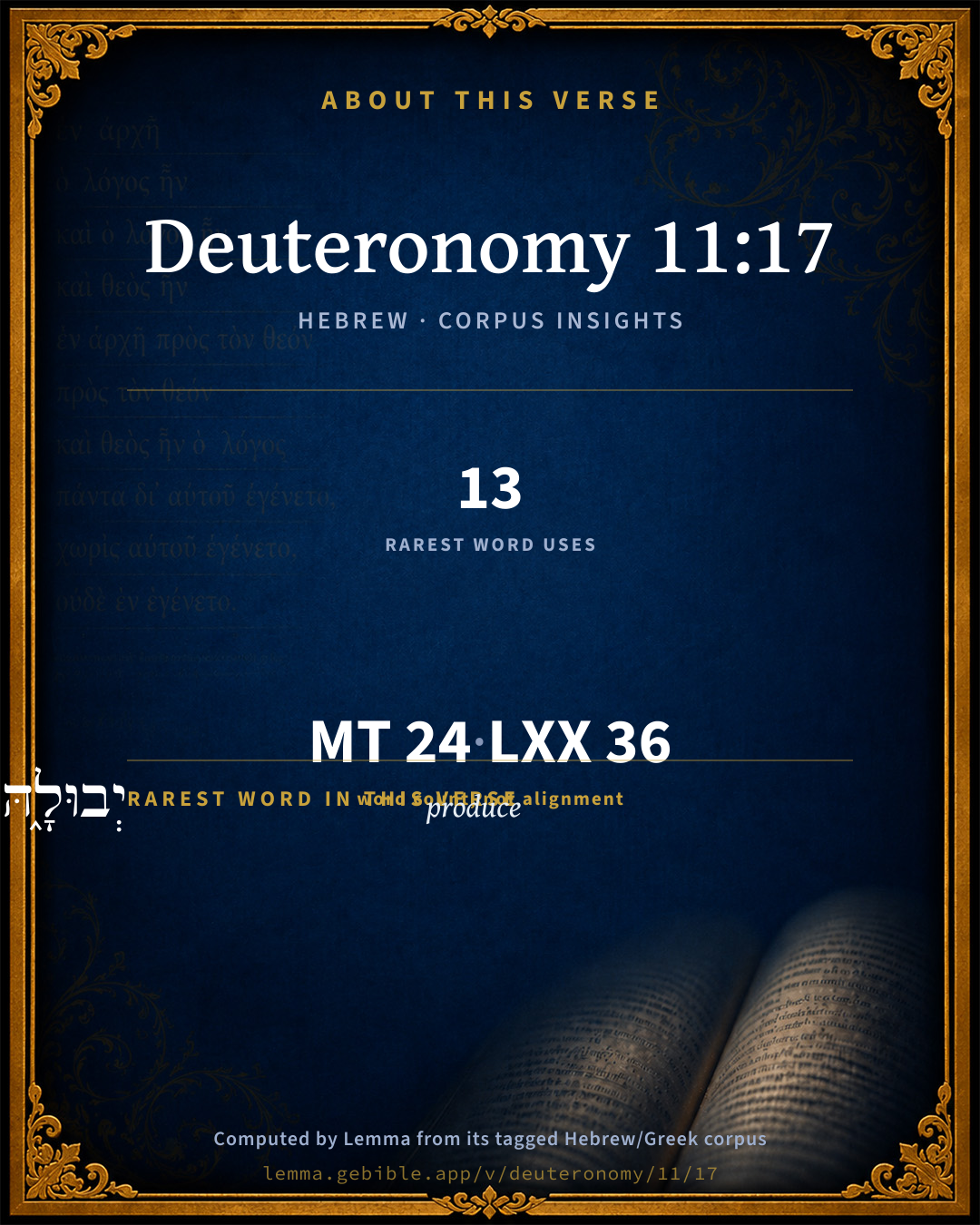
The rarest word here is יְבוּלָ֑הּ produce H2981 — appearing just 13 times in the whole Hebrew Bible.

Shared distinctive vocabulary

יְבוּלָ֑הּ produce H2981 occurs in 13 verses of the Hebrew Bible. Also found in:

Grammatical profile

  • 6 verbs
  • 8 nouns
  • 1 adjective
  • 3 prepositions
  • 6 particles

Verb forms

  • וְחָרָ֨ה Qal · Sequential Perfect
  • וְעָצַ֤ר Qal · Sequential Perfect
  • יִהְיֶ֣ה Qal · Imperfect
  • תִתֵּ֖ן Qal · Imperfect
  • וַאֲבַדְתֶּ֣ם Qal · Sequential Perfect
  • נֹתֵ֥ן Qal · Participle Active

Repetition

Words recur within this verse — often emphatic in Hebrew:

  • יְהוָ֜ה LORD H3068 ×2
  • תִתֵּ֖ן to give H5414 ×2
  • וְלֹֽא not H3808 ×2

Hebrew & Septuagint length

In English translation the verse runs 43 words from the Hebrew and 41 from the Septuagint (LXX English) — closely comparable.

A rough comparison of the two English renderings, which tokenize alike — not a word-level alignment.

Word counts can differ between the Hebrew and the Greek without any difference in meaning — e.g. the Hebrew direct-object marker אֵת has no separate Greek word, and Greek often adds the article ὁ.

In the original languages it is 24 Hebrew tokens and 36 Greek tokens — but the two are counted differently (Hebrew bundles its prefixes and suffixes into one token; the Greek is in lemma form), so that isn’t a like-for-like length.

Cross-references

13

Topical passages linked to Deuteronomy 11:17 in the Treasury of Scripture Knowledge — connected by theme and wording, ordered by reader-vote popularity; previews shown in the World English Bible.

  • 1 Kings 8:35 When the sky is shut up, and there is no rain, because they have sinned against you; if they pray toward this place, and confess your name, and turn from their sin, when you do afflict them:
  • Deuteronomy 6:15 for Yahweh your God in the midst of you is a jealous God; lest the anger of Yahweh your God be kindled against you, and he destroy you from off the face of the earth.
  • 2 Chronicles 6:26 When the sky is shut up, and there is no rain, because they have sinned against you; if they pray toward this place, and confess your name, and turn from their sin, when you do afflict them:
  • Amos 4:7 "I also have withheld the rain from you, When there were yet three months to the harvest; And I caused it to rain on one city, And caused it not to rain on another city. One place was rained on, And the piece where it didn't rain withered.
  • 1 Kings 17:1 Elijah the Tishbite, who was of the foreigners of Gilead, said to Ahab, As Yahweh, the God of Israel, lives, before whom I stand, there shall not be dew nor rain these years, but according to my word.
  • Deuteronomy 4:26 I call heaven and earth to witness against you this day, that you shall soon utterly perish from off the land whereunto you go over the Jordan to possess it; you shall not prolong your days on it, but shall utterly be destroyed.
  • Deuteronomy 8:19–20 It shall be, if you shall forget Yahweh your God, and walk after other gods, and serve them, and worship them, I testify against you this day that you shall surely perish.
  • Deuteronomy 28:23–24 Your sky that is over your head shall be brass, and the earth that is under you shall be iron.
  • Deuteronomy 30:17–18 But if your heart turn away, and you will not hear, but shall be drawn away, and worship other gods, and serve them;
  • 2 Chronicles 7:13 If I shut up the sky so that there is no rain, or if I command the locust to devour the land, or if I send pestilence among my people;
  • Jeremiah 14:1–6 The word of Yahweh that came to Jeremiah concerning the drought.
  • Haggai 1:9–11 "You looked for much, and, behold, it came to little; and when you brought it home, I blew it away. Why?" says Yahweh of Hosts, "Because of my house that lies waste, while each of you is busy with his own house.
  • Joshua 23:13–16 know for a certainty that Yahweh your God will no more drive these nations from out of your sight; but they shall be a snare and a trap to you, and a scourge in your sides, and thorns in your eyes, until you perish from off this good land which Yahweh your God has given you.

Cross-references courtesy of OpenBible.info (CC BY 4.0).

Hebrew and Greek witnesses Masoretic Hebrew ↔ Greek Septuagint

The same verse in the two great witnesses to the Old Testament, shown verse-for-verse.

These are two independent witnesses, not word-aligned to each other, and the Septuagint is shown in lemma (dictionary) form.

Hebrew Deuteronomy 11:17 Masoretic · Westminster Leningrad Codex

וְחָרָ֨ה אַף יְהוָ֜ה בָּכֶ֗ם וְעָצַ֤ר אֶת הַשָּׁמַ֨יִם֙ וְלֹֽא יִהְיֶ֣ה מָטָ֔ר וְהָ֣אֲדָמָ֔ה לֹ֥א תִתֵּ֖ן אֶת יְבוּלָ֑הּ וַאֲבַדְתֶּ֣ם מְהֵרָ֗ה מֵעַל֙ הָאָ֣רֶץ הַטֹּבָ֔ה אֲשֶׁ֥ר יְהוָ֖ה נֹתֵ֥ן לָכֶֽם

and the anger of Yahweh be kindled against you, and he shut up the sky, so that there shall be no rain, and the land shall not yield its fruit; and you perish quickly from off the good land which Yahweh gives you.

World English Bible · Public Domain

Greek LXX Deuteronomy 11:17 Septuagint · lemma form

καί θυμόω ὀργή κύριος ἐπί σύ καί συνἔχω ὁ οὐρανός καί οὐ εἰμί ὑετός καί ὁ γῆ οὐ δίδωμι ὁ καρπός αὐτός καί ἀποὀλλύω ἐν ταχύς ἀπό ὁ γῆ ὁ ἀγαθός ὅς δίδωμι ὁ κύριος σύ

and the Lord be angry with you, and restrain the heaven; and there shall not be rain, and the earth shall not yield its fruit, and you⌃ shall perish quickly from off the good land, which the Lord has given you.

LXX2012 (modern English Septuagint) · Public Domain

Hebrew: Westminster Leningrad Codex (CC BY 4.0). Greek: Septuagint (public domain); English from LXX2012 (modern English Septuagint) (Public Domain). How the Septuagint differs from the Hebrew →

Targum (Aramaic paraphrase)

2

The Targum is the ancient Jewish Aramaic paraphrase of the Hebrew Scriptures — an interpretive translation, not the Hebrew text itself. Onkelos (literal) and Pseudo-Jonathan (expansive) render the Torah, and Jonathan the Prophets. Coverage is partial: where no permissively-licensed English translation exists for a verse, only the Aramaic is shown. This is verse-level text, not a word-by-word alignment to the Hebrew.

  1. Targum Onkelos Torah (Genesis–Deuteronomy)
    וְיִתְקוֹף רָגְזָא דַיְיָ בְּכוֹן וְיֵחוֹד יָת שְׁמַיָא וְלָא יְהֵי מִטְרָא וְאַרְעָא לָא תִתֵּן יָת עֲלַלְתַּהּ וְתֵיבְדוּן בִּפְרִיעַ מֵעַל אַרְעָא טַבְתָא דַיְיָ יָהֵב לְכוֹן

    And it will be vehement, the anger of of YY, upon you, and he will close the Heavens, and there will not be the rain, and the land won't give its produce, and you will perish quickly from the land that is good that YY *gave* to you.

    Targum Onkelos — Aramaic: “Onkelos Genesis” (public domain); “Onkelos Exodus” (public domain); “Onkelos Leviticus” (public domain); “Onkelos Numbers” (public domain); “Onkelos Deuteronomy” (public domain). English: “Sefaria Community Translation” (CC0 1.0 (public-domain dedication)); “J.W. Etheridge. The Targums of Onkelos and Jonathan Ben Uzziel on the Pentateuch. London: Longmans, Green, 1862” (public domain). Text via Sefaria.

  2. Targum Pseudo-Jonathan Torah (Genesis–Deuteronomy)
    וְיִתְקֵף רוּגְזָא דַיְיָ בְּכוֹן וְיֵיחוּד יַת עֲנָנֵי שְׁמַיָא דְלָא יֵחְתוּן מַטְרָא וְאַרְעָא לָא תִתֵּן עֲלַלְתָּהּ וְתֵיבְדוּן בְּסַרְהוֹבַיָא מֵעִלַוֵי אַרְעָא מְשַׁבְּחָא דַיְיָ יָהֵיב לְכוֹן

    and the Lord’s anger be provoked against you, and He shut up the clouds of heaven, and let not the rain come down, and the earth yield no provender, and you perish soon from off the glorious land which the Lord shall give you.

    Targum Pseudo-Jonathan — Aramaic: “Targum Jonathan on Genesis” (public domain); “Targum Jonathan on Exodus” (public domain); “Targum Jonathan on Leviticus” (public domain); “Targum Jonathan on Numbers” (public domain); “Targum Jonathan on Deuteronomy” (public domain). English: “The Targum of Jonathan ben Uzziel, trans. J. W. Etheridge, London, 1862” (public domain). Text via Sefaria.

Commentary

Notes on Deuteronomy 11:17 from classic Christian and Jewish commentators (each source and its license shown beneath its notes). The classic Christian expositions comment on the surrounding passage and are grouped to its opening verse, so a note may address several verses; the Jewish commentaries on the Tanakh (Rashi and others) are per-verse, so they appear only where the commentator wrote on this verse.

Lemma curates 59 commentaries, every one of them public domain or Creative Commons licensed, each selected and text-cleaned for this edition rather than reprinted as found. About our sources →

Trapp's Complete Commentary

John Trapp

Deu 11:17 And [then] the LORD’S wrath be kindled against you, and he shut up the heaven, that there be no rain, and that the land yield not her fruit; and [lest] ye perish quickly from off the good land which the LORD giveth you.

Ver. 17. And he shut up the heaven.] The keys of heaven, of the heart, of the womb, and of the grave, God keeps and carries under his own belt, as we may say.

John Trapp, A Commentary or Exposition upon All the Books of the Old and New Testament (1647–1656) — public domain. Text from a community e-Sword module.

John Gill's Exposition

For if ye shall diligently keep all these commandments which I command you to do them,.... Observe and take notice of them, even all of them, and so as not merely to have a theory or notional knowledge of them, but to put them in practice:

to love the Lord your God; and show it by obeying his commands, and which is the end of the commandment, and the principle from which all obedience should flow:

to walk in all his ways, and to cleave unto him; see Deu 10:12.

John Gill's Exposition of the Whole Bible (1746–1763) — public domain (CC PDM 1.0). Text via the HelloAO Bible API.

Haydock's Catholic Bible Commentary

You. In all this discourse, Moses attributes the fertility of the promised land to the blessing of God, and indeed it seems to be naturally far from being so luxuriant as to be able to feed so many inhabitants. Travellers inform us, that a great part is incapable of cultivation. But it is no longer the object of God’s complacency, ver. 12. It is under the curse, chap. xxviii. 23. (Calmet)

George Leo Haydock (1774–1849), Haydock's Catholic Family Bible and Commentary, 1859 edition — public domain. Excludes Psalms (Douay-Rheims chapter numbering differs from Protestant) and Deuterocanonical books (Catholic canon only).

Matthew Poole's English Annotations

Heaven is compared sometimes to a bottle, Job 38:37, which may be either stopped or opened; sometimes to a great storehouse, wherein God lays up his treasures of rain, Job 38:22; Psa 33:7, the doors whereof God is said to open when he gives rain, and to shut when he withholds it. See 1Ki 8:35; 2Ch 6:26; 7:13.

Matthew Poole's English Annotations on the Holy Bible (1683–1685) — public domain. Text from a community e-Sword/MySword module.

The Pulpit Commentary

He shut up the heaven. "The heaven conceived as a womb" (Schulz); cf. Gen_16:2. The want of rain was regarded as a sign of the Divine displeasure and as a curse (1Ki_8:35; Rev_11:6)

The Pulpit Commentary (1880–1919), ed. H.D.M. Spence-Jones & Joseph S. Exell — public domain. Text from a community e-Sword module.

John Wesley's Explanatory Notes

Shut up the heaven - Which is compared sometimes to a great store-house wherein God lays up his treasures of rain, Job xxxviii, 22, the doors whereof God is said to open when he gives rain, and to shut when he witholds it.

John Wesley, Explanatory Notes Upon the Whole Bible (1754–1765) — public domain. Text via the GEBible commentary corpus.

Rashi

Rabbi Shlomo Yitzchaki (Rashi)

את יבולה [THE GROUND WILL NOT GIVE] ITS יבול — it will not yield even as much as what you have brought (יבול) to it (even the same quantity of seed you have sown in it), just as it is said, (Hag. 1:6) “You sow much, but bring in little” (Sifrei Devarim 43:28; cf. Rashi on Leviticus 26:20).

ואבדתם מהרה AND YE SHALL PERISH QUICKLY — In addition to all the other sufferings I will banish you from the soil which made you sin (Sifrei Devarim 43:29). A parable! It may be compared to the case of a king who sent his son to the banqueting hall and earnestly charged him, “Do not eat more than you need, in order that you may come home clean!” The son, however, took no notice of this; he ate and drank more than he needed, and vomited it up and befouled all the company. They took him by his hands and feet and cast him out of the palace (Sifrei Devarim 43:23).

מהרה [AND YE SHALL PERISH] QUICKLY — I will give you no respite. But if you ask: Was not respite given to the generation of the flood, as it is said, (Genesis 6:3) “His days shall be (i.e. a respite shall be given him for) one hundred and twenty years”? Then I reply: The generation of flood had no one from whom to learn, but you have someone from whom to learn (Sifrei Devarim 43:31).

Rashi on the Tanakh — English translations: “The Judaica Press complete Tanach with Rashi, translated by A. J. Rosenberg” (CC BY 4.0); “Pentateuch with Rashi's commentary by M. Rosenbaum and A.M. Silbermann, 1929-1934” (public domain); “The Metsudah Tanach series, Lakewood, N.J” (CC BY 4.0); and “The Book of Joshua, Metsudah Publications, 1997” (CC BY 4.0). Text via Sefaria.

Sforno

Rabbi Ovadia Sforno

You will swiftly be removed. Due to famine, which is worse than the sword. Therefore, “Look out for yourselves”.

Sforno on the Tanakh — English translation: “Yalkut, Sifsei Chachomim Chumash, Metsudah Publications, 2009” (CC BY 4.0). Text via Sefaria.

Lesson kit

Teaching starters — assembled from the data on this page, not authored interpretation. Every prompt links to the verse data it draws on. Edit before teaching.

Deuteronomy, in the Pentateuch, opens this verse with 24 words (18 distinct Hebrew lemmas). Its most distinctive word is yᵉbûwl (“produce”). A historical commentator’s framing appears above. Read the whole chapter for the surrounding context.

Discussion questions

  1. The word yᵉbûwl carries the sense “produce.” How does it shape the verse?
  2. How does Leviticus 26:4, which shares the word «produce», read alongside this verse?
  3. What does the repetition of “LORD” (2× in this one verse) do in this verse?
  4. These translations render this verse differently. What is at stake in choosing one wording over another?
  5. «וְחָרָ֨ה» is a Qal Sequential Perfect verb. How does that grammatical form shape the action described?
  6. Compare how Trapp's Complete Commentary and John Gill's Exposition read this verse. Where do they agree or differ?

Things to notice

Reading settings

Reading text

Shown beneath each verse's original-language words.

Old Testament
Old Testament edition

Read the OT as the Masoretic Hebrew (MT) or the Greek Septuagint (LXX).

English shown for the Greek Septuagint (in the Hebrew ↔ Greek comparison).

Comparing translations? Open the Compare panel on any verse page to stack up to four side by side.