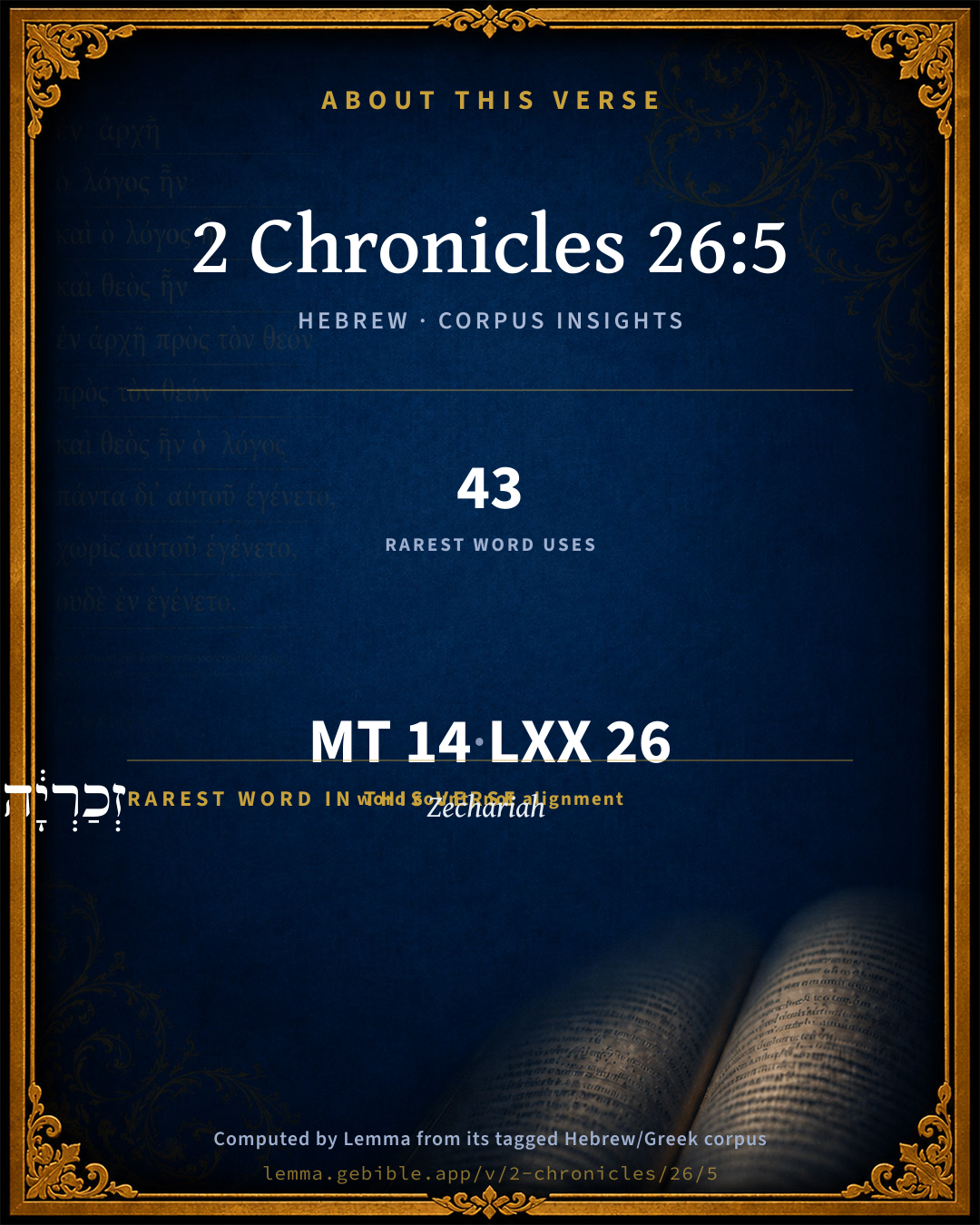
2 Chronicles 26:5

Hebrew (Westminster Leningrad Codex) 2 Chronicles 26:5 appears in the Hebrew Old Testament. The text above is from the Westminster Leningrad Codex. Each word links to its Strong’s number, a concise gloss, and parsing drawn from the Open Scriptures Hebrew Bible morphology. Click any word for its full Brown-Driver-Briggs (BDB) entry.
Download image
Cite this verse

2 Chronicles 26:5 (World English Bible). Public Domain. Lemma interlinear Bible study tool, https://lemma.gebible.app/v/2-chronicles/26/5.

Show BibTeX & RIS
BibTeX
RIS
English Translation
He set himself to seek God in the days of Zechariah, who had understanding in the vision of God: and as long as he sought Yahweh, God made him to prosper.
World English Bible · Public Domain
Download a study sheet

One document with this verse’s original text, its word-by-word gloss line, the meaning frame, cross-references with their text, attributed commentary, and full source and license credits — printable, and it pastes into notes with its structure intact.

This verse Autodidact and up

Study sheet (.html) Plain text (.txt)

A passage Seminary Student

Up to 50 verses in one chapter. A passage sheet keeps up to 6 commentary sources and 12 cross-references per verse, in the order this page ranks them, and says so on the sheet whenever that leaves anything out. Ask for a single verse and you get the Autodidact verse sheet above.

Everything on this page stays free to read, with no account — the sheet is a download of what is already on screen, not access to it.

Want to remove ads? Support Godless Engineer
Compare translations 3

The same verse in 3 English versions, stacked beneath the original-language interlinear above. Click any original word for its lexicon entry.

Each is an independent rendering of the whole verse — the interlinear is not word-aligned to these translations.

Highlighted words mark where these versions differ — a whole-verse word diff, not a word-by-word alignment.

  • World English Bible Public Domain
    He set himself to seek God in the days of Zechariah, who had understanding in the vision of God: and as long as he sought Yahweh, God made him to prosper.
  • King James Version Public Domain
    And he sought God in the days of Zechariah, who had understanding in the visions of God: and as long as he sought the LORD, God made him to prosper.
  • unfoldingWord Literal Text CC BY-SA 4.0
    And he was seeking God in the days of Zechariah, the one instructing to see God. And in the days of his seeking Yahweh, God caused him to prosper.

unfoldingWord Literal Text — © unfoldingWord, licensed CC BY-SA 4.0. Word-aligned USFM3 via Door43 (git.door43.org/unfoldingWord/en_ult).

Versions to compare (up to 4)

3 of 4 selected

Show all 18 translations

Every available English version of this verse, each an independent rendering of the whole verse.

  • World English Bible Public Domain
    He set himself to seek God in the days of Zechariah, who had understanding in the vision of God: and as long as he sought Yahweh, God made him to prosper.
  • Berean Standard Bible Public Domain
    He sought God throughout the days of Zechariah, who instructed him in the fear of God. And as long as he sought the LORD, God gave him success.
  • Majority Standard Bible Public Domain
    He sought God throughout the days of Zechariah, who instructed him in the fear of God. And as long as he sought the LORD, God gave him success.
  • King James Version Public Domain
    And he sought God in the days of Zechariah, who had understanding in the visions of God: and as long as he sought the LORD, God made him to prosper.
  • American Standard Version (1901) Public Domain
    And he set himself to seek God in the days of Zechariah, who had understanding in the vision of God: and as long as he sought Jehovah, God made him to prosper.
  • Revised Version (1885) Public Domain
    And he set himself to seek God in the days of Zechariah, who had understanding in the vision of God: and as long as he sought the LORD, God made him to prosper.
  • Geneva Bible (1599) Public Domain
    And he sought God in the dayes of Zechariah (which vnderstoode the visions of God) and when as he sought the Lord, God made him to prosper.
  • Douay-Rheims (1899) Public Domain
    And he sought the Lord in the days of Zacharias that understood and saw God: and as long as he sought the Lord, he directed him in all things.
  • Young's Literal Translation Public Domain
    and he is as one seeking God in the days of Zechariah who hath understanding in visions of God: and in the days of his seeking Jehovah, God hath caused him to prosper.
  • Literal Standard Version CC BY-SA 4.0
    and he is as one seeking God in the days of Zechariah who has understanding in visions of God: and in the days of his seeking YHWH, God has caused him to prosper.
  • Unlocked Literal Bible CC BY-SA 4.0
    He set himself to seek God in the days of Zechariah, who taught him to honor God. As long as he sought Yahweh, God made him prosper.
  • unfoldingWord Literal Text CC BY-SA 4.0
    And he was seeking God in the days of Zechariah, the one instructing to see God. And in the days of his seeking Yahweh, God caused him to prosper.
  • Darby Bible Public Domain
    And he sought God in the days of Zechariah, who had understanding in the visions of God; and in the days that he sought Jehovah, God made him to prosper.
  • World Messianic Bible Public Domain
    He set himself to seek God in the days of Zechariah, who had understanding in the vision of God; and as long as he sought the LORD, God made him prosper.
  • Webster's Bible Public Domain
    And he sought God in the days of Zechariah, who had understanding in the visions of God: and, as long as he sought the LORD, God made him to prosper.
  • Free Bible Version CC BY-SA 4.0
    He worshiped God during the lifetime of Zechariah, who taught him to respect God. As long as he followed the Lord, God made him successful.
  • Bible in Basic English Public Domain
    He gave himself to searching after God in the days of Zechariah, who made men wise in the fear of God; and as long as he was true to the Lord, God made things go well for him.
  • JPS Tanakh (1917) Public Domain
    And he set himself to seek God in the days of Zechariah, who had understanding in the vision of God; and as long as he sought the LORD, God made him to prosper.

Literal Standard Version (2020), Covenant Press — licensed CC BY-SA 4.0. Text via the HelloAO Bible API (eBible.org). Unlocked Literal Bible (unfoldingWord) — licensed CC BY-SA 4.0. Text via the HelloAO Bible API (eBible.org). unfoldingWord Literal Text — © unfoldingWord, licensed CC BY-SA 4.0. Word-aligned USFM3 via Door43 (git.door43.org/unfoldingWord/en_ult). Free Bible Version, Dr. Jonathan Gallagher — licensed CC BY-SA 4.0. Text via the HelloAO Bible API (eBible.org).

Word by word

More ways to search: Search by grammar → Find every occurrence → Compare this word →

Practice this passage: Drill this verse → Learn its vocabulary →

זְכַרְיָ֔הוּ
Zᵉkaryâh
H2148
“Zechariah”
Noun, Proper
Part of Speech
Noun
Type
Proper
Full BDB Definition

Origin: from H2142 and H3050

TWOT: None

Zechariah = "Jehovah remembers" - 11th in order of the minor prophets; a priest, son of Berechiah and grandson of Iddo, who, along with Haggai, directed the rebuilding of the temple in the days of Zerubbabel - king of Israel, son of Jeroboam II - son of Meshelemiah of Shelemiah, a Korhite, and keeper of the north gate of the tabernacle of the congregation - one of the sons of Jehiel - a Levite of the second order in the temple band in the time of David - one of the princes of Judah in the reign of Jehoshaphat - son of the high priest Jehoiada, in the reign of Joash king of Judah, who was stoned in the court of the temple - a Kohathite Levite in the reign of Josiah - the leader of the sons of Pharosh who returned with Ezra - son of Bebai - one of the chiefs of the people whom Ezra summoned in council at the river Ahava; stood at Ezra's left hand when Ezra expounded the law to the people - one of the family of Elam who had married a foreign wife after the captivity - ancestor of Athaiah or Uthai - a Shilonite, descendant of Perez, grandfather of Athaiah - a priest, son of Pashur - the representative of the priestly family of Iddo in the days of Joiakim the son of Jeshua; possibly the same as 1 above - one of the priests, son of Jonathan, who blew with the trumpets at the dedication of the city wall by Ezra and Nehemiah - a chief of the Reubenites at the time of the captivity by Tiglath-pileser - one of the priests who accompanied the ark from the house of Obed-edom - son of Isshiah of Jesiah, a Kohathite Levite descended from Uzziel - 4th son of Hosah, of the children of Merari - a Manassite, father of Iddo - father of Jahaziel. He prophesied in the spirit - one of the sons of Jehoshaphat - a prophet in the reign of Uzziah, who appears to have acted as the king's counsellor, but of whom nothing is known - father of Abijah or Abi, Hezekiah's mother - one of the family of Asaph in the reign of Hezekiah - one of the rulers of the temple in the reign of Josiah - son of Jeberechiah who was taken by the prophet Isaiah as one of the 'faithful witnesses to record' when he wrote concerning Maher-shalal-hash-baz

  1. וַיְהִי֙ hâyâh H1961 “and · to be” Conjunction + Verb, Qal, Sequential Imperfect, 3rd Person, Masculine, Singular
  2. לִדְרֹ֣שׁ dârash H1875 “to seek” Preposition + Verb, Qal, Infinitive Construct
  3. אֱלֹהִ֔ים ʼĕlôhîym H430 “God(s)” Noun, Common, Masculine, Plural, Absolute
  4. בִּימֵ֣י yôwm H3117 “in/at · days of” Preposition + Noun, Common, Masculine, Plural, Construct
  5. הַמֵּבִ֖ין bîyn H995 “the · understanding” Particle, Definite Article + Verb, Hiphil, Participle Active, Masculine, Singular, Absolute
  6. בִּרְאֹ֣ת râʼâh H7200 “in/at · to see” Preposition + Verb, Qal, Infinitive Construct
  7. הָאֱלֹהִ֑ים ʼĕlôhîym H430 “the · God(s)” Particle, Definite Article + Noun, Common, Masculine, Plural, Absolute
  8. וּבִימֵי֙ yôwm H3117 “and · in/at · days of” Conjunction + Preposition + Noun, Common, Masculine, Plural, Construct
  9. דָּרְשׁ֣וֹ dârash H1875 “to seek · him” Verb, Qal, Infinitive Construct + Suffix, Personal, 3rd Person, Masculine, Singular
  10. אֶת ʼêth H853 “-” Particle, Direct Object
  11. יְהוָ֔ה Yᵉhôvâh H3068 “LORD” Noun, Proper
  12. הִצְלִיח֖וֹ tsâlach H6743 “to prosper · him” Verb, Hiphil, Perfect, 3rd Person, Masculine, Singular + Suffix, Personal, 3rd Person, Masculine, Singular
  13. הָאֱלֹהִֽים ʼĕlôhîym H430 “the · God(s)” Particle, Definite Article + Noun, Common, Masculine, Plural, Absolute

About this verse

These counts appear in no published source. They are computed here, from the morphology-tagged text and Lemma’s own curated glosses. What Lemma adds →

14
words
10
distinct lemmas
Historical
section

Shared distinctive vocabulary

זְכַרְיָ֔הוּ Zechariah H2148 occurs in 43 verses of the Hebrew Bible. Also found in:

Grammatical profile

  • 6 verbs
  • 7 nouns
  • 1 particle

Verb forms

  • וַיְהִי֙ Qal · Sequential Imperfect
  • לִדְרֹ֣שׁ Qal · Infinitive Construct
  • הַמֵּבִ֖ין Hiphil · Participle Active
  • בִּרְאֹ֣ת Qal · Infinitive Construct
  • דָּרְשׁ֣וֹ Qal · Infinitive Construct
  • הִצְלִיח֖וֹ Hiphil · Perfect

Repetition

Words recur within this verse — often emphatic in Hebrew:

  • אֱלֹהִ֔ים God H430 ×3
  • לִדְרֹ֣שׁ to seek H1875 ×2
  • בִּימֵ֣י day H3117 ×2

Hebrew & Septuagint length

In English translation the verse runs 31 words from the Hebrew and 30 from the Septuagint (LXX English) — closely comparable.

A rough comparison of the two English renderings, which tokenize alike — not a word-level alignment.

Word counts can differ between the Hebrew and the Greek without any difference in meaning — e.g. the Hebrew direct-object marker אֵת has no separate Greek word, and Greek often adds the article ὁ.

In the original languages it is 14 Hebrew tokens and 26 Greek tokens — but the two are counted differently (Hebrew bundles its prefixes and suffixes into one token; the Greek is in lemma form), so that isn’t a like-for-like length.

Cross-references

16

Topical passages linked to 2 Chronicles 26:5 in the Treasury of Scripture Knowledge — connected by theme and wording, ordered by reader-vote popularity; previews shown in the World English Bible.

  • 2 Chronicles 15:2 and he went out to meet Asa, and said to him, Hear you me, Asa, and all Judah and Benjamin: Yahweh is with you, while you are with him; and if you seek him, he will be found of you; but if you forsake him, he will forsake you.
  • 2 Chronicles 24:2 Joash did that which was right in the eyes of Yahweh all the days of Jehoiada the priest.
  • 1 Chronicles 22:13 Then shall you prosper, if you observe to do the statutes and the ordinances which Yahweh gave Moses concerning Israel. Be strong, and of good courage. Don't be afraid, neither be dismayed.
  • Genesis 41:38 Pharaoh said to his servants, "Can we find such a one as this, a man in whom is the Spirit of God?"
  • Daniel 5:16 But I have heard of you, that you can give interpretations, and dissolve doubts; now if you can read the writing, and make known to me the interpretation of it, you shall be clothed with purple, and have a chain of gold about your neck, and shall be the third ruler in the kingdom.
  • Genesis 41:15 Pharaoh said to Joseph, "I have dreamed a dream, and there is no one who can interpret it. I have heard it said of you, that when you hear a dream you can interpret it."
  • 2 Chronicles 25:8 But if you will go, do [valiantly], be strong for the battle: God will cast you down before the enemy; for God has power to help, and to cast down.
  • Daniel 1:17 Now as for these four youths, God gave them knowledge and skill in all learning and wisdom: and Daniel had understanding in all visions and dreams.
  • Daniel 2:19 Then was the secret revealed to Daniel in a vision of the night. Then Daniel blessed the God of heaven.
  • Daniel 10:1 In the third year of Cyrus king of Persia a thing was revealed to Daniel, whose name was called Belteshazzar; and the thing was true, even a great warfare: and he understood the thing, and had understanding of the vision.
  • Judges 2:7 The people served Yahweh all the days of Joshua, and all the days of the elders who outlived Joshua, who had seen all the great work of Yahweh that he had worked for Israel.
  • 1 Chronicles 22:11 Now, my son, Yahweh be with you; and prosper you, and build the house of Yahweh your God, as he has spoken concerning you.
  • Hosea 6:4 "Ephraim, what shall I do to you? Judah, what shall I do to you? For your love is like a morning cloud, And like the dew that disappears early.
  • Psalms 1:3 He will be like a tree planted by the streams of water, That brings forth its fruit in its season, Whose leaf also does not wither. Whatever he does shall prosper.
  • Mark 4:16–17 These in like manner are those who are sown on the rocky places, who, when they have heard the word, immediately receive it with joy.
  • Acts 20:30 Men will arise from among your own selves, speaking perverse things, to draw away the disciples after them.

Cross-references courtesy of OpenBible.info (CC BY 4.0).

Hebrew and Greek witnesses Masoretic Hebrew ↔ Greek Septuagint

The same verse in the two great witnesses to the Old Testament, shown verse-for-verse.

These are two independent witnesses, not word-aligned to each other, and the Septuagint is shown in lemma (dictionary) form.

Hebrew 2 Chronicles 26:5 Masoretic · Westminster Leningrad Codex

וַיְהִי֙ לִדְרֹ֣שׁ אֱלֹהִ֔ים בִּימֵ֣י זְכַרְיָ֔הוּ הַמֵּבִ֖ין בִּרְאֹ֣ת הָאֱלֹהִ֑ים וּבִימֵי֙ דָּרְשׁ֣וֹ אֶת יְהוָ֔ה הִצְלִיח֖וֹ הָאֱלֹהִֽים

He set himself to seek God in the days of Zechariah, who had understanding in the vision of God: and as long as he sought Yahweh, God made him to prosper.

World English Bible · Public Domain

Greek LXX 2 Chronicles 26:5 Septuagint · lemma form

καί εἰμί ἐκζητέω ὁ κύριος ἐν ὁ ἡμέρα ζαχαριας ὁ συνεἰμί ἐν φόβος κύριος καί ἐν ὁ ἡμέρα αὐτός ζητέω ὁ κύριος καί εὐοδόω αὐτός κύριος

And he sought the Lord in the days of Zacharias, who understood the fear of the Lord; and in his days he sought the Lord, and the Lord prospered him.

LXX2012 (modern English Septuagint) · Public Domain

On this verse, Ellicott's Commentary for English Readers discusses the Septuagint’s reading. Read the note in Commentary ↓

Hebrew: Westminster Leningrad Codex (CC BY 4.0). Greek: Septuagint (public domain); English from LXX2012 (modern English Septuagint) (Public Domain). How the Septuagint differs from the Hebrew →

Commentary

Notes on 2 Chronicles 26:5 from classic Christian and Jewish commentators (each source and its license shown beneath its notes). The classic Christian expositions comment on the surrounding passage and are grouped to its opening verse, so a note may address several verses; the Jewish commentaries on the Tanakh (Rashi and others) are per-verse, so they appear only where the commentator wrote on this verse.

Lemma curates 59 commentaries, every one of them public domain or Creative Commons licensed, each selected and text-cleaned for this edition rather than reprinted as found. About our sources →

Trapp's Complete Commentary

John Trapp

2Ch 26:5 And he sought God in the days of Zechariah, who had understanding in the visions of God: and as long as he sought the LORD, God made him to prosper.

Ver. 5. And he sought God.] Heb., Full in consulendo Deo, i.e., He was wholly taken up in consulting with God.

In the days of Zechariah.] Who was, saith Jerome, son to Zechariah, the son of Jehoiada. He had a daughter, say others, {a} called Abijah, who became wife to king Ahaz, and mother to Hezekiah.

Who had understanding in the visions of God.] Was a skilful seer or prophet. Some render it, Who made to understand in the fear of God.

And as long as he sought the Lord, God made him to prosper.] So fared it also with that great prince of late years, who, while he stood to the true religion, was Bonus orbi, good of bereft, and prospered in all his enterprises: but afterwards was Orbus boni, bereft of good, and sped accordingly, as one wittily descanted upon his name.

{a} Salian. Cajetan. Dion.

John Trapp, A Commentary or Exposition upon All the Books of the Old and New Testament (1647–1656) — public domain. Text from a community e-Sword module.

The Biblical Illustrator

Joseph S. Exell

2Ch_26:5

And as long as he sought the Lord, God made him to prosper.

Soul prosperity

I. The seekers of the Lord.

1. Every real seeker of the Lord must be a heaven-born soul (Joh_3:8). This involves the bestowment of a Divine existence, the creating of a new nature (2Pe_1:4). This is the nature that habitually seeks after God.

2. Seeking the Lord includes--

(1) Worshipping.

(2) Wrestling.

(3) Waiting.

II. Their experience of prosperity. If you ask a worldling what constitutes prosperity he will say, Many excellent bargains, good customers, ready money, quick returns, the accumulation of property, health, friends, extended connections, and the like. But what is Christian prosperity?

1. Spiritual growth.

2. Triumphant victories. The life of a Christian is the life of a conqueror.

3. The taking of spoils from the vanquished foe. The most valuable lessons are often learnt from the heaviest calamities.

III. The extension of prosperity: As long as he sought the Lord. (Joseph Irons.)

The secret of strength and its perils

I. We have the marvellous help which Jehovah gives to a rightly-purposed man, and its consequences. No one can suppose that Judah was very prosperous before the accession of that king. For, not only had it been humbled at the battle of Beth-Shemesh, but Jerusalem itself had been ravaged and partially dismantled. And, considering the extreme youth of the king, only sixteen years of age when he came to the throne, one would naturally have expected to read of the gradual increase of the disorders of the kingdom through the contests of opposing factions, and of its gradual diminution and enthralment through the successes of its enemies. But, on the contrary, the first thing recorded of Uzziah is that he built Eloth and restored it to Judah; and thenceforward, throughout the greater part of his reign, the story of no single disaster or defeat interrupts the current of prosperity. First of all the Philistines, and then the Arabs, the Mehunim, and the Ammonites were compelled to restore to Judah the cities they had before appropriated, were, indeed, in some instances reduced to the condition of tributary nations. And the internal administration of the country was not less fortunate than its external relationships. Jerusalem was refortified, and for the first time in Biblical history we read of engines, invented by cunning men, to be on the towers and upon the bulwarks, to shoot arrows and great stones withal. And he built towers in the desert, and digged many wells; for he had much cattle, both in the low country and in the plains; husbandmen also and vinedressers in the mountains and in Carmel; for he loved husbandry. Everything shows that the kingdom reached a condition of prosperity such as it had not known since the days of Solomon. And the explanation of it all is the marvellous help of the Almighty. You may see it in almost all aspects and exigencies of life--the wonderful help of God making s Christian prosperous and strong. It is quite true that we sometimes trouble ourselves, as Uzziah must have often in those difficult years troubled himself, with the thought that we have no inherent ability for the work which God gives us to do, whether it be work of service or of sanctification. But in that imagination we are altogether wrong, and therefore wrong in letting ourselves be depressed and unnerved by it. For the Scriptural doctrine always is that it is the marvellous help of God that makes a man strong, that no man is or can become strong, in any religious sense of that word, apart from such help. Work out your own salvation, for it is God that worketh in you. There can be no other explanation of the prosperity of Uzziah, his conquest of difficulties greater than ours, his faithfulness under burdens heavier than ours, than simply that God, because of his faith in God, helped him. And in all times, when duty, sorrow, responsibility, or doubt presses upon ourselves, we can adopt a course that has never failed, and resolve, I will seek unto God, and unto God will I commit my cause, which doeth great things, and unsearchable, marvellous things without number . . . to set up on high those that be low, that those which mourn may be exalted to safety.

II. The peril of prosperity, which was too great a peril for uzziah. His splendid career elated him, and his heart was lifted up to his destruction. Instead of reverent praise to God for having helped him so marvellously, he began to flatter himself with the thought that his success had been achieved by his own wisdom and skill, and he transgressed against the Lord, and went into the temple of the Lord to burn incense upon the altar of incense. It is easy to find excuses for Uzziah, which are sufficient to protect him from our blame, but not sufficient to reduce the heinousness of his sin in the sight of God. It might, for instance, be said that his old godly counsellor Zechariah had lately died. Or it might be said that he was but imitating the conduct of his father, of Jeroboam, of the idolatrous kings around him. But, whatever our charity may dispose us to urge in palliation, the fact remains that he showed his gratitude to God for the marvellous help he had received by setting at nought the express commandment of God. For when Korah, Dathan, and Abiram were destroyed, their brazen censers were made into broad plates for a covering of the altar to be a memorial unto the children of Israel (so runs the law) that no stranger, which is not of the seed of Aaron, come near to offer incense before the Lord. Nor can Uzziah have forgotten that law. It was, indeed, when he became wrath with the faithful priests who reminded him of it, and pressed forward with his censer, that that moment the leprosy rose up to his forehead, and, conscience-smitten, he hastened out of the temple. Just think of the contrast which that sin caused between the earlier and the later parts of Uzziahs reign. There is another place in the Old Testament where that warning is embedded in associations of even greater interest than these--the song of Moses in the thirty-second chapter of Deuteronomy. The marvellous works which God had wrought for Israel are enumerated first. Then follow the ungrateful exaltation of Israel in their own eyes, their desertion of God, and the wrath they thereby brought quickly upon themselves. It is just a type of the process that takes place in many hearts. First of all, God blesses us, enables us to do what otherwise we could not possibly have done, makes us great in control over ourselves, and perhaps, also, in influence over others. We, in some crisis of temptation, listen to the whisper that it was our own hand that made us strong; self-complacency begets presumption; until at last conscience smites us; we know ourselves to be leprous in spirit in the sight of God, and the self-built fabric of prosperity crumbles in a moment. Blessed for us if the Lord gives us what He gave Uzziah--seven quiet years for penitence, thought, and humbler service. It may be well to linger a little upon the different stages of this process, which sometimes leads a godly man from strength to leprosy. Obviously pride was at the bottom of Uzziahs sin. Uzziah seems to have thought, Philistines and Ammonites, its I have defeated them, and my name which they applaud and fear even to the entering in of Egypt. My father left the kingdom circumscribed, so reduced that he had to give hostages to Joash; I have made it great and free. And still whenever by the help of God we have done any useful work, we are liable to a similar temptation, to attribute to ourselves the credit of having done it, and in our self-complacency to forget and to dishonour God. There is nothing but sin, failure, and ruin to be found in yielding to that temptation. For the immediate and necessary consequence of pride is presumption, which, though it may not take the exact form it took in the case of Uzziah, may take an equally sinful form. One form it often assumes now, in the case of men whose real knowledge of God is very defective, is that of patronising the Gospel. But much as that habit of thought requires to be guarded against, it is probably in other directions that most of us are more apt to err. The remembrance of what we have done by the help of God prompts us to attempt what we have to do apart from His help, with confidence in ourselves as sufficient for it, with a neglect of Divine aid as more or less unnecessary and superfluous. Any particle of the pride which leads us to attribute to ourselves the success of the past, whatever the particular form or particular associations of that pride, is a mistake even according to human judgment, an element of weakness which will grievously impede us, and a sin in the sight of God. And, whilst that principle teaches us what is forbidden, it teaches us also what is enjoined. Pride always means folly and failure. And therefore trust in God, the more perfect and supreme the better, means wisdom and success. It was whilst Uzziah looked unto God that he was marvellously helped and made strong. And it will be in proportion as we trust in Jehovah that we shall have vigour to finish and patience to bear whatever He gives us to endure or to do. (R. W. Moss.)

Destroyed by prosperity

I. Uzziahs prosperous career. He was marvellously helped till he was strong. His good fortune, as the world would call it, dated from his seventeenth year. It was a trying position for a mere boy to be placed in; for the cares and responsibilities, as well as the temptations and luxuries, of a royal palace demand a ripe wisdom and strength of moral purpose rarely found at so early an age. But Gods grace could qualify even so young a man for the task; and I am struck with the fact, that almost every one of the good kings of Judah was quite a youth when he succeeded to the throne. There is no reason why the season of young manhood should be given up to passion and frivolity. It was a great advantage to the young Uzziah that he had the loyal attachment and confidence of his people. But what mainly guarded him from the dangers around him, and kept him steady on his throne, was a sincere piety. Never forget the quarter from whence all true prosperity must come. Success does not depend on yourselves alone. Still less does it come from chance. Take God with you into all the affairs of life. Look to Him to bless your business. Ask His help in every fresh enterprise you undertake.

II. His marvellous presumption. But when he was strong, his heart was lifted up to his destruction. It requires special grace to keep a man right when he has had a career of unbroken prosperity. One day, when the celebrated George Whitfield was about to commence the service, an intimation was read out from the desk below: The prayers of the congregation are desired for a young man who has become heir to an immense fortune, and who feels he has much need of grace to keep him humble in the midst of his riches. Nothing tries a man so much as the favour of fortune and the flattery of the world.

III. The note of warning. As there are many kinds of prosperity, so there are many kinds of presumption. A man may be lifted up to his destruction, for example--

1. By the pride of money. It does not take a large fortune to make some people purse-proud --and very disagreeable people these are.

2. The pride of intellect. I wish to put you on your guard against a current which is running very strong in our day. I mean the tendency to set up the reason against religion. Perhaps I might mention--

3. Pride of wit. Now I go in for a sunny, cheerful religion. God has, put within us a faculty of mirthfulness, which He did not mean us to suppress. There is no necessary connection between dulness and piety, between a long face and a new heart. True, but there are some men who are hardly ever serious. (J. T. Davidson, D. D.)

The rise and the fall

To be successful or prosperous, to get on in the world, or to be strong, is what every one, be his position what it may, longs for and struggles after. Prosperity is a relative term. A king is prosperous or strong when from strength of character and purity of life he has secured the confidence and love of his people, and the respect of neighbouring sovereigns and nations. A merchant is prosperous when his dealings are followed by remunerative gains. A minister of Jesus Christ is prosperous when he benefits souls and instructs mens minds, and leads them to think of something higher and more lasting than the passing show of the world. To be prosperous, to be strong, is in one word to get on in ones own department, and at ones peculiar work. Whatever success be ours we ought to acknowledge that God has been with us. It is just here that men are so often thoughtless and ungrateful, and have their heart lifted up to destruction. We see this often in the case--

1. Of individuals.

2. Of families.

3. Of Churches.

4. Of nations. (W. Mackintosh Arthur, M.A.)

Uzziah-his sin and punishment

Rightly to apprehend Uzziahs sin, we must remember through what barriers he had to break before he could resolve to do this thing. He had to disregard the direct command of Jehovah that the priests alone should burn incense on His altar. He had to despise the history of his people, to reject the solemn lessons that he had learned from childhood. He was defiling his own sacred things; the Jewish history was the history of his own people, the charter of his own blessings; the temple and the priesthood were the solemn ordinances of his own worship. He was impiously defying the holy name by which he himself was called.

I. Prosperity and pride. Uzziah did that which was right in the sight of the Lord, according to all that his father Amaziah did. And he sought God in the days of Zechariah, who had understanding in the visions of God: and as long as he sought the Lord, God made him to prosper. The results of godly training and holy companionship are often seen in the prudence, and diligence, and sobriety which command success and reputation. The modes of life which the influence of the gospel forms, which are the tradition of Christian households, are just those which conduce to happiness and honour. Mere worldly prosperity is often the prelude to daring impiety. It is a perpetual question how to remove the hireling spirit out of the Church. Men whose ships bring them wealth, whose plans in business succeed, come to fancy themselves fit for any place of responsibility in the Church. Churches love to pay honour to men of wealth; choose for places of special service, not those of pure heart, and fervent faith, and lowly self-denial, but those who have succeeded in business, and whose plans, it is therefore thought, must needs be followed. Uzziah was a good king, but he was a bad priest; he was not the priest whom God had chosen. Men whose godliness, and integrity, and Christian conduct have won them respect are most valuable helps in all Christian activities. But mere worldly success is a poor standard by which to measure these things, and ought never to be allowed to secure to any voice and direction in Church affairs. It appertains not to these to burn incense unto the Lord. It is a matter of personal experience how prosperity lifts up the heart, and lures us to destruction. Blessed are the poor in spirit: for theirs is the kingdom of heaven.

II. Pride and punishment. Here now, you may be ready to say, is something in the story which is simply Jewish, quite foreign to the life of to-day. Do you mean to say that God visits men with judgments now? Is there anything here to come home to the hearts of Englishmen? I do say that God is judging us; the same God who judged His people of old. There is in this very part of the narrative something to set us thinking on the mysteries of our daily life, and to help in their interpretation. Suppose, now, a physician had given us a purely medical report of this incident. Suppose he had told us that there was in Uzziah an unsuspected taint of leprosy: a taint which, if he had been careful of himself, especially avoiding strong passionate excitements, might never have developed into actual symptoms of disease. Hereditary or constitutional disease may often lurk for a lifetime unsuspected, till some circumstance favours its development, and instantaneously it works itself out in all its power. Of all such favouring circumstances, strong passionate excitement is the surest; in the heat of pride the seeds of sickness are frequently quickened. What stories are more impressive or more common than those of men suddenly stricken down on the eve of the gratification of their pride, in the first thrill of triumph, in the very fever of unbridled ambition? A man has been all his lifetime amassing wealth; satisfied at length, he builds himself a lordly mansion, that he may rank with the nobles of the land. He builds, but he never enjoys it--he is found some morning smitten with impotence; and the palsied speech-muscles refuse to articulate a word. A statesmen is summoned to the royal presence-chamber; at the council-table the blood-stain at his lips declares that honours and life will soon be laid together in the dust. A student is called to preside over some learned body; his brain gives way, and the asylum is henceforth his home. Instead of leprosy, read paralysis or haemorrhage, or softening of the brain, and it is just a narrative from our daily press. Say what we will, this is true, that pride and passion, unregulated ambition and impious recklessness, do terribly punish those whom they enslave. The Jewish story interprets the English life. If Englishman trace these things to natural causes, and go no further, while the Jew says, God has smitten him, the Jew is right and the Englishman is wrong. It is a sign of unbelief and folly to refuse to trace Gods hands, save in events that are utterly unintelligible. Gods great work is to reveal, not to hide Himself. It is part of His order of nature that bodily pains should often reveal and rebuke the workings of an ungodly soul. The hour of pride is often, too, an hour of terrible revelation of hidden spiritual taints; which of us has not found secret sine leaping to light in the heats of unbridled passion? We flattered ourselves that God made us to prosper because we sought Him. Our seeking of Him became a tradition of the past, a memory; we thought we had overcome our temptations, laid aside our easily besetting sin; and, even while we boasted, we fell before God and men. We have thanked God we were not as other men; suddenly we have had to change our boasting, we have known ourselves the chief of sinners. As long as we seek God, He will make us to prosper; but only so long. Keep we ever near Him, ever following Him, ever obeying and trusting Him, and we shall be marvellously helped and be strong.

III. Punishment and shame. Hope concerning Uzziah is given in the record of his hasting to go out of the temple. His proud heart was broken; he was smitten with shame. There needed not the priests, the valiant men, to thrust him out: Yea, himself hasted also to go out, because the Lord had smitten him. It may have been mere terror that drove him forth, the force of circumstances, and not a convicted, penitent heart. His self-abasement may have been as godless as was his exaltation. It may have been so; but it may have been far otherwise. Assuredly God intended it to be otherwise. Of the seven years that he spent in the several house we know nothing; of this we may be sure, that during all those years God was seeking to restore and save his soul. In solitude, while his son was over his kingdom, and regents were doing the work God had taken from his hands, he might have learnt many a lesson he had not learnt upon the throne. The dignity and service forfeited through pride may be never regained. A stain may cling to the name; the reputation long held honourable, and lost through a shameful fall, may not even after death be recovered. Sons may blush more over the dishonourable grave and the one terrible sin of their fathers than they triumph in the glory of a whole life. Impiety is a fearful thing, and has a fearful curse. (A. Mackennal, B.A.)

The religious element necessary in commonwealths

We need more than animals to make a commonwealth worth preserving; we need more than bodies, and more than what is usually, but too narrowly, denominated practical substance; we need the religious element, the spiritual force, that marvellous telescopic faculty that looks away beyond the visible into that which is unseen. We need to have ghostly men among us; men who see the metaphysical in the literal; men who know that nothing is true that is not metaphysically true; men who insist that we see nothing with the naked eye, and that vision is a heart-gift, an inward faculty, a sublime treasure entrusted to men of God. Thus the Church will always have an important part to play in the upbuilding of the State, in the government of kings, in the direction of great affairs. (J. Parker, D.D.)

The Biblical Illustrator, edited by Joseph S. Exell (c. 1880s–1900s) — public domain. Text from a community e-Sword module.

Joseph Benson's Commentary

2Ch 26:5. He sought God in the days of Zechariah — Who was probably the son of that Zechariah whom his grand-father Joash slew. Who had understanding in the visions of God — Either the visions with which he himself was favoured, or the visions of the preceding prophets. He was well skilled in prophecy, and conversed much with the heavenly world; was an intelligent, devout, and good man; and had such influence on Uzziah, that while he lived he sought God, sought his favour, direction, and aid; trusted in him, cleaved to him, and persisted in his worship, and in the true religion. Happy are the great men who have such about them, and are willing to be advised by them: but unhappy those who seek God only while they have such with them, and have not a principle in themselves to bear them out to the end.

Joseph Benson's Commentary on the Old and New Testaments (1811–1818) — public domain. Text from a community e-Sword module.

Geneva Bible (1599)

Geneva Bible translators

For God never forsakes any that seeketh unto him, and therefore man is the cause of his own destruction.

This was not that Zechariah that was the son of Jehoiada, but some other Prophet of that name.

Geneva Bible (1599) marginal notes — public domain. Text via Bolls.life.

Jamieson, Fausset & Brown

Robert Jamieson, A. R. Fausset & David Brown

he sought God in the days of Zechariah--a wise and pious counsellor, who was skilled in understanding the meaning and lessons of the ancient prophecies, and who wielded a salutary influence over Uzziah.

Jamieson, Fausset & Brown — Commentary Critical and Explanatory on the Whole Bible (1871) — public domain (CC PDM 1.0). Text via the HelloAO Bible API.

Adam Clarke's Commentary

Verse 5. In the days of Zechariah] Who this was we know not, but by the character that is given of him here. He was wise in the visions of God-in giving the true interpretation of Divine prophecies. He was probably the tutor of Uzziah.

Adam Clarke's Commentary on the Bible (1810–1826) — public domain. Text from a community e-Sword/MySword module.

Ellicott's Commentary for English Readers

(5) And he sought God.—And he continued to seek God (the Hebrew is an expression peculiar to the chronicler).

In the days of Zechariah.—An otherwise unknown prophet.

Who had understanding in the visions of God.—Literally, the skilled in seeing God—a surprising epithet, occurring nowhere else. Some Hebrew MSS., and the LXX., Syriac, and Arabic versions, and the Targum, read, “in the fear of God.” This is doubtless correct; and the text should be rendered. “who had understanding (or gave instruction) in the fear of God.” So the famous Rabbis, Rashi and Kimchi, long since suggested. Zechariah was thus the guide and counsellor of king Uzziah, and that not only in religious matters, but in what we should call the political sphere; for in those days the distinction between things sacred and secular, civil and ecclesiastical, between Church and State, religion and common life, was wholly unknown.

And as long as he sought.—Literally, in the days of his seeking.

The Lord, God . . .—Such a mode of speech reveals the chronicler’s own hand.

Instead of this verse, 2Ki_15:4 makes the deduction usual in its estimate of the character of a reign: “Only the high places were not taken away; the people still used to sacrifice and burn incense on the high places.”

The power and prosperity of Uzziah are accounted for by the chronicler on the ground that he sought God during the life of Zechariah; although afterwards he offended by rashly intruding upon the priest’s office, and was punished with leprosy (2Ch_26:16-21).

A Bible Commentary for English Readers, edited by Charles John Ellicott (1878–1897) — public domain. Text from a community e-Sword module.

The Cambridge Bible for Schools and Colleges

gen. ed. J. J. S. Perowne

5–10 (not in Kings). The Prosperity of Uzziah

5. Zechariah] Nothing is known (apart from this passage) of this Zechariah. He is hardly to be identified with the author of Zechariah 12-14, though there is an allusion to Uzziah’s reign in Zec_14:5.

who had understanding] R.V. mg., “who gave instruction”; Heb. mçbîn, a word applied to a leader of song (1Ch_15:22, “skilful”; ib. 1Ch_25:7, “conning”; Ch_25:8, “teacher”).

in the visions of God] Read, in the fear of God (so LXX., Targ. Pesh.), making a slight correction of the Heb. text.

The Cambridge Bible for Schools and Colleges (gen. ed. J. J. S. Perowne; Cambridge University Press, 1878–1918) — public domain. Text from a community e-Sword module.

John Gill's Exposition

And he went forth, and warred against the Philistines,.... Who in the times of Jehoram broke in upon Judah, and distressed them, Ch2 21:16.

and brake down the wall of Gath; which was one of the five principalities of the Philistines:

and the wall of Jabneh; nowhere else mentioned in Scripture, but frequent in the Jewish writings; where the sanhedrim sometimes sat, and where was a famous university, and from whence sprung many of the Jewish rabbins; it is the same which in some writers is called Jamnia, and was a port near to Joppa; and belonged to the tribe of Dan, as Josephus (m) writes:

and the wall of Ashdod: another of the principalities of the Philistines, the same with the Azotus of the New Testament; he dismantled all these places:

and built cities about Ashdod, and among the Philistines; where he placed garrisons to keep them in awe; see Amo 1:8.

(m) Antiqu. l. 5. c. 9. sect. 22.

John Gill's Exposition of the Whole Bible (1746–1763) — public domain (CC PDM 1.0). Text via the HelloAO Bible API.

Albert Barnes' Notes on the Bible

Who had understanding in the visions of God - Another reading, supported by the Septuagint, and some ancient versions, is: “who instructed him in the fear of God.”

Albert Barnes' Notes on the Bible (1834–1885) — public domain. Text from a community e-Sword/MySword module.

Haydock's Catholic Bible Commentary

God, or who had the gift of intelligence and prophecy from God. Heb. "who was intelligent in the visions of God." Others have read birath, with the Sept. "in the fear;" or Chaldean, &c. "instructing in the fear of the Lord." The Jews childishly understand Zacharias to mean the king himself, in the early part of his reign. Others suppose the priest, who was slain by Joas, is designated. (Lyranus --- But this was rather his son (T.; Cajetan; C.) and successor, as well as a prophet, who had therefore a more perfect knowledge of God; though none can comprehend his being. H.

George Leo Haydock (1774–1849), Haydock's Catholic Family Bible and Commentary, 1859 edition — public domain. Excludes Psalms (Douay-Rheims chapter numbering differs from Protestant) and Deuterocanonical books (Catholic canon only).

Matthew Poole's English Annotations

He sought God, i.e. he persisted in the true religion and worship of God.

In the days of Zechariah; as long as he lived. Compare 2Ch 24:2. who had understanding; who was a very knowing and experienced person. Or, who made him understanding; or, who instructed him; who was his tutor and teacher, and had great authority and influence upon him; and so restrained him from those exorbitancies to which he was otherwise inclined.

In the visions of God; either,

1. In prophetical visions, which he either received from God himself, or understood and explained the prophetical visions of others, which was a special gift of God; of which see Gen 41:15; Dan 1:17; 2:19. Or,

2. In the law and word of God, which sometimes cometh under that name, as Pro 29:18; Isa 22:1,5.

Matthew Poole's English Annotations on the Holy Bible (1683–1685) — public domain. Text from a community e-Sword/MySword module.

Whedon's Commentary on the Bible

Daniel D. Whedon

5. He sought God in the days of Zechariah — Of this Zechariah we know nothing more than that he had understanding in the visions of God. He was a prophet, perhaps also a priest, who acted as a spiritual adviser to the king.

As long as he sought the Lord, God made him to prosper — Thus the chronicler continually impresses upon his reader the moral lessons of history.

Daniel D. Whedon (gen. ed.), Commentary on the Old and New Testaments (1874–1909) — public domain. Text from a community e-Sword module.

The Pulpit Commentary

In the days of Zechariah. Twice in the foregoing chapter we have read of "a man of God" and "a prophet" whose names are not given. The chariness of the narrative in this exact respect is not very explicable, for if the simple reason be assumed to be that they were not of much repute, now when the name of Zechariah is given, all that we can say is that nothing else is known of him. Had understanding; Hebrew, ybiMeh.

There seems no reason to divest this hiph. conjugation form of its stricter signification, "gave understanding". (see Isa_40:14) In the visions of God; Hebrew, twOarBi. Some slight discrepancy in the usual fuller writing of the word in some manuscripts lends a little ground of preference for the reading, which a few manuscripts evidently had (see Septuagint Version, ejn fobw,), of taryBi; i.e. "in the fear of God" (Pro_1:7; Isa_11:3) either reading in either of these sub-clauses leaves anundisturbed good meaning to the description of Zechariah.

Seeing God.

Zechariah "had understanding in the seeing of God" (marginal reading). In what way did the prophet, and in what respects may we now, have such special "understanding"?

I THE PROPHETIC PRIVILEGE OF SEEING GOD. It might seem, at first sight, that there would be no degrees in such capacity. If God enabled a man to see him and to know his truth by granting him a vision, or by specially enlarging his natural faculty, it must be of no consequence (or of very little) what his individual capacities may be. But, thus reasoning, we should be wrong. God did not then, as he does not now, grant his Divine enlightenment independent of all human conditions. He had regard to:

1. Purity and sanctity of character.

2. Natural intellectual faculty.

3. Special training.

We cannot say that God never revealed his mind to any one who did not possess the first of these qualifications in a high degree. Remembering Balsam and Jonah, it would be impossible to maintain that view. Yet we may be quite sure that such men as Samuel and Elijah were preferred to others because of the elevation of their characters. Nor can we suppose that the second qualification was indispensable; but we may well believe that Balaam was employed as he was partly because he was a man of considerable intellectual endowment, and that Isaiah and Amos were among the "chosen" partly for the same reason. We know that there was special training for the work of prophecy, for there were "schools of the prophets" in the time of the judges. Whether Zechariah had one or all of these three advantages we do not know, but be was a man, on some such grounds, peculiarly adapted to receive communication from God, and, having received them, to deliver them.

II THE FACULTY OF ALL SPIRITUAL MEN. We also, as those who stand among the multitude of godly men undistinguished by any office, may have understanding in the seeing of God." What are its conditions?

1. Docility of spirit. If we would "enter the kingdom of God," i.e. if we would see God and know him as he desires to be seen and known by us as our forgiving Father, we must "become as little children". (Mat_18:3 Mat_19:14) Much "understanding" in the way of human learning may, as in the case of the scribes and lawyers, keep us out of that atmosphere of docility without which we shall not learn of Christ, and shall not know God as we urgently need to know him. (see 1Co_1:26-29) It is the man that has come to understand his own spiritual ignorance and incapacity who will be willing to learn of God, and thus to "have understanding in the seeing of God.

2. Purity of heart. This, we know from the great Teacher himself, is an essential. (Mat_5:8) This purity of which Christ speaks includes:

(1) Simplicity and sincerity of spirit; that which is not content with passing through fleshly rites, but desires to know God himself, to come into communion with him, to gain his loving favour.

(2) A freedom from degrading affections; and therefore from debasing acts and associations a heart that is not worn with selfish ambitions, or worried with corroding cares, or blemished by injurious excitements.

(3) Consequent elevation of affection and aim the love of Christ, the love of man, the earnest desire to be of service to our generation.

3. Patient continuance in well-being and in well-doing. To those who thus "continue in the grace of God" will be granted "eternal life" They who are faithful unto death shall wear "the crown of life" (see Rom_2:7; Rev_2:10) And we are sure that this life which is consummated beyond includes such a vision of God as we do not now enjoy, even when it is most true that "the eyes of our understanding are opened," and even when we are "blessed with all spiritual blessings in heavenly places in Christ." Then, with purer heart than we now possess, and with a holiness (Heb_12:14) to which we do not now attain, we shall "have understanding and experience in the seeing of God." Surely every one that hath this hope in him will "purify himself, even as Christ the Lord is pure. C.

The Pulpit Commentary (1880–1919), ed. H.D.M. Spence-Jones & Joseph S. Exell — public domain. Text from a community e-Sword module.

Rashi

Rabbi Shlomo Yitzchaki (Rashi)

in the days of Zechariah This refers to Uzziah, and he was called by three names: Uzziah, Zechariah, and Azariah, similar to (II Kings 14): Yehoahaz/Ahaziah.

who understood the visions of God who understood that the fear of God is good, and feared the Lord.

Rashi on the Tanakh — English translations: “The Judaica Press complete Tanach with Rashi, translated by A. J. Rosenberg” (CC BY 4.0); “Pentateuch with Rashi's commentary by M. Rosenbaum and A.M. Silbermann, 1929-1934” (public domain); “The Metsudah Tanach series, Lakewood, N.J” (CC BY 4.0); and “The Book of Joshua, Metsudah Publications, 1997” (CC BY 4.0). Text via Sefaria.

Lesson kit

Teaching starters — assembled from the data on this page, not authored interpretation. Every prompt links to the verse data it draws on. Edit before teaching.

2 Chronicles, in the Historical, opens this verse with 14 words (10 distinct Hebrew lemmas). Its most distinctive word is Zᵉkaryâh (“Zechariah”). A historical commentator’s framing appears above. Read the whole chapter for the surrounding context.

Discussion questions

  1. What does “Zechariah” (Zᵉkaryâh) contribute to the verse as a whole?
  2. How does 2 Kings 14:29, which shares the word «Zechariah», read alongside this verse?
  3. What does the repetition of “God” (3× in this one verse) do in this verse?
  4. These translations render this verse differently; the difference is in the English rendering, not the original. What questions does that raise?
  5. «וַיְהִי֙» is a Qal Sequential Imperfect verb. How does that grammatical form shape the action described?
  6. Compare how Trapp's Complete Commentary and The Biblical Illustrator read this verse. Where do they agree or differ?

Things to notice

Reading settings

Reading text

Shown beneath each verse's original-language words.

Old Testament
Old Testament edition

Read the OT as the Masoretic Hebrew (MT) or the Greek Septuagint (LXX).

English shown for the Greek Septuagint (in the Hebrew ↔ Greek comparison).

Comparing translations? Open the Compare panel on any verse page to stack up to four side by side.