1 Chronicles 24:2

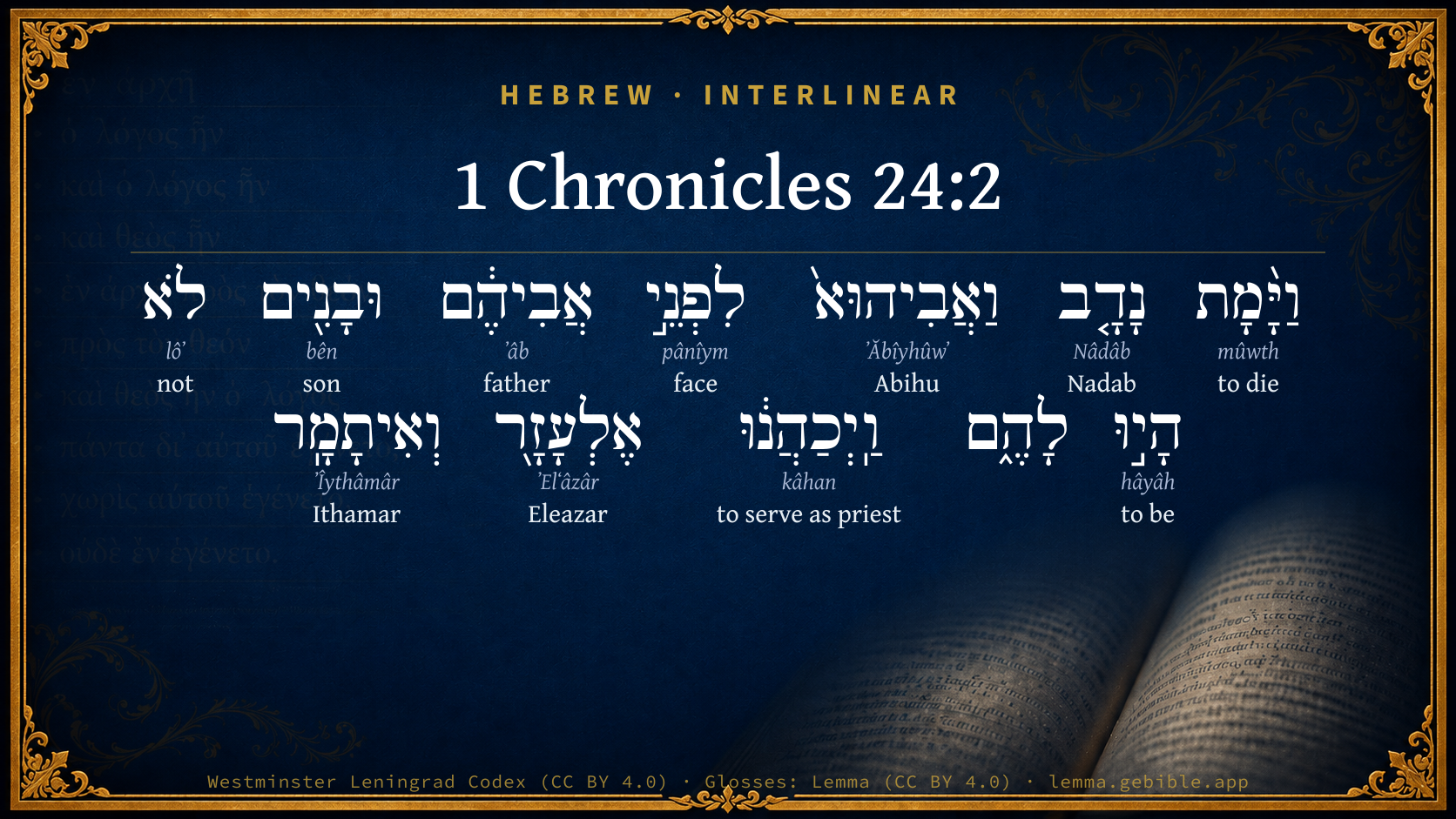
Hebrew (Westminster Leningrad Codex) 1 Chronicles 24:2 appears in the Hebrew Old Testament. The text above is from the Westminster Leningrad Codex. Each word links to its Strong’s number, a concise gloss, and parsing drawn from the Open Scriptures Hebrew Bible morphology. Click any word for its full Brown-Driver-Briggs (BDB) entry.
Download image
Cite this verse

1 Chronicles 24:2 (World English Bible). Public Domain. Lemma interlinear Bible study tool, https://lemma.gebible.app/v/1-chronicles/24/2.

Show BibTeX & RIS
BibTeX
RIS
English Translation
But Nadab and Abihu died before their father, and had no children: therefore Eleazar and Ithamar executed the priest's office.
World English Bible · Public Domain
Download a study sheet

One document with this verse’s original text, its word-by-word gloss line, the meaning frame, cross-references with their text, attributed commentary, and full source and license credits — printable, and it pastes into notes with its structure intact.

This verse Autodidact and up

Study sheet (.html) Plain text (.txt)

A passage Seminary Student

Up to 50 verses in one chapter. A passage sheet keeps up to 6 commentary sources and 12 cross-references per verse, in the order this page ranks them, and says so on the sheet whenever that leaves anything out. Ask for a single verse and you get the Autodidact verse sheet above.

Everything on this page stays free to read, with no account — the sheet is a download of what is already on screen, not access to it.

Want to remove ads? Support Godless Engineer
Compare translations 3

The same verse in 3 English versions, stacked beneath the original-language interlinear above. Click any original word for its lexicon entry.

Each is an independent rendering of the whole verse — the interlinear is not word-aligned to these translations.

Highlighted words mark where these versions differ — a whole-verse word diff, not a word-by-word alignment.

  • World English Bible Public Domain
    But Nadab and Abihu died before their father, and had no children: therefore Eleazar and Ithamar executed the priest's office.
  • King James Version Public Domain
    But Nadab and Abihu died before their father, and had no children: therefore Eleazar and Ithamar executed the priest's office.
  • unfoldingWord Literal Text CC BY-SA 4.0
    And Nadab died, and Abihu, to the face of their father, and sons were not to them. And Eleazar and Ithamar became priests.

unfoldingWord Literal Text — © unfoldingWord, licensed CC BY-SA 4.0. Word-aligned USFM3 via Door43 (git.door43.org/unfoldingWord/en_ult).

Versions to compare (up to 4)

3 of 4 selected

Show all 18 translations

Every available English version of this verse, each an independent rendering of the whole verse.

  • World English Bible Public Domain
    But Nadab and Abihu died before their father, and had no children: therefore Eleazar and Ithamar executed the priest's office.
  • Berean Standard Bible Public Domain
    But Nadab and Abihu died before their father did, and they had no sons; so Eleazar and Ithamar served as priests.
  • Majority Standard Bible Public Domain
    But Nadab and Abihu died before their father did, and they had no sons; so Eleazar and Ithamar served as priests.
  • King James Version Public Domain
    But Nadab and Abihu died before their father, and had no children: therefore Eleazar and Ithamar executed the priest's office.
  • American Standard Version (1901) Public Domain
    But Nadab and Abihu died before their father, and had no children: therefore Eleazar and Ithamar executed the priest's office.
  • Revised Version (1885) Public Domain
    But Nadab and Abihu died before their father, and had no children: therefore Eleazar and Ithamar executed the priest office.
  • Geneva Bible (1599) Public Domain
    But Nadab and Abihu died before their father, and had no children: therefore Eleazar and Ithamar executed the Priestes office.
  • Douay-Rheims (1899) Public Domain
    But Nadab and Abiu died before their father, and had no children: so Eleazar, and Ithamar did the office of the priesthood.
  • Young's Literal Translation Public Domain
    and Nadab dieth, and Abihu, in the presence of their father, and they had no sons, and Eleazar and Ithamar act as priests.
  • Literal Standard Version CC BY-SA 4.0
    And Nadab dies—and Abihu—in the presence of their father, and they had no sons, and Eleazar and Ithamar act as priests.
  • Unlocked Literal Bible CC BY-SA 4.0
    Nadab and Abihu died before their father died. They had no children, so Eleazar and Ithamar served as priests.
  • unfoldingWord Literal Text CC BY-SA 4.0
    And Nadab died, and Abihu, to the face of their father, and sons were not to them. And Eleazar and Ithamar became priests.
  • Darby Bible Public Domain
    And Nadab and Abihu died before their father, and had no children; and Eleazar and Ithamar exercised the priesthood.
  • World Messianic Bible Public Domain
    But Nadab and Abihu died before their father, and had no children; therefore Eleazar and Ithamar served as priests.
  • Webster's Bible Public Domain
    But Nadab and Abihu died before their father, and had no children: therefore Eleazar and Ithamar executed the priests' office.
  • Free Bible Version CC BY-SA 4.0
    But Nadab and Abihu died before their father did, and they had no sons. Only Eleazar and Ithamar carried on as priests.
  • Bible in Basic English Public Domain
    But Nadab and Abihu came to their end before their father, and had no children; so Eleazar and Ithamar did the work of priests.
  • JPS Tanakh (1917) Public Domain
    But Nadab and Abihu died before their father, and had no children; therefore Eleazar and Ithamar executed the priest's office.

Literal Standard Version (2020), Covenant Press — licensed CC BY-SA 4.0. Text via the HelloAO Bible API (eBible.org). Unlocked Literal Bible (unfoldingWord) — licensed CC BY-SA 4.0. Text via the HelloAO Bible API (eBible.org). unfoldingWord Literal Text — © unfoldingWord, licensed CC BY-SA 4.0. Word-aligned USFM3 via Door43 (git.door43.org/unfoldingWord/en_ult). Free Bible Version, Dr. Jonathan Gallagher — licensed CC BY-SA 4.0. Text via the HelloAO Bible API (eBible.org).

Word by word

More ways to search: Search by grammar → Find every occurrence → Compare this word →

Practice this passage: Drill this verse → Learn its vocabulary →

וַאֲבִיהוּא֙
ʼĂbîyhûwʼ
H30
“and · Abihu”
Conjunction + Noun, Proper
Part of Speech
Conjunction + Noun
Type
Proper
Full BDB Definition

Origin: from H1 and H1931

TWOT: None

Abihu = "he is (my) father" - a son of Aaron destroyed for sacrificing strange fire to God
  1. וַיָּ֨מָת mûwth H4191 “and · to die” Conjunction + Verb, Qal, Sequential Imperfect, 3rd Person, Masculine, Singular
  2. נָדָ֤ב Nâdâb H5070 “Nadab” Noun, Proper
  3. לִפְנֵ֣י pânîym H6440 “to/for · face(s) of” Preposition + Noun, Common, Both, Plural, Construct
  4. אֲבִיהֶ֔ם ʼâb H1 “father · their” Noun, Common, Masculine, Singular, Construct + Suffix, Personal, 3rd Person, Masculine, Plural
  5. וּבָנִ֖ים bên H1121 “and · sons” Conjunction + Noun, Common, Masculine, Plural, Absolute
  6. לֹא lôʼ H3808 “not” Particle, Negative
  7. הָי֣וּ hâyâh H1961 “to be” Verb, Qal, Perfect, 3rd Person, Common, Plural
  8. וַֽיְכַהֲנ֔וּ kâhan H3547 “and · to serve as priest” Conjunction + Verb, Piel, Sequential Imperfect, 3rd Person, Masculine, Plural
  9. אֶלְעָזָ֖ר ʼElʻâzâr H499 “Eleazar” Noun, Proper
  10. וְאִיתָמָֽר ʼÎythâmâr H385 “and · Ithamar” Conjunction + Noun, Proper

About this verse

These counts appear in no published source. They are computed here, from the morphology-tagged text and Lemma’s own curated glosses. What Lemma adds →

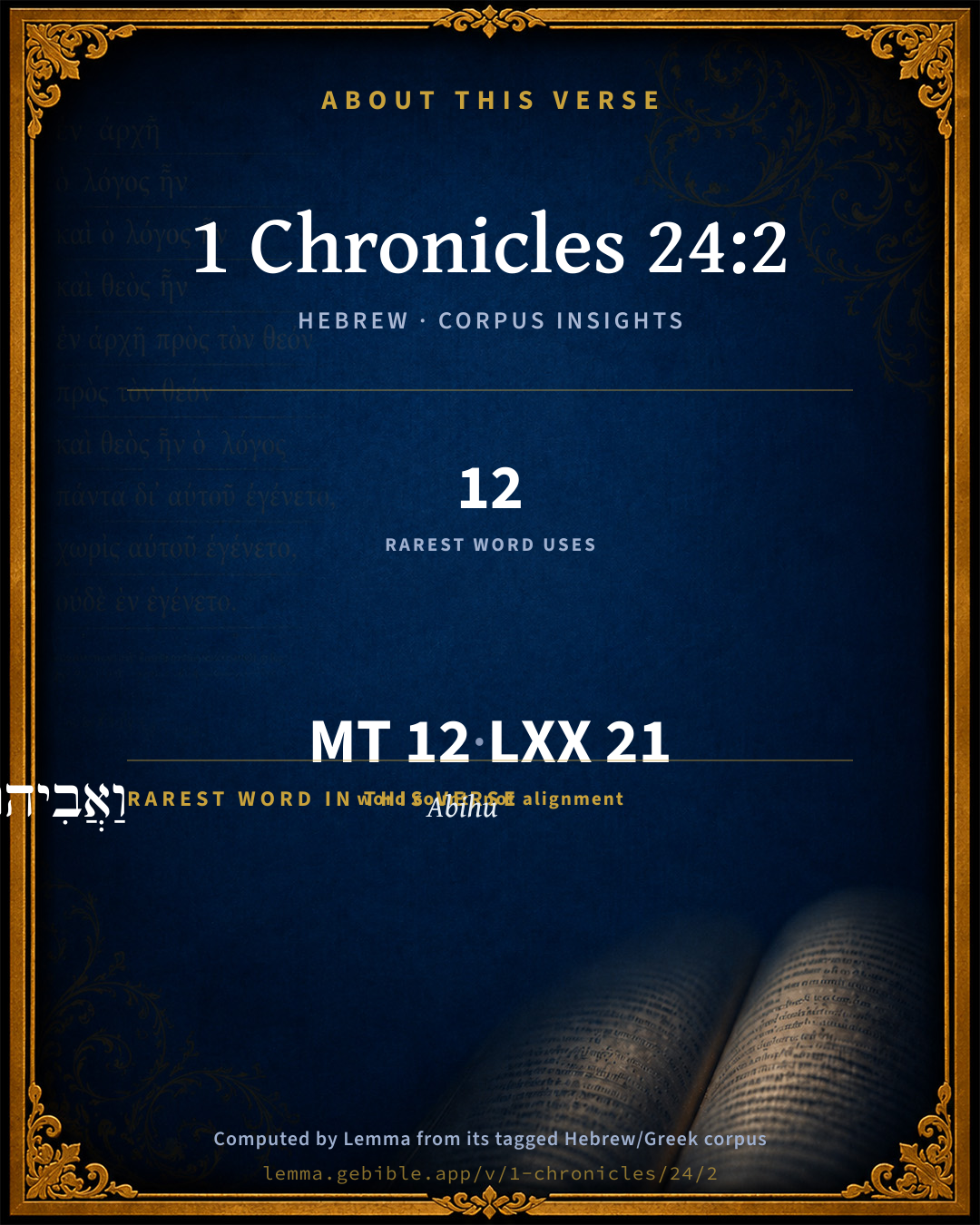
12
words
11
distinct lemmas
Historical
section

Notable vocabulary

The rarest word here is וַאֲבִיהוּא֙ Abihu H30 — appearing just 12 times in the whole Hebrew Bible.

Shared distinctive vocabulary

וַאֲבִיהוּא֙ Abihu H30 occurs in 12 verses of the Hebrew Bible. Also found in:

Grammatical profile

  • 3 verbs
  • 7 nouns
  • 1 preposition
  • 1 particle

Verb forms

  • וַיָּ֨מָת Qal · Sequential Imperfect
  • הָי֣וּ Qal · Perfect
  • וַֽיְכַהֲנ֔וּ Piel · Sequential Imperfect

Hebrew & Septuagint length

In English translation the verse runs 20 words from the Hebrew and 24 from the Septuagint (LXX English) — closely comparable.

A rough comparison of the two English renderings, which tokenize alike — not a word-level alignment.

Word counts can differ between the Hebrew and the Greek without any difference in meaning — e.g. the Hebrew direct-object marker אֵת has no separate Greek word, and Greek often adds the article ὁ.

In the original languages it is 12 Hebrew tokens and 21 Greek tokens — but the two are counted differently (Hebrew bundles its prefixes and suffixes into one token; the Greek is in lemma form), so that isn’t a like-for-like length.

Cross-references

9

Topical passages linked to 1 Chronicles 24:2 in the Treasury of Scripture Knowledge — connected by theme and wording, ordered by reader-vote popularity; previews shown in the World English Bible.

  • Leviticus 10:2 And fire came forth from before Yahweh, and devoured them, and they died before Yahweh.
  • Numbers 3:4 Nadab and Abihu died before Yahweh, when they offered strange fire before Yahweh, in the wilderness of Sinai, and they had no children. Eleazar and Ithamar ministered in the priest's office in the presence of Aaron their father.
  • Numbers 26:61 Nadab and Abihu died, when they offered strange fire before Yahweh.
  • Exodus 24:1 He said to Moses, "Come up to Yahweh, you, and Aaron, Nadab, and Abihu, and seventy of the elders of Israel; and worship from a distance.
  • Exodus 24:9 Then Moses, Aaron, Nadab, Abihu, and seventy of the elders of Israel went up.
  • Exodus 29:9 You shall dress them with belts, Aaron and his sons, and bind headbands on them: and they shall have the priesthood by a perpetual statute: and you shall consecrate Aaron and his sons.
  • Leviticus 10:12 Moses spoke to Aaron, and to Eleazar and to Ithamar, his sons who were left, "Take the meal offering that remains of the offerings of Yahweh made by fire, and eat it without yeast beside the altar; for it is most holy;
  • Numbers 16:39–40 Eleazar the priest took the brazen censers, which those who were burnt had offered; and they beat them out for a covering of the altar,
  • Numbers 18:7 You and your sons with you shall keep your priesthood for everything of the altar, and for that within the veil; and you shall serve: I give you the priesthood as a service of gift: and the stranger who comes near shall be put to death.

Cross-references courtesy of OpenBible.info (CC BY 4.0).

Hebrew and Greek witnesses Masoretic Hebrew ↔ Greek Septuagint

The same verse in the two great witnesses to the Old Testament, shown verse-for-verse.

These are two independent witnesses, not word-aligned to each other, and the Septuagint is shown in lemma (dictionary) form.

Hebrew 1 Chronicles 24:2 Masoretic · Westminster Leningrad Codex

וַיָּ֨מָת נָדָ֤ב וַאֲבִיהוּא֙ לִפְנֵ֣י אֲבִיהֶ֔ם וּבָנִ֖ים לֹא הָי֣וּ לָהֶ֑ם וַֽיְכַהֲנ֔וּ אֶלְעָזָ֖ר וְאִיתָמָֽר

But Nadab and Abihu died before their father, and had no children: therefore Eleazar and Ithamar executed the priest's office.

World English Bible · Public Domain

Greek LXX 1 Chronicles 24:2 Septuagint · lemma form

καί ἀποθνήσκω ναδαβ καί αβιουδ ἐναντίον ὁ πατήρ αὐτός καί υἱός οὐ εἰμί αὐτός καί ἱερατεύω ελεαζαρ καί ιθαμαρ υἱός ἀαρών

And Nadab and Abiud died before their father, and they had no sons: so Eleazar and Ithamar the sons of Aaron ministered as priests.

LXX2012 (modern English Septuagint) · Public Domain

Hebrew: Westminster Leningrad Codex (CC BY 4.0). Greek: Septuagint (public domain); English from LXX2012 (modern English Septuagint) (Public Domain). How the Septuagint differs from the Hebrew →

Commentary

Notes on 1 Chronicles 24:2 from classic Christian and Jewish commentators (each source and its license shown beneath its notes). The classic Christian expositions comment on the surrounding passage and are grouped to its opening verse, so a note may address several verses; the Jewish commentaries on the Tanakh (Rashi and others) are per-verse, so they appear only where the commentator wrote on this verse.

Lemma curates 59 commentaries, every one of them public domain or Creative Commons licensed, each selected and text-cleaned for this edition rather than reprinted as found. About our sources →

Trapp's Complete Commentary

John Trapp

1Ch 24:2 But Nadab and Abihu died before their father, and had no children: therefore Eleazar and Ithamar executed the priest’s office.

Ver. 2. But Nadab and Abihu died.] And, as it is thought, in their drunkenness, to the great grief of their father Aaron. See Lev 10:2-9, {See Trapp on "Lev 10:2"} &c

John Trapp, A Commentary or Exposition upon All the Books of the Old and New Testament (1647–1656) — public domain. Text from a community e-Sword module.

The Biblical Illustrator

Joseph S. Exell

1Ch_24:2

But Nadab and Abihu died before their father.

The death of Nadab and Abihu

Learn:

I. That sin inverts the natural order of things. They died before their father.

II. That sin deprives of blessings which God can bestow. They had no children.

III. That sin often overwhelms with fearful ruin.

IV. That sin is often mentioned in history to warn of its consequences. (J. Wolfendale.)

Sad deaths

I. The sins which caused them.

1. Disobedience to Divine injunction.

2. Gross inconsistency.

3. Rashness in approaching God.

4. Presumptuous in set.

II. The punishment which followed the sins.

1. A dishonourable death.

2. A sudden death.

3. An overwhelming death.

4. A retributive death. (J. Wolfendale.)

The Biblical Illustrator, edited by Joseph S. Exell (c. 1880s–1900s) — public domain. Text from a community e-Sword module.

Geneva Bible (1599)

Geneva Bible translators

While their father yet lived.

Geneva Bible (1599) marginal notes — public domain. Text via Bolls.life.

Jamieson, Fausset & Brown

Robert Jamieson, A. R. Fausset & David Brown

Nadab and Abihu died before their father--that is, not in his presence, but during his lifetime (see Num 3:4; Num 26:61).

therefore Eleazar and Ithamar executed the priest's office--In consequence of the death of his two oldest sons without issue, the descendants of Aaron were comprised in the families of Eleazar and Ithamar. Both of these sons discharged the priestly functions as assistants to their father. Eleazar succeeded him, and in his line the high priesthood continued until it was transferred to the family of Ithamar, in the person of Eli.

Jamieson, Fausset & Brown — Commentary Critical and Explanatory on the Whole Bible (1871) — public domain (CC PDM 1.0). Text via the HelloAO Bible API.

Adam Clarke's Commentary

Verse 2. Nadab and Abihu died before their father] That is, during his lifetime.

Eleazar and Ithamar executed the priest's office.] These two served the office during the life of their father Aaron; after his death Eleazar succeeded in the high priesthood. And under Eli the high priest, the family of Ithamar re-entered into that office.

Adam Clarke's Commentary on the Bible (1810–1826) — public domain. Text from a community e-Sword/MySword module.

Ellicott's Commentary for English Readers

(2) But Nadab and Abihu died before their father.—Lev_10:1-2 tells why: viz., because they offered “strange fire” before the Lord. (See also Num_3:4, from which our text appears to be derived.)

And had no children.—Literally, And sons had not become (been born) to them.

Therefore Eleazar and Ithamar.—And Eleazar and Ithamar acted as priests; Numbers adds, “before the face of Aaron their father.” It is implied that the office of the priesthood remained with the two lines, or houses, of Eleazar and Ithamar.

A Bible Commentary for English Readers, edited by Charles John Ellicott (1878–1897) — public domain. Text from a community e-Sword module.

The Cambridge Bible for Schools and Colleges

gen. ed. J. J. S. Perowne

2. Nadab and Abihu died] By fire from heaven as a punishment for sacrilege; Lev_10:1-2; Num_3:4.

The Cambridge Bible for Schools and Colleges (gen. ed. J. J. S. Perowne; Cambridge University Press, 1878–1918) — public domain. Text from a community e-Sword module.

John Gill's Exposition

But Nadab and Abihu died before their father,.... While he was living, see Lev 10:1.

and had no children, therefore Eleazar and Ithamar executed the priests' office: otherwise, as Jarchi observes, had their brethren left children, they would have come into the office before them.

John Gill's Exposition of the Whole Bible (1746–1763) — public domain (CC PDM 1.0). Text via the HelloAO Bible API.

Haydock's Catholic Bible Commentary

Before. Hebrew, "in the presence of." See Leviticus x. 2. --- Priesthood, under Aaron. Eleazar succeeded him, and the posterity of Ithamar obtained the dignity under Heli.

George Leo Haydock (1774–1849), Haydock's Catholic Family Bible and Commentary, 1859 edition — public domain. Excludes Psalms (Douay-Rheims chapter numbering differs from Protestant) and Deuterocanonical books (Catholic canon only).

Matthew Poole's English Annotations

i.e. Were the only persons to whom and to whose families the execution of that office was committed.

Matthew Poole's English Annotations on the Holy Bible (1683–1685) — public domain. Text from a community e-Sword/MySword module.

The Pulpit Commentary

Comp. Lev_10:1, Lev_10:2, for the death of these; and for their being childless, (Num_3:2-4 Num_26:60, Num_26:61)

HOMILIES BY W. CLARKSON Ver. 2.

Principles in a parenthesis.

This verse is parenthetical; we may let it suggest to us some valuable principles.

I THAT SIN REAPPEARS IN ITS EFFECTS, BOTH IN LIFE AND IN HISTORY. After the full statement of the sin committed by these young men, (Le 10) and the allusion made to it in the Book of Numbers, (Num_3:4) we might have supposed that we had heard the last of it in the sacred narrative. But here it comes up again; once more we are reminded how Aaron"s sons provoked the Lord, and brought down his displeasure. So now are there sins against God and crimes against men which history will not let alone; it records them on its page, and, further on, it writes them down again, that the attention of another generation may be called thereto. Some iniquities there are which are of such significance that no writer of his country"s story will leave them out of his record. But this is as pathetically true of individual life. Too often it happens that men cannot shake themselves free from the sins of earlier days. They think they have done with them, but some way further on they present themselves again, and look them in the face. How many a man is called upon to say, again and again, as the miserable effects of past sin come up to reproach, or to enfeeble, or to baulk him, "Ah! that that word had been left unspoken, that deed undone, that habit unformed, that course unchosen!" If such is sin in its resurgent powers,

(1) what a compensatory fact we have in the truth that it may be wholly forgiven by the mercy of God in Christ Jesus, so that it does not continue to interpose between our souls and his Divine favour! and

(2) how wise to bring our life at its very commencement under the law of holiness, so that those sins may be avoided which would, if incurred, dog our steps and haunt our spirits!

II THAT SIN INVERTS THE NATURAL ORDER OF THINGS IN THE LIFE OF MAN. So far as the word can be used appropriately in such a case, we may say that it is the natural thing for the sons to close the eyes of their father, (see Gen_46:4) to carry him to the grave, to cherish his memory, to follow his last directions. There is something strikingly unnatural when it has to be written that "they died before their father." But it is the constant consequence of sin. Sin is the great overturning, confusing, inverting power in the world; putting that before which should be behind, and that below which should be above, disordering and disarranging everything in the world which God made beautiful and blessed. Illustrations abound in every sphere of human activity.

III THAT SIN CUTS OFF THE GOOD WHICH IT IS IN GOD"S THOUGHT TO GIVE US. These young men died, and "had no children." In the common course of providence they would have had the deep, full joy of parents, and their children and descendants would have carried down their lineage to the distant future. But that one "presumptuous sin" cut all this off. In how many ways does human guilt shut the hand of beneficence, impoverishing itself and all whom it can affect!

IV THAT IT IS WISE TO BE PREPARED FOR EARLY DEATH OR FOR LONELY AGE. These words may be written of those who are not sinful but unfortunate. In the families of the holy and the faithful it is often the painful record the young men, the young women, "die before their parents." No one who is wise will risk anything on the assurance of continued life. Youth in all its vigour may be but a step or two distant from the grave. Strong manhood, rejoicing motherhood, may be about to enter on a life of clouded loneliness. Be ready for early death, and for the long dark shadow of bereavement. C.

HOMILIES BY R. TUCK Ver. 2.

The abiding warning of the wilful.

The narrative of Nadab and Abihu which is here recalled is given in Lev_10:1-5. The wording of the verse is taken from Num_3:4. It is a story which we find it difficult to understand. Probably itsexplanation depends on an intimate acquaintance with the Jewish system, and the sentiments prevailing in those earlier times. Nadab and Abihu had been honoured with special privileges; (see Exo_24:1, Exo_24:9, Exo_24:10) by reason of this they may have become unduly exalted, and have been tempted by spiritual pride to imagine that they were not bound by ordinary rules in the discharge of the duties of the priest"s office. Kitto gives a brief but sufficient sketch of the incident. "Among the priestly services was that of offering the precious incense upon the golden altar within the tabernacle, at the very time that the daily sacrifice was being consumed upon the brazen altar in the court without. At the time the ritual service had been inaugurated, the fire of the great altar was kindled from heaven; and it was made an ordinance that this holy fire should always be kept up and preserved, and that this, and this alone, was to be used in all the sacred services. The priests who offered incense had, therefore, to fill their censers with fire from the great altar when they went into the tabernacle to burn incense. It was in this matter that Nadab and Abihu sinned. Treating this ordinance as of no importance, thinking to themselves that common fire would burn their incense quite as well as the other; or, perhaps, as there is reason to fear, having been led into a mistake, or neglect, by inebriety, they filled their censers with "strange fire," unhallowed fire, not from the altar, and ventured to bring it into the tabernacle? Permanent instruction may be drawn from this incident by regarding wilfulness as the very essence of these men"s sin. When there was a distinct, definite, and well-known Divine command, it pleased them to act on the dictate of their own feeling. In view of that full loyalty to Christ, and daily waiting upon him for guidance and direction, which are necessary features of the Christian life, wilfulness is as perilous and as wicked in the modern dispensation as in the older. In setting forth this evil and its fatal influence, consider

I WILFULNESS AS A DISPOSITION OF CHARACTER. It is the bias left on humanity from our first father"s fall. We see the signs of human depravity mainly in this that men"s wills are set against God"s will, and have to be subdued to his obedience. This is true of man as an individual, and equally true of men when acting together in society or in the nation. But there are different degrees of wilfulness, and in some the self-will is a master-passion. Some measures of wilfulness in the common affairs of life ensure energy and mastery of circumstance; but it is wholly out of place in the religious spheres, where energy must depend on the spirit of service to Christ.

II WILFULNESS FINDING EXPRESSION IN ACTS. Illustrate from King Saul in his later and worse moods, or from Judas Iscariot, who, with views of his own, came to betray his very Lord. The apostle warns us concerning those who "will be rich, and so fall into temptation and a snare." Wilfulness expressed in acts brings us at once under Divine notice, because it then affects the comfort and well-being of others.

III WILFULNESS CORRUPTING THE WHOLE RELIGIOUS LIFE. It puts a wrong tone upon all the relations, and spoils the whole life by possessing it with the spirit of self. God the Spirit cannot rule the life, and self rule at the same time; and if it be self that really rules, then we are "dead while we live." Practically dead, because none of the "means of grace" can prove the soul"s nourishment when wilfulness rules.

IV WILFULNESS BRINGING US UNDER DIVINE JUDGMENTS. Illustrated in the case of Nadab and Abihu. Where wilfulness is but growing, Divine chastisements come for correction. Where wilfulness has gained full mastery, there must be Divine judgments, such as utterly crush down the pride.

Exactly what Christianity proposes is the "conversion of self-will," and the bestowment of the spirit that worships, and follows wholly, the "sweet will" of God. R.T.

The Pulpit Commentary (1880–1919), ed. H.D.M. Spence-Jones & Joseph S. Exell — public domain. Text from a community e-Sword module.

John Wesley's Explanatory Notes

Therefore, &c. - Were the only persons to whom the execution of that office was committed.

John Wesley, Explanatory Notes Upon the Whole Bible (1754–1765) — public domain. Text via the GEBible commentary corpus.

Keil & Delitzsch

C. F. Keil & F. Delitzsch

But Nadab and Abihu died before their father,.... While he was living, see Lev 10:1.

and had no children, therefore Eleazar and Ithamar executed the priests' office: otherwise, as Jarchi observes, had their brethren left children, they would have come into the office before them.

Keil & Delitzsch — Biblical Commentary on the Old Testament (1861–1891) — public domain (CC PDM 1.0). Text via the HelloAO Bible API. (Old Testament only.)

Rashi

Rabbi Shlomo Yitzchaki (Rashi)

And Nadab and Abihu died, etc., and they had no sons Since they had no sons, Eleazar and Ithamar served as priests in their stead, but if Nadab and Abihu had had children, they would have preceded Eleazar and Ithamar in the high priesthood, for so we find with Ezra (3:9), for Jehozadak was Joshua’s father, and Jehozadak and Ezra were the sons of Seraiah, as it is written: (above 5:41): “... and Seraiah begot Jehozadak.” And in Ezra (7:1), it is written: “Ezra the son of Seraiah.” And Jehozadak went into exile to Babylon, and when they came up from Babylon, Joshua went up and served, but Ezra did not serve because Jehozadak was the firstborn, and the son of his firstborn brother preceded him, as is written in the prophecy of Haggai (1:1): “Joshua the son of Jehozadak, the High Priest.”

Rashi on the Tanakh — English translations: “The Judaica Press complete Tanach with Rashi, translated by A. J. Rosenberg” (CC BY 4.0); “Pentateuch with Rashi's commentary by M. Rosenbaum and A.M. Silbermann, 1929-1934” (public domain); “The Metsudah Tanach series, Lakewood, N.J” (CC BY 4.0); and “The Book of Joshua, Metsudah Publications, 1997” (CC BY 4.0). Text via Sefaria.

Lesson kit

Teaching starters — assembled from the data on this page, not authored interpretation. Every prompt links to the verse data it draws on. Edit before teaching.

1 Chronicles, in the Historical, opens this verse with 12 words (11 distinct Hebrew lemmas). Its most distinctive word is ʼĂbîyhûwʼ (“Abihu”). A historical commentator’s framing appears above. Read the whole chapter for the surrounding context.

Discussion questions

  1. What does “Abihu” (ʼĂbîyhûwʼ) contribute to the verse as a whole?
  2. How does Exodus 6:23, which shares the word «Abihu», read alongside this verse?
  3. These translations render this verse differently. What is at stake in choosing one wording over another?
  4. «וַיָּ֨מָת» is a Qal Sequential Imperfect verb. How does that grammatical form shape the action described?
  5. Compare how Trapp's Complete Commentary and The Biblical Illustrator read this verse. Where do they agree or differ?

Things to notice

Reading settings

Reading text

Shown beneath each verse's original-language words.

Old Testament
Old Testament edition

Read the OT as the Masoretic Hebrew (MT) or the Greek Septuagint (LXX).

English shown for the Greek Septuagint (in the Hebrew ↔ Greek comparison).

Comparing translations? Open the Compare panel on any verse page to stack up to four side by side.