
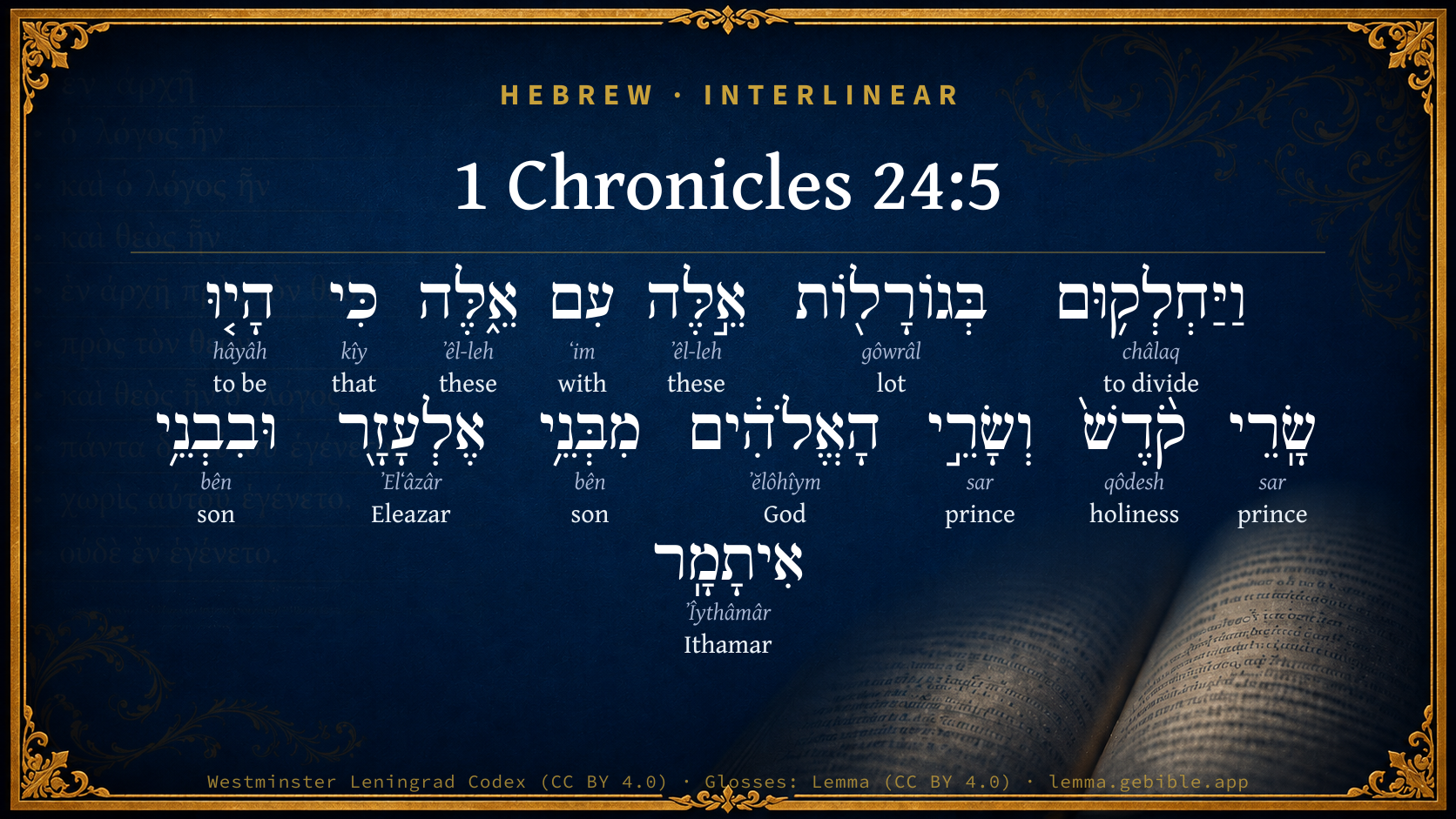
1 Chronicles 24:5

Hebrew (Westminster Leningrad Codex) 1 Chronicles 24:5 appears in the Hebrew Old Testament. The text above is from the Westminster Leningrad Codex. Each word links to its Strong’s number, a concise gloss, and parsing drawn from the Open Scriptures Hebrew Bible morphology. Click any word for its full Brown-Driver-Briggs (BDB) entry.
Download image
Cite this verse

1 Chronicles 24:5 (World English Bible). Public Domain. Lemma interlinear Bible study tool, https://lemma.gebible.app/v/1-chronicles/24/5.

Show BibTeX & RIS
BibTeX
RIS
English Translation
Thus were they divided impartially by drawing lots; for there were princes of the sanctuary, and princes of God, both of the sons of Eleazar, and of the sons of Ithamar.
World English Bible · Public Domain
Download a study sheet

One document with this verse’s original text, its word-by-word gloss line, the meaning frame, cross-references with their text, attributed commentary, and full source and license credits — printable, and it pastes into notes with its structure intact.

This verse Autodidact and up

Study sheet (.html) Plain text (.txt)

A passage Seminary Student

Up to 50 verses in one chapter. A passage sheet keeps up to 6 commentary sources and 12 cross-references per verse, in the order this page ranks them, and says so on the sheet whenever that leaves anything out. Ask for a single verse and you get the Autodidact verse sheet above.

Everything on this page stays free to read, with no account — the sheet is a download of what is already on screen, not access to it.

Want to remove ads? Support Godless Engineer
Compare translations 3

The same verse in 3 English versions, stacked beneath the original-language interlinear above. Click any original word for its lexicon entry.

Each is an independent rendering of the whole verse — the interlinear is not word-aligned to these translations.

Highlighted words mark where these versions differ — a whole-verse word diff, not a word-by-word alignment.

  • World English Bible Public Domain
    Thus were they divided impartially by drawing lots; for there were princes of the sanctuary, and princes of God, both of the sons of Eleazar, and of the sons of Ithamar.
  • King James Version Public Domain
    Thus were they divided by lot, one sort with another; for the governors of the sanctuary, and governors of the house of God, were of the sons of Eleazar, and of the sons of Ithamar.
  • unfoldingWord Literal Text CC BY-SA 4.0
    And they divided them by lots, these with these, for officials of the holy place and officials of God were from the sons of Eleazar and among the sons of Ithamar.

unfoldingWord Literal Text — © unfoldingWord, licensed CC BY-SA 4.0. Word-aligned USFM3 via Door43 (git.door43.org/unfoldingWord/en_ult).

Versions to compare (up to 4)

3 of 4 selected

Show all 18 translations

Every available English version of this verse, each an independent rendering of the whole verse.

  • World English Bible Public Domain
    Thus were they divided impartially by drawing lots; for there were princes of the sanctuary, and princes of God, both of the sons of Eleazar, and of the sons of Ithamar.
  • Berean Standard Bible Public Domain
    Thus they were divided by lot, for there were officers of the sanctuary and officers of God among both Eleazar’s and Ithamar’s descendants.
  • Majority Standard Bible Public Domain
    Thus they were divided by lot, for there were officers of the sanctuary and officers of God among both Eleazar’s and Ithamar’s descendants.
  • King James Version Public Domain
    Thus were they divided by lot, one sort with another; for the governors of the sanctuary, and governors of the house of God, were of the sons of Eleazar, and of the sons of Ithamar.
  • American Standard Version (1901) Public Domain
    Thus were they divided by lot, one sort with another; for there were princes of the sanctuary, and princes of God, both of the sons of Eleazar, and of the sons of Ithamar.
  • Revised Version (1885) Public Domain
    Thus were they divided by lot, one sort with another; for there were princes of the sanctuary, and princes of God, both of the sons of Eleazar, and of the sons of Ithamar.
  • Geneva Bible (1599) Public Domain
    Thus they distributed them by lot the one from the other, and so the rulers of the Sanctuarie and the rulers of the house of God were of the sonnes of Eleazar and of the sonnes of Ithamar.
  • Douay-Rheims (1899) Public Domain
    And he divided both the families one with the other by lot: for there were princes of the sanctuary, and princes of God, both of the sons of Eleazar, and of the sons of Ithamar.
  • Young's Literal Translation Public Domain
    And they distribute them, by lots, one with another, for princes of the sanctuary, and princes of God, have been of the sons of Eleazar, and of the sons of Ithamar.
  • Literal Standard Version CC BY-SA 4.0
    And they distribute them by lots, with one another, for they have been princes of the holy place and princes of God, from the sons of Eleazar and from the sons of Ithamar.
  • Unlocked Literal Bible CC BY-SA 4.0
    They divided them impartially by lot, for there were holy officials and officials of God, from both Eleazar's descendants and Ithamar's descendants.
  • unfoldingWord Literal Text CC BY-SA 4.0
    And they divided them by lots, these with these, for officials of the holy place and officials of God were from the sons of Eleazar and among the sons of Ithamar.
  • Darby Bible Public Domain
    And they were divided by lot, one with another; for the princes of the sanctuary and the princes of God were of the sons of Eleazar and of the sons of Ithamar.
  • World Messianic Bible Public Domain
    Thus they were divided impartially by drawing lots; for there were princes of the sanctuary and princes of God, both of the sons of Eleazar, and of the sons of Ithamar.
  • Webster's Bible Public Domain
    Thus were they divided by lot, one sort with another; for the governors of the sanctuary, and governors of the house of God, were of the sons of Eleazar, and of the sons of Ithamar.
  • Free Bible Version CC BY-SA 4.0
    They were divided by casting lots, without preference, for there were officers of the sanctuary and officers of God from both the sons of Eleazar and the sons of Ithamar.
  • Bible in Basic English Public Domain
    So they were put into groups, by the Lord's decision, one with another; for there were rulers of the holy place and rulers of the house of God among the sons of Eleazar and the sons of Ithamar.
  • JPS Tanakh (1917) Public Domain
    Thus were they divided by lot, one sort with another; for they were princes of the sanctuary and princes of God, both of the sons of Eleazar, and of the sons of Ithamar.

Literal Standard Version (2020), Covenant Press — licensed CC BY-SA 4.0. Text via the HelloAO Bible API (eBible.org). Unlocked Literal Bible (unfoldingWord) — licensed CC BY-SA 4.0. Text via the HelloAO Bible API (eBible.org). unfoldingWord Literal Text — © unfoldingWord, licensed CC BY-SA 4.0. Word-aligned USFM3 via Door43 (git.door43.org/unfoldingWord/en_ult). Free Bible Version, Dr. Jonathan Gallagher — licensed CC BY-SA 4.0. Text via the HelloAO Bible API (eBible.org).

Word by word

More ways to search: Search by grammar → Find every occurrence → Compare this word →

Practice this passage: Drill this verse → Learn its vocabulary →

אִיתָמָֽר
ʼÎythâmâr
H385
“Ithamar”
Noun, Proper
Part of Speech
Noun
Type
Proper
Full BDB Definition

Origin: from H339 and H8558

TWOT: None

Ithamar = "coast of palms" - fourth and youngest son of Aaron
  1. וַיַּחְלְק֥וּם châlaq H2505 “and · to divide · them” Conjunction + Verb, Qal, Sequential Imperfect, 3rd Person, Masculine, Plural + Suffix, Personal, 3rd Person, Masculine, Plural
  2. בְּגוֹרָל֖וֹת gôwrâl H1486 “in/at · lots” Preposition + Noun, Common, Masculine, Plural, Absolute
  3. אֵ֣לֶּה ʼêl-leh H428 “these” Pronoun, Demonstrative, Common, Plural
  4. עִם ʻim H5973 “with” Preposition
  5. אֵ֑לֶּה ʼêl-leh H428 “these” Pronoun, Demonstrative, Common, Plural
  6. כִּי kîy H3588 “that” Conjunction
  7. הָי֤וּ hâyâh H1961 “to be” Verb, Qal, Perfect, 3rd Person, Common, Plural
  8. שָֽׂרֵי sar H8269 “princes of” Noun, Common, Masculine, Plural, Construct
  9. קֹ֨דֶשׁ֙ qôdesh H6944 “holiness” Noun, Common, Masculine, Singular, Absolute
  10. וְשָׂרֵ֣י sar H8269 “and · princes of” Conjunction + Noun, Common, Masculine, Plural, Construct
  11. הָאֱלֹהִ֔ים ʼĕlôhîym H430 “the · God(s)” Particle, Definite Article + Noun, Common, Masculine, Plural, Absolute
  12. מִבְּנֵ֥י bên H1121 “from · sons of” Preposition + Noun, Common, Masculine, Plural, Construct
  13. אֶלְעָזָ֖ר ʼElʻâzâr H499 “Eleazar” Noun, Proper
  14. וּבִבְנֵ֥י bên H1121 “and · in/at · sons of” Conjunction + Preposition + Noun, Common, Masculine, Plural, Construct

About this verse

These counts appear in no published source. They are computed here, from the morphology-tagged text and Lemma’s own curated glosses. What Lemma adds →

15
words
12
distinct lemmas
Historical
section

Notable vocabulary

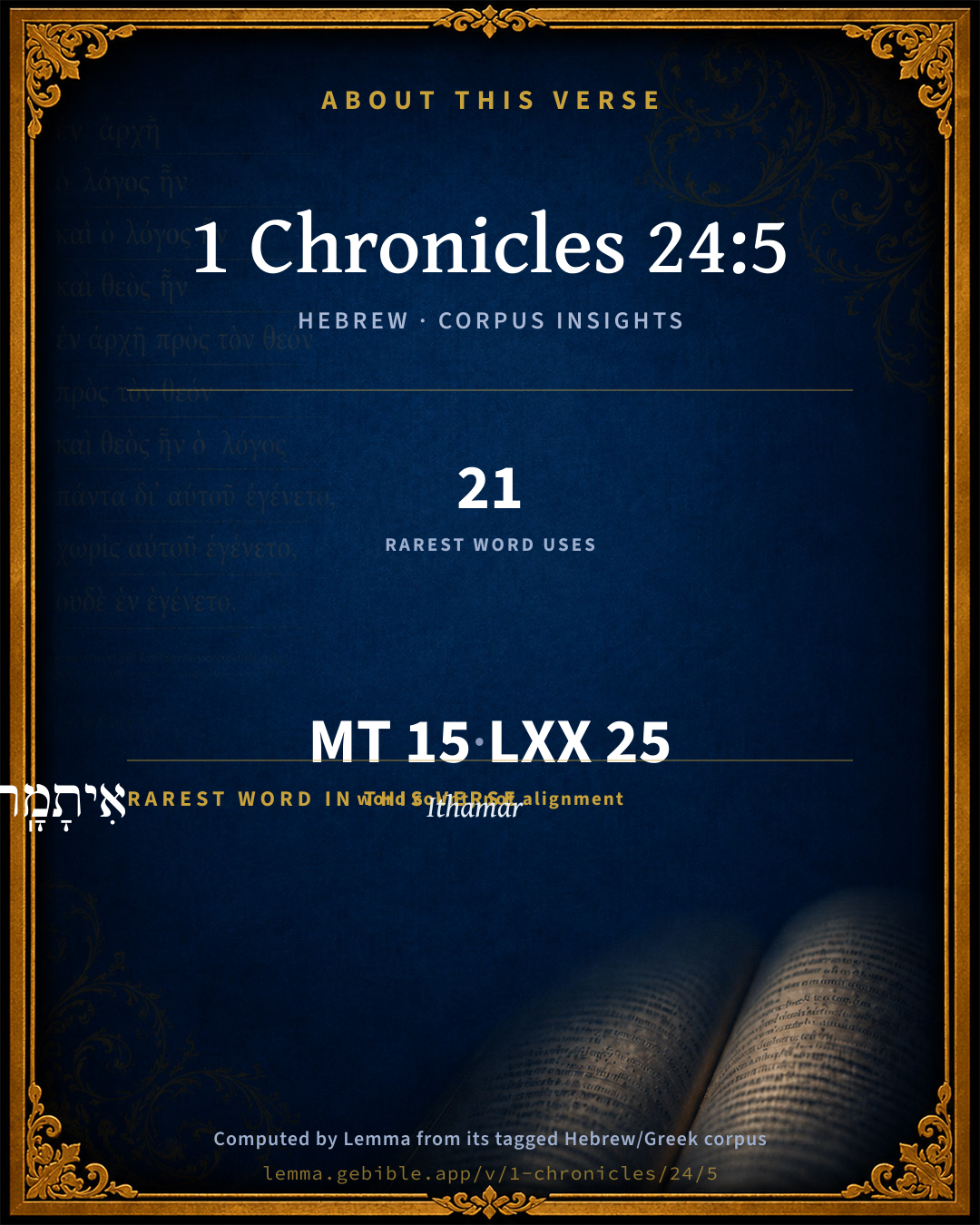
The rarest word here is אִיתָמָֽר Ithamar H385 — appearing just 21 times in the whole Hebrew Bible.

Shared distinctive vocabulary

אִיתָמָֽר Ithamar H385 occurs in 20 verses of the Hebrew Bible. Also found in:

Grammatical profile

  • 2 verbs
  • 9 nouns
  • 2 pronouns
  • 1 preposition
  • 1 conjunction

Verb forms

  • וַיַּחְלְק֥וּם Qal · Sequential Imperfect
  • הָי֤וּ Qal · Perfect

Repetition

Words recur within this verse — often emphatic in Hebrew:

  • שָֽׂרֵי prince H8269 ×2
  • מִבְּנֵ֥י son H1121 ×2
  • אֵ֣לֶּה these H428 ×2

Hebrew & Septuagint length

In English translation the verse runs 31 words from the Hebrew and 45 from the Septuagint (LXX English) — the Septuagint runs noticeably longer here. See the side-by-side →

A rough comparison of the two English renderings, which tokenize alike — not a word-level alignment.

Word counts can differ between the Hebrew and the Greek without any difference in meaning — e.g. the Hebrew direct-object marker אֵת has no separate Greek word, and Greek often adds the article ὁ.

In the original languages it is 15 Hebrew tokens and 25 Greek tokens — but the two are counted differently (Hebrew bundles its prefixes and suffixes into one token; the Greek is in lemma form), so that isn’t a like-for-like length.

Cross-references

13

Topical passages linked to 1 Chronicles 24:5 in the Treasury of Scripture Knowledge — connected by theme and wording, ordered by reader-vote popularity; previews shown in the World English Bible.

  • 1 Chronicles 24:31 These likewise cast lots even as their brothers the sons of Aaron in the presence of David the king, and Zadok, and Ahimelech, and the heads of the fathers' [houses] of the priests and of the Levites; the fathers' [houses] of the chief even as those of his younger brother.
  • Joshua 18:10 Joshua cast lots for them in Shiloh before Yahweh: and there Joshua divided the land to the children of Israel according to their divisions.
  • 1 Chronicles 9:11 and Azariah the son of Hilkiah, the son of Meshullam, the son of Zadok, the son of Meraioth, the son of Ahitub, the ruler of the house of God;
  • 2 Chronicles 35:8 His princes gave for a freewill-offering to the people, to the priests, and to the Levites. Hilkiah and Zechariah and Jehiel, the rulers of the house of God, gave to the priests for the Passover offerings two thousand and six hundred [small cattle], and three hundred oxen.
  • Nehemiah 11:11 Seraiah the son of Hilkiah, the son of Meshullam, the son of Zadok, the son of Meraioth, the son of Ahitub, the ruler of the house of God,
  • Proverbs 16:33 The lot is cast into the lap, But its every decision is from Yahweh.
  • Jonah 1:7 They all said to each other, "Come, let us cast lots, that we may know for whose cause this evil is on us." So they cast lots, and the lot fell on Jonah.
  • Matthew 26:3 Then the chief priests, the scribes, and the elders of the people were gathered together in the court of the high priest, who was called Caiaphas.
  • Matthew 27:1 Now when morning had come, all the chief priests and the elders of the people took counsel against Jesus to put him to death:
  • Acts 1:26 They drew lots for them, and the lot fell on Matthias, and he was numbered with the eleven apostles.
  • Acts 4:1 As they spoke to the people, the priests and the captain of the temple and the Sadducees came to them,
  • Acts 4:6 Annas the high priest was there, with Caiaphas, John, Alexander, and as many as were relatives of the high priest.
  • Acts 5:24 Now when the high priest, the captain of the temple, and the chief priests heard these words, they were very perplexed about them and what might become of this.

Cross-references courtesy of OpenBible.info (CC BY 4.0).

Hebrew and Greek witnesses Masoretic Hebrew ↔ Greek Septuagint

The same verse in the two great witnesses to the Old Testament, shown verse-for-verse.

Here the Septuagint runs noticeably longer than the Hebrew — LXX2012 (modern English Septuagint) 45 words vs World English Bible 31. A rough length comparison of the two English translations, not a word-level alignment — read both below.

These are two independent witnesses, not word-aligned to each other, and the Septuagint is shown in lemma (dictionary) form.

Hebrew 1 Chronicles 24:5 Masoretic · Westminster Leningrad Codex

וַיַּחְלְק֥וּם בְּגוֹרָל֖וֹת אֵ֣לֶּה עִם אֵ֑לֶּה כִּי הָי֤וּ שָֽׂרֵי קֹ֨דֶשׁ֙ וְשָׂרֵ֣י הָאֱלֹהִ֔ים מִבְּנֵ֥י אֶלְעָזָ֖ר וּבִבְנֵ֥י אִיתָמָֽר

Thus were they divided impartially by drawing lots; for there were princes of the sanctuary, and princes of God, both of the sons of Eleazar, and of the sons of Ithamar.

World English Bible · Public Domain

Greek LXX 1 Chronicles 24:5 Septuagint · lemma form

καί διααἱρέω αὐτός κατά κλῆρος οὗτος πρός οὗτος ὅτι εἰμί ἄρχων ὁ ἅγιος καί ἄρχων κύριος ἐν ὁ υἱός ελεαζαρ καί ἐν ὁ υἱός ιθαμαρ

And he divided them according to their lots, one with the other; for there were those who had charge of the holy things, and those who had charge of the house of the Lord among the sons of Eleazar, and among the sons of Ithamar.

LXX2012 (modern English Septuagint) · Public Domain

Hebrew: Westminster Leningrad Codex (CC BY 4.0). Greek: Septuagint (public domain); English from LXX2012 (modern English Septuagint) (Public Domain). How the Septuagint differs from the Hebrew →

Commentary

Notes on 1 Chronicles 24:5 from classic Christian and Jewish commentators (each source and its license shown beneath its notes). The classic Christian expositions comment on the surrounding passage and are grouped to its opening verse, so a note may address several verses; the Jewish commentaries on the Tanakh (Rashi and others) are per-verse, so they appear only where the commentator wrote on this verse.

Lemma curates 59 commentaries, every one of them public domain or Creative Commons licensed, each selected and text-cleaned for this edition rather than reprinted as found. About our sources →

Trapp's Complete Commentary

John Trapp

1Ch 24:5 Thus were they divided by lot, one sort with another; for the governors of the sanctuary, and governors [of the house] of God, were of the sons of Eleazar, and of the sons of Ithamar.

Ver. 5. Thus were they divided by lot.] To take away all cause of contention or complaint.

One sort with another.] Promiscuously, pell mell.

And governors of the house of God.] Heb., Governors, or princes of God; antistites scilicet rerum sacrarum. {a} These were called chief priests - of such we read often in the gospel - and ruled over other priests of their own order; but were subject to the high priest.

{a} Hi erant veluti Ephori et εργοδιωκται.

John Trapp, A Commentary or Exposition upon All the Books of the Old and New Testament (1647–1656) — public domain. Text from a community e-Sword module.

Joseph Benson's Commentary

1Ch 24:5. Thus were they divided by lot — That the business being committed, in this way, to the Divine disposal, there might be no occasion for complaint, and so all contentions might be prevented, as no man could be charged with partiality, nor could any say they had wrong done them. Solomon says, the lot causes contention to cease. It is evident from the Scriptures, that it was a very ancient custom to refer matters of a doubtful nature to the decision of the lot; and, in particular, persons were often chosen in this way to sacred offices. But, as it is an appeal to God, it ought to be managed with a proper reverence and sincerity. Thus Matthias was chosen to the apostleship by lot with solemn prayer. “And I know not,” says Henry, “but it might still be used, in faith, in parallel cases, as an instituted ordinance.” One sort with another — Both the sons of Eleazar and those of Ithamar were thus chosen, who should wait together. Governors of the house of God — Hebrew, governors of God; that is, the judges, says Houbigant. The ministers of religion are expressed in the foregoing words, the governors of the sanctuary. It is very justly observed by Grotius, that governors of God never signify, in the sacred writings, those that minister to God, but governors in the commonwealth, chiefs, or judges. Were of the sons of Eleazar and the sons of Ithamar — These two families had obtained the chief functions, both in the temple and in the magistracy; which could not be distributed so well any way as by lot, without danger of envy among themselves.

Joseph Benson's Commentary on the Old and New Testaments (1811–1818) — public domain. Text from a community e-Sword module.

Jamieson, Fausset & Brown

Robert Jamieson, A. R. Fausset & David Brown

Thus were they divided by lot--This method of allocation was adopted manifestly to remove all cause of jealousy as to precedence and the right of performing particular duties.

Jamieson, Fausset & Brown — Commentary Critical and Explanatory on the Whole Bible (1871) — public domain (CC PDM 1.0). Text via the HelloAO Bible API.

Adam Clarke's Commentary

Verse 5. They divided by lot] This prevented jealousies: for, as all the families were equally noble, they had equal right to all ecclesiastical and civil distinctions.

Adam Clarke's Commentary on the Bible (1810–1826) — public domain. Text from a community e-Sword/MySword module.

Ellicott's Commentary for English Readers

(5) Thus were they divided by lot, one sort with another.—Literally, And they divided them by lots, these with those: i.e., the sons of Eleazar with those of Ithamar, the clans of each standing together, apart from those of the other, and the lots being drawn for each alternately. The object was to decide the question of precedence in the order of ministration (comp. Luk_1:5; Luk_1:8-9), the liturgical functions being, of course, the same for all.

For the governors of the sanctuary . . .—Better, for there had arisen holy princes (“lords spiritual”) and princes of God (both) from among the sons of Eleazar, and from among the sons of Ithamar. The decision was referred to the equal arbitrament of the lot, because there had been, and were, distinguished heads of priestly houses belonging to both lines of descent. “Princes of the sanctuary” (Isa_43:28)—the phrase is equivalent to “princes of the priests” (2Ch_36:14). “Princes of God”—an expression (sârê ’ĕlôhîm) not found elsewhere; it is either synonymous with the last, or perhaps denotes the high priests. (Comp. Notes on 1Ch_6:4-6.) The term “Prince of God” (nĕsî ’ĕlôhîm) is applied to Abraham (Gen_23:6), apparently in the sense of mighty prince, which may be the meaning here.

A Bible Commentary for English Readers, edited by Charles John Ellicott (1878–1897) — public domain. Text from a community e-Sword module.

The Cambridge Bible for Schools and Colleges

gen. ed. J. J. S. Perowne

5. one sort with another] i.e. sons of Eleazar with sons of Ithamar.

the governors of the sanctuary, and governors of the house of God were of the sons, etc.] R.V. there were princes of the sanctuary, and prices of God, both of the sons etc. The princes of the sanctuary (Isa_43:28) are probably the same as the princes of God and as the chiefs of the priests (2Ch_36:14). The Heb. expression in 2Ch_35:8 is different (rulers of the house of God).

The Cambridge Bible for Schools and Colleges (gen. ed. J. J. S. Perowne; Cambridge University Press, 1878–1918) — public domain. Text from a community e-Sword module.

John Gill's Exposition

Thus were they divided by lot, one sort with another,.... Which course should serve first, and which next, and so on; and who should be the chief to each course; which course was to serve a week, and then go out; and this method was taken to prevent envy, strife, and contention about precedence:

for the governors of the sanctuary; or of the holy things, or who presided in things ecclesiastical:

and governors of the house of God: or rather "governors of God", appointed by him judges in civil things:

were of the sons of Eleazar, and of the sons of Ithamar: there were, of both families, some employed both in sacred and civil things, and who presided in each.

John Gill's Exposition of the Whole Bible (1746–1763) — public domain (CC PDM 1.0). Text via the HelloAO Bible API.

Albert Barnes' Notes on the Bible

One sort with another - i. e., “the assignment of their order in the courses was made by lot to the families belonging to Eleazar, and to the families belonging to Ithamar, equally.” Both houses had furnished functionaries of the highest class, and therefore no preference was now given to either over the other.

Albert Barnes' Notes on the Bible (1834–1885) — public domain. Text from a community e-Sword/MySword module.

Haydock's Catholic Bible Commentary

Of God, great. Elohim also signifies "judges," and we might translate, "princes of the judges." (Grotius) (Du Hamel) --- These men occupied the first dignities of the priesthood, and of the judicature, or they were princes in all sacred affairs. (Calmet) --- They were to offer sacrifice, and to enjoy spiritual jurisdiction, in the house of God. (Worthington) --- As their claims were therefore equal, the decision was left to lots. (Menochius) --- It would have been otherwise difficult for all to be satisfied. See Josue vii. 14. (Calmet)

George Leo Haydock (1774–1849), Haydock's Catholic Family Bible and Commentary, 1859 edition — public domain. Excludes Psalms (Douay-Rheims chapter numbering differs from Protestant) and Deuterocanonical books (Catholic canon only).

Matthew Poole's English Annotations

Thus were they divided by lot; partly to prevent that envy or emulation which otherwise might arise among them; and partly that all men’s minds and consciences might be fully satisfied in the order now established by this Divine way of decision.

Governors of the house of God; but that is no other than the sanctuary; and so it may seem to make this division improper and irregular, the several members of it being altogether the same. Or rather, of the things of God, i.e. of all persons ministering in the sanctuary, and of all holy ministrations done in it, and of all other matters of the Lord, as they are called by way of distinction from the king’s matters, 2Ch 19:11.

Matthew Poole's English Annotations on the Holy Bible (1683–1685) — public domain. Text from a community e-Sword/MySword module.

The Pulpit Commentary

Translate, And they divided them by lots, these with those; i.e. as there was no ground of choice between the two families, which differed only in number, and as the highest ecclesiastical places had been filled already by both of them, the impartiality of the "lot" was resorted to, for the settling of the order in which they would take the services now in question. (1Ch_25:8) The governors; read rather, the princes. The distinction intended between "the holy princes," or "princes of the sanctuary," on the one hand, and "the princes of God" on the other, is not very clear. One instance of the former expression is found in Isa_43:28. Keil supposes there may be no distinction between them, but addsthat if there is, he would take the "princes of God" to stand for the regular high priests exclusively, viz. those who could enter into the most holy place before God. The "princes of God" is a title evidently illustrated by the word "Israel". (Gen_32:28)

The Pulpit Commentary (1880–1919), ed. H.D.M. Spence-Jones & Joseph S. Exell — public domain. Text from a community e-Sword module.

John Wesley's Explanatory Notes

By lot - That the disposal thereof might be of the Lord, and so all contention be prevented, as no man could be charged with partiality, nor could any say, they had wrong done them. In like manner Matthias was chosen to the apostleship by lot with prayer. "And I know not, says Mr. Henry, but it might be still used in faith, in parallel cases, as an instituted ordinance." Of God - Or rather, of the things of God, that is, of all persons ministering in the sanctuary, and of all holy ministrations done in it, and of all other matters of the Lord, as they are called by way of distinction from, the king's matters, 2 Chron. xix, 11.

John Wesley, Explanatory Notes Upon the Whole Bible (1754–1765) — public domain. Text via the GEBible commentary corpus.

Keil & Delitzsch

C. F. Keil & F. Delitzsch

Thus were they divided by lot, one sort with another,.... Which course should serve first, and which next, and so on; and who should be the chief to each course; which course was to serve a week, and then go out; and this method was taken to prevent envy, strife, and contention about precedence:

for the governors of the sanctuary; or of the holy things, or who presided in things ecclesiastical:

and governors of the house of God: or rather "governors of God", appointed by him judges in civil things:

were of the sons of Eleazar, and of the sons of Ithamar: there were, of both families, some employed both in sacred and civil things, and who presided in each.

Keil & Delitzsch — Biblical Commentary on the Old Testament (1861–1891) — public domain (CC PDM 1.0). Text via the HelloAO Bible API. (Old Testament only.)

Rashi

Rabbi Shlomo Yitzchaki (Rashi)

And they divided them by lots, these with those to whom the lot would fall to be first or second or third or fourth, and so all of them.

Rashi on the Tanakh — English translations: “The Judaica Press complete Tanach with Rashi, translated by A. J. Rosenberg” (CC BY 4.0); “Pentateuch with Rashi's commentary by M. Rosenbaum and A.M. Silbermann, 1929-1934” (public domain); “The Metsudah Tanach series, Lakewood, N.J” (CC BY 4.0); and “The Book of Joshua, Metsudah Publications, 1997” (CC BY 4.0). Text via Sefaria.

Lesson kit

Teaching starters — assembled from the data on this page, not authored interpretation. Every prompt links to the verse data it draws on. Edit before teaching.

1 Chronicles, in the Historical, opens this verse with 15 words (12 distinct Hebrew lemmas). Its most distinctive word is ʼÎythâmâr (“Ithamar”). The Greek Septuagint runs longer here. A historical commentator’s framing appears above. Read the whole chapter for the surrounding context.

Discussion questions

  1. What does “Ithamar” (ʼÎythâmâr) contribute to the verse as a whole?
  2. Exodus 6:23 shares the word «Ithamar» with this verse. How do the two illuminate each other?
  3. “prince” occurs 2× in this one verse. What is the effect of the repetition?
  4. Compared with the Hebrew, the Septuagint runs longer here. What questions does that raise?
  5. These translations render this verse differently. What is at stake in choosing one wording over another?
  6. The verb «וַיַּחְלְק֥וּם» is Qal Sequential Imperfect. How does its form color the action?
  7. Reading how Trapp's Complete Commentary and Joseph Benson's Commentary read this verse, where do the two commentators agree and where do they part?

Things to notice

Reading settings

Reading text

Shown beneath each verse's original-language words.

Old Testament
Old Testament edition

Read the OT as the Masoretic Hebrew (MT) or the Greek Septuagint (LXX).

English shown for the Greek Septuagint (in the Hebrew ↔ Greek comparison).

Comparing translations? Open the Compare panel on any verse page to stack up to four side by side.