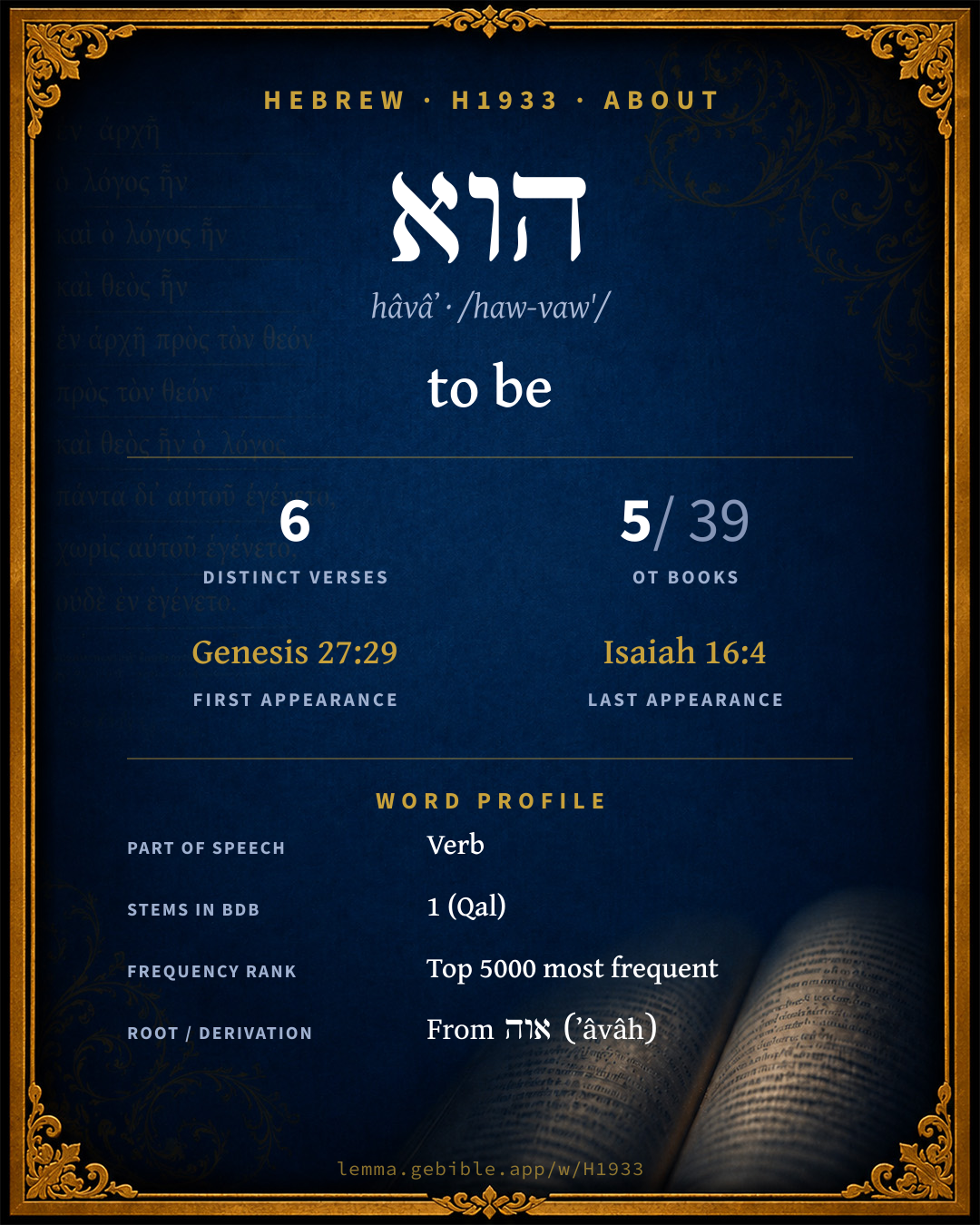
הָוָא
to be
‘to be’ is one of 3 main senses fuller range ↓
Full lexicon entry — Brown-Driver-Briggs (BDB)
From Brown-Driver-Briggs (BDB)
Where this word appears
Grammar key — what these labels mean
Part of speech
- Verb
- An action or state-of-being word.
Stem
- Qal
- The basic, simple active stem — the plain form of the verb (“he wrote”).
Form
- Participle Active
- A verbal adjective expressing ongoing or characteristic action (“writing / one who writes”).
- Imperative
- A direct command (“write!”).
- Imperfect
- An incomplete, ongoing, or future action (“he will / would write”).
State
- Absolute
- The independent form of a noun, not bound to a following word.
Person
- 2nd Person
- The one addressed (“you”).
- 3rd Person
- The one spoken about (“he / she / it / they”).
Gender
- Masculine
- Grammatically masculine.
- Feminine
- Grammatically feminine.
Number
- Singular
- One.
Grammatical forms
- Verb, Qal, Participle Active, Masculine, Singular, Absolute 2 times (33%)
- Verb, Qal, Imperative, 2nd Person, Masculine, Singular 2 times (33%)
- Verb, Qal, Imperfect, 3rd Person, Masculine, Singular 1 time (17%)
- Verb, Qal, Imperative, 2nd Person, Feminine, Singular 1 time (17%)
Parsed forms decoded from the imported morphology (morphhb / Westminster Leningrad Codex — WLC text public domain, morphhb tagging CC BY 4.0), counted across 6 parsed occurrences — not distinct verses.
Every verse where H1933 appears — 6 distinct verses across 5 books. Click any verse to open its interlinear word-by-word view. Verse text shown in the World English Bible for context — . Each verse’s Hebrew form is shown with its reference; the English is not keyword-highlighted, since the data carries no word-level English alignment. Use “Compare translations” on any verse to read it across multiple English versions. This concordance covers the Hebrew Bible; Septuagint (Greek Old Testament) occurrences are not indexed here.
Genesis 1 verse
Nehemiah 1 verse
Job 1 verse
Ecclesiastes 2 verses
- Ecclesiastes 2:22 הֹוֶ֤ה Qal ptcp.act ms For what has a man of all his labor, and of the striving of his heart, in which he labors under the sun?
- Ecclesiastes 11:3 יְהֽוּא Qal impf 3ms If the clouds are full of rain, they empty themselves on the earth; And if a tree falls toward the south, or toward the north, In the place where the tree falls, there shall it be.
Isaiah 1 verse
About this entry
At a glance — auto-summarized from this page’s data, not written by a person. Every figure links to its source below. This summary describes the numbers; it doesn’t interpret them.
הוא — transliterated hâvâʼ — is a Hebrew verb carrying the sense “to be.” Its earliest occurrence is Genesis 27:29. Spanning 6 verses in 5 books, it ranks among the uncommon words of the Hebrew Bible. Its uses concentrate in Ecclesiastes (33% of all occurrences). The lexicon spreads it across several senses; see its full sense range. The sections below give every sense, occurrence, and version rendering.
Gloss history
Strong's 1890 vs modern scholarship
About this word
Strong's H1933 catalogs a Hebrew word from the Hebrew Old Testament.
These counts are not copied from any lexicon or concordance. They are computed here, from the morphology-tagged Hebrew Old Testament. What Lemma adds →
- 6
- distinct verses
- The word appears in 6 distinct verses.
- 5 / 39
- OT books
- The word appears in 5 of 39 Old Testament books.
- #3,040
- by frequency
- Top 5000 most frequent Hebrew words (rank 3,040 of 8,640 Hebrew words by occurrence).
View all 6 occurrences in the concordance →
Most concentrated in
- Ecclesiastes 2 verses 33%
- Genesis 1 verse 17%
- Nehemiah 1 verse 17%
By section of the Old Testament
By traditional corpus
Conventional, traditional groupings — biblical authorship is debated, so this is a traditional corpus grouping, not an authorship claim. Each share is this word’s portion of its verses in that division of the Hebrew canon. Each figure is a share of the word’s 6 distinct verses.
- Writings (Ketuvim) 4 verses · 67%
- Torah (Pentateuch) 1 verse · 17%
- Prophets (Nevi'im) 1 verse · 17%
How translations render this word
Counts come from each version’s own published word-to-Strong’s tagging or interlinear alignment — an approximate guide to how each version renders this word, not a word-level alignment the data otherwise carries. Because each total is that version’s own tagged count, the per-version totals vary from one another and need not match the appearance or distinct-verse counts above. These counts may also differ from a printed concordance because Lemma counts each distinctly tagged rendering and does not collapse phrase taggings into a single head-word total. This is a fixed set of word-tagged versions (KJV, ASV, BSB, ULT) and does not change with the reading translation you choose elsewhere. Each version’s license is shown beside its name below (and on Sources).
- King James Version: Be 1×, Be thou 1×, Hath 1×
- American Standard Version: Fall thou 1×, Hath 1×, Moab be 1×
- Berean Standard Bible: Are to become 1×, Be 1×, Fall 1×
- unfoldingWord Literal Text: Be 3×
King James Version Public Domain
Renders H1933 across 6 tagged occurrences — most commonly:
American Standard Version Public Domain
Renders H1933 across 6 tagged occurrences — most commonly:
Berean Standard Bible Public Domain
Renders H1933 across 6 tagged occurrences — most commonly:
unfoldingWord Literal Text CC BY-SA 4.0
Renders H1933 across 6 tagged occurrences — most commonly:
Plus 3 renderings that appear only once — usually multi-word phrases or single function words the recovered tagging swept in, not distinct renderings.
Senses in the full BDB
What do BDB’s symbols mean?
BDB uses these scholarly abbreviations:
| Symbol | Meaning |
|---|---|
| 𝔊 | the Septuagint (the ancient Greek translation, LXX) |
| 𝔙 | the Vulgate (the Latin translation) |
| 𝔖 | the Syriac version (the Peshitta) |
| 𝔗 | the Targum (the Aramaic translation) |
| ψ | the Psalms |
| √ | root (the underlying root or stem) |
| ‖ | parallel passage (a synonymous or contrasted parallel) |
| † | the dagger: every passage where the word occurs is cited |
The 1 sense the full Brown-Driver-Briggs lexicon distinguishes for this word, in lexicon order (not ranked by frequency), with BDB’s own verbatim wording and sub-sense lettering. Shown in Hebrew script with BDB’s own scholarly abbreviations. The condensed entry is in the Lexicon Entry tab. See also the Forms in the corpus table below.
Qal
- Impf. apoc. יְהוּא Ec 11:3 (for יְהוּ with א otiosum; Ges§ 75 R. I 3 e Kön p. 597 f.; but Gr. plausibly הוּא); Imv. ms. הֱוֵה Gn 27:29, fs. הֱוִי Is 16:4, Pt. הֹוֶה Ec 2:22; Ne 6:6:—Gn 27:29 הֱוֵה גְבִיר לְאַחֶיךָ become lord to thy brethren, Is 16:4 (perhaps in imit. of Moab. dialect) הֱוִי סֵתֶר לָמוֹ become thou (Zion) a defence to them, Ec 2:22; 11:3; Ne 6:6. e.g. Ecclesiastes 11:3
Senses from the full Brown-Driver-Briggs lexicon (Brown, Driver, Briggs; Oxford 1906 — public domain), digitized via Sefaria, supplemented by the OpenScriptures HebrewLexicon (CC BY 4.0). Full attribution on Sources.
Word origin
vb. become (Arabic هَوَى to fall (v. הָוָא), also to gape or yawn, and to desire (cf. הַוָּה): cf. FlDe Jb 6:2; Aramaic הֲוָא, ܗܘܳܐ the usual word for to be (prob. orig. to fall out, accidit, hence come to pass, come to be, γίγνεσθαι), Mish. id. very common) a rare syn. of הָיָה q.v.:—
— Brown-Driver-Briggs (Oxford 1906, public domain), digitized via Sefaria, supplemented by the OpenScriptures HebrewLexicon (CC BY 4.0). See Sources.
Derived from אוה (ʼâvâh) (H183) — to desire.
Jastrow Dictionary
A second Hebrew/Aramaic lexicon for comparison, covering Aramaic and post-biblical (Talmudic, Targumic, Midrashic) usage that the biblical-Hebrew BDB does not. Matched by lemma rather than by Strong’s number, so a lemma may carry more than one Jastrow headword (shown separately below), and the entries cover usage well beyond the Bible.
הוּא
- (b. h.) he, it; she; it is &c. Snh. III, 3 (24ᵇ) if he has no trade אלא הוא (Y. ed., Erub. 82ᵃ היא) except this (gambling &c.); יש לו אומנות שלא הוא (היא) if he has a trade besides this (v. Rabb. D. S. a. l. note 80).—הוא—הוא, היא—היא it is the same, i.e. there is no difference between the two. Y. Ber. I, 3ᵇ היא היא both are equally precious. Gen. R. s. 9, end הוא מאד הוא אדם the word מאד has the same letters as אדם. Ber. 2ᵇ דילמא ביאת אורו הוא perhaps it is (means) the arrival of his day, v. אוֹר II; a. v. fr.—[Shebi. III, 8 עושה הוא; IV, 5 מכסה הוא, Y. ed. עוֹשֵׂהוּ, מְכַסֵּהוּ; ib. X, 6 מזכה הוא; Ms. M., Gitt. 37ᵃ מְזַכֵּהוּ.]—ולא היא but it is not so (it has a different reason &c.). Ber. 57ᵃ; a. fr.—כל שהוא (כל שהיא) a) whosoever, whatsoever (is). Peah II, 4 כל ש׳ אוכל whatever is eatable &c.; a. fr.—b) whatever it may be, a minimum, v. כָּל. Shebi. X, 6 כל שהוא; Gitt. l. c. כל שֶׁהוּ; a. fr.—ספר היא the Book Hi, name of a Pentateuch scroll in the Temple in which היא occurs nine times (for the archaic הִוא), whereas in others it appears eleven times (v. Ab. d’R. N. ch. XXXIV, ed. Schechter). Sifré Deut. 356; Y. Taan. IV, 68ᵃ bot.—הַהוּא, הַהִיא, mostly in Chald. diction, v. next w.—Pl. הֵם m., הֵן c. Ber. 2ᵇ והלא כהנים … הם טובלים but do not priests bathe &c.?—Meg. 14ᵇ רהמניות הן are compassionate. Ḥull. 127ᵇ הרי הן וכ׳ they are to be treated as if &c.; a. v. fr.—הן … הן are the same. Y. Ab. Zar. II, end, 42ᵃ, v. אִסְטַגְיוֹת.—With prep. מֵהֶם, מֵהֶן, לָהֶם &c.
הוּא ²
- , ch. same. Targ. Ex. I, 16; a. v. fr.—היא הדא, v. דָּא.—Y. Shebi. VII, 37ᶜ top בהוא אתר (R. S. to Shebi. VII, 3 בההוא אתרא) in the same place.—כל דהו whatsoever, v. preced. Arakh. 2ᵃ נפשות כל דהו human beings of any nature, v. כָּל.—Y. Kil. VI, 31ᵇ top כהיא דאמר וכ׳ (in Babli כי הא) as (that which) R. … said.—Pl. הֵן (perhaps only in Hebr. phrases); הִינוּן, הִינִין. Targ. Y. Ex. I, 10; Ib. 19 (O. אינ׳); a. fr.—With prefix ה: הַהוּא, הַהִיא. Targ. Y. Ex. XXI, 20; a. fr.—In Talmud frequ. used to introduce a case. Pes. 3ᵇ ה׳ ארמאה ד־ it occurred that a gentile &c. Keth. 78ᵇ ה׳ איתתא ד־ the case came up of a woman that &c.; a. v. fr.—ה׳ גברא, ה׳ איתתא frequ. euphemistically for myself, thyself (to avoid ominous speech or curse). Y. Maas. Sh. IV, 55ᵇ bot. אביו דה׳ ג׳ thy father. Ib.ᶜ top חמית ה׳ א׳ I saw; בעלה דה׳ א׳ thy husband; a. v. fr.—With prefix ד־: דהוא, דהיא, contr. דּוּ, דִּי, v. דְּ־ a. דּוּ.—With prefixed prep. בְּהוֹן, בּוֹן, לְהוֹן, לוֹן.
הֲוָא
- , v. הוי
A Dictionary of the Targumim, the Talmud Babli and Yerushalmi, and the Midrashic Literature (Marcus Jastrow; London, Luzac, 1903) — Public Domain. Digitized via Sefaria. Digitized via Sefaria. Full attribution on Sources.
Forms in the corpus
The 5 distinct written forms H1933 takes in the Hebrew Bible, most frequent first — each parse links to that stem’s occurrences in the concordance. Hebrew forms include their vowel points and cantillation, so a single lemma takes many written forms.
| Form | Parsing | Example | Uses |
|---|---|---|---|
| הֹוֶ֤ה | Verb, Qal, Participle Active, Masculine, Singular, Absolute | Ecclesiastes 2:22 | 2 |
| הֱוִי | Verb, Qal, Imperative, 2nd Person, Feminine, Singular | Isaiah 16:4 | 1 |
| הֱוֵ֤ה | Verb, Qal, Imperative, 2nd Person, Masculine, Singular | Genesis 27:29 | 1 |
| הֱוֵ֫א | Verb, Qal, Imperative, 2nd Person, Masculine, Singular | Job 37:6 | 1 |
| יְהֽוּא | Verb, Qal, Imperfect, 3rd Person, Masculine, Singular | Ecclesiastes 11:3 | 1 |
Same root — word family
Other BDB entries built from the same root as H1933, grouped by Strong’s listed origin. These share a root / origin per the lexicon — not necessarily a shared meaning. Each links to that word’s own entry.
Derives from
Shares the same root
- אוה ʼavvâh H185 desire
- אוי ʼôwy H188 woe
- אי ʼîy H339 island
- מאוי maʼăvay H3970 desire
- תאוה taʼăvâh H8378 desire
Derived from this word
Proper names from this root
People and places named from this root — a name, not an additional meaning of the word.
Compare all same-root words → Showing 4 of 11 — not the complete family. 1 of the same-root words is a proper name (a person or place). They share a root, not necessarily a meaning.
Septuagint verse parallels
This word appears in 5 verses that also exist in the Greek Old Testament (Septuagint), out of the 6 Hebrew verses it occurs in. You can read those verses in Greek by switching the Old Testament edition to the Septuagint.
Read these verses in the Septuagint
This is a verse-level parallel only — the same verses exist in both the Hebrew and Greek Old Testaments. No word-level Hebrew↔Greek correspondence is claimed: the data carries no such alignment, so no Greek word is shown as this Hebrew word’s translation. Coverage is not total — the Septuagint omits the deuterocanon and renumbers the Psalms, so some Hebrew verses have no direct Greek parallel.