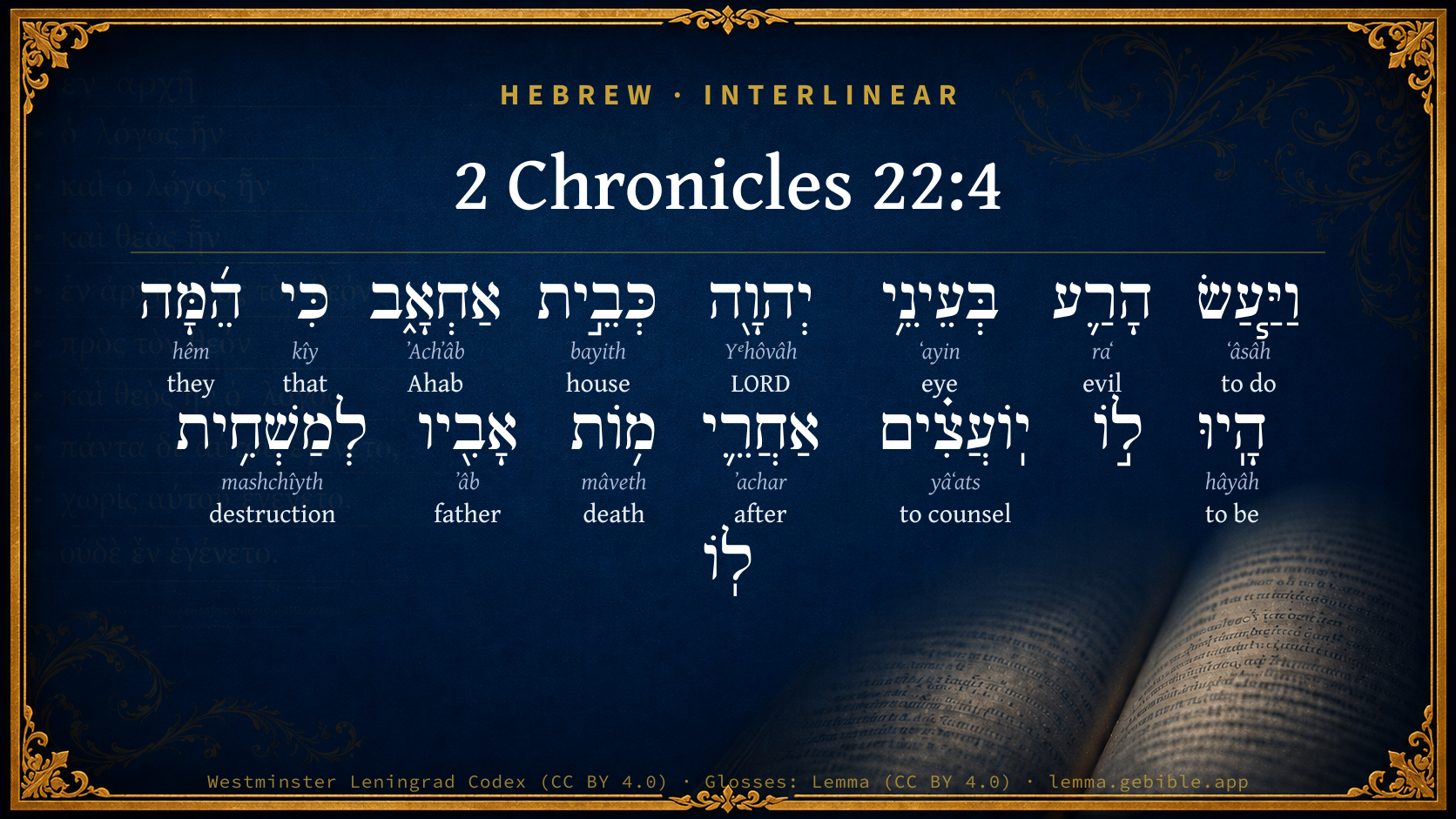
2 Chronicles 22:4

Hebrew (Westminster Leningrad Codex) 2 Chronicles 22:4 appears in the Hebrew Old Testament. The text above is from the Westminster Leningrad Codex. Each word links to its Strong’s number, a concise gloss, and parsing drawn from the Open Scriptures Hebrew Bible morphology. Click any word for its full Brown-Driver-Briggs (BDB) entry.
Download image
Cite this verse

2 Chronicles 22:4 (World English Bible). Public Domain. Lemma interlinear Bible study tool, https://lemma.gebible.app/v/2-chronicles/22/4.

Show BibTeX & RIS
BibTeX
RIS
English Translation
He did that which was evil in the sight of Yahweh, as did the house of Ahab; for they were his counselors after the death of his father, to his destruction.
World English Bible · Public Domain
Download a study sheet

One document with this verse’s original text, its word-by-word gloss line, the meaning frame, cross-references with their text, attributed commentary, and full source and license credits — printable, and it pastes into notes with its structure intact.

This verse Autodidact and up

Study sheet (.html) Plain text (.txt)

A passage Seminary Student

Up to 50 verses in one chapter. A passage sheet keeps up to 6 commentary sources and 12 cross-references per verse, in the order this page ranks them, and says so on the sheet whenever that leaves anything out. Ask for a single verse and you get the Autodidact verse sheet above.

Everything on this page stays free to read, with no account — the sheet is a download of what is already on screen, not access to it.

Want to remove ads? Support Godless Engineer
Compare translations 3

The same verse in 3 English versions, stacked beneath the original-language interlinear above. Click any original word for its lexicon entry.

Each is an independent rendering of the whole verse — the interlinear is not word-aligned to these translations.

Highlighted words mark where these versions differ — a whole-verse word diff, not a word-by-word alignment.

  • World English Bible Public Domain
    He did that which was evil in the sight of Yahweh, as did the house of Ahab; for they were his counselors after the death of his father, to his destruction.
  • King James Version Public Domain
    Wherefore he did evil in the sight of the LORD like the house of Ahab: for they were his counselors after the death of his father to his destruction.
  • unfoldingWord Literal Text CC BY-SA 4.0
    And he did evil in the eyes of Yahweh, like the house of Ahab, for they themselves were to him advisors after the death of his father, for destruction to him.

unfoldingWord Literal Text — © unfoldingWord, licensed CC BY-SA 4.0. Word-aligned USFM3 via Door43 (git.door43.org/unfoldingWord/en_ult).

Versions to compare (up to 4)

3 of 4 selected

Show all 18 translations

Every available English version of this verse, each an independent rendering of the whole verse.

  • World English Bible Public Domain
    He did that which was evil in the sight of Yahweh, as did the house of Ahab; for they were his counselors after the death of his father, to his destruction.
  • Berean Standard Bible Public Domain
    And he did evil in the sight of the LORD, as the house of Ahab had done, for to his destruction they were his counselors after the death of his father.
  • Majority Standard Bible Public Domain
    And he did evil in the sight of the LORD, as the house of Ahab had done, for to his destruction they were his counselors after the death of his father.
  • King James Version Public Domain
    Wherefore he did evil in the sight of the LORD like the house of Ahab: for they were his counselors after the death of his father to his destruction.
  • American Standard Version (1901) Public Domain
    And he did that which was evil in the sight of Jehovah, as did the house of Ahab; for they were his counsellors after the death of his father, to his destruction.
  • Revised Version (1885) Public Domain
    And he did that which was evil in the sight of the LORD, as did the house of Ahab: for they were his counsellors: after the death of his father, to his destruction.
  • Geneva Bible (1599) Public Domain
    Wherefore he did euill in the sight of the Lord, like the house of Ahab: for they were his counsellers after the death of his father, to his destruction.
  • Douay-Rheims (1899) Public Domain
    So he did evil in the sight of the Lord, as the house of Achab did: for they were his counsellors after the death of his father, to his destruction.
  • Young's Literal Translation Public Domain
    And he doth the evil thing in the eyes of Jehovah, like the house of Ahab, for they have been his counsellors, after the death of his father, for destruction to him.
  • Literal Standard Version CC BY-SA 4.0
    And he does evil in the eyes of YHWH, like the house of Ahab, for they have been his counselors, after the death of his father, for destruction to him.
  • Unlocked Literal Bible CC BY-SA 4.0
    Ahaziah did what was evil in the sight of Yahweh, as the house of Ahab was doing, for they were his advisors after the death of his father, to his destruction.
  • unfoldingWord Literal Text CC BY-SA 4.0
    And he did evil in the eyes of Yahweh, like the house of Ahab, for they themselves were to him advisors after the death of his father, for destruction to him.
  • Darby Bible Public Domain
    And he did evil in the sight of Jehovah like the house of Ahab; for they were his counsellors after the death of his father, to his destruction.
  • World Messianic Bible Public Domain
    He did that which was evil in the LORD’s sight, as did Ahab’s house, for they were his counselors after the death of his father, to his destruction.
  • Webster's Bible Public Domain
    Wherefore he did evil in the sight of the LORD like the house of Ahab: for they were his counselors, after the death of his father, to his destruction.
  • Free Bible Version CC BY-SA 4.0
    He did what was evil in the Lord's sight, just as the family of Ahab had done. For after his father's death they were his counselors, to his ruin.
  • Bible in Basic English Public Domain
    And he did evil in the eyes of the Lord, as the family of Ahab did; for after the death of his father they were his guides to his destruction.
  • JPS Tanakh (1917) Public Domain
    And he did that which was evil in the sight of the LORD, as did the house of Ahab; for they were his counsellors after the death of his father, to his destruction.

Literal Standard Version (2020), Covenant Press — licensed CC BY-SA 4.0. Text via the HelloAO Bible API (eBible.org). Unlocked Literal Bible (unfoldingWord) — licensed CC BY-SA 4.0. Text via the HelloAO Bible API (eBible.org). unfoldingWord Literal Text — © unfoldingWord, licensed CC BY-SA 4.0. Word-aligned USFM3 via Door43 (git.door43.org/unfoldingWord/en_ult). Free Bible Version, Dr. Jonathan Gallagher — licensed CC BY-SA 4.0. Text via the HelloAO Bible API (eBible.org).

Word by word

More ways to search: Search by grammar → Find every occurrence → Compare this word →

Practice this passage: Drill this verse → Learn its vocabulary →

לְמַשְׁחִ֥ית
mashchîyth
H4889
“to/for · destruction”
Preposition + Noun, Common, Masculine, Singular, Absolute
Part of Speech
Preposition + Noun
Type
Common
Gender
Masculine
Number
Singular
State
Absolute
Full BDB Definition

Origin: from H7843

TWOT: 2370a

ruin, destruction
  1. וַיַּ֧עַשׂ ʻâsâh H6213 “and · to do” Conjunction + Verb, Qal, Sequential Imperfect, 3rd Person, Masculine, Singular
  2. הָרַ֛ע raʻ H7451 “the · evil” Particle, Definite Article + Adjective, Adjective, Masculine, Singular, Absolute
  3. בְּעֵינֵ֥י ʻayin H5869 “in/at · eyes of” Preposition + Noun, Common, Both, Dual, Construct
  4. יְהוָ֖ה Yᵉhôvâh H3068 “LORD” Noun, Proper
  5. כְּבֵ֣ית bayith H1004 “like/as · house of” Preposition + Noun, Common, Masculine, Singular, Construct
  6. אַחְאָ֑ב ʼAchʼâb H256 “Ahab” Noun, Proper
  7. כִּי kîy H3588 “that” Conjunction
  8. הֵ֜מָּה hêm H1992 “they” Pronoun, Personal, 3rd Person, Masculine, Plural
  9. הָֽיוּ hâyâh H1961 “to be” Verb, Qal, Perfect, 3rd Person, Common, Plural
  10. יֽוֹעֲצִ֗ים yâʻats H3289 “counseling” Verb, Qal, Participle Active, Masculine, Plural, Absolute
  11. אַחֲרֵ֛י ʼachar H310 “after” Preposition
  12. מ֥וֹת mâveth H4194 “death of” Noun, Common, Masculine, Singular, Construct
  13. אָבִ֖יו ʼâb H1 “father · his” Noun, Common, Masculine, Singular, Construct + Suffix, Personal, 3rd Person, Masculine, Singular

About this verse

These counts appear in no published source. They are computed here, from the morphology-tagged text and Lemma’s own curated glosses. What Lemma adds →

16
words
14
distinct lemmas
Historical
section

Notable vocabulary

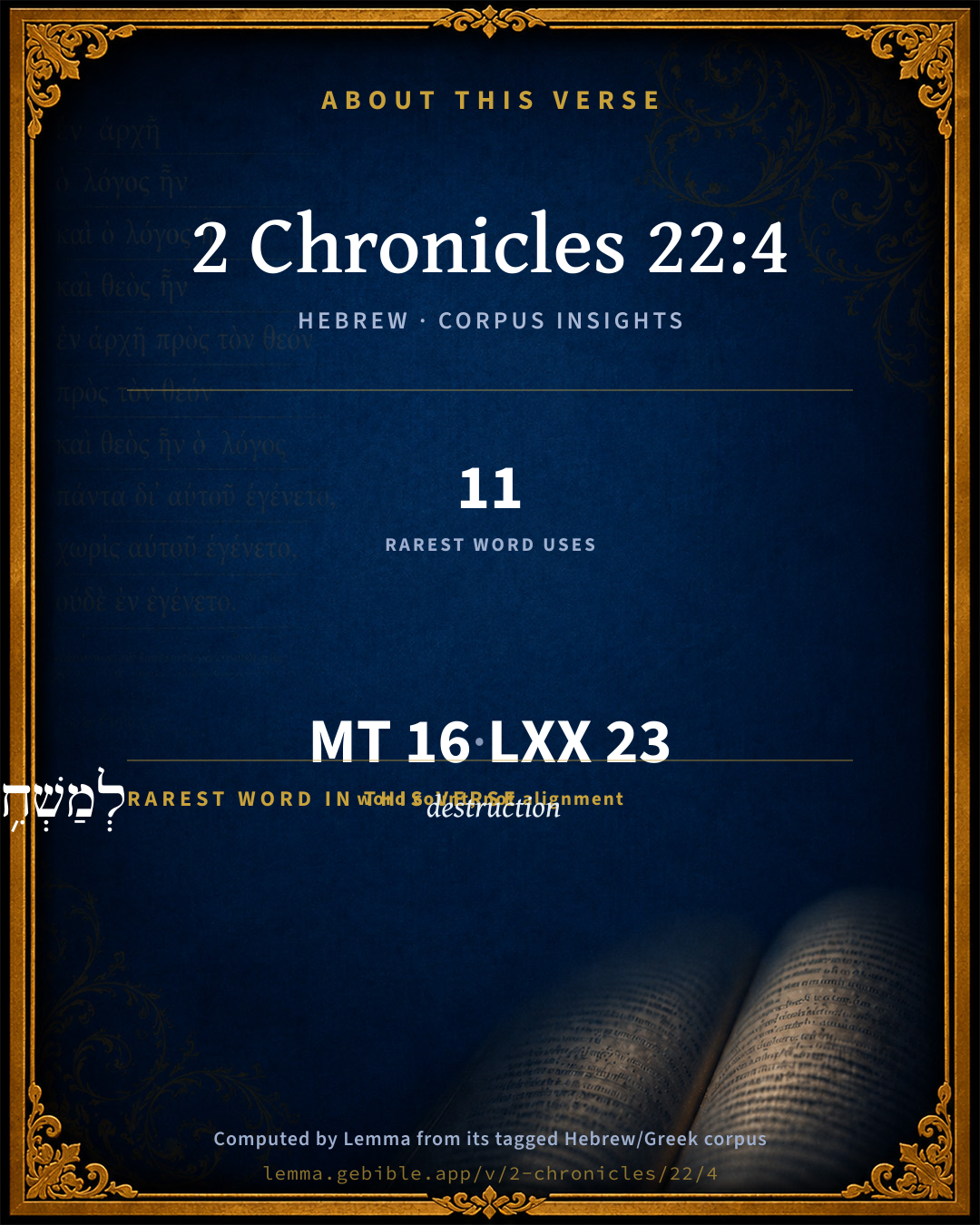
The rarest word here is לְמַשְׁחִ֥ית destruction H4889 — appearing just 11 times in the whole Hebrew Bible.

Shared distinctive vocabulary

לְמַשְׁחִ֥ית destruction H4889 occurs in 11 verses of the Hebrew Bible. Also found in:

Grammatical profile

  • 3 verbs
  • 7 nouns
  • 1 adjective
  • 1 pronoun
  • 3 prepositions
  • 1 conjunction

Verb forms

  • וַיַּ֧עַשׂ Qal · Sequential Imperfect
  • הָֽיוּ Qal · Perfect
  • יֽוֹעֲצִ֗ים Qal · Participle Active

Hebrew & Septuagint length

In English translation the verse runs 31 words from the Hebrew and 34 from the Septuagint (LXX English) — closely comparable.

A rough comparison of the two English renderings, which tokenize alike — not a word-level alignment.

Word counts can differ between the Hebrew and the Greek without any difference in meaning — e.g. the Hebrew direct-object marker אֵת has no separate Greek word, and Greek often adds the article ὁ.

In the original languages it is 16 Hebrew tokens and 23 Greek tokens — but the two are counted differently (Hebrew bundles its prefixes and suffixes into one token; the Greek is in lemma form), so that isn’t a like-for-like length.

Cross-references

5

Topical passages linked to 2 Chronicles 22:4 in the Treasury of Scripture Knowledge — connected by theme and wording, ordered by reader-vote popularity; previews shown in the World English Bible.

  • Proverbs 13:20 One who walks with wise men grows wise, But a companion of fools suffers harm.
  • 2 Chronicles 24:17–18 Now after the death of Jehoiada came the princes of Judah, and made obeisance to the king. Then the king listened to them.
  • Proverbs 1:10 My son, if sinners entice you, don't consent.
  • Proverbs 12:5 The thoughts of the righteous are just, But the advice of the wicked is deceitful.
  • Proverbs 19:27 If you stop listening to instruction, my son, You will stray from the words of knowledge.

Cross-references courtesy of OpenBible.info (CC BY 4.0).

Hebrew and Greek witnesses Masoretic Hebrew ↔ Greek Septuagint

The same verse in the two great witnesses to the Old Testament, shown verse-for-verse.

These are two independent witnesses, not word-aligned to each other, and the Septuagint is shown in lemma (dictionary) form.

Hebrew 2 Chronicles 22:4 Masoretic · Westminster Leningrad Codex

וַיַּ֧עַשׂ הָרַ֛ע בְּעֵינֵ֥י יְהוָ֖ה כְּבֵ֣ית אַחְאָ֑ב כִּי הֵ֜מָּה הָֽיוּ ל֣וֹ יֽוֹעֲצִ֗ים אַחֲרֵ֛י מ֥וֹת אָבִ֖יו לְמַשְׁחִ֥ית לֽוֹ

He did that which was evil in the sight of Yahweh, as did the house of Ahab; for they were his counselors after the death of his father, to his destruction.

World English Bible · Public Domain

Greek LXX 2 Chronicles 22:4 Septuagint · lemma form

καί ποιέω ὁ πονηρός ἐναντίον κύριος ὡς οἶκος αχααβ ὅτι αὐτός εἰμί αὐτός μετά ὁ ἀποθνήσκω ὁ πατήρ αὐτός σύμβουλος ὁ ἐκὀλεθρεύω αὐτός

And he did that which was evil in the sight of the Lord as the house of Achaab had done: for they were his counselors after the death of his father to his destruction.

LXX2012 (modern English Septuagint) · Public Domain

Hebrew: Westminster Leningrad Codex (CC BY 4.0). Greek: Septuagint (public domain); English from LXX2012 (modern English Septuagint) (Public Domain). How the Septuagint differs from the Hebrew →

Commentary

Notes on 2 Chronicles 22:4 from classic Christian and Jewish commentators (each source and its license shown beneath its notes). The classic Christian expositions comment on the surrounding passage and are grouped to its opening verse, so a note may address several verses; the Jewish commentaries on the Tanakh (Rashi and others) are per-verse, so they appear only where the commentator wrote on this verse.

Lemma curates 59 commentaries, every one of them public domain or Creative Commons licensed, each selected and text-cleaned for this edition rather than reprinted as found. About our sources →

Trapp's Complete Commentary

John Trapp

2Ch 22:4 Wherefore he did evil in the sight of the LORD like the house of Ahab: for they were his counsellors after the death of his father to his destruction.

Ver. 4. Wherefore he did evil.] See 2Ki 8:27, where he is said to be the son-in-law to the house of Ahab. So that what by his mother’s command, and what by his wife’s importunity, he was utterly marred.

John Trapp, A Commentary or Exposition upon All the Books of the Old and New Testament (1647–1656) — public domain. Text from a community e-Sword module.

Geneva Bible (1599)

Geneva Bible translators

He showeth that it must needs follow that the rulers are such as their counselors be, and that there cannot be a good King, that suffereth wicked counselors.

Geneva Bible (1599) marginal notes — public domain. Text via Bolls.life.

Ellicott's Commentary for English Readers

(4) Wherefore.—And he did the evil. So 2Ki_8:27.

For they were his counsellors.—Or, became.

To his destruction.—Literally, to destruction to him, the same peculiar expression being used which occurred in 2Ch_20:23. This last half of the verse is evidently the chronicler’s own free expansion or interpretation of the words of Kings, “for he was son-in-law of the house of Ahab.”

A Bible Commentary for English Readers, edited by Charles John Ellicott (1878–1897) — public domain. Text from a community e-Sword module.

The Cambridge Bible for Schools and Colleges

gen. ed. J. J. S. Perowne

4. after the death of his father] This phrase suggests that he acted as regent in his father’s lifetime during his father’s two years’ illness.

The Cambridge Bible for Schools and Colleges (gen. ed. J. J. S. Perowne; Cambridge University Press, 1878–1918) — public domain. Text from a community e-Sword module.

John Gill's Exposition

Wherefore he did evil in the sight of the Lord, like the house of Ahab,.... See Kg2 8:27.

for they were his counsellors, after the death of his father, to his destruction; both of soul and body; for they gave him bad advice, both in religious and civil things; these were some of the family or court of the king of Israel, that his mother sent for after his father's death to be of his council.

John Gill's Exposition of the Whole Bible (1746–1763) — public domain (CC PDM 1.0). Text via the HelloAO Bible API.

Matthew Poole's English Annotations

After the death of his father; who, whilst he lived, seduced his son by his counsel and authority, and made other evil counsellors then unnecessary.

Matthew Poole's English Annotations on the Holy Bible (1683–1685) — public domain. Text from a community e-Sword/MySword module.

The Pulpit Commentary

The counsel that destroys, and that which saves.

counsellors to his destruction." The counsel we receive has much to do with the character we form and the life we live; much, therefore, with the destiny we are weaving.

I THE URGENT NEED FOR COUNSEL IN A CRITICAL PERIOD OF OUR LIFE. In our earliest years the river of our life flows between high and narrow banks. We are well fenced in, and must move according to our surroundings. But later on the banks are lower, the restrictions are weaker, and we may overflow, may cut a new channel for ourselves. At first we are under commandment from hour to hour; we do that which is prescribed for us; we shun that which is interdicted. Then comes a time when we disengage ourselves from this position; it has become bondage; we demand to enter upon the rights of maturity, to form our own judgment, to act according to our own choice. It is at this point, when the father"s authority is no longer paramount, that we need to act under counsel. We urgently need the help of those who will advise, though they do not assume to direct us. We want the guidance of those who will say to us, not, You shall, but, You should. We require the advantage of the experience of men who have gone through the ways that now lie before us; of men whose wisdom will equip us for the new duties that have to be discharged, for the new burdens that have to be borne, for the new dangers and difficulties that have to be faced and fought, for the new teen, rations that have to be met and mastered. But there are two kinds of counsel, and everything depends on which we shall adopt.

II THE COUNSEL THAT DESTROYS; Viz. the counsel that kills all that is best in our nature, and brings us down to spiritual if not, indeed, to material ruin.

1. The counsel of a degrading selfishness, which speaks on this wise: "Take care of number one;" "Every man for himself," etc.; that would impress the opening mind of young manhood with the miserable falsehood that, so long as we can secure what we crave for ourselves, it is of little consequence what becomes of our neighbours or of our fellow-men.

2. The counsel of shameful indulgence, which speaks in this strain: "Youth comes but once in a lifetime;" "A short life and a merry one;" counsel that would recommend the young to consume all that is pure and sound in their nature in the fires of unholy passion, to drown all that is worthiest, all sense of what is becoming, and all self-respect, in the turgid waters of unrestrained or ill-restrained indulgence.

3. The counsel of financial exaggeration, which says, "Get money by all means, honestly if possible, but get money;" this is counsel which would "sacrifice life for the sake of the means of living," which would lead to the loss of that which is most sacred and precious for the sake of that which, at best, can only supply the outward conditions of well-being. It makes mere pecuniary possession the goal of human life a very common but an utter and pitiable mistake.

4. The counsel of a shallow materialism; that which lays great stress on temporal success and on human favour, and makes little or nothing of spiritual worth and the favour of God. Such counsels as these are truly destructive; they kill faith, love, purity, hope, spirituality everything, indeed, which makes our manhood, which constitutes our true heritage. Under such counsellors we may gain the world, but we lose our soul; they are "counsellors to our destruction.

III THE COUNSEL WHICH SAVES. There is One of whom, many centuries before he came, it was said, "His name shall be called Counsellor;" of whom, when he was with us, it was said, "Whence hath this Man this wisdom?" who came to be to us "the Wisdom of God". (1Co_1:24) If we will learn of him, we shall know what is the truth indeed respecting human life, worldly wealth, the honour which comes from man and that which is of God, what constitutes eternal life below, and what it is that leads on to the heavenly life beyond the grave C. (see Mat_6:19, Mat_6:20, 33 10:37-39; Luk_4:4 Luk_12:15; Joh_5:44 Joh_14:23 Joh_17:24)

The Pulpit Commentary (1880–1919), ed. H.D.M. Spence-Jones & Joseph S. Exell — public domain. Text from a community e-Sword module.

John Wesley's Explanatory Notes

His father - Who, while he lived, seduced his son himself, and made other evil counsellors unnecessary.

John Wesley, Explanatory Notes Upon the Whole Bible (1754–1765) — public domain. Text via the GEBible commentary corpus.

unfoldingWord translationNotes

Door43 World Missions Community

in the sight of Yahweh

The sight of Yahweh represents his judgment or evaluation. AT: "as Yahweh judged" (See: Metaphor)

the house of Ahab was doing

The word "house" is a metonym for the family that lives in the house. In this case it refers to the descendants of Ahab. See how you translated this in 2 Chronicles 21:6. AT: "the descendants of Ahab were doing" (See: Metonymy)

they were his advisors

"descendants of Ahab advised him"

to his destruction

"and this caused his destruction"

He also followed their advice; he went

"He also followed their advice and went" or "He also followed their advice to go"

to fight against Hazael, king of Aram

The reader should understand that Hazael did not fight alone, but that he took his army with him. AT: "to fight against Hazael, king of Aram, and his army" (See: Synecdoche)

Hazael

This is a man's name. (See: How to Translate Names)

translationWords

Yahweh

die

Joram

Israel

Aram

Ramoth

Gilead

unfoldingWord translationNotes — © Distant Shores Media and the Door43 World Missions Community, licensed CC BY-SA 4.0. Source: git.door43.org/Door43/en_tn.

Lesson kit

Teaching starters — assembled from the data on this page, not authored interpretation. Every prompt links to the verse data it draws on. Edit before teaching.

2 Chronicles, in the Historical, opens this verse with 16 words (14 distinct Hebrew lemmas). Its most distinctive word is mashchîyth (“destruction”). A historical commentator’s framing appears above. Read the whole chapter for the surrounding context.

Discussion questions

  1. What does “destruction” (mashchîyth) contribute to the verse as a whole?
  2. Exodus 12:13 shares the word «destruction» with this verse. How do the two illuminate each other?
  3. The translations on this page render this verse differently — a whole-verse word diff, not a word-by-word alignment. What might account for the different wordings?
  4. The verb «וַיַּ֧עַשׂ» is Qal Sequential Imperfect. How does its form color the action?
  5. Reading how Trapp's Complete Commentary and Geneva Bible (1599) read this verse, where do the two commentators agree and where do they part?

Things to notice

Reading settings

Reading text

Shown beneath each verse's original-language words.

Old Testament
Old Testament edition

Read the OT as the Masoretic Hebrew (MT) or the Greek Septuagint (LXX).

English shown for the Greek Septuagint (in the Hebrew ↔ Greek comparison).

Comparing translations? Open the Compare panel on any verse page to stack up to four side by side.