Esther 9:21

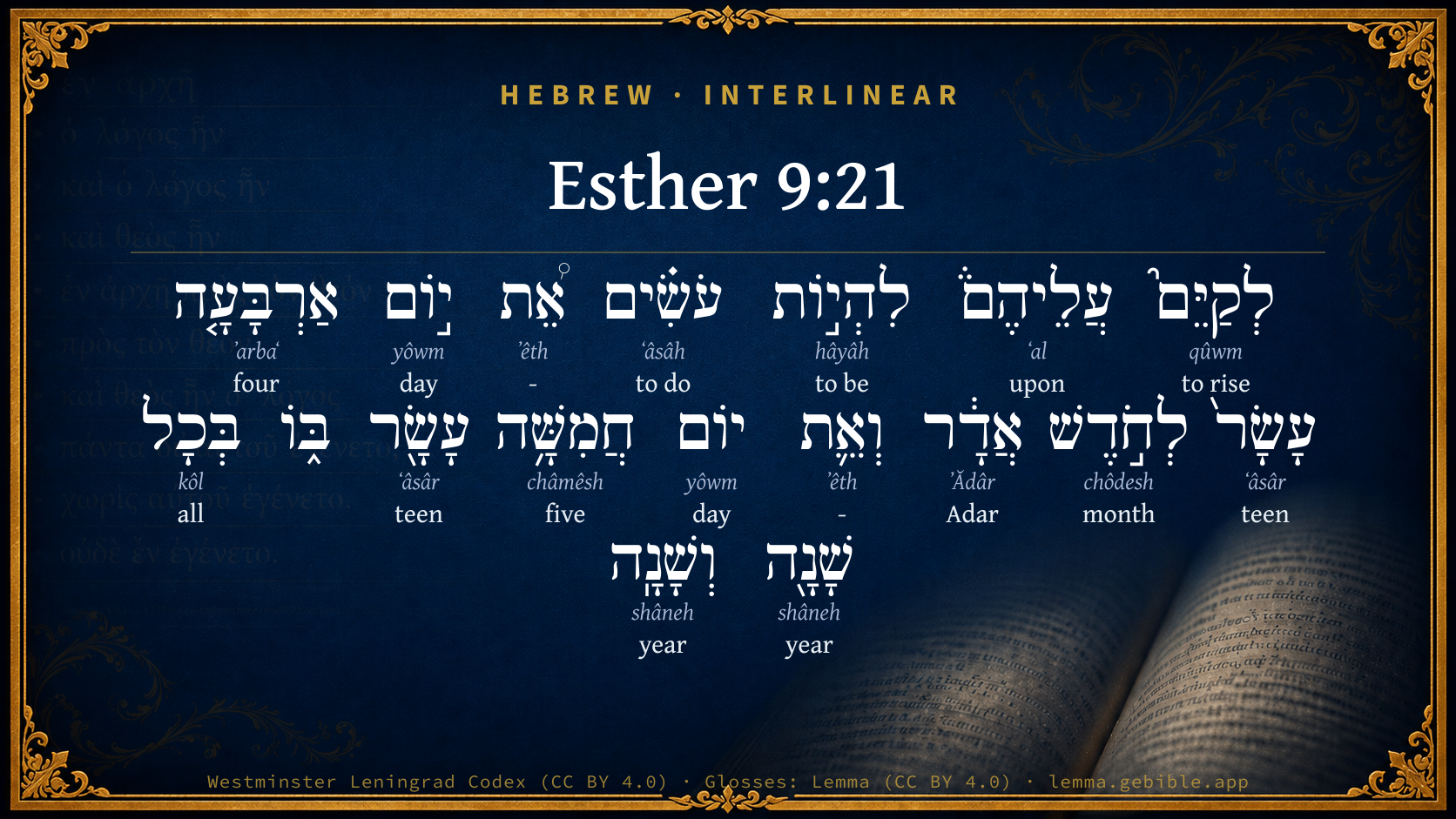
Hebrew (Westminster Leningrad Codex) Esther 9:21 appears in the Hebrew Old Testament. The text above is from the Westminster Leningrad Codex. Each word links to its Strong’s number, a concise gloss, and parsing drawn from the Open Scriptures Hebrew Bible morphology. Click any word for its full Brown-Driver-Briggs (BDB) entry.
Download image
Cite this verse

Esther 9:21 (World English Bible). Public Domain. Lemma interlinear Bible study tool, https://lemma.gebible.app/v/esther/9/21.

Show BibTeX & RIS
BibTeX
RIS
English Translation
to enjoin those who they should keep the fourteenth day of the month Adar, and the fifteenth day of the same, yearly,
World English Bible · Public Domain
Download a study sheet

One document with this verse’s original text, its word-by-word gloss line, the meaning frame, cross-references with their text, attributed commentary, and full source and license credits — printable, and it pastes into notes with its structure intact.

This verse Autodidact and up

Study sheet (.html) Plain text (.txt)

A passage Seminary Student

Up to 50 verses in one chapter. A passage sheet keeps up to 6 commentary sources and 12 cross-references per verse, in the order this page ranks them, and says so on the sheet whenever that leaves anything out. Ask for a single verse and you get the Autodidact verse sheet above.

Everything on this page stays free to read, with no account — the sheet is a download of what is already on screen, not access to it.

Want to remove ads? Support Godless Engineer
Compare translations 3

The same verse in 3 English versions, stacked beneath the original-language interlinear above. Click any original word for its lexicon entry.

Each is an independent rendering of the whole verse — the interlinear is not word-aligned to these translations.

Highlighted words mark where these versions differ — a whole-verse word diff, not a word-by-word alignment.

  • World English Bible Public Domain
    to enjoin those who they should keep the fourteenth day of the month Adar, and the fifteenth day of the same, yearly,
  • King James Version Public Domain
    To stablish this among them, that they should keep the fourteenth day of the month Adar, and the fifteenth day of the same, yearly,
  • unfoldingWord Literal Text CC BY-SA 4.0
    to set up for them to be making day 14 of the month of Adar and day 15 of it, every year by year,

unfoldingWord Literal Text — © unfoldingWord, licensed CC BY-SA 4.0. Word-aligned USFM3 via Door43 (git.door43.org/unfoldingWord/en_ult).

Versions to compare (up to 4)

3 of 4 selected

Show all 18 translations

Every available English version of this verse, each an independent rendering of the whole verse.

  • World English Bible Public Domain
    to enjoin those who they should keep the fourteenth day of the month Adar, and the fifteenth day of the same, yearly,
  • Berean Standard Bible Public Domain
    to establish among them an annual celebration on the fourteenth and fifteenth days of the month of Adar
  • Majority Standard Bible Public Domain
    to establish among them an annual celebration on the fourteenth and fifteenth days of the month of Adar
  • King James Version Public Domain
    To stablish this among them, that they should keep the fourteenth day of the month Adar, and the fifteenth day of the same, yearly,
  • American Standard Version (1901) Public Domain
    to enjoin them that they should keep the fourteenth day of the month Adar, and the fifteenth day of the same, yearly,
  • Revised Version (1885) Public Domain
    to enjoin them that they should keep the fourteenth day of the month Adar, and the fifteenth day of the same, yearly,
  • Geneva Bible (1599) Public Domain
    Inioyning them that they shoulde keepe the fourteenth day of the moneth Adar, and the fifteenth day of the same, euery yeere.
  • Douay-Rheims (1899) Public Domain
    ,21That they should receive the fourteenth and fifteenth day of the month Adar for holy days, and always at the return of the year should celebrate them with solemn honour:
  • Young's Literal Translation Public Domain
    to establish on them, to be keeping the fourteenth day of the month of Adar, and the fifteenth day of it, in every year and year,
  • Literal Standard Version CC BY-SA 4.0
    to establish on them, to be keeping the fourteenth day of the month of Adar, and the fifteenth day of it, in every year and year,
  • Unlocked Literal Bible CC BY-SA 4.0
    obligating them to keep the fourteenth and the fifteenth day of Adar every year.
  • unfoldingWord Literal Text CC BY-SA 4.0
    to set up for them to be making day 14 of the month of Adar and day 15 of it, every year by year,
  • Darby Bible Public Domain
    to establish [this] among them, that they should keep the fourteenth day of the month Adar, and the fifteenth day of the same, yearly,
  • World Messianic Bible Public Domain
    to enjoin them that they should keep the fourteenth and fifteenth days of the month Adar yearly,
  • Webster's Bible Public Domain
    To establish this among them, that they should keep the fourteenth day of the month Adar, and the fifteenth day of the same, yearly,
  • Free Bible Version CC BY-SA 4.0
    requiring them to celebrate every year the fourteenth and fifteenth days of the month of Adar
  • Bible in Basic English Public Domain
    Ordering them to keep the fourteenth day of the month Adar and the fifteenth day of the same month, every year,
  • JPS Tanakh (1917) Public Domain
    to enjoin them that they should keep the fourteenth day of the month Adar, and the fifteenth day of the same, yearly,

Literal Standard Version (2020), Covenant Press — licensed CC BY-SA 4.0. Text via the HelloAO Bible API (eBible.org). Unlocked Literal Bible (unfoldingWord) — licensed CC BY-SA 4.0. Text via the HelloAO Bible API (eBible.org). unfoldingWord Literal Text — © unfoldingWord, licensed CC BY-SA 4.0. Word-aligned USFM3 via Door43 (git.door43.org/unfoldingWord/en_ult). Free Bible Version, Dr. Jonathan Gallagher — licensed CC BY-SA 4.0. Text via the HelloAO Bible API (eBible.org).

Word by word

More ways to search: Search by grammar → Find every occurrence → Compare this word →

Practice this passage: Drill this verse → Learn its vocabulary →

אֲדָ֔ר
ʼĂdâr
H143
“Adar”
Noun, Proper
Part of Speech
Noun
Type
Proper
Full BDB Definition

Origin: probably of foreign derivation

TWOT: None

Adar = "glorious" - twelfth month, corresponding to modern March-April
  1. לְקַיֵּם֮ qûwm H6965 “to rise” Preposition + Verb, Piel, Infinitive Construct
  2. עֲלֵיהֶם֒ ʻal H5921 “upon · them” Preposition + Suffix, Personal, 3rd Person, Masculine, Plural
  3. לִהְי֣וֹת hâyâh H1961 “to be” Preposition + Verb, Qal, Infinitive Construct
  4. עֹשִׂ֗ים ʻâsâh H6213 “doing” Verb, Qal, Participle Active, Masculine, Plural, Absolute
  5. אֵ֠ת ʼêth H853 “-” Particle, Direct Object
  6. י֣וֹם yôwm H3117 “day of” Noun, Common, Masculine, Singular, Construct
  7. אַרְבָּעָ֤ה ʼarbaʻ H702 “four” Adjective, Cardinal number, Masculine, Singular, Absolute
  8. עָשָׂר֙ ʻâsâr H6240 “teen” Adjective, Cardinal number, Masculine, Singular, Absolute
  9. לְחֹ֣דֶשׁ chôdesh H2320 “to/for · month of” Preposition + Noun, Common, Masculine, Singular, Construct
  10. וְאֵ֛ת ʼêth H853 “and · -” Conjunction + Particle, Direct Object
  11. יוֹם yôwm H3117 “day of” Noun, Common, Masculine, Singular, Construct
  12. חֲמִשָּׁ֥ה châmêsh H2568 “five” Adjective, Cardinal number, Masculine, Singular, Absolute
  13. עָשָׂ֖ר ʻâsâr H6240 “teen” Adjective, Cardinal number, Masculine, Singular, Absolute
  14. בְּכָל kôl H3605 “in/at · all of” Preposition + Noun, Common, Masculine, Singular, Construct
  15. שָׁנָ֖ה shâneh H8141 “year” Noun, Common, Feminine, Singular, Absolute
  16. וְשָׁנָֽה shâneh H8141 “and · year” Conjunction + Noun, Common, Feminine, Singular, Absolute

About this verse

These counts appear in no published source. They are computed here, from the morphology-tagged text and Lemma’s own curated glosses. What Lemma adds →

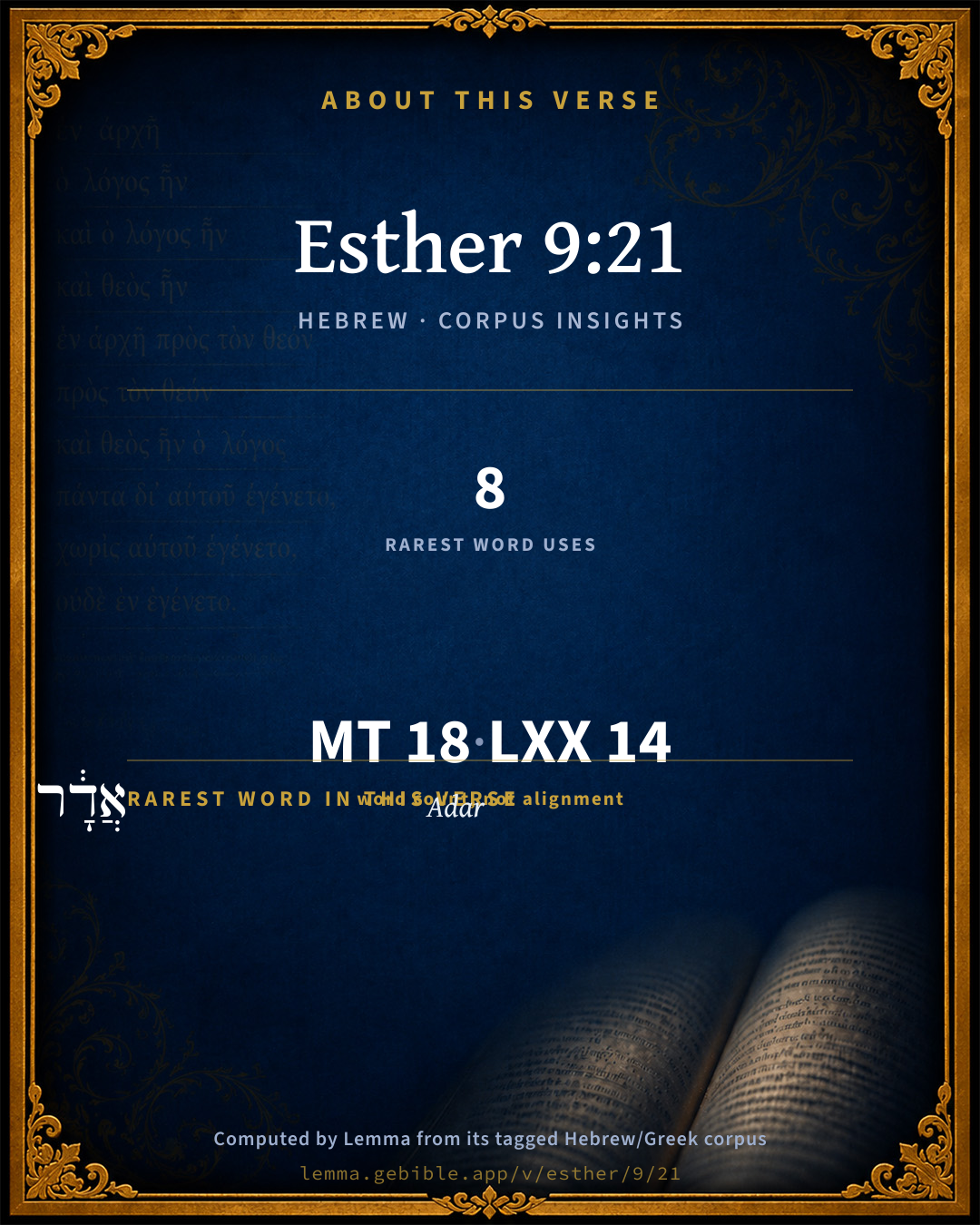
18
words
13
distinct lemmas
Historical
section

Notable vocabulary

The rarest word here is אֲדָ֔ר Adar H143 — appearing just 8 times in the whole Hebrew Bible.

Shared distinctive vocabulary

אֲדָ֔ר Adar H143 occurs in 8 verses of the Hebrew Bible. Also found in:

Grammatical profile

  • 3 verbs
  • 7 nouns
  • 4 adjectives
  • 2 prepositions
  • 2 particles

Verb forms

  • לְקַיֵּם֮ Piel · Infinitive Construct
  • לִהְי֣וֹת Qal · Infinitive Construct
  • עֹשִׂ֗ים Qal · Participle Active

Repetition

Words recur within this verse — often emphatic in Hebrew:

  • י֣וֹם day H3117 ×2
  • עָשָׂר֙ teen H6240 ×2
  • שָׁנָ֖ה year H8141 ×2

Hebrew & Septuagint length

In English translation the verse runs 22 words from the Hebrew and 15 from the Septuagint (LXX English) — the Septuagint runs noticeably shorter here. See the side-by-side →

A rough comparison of the two English renderings, which tokenize alike — not a word-level alignment.

Word counts can differ between the Hebrew and the Greek without any difference in meaning — e.g. the Hebrew direct-object marker אֵת has no separate Greek word, and Greek often adds the article ὁ.

In the original languages it is 18 Hebrew tokens and 14 Greek tokens — but the two are counted differently (Hebrew bundles its prefixes and suffixes into one token; the Greek is in lemma form), so that isn’t a like-for-like length.

Hebrew and Greek witnesses Masoretic Hebrew ↔ Greek Septuagint

The same verse in the two great witnesses to the Old Testament, shown verse-for-verse.

Here the Septuagint runs noticeably shorter than the Hebrew — LXX2012 (modern English Septuagint) 15 words vs World English Bible 22. A rough length comparison of the two English translations, not a word-level alignment — read both below.

These are two independent witnesses, not word-aligned to each other, and the Septuagint is shown in lemma (dictionary) form.

Hebrew Esther 9:21 Masoretic · Westminster Leningrad Codex

לְקַיֵּם֮ עֲלֵיהֶם֒ לִהְי֣וֹת עֹשִׂ֗ים אֵ֠ת י֣וֹם אַרְבָּעָ֤ה עָשָׂר֙ לְחֹ֣דֶשׁ אֲדָ֔ר וְאֵ֛ת יוֹם חֲמִשָּׁ֥ה עָשָׂ֖ר בּ֑וֹ בְּכָל שָׁנָ֖ה וְשָׁנָֽה

to enjoin those who they should keep the fourteenth day of the month Adar, and the fifteenth day of the same, yearly,

World English Bible · Public Domain

Greek LXX Esther 9:21 Septuagint · lemma form

ἵστημι ὁ ἡμέρα οὗτος ἀγαθός ἄγω τε ὁ οςτεσσαρεσκαιδέκατ καί ὁ πεντεκαιδέκατος ὁ αδαρ

to establish these as joyful days, and to keep the fourteenth and fifteenth of Adar;

LXX2012 (modern English Septuagint) · Public Domain

Hebrew: Westminster Leningrad Codex (CC BY 4.0). Greek: Septuagint (public domain); English from LXX2012 (modern English Septuagint) (Public Domain). How the Septuagint differs from the Hebrew →

Commentary

Notes on Esther 9:21 from classic Christian and Jewish commentators (each source and its license shown beneath its notes). The classic Christian expositions comment on the surrounding passage and are grouped to its opening verse, so a note may address several verses; the Jewish commentaries on the Tanakh (Rashi and others) are per-verse, so they appear only where the commentator wrote on this verse.

Lemma curates 59 commentaries, every one of them public domain or Creative Commons licensed, each selected and text-cleaned for this edition rather than reprinted as found. About our sources →

Trapp's Complete Commentary

John Trapp

Est 9:21 To stablish [this] among them, that they should keep the fourteenth day of the month Adar, and the fifteenth day of the same, yearly,

Ver. 21. To establish this among them] sc. By a law, that they should yearly on those two days rest, and repeat among themselves that signal deliverance, propagating the remembrance of it to all posterity. Mordecai well knew that eaten bread is soon forgotten, that deliverances are usually but nine days’ wonderment, that it is easy and ordinary with people to rob God and wrong themselves by their unthankfulness, which forfeiteth former mercies and forestalleth future, he therefore settleth it upon them, saith the text, statuendo eis ut facerent, he exacteth it of them by virtue of his office.

That they should keep the fourteenth day, and the fifteenth day] Both days, nam gaudet produci haec solennitas, for he rejoices to promote these feasts, as Austin said of the feast of Pentecost, such a solemnity should be drawn out to the full length, as the silkworm stretcheth forth herself before she spinneth her finest thread. Jehoshaphat and his people showed themselves unsatisfiable in their praises, which they presented again and again, 2Ch 20:26-27. And good Hezekiah, when he observed in his subjects such a float of affections at the passover, and that they were in so good a frame, took counsel with them to keep other seven days, and they kept other seven days with gladness, 2Ch 30:21-23. See with what a flood of words holy David poureth forth his soul in prayer, Psa 145:1-8, as if therewith he would even fill up the distance between God and himself. Sometimes he seemeth to forget himself in point of praising God; for he will, like a bird, having got a note, record it over and over, as Psa 136:1-26. And in the last psalm there are but six verses yet twelve hallelujahs. He concludeth, Let everything that hath breath, or, Let every breath praise the Lord, let it be as the smoke of the tabernacle, when peace offerings were offered. Tam Dei meminisse opus est quam respirare, saith Chrysostom, We have as much need to remember God as to take breath.

John Trapp, A Commentary or Exposition upon All the Books of the Old and New Testament (1647–1656) — public domain. Text from a community e-Sword module.

Joseph Benson's Commentary

Est 9:21. To establish this — to keep the fourteenth day, and the fifteenth day of the month Adar — The twelfth month; just a month before the passover. Thus the first and the last month of the year were kept in remembrance of the days when God preserved them. They were enjoined to keep two days together, because both those days had been set apart this year, the latter at Shushan, and the former in other parts; and because that victory over their enemies, which was to be the ground of this festival, had been achieved on both the thirteenth and fourteenth days. Let us not be niggardly in our returns of praise to him, who bestows his favours so liberally upon us.

Joseph Benson's Commentary on the Old and New Testaments (1811–1818) — public domain. Text from a community e-Sword module.

Ellicott's Commentary for English Readers

(21) And the fifteenth day of the same.—The Jews in the provinces had already made the fourteenth day a day of gladness and feasting. Mordecai now bids that the fifteenth also be so kept.

A Bible Commentary for English Readers, edited by Charles John Ellicott (1878–1897) — public domain. Text from a community e-Sword module.

John Gill's Exposition

And the Jews undertook to do as they had begun, and as Mordecai had written unto them. They engaged to keep these two days as festivals annually, as they had at this time done; not in a religious but in a civil way, not as parts of religious worship, and as additions to and innovations of the law, but by way of commemoration of a civil benefit which they had received; and yet we find in later times that this was scrupled by some as an innovation; for we are told (r) that there were eighty five elders, and more than thirty of them prophets, who were distressed about this matter, fearing it was an innovation.

(r) T. Hieros. Megillah. fol. 70. 4.

John Gill's Exposition of the Whole Bible (1746–1763) — public domain (CC PDM 1.0). Text via the HelloAO Bible API.

Haydock's Catholic Bible Commentary

Receive. Protestants, "establish this among them, that they should keep the 14th....yearly," 2 Machabees xv. 37. (Haydock) --- None were obliged to keep more than one of these days, according to their respective dwellings. The 14th was for the provinces, the 15th for the Jews of Susan, ver. 18. (Tirinus) (Calmet) (Worthington) --- Yet it would seem that both days were enjoined, ver. 27, 28. (Haydock) --- The Jews still observe, them, as they gratify their vanity and vindictive spirit. The 13th is kept a rigid fast, for all above sixteen, for twenty-four hours, during which they eat nothing. (Calmet) --- If that day should be a sabbath, or its eve, they fast on the 11th or 12th. (Drusius) --- The day before the festival they give alms to their poor brethren, enjoining them to consume the whole in making good cheer. Each person must then contribute the half sicle, (Exodus xxx. 13.) which is bestowed on those who undertake a pilgrimage to the land of promise. At night, when the feast commences, they light the lamps, and begin to read the Book of Esther, as soon as the stars appear. They use an old parchment manuscript roll, and, in the five places, the reader shouts with all his might, running over the names of the ten sons of Aman with all haste, to shew that they all died in a moment. Whenever Aman is mentioned, the children beat the benches with mallets; and formerly they used to strike at a stone, on which his name was cut, till it broke, ver. 31. After the lecture, they take a repast at home. Early the next morning they return to the synagogue, and read the account of Amalec from the Pentateuch, and repeat the Book of Esther, with the aforesaid ceremonies. The rest of the day they spend in merriment. Their teachers allow them to drink till they are unable to distinguish the name of Aman from that of Mardochai. (Basnage, vi. 15.) --- They also change clothes, in contradiction to the law; (Deuteronomy xxii. 5.) and were formerly accustomed to crucify a man of straw, which they burnt with the cross, till Christian emperors put a stop to them; as it was concluded, from their curses, &c., that they had an eye to our Saviour. (Calmet) See chap. v. 14. (Haydock)

George Leo Haydock (1774–1849), Haydock's Catholic Family Bible and Commentary, 1859 edition — public domain. Excludes Psalms (Douay-Rheims chapter numbering differs from Protestant) and Deuterocanonical books (Catholic canon only).

Matthew Poole's English Annotations

Because both these days had been set apart this year, the latter at Shushan, the former in other parts; and because that great work of God, which was the ground of this solemnity, had been done both upon the thirteenth and the fourteenth day.

Matthew Poole's English Annotations on the Holy Bible (1683–1685) — public domain. Text from a community e-Sword/MySword module.

Whedon's Commentary on the Bible

Daniel D. Whedon

21. To establish this among them — That is, to establish or appoint the fourteenth and fifteenth days of Adar as an annual feast of joy and gladness.

Daniel D. Whedon (gen. ed.), Commentary on the Old and New Testaments (1874–1909) — public domain. Text from a community e-Sword module.

The Pulpit Commentary

To stablish. i.e. "with a view to establishing not actually doing so.

Vers. 21, 27, 28, 31.

The religion of national gratitude.

Mordecai and Esther were not the people to receive great blessings and then at once to forget them. We not unfrequently see those who have had hair-breadth escapes from the worst of calamities recover in a moment their previous light and jaunty spirits. They seem insensible to the risk which had so imperilled them, and certainly are not grateful for the mercy which had rescued them. They do not return either to give thanks to man or glory to God. It is far otherwise now with Mordecai, with Esther, and, at their initiative, with the mass of the people. Wherever Mordecai had sent to his people the messages of relief and the warrants to resist, there he now sends proposals which, if acceded to, will insure the perpetual memory of their deliverance, and will suggest ever new gratefulness for it. Esther joins heart and hand in the same, and the people themselves warmly approve the suggestion. They solemnly and enthusiastically adopt the proposal. They "undertook to do as they had begun, and as Mordecai had written to them." The method of observing an anniversary to all generations is accepted as the means by which "the memorial" of their deliverance "shall never perish" from them or "their seed." It is evident that a deep religious interest was thrown into this matter, and the account of it is repeated as many as four times, and with minuteness of detail. The example is good for individuals. The precedent is good for nations. We have here

I A LEADING INSTANCE OF NATIONAL GRATITUDE. There is great danger of the fit occasions of national gratitude passing by unimproved. This may often arise simply from the fact that "what is every one"s business is no one"s." The danger needs to be counteracted, and sometimes it is effectually counteracted. Three conditions present, will exhibit, the fair and happy display of national gratitude.

1. The benefit must be in its character such as reaches the heart. Whethercheap bread, cheap health, or cheap Bible; whether free laws, free knowledge, or free conscience, it must be what is adapted to all, and can be appreciated by all. The blessing called life had perhaps never been considered in this light by the Jews till they were so near to losing it. But it was what every one of them, young and old, and of every class, appreciated.

2. The benefit must be such as has reached, either directly or indirectly,every class of the people. In highly-developed communities it should form part of the self-imposed work of all kinds of public and religious teachers to show the value of benefits which may be only indirect, and how they claim gratitude. In the present instance, the benefit for which such gladness and joy had sprung up had penetrated not only to every class, but to every individual.

3. The call to celebrate the benefit must be made so as to win the heartyapproval and co-operation of the people. The moral influence of Mordecai and Esther was evidently very great. Their own example, their own deep interest in the course suggested, was contagious. The urgency with which they wrote helped to throw conviction of duty and enthusiasm toward its performance into the hearts of all the people. God never loves a cheerful giver more than when the cheerful giving is in very simple matters that of thanks, or praise, or grateful adoration presented to himself.

II A SOLEMN RESOLUTION FOR THE PERPETUATION OF NATIONAL GRATITUDE. Much kindly feeling passes away for want of embodiment. It dies down within, and there comes "no second spring" for it. Certainly gratitude is liable soon to die away. The most solemn claim of affection that the world knows is couched in the language of the claim of gratitude: "Do this in remembrance of me." In this perpetuation of national thanksgiving we may notice

1. The wise method by which it was obtained.

(1) The happy moment was seized by the moral leaders of the people for giving a religious character to the joy that already possessed them.

Mordecai made use of the excited state of feeling to say, Let it take the direction of thanksgiving.

(2) The right moment was seized, when the "willing mind" of a whole people would be inclined to make a day into an anniversary ever to be observed. After the people had once pronounced assent, as it were with one voice, and their chief men had put their hand to the engagement, they would not be likely to turn back. The resolution of that critical time has lasted and has borne fruit now over twenty-three centuries.

2. The good ends which it would serve. Love and thankfulness, and praiseand gratitude, are all alike in one respect, that they ask no utilitarian questions. Their motive lies in themselves. And probably it was never more so than in this history. Yet we are permitted to observe the many directions in which they bear good fruit. The perpetuation of national thanksgiving on the right occasion that is to say, not after every bloody battle, to which the Lord never sent forth his people; and in the right methodi.e. not in such a way as will gratuitously wound the feeling of another nation, is adapted to produce great and good results.

(1) The acknowledgment is a direct act of glorifying God.

(2) It keeps him in the memory of the people as the Giver of all good, as the Sovereign Ruler and the beneficent Friend.

(3) It reminds again and again of the need once felt so keenly, of the poverty once so trying, of the exceeding peril which once threatened, of the boundless relief once experienced. God"s people were bidden to remember how "they were bondsmen in Egypt," to "look to the rock whence they were hewn, and to the hole of the pit whence they were digged." And these are the memories that chastise the pride of the human heart, and raise the tone and level of the character, and lead gradually nearer real safety and real prosperity. They are also the memories which for the future guide to the right source of confidence and of help. Of whatever advantage we know these things to be in any individual life, the advantage is one immensely multiplied in the case of a nation multiplied, that is, by the whole number of those who go together to compose it. B.

The Pulpit Commentary (1880–1919), ed. H.D.M. Spence-Jones & Joseph S. Exell — public domain. Text from a community e-Sword module.

Lesson kit

Teaching starters — assembled from the data on this page, not authored interpretation. Every prompt links to the verse data it draws on. Edit before teaching.

Esther, in the Historical, opens this verse with 18 words (13 distinct Hebrew lemmas). Its most distinctive word is ʼĂdâr (“Adar”). The Greek Septuagint runs shorter here. A historical commentator’s framing appears above. Read the whole chapter for the surrounding context.

Discussion questions

  1. How does “Adar” (ʼĂdâr) shape what this verse is saying?
  2. How does Esther 3:7, which shares the word «Adar», read alongside this verse?
  3. What does the repetition of “day” (2× in this one verse) do in this verse?
  4. The Septuagint runs shorter here than the Hebrew. What might account for the difference?
  5. The translations on this page render this verse differently — a whole-verse word diff, not a word-by-word alignment. What might account for the different wordings?
  6. «לְקַיֵּם֮» is a Piel Infinitive Construct verb. How does that grammatical form shape the action described?
  7. Compare how Trapp's Complete Commentary and Joseph Benson's Commentary read this verse. Where do they agree or differ?

Things to notice

Reading settings

Reading text

Shown beneath each verse's original-language words.

Old Testament
Old Testament edition

Read the OT as the Masoretic Hebrew (MT) or the Greek Septuagint (LXX).

English shown for the Greek Septuagint (in the Hebrew ↔ Greek comparison).

Comparing translations? Open the Compare panel on any verse page to stack up to four side by side.