
2 Chronicles 32:31

Hebrew (Westminster Leningrad Codex) 2 Chronicles 32:31 appears in the Hebrew Old Testament. The text above is from the Westminster Leningrad Codex. Each word links to its Strong’s number, a concise gloss, and parsing drawn from the Open Scriptures Hebrew Bible morphology. Click any word for its full Brown-Driver-Briggs (BDB) entry.
Download image
Cite this verse

2 Chronicles 32:31 (World English Bible). Public Domain. Lemma interlinear Bible study tool, https://lemma.gebible.app/v/2-chronicles/32/31.

Show BibTeX & RIS
BibTeX
RIS
English Translation
However in [the business of] the ambassadors of the princes of Babylon, who sent to him to inquire of the wonder that was done in the land, God left him, to try him, that he might know all that was in his heart.
World English Bible · Public Domain
Download a study sheet

One document with this verse’s original text, its word-by-word gloss line, the meaning frame, cross-references with their text, attributed commentary, and full source and license credits — printable, and it pastes into notes with its structure intact.

This verse Autodidact and up

Study sheet (.html) Plain text (.txt)

A passage Seminary Student

Up to 50 verses in one chapter. A passage sheet keeps up to 6 commentary sources and 12 cross-references per verse, in the order this page ranks them, and says so on the sheet whenever that leaves anything out. Ask for a single verse and you get the Autodidact verse sheet above.

Everything on this page stays free to read, with no account — the sheet is a download of what is already on screen, not access to it.

Want to remove ads? Support Godless Engineer
Compare translations 3

The same verse in 3 English versions, stacked beneath the original-language interlinear above. Click any original word for its lexicon entry.

Each is an independent rendering of the whole verse — the interlinear is not word-aligned to these translations.

Highlighted words mark where these versions differ — a whole-verse word diff, not a word-by-word alignment.

  • World English Bible Public Domain
    However in [the business of] the ambassadors of the princes of Babylon, who sent to him to inquire of the wonder that was done in the land, God left him, to try him, that he might know all that was in his heart.
  • King James Version Public Domain
    Howbeit in the business of the ambassadors of the princes of Babylon, who sent unto him to enquire of the wonder that was done in the land, God left him, to try him, that he might know all that was in his heart.
  • unfoldingWord Literal Text CC BY-SA 4.0
    And thus, when the envoys of the chiefs of Babylon sent to him to seek the sign that was in the land, God left him to test him, to know all in his heart.

unfoldingWord Literal Text — © unfoldingWord, licensed CC BY-SA 4.0. Word-aligned USFM3 via Door43 (git.door43.org/unfoldingWord/en_ult).

Versions to compare (up to 4)

3 of 4 selected

Show all 18 translations

Every available English version of this verse, each an independent rendering of the whole verse.

  • World English Bible Public Domain
    However in [the business of] the ambassadors of the princes of Babylon, who sent to him to inquire of the wonder that was done in the land, God left him, to try him, that he might know all that was in his heart.
  • Berean Standard Bible Public Domain
    And so when ambassadors of the rulers of Babylon were sent to him to inquire about the wonder that had happened in the land, God left him alone to test him, that He might know all that was in Hezekiah’s heart.
  • Majority Standard Bible Public Domain
    And so when ambassadors of the rulers of Babylon were sent to him to inquire about the wonder that had happened in the land, God left him alone to test him, that He might know all that was in Hezekiah’s heart.
  • King James Version Public Domain
    Howbeit in the business of the ambassadors of the princes of Babylon, who sent unto him to enquire of the wonder that was done in the land, God left him, to try him, that he might know all that was in his heart.
  • American Standard Version (1901) Public Domain
    Howbeit in `the business of' the ambassadors of the princes of Babylon, who sent unto him to inquire of the wonder that was done in the land, God left him, to try him, that he might know all that was in his heart.
  • Revised Version (1885) Public Domain
    Howbeit in the business of the ambassadors of the princes of Babylon, who sent unto him to inquire of the wonder that was done in the land, God left him, to try him, that he might know all that was in his heart.
  • Geneva Bible (1599) Public Domain
    But because of the ambassadours of the princes of Babel, which sent vnto him to enquire of the wonder that was done in the lande, God left him to trie him, and to knowe all that was in his heart.
  • Douay-Rheims (1899) Public Domain
    But yet in the embassy of the princes of Babylon, that were sent to him, to inquire of the wonder that had happened upon the earth, God left him that he might be tempted, and all things might be made known that were in his heart.
  • Young's Literal Translation Public Domain
    and so with the ambassadors of the heads of Babylon, those sending unto him to inquire of the wonder that hath been in the land, God hath left him to try him, to know all in his heart,
  • Literal Standard Version CC BY-SA 4.0
    and so with the ambassadors of the heads of Babylon, those sending to him to inquire of the wonder that has been in the land, God has left him to try him, to know all in his heart.
  • Unlocked Literal Bible CC BY-SA 4.0
    However, in the matter of the ambassadors of the princes of Babylon, who sent to him to ask questions of those who knew, about the miraculous sign that had been done in the land, God left him to himself, in order to test him, and to know all that was in his heart.
  • unfoldingWord Literal Text CC BY-SA 4.0
    And thus, when the envoys of the chiefs of Babylon sent to him to seek the sign that was in the land, God left him to test him, to know all in his heart.
  • Darby Bible Public Domain
    However in [the matter of] the ambassadors of the princes of Babylon, who sent to him to inquire of the wonder that was done in the land, God left him, to try him, that he might know all [that was] in his heart.
  • World Messianic Bible Public Domain
    However, concerning the ambassadors of the princes of Babylon, who sent to him to inquire of the wonder that was done in the land, God left him to test him, that he might know all that was in his heart.
  • Webster's Bible Public Domain
    But, in the business of the embassadors of the princes of Babylon, who sent to him to inquire of the wonder that was done in the land, God left him, to try him, that he might know all that was in his heart.
  • Free Bible Version CC BY-SA 4.0
    But when ambassadors of the rulers of Babylon came to him to ask about the miraculous sign that had happened in the country, God left him to test him, so he could know Hezekiah's true thinking.
  • Bible in Basic English Public Domain
    However, in the business of the representatives sent by the rulers of Babylon to get news of the wonder which had taken place in the land, God gave up guiding him, testing him to see what was in his heart.
  • JPS Tanakh (1917) Public Domain
    Howbeit in the business of the ambassadors of the princes of Babylon, who sent unto him to inquire of the wonder that was done in the land, God left him, to try him, that He might know all that was in his heart.

Literal Standard Version (2020), Covenant Press — licensed CC BY-SA 4.0. Text via the HelloAO Bible API (eBible.org). Unlocked Literal Bible (unfoldingWord) — licensed CC BY-SA 4.0. Text via the HelloAO Bible API (eBible.org). unfoldingWord Literal Text — © unfoldingWord, licensed CC BY-SA 4.0. Word-aligned USFM3 via Door43 (git.door43.org/unfoldingWord/en_ult). Free Bible Version, Dr. Jonathan Gallagher — licensed CC BY-SA 4.0. Text via the HelloAO Bible API (eBible.org).

Word by word

More ways to search: Search by grammar → Find every occurrence → Compare this word →

Practice this passage: Drill this verse → Learn its vocabulary →

בִּמְלִיצֵ֣י
lûwts
H3887
“in/at · scorning”
Preposition + Verb, Hiphil, Participle Active, Masculine, Plural, Construct
Part of Speech
Preposition + Verb
Stem
Hiphil
Form
Participle Active
Gender
Masculine
Number
Plural
State
Construct
Full BDB Definition

Origin: a primitive root

TWOT: 1113

to scorn, make mouths at, talk arrogantly - (Qal) - to boast - to scorn - (Hiphil) - to mock, deride - to interpret (language) - interpreter (participle) - ambassador (figuratively) - (Hithpalpel) to be inflated, scoff, act as a scorner, show oneself a mocker
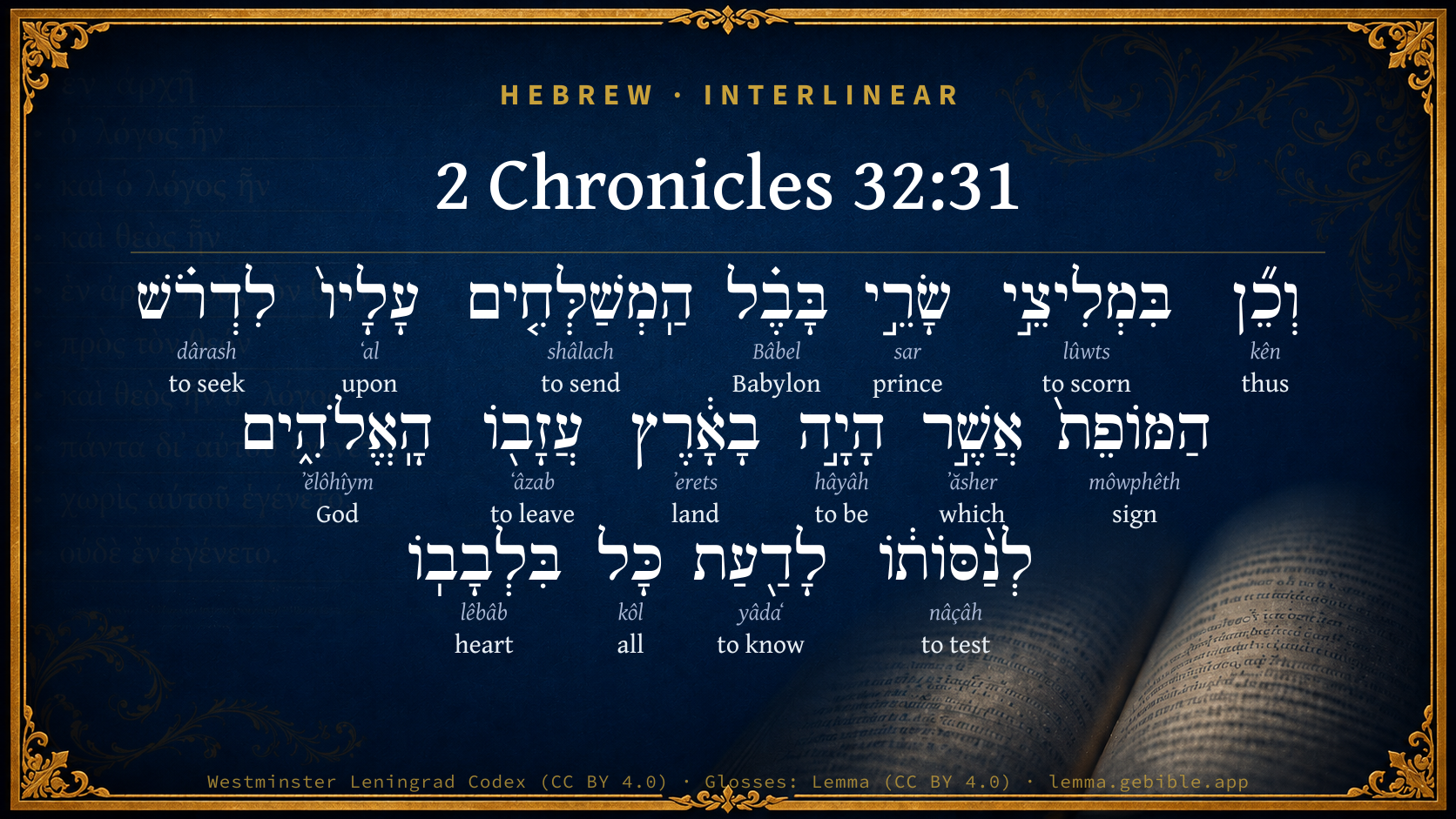
  1. וְכֵ֞ן kên H3651 “and · thus” Conjunction + Particle, Demonstrative
  2. שָׂרֵ֣י sar H8269 “princes of” Noun, Common, Masculine, Plural, Construct
  3. בָּבֶ֗ל Bâbel H894 “Babylon” Noun, Proper
  4. הַֽמְשַׁלְּחִ֤ים shâlach H7971 “the · sending” Particle, Definite Article + Verb, Piel, Participle Active, Masculine, Plural, Absolute
  5. עָלָיו֙ ʻal H5921 “upon · him” Preposition + Suffix, Personal, 3rd Person, Masculine, Singular
  6. לִדְרֹ֗שׁ dârash H1875 “to seek” Preposition + Verb, Qal, Infinitive Construct
  7. הַמּוֹפֵת֙ môwphêth H4159 “the · sign” Particle, Definite Article + Noun, Common, Masculine, Singular, Absolute
  8. אֲשֶׁ֣ר ʼăsher H834 “which” Particle, Relative
  9. הָיָ֣ה hâyâh H1961 “to be” Verb, Qal, Perfect, 3rd Person, Masculine, Singular
  10. בָאָ֔רֶץ ʼerets H776 “in/at the · land” Preposition, Determined + Noun, Common, Both, Singular, Absolute
  11. עֲזָב֖וֹ ʻâzab H5800 “to leave · him” Verb, Qal, Perfect, 3rd Person, Masculine, Singular + Suffix, Personal, 3rd Person, Masculine, Singular
  12. הָֽאֱלֹהִ֑ים ʼĕlôhîym H430 “the · God(s)” Particle, Definite Article + Noun, Common, Masculine, Plural, Absolute
  13. לְנַ֨סּוֹת֔וֹ nâçâh H5254 “to test · him” Preposition + Verb, Piel, Infinitive Construct + Suffix, Personal, 3rd Person, Masculine, Singular
  14. לָדַ֖עַת yâdaʻ H3045 “to know” Preposition + Verb, Qal, Infinitive Construct
  15. כָּל kôl H3605 “all of” Noun, Common, Masculine, Singular, Construct
  16. בִּלְבָבֽוֹ lêbâb H3824 “in/at · heart · his” Preposition + Noun, Common, Masculine, Singular, Construct + Suffix, Personal, 3rd Person, Masculine, Singular

About this verse

These counts appear in no published source. They are computed here, from the morphology-tagged text and Lemma’s own curated glosses. What Lemma adds →

17
words
17
distinct lemmas
Historical
section

Shared distinctive vocabulary

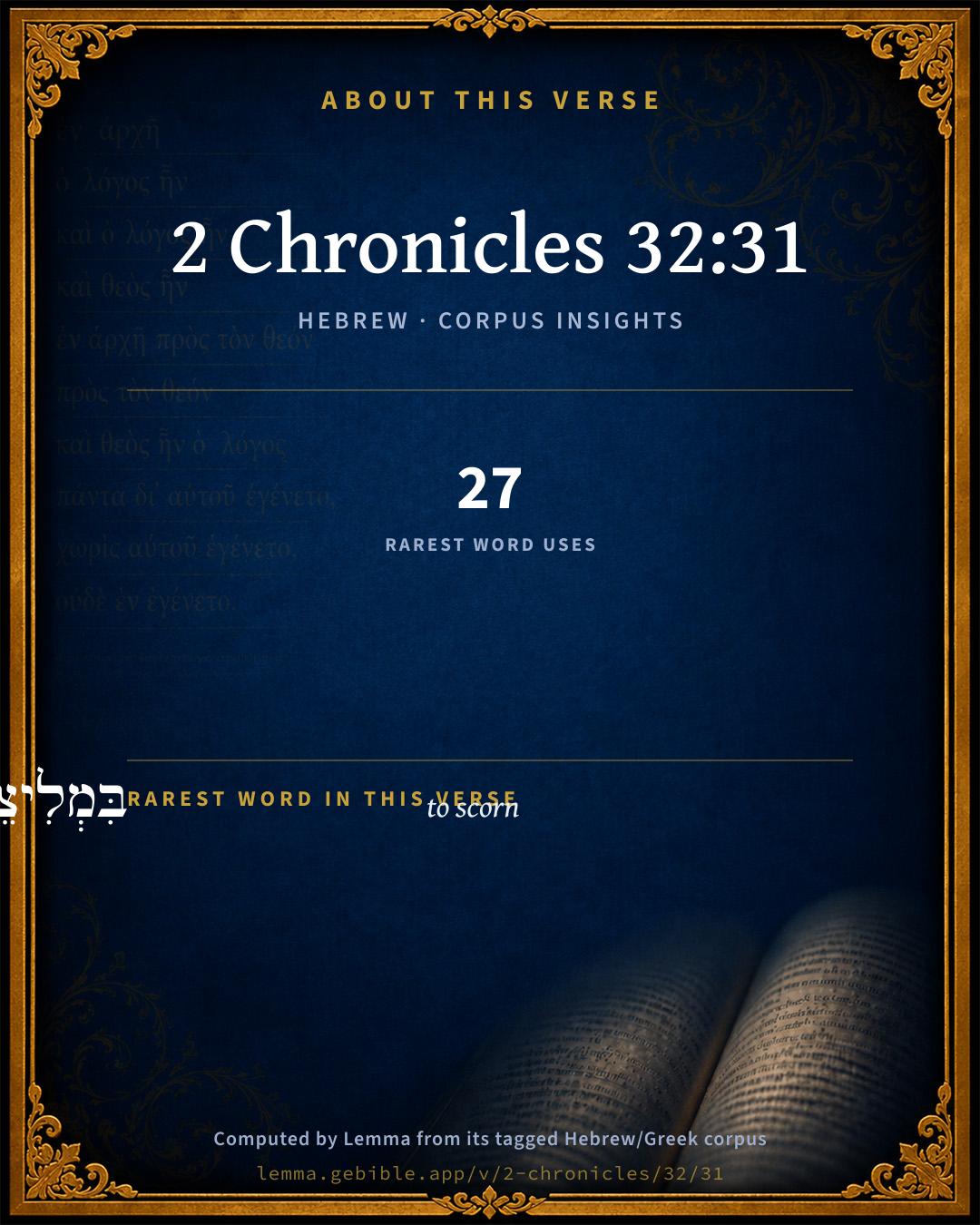
בִּמְלִיצֵ֣י to scorn H3887 occurs in 26 verses of the Hebrew Bible. Also found in:

Grammatical profile

  • 7 verbs
  • 7 nouns
  • 1 preposition
  • 2 particles

Verb forms

  • בִּמְלִיצֵ֣י Hiphil · Participle Active
  • הַֽמְשַׁלְּחִ֤ים Piel · Participle Active
  • לִדְרֹ֗שׁ Qal · Infinitive Construct
  • הָיָ֣ה Qal · Perfect
  • עֲזָב֖וֹ Qal · Perfect
  • לְנַ֨סּוֹת֔וֹ Piel · Infinitive Construct
  • לָדַ֖עַת Qal · Infinitive Construct

Hebrew & Septuagint length

In English translation the verse runs 43 words from the Hebrew and 42 from the Septuagint (LXX English) — closely comparable.

A rough comparison of the two English renderings, which tokenize alike — not a word-level alignment.

Word counts can differ between the Hebrew and the Greek without any difference in meaning — e.g. the Hebrew direct-object marker אֵת has no separate Greek word, and Greek often adds the article ὁ.

Cross-references

22

Topical passages linked to 2 Chronicles 32:31 in the Treasury of Scripture Knowledge — connected by theme and wording, ordered by reader-vote popularity; previews shown in the World English Bible.

  • Deuteronomy 8:2 You shall remember all the way which Yahweh your God has led you these forty years in the wilderness, that he might humble you, to prove you, to know what was in your heart, whether you would keep his commandments, or not.
  • Proverbs 17:3 The refining pot is for silver, and the furnace for gold, But Yahweh tests the hearts.
  • John 15:5 I am the vine. You are the branches. He who remains in me, and I in him, the same bears much fruit, for apart from me you can do nothing.
  • Genesis 22:1 It happened after these things, that God tested Abraham, and said to him, "Abraham!" He said, "Here I am."
  • 2 Chronicles 32:24 In those days Hezekiah was sick even to death: and he prayed to Yahweh; and he spoke to him, and gave him a sign.
  • Deuteronomy 8:16 who fed you in the wilderness with manna, which your fathers didn't know; that he might humble you, and that he might prove you, to do you good at your latter end:
  • Zechariah 13:9 I will bring the third part into the fire, And will refine them as silver is refined, And will test them like gold is tested. They will call on my name, and I will hear them. I will say, 'It is my people;' And they will say, 'Yahweh is my God.'"
  • Job 1:11–12 But put forth your hand now, and touch all that he has, and he will renounce you to your face."
  • Psalms 139:1–2 Yahweh, you have searched me, And you know me.
  • Isaiah 39:1–8 At that time Merodach Baladan the son of Baladan, king of Babylon, sent letters and a present to Hezekiah; for he heard that he had been sick, and was recovered.
  • Malachi 3:2–3 "But who can endure the day of his coming? And who will stand when he appears? For he is like a refiner's fire, and like launderer's soap;
  • James 1:13 Let no man say when he is tempted, "I am tempted by God," for God can't be tempted by evil, and he himself tempts no one.
  • Deuteronomy 13:3 you shall not listen to the words of that prophet, or to that dreamer of dreams: for Yahweh your God proves you, to know whether you love Yahweh your God with all your heart and with all your soul.
  • Judges 16:20 She said, The Philistines are on you, Samson. He awoke out of his sleep, and said, I will go out as at other times, and shake myself free. But he didn't know that Yahweh had departed from him.
  • 2 Kings 20:8–13 Hezekiah said to Isaiah, What shall be the sign that Yahweh will heal me, and that I shall go up to the house of Yahweh the third day?
  • Job 2:3–6 Yahweh said to Satan, "Have you considered my servant Job? For there is none like him in the earth, a blameless and an upright man, one who fears God, and turns away from evil. He still maintains his integrity, although you incited me against him, to ruin him without cause."
  • Psalms 51:11–12 Don't throw me from your presence, And don't take your holy Spirit from me.
  • Psalms 119:116–117 Uphold me according to your word, that I may live. Let me not be ashamed of my hope.
  • Isaiah 38:7–8 This shall be the sign to you from Yahweh, that Yahweh will do this thing that he has spoken:
  • 1 Peter 1:7 that the proof of your faith, which is more precious than gold that perishes even though it is tested by fire, may be found to result in praise, glory, and honor at the revelation of Jesus Christ--
  • Psalms 27:9 Don't hide your face from me. Don't put your servant away in anger. You have been my help. Don't abandon me, Neither forsake me, God of my salvation.
  • Psalms 139:23–24 Search me, God, and know my heart. Try me, and know my thoughts.

Cross-references courtesy of OpenBible.info (CC BY 4.0).

Hebrew and Greek witnesses Masoretic Hebrew ↔ Greek Septuagint

The same verse in the two great witnesses to the Old Testament, shown verse-for-verse.

These are two independent witnesses, not word-aligned to each other, and the Septuagint is shown in lemma (dictionary) form.

Hebrew 2 Chronicles 32:31 Masoretic · Westminster Leningrad Codex

וְכֵ֞ן בִּמְלִיצֵ֣י שָׂרֵ֣י בָּבֶ֗ל הַֽמְשַׁלְּחִ֤ים עָלָיו֙ לִדְרֹ֗שׁ הַמּוֹפֵת֙ אֲשֶׁ֣ר הָיָ֣ה בָאָ֔רֶץ עֲזָב֖וֹ הָֽאֱלֹהִ֑ים לְנַ֨סּוֹת֔וֹ לָדַ֖עַת כָּל בִּלְבָבֽוֹ

However in [the business of] the ambassadors of the princes of Babylon, who sent to him to inquire of the wonder that was done in the land, God left him, to try him, that he might know all that was in his heart.

World English Bible · Public Domain

Greek LXX 2 Chronicles 32:31 Septuagint · lemma form

καί οὕτως ὁ πρεσβευτής ὁ ἄρχων ἀπό βαβυλών ὁ ἀποστέλλω πρός αὐτός πυνθάνομαι παρά αὐτός ὁ τέρας ὅς γίγνομαι ἐπί ὁ γῆ καί ἐν καταλείπω αὐτός κύριος ὁ πειράζω αὐτός οἶδα ὁ ἐν ὁ καρδία αὐτός

Notwithstanding, in regard to the ambassadors of the princes of Babylon, who were sent to him to enquire of him concerning the prodigy which came upon the land, the Lord left him, to try him, to know what was in his heart.

LXX2012 (modern English Septuagint) · Public Domain

Hebrew: Westminster Leningrad Codex (CC BY 4.0). Greek: Septuagint (public domain); English from LXX2012 (modern English Septuagint) (Public Domain). How the Septuagint differs from the Hebrew →

Commentary

Notes on 2 Chronicles 32:31 from classic Christian and Jewish commentators (each source and its license shown beneath its notes). The classic Christian expositions comment on the surrounding passage and are grouped to its opening verse, so a note may address several verses; the Jewish commentaries on the Tanakh (Rashi and others) are per-verse, so they appear only where the commentator wrote on this verse.

Lemma curates 59 commentaries, every one of them public domain or Creative Commons licensed, each selected and text-cleaned for this edition rather than reprinted as found. About our sources →

Trapp's Complete Commentary

John Trapp

2Ch 32:31 Howbeit in [the business of] the ambassadors of the princes of Babylon, who sent unto him to enquire of the wonder that was [done] in the land, God left him, to try him, that he might know all [that was] in his heart.

Ver. 31. Howbeit in the business of the ambassadors.] See 2Ki 20:12-14.

God left him, to try him.] As he oft doth his best children, {Gen 22:1 Job 1:12; Job 2:3; Job 2:6} but forsaketh them not utterly. {Psa 119:8} The humility that Hezekiah showed when the prophet admonished him, and his perseverance in piety, do show that God never quite deprived him of his grace: only sivit eum agere ex affectu suo, he let him, for this once, do as he would, not strengthening him by his Spirit in this temptation of worldly ambition, that he might discover him to himself and to others; for that a man is, that he is in a temptation. Satan can work but according to the matter he findeth in us. The wind addeth no water to the sea, only can make the waves to rise and surge. The fire addeth nothing to the water when it is set upon it, but attenuateth it only, and causeth it to boil, &c.

John Trapp, A Commentary or Exposition upon All the Books of the Old and New Testament (1647–1656) — public domain. Text from a community e-Sword module.

The Biblical Illustrator

Joseph S. Exell

2Ch_32:31

God left him to try him, that he might know all that was in his heart.

Hezekiahs fall considered and applied

I. Hezekiahs sin.

1. Its nature.

(1) All sin originates in the heart. Hezekiahs sin did not, like that of David, break forth into gross and external violations of the Divine law, but it betrayed itself in the indulgence of secret pride, in the gratification of a vainglorious spirit, in an idolatrous exaltation of the creature above the Creator. His heart was lifted up.

(2) The particular nature of his sin will be more clearly discerned, if we advert to the occasion of his fall (2Ki_20:13).

(a) He was actuated by a wrong spirit.

(b) His action had a wrong tendency.

It was calculated to erase every serious impression which a recital of the wonder done in the land might have made on these heathen strangers. It was also calculated to confirm them in the conviction that the kings of Judah, notwithstanding their superior pretensions to the knowledge and favour of the true God, in reality neither possessed nor avowed any better source of protection and prosperity than the kings of other nations enjoyed.

2. Its aggravations.

(1) His whole life had been an uninterrupted succession of great distinguished mercies.

(2) He had lately experienced a most remarkable proof of the Divine interposition in his favour.

II. The particular view of this transaction exhibited in the text.

1. It unfolds the cause of Hezekiahs fall. God left him. What a striking illustration is thus incidentally presented to us of mans depravity and weakness. No sooner was the barrier removed than the stream rushed with impetuosity into the channel of sin. To guard us against presumption the Scriptures present to us the examples of some of the most eminent servants of God, not all falling whenever they were left to themselves, but falling in those very points where we should conceive them to have been most firmly established; Abraham, Moses, etc. What need for us to pray, Take not Thy Holy Spirit from us.

2. It discloses to us the secret reasons of the Divine conduct in thus permitting him for a season to be overcome. God left him to try him, that Hezekiah himself might know all that was in his heart.

(1) Nothing but a deep sense of our natural depravity can effectually destroy our vain self-confidence, and can excite us to a diligent use of those means which are essential to our growth in grace, and to our perseverance in well-doing. We shall

(a) Regard our heart with a holy jealousy.

(b) Studiously examine the secret motives of our conduct.

(c) Sedulously avoid those places and practices which are most likely to prove a snare to us.

(d) Be instant in prayer for a supply of the grace that is in Christ.

(e) Fear to resist and grieve the Holy Spirit of God.

(2) In exact proportion to our views of the depravity of our heart will be the degree of our self-condemnation and humiliation before God. Hence, how highly should we value self-knowledge, and how anxiously should we labour to acquire it. Address--

1. Those who studiously close their eyes and shut their ears against every discovery of the sin which dwelleth in them.

2. Those who having in vain endeavoured to stifle their convictions of sin, are filled with consternation and terror at the extent of their depravity. (E. Cooper.)

Hezekiahs trespass with the ambassadors from Babylon

1. Nations professing Gods holy name must beware of sinful compromises with those by whom His truth is corrupted. The chief fault for which judgment befel Hezekiah was listening to the proposal to become the ally of a heathen prince.

2. It is an imperative duty which rests upon Christians to do somewhat for the spiritual welfare of foreigners who visit them.

3. The necessity for recognising every moment our need of Divine help. (R. Bickersteth, M.A.)

Hezekiahs sin

A fragment of the history of the Assyrian writer Berosus tells us that at this time Babylon had shaken off for a season the supremacy of Assyria, and, under Berodach Baladan, was strengthening herself as a rival sovereignty. The fame of the discomfiture of Sennacherib before Jerusalem had reached his ears, and it might well seem to him that an alliance with Hezekiah would be useful against a common danger. The recovery of Hezekiah and the miraculous sign furnished a suitable occasion for an embassy which was sent ostensibly to congratulate the king and inquire of the wonder done in the land. There was no sin in Hezekiah showing the embassy what was costly, useful, beautiful, but in the vanity which gave these things chief prominence.

I. Here is a lesson for us as a nation. Let us also show strangers whatever we have of interest; but let us not keep in the background what should be chief of all, and let them go away thinking that what we most value is wealth, power, pleasure. It is the duty of the Christian pulpit at such a time to ask the people, What have you shown? What is in your heart? Has God the chief place? Is righteousness more to us than riches, and principle than policy? Are we more desirous to live in the fear of God than to keep in awe other nations? If we pompously display our treasures, may we not some day be ignominiously despoiled? If in any form we embrace Babylon, may not our nation some day be crushed by Babylon? Whatever our princes and statesmen may do, let the people, who, more and more, are the nation and responsible for its character and conduct, let the people cherish and make manifest the conviction that worth is more than wealth, and piety than power, and righteousness than rank, and purity than pleasure, and God than gold. In the fear of the Lord is strong confidence; The throne is established by righteousness; Righteousness exalteth a nation; Seek, first, the Kingdom of God and His righteousness, and all these things shall be added unto you.

II. The lesson is applicable to the Church as well as to the Nation. What is our idea of the chief excellence and stability of any Church? Is it the support of Law, the patronage of princes, a grand hierarchy, rich endowments? Is it noble buildings, imposing ritual, inspiring music? Is it learning and eloquence in the pulpit, with congregations numerous, or cultured, or wealthy? These features have their value more or less, and these can be shown, displayed, gloried in. But the chief treasures of the Church cannot thus be exhibited. Alas for the Church that prides itself chiefly in the outward and visible. Do we desire for our church such things chiefly and regard them most worth seeking, prizing, extolling? Or are we cultivating, praying for, and valuing far more--Penitence, Faith, Love, Zeal, Holiness, Usefulness? What is in our heart?

III. We may apply the lesson to individuals. What do we ourselves regard as our chief treasure? This may be developed by circumstances. It has been said that after the massacre at Culloden certain flowers bloomed where blood had been copiously shed, unknown before. The seeds were dormant, till favourable conditions brought them forth. Hezekiah was a good man, but in his heart were latent weaknesses, which it was well for him to know before it was too late. Better that they should be revealed and cured than be hidden, unchecked, and with worse and more lasting fruits. Crises in the life of nations and individuals have developed unsuspected capacities, both for good and evil. For both in the case of David and Peter. For the commission of the worst of crimes in the case of Judas. If occasion occurred of displaying our most valued possession, what would we select? We may reasonably show what is showable--house, garden, books, pictures, children; if gratefully to the Giver, and not in vanity. But are these our chief treasures? If angels came to us from their far country, what would they see we prize most? Were some such unexpected visitor to enter our abode to interview us, would he find family religion--the gathered household at the domestic altar, private prayer, personal godliness? Is the maturity of Christian character sought more than the prosperity of business and the increase of wealth? Do we regard the favour of God more than the praise of men; communion with heaven more than intimacy with the great ones of the earth; a good conscience more than stores of silver and gold? Temptation may come to try what is in our heart. By some departure from strict integrity business may be promoted and wealth increased. If we yield it is evident that we regard money as more worth having than a good conscience. If some gratification is indulged at the cost of sobriety and virtue, we show that pleasure is more to us than purity. On what do our thoughts chiefly dwell? As a man thinketh in his heart so is he. On what do we chiefly set our affections and direct our energies? Where a mans treasure is there will his heart be also. Hezekiahs wealth went to the Babylon he courted. If we choose the world we perish with it. Jerusalem in ruins is an emblem of a soul without God. (Newman Hall, LL.B.)

Danger of prosperity

The naturalists observe well, that the north wind is more healthful, though the south be more pleasant; the south with his warmth raiseth vapours, which breed putrefaction, and cause diseases; the north with his cold drieth those vapours up, purging the blood, and quickening the spirits. Thus adversity is unpleasant, but it keepeth us watchful against sin, and careful to do our duties; whereas prosperity doth flatteringly lull us asleep. It never goes worse with men spiritually than when they find themselves corporeally best at ease; Hezekiah was better upon his sick-bed than when he was showing off his treasures to the ambassadors of the King of Babylon. (J. Spencer.)

The danger of being left to oneself

One day I went out with my little girl. I said to her, Emma, you had better let me take hold of your hand. She said, No; I had rather keep my hands in my muff, and she walked off very proudly. Presently she came to some ice, and down she went, and was hurt a little. I said, You had better let me hold on to your hand. She said, No; but let me hold on to your finger. Presently she came to some more ice; she could not hold on to my finger, and down she went, and hurt herself still more. Then she said, Papa, I wish you would hold on to my hand. So I took her wrist in my hand, and she couldnt fall. (D. L. Moody.)

The Biblical Illustrator, edited by Joseph S. Exell (c. 1880s–1900s) — public domain. Text from a community e-Sword module.

Joseph Benson's Commentary

2Ch 32:31. To inquire of the wonder done in the land — Either the destruction of the Assyrians, or the going back of the sun. These miracles were wrought to alarm and awaken a stupid, careless world, and to turn them from dumb and lame idols to the living God. God left him — To himself, and suffered Satan to try him, that he might know he had infirmities and sins as well as virtues. O, what need have great men, and good men, and useful men, to study their own follies and infirmities, and to beg earnestly of God, that he would hide pride from them!

Joseph Benson's Commentary on the Old and New Testaments (1811–1818) — public domain. Text from a community e-Sword module.

The Pulpit Commentary

Howbeit; literally, and thus. The italic type dispensed with, the verse may be rendered, And thus with or among the ambassadors of the princes God left him to, etc. The princes. This plural may be the pluralis excellentiae, and designate the king himself, who doubtless issued the official command to the messengers to visit Hezekiah with gifts, etc., but not necessarily so. The word may betray the inquiries and curiosity of the princes of Babylon, under the king, the expression of which led to the embassy, so to call it.

Hezekiah"s mistake.

I ITS OCCASION. "In connection with the business of the ambassadors of the princes of Babylon.

1. The senders of this embassy. "The princes of Babylon;" more particularly Berodach-Baladan, the son of Baladan, King of Babylon; (2Ki_20:12) or Merodach-Baladan (Isa_39:1) undoubtedly thecorrect form, "Merodach has given a son." Three bearers of this name in the cuneiform inscriptions. The first, a king of South Chaldea and son of Jakin, with whom Tiglath-Pileser II had warlike dealings (O. Smith, "Assyrian Discoveries," p. 256); the second, also a son or" Jakin and King of the Chaldeans, whom Sargon defeated, dethroning him and burning his city of Dur-jakin, B.C. 710-9 ("Records," etc., 7:46-49); and the third, a King of Babylonia, whom Sennacherib overthrew in the vicinity of Kish ("Records," etc., 1:25; G. Smith, "Assyrian. Discoveries," p. 297). The Merodach-Baladan who sent ambassadors to Hezekiah was not the first, unless all three were the same person, but the son and successor of the first (Schrader). The sole question is whether the second and the third were the same, and, if not, which of them it was that despatched envoys to Hezekiah. Sehrader distinguishes the two because the Bible describes Hezekiah"s Merodach-Baladan as the son of Baladan; while the monuments designate Sargon"s as the son of Jakin ("Die Keilinschriften," p. 342); but Sayce ("Fresh Light," p. 135) identifies the two, and explains "the son of Baladan" (2Ki_20:12; Isa_39:1) as due to the error of a copyist, like "Berodach" for "Merodach." An absolute decision is meanwhile impossible.

2. The date of the embassy.

(1) The sacred narrative appears to connect it with Hezekiah"s sickness, and this again with Sennacherib"s invasion (Ewald, Schrader, Delitzsch). But if Hezekiah"s sickness occurred after the invasion, the arrival of the ambassadors must have taken place before it, as otherwise he could not have shown them the treasures of the palace which, prior to their coming, had been despoiled to appease Sennacherib.

(2) Hence the opinion has gained ground that, as Hezekiah"s sickness must have occurred about the time of Sargon"s invasion of Judaea, the mission of Merodach-Baladan must be placed in connection with that event, and that both the sickness and the mission should be dated about B.C. 712-10 (Sayce, Cheyne, Driver).

3. The pretext of this embassy.

(1) Friendship. To congratulate Hezekiah upon his recovery from what had seemed a fatal malady. (2Ki_20:12) A proper thing for friends and acquaintances, especially if Christian, to do to congratulate each other on restored health, provided always such congratulations be sincere, not like these of Joab to Amasa, (2Sa_20:9) but like those the patriarch of Uz received from his friends. (Job_42:11)

(2) Scientific research. To inquire of Hezekiah concerning the wonder that was done in the land. (2Ch_32:31) According to the view taken of the date of this embassy, the wonder referred to will be the destruction of Sennacherib"s army, or, what is more probable, the miraculous phenomenon connected with the step-clock of Ahaz (Delitzsch, Keil, Stanley). There is, however, no ground for thinking that either of these formed the real reason.

4. The object of this embassy. Political. Perhaps

(1) with an eye to future expeditions, "to investigate a little more closely the condition of the forces of Judah" (Ewald); but also

(2) with a view to present needs, to concert measures against the King of Assyria by forming a league between Babylon and the Palestinian states (Sayce, Rawlinson).

II ITS NATURE. The discovery to Sargon"s (or Sennacherib"s) envoys of all the treasures in his palace and in his kingdom (2Ki_20:13; Isa 39) A twofold indiscretion.

1. A political blunder. So Isaiah warned Hezekiah. The days would come when these very treasures which Hezekiah had so good-naturedly exhibited to the ambassadors of the Babylonian king, or others in their room, would be carried into Babylon. (Isa_39:3-8) The prophet saw that "from Babylon especially Judah had nothing good to hope for, inasmuch as that state, though often in dispute with Nineveh, was yet by its peculiar position too closely entwined with Assyria; and it was really only a question whether Nineveh or Babylon should be the seat of universal dominion Accordingly, it flashed like lightning across Isaiah"s mind that Babylon, attracted by those very treasures which Hezekiah, not without a certain complacency, had displayed to the ambassadors, might in the future become dangerous to that same kingdom of Judah it was now flattering" (Ewald, "The History of Israel," 4:188). "Even political sharp-sightedness might have foreseen that some such disastrous consequences would follow Hezekiah"s imprudent course" (Delitzsch on "Isaiah," 2:126).

2. A personal transgression. That Hezekiah"s indiscreet conduct was the outcome of mingled motives is hardly doubtful. Amongst these were

(1) vanity, or a feeling of inward complacency in fact, he felt flattered by the attentions of a great Oriental prince like Merodach-Baladan;

(2) pride, or a sense of his own importance, arising from the fact that his military resources his wealth, weapons, and war-chariots were so abundant; and

(3) self-sufficiency, which made him set a higher value on himself than on Jehovah as an Ally.

III ITS CAUSE. "Jehovah left Hezekiah to try him, that he might know all that was in his heart.

1. The fact stated. "Jehovah left Hezekiah.

(1) He did not warn Hezekiah by sending Isaiah to him before the Babylonian ambassadors had arrived at Jerusalem, or before the evil had been done. God is under no obligation to his intelligent creatures, or even regenerate children, to adopt special means to warn them of approaching danger in the shape of temptation, seeing that the faculties they possess, aided by the light of natural and revealed truth, should suffice to apprize them of the imminence of peril.

(2) He did not supernaturally enlighten Hezekiah, either as to the secret designs of the ambassadors or as to the disastrous consequences that should in after-years result from the false step he was about to take. The former Hezekiah should have suspected Timeo Danaos et dona ferentes; knowledge of the latter was not requisite for determining the course of action which duty prescribed.

(3) He did not exceptionally reinforce Hezekiah in the moment of trial, so as to prevent him from falling. Had Hezekiah sought grace, he would have got it; Jehovah was under no obligation to extend it unasked.

2. The reason given. "That he might know all that was in his Hezekiah"s heart." The heart the proper seat of religion (Deu_30:6; 1Ki_8:58; Jer_32:39; Eze_11:19) The character of the heart in every instance known to God (2Ch_6:30; Ps 7 Ps 9 Ps 139 Psa_50:4; Jer_17:10; Luk_16:15) Yet this character not always visible to others or even to one"s self. (Jer_17:9) Hence God is wont, when his wisdom deems it necessary, to withhold reinforcements of grace from the individual, that this discovery the unsuspected character of the heart may be thereby brought to the light. So Christ dealt with Peter. (Luk_22:31, Luk_22:32)

LESSONS.

1. The danger of flattery.

2. The sin of ostentation.

3. The feebleness of good men when left by God.

4. The necessity of having the heart right in religion.

5. The certainty that God tries all. W.

The Pulpit Commentary (1880–1919), ed. H.D.M. Spence-Jones & Joseph S. Exell — public domain. Text from a community e-Sword module.

Tyndale Open Study Notes

Tyndale Open Resources

32:31 The details of the visit by the Babylonian envoys is recorded more fully in 2 Kgs 20:12-20. The Chronicler provides a commentary on God’s purposes in that visit.

Tyndale Open Study Notes — © Tyndale Open Resources, licensed CC BY-SA 4.0. Text via the HelloAO Bible API.

Geneva Bible (1599)

Geneva Bible translators

Here we see the cause, why the faithful are tempted, which is to try whether they have faith or no, and that they may feel the presence of God, who suffereth them not to be overcome by tentations, but in their weakness ministereth strength.

Geneva Bible (1599) marginal notes — public domain. Text via Bolls.life.

Jamieson, Fausset & Brown

Robert Jamieson, A. R. Fausset & David Brown

in the business of the ambassadors who sent . . . to inquire of the wonder that was done in the land, &c.--They brought a present (Ch2 32:23; see on Kg2 20:12-13), and a letter of congratulation on his recovery, in which particular enquiries were made about the miracle of the sun's retrocession--a natural phenomenon that could not fail to excite great interest and curiosity at Babylon, where astronomy was so much studied. At the same time, there is reason to believe that they proposed a defensive league against the Assyrians.

God left him, to try him, &c.--Hezekiah's offense was not so much in the display of his military stores and treasures, as in not giving to God the glory both of the miracle and of his recovery, and thus leading those heathen ambassadors to know Him.

Next: 2 Chronicles Chapter 33

Jamieson, Fausset & Brown — Commentary Critical and Explanatory on the Whole Bible (1871) — public domain (CC PDM 1.0). Text via the HelloAO Bible API.

Adam Clarke's Commentary

Verse 31. Of the ambassadors] See 2Kg 20:13, and the observations at the end of that chapter. 2Ch 20:20.

Adam Clarke's Commentary on the Bible (1810–1826) — public domain. Text from a community e-Sword/MySword module.

Ellicott's Commentary for English Readers

(31) Howbeit.—Literally, And thus; that is, and when things were thus prosperous with him. In the midst of Hezekiah’s prosperity, God left him for a moment to himself, by way of putting him to the proof.

The princes of Babylon.—The same vague plural which we have already noticed in 2Ch_28:16; 2Ch_30:6, and 2Ch_32:4, supra. The king who “sent letters and a present “to Hezekiah, with congratulations on his recovery from Sickness, and overtures of alliance against the common enemy, Assyria, was Merodach-baladan (Maruduk-abla-iddina, “Merodach gave a son”). (See the account in 2Ki_20:12, seq.; Isaiah 39)

Who sent unto him to enquire of the wonder (Hebrew, the sign, as in 2Ch_32:24).—This is not mentioned in the parallel passage of Kings and Isaiah. But such an inquiry is quite in harmony with what we know of the Babylonians from their own monuments. Babylon was the home of the arts of divination and augury, from observation of all kinds of signs and portents in every department of nature. Moreover, the sign given to Hezekiah would have a special interest for the astrologers and astronomers of the Babylonian temple-towers.

God left him, to try him, that he might know all that was in his heart.—“To try,” the same word as “to tempt” (Isa_7:12; Psa_95:9; and often).

That he might know—i.e., in order to bring out and make manifest the latent possibilities of Hezekiah’s character. The Searcher of hearts knew the issue beforehand; but we can only conceive of His dealings with man by means of human analogies, such as that of the chemist, who subjects an imperfectly known substance to various combinations of circumstances, by way of ascertaining its nature and affinities. The remark is peculiar to the chronicler.

A Bible Commentary for English Readers, edited by Charles John Ellicott (1878–1897) — public domain. Text from a community e-Sword module.

The Cambridge Bible for Schools and Colleges

gen. ed. J. J. S. Perowne

31. ambassadors] Lit. “interpreters.”

to inquire of the wonder] According to 2Ki_20:12; Isa_39:1, the ostensible reason of the embassy was to congratulate Hezekiah on his recovery. The real object was to gain over Judah to an alliance against Assyria, against which Babylon was in a chronic state of revolt.

to try him, that he might know, etc.] The phrase is based on Deu_8:2.

The Cambridge Bible for Schools and Colleges (gen. ed. J. J. S. Perowne; Cambridge University Press, 1878–1918) — public domain. Text from a community e-Sword module.

Haydock's Catholic Bible Commentary

Wonder, at the defeat of Sennacherib; (Grotius; D.) or rather the retrogradation of the sun, as the Chaldeans studied astronomy with diligence. M. T. C. --- Left him, in punishment of his vanity. H. --- Heart. How feeble is man when destitute of the divine assistance! M. --- God permitted, therefore, the king to be tempted, (C.) that he might know himself, and that others might have a true idea of him. D.

George Leo Haydock (1774–1849), Haydock's Catholic Family Bible and Commentary, 1859 edition — public domain. Excludes Psalms (Douay-Rheims chapter numbering differs from Protestant) and Deuterocanonical books (Catholic canon only).

Matthew Poole's English Annotations

God left him, to wit, to himself, and his own impotency and corruption. God withdrew from him those supplies and assistances of his Spirit which would certainly and effectually have kept him from that sin, and suffered Satan to tempt him, and him to fall into the sin of pride and ostentation.

That he might know; either,

1. That God might know it. So it is spoken of God after the manner of men; whereof we have had many instances. Or,

2. That Hezekiah might know that he had infirmities and sins as well as virtues; and therefore that the great mercies which he had received were not the effects of his own merits, as he might be prone to believe, but of God’s free grace.

Matthew Poole's English Annotations on the Holy Bible (1683–1685) — public domain. Text from a community e-Sword/MySword module.

John Wesley's Explanatory Notes

Wonder that was done - Either the destruction of the Assyrians, or the going back of the sun. These miracles were wrought to alarm and awaken a stupid, careless world, and to turn them from dumb and lame idols to the living God. God left him - To himself, and suffered Satan to try him; that he might know he had infirmities and sins as well as virtues. O what need have great men, and good men, and useful men, to study their own follies and infirmities, and to beg earnestly of God, that he would hide pride from them!

John Wesley, Explanatory Notes Upon the Whole Bible (1754–1765) — public domain. Text via the GEBible commentary corpus.

Rashi

Rabbi Shlomo Yitzchaki (Rashi)

And so, because of the emissaries of Heb. בִּמְלִיצֵי, messengers, similar to (Gen. 42:23): “for the interpreter (הַמֵּלִיץ) was between them” because the messenger is the liaison between the sender and the one to whom he is sent. This is related to the verse that states: “and Hezekiah prospered in all his work,” and after all this good, which the Holy One, blessed be He, had bestowed on him, God forsook him to test him, to know what was in his heart through the emissaries of the officers of Babylon, who were sent to him.

to seek the sign that was in the land He did not stand up to the test, and he showed them the weakness of his whole house. The verse is to be explained as if the phrases are reversed.

Rashi on the Tanakh — English translations: “The Judaica Press complete Tanach with Rashi, translated by A. J. Rosenberg” (CC BY 4.0); “Pentateuch with Rashi's commentary by M. Rosenbaum and A.M. Silbermann, 1929-1934” (public domain); “The Metsudah Tanach series, Lakewood, N.J” (CC BY 4.0); and “The Book of Joshua, Metsudah Publications, 1997” (CC BY 4.0). Text via Sefaria.

Lesson kit

Teaching starters — assembled from the data on this page, not authored interpretation. Every prompt links to the verse data it draws on. Edit before teaching.

2 Chronicles, in the Historical, opens this verse with 17 words (17 distinct Hebrew lemmas). Its most distinctive word is lûwts (“to scorn”). A historical commentator’s framing appears above. Read the whole chapter for the surrounding context.

Discussion questions

  1. How does “to scorn” (lûwts) shape what this verse is saying?
  2. How does Genesis 42:23, which shares the word «to scorn», read alongside this verse?
  3. The translations on this page render this verse differently — a whole-verse word diff, not a word-by-word alignment. What might account for the different wordings?
  4. «בִּמְלִיצֵ֣י» is a Hiphil Participle Active verb. How does that grammatical form shape the action described?
  5. Compare how Trapp's Complete Commentary and The Biblical Illustrator read this verse. Where do they agree or differ?

Things to notice

Reading settings

Reading text

Shown beneath each verse's original-language words.

Old Testament
Old Testament edition

Read the OT as the Masoretic Hebrew (MT) or the Greek Septuagint (LXX).

English shown for the Greek Septuagint (in the Hebrew ↔ Greek comparison).

Comparing translations? Open the Compare panel on any verse page to stack up to four side by side.