
Ezekiel 1:3

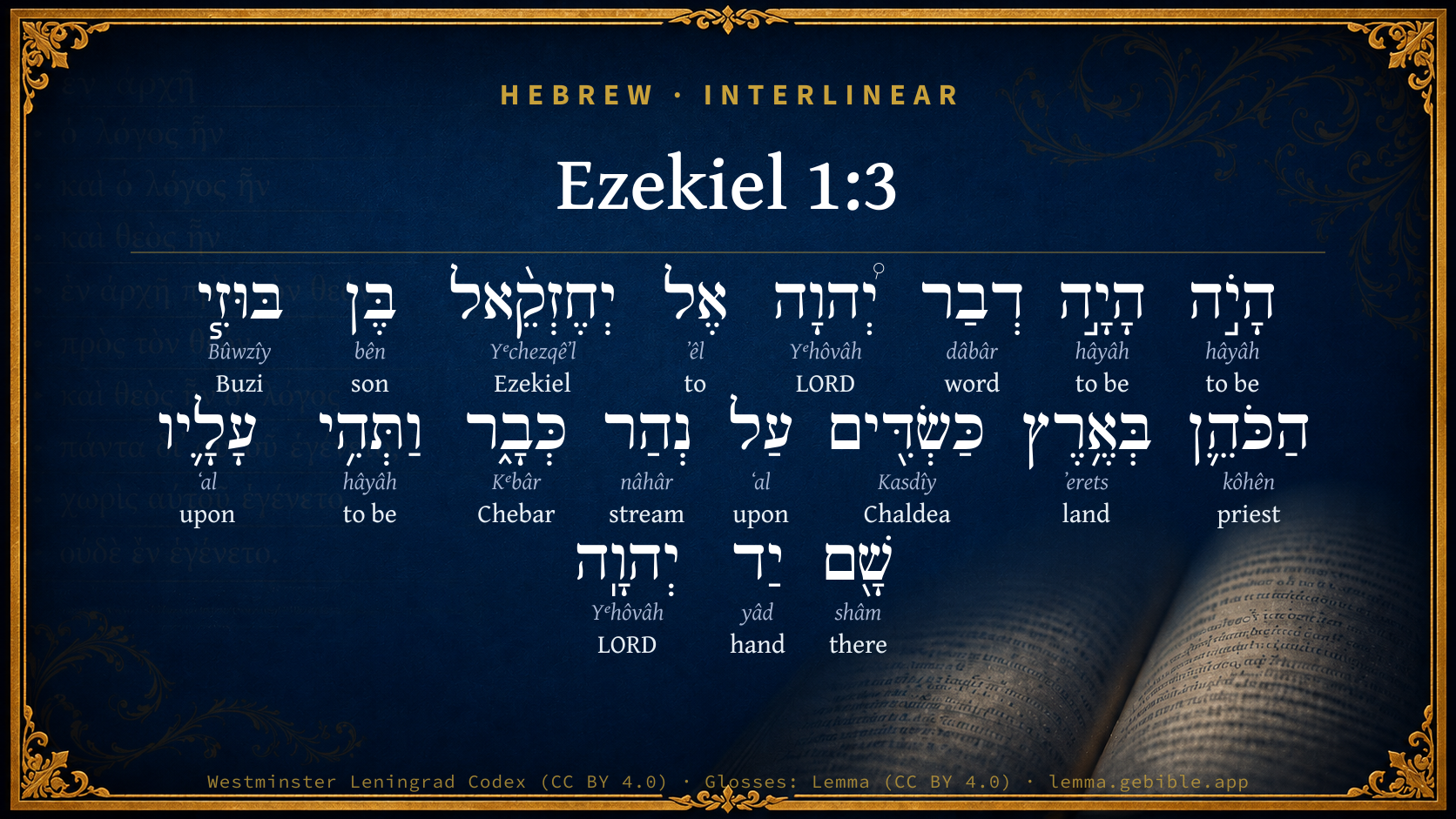
Hebrew (Westminster Leningrad Codex) Ezekiel 1:3 appears in the Hebrew Old Testament. The text above is from the Westminster Leningrad Codex. Each word links to its Strong’s number, a concise gloss, and parsing drawn from the Open Scriptures Hebrew Bible morphology. Click any word for its full Brown-Driver-Briggs (BDB) entry.
Download image
Cite this verse

Ezekiel 1:3 (World English Bible). Public Domain. Lemma interlinear Bible study tool, https://lemma.gebible.app/v/ezekiel/1/3.

Show BibTeX & RIS
BibTeX
RIS
English Translation
the word of Yahweh came expressly to Ezekiel the priest, the son of Buzi, in the land of the Chaldeans by the river Chebar; and the hand of Yahweh was there on him.
World English Bible · Public Domain
Highlights
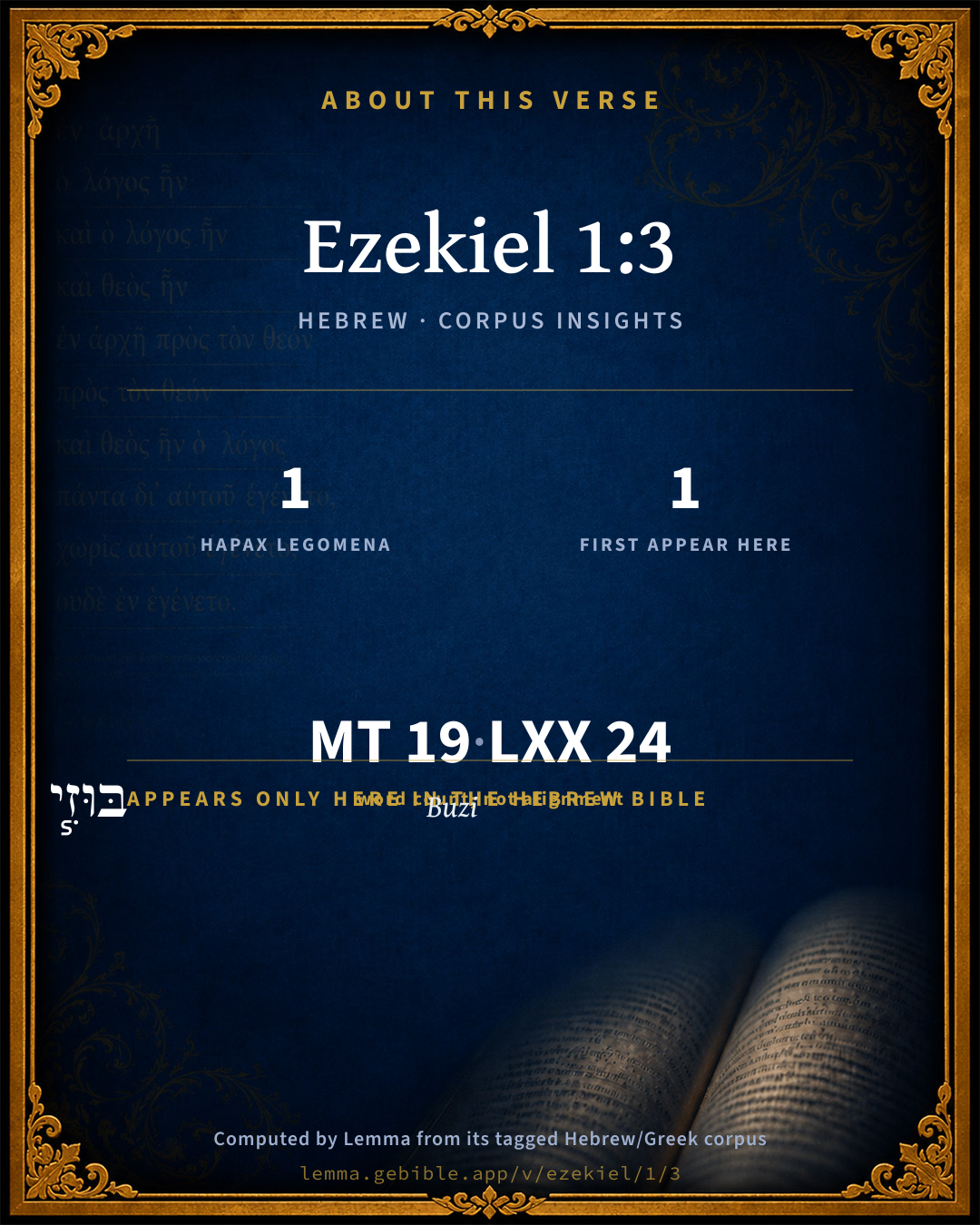
  • 1 hapax legomenon — only here in the Hebrew Bible
  • 1 first appearance in the Hebrew Bible
Full analysis ↓
Download a study sheet

One document with this verse’s original text, its word-by-word gloss line, the meaning frame, cross-references with their text, attributed commentary, and full source and license credits — printable, and it pastes into notes with its structure intact.

This verse Autodidact and up

Study sheet (.html) Plain text (.txt)

A passage Seminary Student

Up to 50 verses in one chapter. A passage sheet keeps up to 6 commentary sources and 12 cross-references per verse, in the order this page ranks them, and says so on the sheet whenever that leaves anything out. Ask for a single verse and you get the Autodidact verse sheet above.

Everything on this page stays free to read, with no account — the sheet is a download of what is already on screen, not access to it.

Want to remove ads? Support Godless Engineer
Compare translations 3

The same verse in 3 English versions, stacked beneath the original-language interlinear above. Click any original word for its lexicon entry.

Each is an independent rendering of the whole verse — the interlinear is not word-aligned to these translations.

Highlighted words mark where these versions differ — a whole-verse word diff, not a word-by-word alignment.

  • World English Bible Public Domain
    the word of Yahweh came expressly to Ezekiel the priest, the son of Buzi, in the land of the Chaldeans by the river Chebar; and the hand of Yahweh was there on him.
  • King James Version Public Domain
    The word of the LORD came expressly unto Ezekiel the priest, the son of Buzi, in the land of the Chaldeans by the river Chebar; and the hand of the LORD was there upon him.
  • unfoldingWord Literal Text CC BY-SA 4.0
    the word of Yahweh came to Ezekiel son of Buzi the priest, in the land of the Chaldeans by the Kebar Canal, and the hand of Yahweh was upon him there.

unfoldingWord Literal Text — © unfoldingWord, licensed CC BY-SA 4.0. Word-aligned USFM3 via Door43 (git.door43.org/unfoldingWord/en_ult).

Versions to compare (up to 4)

3 of 4 selected

Show all 18 translations

Every available English version of this verse, each an independent rendering of the whole verse.

  • World English Bible Public Domain
    the word of Yahweh came expressly to Ezekiel the priest, the son of Buzi, in the land of the Chaldeans by the river Chebar; and the hand of Yahweh was there on him.
  • Berean Standard Bible Public Domain
    the word of the LORD came directly to Ezekiel the priest, the son of Buzi, in the land of the Chaldeans by the River Kebar. And there the LORD’s hand was upon him.
  • Majority Standard Bible Public Domain
    the word of the LORD came directly to Ezekiel the priest, the son of Buzi, in the land of the Chaldeans by the River Kebar. And there the LORD’s hand was upon him.
  • King James Version Public Domain
    The word of the LORD came expressly unto Ezekiel the priest, the son of Buzi, in the land of the Chaldeans by the river Chebar; and the hand of the LORD was there upon him.
  • American Standard Version (1901) Public Domain
    the word of Jehovah came expressly unto Ezekiel the priest, the son of Buzi, in the land of the Chaldeans by the river Chebar; and the hand of Jehovah was there upon him.
  • Revised Version (1885) Public Domain
    the word of the LORD came expressly unto Ezekiel the priest, the son of Buzi, in the land of the Chaldeans by the river Chebar; and the hand of the LORD was there upon him.
  • Geneva Bible (1599) Public Domain
    The word of the Lord came vnto Ezekiel the Priest, the sonne of Buzi, in the lande of the Caldeans, by the riuer Chebar, where the hande of the Lord was vpon him.
  • Douay-Rheims (1899) Public Domain
    The word of the Lord came to Ezechiel the priest the son of Bud in the land of the Chaldeans, by the river Chobar: and the hand of the Lord was there upon him.
  • Young's Literal Translation Public Domain
    hath the word of Jehovah certainly been unto Ezekiel son of Buzi the priest, in the land of the Chaldeans, by the river Chebar, and there is on him there a hand of Jehovah.
  • Literal Standard Version CC BY-SA 4.0
    the word of YHWH has certainly been to Ezekiel son of Buzi the priest, in the land of the Chaldeans, by the river Chebar, and there is on him there a hand of YHWH.
  • Unlocked Literal Bible CC BY-SA 4.0
    the word of Yahweh came to Ezekiel son of Buzi the priest, in the land of the Chaldeans by the Kebar Canal, and the hand of Yahweh was upon him there.
  • unfoldingWord Literal Text CC BY-SA 4.0
    the word of Yahweh came to Ezekiel son of Buzi the priest, in the land of the Chaldeans by the Kebar Canal, and the hand of Yahweh was upon him there.
  • Darby Bible Public Domain
    the word of Jehovah came expressly unto Ezekiel the priest, the son of Buzi, in the land of the Chaldeans by the river Chebar; and the hand of Jehovah was there upon him.
  • World Messianic Bible Public Domain
    the LORD’s word came to Ezekiel the priest, the son of Buzi, in the land of the Kasdim by the river Chebar; and the LORD’s hand was there on him.
  • Webster's Bible Public Domain
    The word of the LORD came expressly to Ezekiel the priest, the son of Buzi, in the land of the Chaldeans by the river Kebar; and the hand of the LORD was there upon him.
  • Free Bible Version CC BY-SA 4.0
    a message from Lord was given to Ezekiel the priest, the son of Buzi, in the land of Babylonia by the River Kebar. There the Lord's power came over him.)
  • Bible in Basic English Public Domain
    The word of the Lord came to me, Ezekiel the priest, the son of Buzi, in the land of the Chaldaeans by the river Chebar; and the hand of the Lord was on me there.
  • JPS Tanakh (1917) Public Domain
    the word of the LORD came expressly unto Ezekiel the priest, the son of Buzi, in the land of the Chaldeans by the river Chebar; and the hand of the LORD was there upon him.

Literal Standard Version (2020), Covenant Press — licensed CC BY-SA 4.0. Text via the HelloAO Bible API (eBible.org). Unlocked Literal Bible (unfoldingWord) — licensed CC BY-SA 4.0. Text via the HelloAO Bible API (eBible.org). unfoldingWord Literal Text — © unfoldingWord, licensed CC BY-SA 4.0. Word-aligned USFM3 via Door43 (git.door43.org/unfoldingWord/en_ult). Free Bible Version, Dr. Jonathan Gallagher — licensed CC BY-SA 4.0. Text via the HelloAO Bible API (eBible.org).

Word by word

More ways to search: Search by grammar → Find every occurrence → Compare this word →

Practice this passage: Drill this verse → Learn its vocabulary →

בּוּזִ֧י
Bûwzîy
H941
“Buzi”
Noun, Proper
Part of Speech
Noun
Type
Proper
Full BDB Definition

Origin: the same as H940

TWOT: None

Buzi = "my contempt" - father of Ezekiel (or ancestor)
  1. הָיֹ֣ה hâyâh H1961 “to be” Verb, Qal, Infinitive Absolute
  2. הָיָ֣ה hâyâh H1961 “to be” Verb, Qal, Perfect, 3rd Person, Masculine, Singular
  3. דְבַר dâbâr H1697 “word of” Noun, Common, Masculine, Singular, Construct
  4. יְ֠הוָה Yᵉhôvâh H3068 “LORD” Noun, Proper
  5. אֶל ʼêl H413 “to” Preposition
  6. יְחֶזְקֵ֨אל Yᵉchezqêʼl H3168 “Ezekiel” Noun, Proper
  7. בֶּן bên H1121 “son of” Noun, Common, Masculine, Singular, Construct
  8. הַכֹּהֵ֛ן kôhên H3548 “the · priest” Particle, Definite Article + Noun, Common, Masculine, Singular, Absolute
  9. בְּאֶ֥רֶץ ʼerets H776 “in/at · land of” Preposition + Noun, Common, Both, Singular, Construct
  10. כַּשְׂדִּ֖ים Kasdîy H3778 “Chaldea” Noun, Proper
  11. עַל ʻal H5921 “upon” Preposition
  12. נְהַר nâhâr H5104 “stream of” Noun, Common, Masculine, Singular, Construct
  13. כְּבָ֑ר Kᵉbâr H3529 “Chebar” Noun, Proper
  14. וַתְּהִ֥י hâyâh H1961 “and · to be” Conjunction + Verb, Qal, Sequential Imperfect, 3rd Person, Feminine, Singular
  15. עָלָ֛יו ʻal H5921 “upon · him” Preposition + Suffix, Personal, 3rd Person, Masculine, Singular
  16. שָׁ֖ם shâm H8033 “there” Adverb
  17. יַד yâd H3027 “hand of” Noun, Common, Both, Singular, Construct
  18. יְהוָֽה Yᵉhôvâh H3068 “LORD” Noun, Proper

About this verse

These counts appear in no published source. They are computed here, from the morphology-tagged text and Lemma’s own curated glosses. What Lemma adds →

19
words
15
distinct lemmas
Prophets
section

Notable vocabulary

1 hapax legomenon — a word that appears only here in the entire Hebrew Bible:

  • בּוּזִ֧י Buzi H941

First appearance in Scripture

This word makes its first canonical appearance in the Hebrew Bible here:

  • בּוּזִ֧י Buzi H941

Shared distinctive vocabulary

יְחֶזְקֵ֨אל Ezekiel H3168 occurs in 3 verses of the Hebrew Bible. Also found in:

Grammatical profile

  • 3 verbs
  • 12 nouns
  • 3 prepositions
  • 1 adverb

Verb forms

  • הָיֹ֣ה Qal · Infinitive Absolute
  • הָיָ֣ה Qal · Perfect
  • וַתְּהִ֥י Qal · Sequential Imperfect

Repetition

Words recur within this verse — often emphatic in Hebrew:

  • הָיֹ֣ה to be H1961 ×3
  • יְ֠הוָה LORD H3068 ×2
  • עַל upon H5921 ×2

Hebrew & Septuagint length

In English translation the verse runs 33 words from the Hebrew and 35 from the Septuagint (LXX English) — closely comparable.

A rough comparison of the two English renderings, which tokenize alike — not a word-level alignment.

Word counts can differ between the Hebrew and the Greek without any difference in meaning — e.g. the Hebrew direct-object marker אֵת has no separate Greek word, and Greek often adds the article ὁ.

In the original languages it is 19 Hebrew tokens and 24 Greek tokens — but the two are counted differently (Hebrew bundles its prefixes and suffixes into one token; the Greek is in lemma form), so that isn’t a like-for-like length.

Cross-references

14

Topical passages linked to Ezekiel 1:3 in the Treasury of Scripture Knowledge — connected by theme and wording, ordered by reader-vote popularity; previews shown in the World English Bible.

  • Ezekiel 3:14 So the Spirit lifted me up, and took me away; and I went in bitterness, in the heat of my spirit; and the hand of Yahweh was strong on me.
  • Ezekiel 3:22 The hand of Yahweh was there on me; and he said to me, Arise, go forth into the plain, and I will there talk with you.
  • 1 Kings 18:46 and the hand of Yahweh was on Elijah; and he girded up his loins, and ran before Ahab to the entrance of Jezreel.
  • 2 Kings 3:15 But now bring me a minstrel. It happened, when the minstrel played, that the hand of Yahweh came on him.
  • Ezekiel 8:1 It happened in the sixth year, in the sixth [month], in the fifth [day] of the month, as I sat in my house, and the elders of Judah sat before me, that the hand of the Lord Yahweh fell there on me.
  • Ezekiel 33:22 Now the hand of Yahweh had been on me in the evening, before he who was escaped came; and he had opened my mouth, until he came to me in the morning; and my mouth was opened, and I was no more mute.
  • Ezekiel 37:1 The hand of Yahweh was on me, and he brought me out in the Spirit of Yahweh, and set me down in the midst of the valley; and it was full of bones.
  • Ezekiel 40:1 In the five and twentieth year of our captivity, in the beginning of the year, in the tenth [day] of the month, in the fourteenth year after that the city was struck, in the same day, the hand of Yahweh was on me, and he brought me there.
  • Ezekiel 1:1 Now it happened in the thirtieth year, in the fourth [month], in the fifth [day] of the month, as I was among the captives by the river Chebar, that the heavens were opened, and I saw visions of God.
  • Hosea 1:1 The word of Yahweh that came to Hosea the son of Beeri, in the days of Uzziah, Jotham, Ahaz, and Hezekiah, kings of Judah, and in the days of Jeroboam the son of Joash, king of Israel.
  • Joel 1:1 The Word of Yahweh that came to Joel, the son of Pethuel.
  • 1 Timothy 4:1 But the Spirit says expressly that in later times some will fall away from the faith, paying attention to seducing spirits and doctrines of demons,
  • Jeremiah 1:2 to whom the word of Yahweh came in the days of Josiah the son of Amon, king of Judah, in the thirteenth year of his reign.
  • Jeremiah 1:4 Now the word of Yahweh came to me, saying,

Cross-references courtesy of OpenBible.info (CC BY 4.0).

Hebrew and Greek witnesses Masoretic Hebrew ↔ Greek Septuagint

The same verse in the two great witnesses to the Old Testament, shown verse-for-verse.

These are two independent witnesses, not word-aligned to each other, and the Septuagint is shown in lemma (dictionary) form.

Hebrew Ezekiel 1:3 Masoretic · Westminster Leningrad Codex

הָיֹ֣ה הָיָ֣ה דְבַר יְ֠הוָה אֶל יְחֶזְקֵ֨אל בֶּן בּוּזִ֧י הַכֹּהֵ֛ן בְּאֶ֥רֶץ כַּשְׂדִּ֖ים עַל נְהַר כְּבָ֑ר וַתְּהִ֥י עָלָ֛יו שָׁ֖ם יַד יְהוָֽה

the word of Yahweh came expressly to Ezekiel the priest, the son of Buzi, in the land of the Chaldeans by the river Chebar; and the hand of Yahweh was there on him.

World English Bible · Public Domain

Greek LXX Ezekiel 1:3 Septuagint · lemma form

καί γίγνομαι λόγος κύριος πρός ιεζεκιηλ υἱός βουζι ὁ ἱερεύς ἐν γῆ χαλδαῖος ἐπί ὁ ποταμός ὁ χοβαρ καί γίγνομαι ἐπί ἐγώ χείρ κύριος

And the word of the Lord came to Jezekiel the priest, the son of Buzi, in the land of the Chaldeans, by the river of Chobar; and the hand of the Lord was upon me.

LXX2012 (modern English Septuagint) · Public Domain

Hebrew: Westminster Leningrad Codex (CC BY 4.0). Greek: Septuagint (public domain); English from LXX2012 (modern English Septuagint) (Public Domain). How the Septuagint differs from the Hebrew →

Targum (Aramaic paraphrase)

1

The Targum is the ancient Jewish Aramaic paraphrase of the Hebrew Scriptures — an interpretive translation, not the Hebrew text itself. Onkelos (literal) and Pseudo-Jonathan (expansive) render the Torah, and Jonathan the Prophets. Coverage is partial: where no permissively-licensed English translation exists for a verse, only the Aramaic is shown. This is verse-level text, not a word-by-word alignment to the Hebrew.

  1. Targum Jonathan Prophets (Joshua–Malachi)
    מֶהֱוֵי הֲוָה פִּתְגָם נְבוּאָה מִן קֳדָם יְיָ עִם יְחֶזְקֵאל בַּר בּוּזִי כַהֲנָא בְאַרְעָא דְיִשְׂרָאֵל תָּב תִּנְיָנוּת וְאִתְמַלֵל עִמֵיהּ בִּמְדִינַת אֲרַע כַּסְדָאֵי עַל נְהַר כְּבָר וּשְׁרָת עֲלוֹהִי תַּמָן רוּחַ נְבוּאָה מִן קֳדָם יְיָ:

    (no public-domain English translation for this verse)

    Targum Jonathan — Aramaic: “Mikraot Gedolot” (public domain). English: “Sefaria Community Translation” (CC0 1.0 (public-domain dedication)); “London "Chaldee Paraphrase," 1871” (public domain). Text via Sefaria.

Commentary

Notes on Ezekiel 1:3 from classic Christian and Jewish commentators (each source and its license shown beneath its notes). The classic Christian expositions comment on the surrounding passage and are grouped to its opening verse, so a note may address several verses; the Jewish commentaries on the Tanakh (Rashi and others) are per-verse, so they appear only where the commentator wrote on this verse.

Lemma curates 59 commentaries, every one of them public domain or Creative Commons licensed, each selected and text-cleaned for this edition rather than reprinted as found. About our sources →

Trapp's Complete Commentary

John Trapp

Eze 1:3 The word of the LORD came expressly unto Ezekiel the priest, the son of Buzi, in the land of the Chaldeans by the river Chebar; and the hand of the LORD was there upon him.

Ver. 3. The word of the Lord came expressly.] Heb., By being hath been, or hath altogether been - Existendo extitit. Accurate factum est it really wrought upon me and made me a prophet.

Unto Ezekiel the priest.] Whom, therefore, some have called Urim and Thummim in Babylon.

The son of Buzi.] That this Buzi was Jeremiah, so called because despised for his plain dealing, as some Rabbis have affirmed, is as true as that Ezekiel himself was the same with Pythagoras the philosopher; which yet some ancients have fondly fancied.

In the land of the Chaldeans] Though a polluted land, {Mic 2:10} and the dwelling place of wickedness, {Zec 5:8; Zec 5:11} the mother of harlots, and abominations of the earth. {Rev 17:5}

By the river Chebar.] The Rabbis {a} call it the Sabbath river; and, further, tell us that it runneth not, but resteth on the Sabbath day.

“ Credat Iudaeus Apella:

Non ego. ” - Hor.

And the hand of the Lord was there upon him.] Not only came God’s Word expressly to him, but the power and Spirit of God came mightily upon him; so that he felt the intrinsic virtue of this hand, as one phraseth it, the Spirit of God in his own heart; it was a quick and lively word unto him, and to as many as believed.

{a} Sabbatian.

John Trapp, A Commentary or Exposition upon All the Books of the Old and New Testament (1647–1656) — public domain. Text from a community e-Sword module.

Tyndale Open Study Notes

Tyndale Open Resources

1:3 Ezekiel was a priest by descent and a prophet because the hand of the Lord was upon him. Priests offered sacrifices in the Temple and explained God’s law. Prophets delivered God’s words of blessing or curse to the people and interceded with God for them. Ezekiel’s ministry included aspects of both priestly and prophetic mediation between God and the Israelites.

Tyndale Open Study Notes — © Tyndale Open Resources, licensed CC BY-SA 4.0. Text via the HelloAO Bible API.

Geneva Bible (1599)

Geneva Bible translators

That is, the spirit of prophecy, as Ezek. 3:22 and 37:1.

Geneva Bible (1599) marginal notes — public domain. Text via Bolls.life.

Adam Clarke's Commentary

Verse 3. The hand of the Lord] I was filled with his power, and with the influence of the prophetic spirit.

Adam Clarke's Commentary on the Bible (1810–1826) — public domain. Text from a community e-Sword/MySword module.

John Calvin's Commentaries

He does not repeat the copula which was placed at the beginning of the first verse, and we may perhaps wonder why the book should begin with a copula: for when he says, “and it came to pass,” it seems to denote something going before it, and it seems out of place when nothing precedes it. But probably an oblique antithesis or comparison is intended between those prophecies which had flourished for a long period at Jerusalem, which was their peculiar and genuine scat, and that which was arising in Chaldea; as if he would say, “even among Chaldaeans,” for the particle ו, vau, is often used in the sense of גם, gam, “even.” The sense therefore is, after God had exercised his servants even to weariness, since many prophets had discharged their duties at Jerusalem, now at length he speaks in Chaldea. He says, therefore, “the word of the Lord came unto him.” I know not why some dream that Jeremiah is here called “Buzi,” unless because it was a foolish persuasion of the Jews, that the father of a prophet is never mentioned unless he were a prophet himself. Their ignorance is proved on other occasions, and here surely their curiosity is shameful, since they decide this Buzi to be a prophet, and because they know of no one else, they fix on Jeremiah: as if it were probable, that when the father was left at Jerusalem, the son was an exile, which is entirely conjectural. But because he was a priest;, so he says, “the son of Buzi.” Our Prophet ought to have some reputation, for if he had been of plebeian obscurity, he would scarcely have been listened to. The priestly dignity, then, availed something towards securing attention. Now he expresses what I have previously mentioned, in the land of Chaldea, as if he had said: although God has not been accustomed to raise up prophets in lands so distant and polluted, yet now his rule is changed, for even among the Chaldeans is one endued with the prophetic spirit. And the particle שם, illic, “there,” is emphatically added, “was there upon him,” says he. For otherwise the Jews would have dreaded Ezekiel, as if he were a monster, when they found that the word of God had proceeded from Chaldea. “What,” say they, “will God pollute and contaminate his doctrine, by its springing up from such a place as that? Who are the Chaldeans, that God should erect his seat there? Mount Zion is his dwelling-place: here he is worshipped and invoked. Here must his lamp burn of necessity, as he has often witnessed by his prophets.” To such taunts the Prophet; replies: God has begun to speak in Chaldea — there his power is conspicuous: “The word of the Lord is come unto me; for we know that God alone is to be heard, and that prophets are only to be attended to, as far as they utter what proceeds from him.” Hence it is required that all teachers of the Church should first have been learners, so that God alone may retain his own rights, and be the only Lord and Master. As then supreme authority resides in God alone, when prophets desire to be heard, they profess not to offer their own comments, but faithfully to deliver a message from God. Thus also our Prophet. I touch these points rather lightly now, as I have treated them more at length elsewhere. At length he adds, the hand of the Lord was upon him Some explain the word “hand” by “prophecy,” but this seems to me weak and poor: I take “hand” to mean divine power, as if Ezekiel had said that he was endued with divine power, so that it should be quite clear that he was chosen a Prophet. The hand of God, then, was a proof of new favor, so that Ezekiel might subject; to his own sway all the captives, since he carried with him the authority of God. This may also be referred to the efficacy of his doctrine. For the Lord not only suggests words to his servants, but also works by the secret influence of his Spirit, and suffers not their labors to be in vain. The passage then may be received in this sense. But since the Prophet only assumes to himself what was necessary, and so claims for himself the position and standing of a Prophet, so when he uses the word “hand,” I do not doubt his meaning to be an inward operation. There is, it is admitted, an inward efficacy of the Holy Spirit when he sheds forth his power upon hearers, that they may embrace a discourse by faith, so also if all hearers were deaf, and God’s word should evaporate as smoke, yet there is an intrinsic virtue in the prophecies themselves: Ezekiel points out this as given to him by God. Here I shall finish, because I should be compelled to break off directly, and we shall be coming to the vision, which is the most difficult of all.

John Calvin's Commentaries (1540-1563) — public domain. Text from the Calvin Translation Society English edition (1840s-50s) via the Christian Classics Ethereal Library (ccel.org). Calvin's coverage is partial (roughly two-thirds of the Bible); uncommented books and verses are honest gaps, never fabricated. The 19th-century editor's footnotes and remarks are omitted so the notes are faithfully Calvin's own voice.

Ellicott's Commentary for English Readers

(3) Came expressly.—Or, came certainly, with the fullest proof of reality. In the original there is simply the ordinary form of the repetition of the verb for the sake of emphasis. The prophet mentions his own name only here and in Eze_24:24.

The hand of the Lord was there upon him.—A form of expression to indicate that special power and influence which the Spirit exercised over the prophets at times when they were called to become the means of the Divine communications. (Comp. 1Ki_18:46, and Eze_3:22; Eze_37:1; see also Dan_8:18; Dan_10:10; Rev_1:17.) It is noticeable that Ezekiel here speaks of himself in the third person, while in Eze_1:1, and always after this, he uses the first person. It had been suggested that this, together with the mention of his own name, may indicate the insertion of these two verses on a revision of his work by the prophet.

In entering upon the vision of the glory of the Lord, which fills the rest of this chapter, it is to be remembered that Ezekiel is struggling to portray that which necessarily exceeds the power of human language; it is not therefore surprising that there should be something of repetition and of obscurity in the detail. All similar descriptions of Divine manifestations are marked more or less strongly by the same characteristics. (See Exo_24:9-10; Isa_6:1-4; Dan_7:9-10; Rev_1:12-20; Rev_4:2-6, &c.) It is also to be borne in mind that what the prophet saw was not the eternal Father in His own absolute essence, who dwells in unapproachable light, and whom “no man hath seen, nor can see” (1Ti_6:16); and had it been possible that Ezekiel should have been so transported out of the body as to behold this, it would then have been impossible for him to describe it. But what he saw in vision was such manifestation as man could bear, in which God hides His face, and allows to be seen only His uttermost parts (Exo_33:22-23). In the description that follows may be recognised a mingling of the symbols of the Divine manifestation at Sinai with the “patterns of heavenly things” in the most holy place of the Temple, the whole modified to suit the present occasion, and possibly somewhat coloured by the now familiar symbolic art of Babylonia.

A Bible Commentary for English Readers, edited by Charles John Ellicott (1878–1897) — public domain. Text from a community e-Sword module.

The Cambridge Bible for Schools and Colleges

gen. ed. J. J. S. Perowne

3. came expressly] Omit expressly. The name Ezekiel probably means “God is strong.” Nothing further is known of Ezekiel or of his father Buzi. The designation “priest” appears to apply to Ezekiel, not to his father. As the prophet excludes all Levites from priestly office except the “sons of Zadok” (Eze_40:46, Eze_43:19, Eze_44:15-16), it may be inferred that he belonged himself to this family. It appears from Jer_29:1 seq. that among the captives carried away with Jehoiachin were both priests and prophets.

hand of the Lord] the prophetic ecstasy.

The Cambridge Bible for Schools and Colleges (gen. ed. J. J. S. Perowne; Cambridge University Press, 1878–1918) — public domain. Text from a community e-Sword module.

John Gill's Exposition

The word of the Lord came expressly,.... Or, "in being was" (d); which phrase denotes the reality, certainty, substantiality and evidence of the word of the Lord to him:

unto Ezekiel the priest, the son of Buzi; which Buzi, some say, was Jeremiah. Kimchi observes, that, in the Jerusalem Targum, the Prophet Ezekiel is called the son of Jeremiah the prophet: and Jeremiah was called Buzi because they despised him; this is rejected by Abarbinel; nor is there any reason to believe it, any more than what Nazianzen (e) says, that Ezekiel was a servant of Jeremiah:

in the land of the Chaldeans, by the river Chebar; See Gill on Eze 1:1. The Chaldee paraphrase makes the word of the Lord to come to him at two distinct times and places;

"the word of prophecy from before the Lord was with Ezekiel the son of Buzi the priest in the land of Israel: it returned a second time, and spoke with him in the province, the land of the Chaldeans, by the river Chebar:''

and the hand of the Lord was there upon him; by which is meant the gift and word of prophecy, which came with power and efficacy, clearness and evidence; so the Targum, and the

"spirit of prophecy from before the Lord there abode by him;''

by which he saw all later visions, and delivered out the following prophecies; see Pe2 1:21.

(d) "essendo fuit", Pagninus, Montanus. Heb. ; "existendo exstitit", Polanus. (e) Orat. 47. vol. 1. p. 724.

John Gill's Exposition of the Whole Bible (1746–1763) — public domain (CC PDM 1.0). Text via the HelloAO Bible API.

Albert Barnes' Notes on the Bible

Came expressly - The phrase marks that it was in truth a heaven-sent vision.

The hand of the Lord - A phrase in all prophecy implying a “constraining” power, because the spirit “constrains” the prophet independently of his own will.

Albert Barnes' Notes on the Bible (1834–1885) — public domain. Text from a community e-Sword/MySword module.

Haydock's Catholic Bible Commentary

Hand; power, energy of the Holy Spirit. (Theodoret)

George Leo Haydock (1774–1849), Haydock's Catholic Family Bible and Commentary, 1859 edition — public domain. Excludes Psalms (Douay-Rheims chapter numbering differs from Protestant) and Deuterocanonical books (Catholic canon only).

Matthew Poole's English Annotations

What was

visions, Eze 1:1, is here

the word, both as signifying and declaring the mind of God, what he would do, and as containing his commands to Ezekiel and to the people, to whom these visions spake by signs.

The word of the Lord: lest the prophet should want his warrant, or the Jews except to his advice, it is plainly told them that Jehovah the sovereign Lord and eternal God, by Ezekiel, counsels, warns, commands, and threatens.

Came expressly unto; emphatically translated as it is emphatically expressed in the Hebrew,

being with him,

it was with him; so long he might discern, so clear he might understand, so near he could not be deceived, or easily forget what he was to tell them.

Ezekiel signifies either, the strength of God, or, strengthened by God, and in a few syllables contains what is more largely set forth, Eze 3:8,9. He speaks of himself in the third person.

The priest; who therefore should be regarded as one whose interest among the priests at Jerusalem would be best promoted if better things might be hoped and shortly expected than he must now tell them; it was likely he dealt truly with them, when he must share so much in the sad things foretold. He was of the priests originally, he was a prophet by extraordinary call.

The son of Buzi; of a contemned man, so the etymology of the Hebrew, which gave the rabbins occasion to apply it to Jeremiah, and to account the prophet either son or servant to Jeremiah; but it is a proper name.

In the land of the Chaldeans, enemies to, and now masters of, poor captive Jews, the church of God: there God makes him a prophet, who was an ordinary priest in the land of Israel.

The river Chebar, though a river of Mesopotamia, yet here seems placed in Chaldea, because Mesopotamia was part of the kingdom of the Chaldeans; so Chebar or Chobar was in the land, i.e. within the kingdom, of Chaldea, but particularly in Mesopotamia, a province of that kingdom.

The hand of the Lord; the Divine impulse moving with power and efficacy on Ezekiel for the work, and clearly confirming and demonstrating to the captive Jews that he was the prophet of the Lord, and spake to them in his name; the Spirit of prophecy, as the Chaldee Paraphrase.

Was upon him there: God is not confined; though most prophets were in the land of Israel, yet here in Chaldea also appears a great prophet, and should be hearkened unto.

Matthew Poole's English Annotations on the Holy Bible (1683–1685) — public domain. Text from a community e-Sword/MySword module.

Whedon's Commentary on the Bible

Daniel D. Whedon

3. Ezekiel — God is strong (Kuenen). Because of this all too brief biographical sketch, and because of Ezekiel’s reticence regarding himself, many have supposed that nothing can be known of this great prophet excepting the name of his father, and the fact that he was a priest of the family of Zadok; but such visions only come to the prepared man. Only the pure in heart can see God. (See Introduction, “IV. Ezekiel’s Personality.”)

The priest — This shows his training, education, environment, and natural prejudices. Buzi, Ezekiel’s father, is known to us only through his illustrious son. Did he also dream dreams and see visions? When God wants to make a great man he usually begins with his parents and grandparents.

The hand of the Lord — The hand that is under the throbbing earth is upon him (Eze_8:3; Eze_10:8). The universe feels the touch of Omnipotence; why should not man? This is a strong figure to show that the prophet spoke and acted not of his own will, but because of a controlling divine power. Ezekiel, like Jeremiah and Moses (Jer_1:6; Exo_3:11), felt that he could not take up the work of a prophet, but God’s hand turned him to his duty.

Daniel D. Whedon (gen. ed.), Commentary on the Old and New Testaments (1874–1909) — public domain. Text from a community e-Sword module.

The Pulpit Commentary

The word of the Lord came expressly, etc.; literally, coming, there come the word of the Lord; the iteration having (as commonly in this combination in Hebrew) the force of emphasis. The phrase stands, as elsewhere, for the conscious inspiration which made men feel that Jehovah had indeed spoken unto them, and that they had a message from him to deliver. To give parallel passages would be to copy several pages from a concordance, but it may not be without interest to note its first (Gen_15:1) and last (Mal_1:1) occurrences in the Old Testament, and its reappear, race in the New Testament. (Luk_3:2) Unto Ezekiel. We note the transition from the first person to the third; but

it does not give sufficient ground for rejecting either ver. 1 or ver. 2, 3 as an interpolation. (For the prophet"s name, which appears only here and in Eze_24:24, see Introduction; and for "land of Chaldeans," note on ver. 1.) The hand of the Lord. Here again we haw a phrase of frequent occurrence, used of Elijah, (1Ki_18:46) of Elisha, (2Ki_3:15) of Daniel, (Dan_8:18 Dan_10:10) of Isaiah, (Isa_8:11) of St. John. (Rev_1:17) The "hand" of the Lord is the natural symbol of his power, and the phrase seems to be used to add to the consciousness of inspiration, that of a constraining, irresistible power. Ezekiel continually uses it. (Eze_3:14, 22 8:1 33:22 37:1 40:1)

The Lord"s word and the Lord"s hand.

The prophet felt and knew that God was drawing near to him. This experience he could only express in language drawn from human relations. Spiritual realities were by him expressed in terms derived from the acts of bodily life. The "word" and the "hand" here spoken of are metaphorical, but they are strictly true; i.e. the just idea is, as far as may be by language and emblem, thus conveyed to our mind. If God reveal himself to man, it must be by means of the characteristics of man"s spiritual nature; and such characteristics are pictured in the expressions here employed by Ezekiel. The "word" of the Lord means one thing, the "hand" another; yet the employment of both expressions is necessary in order to convey, with anything like completeness, the penetration of the prophet"s nature by Divine truth, the commission of the prophet to undertake Divine service.

I THE QUICKENING AND ILLUMINATION OF THE MIND TO RECEIVE THE TRUTH. The word is the expression of the thought. The Divine word is the utterance of the Divine thought, and the Divine thought is truth. The expression here used implies a community of nature between man and God. God has thoughts and purposes which concern man"s good; and man"s highest well being is dependent upon the introduction of these into his spiritual nature. Man has not simply to hear and understand the word; it is for him to welcome and retain and ponder it, as a precious possession and a mighty power. The word of God, no doubt, came in a special sense to the prophets; there was a directness, an absence of any intermediary, in this communication. Through the prophet the word came to the people, to whom it might and did prove a word of enlightenment, of warning, of encouragement. That this might be so, the prophet"s nature needed to be yielded up to the penetrating, purifying, illumining grace of God himself.

II THE SUBMISSION AND OBEDIENCE OF THE WILL PRACTICALLY TO ACKNOWLEDGE DIVINE AUTHORITY. The "hand of the Lord" is an expression frequently met with in the Scriptures. Nehemiah acknowledges the "good hand of God upon him." To interpret the expression, it must be remembered that the hand is the symbol of activity, of the practical nature, of direction, of control, of protecting power. Now, a man could not fulfil prophetic functions simply by hearing the word of the Lord; there was something for him to do. In truth, the relations between God and man are such that it is necessary that God should command, and that man should obey. And if this is true of men generally, it is manifestly true of those who were called to the prophetic office. They had need not simply of revelation, but of guidance, of authority exercised and conveyed. What is this but to say that they needed that the hand of the Lord should be upon them? It must be remembered that the Prophet Ezekiel discharged his ministry, both by the communication verbally of Divine messages, and by the performance of certain actions. Of these actions some were symbolical, and others were directly and obviously instructive and directive. Thus the prophet needed, not merely the word of the Lord to enter his mind, but the hand of the Lord to control and govern his conduct.

APPLICATION. True religion is twofold. It enjoins upon us

(1) the reception of Divine truth, as graciously revealed in various ways to the human intelligence; and

(2) the subjection to Divine authority, as exercised with wisdom and compassion by him whose omnipotent hand can both point out the path of duty and service, and can clear away every obstacle which might prevent that path being pursued. T.

The Pulpit Commentary (1880–1919), ed. H.D.M. Spence-Jones & Joseph S. Exell — public domain. Text from a community e-Sword module.

John Wesley's Explanatory Notes

The word - What was visions, ver. 1, is here the word, both as signifying and declaring the mind of God, what he would do, and as continuing his commands to Ezekiel and to the people. Ezekiel - He speaks of himself in a third person. Priest - He was of the priests originally; he was a prophet by an extraordinary call. The hand - He felt the power of God opening his eyes to see the visions, opening his ear to hear the voice, and his heart to receive both. When the hand of the Lord goes along with his word, then it becomes effectual.

John Wesley, Explanatory Notes Upon the Whole Bible (1754–1765) — public domain. Text via the GEBible commentary corpus.

Rashi

Rabbi Shlomo Yitzchaki (Rashi)

The word of the Lord was [revealed] Heb. הָיֹה הָיָה [lit. being was.] Our Sages said (Mechilta to Exod. 12:1): “[It] had already come,” because the Shechinah does not rest upon a prophet outside the [Holy] Land, except by having first rested upon him in the Land. We learned in a Baraitha of the Mechilta (Exod. 15:9): [The verse 2:1,] “Son of man, stand on your feet,” was the [actual] beginning of the Book, only there is no chronological order [in Scripture]. Others say that (12:1f.) “Son of man, compose a riddle,” is the [true] beginning of the Book. [Mechilta ends here.] I say that this prophecy was told to him before they were exiled, because it is appropriate to be said to him in the Land, for the community of the exile is not mentioned explicitly in it. It can be recognized as the beginning of his mission to them. Jonathan, too, paraphrased in that manner: The prophetic word from before the Lord was revealed to Ezekiel the son of Buzi the priest in the land of Israel; it returned a second time and spoke with him in the state of the land of the Chaldeans. Now Ezekiel was exiled with the “craftsmen and the sentries of the gates,” who were exiled with Jehoiachin.

the hand of the Lord Every expression of יַד mentioned in this Book or in any expression of prophecy is invariably an expression of compulsion, [implying] that the prophecy seizes him against his will, like a person going mad, destreze in Old French, compulsion.

Rashi on the Tanakh — English translations: “The Judaica Press complete Tanach with Rashi, translated by A. J. Rosenberg” (CC BY 4.0); “Pentateuch with Rashi's commentary by M. Rosenbaum and A.M. Silbermann, 1929-1934” (public domain); “The Metsudah Tanach series, Lakewood, N.J” (CC BY 4.0); and “The Book of Joshua, Metsudah Publications, 1997” (CC BY 4.0). Text via Sefaria.

Lesson kit

Teaching starters — assembled from the data on this page, not authored interpretation. Every prompt links to the verse data it draws on. Edit before teaching.

Ezekiel, in the Prophets, opens this verse with 19 words (15 distinct Hebrew lemmas). Its most distinctive word is Bûwzîy (“Buzi”). A historical commentator’s framing appears above. Read the whole chapter for the surrounding context.

Discussion questions

  1. The word Bûwzîy carries the sense “Buzi.” How does it shape the verse?
  2. 1 word here appears nowhere else in the Hebrew Bible. Why might the author reach for such rare wording?
  3. This is the first place “Buzi” appears in Scripture (first appears here). What does its debut here establish?
  4. How does 1 Chronicles 24:16, which shares the word «Ezekiel», read alongside this verse?
  5. What does the repetition of “to be” (3× in this one verse) do in this verse?
  6. The translations on this page render this verse differently — a whole-verse word diff, not a word-by-word alignment. What might account for the different wordings?
  7. «הָיֹ֣ה» is a Qal Infinitive Absolute verb. How does that grammatical form shape the action described?
  8. Compare how Trapp's Complete Commentary and Tyndale Open Study Notes read this verse. Where do they agree or differ?

Things to notice

  • 1 word in this verse appears nowhere else in the Hebrew Bible.
  • 1 word makes its first canonical appearance in Scripture here.
  • This verse counts 19 Hebrew ↔ 24 Greek words.
  • These translations choose different wording for 8 words in this verse.
  • “to be” occurs 3× in this single verse.

Reading settings

Reading text

Shown beneath each verse's original-language words.

Old Testament
Old Testament edition

Read the OT as the Masoretic Hebrew (MT) or the Greek Septuagint (LXX).

English shown for the Greek Septuagint (in the Hebrew ↔ Greek comparison).

Comparing translations? Open the Compare panel on any verse page to stack up to four side by side.