
2 Chronicles 6:28

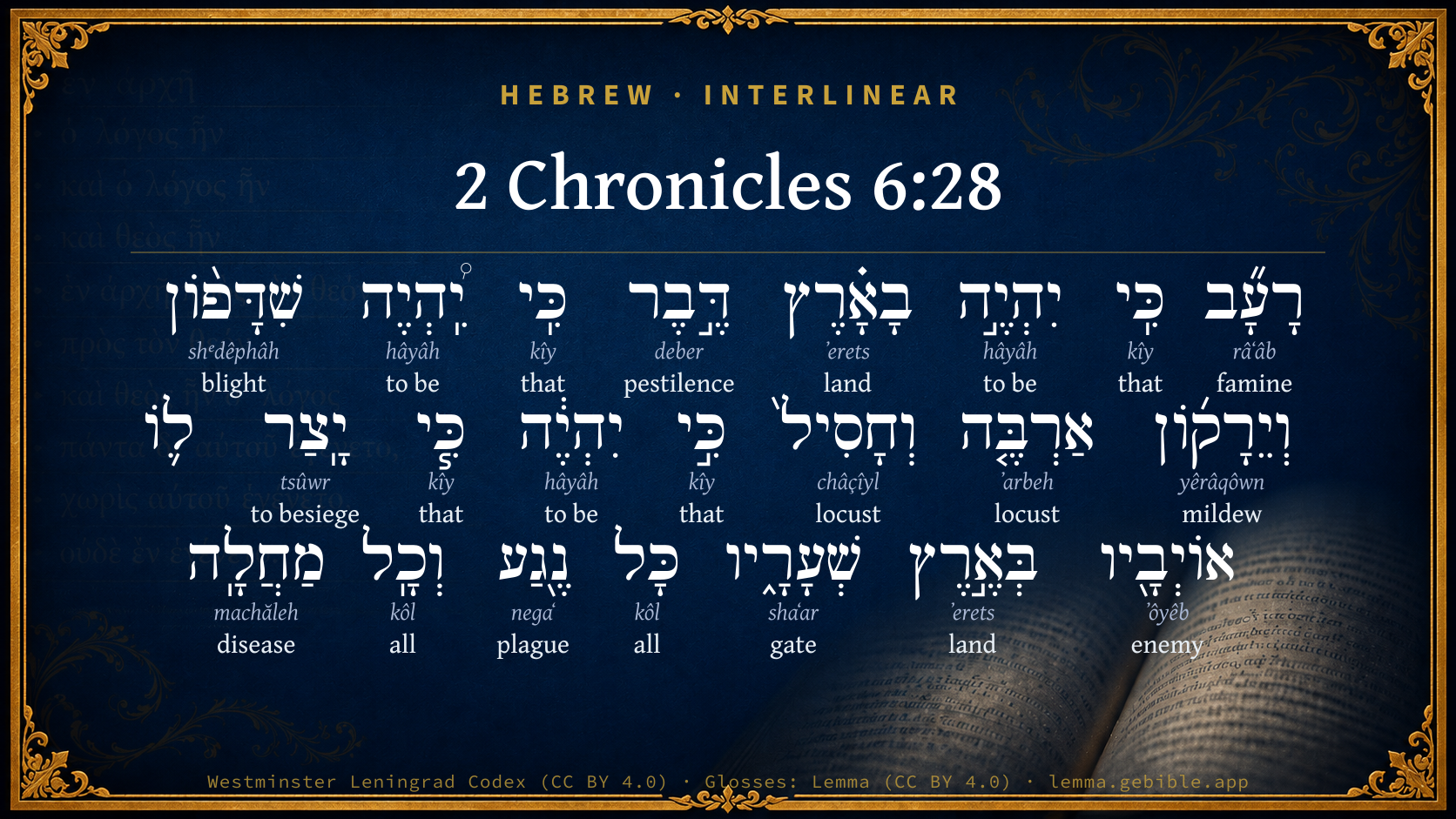
Hebrew (Westminster Leningrad Codex) 2 Chronicles 6:28 appears in the Hebrew Old Testament. The text above is from the Westminster Leningrad Codex. Each word links to its Strong’s number, a concise gloss, and parsing drawn from the Open Scriptures Hebrew Bible morphology. Click any word for its full Brown-Driver-Briggs (BDB) entry.
Download image
Cite this verse

2 Chronicles 6:28 (World English Bible). Public Domain. Lemma interlinear Bible study tool, https://lemma.gebible.app/v/2-chronicles/6/28.

Show BibTeX & RIS
BibTeX
RIS
English Translation
If there be in the land famine, if there be pestilence, if there be blasting or mildew, locust or caterpillar; if their enemies besiege them in the land of their cities; whatever plague or whatever sickness there be;
World English Bible · Public Domain
Download a study sheet

One document with this verse’s original text, its word-by-word gloss line, the meaning frame, cross-references with their text, attributed commentary, and full source and license credits — printable, and it pastes into notes with its structure intact.

This verse Autodidact and up

Study sheet (.html) Plain text (.txt)

A passage Seminary Student

Up to 50 verses in one chapter. A passage sheet keeps up to 6 commentary sources and 12 cross-references per verse, in the order this page ranks them, and says so on the sheet whenever that leaves anything out. Ask for a single verse and you get the Autodidact verse sheet above.

Everything on this page stays free to read, with no account — the sheet is a download of what is already on screen, not access to it.

Want to remove ads? Support Godless Engineer
Compare translations 3

The same verse in 3 English versions, stacked beneath the original-language interlinear above. Click any original word for its lexicon entry.

Each is an independent rendering of the whole verse — the interlinear is not word-aligned to these translations.

Highlighted words mark where these versions differ — a whole-verse word diff, not a word-by-word alignment.

  • World English Bible Public Domain
    If there be in the land famine, if there be pestilence, if there be blasting or mildew, locust or caterpillar; if their enemies besiege them in the land of their cities; whatever plague or whatever sickness there be;
  • King James Version Public Domain
    If there be dearth in the land, if there be pestilence, if there be blasting, or mildew, locusts, or caterpillars; if their enemies besiege them in the cities of their land; whatsoever sore or whatsoever sickness there be:
  • unfoldingWord Literal Text CC BY-SA 4.0
    Famine, if there is, in the land pestilence, if there is blight or mildew, locust or grasshopper, if there is indeed they suffer distress from their enemies in the land at the gates, any plague or any sickness,

unfoldingWord Literal Text — © unfoldingWord, licensed CC BY-SA 4.0. Word-aligned USFM3 via Door43 (git.door43.org/unfoldingWord/en_ult).

Versions to compare (up to 4)

3 of 4 selected

Show all 18 translations

Every available English version of this verse, each an independent rendering of the whole verse.

  • World English Bible Public Domain
    If there be in the land famine, if there be pestilence, if there be blasting or mildew, locust or caterpillar; if their enemies besiege them in the land of their cities; whatever plague or whatever sickness there be;
  • Berean Standard Bible Public Domain
    When famine or plague comes upon the land, or blight or mildew or locusts or grasshoppers, or when their enemies besiege them in their cities, whatever plague or sickness may come,
  • Majority Standard Bible Public Domain
    When famine or plague comes upon the land, or blight or mildew or locusts or grasshoppers, or when their enemies besiege them in their cities, whatever plague or sickness may come,
  • King James Version Public Domain
    If there be dearth in the land, if there be pestilence, if there be blasting, or mildew, locusts, or caterpillars; if their enemies besiege them in the cities of their land; whatsoever sore or whatsoever sickness there be:
  • American Standard Version (1901) Public Domain
    If there be in the land famine, if there be pestilence, if there be blasting or mildew, locust or caterpillar; if their enemies besiege them in the land of their cities; whatsoever plague or whatsoever sickness there be;
  • Revised Version (1885) Public Domain
    If there be in the land famine, if there be pestilence, if there be blasting or mildew, locust or caterpiller; if their enemies besiege them in the land of their cities; whatsoever plague or whatsoever sickness there be;
  • Geneva Bible (1599) Public Domain
    When there shalbe famine in the land, when there shalbe pestilence, blasting, or mildew, when there shall be grashopper, or caterpiller, when their enemie shall besiege them in the cities of their land, or any plague or any sickenesse,
  • Douay-Rheims (1899) Public Domain
    If a famine arise in the land, or a pestilence or blasting, or mildew, or locusts, or caterpillars: or if their enemies waste the country, and besiege the cities, whatsoever scourge or infirmity shall be upon them:
  • Young's Literal Translation Public Domain
    `Famine, when it is in the land, pestilence, when it is, blasting, and mildew, locust, and caterpillar, when they are, when its enemies have distressed it in the land -- its gates, any plague and any sickness;
  • Literal Standard Version CC BY-SA 4.0
    Famine, when it is in the land, [and] pestilence, when it is [in the land], blasting and mildew, locust and caterpillar, when they are [in the land], when its enemies have distressed it in the land—its gates, any plague and any sickness;
  • Unlocked Literal Bible CC BY-SA 4.0
    Suppose there is famine in the land, or suppose that there is disease, blight or mildew, locusts or caterpillars; or suppose that its enemies attack the city gates in their land, or that there is any plague or sickness—
  • unfoldingWord Literal Text CC BY-SA 4.0
    Famine, if there is, in the land pestilence, if there is blight or mildew, locust or grasshopper, if there is indeed they suffer distress from their enemies in the land at the gates, any plague or any sickness,
  • Darby Bible Public Domain
    If there be famine in the land, if there be pestilence, if there be blight or mildew, locust or caterpillar; if their enemies besiege them in the land of their gates; whatever plague or whatever sickness there be:
  • World Messianic Bible Public Domain
    “If there is famine in the land, if there is pestilence, if there is blight or mildew, locust or caterpillar; if their enemies besiege them in the land of their cities; whatever plague or whatever sickness there is—
  • Webster's Bible Public Domain
    If there shall be dearth in the land, if there be pestilence, if there be blasting, or mildew, locusts, or caterpillars; if their enemies shall besiege them in the cities of their land; whatever calamity, or whatever sickness there be:
  • Free Bible Version CC BY-SA 4.0
    If there is famine in the land, or disease, or blight or mildew on the crops, or if there are locusts or caterpillars, or if an enemy comes to lay siege to the towns in the land—it can be whatever kind of plague or whatever kind of disease—
  • Bible in Basic English Public Domain
    If there is no food in the land, if there is disease, if the fruits of the earth are damaged by heat or water, locust or worm; if their towns are shut in by their attackers: whatever trouble or whatever disease there may be:
  • JPS Tanakh (1917) Public Domain
    If there be in the land famine, if there be pestilence, if there be blasting or mildew, locust or caterpillar; if their enemies besiege them in the land of their cities; whatsoever plague or whatsoever sickness there be;

Literal Standard Version (2020), Covenant Press — licensed CC BY-SA 4.0. Text via the HelloAO Bible API (eBible.org). Unlocked Literal Bible (unfoldingWord) — licensed CC BY-SA 4.0. Text via the HelloAO Bible API (eBible.org). unfoldingWord Literal Text — © unfoldingWord, licensed CC BY-SA 4.0. Word-aligned USFM3 via Door43 (git.door43.org/unfoldingWord/en_ult). Free Bible Version, Dr. Jonathan Gallagher — licensed CC BY-SA 4.0. Text via the HelloAO Bible API (eBible.org).

Word by word

More ways to search: Search by grammar → Find every occurrence → Compare this word →

Practice this passage: Drill this verse → Learn its vocabulary →

שִׁדָּפ֨וֹן
shᵉdêphâh
H7711
“blight”
Noun, Common, Masculine, Singular, Absolute
Part of Speech
Noun
Type
Common
Gender
Masculine
Number
Singular
State
Absolute
Full BDB Definition

Origin: from H7710

TWOT: 2335a , 2335b

blighted or blasted thing, blighted, blasted (noun feminine) - blight (of crops) (noun masculine)
  1. רָעָ֞ב râʻâb H7458 “famine” Noun, Common, Masculine, Singular, Absolute
  2. כִּֽי kîy H3588 “that” Conjunction
  3. יִהְיֶ֣ה hâyâh H1961 “to be” Verb, Qal, Imperfect, 3rd Person, Masculine, Singular
  4. בָאָ֗רֶץ ʼerets H776 “in/at the · land” Preposition, Determined + Noun, Common, Both, Singular, Absolute
  5. דֶּ֣בֶר deber H1698 “pestilence” Noun, Common, Masculine, Singular, Absolute
  6. כִּֽי kîy H3588 “that” Conjunction
  7. יִֽ֠הְיֶה hâyâh H1961 “to be” Verb, Qal, Imperfect, 3rd Person, Masculine, Singular
  8. וְיֵרָק֜וֹן yêrâqôwn H3420 “and · mildew” Conjunction + Noun, Common, Masculine, Singular, Absolute
  9. אַרְבֶּ֤ה ʼarbeh H697 “locust” Noun, Common, Masculine, Singular, Absolute
  10. וְחָסִיל֙ châçîyl H2625 “and · locust” Conjunction + Noun, Common, Masculine, Singular, Absolute
  11. כִּ֣י kîy H3588 “that” Conjunction
  12. יִהְיֶ֔ה hâyâh H1961 “to be” Verb, Qal, Imperfect, 3rd Person, Masculine, Singular
  13. כִּ֧י kîy H3588 “that” Conjunction
  14. יָֽצַר tsûwr H6696 “to besiege” Verb, Hiphil, Imperfect, 3rd Person, Masculine, Singular
  15. אוֹיְבָ֖יו ʼôyêb H341 “enemy · him” Verb, Qal, Participle Active, Masculine, Plural, Construct + Suffix, Personal, 3rd Person, Masculine, Singular
  16. בְּאֶ֣רֶץ ʼerets H776 “in/at · land of” Preposition + Noun, Common, Both, Singular, Construct
  17. שְׁעָרָ֑יו shaʻar H8179 “gates · his” Noun, Common, Masculine, Plural, Construct + Suffix, Personal, 3rd Person, Masculine, Singular
  18. כָּל kôl H3605 “all of” Noun, Common, Masculine, Singular, Construct
  19. נֶ֖גַע negaʻ H5061 “plague” Noun, Common, Masculine, Singular, Absolute
  20. וְכָֽל kôl H3605 “and · all of” Conjunction + Noun, Common, Masculine, Singular, Construct
  21. מַחֲלָֽה machăleh H4245 “disease” Noun, Common, Feminine, Singular, Absolute

About this verse

These counts appear in no published source. They are computed here, from the morphology-tagged text and Lemma’s own curated glosses. What Lemma adds →

23
words
15
distinct lemmas
Historical
section

Notable vocabulary

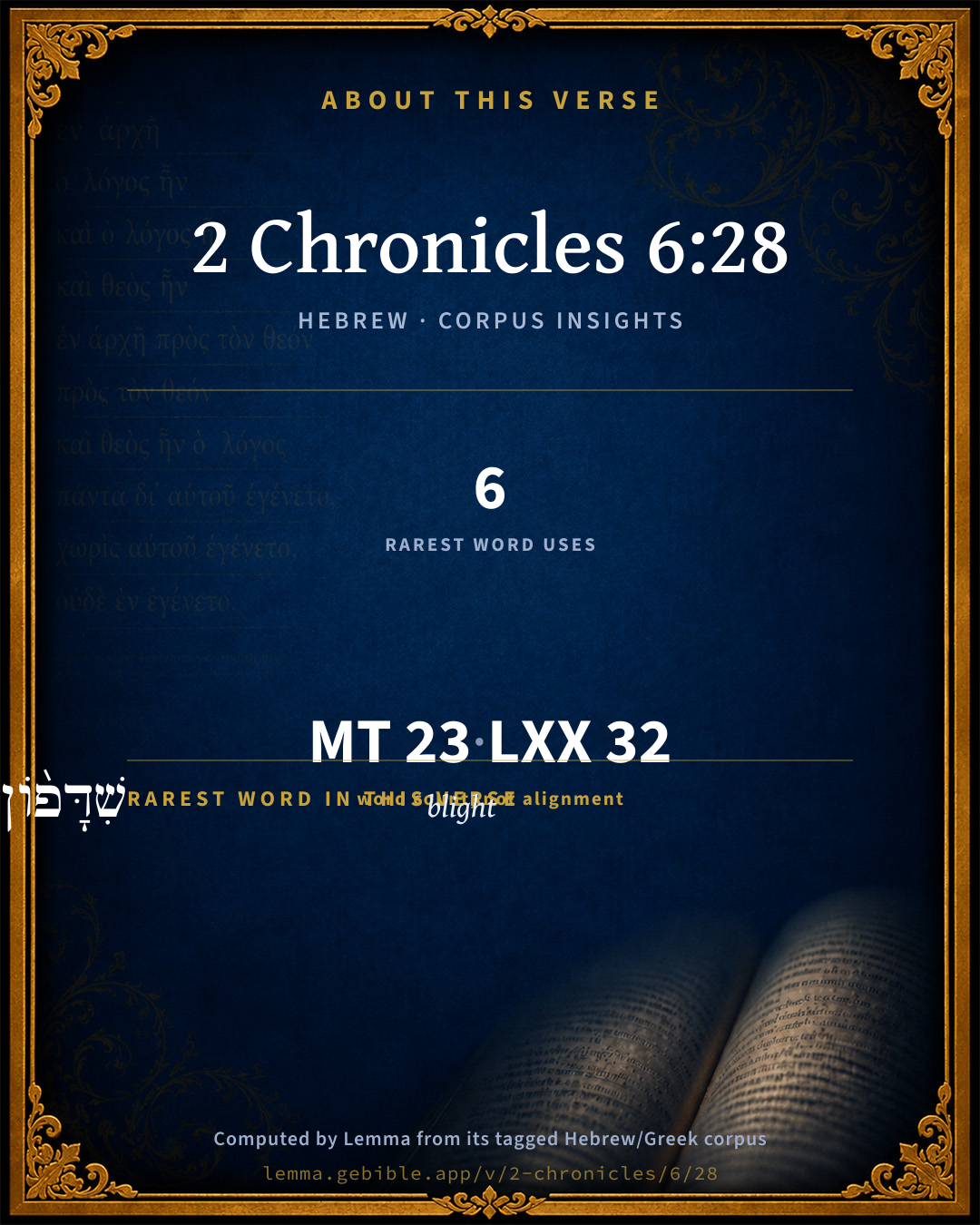
The rarest word here is שִׁדָּפ֨וֹן blight H7711 — appearing just 6 times in the whole Hebrew Bible.

Shared distinctive vocabulary

שִׁדָּפ֨וֹן blight H7711 occurs in 6 verses of the Hebrew Bible. Also found in:

Grammatical profile

  • 5 verbs
  • 13 nouns
  • 1 preposition
  • 4 conjunctions

Verb forms

  • יִהְיֶ֣ה Qal · Imperfect
  • יִֽ֠הְיֶה Qal · Imperfect
  • יִהְיֶ֔ה Qal · Imperfect
  • יָֽצַר Hiphil · Imperfect
  • אוֹיְבָ֖יו Qal · Participle Active

Repetition

Words recur within this verse — often emphatic in Hebrew:

  • יִהְיֶ֣ה to be H1961 ×3
  • בָאָ֗רֶץ land H776 ×2
  • כָּל all H3605 ×2
  • כִּֽי that H3588 ×4

Hebrew & Septuagint length

In English translation the verse runs 38 words from the Hebrew and 44 from the Septuagint (LXX English) — closely comparable.

A rough comparison of the two English renderings, which tokenize alike — not a word-level alignment.

Word counts can differ between the Hebrew and the Greek without any difference in meaning — e.g. the Hebrew direct-object marker אֵת has no separate Greek word, and Greek often adds the article ὁ.

In the original languages it is 23 Hebrew tokens and 32 Greek tokens — but the two are counted differently (Hebrew bundles its prefixes and suffixes into one token; the Greek is in lemma form), so that isn’t a like-for-like length.

Cross-references

17

Topical passages linked to 2 Chronicles 6:28 in the Treasury of Scripture Knowledge — connected by theme and wording, ordered by reader-vote popularity; previews shown in the World English Bible.

  • Ruth 1:1 It happened in the days when the judges judged, that there was a famine in the land. A certain man of Bethlehem Judah went to sojourn in the country of Moab, he, and his wife, and his two sons.
  • Joel 2:25 I will restore to you the years that the swarming locust has eaten, The great locust, the grasshopper, and the caterpillar, My great army, which I sent among you.
  • James 5:13 Is any among you suffering? Let him pray. Is any cheerful? Let him sing praises.
  • Revelation 9:3–11 Then out of the smoke came forth locusts on the earth, and power was given to them, as the scorpions of the earth have power.
  • Exodus 10:12–15 Yahweh said to Moses, "Stretch out your hand over the land of Egypt for the locusts, that they may come up on the land of Egypt, and eat every herb of the land, even all that the hail has left."
  • Leviticus 26:16 I also will do this to you: I will appoint terror over you, even consumption and fever, that shall consume the eyes, and make the soul to pine away; and you will sow your seed in vain, for your enemies will eat it.
  • Leviticus 26:25–26 I will bring a sword upon you, that will execute the vengeance of the covenant; and you will be gathered together within your cities: and I will send the pestilence among you; and you will be delivered into the hand of the enemy.
  • Deuteronomy 28:21–61 Yahweh will make the pestilence cleave to you, until he have consumed you from off the land, where you go in to possess it.
  • 1 Kings 8:37–40 If there be in the land famine, if there be pestilence, if there be blasting [or] mildew, locust [or] caterpillar; if their enemy besiege them in the land of their cities; whatever plague, whatever sickness there be;
  • 2 Kings 6:25–29 There was a great famine in Samaria: and, behold, they besieged it, until a donkey's head was sold for eighty [pieces] of silver, and the fourth part of a kab of dove's dung for five [pieces] of silver.
  • 2 Kings 8:1 Now Elisha had spoken to the woman, whose son he had restored to life, saying, Arise, and go you and your household, and sojourn wherever you can sojourn: for Yahweh has called for a famine; and it shall also come on the land seven years.
  • 2 Chronicles 12:2–5 It happened in the fifth year of king Rehoboam, that Shishak king of Egypt came up against Jerusalem, because they had trespassed against Yahweh,
  • 2 Chronicles 20:5–13 Jehoshaphat stood in the assembly of Judah and Jerusalem, in the house of Yahweh, before the new court;
  • 2 Chronicles 32:1 After these things, and this faithfulness, Sennacherib king of Assyria came, and entered into Judah, and encamped against the fortified cities, and thought to win them for himself.
  • 2 Chronicles 32:24 In those days Hezekiah was sick even to death: and he prayed to Yahweh; and he spoke to him, and gave him a sign.
  • Joel 1:4–7 What the swarming locust has left, the great locust has eaten. What the great locust has left, the grasshopper has eaten. What the grasshopper has left, the caterpillar has eaten.
  • Joel 1:11 Be confounded, you farmers! Wail, you vineyard keepers; For the wheat and for the barley; For the harvest of the field has perished.

Cross-references courtesy of OpenBible.info (CC BY 4.0).

Hebrew and Greek witnesses Masoretic Hebrew ↔ Greek Septuagint

The same verse in the two great witnesses to the Old Testament, shown verse-for-verse.

These are two independent witnesses, not word-aligned to each other, and the Septuagint is shown in lemma (dictionary) form.

Hebrew 2 Chronicles 6:28 Masoretic · Westminster Leningrad Codex

רָעָ֞ב כִּֽי יִהְיֶ֣ה בָאָ֗רֶץ דֶּ֣בֶר כִּֽי יִֽ֠הְיֶה שִׁדָּפ֨וֹן וְיֵרָק֜וֹן אַרְבֶּ֤ה וְחָסִיל֙ כִּ֣י יִהְיֶ֔ה כִּ֧י יָֽצַר ל֛וֹ אוֹיְבָ֖יו בְּאֶ֣רֶץ שְׁעָרָ֑יו כָּל נֶ֖גַע וְכָֽל מַחֲלָֽה

If there be in the land famine, if there be pestilence, if there be blasting or mildew, locust or caterpillar; if their enemies besiege them in the land of their cities; whatever plague or whatever sickness there be;

World English Bible · Public Domain

Greek LXX 2 Chronicles 6:28 Septuagint · lemma form

λιμός ἐάν γίγνομαι ἐπί ὁ γῆ θάνατος ἐάν γίγνομαι ἀνεμοφθορία καί ἴκτερος ἀκρίς καί βροῦχος ἐάν γίγνομαι ἐάν θλίβω αὐτός ὁ ἐχθρός κατέναντι ὁ πόλις αὐτός κατά πᾶς πληγή καί πᾶς πόνος

If there should be famine upon the land, if there should be death, a pestilent wind an blight; if there should be locust and caterpiller, and if the enemy should harass them before their cities: in whatever plague and whatever distress they may be;

LXX2012 (modern English Septuagint) · Public Domain

On this verse, Ellicott's Commentary for English Readers discusses the Septuagint’s reading. Read the note in Commentary ↓

Hebrew: Westminster Leningrad Codex (CC BY 4.0). Greek: Septuagint (public domain); English from LXX2012 (modern English Septuagint) (Public Domain). How the Septuagint differs from the Hebrew →

Commentary

Notes on 2 Chronicles 6:28 from classic Christian and Jewish commentators (each source and its license shown beneath its notes). The classic Christian expositions comment on the surrounding passage and are grouped to its opening verse, so a note may address several verses; the Jewish commentaries on the Tanakh (Rashi and others) are per-verse, so they appear only where the commentator wrote on this verse.

Lemma curates 59 commentaries, every one of them public domain or Creative Commons licensed, each selected and text-cleaned for this edition rather than reprinted as found. About our sources →

Tyndale Open Study Notes

Tyndale Open Resources

6:28-31 Petition 4: Solomon showed a special sensitivity to human suffering by including both the private sorrow of those whose pain is hidden and the public distress of those whose pain is apparent. The prayer is personal, appealing to God’s knowledge of each individual motive. A further appeal pleads for God’s instruction so that the pain of failure might lead the individual to follow God’s ways in the future.

Tyndale Open Study Notes — © Tyndale Open Resources, licensed CC BY-SA 4.0. Text via the HelloAO Bible API.

Geneva Bible (1599)

Geneva Bible translators

Hebrew, in the land of their gates.

Geneva Bible (1599) marginal notes — public domain. Text via Bolls.life.

Ellicott's Commentary for English Readers

(28) If their enemies besiege them.—If his enemies (Kings, “enemy”) besiege him. (So in 2Ch_6:34.)

In the cities of their land.—See margin, which correctly renders the Hebrew text. But the expression “in the land of his gates” is strange. LXX. has, “if the enemy afflict him before their cities;” Vulg., “et hostes, vastatis regionibus, portas obsederint civitatis;” Syriac and Arabic, “when enemies press them hard in their land and in their cities.” Perhaps “in the land (at) his gates” is right (Bertheau).

A Bible Commentary for English Readers, edited by Charles John Ellicott (1878–1897) — public domain. Text from a community e-Sword module.

The Cambridge Bible for Schools and Colleges

gen. ed. J. J. S. Perowne

28. dearth] R.V. famine (as in 1 Kings).

caterpillars] Rather some kind of locust; see Driver on Joe_1:4.

in the cities of their land] R.V. in the land of their cities (Heb. gates). The text is probably corrupt: read either, in any one of their cities (cp. LXX.), or, by making a breach in his gates (Heb. biphìrôç for b’ereç).

whatsoever sore] R.V. whatsoever plague. “Plague” is used here in the general sense of calamity, as in the phrase. The Ten Plagues of Egypt.

The Cambridge Bible for Schools and Colleges (gen. ed. J. J. S. Perowne; Cambridge University Press, 1878–1918) — public domain. Text from a community e-Sword module.

Haydock's Catholic Bible Commentary

Blasting, or mildew, (ærugo & aurugo.) The first has the colour of brass, the other of gold. both have nearly the same import. (Menochius) --- One of the terms is rendered, corrupt air; (3 Kings viii. 37.; Calmet) as this is one of the great causes why both plants and animals do not thrive. Septuagint, "corruption of the air and king’s evil, or yellow jaundice:" Greek: ikteros. (Haydock)

George Leo Haydock (1774–1849), Haydock's Catholic Family Bible and Commentary, 1859 edition — public domain. Excludes Psalms (Douay-Rheims chapter numbering differs from Protestant) and Deuterocanonical books (Catholic canon only).

The Pulpit Commentary

(See Lev_26:16-26; Deu_28:22-52, 59 2Ch_20:9) In the cities of their land. This, to represent correctly the Hebrew, should read, in the land of their gates. Reference probably is being made to the fact that law and justice and judgment were administered "in the gate of the city" (Deu_16:18 Deu_21:19; Jos_20:4) Thou only knowest. (so 1Ch_28:9) That they may fear thee. (Psa_130:4) In the absence of a healthy fear is involved both the absence of a healing hopefulness, and too probably the presence of recklessness.

The Pulpit Commentary (1880–1919), ed. H.D.M. Spence-Jones & Joseph S. Exell — public domain. Text from a community e-Sword module.

unfoldingWord translationNotes

Door43 World Missions Community

blight or mildew

These are agricultural terms that refer to the death of crops from either too little or too much rain, respectively.

locusts or caterpillars

A "locust" is a type of grasshopper that causes destruction by eating crops. The word "caterpillar" refers to an early growth stage of the locust.

prayers and requests are made by a person or by all your people Israel

This can be stated in active form. AT: "a person, or all your people Israel, prays and makes requests" (See: Active or Passive)

prayers and requests

The words "prayers" and "requests" mean basically the same thing and emphasize that the person is sincere as he makes his requests. (See: Doublet)

knowing the plague and sorrow in his own heart

Here "plague" is a metaphor for sin, and sin and sorrow are spoken of as being in people's hearts. AT: "knowing the sin and sorrow in his own heart" (See: Metaphor)

he spreads out his hands toward this temple

This was a way of showing that they were praying to the God of the temple. See how you translated "spread out his hands" in 2 Chronicles 6:12. (See: Symbolic Action)

for all his ways

Here "his ways" represents the person's behavior. AT: "for what he has done" (See: Metaphor)

so that they may walk in your ways

Here "walk in your ways" represents living and behaving the way God wants. AT: "so that they may live as you want them to" (See: Metaphor)

translationWords

famine

locust

gate

plague

heaven

forgive

know

fear

unfoldingWord translationNotes — © Distant Shores Media and the Door43 World Missions Community, licensed CC BY-SA 4.0. Source: git.door43.org/Door43/en_tn.

Rashi

Rabbi Shlomo Yitzchaki (Rashi)

whatsoever plague, whatsoever sickness (there be) The meaning is: I have mentioned to You pestilence, blast and mildew, being struck down [in battle], and lack of rainfall, and what else can I include, but whatsoever plague, whatsoever sickness there may be, and he pray and spread forth his hands toward this House, and this is what it says.

Rashi on the Tanakh — English translations: “The Judaica Press complete Tanach with Rashi, translated by A. J. Rosenberg” (CC BY 4.0); “Pentateuch with Rashi's commentary by M. Rosenbaum and A.M. Silbermann, 1929-1934” (public domain); “The Metsudah Tanach series, Lakewood, N.J” (CC BY 4.0); and “The Book of Joshua, Metsudah Publications, 1997” (CC BY 4.0). Text via Sefaria.

Lesson kit

Teaching starters — assembled from the data on this page, not authored interpretation. Every prompt links to the verse data it draws on. Edit before teaching.

2 Chronicles, in the Historical, opens this verse with 23 words (15 distinct Hebrew lemmas). Its most distinctive word is shᵉdêphâh (“blight”). A historical commentator’s framing appears above. Read the whole chapter for the surrounding context.

Discussion questions

  1. The word shᵉdêphâh carries the sense “blight.” How does it shape the verse?
  2. Deuteronomy 28:22 shares the word «blight» with this verse. How do the two illuminate each other?
  3. “to be” occurs 3× in this one verse. What is the effect of the repetition?
  4. The translations on this page render this verse differently — a whole-verse word diff, not a word-by-word alignment. What might account for the different wordings?
  5. The verb «יִהְיֶ֣ה» is Qal Imperfect. How does its form color the action?
  6. Reading how Tyndale Open Study Notes and Geneva Bible (1599) read this verse, where do the two commentators agree and where do they part?

Things to notice

Reading settings

Reading text

Shown beneath each verse's original-language words.

Old Testament
Old Testament edition

Read the OT as the Masoretic Hebrew (MT) or the Greek Septuagint (LXX).

English shown for the Greek Septuagint (in the Hebrew ↔ Greek comparison).

Comparing translations? Open the Compare panel on any verse page to stack up to four side by side.