
2 Kings 1:17

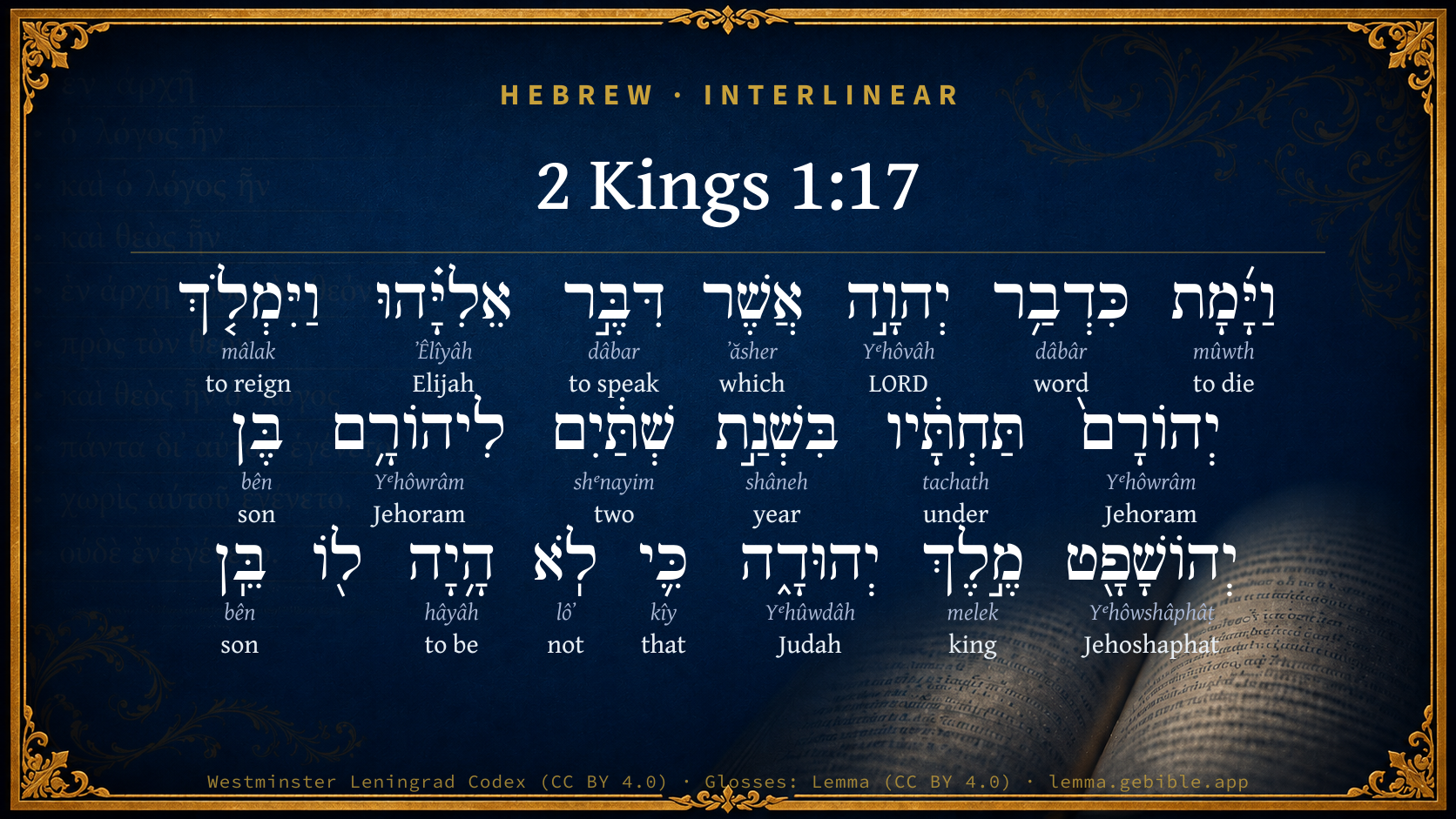
Hebrew (Westminster Leningrad Codex) 2 Kings 1:17 appears in the Hebrew Old Testament. The text above is from the Westminster Leningrad Codex. Each word links to its Strong’s number, a concise gloss, and parsing drawn from the Open Scriptures Hebrew Bible morphology. Click any word for its full Brown-Driver-Briggs (BDB) entry.
Download image
Cite this verse

2 Kings 1:17 (World English Bible). Public Domain. Lemma interlinear Bible study tool, https://lemma.gebible.app/v/2-kings/1/17.

Show BibTeX & RIS
BibTeX
RIS
English Translation
So he died according to the word of Yahweh which Elijah had spoken. Jehoram began to reign in his place in the second year of Jehoram the son of Jehoshaphat king of Judah; because he had no son.
World English Bible · Public Domain
Download a study sheet

One document with this verse’s original text, its word-by-word gloss line, the meaning frame, cross-references with their text, attributed commentary, and full source and license credits — printable, and it pastes into notes with its structure intact.

This verse Autodidact and up

Study sheet (.html) Plain text (.txt)

A passage Seminary Student

Up to 50 verses in one chapter. A passage sheet keeps up to 6 commentary sources and 12 cross-references per verse, in the order this page ranks them, and says so on the sheet whenever that leaves anything out. Ask for a single verse and you get the Autodidact verse sheet above.

Everything on this page stays free to read, with no account — the sheet is a download of what is already on screen, not access to it.

Want to remove ads? Support Godless Engineer
Compare translations 3

The same verse in 3 English versions, stacked beneath the original-language interlinear above. Click any original word for its lexicon entry.

Each is an independent rendering of the whole verse — the interlinear is not word-aligned to these translations.

Highlighted words mark where these versions differ — a whole-verse word diff, not a word-by-word alignment.

  • World English Bible Public Domain
    So he died according to the word of Yahweh which Elijah had spoken. Jehoram began to reign in his place in the second year of Jehoram the son of Jehoshaphat king of Judah; because he had no son.
  • King James Version Public Domain
    So he died according to the word of the LORD which Elijah had spoken. And Jehoram reigned in his stead in the second year of Jehoram the son of Jehoshaphat king of Judah; because he had no son.
  • unfoldingWord Literal Text CC BY-SA 4.0
    And he died, according to the word of Yahweh that Elijah had spoken. And Jehoram reigned in his place in the year of two to Jehoram, the son of Jehoshaphat, the king of Judah, because a son was not to him.

unfoldingWord Literal Text — © unfoldingWord, licensed CC BY-SA 4.0. Word-aligned USFM3 via Door43 (git.door43.org/unfoldingWord/en_ult).

Versions to compare (up to 4)

3 of 4 selected

Show all 18 translations

Every available English version of this verse, each an independent rendering of the whole verse.

  • World English Bible Public Domain
    So he died according to the word of Yahweh which Elijah had spoken. Jehoram began to reign in his place in the second year of Jehoram the son of Jehoshaphat king of Judah; because he had no son.
  • Berean Standard Bible Public Domain
    So Ahaziah died according to the word of the LORD that Elijah had spoken. And since he had no son, Jehoram succeeded him in the second year of the reign of Jehoram son of Jehoshaphat over Judah.
  • Majority Standard Bible Public Domain
    So Ahaziah died according to the word of the LORD that Elijah had spoken. And since he had no son, Jehoram succeeded him in the second year of the reign of Jehoram son of Jehoshaphat over Judah.
  • King James Version Public Domain
    So he died according to the word of the LORD which Elijah had spoken. And Jehoram reigned in his stead in the second year of Jehoram the son of Jehoshaphat king of Judah; because he had no son.
  • American Standard Version (1901) Public Domain
    So he died according to the word of Jehovah which Elijah had spoken. And Jehoram began to reign in his stead in the second year of Jehoram the son of Jehoshaphat king of Judah; because he had no son.
  • Revised Version (1885) Public Domain
    So he died according to the word of the LORD which Elijah had spoken. And Jehoram began to reign in his stead in the second year of Jehoram the son of Jehoshaphat king of Judah; because he had no son.
  • Geneva Bible (1599) Public Domain
    So he dyed according to the worde of the Lord which Eliiah had spoken. And Iehoram began to reigne in his steade, in the seconde yeere of Iehoram the sonne of Iehoshaphat King of Iudah, because he had no sonne.
  • Douay-Rheims (1899) Public Domain
    So he died according to the word of the Lord which Elias spoke, and Joram his brother reigned in his stead, in the second year of Joram the son of Josaphat king of Juda: because he had no son.
  • Young's Literal Translation Public Domain
    And he dieth, according to the word of Jehovah that Elijah spake, and Jehoram reigneth in his stead, in the second year of Jehoram son of Jehoshaphat king of Judah, for he had no son.
  • Literal Standard Version CC BY-SA 4.0
    And he dies, according to the word of YHWH that Elijah spoke, and Jehoram reigns in his stead, in the second year of Jehoram son of Jehoshaphat king of Judah, for he had no son.
  • Unlocked Literal Bible CC BY-SA 4.0
    So King Ahaziah died according to the word of Yahweh that Elijah had spoken. Joram began to reign in his place, in the second year of Jehoram son of Jehoshaphat king of Judah, because Ahaziah had no son.
  • unfoldingWord Literal Text CC BY-SA 4.0
    And he died, according to the word of Yahweh that Elijah had spoken. And Jehoram reigned in his place in the year of two to Jehoram, the son of Jehoshaphat, the king of Judah, because a son was not to him.
  • Darby Bible Public Domain
    And he died according to the word of Jehovah that Elijah had spoken. And Jehoram began to reign in his stead, in the second year of Jehoram the son of Jehoshaphat king of Judah; for he had no son.
  • World Messianic Bible Public Domain
    So he died according to the LORD’s word which Elijah had spoken. Jehoram began to reign in his place in the second year of Jehoram the son of Jehoshaphat king of Judah, because he had no son.
  • Webster's Bible Public Domain
    So he died according to the word of the LORD which Elijah had spoken. And Jehoram reigned in his stead in the second year of Jehoram the son of Jehoshaphat king of Judah; because he had no son.
  • Free Bible Version CC BY-SA 4.0
    Ahaziah died just as the Lord had said through Elijah. Because he had no son, Joram succeeded him as king in the second year of the reign of Jehoram, son of Jehoshaphat, king of Judah.
  • Bible in Basic English Public Domain
    So death came to him, as the Lord had said by the mouth of Elijah. And Jehoram became king in his place in the second year of the rule of Jehoram, son of Jehoshaphat, king of Judah; because he had no son.
  • JPS Tanakh (1917) Public Domain
    So he died according to the word of the LORD which Elijah had spoken. And Jehoram began to reign in his stead in the second year of Jehoram the son of Jehoshaphat king of Judah; because he had no son.

Literal Standard Version (2020), Covenant Press — licensed CC BY-SA 4.0. Text via the HelloAO Bible API (eBible.org). Unlocked Literal Bible (unfoldingWord) — licensed CC BY-SA 4.0. Text via the HelloAO Bible API (eBible.org). unfoldingWord Literal Text — © unfoldingWord, licensed CC BY-SA 4.0. Word-aligned USFM3 via Door43 (git.door43.org/unfoldingWord/en_ult). Free Bible Version, Dr. Jonathan Gallagher — licensed CC BY-SA 4.0. Text via the HelloAO Bible API (eBible.org).

Word by word

More ways to search: Search by grammar → Find every occurrence → Compare this word →

Practice this passage: Drill this verse → Learn its vocabulary →

יְהוֹרָם֙
Yᵉhôwrâm
H3088
“Jehoram”
Noun, Proper
Part of Speech
Noun
Type
Proper
Full BDB Definition

Origin: from H3068 and H7311

TWOT: None

Jehoram or Joram = "Jehovah is exalted" - son of king Jehoshaphat of Judah and himself king of Judah for 8 years; his wife was the wicked Athaliah who was probably the instigator for his returning the nation of Judah to the worship of Baal - son of king Ahab of the northern kingdom of Israel and king of Israel himself for 12 years; he was murdered by Jehu on the plot of land for which his father had murdered Naboth thus fulfilling the prophecy of Elijah to the very letter - a priest in the reign of Jehoshaphat
  1. וַיָּ֜מָת mûwth H4191 “and · to die” Conjunction + Verb, Qal, Sequential Imperfect, 3rd Person, Masculine, Singular
  2. כִּדְבַ֥ר dâbâr H1697 “like/as · word of” Preposition + Noun, Common, Masculine, Singular, Construct
  3. יְהוָ֣ה Yᵉhôvâh H3068 “LORD” Noun, Proper
  4. אֲשֶׁר ʼăsher H834 “which” Particle, Relative
  5. דִּבֶּ֣ר dâbar H1696 “to speak” Verb, Piel, Perfect, 3rd Person, Masculine, Singular
  6. אֵלִיָּ֗הוּ ʼÊlîyâh H452 “Elijah” Noun, Proper
  7. וַיִּמְלֹ֤ךְ mâlak H4427 “and · to reign” Conjunction + Verb, Qal, Sequential Imperfect, 3rd Person, Masculine, Singular
  8. תַּחְתָּ֔יו tachath H8478 “under · him” Preposition + Suffix, Personal, 3rd Person, Masculine, Singular
  9. בִּשְׁנַ֣ת shâneh H8141 “in/at · year of” Preposition + Noun, Common, Feminine, Singular, Construct
  10. שְׁתַּ֔יִם shᵉnayim H8147 “two” Adjective, Cardinal number, Feminine, Dual, Absolute
  11. לִיהוֹרָ֥ם Yᵉhôwrâm H3088 “to/for · Jehoram” Preposition + Noun, Proper
  12. בֶּן bên H1121 “son of” Noun, Common, Masculine, Singular, Construct
  13. יְהוֹשָׁפָ֖ט Yᵉhôwshâphâṭ H3092 “Jehoshaphat” Noun, Proper
  14. מֶ֣לֶךְ melek H4428 “king of” Noun, Common, Masculine, Singular, Construct
  15. יְהוּדָ֑ה Yᵉhûwdâh H3063 “Judah” Noun, Proper
  16. כִּ֛י kîy H3588 “that” Conjunction
  17. לֹֽא lôʼ H3808 “not” Particle, Negative
  18. הָ֥יָה hâyâh H1961 “to be” Verb, Qal, Perfect, 3rd Person, Masculine, Singular
  19. בֵּֽן bên H1121 “son” Noun, Common, Masculine, Singular, Absolute

About this verse

These counts appear in no published source. They are computed here, from the morphology-tagged text and Lemma’s own curated glosses. What Lemma adds →

21
words
18
distinct lemmas
Historical
section

Shared distinctive vocabulary

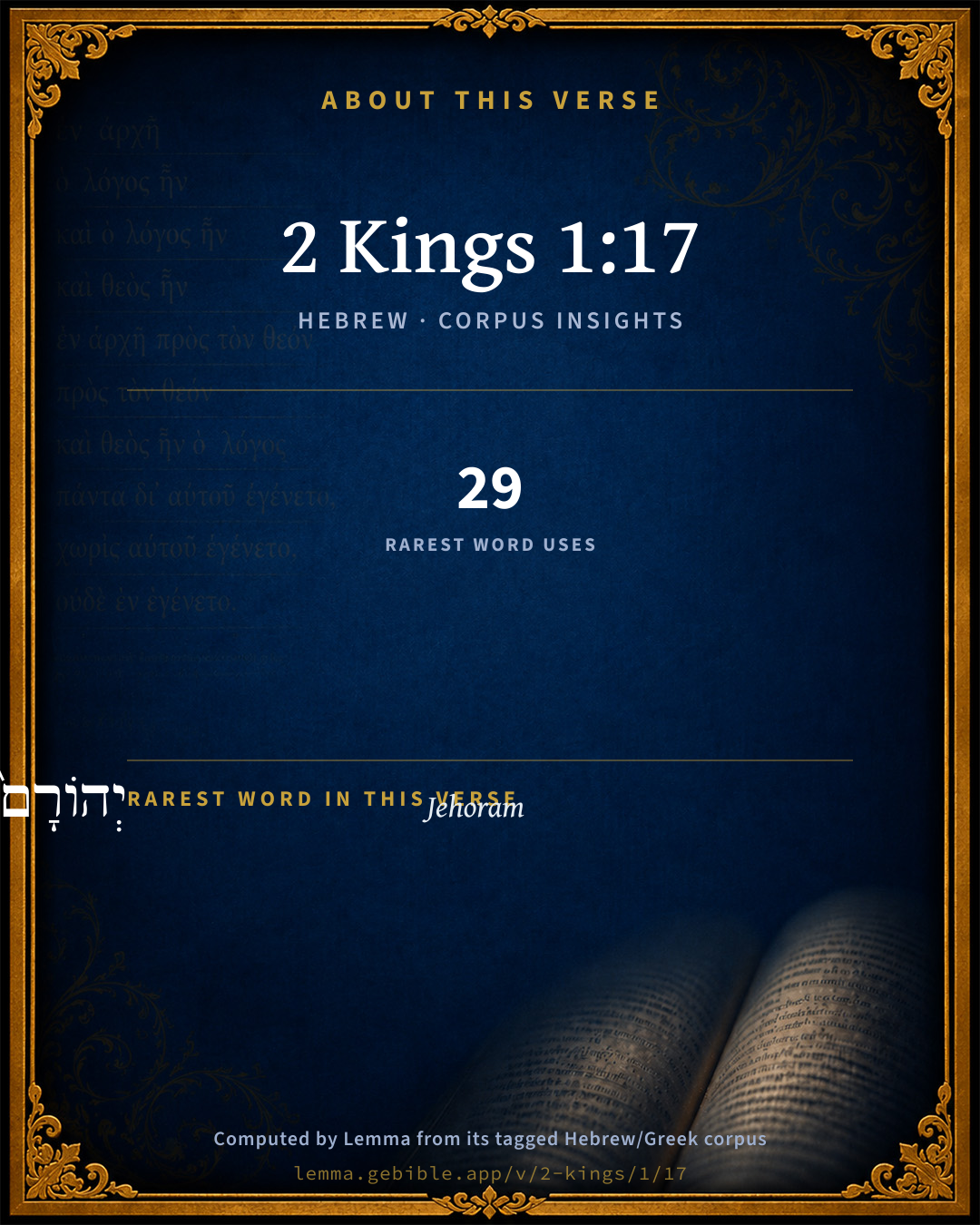
יְהוֹרָם֙ Jehoram H3088 occurs in 26 verses of the Hebrew Bible. Also found in:

Grammatical profile

  • 4 verbs
  • 11 nouns
  • 1 adjective
  • 2 prepositions
  • 1 conjunction
  • 2 particles

Verb forms

  • וַיָּ֜מָת Qal · Sequential Imperfect
  • דִּבֶּ֣ר Piel · Perfect
  • וַיִּמְלֹ֤ךְ Qal · Sequential Imperfect
  • הָ֥יָה Qal · Perfect

Repetition

Words recur within this verse — often emphatic in Hebrew:

  • יְהוֹרָם֙ Jehoram H3088 ×2
  • בֶּן son H1121 ×2

Hebrew & Septuagint length

In English translation the verse runs 38 words from the Hebrew and 14 from the Septuagint (LXX English) — the Septuagint runs noticeably shorter here. See the side-by-side →

A rough comparison of the two English renderings, which tokenize alike — not a word-level alignment.

Word counts can differ between the Hebrew and the Greek without any difference in meaning — e.g. the Hebrew direct-object marker אֵת has no separate Greek word, and Greek often adds the article ὁ.

Cross-references

3

Topical passages linked to 2 Kings 1:17 in the Treasury of Scripture Knowledge — connected by theme and wording, ordered by reader-vote popularity; previews shown in the World English Bible.

  • 2 Kings 3:1 Now Jehoram the son of Ahab began to reign over Israel in Samaria in the eighteenth year of Jehoshaphat king of Judah, and reigned twelve years.
  • 1 Kings 22:51 Ahaziah the son of Ahab began to reign over Israel in Samaria in the seventeenth year of Jehoshaphat king of Judah, and he reigned two years over Israel.
  • 2 Kings 8:16–17 In the fifth year of Joram the son of Ahab king of Israel, Jehoshaphat being then king of Judah, Jehoram the son of Jehoshaphat king of Judah began to reign.

Cross-references courtesy of OpenBible.info (CC BY 4.0).

Hebrew and Greek witnesses Masoretic Hebrew ↔ Greek Septuagint

The same verse in the two great witnesses to the Old Testament, shown verse-for-verse.

Here the Septuagint runs noticeably shorter than the Hebrew — LXX2012 (modern English Septuagint) 14 words vs World English Bible 38. A rough length comparison of the two English translations, not a word-level alignment — read both below.

These are two independent witnesses, not word-aligned to each other, and the Septuagint is shown in lemma (dictionary) form.

Hebrew 2 Kings 1:17 Masoretic · Westminster Leningrad Codex

וַיָּ֜מָת כִּדְבַ֥ר יְהוָ֣ה אֲשֶׁר דִּבֶּ֣ר אֵלִיָּ֗הוּ וַיִּמְלֹ֤ךְ יְהוֹרָם֙ תַּחְתָּ֔יו בִּשְׁנַ֣ת שְׁתַּ֔יִם לִיהוֹרָ֥ם בֶּן יְהוֹשָׁפָ֖ט מֶ֣לֶךְ יְהוּדָ֑ה כִּ֛י לֹֽא הָ֥יָה ל֖וֹ בֵּֽן

So he died according to the word of Yahweh which Elijah had spoken. Jehoram began to reign in his place in the second year of Jehoram the son of Jehoshaphat king of Judah; because he had no son.

World English Bible · Public Domain

Greek LXX 2 Kings 1:17 Septuagint · lemma form

καί ἀποθνήσκω κατά ὁ ῥῆμα κύριος ὅς λαλέω ηλιου

So he died according to the word of the Lord which Eliu has spoken.

LXX2012 (modern English Septuagint) · Public Domain

On this verse, Keil & Delitzsch discusses the Septuagint’s reading. Read the note in Commentary ↓

Hebrew: Westminster Leningrad Codex (CC BY 4.0). Greek: Septuagint (public domain); English from LXX2012 (modern English Septuagint) (Public Domain). How the Septuagint differs from the Hebrew →

Targum (Aramaic paraphrase)

1

The Targum is the ancient Jewish Aramaic paraphrase of the Hebrew Scriptures — an interpretive translation, not the Hebrew text itself. Onkelos (literal) and Pseudo-Jonathan (expansive) render the Torah, and Jonathan the Prophets. Coverage is partial: where no permissively-licensed English translation exists for a verse, only the Aramaic is shown. This is verse-level text, not a word-by-word alignment to the Hebrew.

  1. Targum Jonathan Prophets (Joshua–Malachi)
    וּמִית כְּפִתְגָמָא דַייָ דְמַלֵיל אֵלִיָהוּ וּמְלַךְ יְהוֹרָם תְּחוֹתוֹהִי בִּשְׁנַת תַּרְתֵּין לִיהוֹרָם בַּר יְהוֹשָׁפָט מַלְכָּא דְבֵית יְהוּדָה אֲרֵי לָא הֲוָה לֵיהּ בַּר:

    (no public-domain English translation for this verse)

    Targum Jonathan — Aramaic: “Mikraot Gedolot” (public domain). English: “Sefaria Community Translation” (CC0 1.0 (public-domain dedication)); “London "Chaldee Paraphrase," 1871” (public domain). Text via Sefaria.

Commentary

Notes on 2 Kings 1:17 from classic Christian and Jewish commentators (each source and its license shown beneath its notes). The classic Christian expositions comment on the surrounding passage and are grouped to its opening verse, so a note may address several verses; the Jewish commentaries on the Tanakh (Rashi and others) are per-verse, so they appear only where the commentator wrote on this verse.

Lemma curates 59 commentaries, every one of them public domain or Creative Commons licensed, each selected and text-cleaned for this edition rather than reprinted as found. About our sources →

Jamieson, Fausset & Brown

Robert Jamieson, A. R. Fausset & David Brown

AHAZIAH DIES, AND IS SUCCEEDED BY JEHORAM. (Kg2 1:17-18)

Jehoram--The brother of Ahaziah (see on Kg2 3:1).

Next: 2 Kings Chapter 2

Jamieson, Fausset & Brown — Commentary Critical and Explanatory on the Whole Bible (1871) — public domain (CC PDM 1.0). Text via the HelloAO Bible API.

Trapp's Complete Commentary

John Trapp

2Ki 1:17 So he died according to the word of the LORD which Elijah had spoken. And Jehoram reigned in his stead in the second year of Jehoram the son of Jehoshaphat king of Judah; because he had no son.

Ver. 17. So he died.] Some wicked men live long, that they may aggravate their judgment: others die sooner, that they may hasten it.

In the second year of Jehoram.] See on 1Ki 22:50.

John Trapp, A Commentary or Exposition upon All the Books of the Old and New Testament (1647–1656) — public domain. Text from a community e-Sword module.

Joseph Benson's Commentary

2Ki 1:17. Jehoram reigned in his stead — Namely, his brother, because he had no son. In the second year of Jehoram the son of Jehoshaphat — To avoid confusion, the reader should take notice, that in the course of this history, there is mention made of two Jehorams; one the second son of Ahab, who succeeded Ahaziah, and was king of Israel; the other, the heir of Jehoshaphat, who reigned in Judah. By comparing 2Ki 3:1, and 2Ki 8:16, it will appear that there is a considerable difference in the reading of the dates, which made Houbigant suppose that some errors have crept into the text. To reconcile, however, the above-mentioned passages, some have supposed that Jehoshaphat, in his seventeenth year, when he went to Ahab, and with him to Ramoth-gilead, appointed his son Jehoram his viceroy, and (in case of his death) his successor. In the second year from that time, when Jehoram was thus made vice-king in his father’s stead and absence, this Jehoram, Ahab’s son, began to reign: and in the fifth year of the reign of this Jehoram, son of Ahab, which was about the twenty- fourth year of Jehoshaphat’s reign, Jehoram, son of Jehoshaphat, was made king of Judah, together with his father. This supposition, if allowed, will, in a great degree, clear up the difficulty.

Joseph Benson's Commentary on the Old and New Testaments (1811–1818) — public domain. Text from a community e-Sword module.

Whedon's Commentary on the Bible

Daniel D. Whedon

DEATH OF AHAZIAH, 2Ki_1:17-18.

17. He died according to the word of the Lord — His death, like that of the two companies of fifties, was a judgment from Heaven. It would not do to punish those messengers of the king for insolence towards Jehovah and his prophet, and let the king himself go clear. So this impious monarch is made to drag out his last days under the consciousness of being an object of Jehovah’s wrath.

Jehoram reigned in his stead — This Jehoram was a brother of Ahaziah, and succeeded him on the throne because he had no son.

In the second year of Jehoram the son of Jehoshaphat — On the probable reason for this likeness of names among the kings of the two rival kingdoms, see note on 1Ki_22:44. According to 1Ki_22:42, Jehoshaphat reigned twenty-five years, and according to 2Ki_3:1, Ahab’s son, Jehoram, began to reign in the eighteenth year of Jehoshaphat, whence it appears, as our margin expresses it, that Jehoshaphat’s son, Jehoram, was made prorex some years before his father’s death. Compare also 2Ch_21:3. But according to 2Ki_8:16, Jehoshaphat’s Jehoram began to reign in the fifth year of Ahab’s Jehoram, which, according to the above statements, would be the twenty-third year of Jehoshaphat. Now, how could Ahab’s Jehoram begin to reign in the second year of Jehoshaphat’s Jehoram, and yet the latter begin to reign in the fifth year of the former? A solution of the difficulty, in which Usher, Lightfoot, Patrick, Keil, and Wordsworth substantially agree, is thus stated by the last-named commentator: “Jehoshaphat made two sessions of sovereignty to his son Jehoram — one partial and temporary, the other total and final. The first was made in the seventeenth year of his reign, because he then quitted Jerusalem in order to join Ahab against the Syrians, (1 Kings 22;) he then left his son Jehoram to act as viceroy in his absence. But in the twenty-third year of his reign Jehoshaphat associated his son Jehoram with him in the entire sovereignty, and therefore the eight years of that son (2Ki_8:17) are not to be reckoned from Jehoshaphat’s death, but from the twenty-third year of his reign, two years before his death.”

Daniel D. Whedon (gen. ed.), Commentary on the Old and New Testaments (1874–1909) — public domain. Text from a community e-Sword module.

Keil & Delitzsch

C. F. Keil & F. Delitzsch

When Ahaziah died, according to the word of the Lord through Elijah, as he had no son, he was followed upon the throne by his brother Joram, "in the second year of Joram the son of Jehoshaphat, king of Judah." This statement is at variance both with that in Kg2 3:1, to the effect that Joram began to reign in the eighteenth year of Jehoshaphat, and with that in Kg1 22:52, viz., that Ahaziah ascended the throne in the seventeenth year of the reign of Jehoshaphat, which lasted twenty-five years, and also with the statement in Kg2 8:16, that Joram of Judah became king over Judah in the fifth year of Joram of Israel. If, for example, Ahaziah of Israel died after a reign of not quite two years, at the most a year and a half, in the eighteenth year of Jehoshaphat; as Jehoshaphat himself reigned twenty-five years, he cannot have died till the seventh year of Joram of Israel, and his son Joram followed him upon the throne. The last of these discrepancies may be solved very simply, from the fact that, according to Kg2 8:16, Jehoshaphat was still king when his son Joram began to reign so that Jehoshaphat abdicated in favour of his son about two years before his death. And the first discrepancy (that between Kg2 1:17 and Kg1 3:1) is removed by Usher (Annales M. ad a.m. 3106 and 3112), Lightfoot, and others, after the example of the Seder Olam, by the assumption of the co-regency. According to this, when Jehoshaphat went with Ahab to Ramoth in Gilead to war against the Syrians, in the eighteenth year of his reign, which runs parallel to the twenty-second year of the reign of Ahab, he appointed his son Joram to the co-regency, and transferred to him the administration of the kingdom. It is from this co-regency that the statement in Kg2 1:17 is dated, to the effect that Joram of Israel became king in the second year of Joram of Judah. This second year of the co-regency of Joram corresponds to the eighteenth year of the reign of Jehoshaphat (Kg2 3:1). And in the fifth year of his co-regency Jehoshaphat gave up the reins of government entirely to him. It is from this point in time, i.e., from the twenty-third year of Jehoshaphat, that we are to reckon the eight years of the reign of Joram (of Judah), so that he only reigned six years more after his father's death.

(Note: Wolff indeed boldly declares that "the co-regency of Joram is a pure fiction, and the biblical historians do not furnish the slightest warrant for any such supposition" (see p. 628 of the treatise mentioned at p. 187); but he cannot think of any other way of reconciling the differences than by making several alterations in the text, and inventing a co-regency in the case of the Israelitish king Ahaziah. The synchronism of the reigns of the Israelitish kings necessarily requires the solution adopted in the text. For if Joram of Israel, who began to reign in the eighteenth year of Jehoshaphat and reigned twelve years (Kg2 3:1), was slain at the same time as Ahaziah of Judah (Kg2 9:24-27), and Ahaziah of Judah reigned about one year and his predecessor Joram about eight years, so that the two together certainly reigned fully eight years; Joram of Judah must have ascended the throne four years after Joram of Israel, i.e., in the twenty-third year of Jehoshaphat, which runs parallel to the fifty year of Joram of Israel. Consequently the twenty-five years of Jehoshaphat are to be reduced to twenty-three in reckoning the sum-total of the years embraced by the period of the kings. It is true that there is no analogy for this combination of the years of the reigns of two kings, since the other reductions of which different chronologists are fond are perfectly arbitrary, and the case before us stands quite alone; but this exception to the rule is indicated clearly enough in the statement in Kg2 8:16, that Joram began to reign while Jehoshaphat was (still) king. When, however, Thenius objects to this mode of reconciling the differences, which even Winer adopts in the third edition of his bibl. Real-Wצrterbuch, i. p. 539, on the ground that the reign of Joram is dated most precisely in Kg1 22:51 and Ch2 21:1, Ch2 21:5,Ch2 21:20, from the death of Jehoshaphat, and that an actual co-regency, viz., that of Jotham, is expressly mentioned in Kg2 15:5, which does not render it at all necessary to carry the years of his reign into those of his father's, this appeal to the case of Jotham cannot prove anything, for the simple reason that the biblical text knows nothing of any co-regency of Jotham and Uzziah, but simply states that when Uzziah was smitten with leprosy, his son Jotham judged the people of the land, but that he did not become king till after his father's death (Kg2 15:5, Kg2 15:7; Ch2 26:21, Ch2 26:23). It is indeed stated in Kg1 22:51 and Ch2 26:1, Ch2 26:5,Ch2 26:20, that Jehoshaphat died and his son Joram became king, which may be understood as meaning that he did not become king till after the death of Jehoshaphat; but there is no necessity to understand it so, and therefore it can be very easily reconciled with the more precise statement in Kg2 8:16, that Joram ascended the throne during the reign of Jehoshaphat, whereas the assertion of Thenius, that the circumstantial clause יהוּדה מלך ויהושׁפט in Kg2 8:16 is a gloss, is not critically established by the absence of these words from the lxx, Syr., and Arabic, and to expunge them from the text is nothing but an act of critical violence.)

We have no information as to the reason which induced Jehoshaphat to abdicate in favour of his son two years before his death; for there is very little probability in the conjecture of Lightfoot (Opp. i. p. 85), that Jehoshaphat did this when he commenced the war with the Moabites in alliance with Joram of Israel, for the simple reason that the Moabites revolted after the death of Ahab, and Joram made preparations for attacking them immediately after their rebellion (Kg2 3:5-7), so that he must have commenced this expedition before the fifth year of his reign.

Keil & Delitzsch — Biblical Commentary on the Old Testament (1861–1891) — public domain (CC PDM 1.0). Text via the HelloAO Bible API. (Old Testament only.)

Tyndale Open Study Notes

Tyndale Open Resources

1:17 The second year of the reign of Jehoram was 852 BC, during Jehoram’s co-regency with his father, Jehoshaphat (853–848 BC).

Tyndale Open Study Notes — © Tyndale Open Resources, licensed CC BY-SA 4.0. Text via the HelloAO Bible API.

Geneva Bible (1599)

Geneva Bible translators

Jehoshaphat going to battle against the Syrians, made his son Jehoram king in the 17th year of his reign: and in the 18th year which was the second year of his son, Jehoram the son of Ahab reigned in Israel: and in the fifth year of this Jehoram Jehoshaphat died, and the kingdom of Judah was confirmed to his son.

Geneva Bible (1599) marginal notes — public domain. Text via Bolls.life.

Adam Clarke's Commentary

Verse 17. And Jehoram reigned in his stead] The Vulgate, Septuagint, and Syriac say, Jehoram HIS BROTHER reigned in his stead, in the second year of Jehoram. There were two Jehorams who were contemporary: the first, the son of Ahab, brother to Ahaziah, and his successor in the kingdom of Israel; the second, the son of Jehoshaphat, king of Judah, who succeeded his father in Judah. But there is a difficulty here: "How is it that Jehoram the brother of Ahaziah began to reign in the second year of Jehoram son of Jehoshaphat, seeing that, according to 2Kg 3:1, he began his reign in the eighteenth year of the reign of Jehoshaphat; and, according to 2Kg 8:16, Jehoram son of Jehoshaphat began to reign in the fifth year of Jehoram king of Israel?" Calmet and others answer thus: "Jehoram king of Israel began to reign in the eighteenth year of Jehoshaphat king of Judah, which was the second year after this same Jehoshaphat had given the viceroyalty to his son Jehoram; and afterwards Jehoshaphat communicated the royalty to Jehoram his successor, two years before his death, and the fifth year of Jehoram, king of Israel." Dr. Lightfoot takes another method: -

"Observe," says he, "these texts, 1Kg 22:51: Ahaziah the son of Ahab began to reign over Israel in Samaria the seventeenth year of Jehoshaphat king of Judah, and reigned two years; and 2Kg 1:17: And Ahaziah died according to the word of the Lord which Elijah had spoken, and Jehoram reigned in his stead, in the second gear of Jehoram son of Jehoshaphat king of Judah; and 2Kg 3:1: Now Jehoram the son of Ahab began to reign over Israel in Samaria the eighteenth year of Jehoshaphat king of Judah. By these scriptures it is most plain, that both Jehoram the son of Jehoshaphat, and Ahaziah the son of Ahab, began to reign in the seventeenth of Jehoshaphat; for who sees not in these texts that Jehoshaphat's eighteenth, when Jehoram the son of Ahab began to reign, is called the second year of Jehoram the son of Jehoshaphat? Now Jehoshaphat's reign was not yet expired by eight or nine years, for this was in his seventeenth year, and he reigned twenty-five years, 1Kg 22:42; nor was Ahab's reign expired by two or three years, for this was in his twentieth year, and he reigned twenty-two years. 1Kg 16:29. But the reason why both their sons came thus into their thrones in their lifetime, and both in the same year, was because their fathers, Jehoshaphat and Ahab, were both engaged in the war against the Syrians about Ramoth-gilead: and while they were providing for it, and carrying it on, they made their sons viceroys, and set them to reign in their stead, while they were absent or employed upon that expedition." This is very probable, and seems well supported by the above texts, and would solve all the difficulties with which many have been puzzled and not a few stumbled, had we sufficient evidence for the viceroyalty here mentioned.

Adam Clarke's Commentary on the Bible (1810–1826) — public domain. Text from a community e-Sword/MySword module.

Ellicott's Commentary for English Readers

(17) And Jehoram.—LXX. (Alex.), Syriac, and Vulgate add “his brother,” an expression which has fallen out of the Hebrew text, owing to its resemblance to the next (tahtâw, “in his stead”). (Comp. 2Ki_3:1, “son of Ahab.”)

In the second year of Jehoram.—Vat. LXX., “in the eighteenth year,” which is probably right. (Comp. 1Ki_22:52, “Ahaziah . . . reigned over Israel in . . . the seventeenth year of Jehoshaphat . . . and he reigned two years.” Either, therefore, our present Heb. text is corrupt, or the compiler followed a different source in this place.) Thenius proposes the reading, “in the twenty-second year of Jehoshaphat,” in place of “in the second year of Jehoram the son of Jehoshaphat.”

(17, 18) Concluding remarks added by the compiler.

A Bible Commentary for English Readers, edited by Charles John Ellicott (1878–1897) — public domain. Text from a community e-Sword module.

The Cambridge Bible for Schools and Colleges

gen. ed. J. J. S. Perowne

17. So he died] The whole narrative bears marks of extreme simplicity. Nothing but the barest facts are given, and no attempt made to explain or account for any part of the history. The touches which Josephus adds to the story mark the difference between the early and the later record. He describes the hasty return of the messengers and the king’s astonishment thereat. They relate how the prophet had hindered their further journey. The first captain threatens force to the prophet if he refuse to obey the king’s order, and the second is equally imperative. The third captain is described as prudent and exceeding gentle in disposition, and as speaking friendly to Elijah, and explaining that he himself, as well as the other two bands had only come because they were forced to do so, and that this, of course, the prophet knew. The language and demeanour were acceptable to Elijah and so he followed the captain to Samaria.

which Elijah had spoken] We are told nothing of what must have been a most solemn interview, nor how it came to pass that the prophet was allowed to go without any punishment. Elijah disappears, as is usual in the history, without a word to tell us of his whereabouts.

And Jehoram reigned in his stead] This was the brother of Ahaziah. The LXX. omits in this verse ‘And Jehoram … no son.’ But instead of it after verse 18 there is a long addition, substantially like 2Ki_3:1-3 below, but the LXX. has the same words in that place also.

in the second year of Jehoram the son of Jehoshaphat king of Judah] It is extremely difficult to make this statement fit with the rest of the chronological details of the books of Kings. The accession of Jehoram of Israel is here fixed in the second year of Jehoram of Judah, but in 2Ki_3:1 the same event is assigned to the eighteenth year of Jehoshaphat king of Judah. Now Jehoshaphat reigned 25 years (1Ki_22:42). If therefore the two statements are correct Jehoram of Judah must, in some form or other, have been counted as king along with his father from about the 17th year of Jehoshaphat’s reign. But according to 2Ki_8:16, it was in the 5th year of Jehoram of Israel that Jehoram of Judah began his reign. This of course must refer to his independent reign. But Jehoshaphat’s reign of 25 years causes some difficulty, unless we suppose, as the Jews are said to have reckoned, that 25 years might really be only 23 and small portions of 2 other years. Then Jehoram of Israel, who began to reign in the 18th year of Jehoshaphat, might have reigned little more than 5 years when Jehoshaphat died, and when Jehoram of Judah began the 8 years of his independent reign, he having reigned about the same period along with his father Jehoshaphat. This is the generally accepted settlement of the dates, but the chronology of the two kingdoms is far from being clearly marked. Nor is there satisfactory evidence that a son was ever king along with his father.

The Cambridge Bible for Schools and Colleges (gen. ed. J. J. S. Perowne; Cambridge University Press, 1878–1918) — public domain. Text from a community e-Sword module.

Albert Barnes' Notes on the Bible

The similarity of names in the two royal houses of Israel and Judah at this time, and at no other, seems to be the consequence of the close ties which united the two reigning families, and is well noted among the “undesigned coincidences” of the Old Testament. The accession of the Israelite Jehoram (Ahab’s brother) took place, according to 2Ki 3:1, in the eighteenth year of Jehoshaphat. Jehoram of Judah perhaps received the royal title from his father as early as his father’s sixteenth year, when he was about to join Ahab against the Syrians; the same year might then be called either the eighteenth year of Jehoshaphat or the second year of Jehoram.

Albert Barnes' Notes on the Bible (1834–1885) — public domain. Text from a community e-Sword/MySword module.

Haydock's Catholic Bible Commentary

The second year of Joram, &c., counted from the time that he was associated to the throne of his father Josaphat; (Challoner) so that it is said that he reigned also in the 18th year of Josaphat, chap. iii. 1. See also chap. viii. 16. To obviate there apparent contradictions, chronologists suppose that Joram reigned over Israel in the 18th of Josaphat, king of Juda, and in the second year after the latter had appointed his son Joram viceroy. He was associated with his father on the throne two years before his death, and in the 5th of Joram, king of Israel. Examples of this kind are frequent among the Hebrews, and particularly among the Persians, whose chronology is thus rendered very difficult. Why should we allow that the numbers are erroneous, when this explanation will suffice? (Calmet) --- Grotius leaves the matter undecided. (Du Hamel) --- Capel (Crit. p. 414.) maintains that the numbers have been ill transcribed; and so does Houbigant, who asserts that such a mode of writing whould not be tolerated in a profane author; thus the mention of different dates, without intimating how they are to be reconciled. If we should read, that Heraclius began to reign "in the 18th year of Chosroes," and a little after, that he ascended the throne "in the second year of the son of Chosroes," without ever specifying how Heraclius began his reign at two different periods, who would not suspect a mistake? Is it not more rational to throw the blame on the transcriber, than on the author? The modern chronologists seem to have invented the idea of viceroys and simultaneous kings, among the Hebrews, merely to get over difficulties; though the Scripture be entirely silent on this head. Houbigant would therefore read, "in the 22d year of Josaphat," as the mention of Joram seems here improper, (absurda) his father reigning 25 years. Ochozias began to reign when Josaphat had almost completed his 17th year. See 3 Kings xxii. 52. (Haydock) --- His brother is not specified in Hebrew, Chaldean, Arabic, and in some copies of the Septuagint, but it is in most others, as well as in the Syriac, (Calmet) Josephus, &c., (Haydock) and this is the common opinion. The Roman edition here inserts (Calmet) after Elias spoke, (18) "And the, &c....and Joram," &c., nearly as chap. iii. 1, 2, 3; only for father, it substitutes, "not like his brothers;" and adds, "the wrath of the Lord was enkindled against the house of Achab." No mention is made of the second year of Joram, &c., (Haydock) in any edition of the Septuagint. (Capel) --- In the mean time Josaphat, being returned from the unfortunate expedition with Achab, set his kingdom in order, purifying it from all the vestiges of idolatry, as much as he was able, and appointing proper judges, 2 Paralipomenon xix.

George Leo Haydock (1774–1849), Haydock's Catholic Family Bible and Commentary, 1859 edition — public domain. Excludes Psalms (Douay-Rheims chapter numbering differs from Protestant) and Deuterocanonical books (Catholic canon only).

Matthew Poole's English Annotations

Jehoram; Ahaziah’s brother, 2Ki 3:1, for he had no son to succeed him, as it here follows.

In the second year of Jehoram the son of Jehoshaphat: other passages of Scripture seem to clash with this, as that Ahaziah, who reigned but two years, begun his reign in Jehoshaphat’s seventeenth year, 1Ki 22:51; and therefore this Jehoram must begin his reign in Jehoshaphat’s nineteenth year; and therefore before the reign of Jehoram, Jehoshaphat’s son; and that Jehoram the son of Jehoshaphat began to reign in the fifth year of Joram, Ahab’s son, 2Ki 8:16.

Answ. These difficulties are easily resolved by this consideration, that it was a usual practice among kings in former ages, to make their sons sometimes their viceroys and deputies in the administration of the kingdom; and sometimes formally kings in conjunction with themselves, and whilst they lived; whereof there are instances, both in profane history, among the Persians, Greeks, and Romans, and in the sacred Scripture, as in David, 1Ch 23:1; 29:22, in Uzziah, 2Ch 26:21, and (to come close to the point) in Jehoshaphat, 2Ki 8:16; who in his seventeenth year, when he went to Ahab, and with him to Ramoth-gilead, appointed his son Jehoram his viceroy, and (in case of his death) his successor. In the second year from that time, when Jehoram was thus made vice-king in his father’s stead and absence, this Jehoram, Ahab’s son, began to reign; and in the fifth year of the reign of this Joram, son of Ahab, which was about the twenty-fourth year of Jehoshaphat’s reign,

Jehoram the son of Jehoshaphat was formally made king of Judah, together with his father; or whilst Jehoshaphat lived, and was king of Judah also. And so all the places agree. To which some add, that this verse, or this part of it, wherein the difficulty consists, is wanting in some ancient copies, and is omitted by the LXX. interpreters; which is far more prudent and pious to grant, than upon such chronological difficulties to question the truth and divinity of the Holy Scriptures.

Matthew Poole's English Annotations on the Holy Bible (1683–1685) — public domain. Text from a community e-Sword/MySword module.

The Pulpit Commentary

Ver. 17a. So he died according to the word of the Lord which Elijah had spoken. Not only did he die in consequence of his fall without once quitting his bed, but his death was, as Elijah had said, a judgment on his sin in sending to consult Baal-zebub.

REIGN OF JEHORAM.

Ver. 17b. And Jehoram or, Joram LXX, "whom Jehovah exalts;" another evidence that Ahab did not regard himself as having abandoned altogether the worship of Jehovah (see the comment on 1Ki_22:40) reigned in his stead ("his brother," wyja, has probably fallen out after "Jehoram," and requires to be inserted in order to give force to the last clause of the verse) in the second year of Jehoram the son of Jehoshaphat King of Judah. in 2Ki_3:1 it is said that Jehoram, the son of Ahab and brother of Ahaziah, began to reign over Israel in the eighteenth year of Jehoshaphat himself. The apparent discrepancy is reconciled by supposing that Jehoshaphat associated his son Jehoram in the kingdom in his seventeenth year, when he was about to enter upon the Syrian war, so that the eighteenth year of Jehoshaphat was also the second year of Jehoram. It is certain that association was largely practiced in Egypt at a date long anterior to Jehoshaphat, and David"s proclamation of Solomon as king was an association, so that the explanation is not untenable. On the other hand, the difficulties of the chronology of 2 Kings are so numerous and so great as to defy complete reconciliation, and to lead to a suspicion that the numbers have either suffered extensive corruption, or have been manipulated by an unskillful reviser (see Introduction, p. 3.). Because he had no son; i.e. because he, Ahaziah, had no son, he was succeeded by his younger brother, Jehoram.

Vers. 17, 18.

Unwritten history.

Ahaziah died, and Jehoram his brother succeeded him. "The rest of his acts" were written "in the book of the chronicles of the Kings of Israel;" but Scripture has not preserved them. Why should it? What was there in the records of that brief and evil existence to entitle the memory of it to live? "The memory of the just is blessed; but the name of the wicked shall. (Pro_10:7) Enough is written to hold him up to after-ages as an example of the certainty of retribution. Then Scripture buries him with the epitaph, "So he died according to the word of the Lord which Elijah had spoken. J.O.

The Pulpit Commentary (1880–1919), ed. H.D.M. Spence-Jones & Joseph S. Exell — public domain. Text from a community e-Sword module.

John Wesley's Explanatory Notes

Jehoram - His brother. The son of Jehoshaphat - Jehoshaphat, in his seventeenth year, when he went to Ahab, and with him to Ramoth-Gilead, appointed his son Jehoram his vice-roy, and (in case of his death) his successor. In the second year from that time, when Jehoram was thus made vice-king in his father's stead; this Jehoram, Ahab's son, began to reign: and in the fifth year of the reign of this Jehoram son of Ahab, which was about the twenty- fourth year of Jehoshaphat's reign, Jehoram son of Jehoshaphat was made king of Judah, together with his father.

John Wesley, Explanatory Notes Upon the Whole Bible (1754–1765) — public domain. Text via the GEBible commentary corpus.

unfoldingWord translationNotes

Door43 World Missions Community

the word of Yahweh that Elijah had spoken

"what Yahweh had told Elijah that Elijah had spoken"

in the second year of Jehoram son of Jehoshaphat king of Judah

This describes the time that Joram began to reign over Israel by stating how long Jehoram had been reigning over Jerusalem. AT: "in the second year that Jehoram son of Jehoshaphat was king of Judah" (See: Assumed Knowledge and Implicit Information and Ordinal Numbers)

are they not written ... Israel?

This rhetorical question can be written as a statement. It can also be stated in active form. AT: "they are written ... Israel." or "someone has written about them in ... Israel." (See: Rhetorical Question and Active or Passive)

translationWords

word of God

Jehoram

reign

Jehoshaphat

kingdom of Judah

written

unfoldingWord translationNotes — © Distant Shores Media and the Door43 World Missions Community, licensed CC BY-SA 4.0. Source: git.door43.org/Door43/en_tn.

Rashi

Rabbi Shlomo Yitzchaki (Rashi)

And Yehorom reigned in his place. He was his brother.

In the second year of Yehorom, son of Yehoshophot. Is it possible to say this? Did he not reign in the nineteenth year of Yehoshophot? For Achazyah reigned in the seventeenth year [of Yehoshophot] and he reigned for two years, and also, below it is written, “In the eighteenth year of Yehoshophot,” that Yehorom reigned, and Yehoshophot reigned twenty-five years before Yehorom, his son, reigned. But, Yehoshophot deserved to be killed in Ramos Gilad, but as a reward for [his] crying out, his [death] was suspended for seven years, and from that time [Scripture] counts [the years] to his son.

Rashi on the Tanakh — English translations: “The Judaica Press complete Tanach with Rashi, translated by A. J. Rosenberg” (CC BY 4.0); “Pentateuch with Rashi's commentary by M. Rosenbaum and A.M. Silbermann, 1929-1934” (public domain); “The Metsudah Tanach series, Lakewood, N.J” (CC BY 4.0); and “The Book of Joshua, Metsudah Publications, 1997” (CC BY 4.0). Text via Sefaria.

Lesson kit

Teaching starters — assembled from the data on this page, not authored interpretation. Every prompt links to the verse data it draws on. Edit before teaching.

2 Kings, in the Historical, opens this verse with 21 words (18 distinct Hebrew lemmas). Its most distinctive word is Yᵉhôwrâm (“Jehoram”). The Greek Septuagint runs shorter here. A historical commentator’s framing appears above. Read the whole chapter for the surrounding context.

Discussion questions

  1. What does “Jehoram” (Yᵉhôwrâm) contribute to the verse as a whole?
  2. How does 1 Kings 22:50, which shares the word «Jehoram», read alongside this verse?
  3. What does the repetition of “Jehoram” (2× in this one verse) do in this verse?
  4. The Septuagint runs shorter here than the Hebrew. What might account for the difference?
  5. The translations on this page render this verse differently — a whole-verse word diff, not a word-by-word alignment. What might account for the different wordings?
  6. «וַיָּ֜מָת» is a Qal Sequential Imperfect verb. How does that grammatical form shape the action described?
  7. Compare how Jamieson, Fausset & Brown and Trapp's Complete Commentary read this verse. Where do they agree or differ?

Things to notice

Reading settings

Reading text

Shown beneath each verse's original-language words.

Old Testament
Old Testament edition

Read the OT as the Masoretic Hebrew (MT) or the Greek Septuagint (LXX).

English shown for the Greek Septuagint (in the Hebrew ↔ Greek comparison).

Comparing translations? Open the Compare panel on any verse page to stack up to four side by side.