
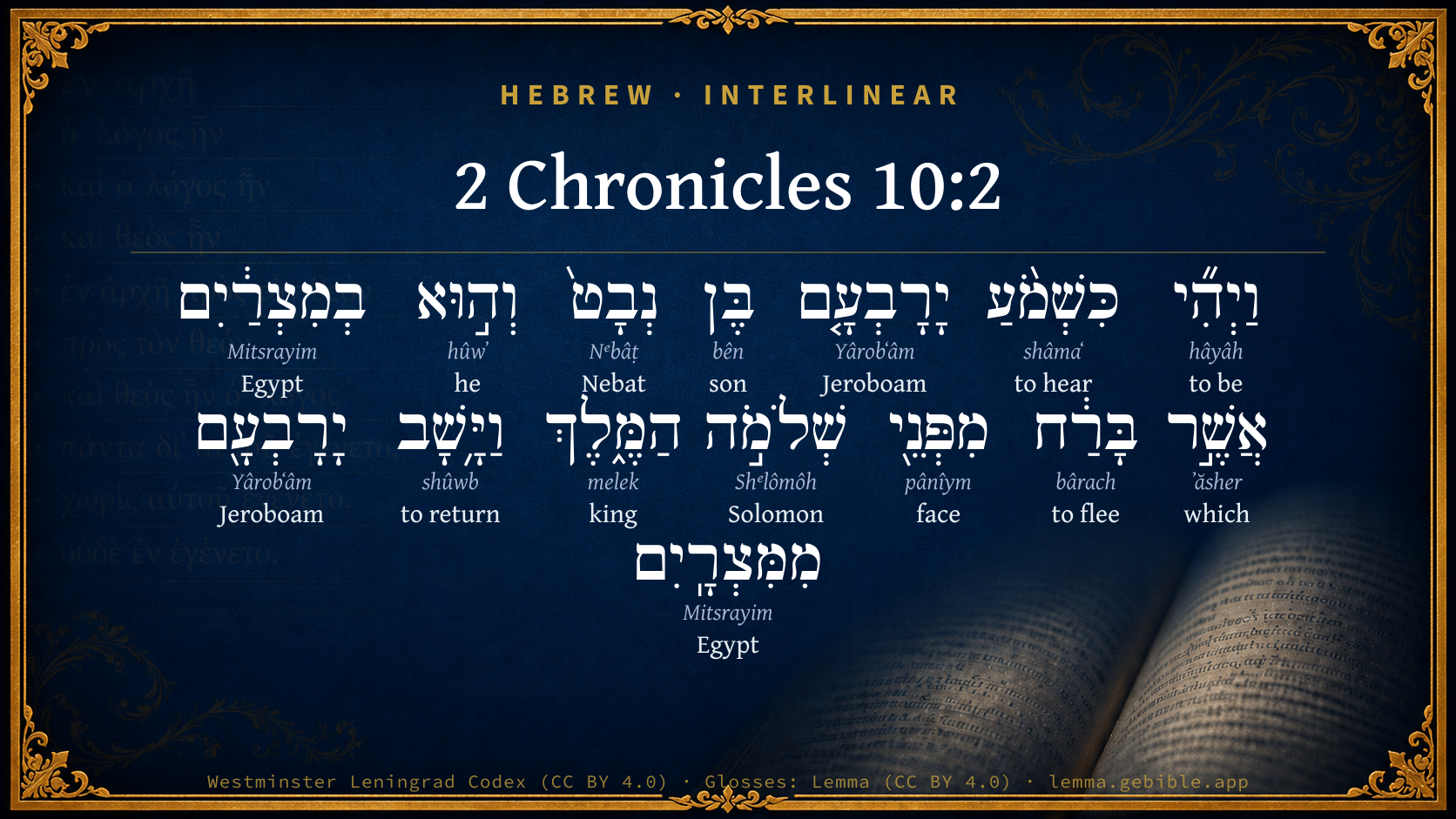
2 Chronicles 10:2

Hebrew (Westminster Leningrad Codex) 2 Chronicles 10:2 appears in the Hebrew Old Testament. The text above is from the Westminster Leningrad Codex. Each word links to its Strong’s number, a concise gloss, and parsing drawn from the Open Scriptures Hebrew Bible morphology. Click any word for its full Brown-Driver-Briggs (BDB) entry.
Download image
Cite this verse

2 Chronicles 10:2 (World English Bible). Public Domain. Lemma interlinear Bible study tool, https://lemma.gebible.app/v/2-chronicles/10/2.

Show BibTeX & RIS
BibTeX
RIS
English Translation
It happened, when Jeroboam the son of Nebat heard of it, (for he was in Egypt, where he had fled from the presence of king Solomon), that Jeroboam returned out of Egypt.
World English Bible · Public Domain
Download a study sheet

One document with this verse’s original text, its word-by-word gloss line, the meaning frame, cross-references with their text, attributed commentary, and full source and license credits — printable, and it pastes into notes with its structure intact.

This verse Autodidact and up

Study sheet (.html) Plain text (.txt)

A passage Seminary Student

Up to 50 verses in one chapter. A passage sheet keeps up to 6 commentary sources and 12 cross-references per verse, in the order this page ranks them, and says so on the sheet whenever that leaves anything out. Ask for a single verse and you get the Autodidact verse sheet above.

Everything on this page stays free to read, with no account — the sheet is a download of what is already on screen, not access to it.

Want to remove ads? Support Godless Engineer
Compare translations 3

The same verse in 3 English versions, stacked beneath the original-language interlinear above. Click any original word for its lexicon entry.

Each is an independent rendering of the whole verse — the interlinear is not word-aligned to these translations.

Highlighted words mark where these versions differ — a whole-verse word diff, not a word-by-word alignment.

  • World English Bible Public Domain
    It happened, when Jeroboam the son of Nebat heard of it, (for he was in Egypt, where he had fled from the presence of king Solomon), that Jeroboam returned out of Egypt.
  • King James Version Public Domain
    And it came to pass, when Jeroboam the son of Nebat, who was in Egypt, whither he fled from the presence of Solomon the king, heard it, that Jeroboam returned out of Egypt.
  • unfoldingWord Literal Text CC BY-SA 4.0
    And it happened when Jeroboam the son of Nebat heard, for he was in Egypt where he had fled from the face of King Solomon. And Jeroboam returned from Egypt.

unfoldingWord Literal Text — © unfoldingWord, licensed CC BY-SA 4.0. Word-aligned USFM3 via Door43 (git.door43.org/unfoldingWord/en_ult).

Versions to compare (up to 4)

3 of 4 selected

Show all 18 translations

Every available English version of this verse, each an independent rendering of the whole verse.

  • World English Bible Public Domain
    It happened, when Jeroboam the son of Nebat heard of it, (for he was in Egypt, where he had fled from the presence of king Solomon), that Jeroboam returned out of Egypt.
  • Berean Standard Bible Public Domain
    When Jeroboam son of Nebat heard about this, he returned from Egypt, where he had fled from King Solomon.
  • Majority Standard Bible Public Domain
    When Jeroboam son of Nebat heard about this, he returned from Egypt, where he had fled from King Solomon.
  • King James Version Public Domain
    And it came to pass, when Jeroboam the son of Nebat, who was in Egypt, whither he fled from the presence of Solomon the king, heard it, that Jeroboam returned out of Egypt.
  • American Standard Version (1901) Public Domain
    And it came to pass, when Jeroboam the son of Nebat heard of it, (for he was in Egypt, whither he had fled from the presence of king Solomon,) that Jeroboam returned out of Egypt.
  • Revised Version (1885) Public Domain
    And it came to pass, when Jeroboam the son of Nebat heard of it, (for he was in Egypt, whither he had fled from the presence of king Solomon,) that Jeroboam returned out of Egypt.
  • Geneva Bible (1599) Public Domain
    And when Ieroboam the sonne of Nebat heard it, (which was in Egypt, whither he had fled from the presence of Salomon the King) he returned out of Egypt.
  • Douay-Rheims (1899) Public Domain
    And when Jeroboam the son of Nabat, who was in Egypt, (for he was fled thither from Solomon,) heard it, forthwith he returned.
  • Young's Literal Translation Public Domain
    And it cometh to pass, at Jeroboam son of Nebat's -- who `is' in Egypt because he hath fled from the face of Solomon the king -- hearing, that Jeroboam turneth back out of Egypt;
  • Literal Standard Version CC BY-SA 4.0
    And it comes to pass, at Jeroboam son of Nebat—who [is] in Egypt because he has fled from the face of Solomon the king—hearing, that Jeroboam turns back out of Egypt;
  • Unlocked Literal Bible CC BY-SA 4.0
    When Jeroboam the son of Nebat heard this (for he was in Egypt, where he had fled from King Solomon), he returned from Egypt.
  • unfoldingWord Literal Text CC BY-SA 4.0
    And it happened when Jeroboam the son of Nebat heard, for he was in Egypt where he had fled from the face of King Solomon. And Jeroboam returned from Egypt.
  • Darby Bible Public Domain
    And it came to pass when Jeroboam the son of Nebat heard it (now he was in Egypt, whither he had fled from the presence of king Solomon) that Jeroboam returned out of Egypt.
  • World Messianic Bible Public Domain
    When Jeroboam the son of Nebat heard of it (for he was in Egypt, where he had fled from the presence of King Solomon), Jeroboam returned out of Egypt.
  • Webster's Bible Public Domain
    And it came to pass, when Jeroboam the son of Nebat, who was in Egypt, whither he had fled from the presence of Solomon the king, heard it, that Jeroboam returned from Egypt.
  • Free Bible Version CC BY-SA 4.0
    Jeroboam, son of Nebat, was still in Egypt when he heard about this. (He had run away to Egypt to escape from King Solomon and was living there.)
  • Bible in Basic English Public Domain
    And when Jeroboam, the son of Nebat, had news of it, (for he was in Egypt where he had gone in flight from King Solomon,) he came back from Egypt.
  • JPS Tanakh (1917) Public Domain
    And it came to pass, when Jeroboam the son of Nebat heard of it — for he was in Egypt, whither he had fled from the presence of king Solomon — that Jeroboam returned out of Egypt.

Literal Standard Version (2020), Covenant Press — licensed CC BY-SA 4.0. Text via the HelloAO Bible API (eBible.org). Unlocked Literal Bible (unfoldingWord) — licensed CC BY-SA 4.0. Text via the HelloAO Bible API (eBible.org). unfoldingWord Literal Text — © unfoldingWord, licensed CC BY-SA 4.0. Word-aligned USFM3 via Door43 (git.door43.org/unfoldingWord/en_ult). Free Bible Version, Dr. Jonathan Gallagher — licensed CC BY-SA 4.0. Text via the HelloAO Bible API (eBible.org).

Word by word

More ways to search: Search by grammar → Find every occurrence → Compare this word →

Practice this passage: Drill this verse → Learn its vocabulary →

נְבָט֙
Nᵉbâṭ
H5028
“Nebat”
Noun, Proper
Part of Speech
Noun
Type
Proper
Full BDB Definition

Origin: from H5027

TWOT: None

Nebat = "aspect" - an Ephraimite of Zereda, father of king Jeroboam I of the northern kingdom of Israel
  1. וַיְהִ֞י hâyâh H1961 “and · to be” Conjunction + Verb, Qal, Sequential Imperfect, 3rd Person, Masculine, Singular
  2. כִּשְׁמֹ֨עַ shâmaʻ H8085 “like/as · to hear” Preposition + Verb, Qal, Infinitive Construct
  3. יָרָבְעָ֤ם Yârobʻâm H3379 “Jeroboam” Noun, Proper
  4. בֶּן bên H1121 “son of” Noun, Common, Masculine, Singular, Construct
  5. וְה֣וּא hûwʼ H1931 “and · he” Conjunction + Pronoun, Personal, 3rd Person, Masculine, Singular
  6. בְמִצְרַ֔יִם Mitsrayim H4714 “in/at · Egypt” Preposition + Noun, Proper
  7. אֲשֶׁ֣ר ʼăsher H834 “which” Particle, Relative
  8. בָּרַ֔ח bârach H1272 “to flee” Verb, Qal, Perfect, 3rd Person, Masculine, Singular
  9. מִפְּנֵ֖י pânîym H6440 “from · face(s) of” Preposition + Noun, Common, Both, Plural, Construct
  10. שְׁלֹמֹ֣ה Shᵉlômôh H8010 “Solomon” Noun, Proper
  11. הַמֶּ֑לֶךְ melek H4428 “the · king” Particle, Definite Article + Noun, Common, Masculine, Singular, Absolute
  12. וַיָּ֥שָׁב shûwb H7725 “and · to return” Conjunction + Verb, Qal, Sequential Imperfect, 3rd Person, Masculine, Singular
  13. יָרָבְעָ֖ם Yârobʻâm H3379 “Jeroboam” Noun, Proper
  14. מִמִּצְרָֽיִם Mitsrayim H4714 “from · Egypt” Preposition + Noun, Proper

About this verse

These counts appear in no published source. They are computed here, from the morphology-tagged text and Lemma’s own curated glosses. What Lemma adds →

15
words
13
distinct lemmas
Historical
section

Notable vocabulary

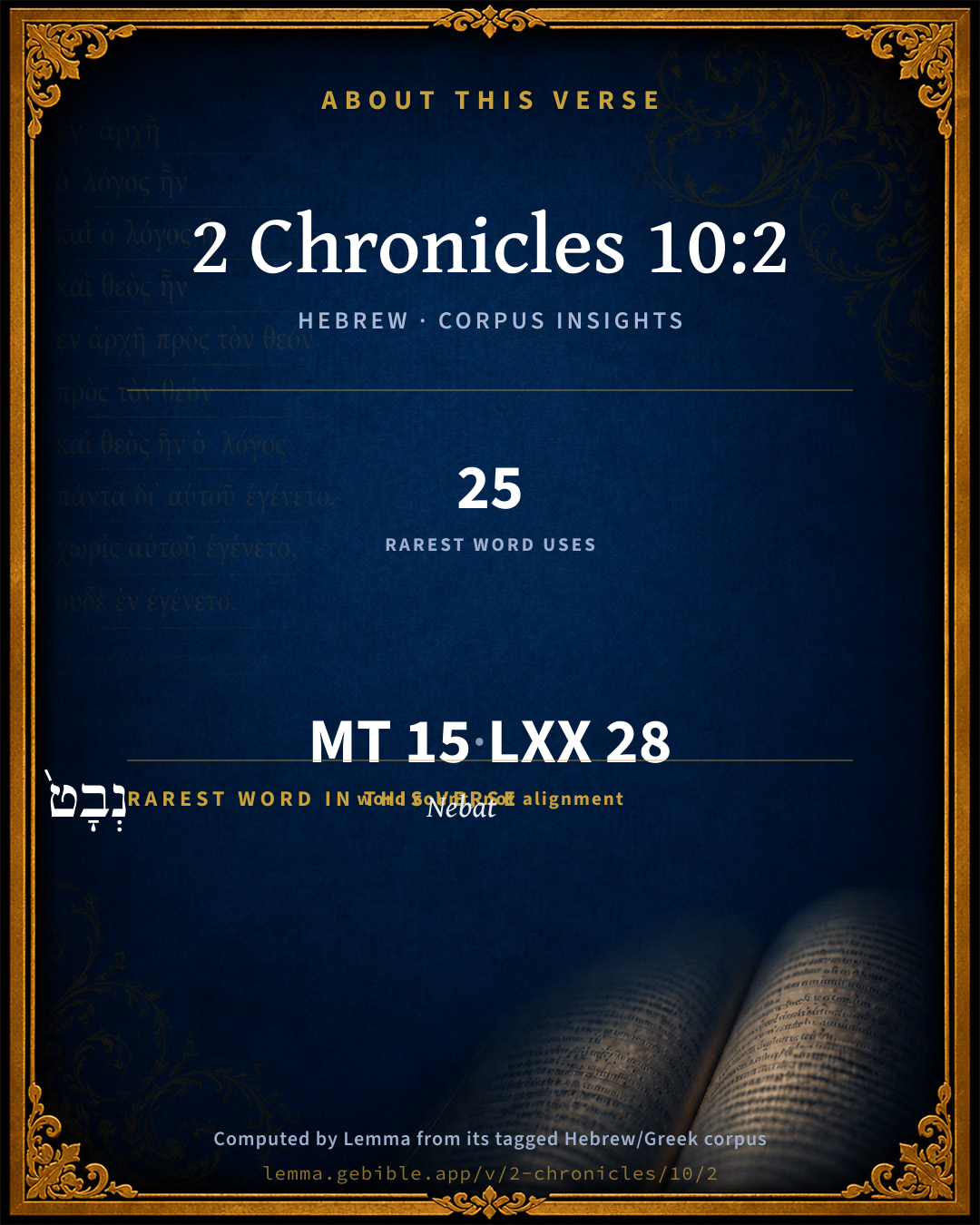
The rarest word here is נְבָט֙ Nebat H5028 — appearing just 25 times in the whole Hebrew Bible.

Shared distinctive vocabulary

נְבָט֙ Nebat H5028 occurs in 25 verses of the Hebrew Bible. Also found in:

Grammatical profile

  • 4 verbs
  • 9 nouns
  • 1 pronoun
  • 1 particle

Verb forms

  • וַיְהִ֞י Qal · Sequential Imperfect
  • כִּשְׁמֹ֨עַ Qal · Infinitive Construct
  • בָּרַ֔ח Qal · Perfect
  • וַיָּ֥שָׁב Qal · Sequential Imperfect

Repetition

Words recur within this verse — often emphatic in Hebrew:

  • יָרָבְעָ֤ם Jeroboam H3379 ×2
  • בְמִצְרַ֔יִם Egypt H4714 ×2

Hebrew & Septuagint length

In English translation the verse runs 32 words from the Hebrew and 41 from the Septuagint (LXX English) — closely comparable.

A rough comparison of the two English renderings, which tokenize alike — not a word-level alignment.

Word counts can differ between the Hebrew and the Greek without any difference in meaning — e.g. the Hebrew direct-object marker אֵת has no separate Greek word, and Greek often adds the article ὁ.

In the original languages it is 15 Hebrew tokens and 28 Greek tokens — but the two are counted differently (Hebrew bundles its prefixes and suffixes into one token; the Greek is in lemma form), so that isn’t a like-for-like length.

Cross-references

4

Topical passages linked to 2 Chronicles 10:2 in the Treasury of Scripture Knowledge — connected by theme and wording, ordered by reader-vote popularity; previews shown in the World English Bible.

  • 1 Kings 11:40 Solomon sought therefore to kill Jeroboam; but Jeroboam arose, and fled into Egypt, to Shishak king of Egypt, and was in Egypt until the death of Solomon.
  • 1 Kings 11:26 Jeroboam the son of Nebat, an Ephraimite of Zeredah, a servant of Solomon, whose mother's name was Zeruah, a widow, he also lifted up his hand against the king.
  • 1 Kings 11:28 The man Jeroboam was a mighty man of valor; and Solomon saw the young man that he was industrious, and he gave him charge over all the labor of the house of Joseph.
  • 1 Kings 12:2 It happened, when Jeroboam the son of Nebat heard of it (for he was yet in Egypt, where he had fled from the presence of king Solomon, and Jeroboam lived in Egypt,

Cross-references courtesy of OpenBible.info (CC BY 4.0).

Hebrew and Greek witnesses Masoretic Hebrew ↔ Greek Septuagint

The same verse in the two great witnesses to the Old Testament, shown verse-for-verse.

These are two independent witnesses, not word-aligned to each other, and the Septuagint is shown in lemma (dictionary) form.

Hebrew 2 Chronicles 10:2 Masoretic · Westminster Leningrad Codex

וַיְהִ֞י כִּשְׁמֹ֨עַ יָרָבְעָ֤ם בֶּן נְבָט֙ וְה֣וּא בְמִצְרַ֔יִם אֲשֶׁ֣ר בָּרַ֔ח מִפְּנֵ֖י שְׁלֹמֹ֣ה הַמֶּ֑לֶךְ וַיָּ֥שָׁב יָרָבְעָ֖ם מִמִּצְרָֽיִם

It happened, when Jeroboam the son of Nebat heard of it, (for he was in Egypt, where he had fled from the presence of king Solomon), that Jeroboam returned out of Egypt.

World English Bible · Public Domain

Greek LXX 2 Chronicles 10:2 Septuagint · lemma form

καί γίγνομαι ὡς ἀκούω ιεροβοαμ υἱός ναβατ καί αὐτός ἐν αἴγυπτος ὡς φεύγω ἀπό πρόσωπον σαλωμών ὁ βασιλεύς καί καταοἰκέω ιεροβοαμ ἐν αἴγυπτος καί ἀποστρέφω ιεροβοαμ ἐκ αἴγυπτος

And it came to pass when Jeroboam the son of Nabat heard it, (now he was in Egypt, forasmuch as he had fled there from the face of king Solomon, and Jeroboam lived in Egypt,) that Jeroboam returned out of Egypt.

LXX2012 (modern English Septuagint) · Public Domain

On this verse, The Pulpit Commentary discusses the Septuagint’s reading. Read the note in Commentary ↓

Hebrew: Westminster Leningrad Codex (CC BY 4.0). Greek: Septuagint (public domain); English from LXX2012 (modern English Septuagint) (Public Domain). How the Septuagint differs from the Hebrew →

Commentary

Notes on 2 Chronicles 10:2 from classic Christian and Jewish commentators (each source and its license shown beneath its notes). The classic Christian expositions comment on the surrounding passage and are grouped to its opening verse, so a note may address several verses; the Jewish commentaries on the Tanakh (Rashi and others) are per-verse, so they appear only where the commentator wrote on this verse.

Lemma curates 59 commentaries, every one of them public domain or Creative Commons licensed, each selected and text-cleaned for this edition rather than reprinted as found. About our sources →

Tyndale Open Study Notes

Tyndale Open Resources

10:2 Jeroboam . . . had fled to Egypt to escape from King Solomon: See 1 Kgs 11:26-40. Jeroboam returned from Egypt at the news of Solomon’s death.

Tyndale Open Study Notes — © Tyndale Open Resources, licensed CC BY-SA 4.0. Text via the HelloAO Bible API.

Ellicott's Commentary for English Readers

(2) Who was in Egypt.—Really a parenthesis, “And it came to pass, when Jeroboam the son of Nebat heard (now he was in Egypt, whither he had fled from the face of Solomon the king), that Jeroboam returned from Egypt.” The chronicler has omitted to say he was still in Egypt (‘ôdennû, Kings), because he has not alluded before to his flight thither. (See 1Ki_11:26-40.)

That Jeroboam returned out of Egypt.—Kings continues the parenthesis, “and Jeroboam dwelt in Egypt.” The words dwelt and returned are spelt with the same letters in Hebrew, the difference being one of pointing only.

A Bible Commentary for English Readers, edited by Charles John Ellicott (1878–1897) — public domain. Text from a community e-Sword module.

The Cambridge Bible for Schools and Colleges

gen. ed. J. J. S. Perowne

2. Jeroboam] For his antecedents (which are not given by the Chronicler) see 1Ki_11:26 ff.

that Jeroboam returned out of Egypt] So we should read also in 1Ki_12:2 for “and Jeroboam dwelt in Egypt.” The difference in Heb. between the two readings when written without the vowels is confined to one letter.

The Cambridge Bible for Schools and Colleges (gen. ed. J. J. S. Perowne; Cambridge University Press, 1878–1918) — public domain. Text from a community e-Sword module.

The Pulpit Commentary

Vers. 2, 3. In these verses the compiler brings up lost time. He has not mentioned before the name of Jeroboam, just as he has not mentioned the lustful sins of Solomon that led to idolatry, and these sequel idolatries of his, that heralded the shattering of his kingdom immediately on his decease. So we are now told all in one how Jeroboam, in his refuge-retreat in Egypt, (1Ki_11:26-40) "heard" of Solomon"s demise, and apparently (see first clause of our third verse) heard of it in this wise, that "they," i.e. the "all Israel" (of our first verse) "had sent and called him" Probably the growing sense of discontent and the rankling in those tribes that were not closely breathing the atmosphere of Jerusalem and the one home county, because of their burdens and taxation, and possibly also Ephraim"s ancient and famed rivalry, knew instinctively that this hour of Solomon"s death was the hour, if any, of their redemption. The lacunae in the history speak for themselves; for though the tribes, after the long seething of their complainings and sufferings, needed but short time for deliberation, Solomon"s death must have been an accomplished fact before they (whoever the "they" were) sent to Egypt to Jeroboam; and that sending and his returning or otherwise, at any rate his hearing and consequent returning, must have taken time. Considering all this, it is re markable that no note of time is found. But had only our first verse been placed as the last of the foregoing chapter, the ambiguity would have been less. For the strange variations on the history of Jeroboam (a name, together with that of Rehoboam, new to Solomon"s time, meaning "many-peopled," while Rehoboam signifies "increaser of people"), as found in the Hebrew texts, and additions to it, see the Septuagint Version, 1Ki_11:43 1Ki_12:24; and A. P. Stanley"s article, "Jeroboam," in Dr. Smith"s "Bible Dictionary," 1. 979, 980; and comp. again 1Ki_11:26-40 1Ki_12:25 1Ki_14:13, 1Ki_14:17, 1Ki_14:18. Stanley"s faith in the Septuagint notwithstanding, its variations and additions are not reconcileable enough with either the Hebrew text or themselves to command anything like unfeigned acceptance. One thing may be considered to come out without much obscurity or uncertainty that Jeroboam was the acknowledged rather than tacit leader of an opposition that was tacit at present rather than acknowledged; nor is it at all improbable, under all the circumstances, that the Rehoboam party in, knowing well how the ground really lay, were as content to let the coronation, so to call it, at Shechem linger awhile for Jeroboam"s return, as Jeroboam"s opposition party out desired and perhaps compelled the delay. Of course, Jeroboam knew well, none better than he, as of old the overseer of the forced labour and taxation of Ephraim, (1Ki_11:28 1Ki_9:15) how grievous the service and how heavy the yoke to his people, even when he had acquitted himself as the most "industrious" of taskmasters.

The recall of an exile.

I THE EXILE"S STORY.

1. His name. Jeroboam, "whose people are many;" the son of Nebat. His father was an Ephrathite of Zareda, in Ephraim; his mother a widow (1Ki_11:26) which may mean either that he had been born in unlawful wedlock (LXX), or that his father had died while he was young, leaving him to be brought up by his widowed mother (Josephus).

2. His character. Courageous and industrious, "a mighty man of valour", (Jud_1:6:12 11:1) and a man that did work (Pro_22:29) two qualities befitting youth, and almost certain to bring temporal success in their train; two qualities that should never be absent from Christians, who are specially commanded to "add to their faith virtue, or courage", (2Pe_1:5) and to "be not slothful in business". (Rom_12:10)

1. His promotion. Just when Jeroboam came to manhood, Solomon was engaged in building Millo, and closing up the breach in the city of David

2. (1Ki_9:15) For these purposes Solomon raised a levy of workmen, not of the Hittites, Amorites, etc., (2Ch_8:7) but of Israelites, who worked by courses of ten thousand a month; (1Ki_5:13 1Ki_9:15) or imposed certain burdens in connection with those works which required to be borne by the Israelites. Discerning Jeroboam to be a capable youth, of spirit and energy, Solomon appointed him overseer or governor of all those Israelites employed in or about the works who belonged to the house of Joseph, i.e. who were Ephraimites.

3. His incipient rebellion. Serving in this office, he began to commune with his own thoughts about raising a revolt. Either as an Ephraimite he felt humiliated at being obliged to work in the capital of Judah, or being a youth of aspiring mind he was not content with the elevation suddenly thrust upon him, and wished to climb higher; but in any case, when the "mood" was on him, an incident occurred which, chiming in as it did with his own aspirations, pricked the sides of his intent, and bore him onwards in his dangerous career of ambition. That incident was his meeting with Ahijah the Shilonite, who told him that Jehovah intended to wrest ten tribes from the Davidic kingdom and give them to him, Jeroboam. (1Ki_11:29) A perilous communication for a youth like Jeroboam to carry about with him! Josephus states that it prompted him "to persuade the people to forsake Solomon, to make a disturbance, and to bring the government over to himself" ("Ant.," 8:7.8).

4. His precipitate flight. His treason having come to the king"s knowledge, he was obliged to save himself from well-merited execution by suddenly withdrawing from the land, and seeking refuge in Egypt under the sceptre of Shishak. (see on 2Ch_12:2)

II THE EXILE"S RETURN.

1. Its date. When Solomon was dead. A king"s life is sometimes a kingdom"s best bulwark against revolution. So long as Solomon lived, insurrection under Jeroboam was impracticable. Yet a king"s life may be the greatest barrier to the progress of a good work. Moses could not return to Egypt to resume his emancipation work until Rameses II was dead. (Exo_2:23) Joseph could not return from Egypt with Mary and Jesus until Herod was dead. (Mat_2:19)

1. Its occasion. The invitation of the northern tribes (ver. 3). This, addressed to Jeroboam while at the court of Shishak, (1Ki_12:2; Josephus, " Ant.," 8:8. 1) was probably the medium through which he

2. learnt of Solomon"s decease. Not necessary to hold. that it was only despatched to Jeroboam after the tribes had assembled at Shechem (Bahr), since it may easily have been sent immediately on Solomon"s death, between which event and the gathering at Shechem twelve months intervened. Jeroboam, however, is commonly supposed (Bertheau, Bahr) to have returned from Egypt ex proprio motu, and to have been residing with his wife and child at Zareda or Sarira, when summoned to Shechem. The suggestion (Keil) is probably correct that two invitations were addressed to Jeroboam the first while he was yet in Egypt, to return to his native land; the second while he lingered at Zareda, to come to Shechem.

3. Its object. Whether of his own accord, or in obedience to the summons of the tribes, Jeroboam returned from Egypt; his ulterior aim, there can be little question, was to further his own ambitious projects.

LESSONS.

1. The value to a young man of energy and talent.

2. The danger as well as sin of harbouring ambitious thoughts.

3. The hatefulness of treachery.

4. The possibility of a wicked man"s schemes furthering God"sdesigns. W.

The Pulpit Commentary (1880–1919), ed. H.D.M. Spence-Jones & Joseph S. Exell — public domain. Text from a community e-Sword module.

Rashi

Rabbi Shlomo Yitzchaki (Rashi)

And it was when... heard The meaning is: And it was when he heard - prior to this, when they came to make him [Rehoboam] king in Shechem, when he [Jeroboam] was still in Egypt.

Rashi on the Tanakh — English translations: “The Judaica Press complete Tanach with Rashi, translated by A. J. Rosenberg” (CC BY 4.0); “Pentateuch with Rashi's commentary by M. Rosenbaum and A.M. Silbermann, 1929-1934” (public domain); “The Metsudah Tanach series, Lakewood, N.J” (CC BY 4.0); and “The Book of Joshua, Metsudah Publications, 1997” (CC BY 4.0). Text via Sefaria.

Lesson kit

Teaching starters — assembled from the data on this page, not authored interpretation. Every prompt links to the verse data it draws on. Edit before teaching.

2 Chronicles, in the Historical, opens this verse with 15 words (13 distinct Hebrew lemmas). Its most distinctive word is Nᵉbâṭ (“Nebat”). A historical commentator’s framing appears above. Read the whole chapter for the surrounding context.

Discussion questions

  1. How does “Nebat” (Nᵉbâṭ) shape what this verse is saying?
  2. How does 1 Kings 11:26, which shares the word «Nebat», read alongside this verse?
  3. What does the repetition of “Jeroboam” (2× in this one verse) do in this verse?
  4. The translations on this page render this verse differently — a whole-verse word diff, not a word-by-word alignment. What might account for the different wordings?
  5. «וַיְהִ֞י» is a Qal Sequential Imperfect verb. How does that grammatical form shape the action described?
  6. Compare how Tyndale Open Study Notes and Ellicott's Commentary for English Readers read this verse. Where do they agree or differ?

Things to notice

Reading settings

Reading text

Shown beneath each verse's original-language words.

Old Testament
Old Testament edition

Read the OT as the Masoretic Hebrew (MT) or the Greek Septuagint (LXX).

English shown for the Greek Septuagint (in the Hebrew ↔ Greek comparison).

Comparing translations? Open the Compare panel on any verse page to stack up to four side by side.