
2 Chronicles 5:9

Hebrew (Westminster Leningrad Codex) 2 Chronicles 5:9 appears in the Hebrew Old Testament. The text above is from the Westminster Leningrad Codex. Each word links to its Strong’s number, a concise gloss, and parsing drawn from the Open Scriptures Hebrew Bible morphology. Click any word for its full Brown-Driver-Briggs (BDB) entry.
Download image
Cite this verse

2 Chronicles 5:9 (World English Bible). Public Domain. Lemma interlinear Bible study tool, https://lemma.gebible.app/v/2-chronicles/5/9.

Show BibTeX & RIS
BibTeX
RIS
English Translation
The poles were so long that the ends of the poles were seen from the ark before the oracle; but they were not seen outside: and there it is to this day.
World English Bible · Public Domain
Download a study sheet

One document with this verse’s original text, its word-by-word gloss line, the meaning frame, cross-references with their text, attributed commentary, and full source and license credits — printable, and it pastes into notes with its structure intact.

This verse Autodidact and up

Study sheet (.html) Plain text (.txt)

A passage Seminary Student

Up to 50 verses in one chapter. A passage sheet keeps up to 6 commentary sources and 12 cross-references per verse, in the order this page ranks them, and says so on the sheet whenever that leaves anything out. Ask for a single verse and you get the Autodidact verse sheet above.

Everything on this page stays free to read, with no account — the sheet is a download of what is already on screen, not access to it.

Want to remove ads? Support Godless Engineer
Compare translations 3

The same verse in 3 English versions, stacked beneath the original-language interlinear above. Click any original word for its lexicon entry.

Each is an independent rendering of the whole verse — the interlinear is not word-aligned to these translations.

Highlighted words mark where these versions differ — a whole-verse word diff, not a word-by-word alignment.

  • World English Bible Public Domain
    The poles were so long that the ends of the poles were seen from the ark before the oracle; but they were not seen outside: and there it is to this day.
  • King James Version Public Domain
    And they drew out the staves of the ark, that the ends of the staves were seen from the ark before the oracle; but they were not seen without. And there it is unto this day.
  • unfoldingWord Literal Text CC BY-SA 4.0
    And the poles lengthened and the heads of the poles from the Box were seen at the front of the inner sanctuary, but they were not seen outside. And they are there until this day.

unfoldingWord Literal Text — © unfoldingWord, licensed CC BY-SA 4.0. Word-aligned USFM3 via Door43 (git.door43.org/unfoldingWord/en_ult).

Versions to compare (up to 4)

3 of 4 selected

Show all 18 translations

Every available English version of this verse, each an independent rendering of the whole verse.

  • World English Bible Public Domain
    The poles were so long that the ends of the poles were seen from the ark before the oracle; but they were not seen outside: and there it is to this day.
  • Berean Standard Bible Public Domain
    The poles of the ark extended far enough that their ends were visible from in front of the inner sanctuary, but not from outside the Holy Place; and they are there to this day.
  • Majority Standard Bible Public Domain
    The poles of the ark extended far enough that their ends were visible from in front of the inner sanctuary, but not from outside the Holy Place; and they are there to this day.
  • King James Version Public Domain
    And they drew out the staves of the ark, that the ends of the staves were seen from the ark before the oracle; but they were not seen without. And there it is unto this day.
  • American Standard Version (1901) Public Domain
    And the staves were so long that the ends of the staves were seen from the ark before the oracle; but they were not seen without: and there it is unto this day.
  • Revised Version (1885) Public Domain
    And the staves were so long that the ends of the staves were seen from the ark before the oracle; but they were not seen without: and there it is, unto this day.
  • Geneva Bible (1599) Public Domain
    And they drewe out the barres, that the endes of the barres might bee seene out of the Arke before the Oracle, but they were not seene without: and there they are vnto this day.
  • Douay-Rheims (1899) Public Domain
    Now the ends of the staves wherewith the ark was carried, because they were some thing longer, were seen before the oracle: but if a man were a little outward, he could not see them. So the ark has been there unto this day.
  • Young's Literal Translation Public Domain
    and they lengthen the staves, and the heads of the staves are seen out of the ark on the front of the oracle, and they are not seen without; and it is there unto this day.
  • Literal Standard Version CC BY-SA 4.0
    and they lengthen the poles, and the heads of the poles are seen out of the Ark on the front of the oracle, and they are not seen outside; and it is there to this day.
  • Unlocked Literal Bible CC BY-SA 4.0
    The poles were so long that their ends were seen from the holy place in front of the inner room, but they could not be seen from outside. They are there to this day.
  • unfoldingWord Literal Text CC BY-SA 4.0
    And the poles lengthened and the heads of the poles from the Box were seen at the front of the inner sanctuary, but they were not seen outside. And they are there until this day.
  • Darby Bible Public Domain
    And the staves were long, so that the ends of the staves were seen outside the ark before the oracle; but they were not seen without. And there they are to this day.
  • World Messianic Bible Public Domain
    The poles were so long that the ends of the poles were seen from the ark in front of the inner sanctuary, but they were not seen outside; and it is there to this day.
  • Webster's Bible Public Domain
    And they drew out the staffs of the ark, that the ends of the staffs were seen from the ark before the oracle; but they were not seen without. And there it is to this day.
  • Free Bible Version CC BY-SA 4.0
    The poles were so long that their ends could be seen from the Holy Place in front of the Most Holy Place, but not from outside. They are there to this day.
  • Bible in Basic English Public Domain
    The rods were so long that their ends were seen from the holy place before the inmost room; but they were not seen from outside; and there they are to this day.
  • JPS Tanakh (1917) Public Domain
    And the staves were so long that the ends of the staves were seen from the ark before the Sanctuary; but they could not be seen without; and there they are unto this day.

Literal Standard Version (2020), Covenant Press — licensed CC BY-SA 4.0. Text via the HelloAO Bible API (eBible.org). Unlocked Literal Bible (unfoldingWord) — licensed CC BY-SA 4.0. Text via the HelloAO Bible API (eBible.org). unfoldingWord Literal Text — © unfoldingWord, licensed CC BY-SA 4.0. Word-aligned USFM3 via Door43 (git.door43.org/unfoldingWord/en_ult). Free Bible Version, Dr. Jonathan Gallagher — licensed CC BY-SA 4.0. Text via the HelloAO Bible API (eBible.org).

Word by word

More ways to search: Search by grammar → Find every occurrence → Compare this word →

Practice this passage: Drill this verse → Learn its vocabulary →

הַדְּבִ֔יר
dᵉbîyr
H1687
“the · holy of holies”
Particle, Definite Article + Noun, Common, Masculine, Singular, Absolute
Part of Speech
Particle + Noun
Type
Common
Gender
Masculine
Number
Singular
State
Absolute
Full BDB Definition

Origin: from H1696 (apparently in the sense of oracle)

TWOT: 399g

the holy of holies, the innermost room of the temple or tabernacle - hindmost chamber, innermost room of the temple of Solomon, most holy place, holy of holies - (TWOT) oracle
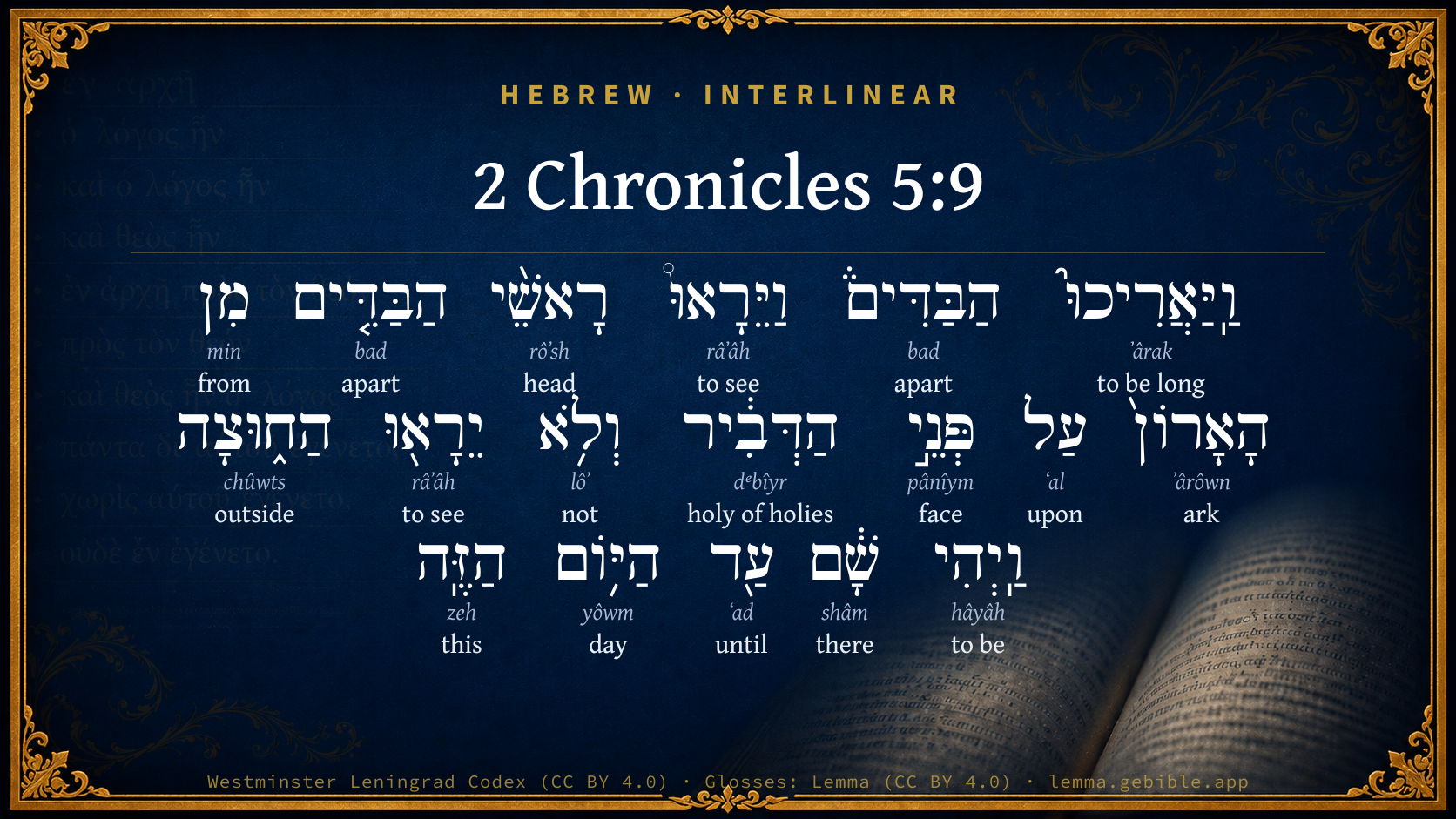
  1. וַֽיַּאֲרִיכוּ֮ ʼârak H748 “and · to be long” Conjunction + Verb, Hiphil, Sequential Imperfect, 3rd Person, Masculine, Plural
  2. הַבַּדִּים֒ bad H905 “the · poles” Particle, Definite Article + Noun, Common, Masculine, Plural, Absolute
  3. וַיֵּרָאוּ֩ râʼâh H7200 “and · to see” Conjunction + Verb, Niphal, Sequential Imperfect, 3rd Person, Masculine, Plural
  4. רָאשֵׁ֨י rôʼsh H7218 “heads of” Noun, Common, Masculine, Plural, Construct
  5. הַבַּדִּ֤ים bad H905 “the · poles” Particle, Definite Article + Noun, Common, Masculine, Plural, Absolute
  6. מִן min H4480 “from” Preposition
  7. הָאָרוֹן֙ ʼârôwn H727 “the · ark” Particle, Definite Article + Noun, Common, Both, Singular, Absolute
  8. עַל ʻal H5921 “upon” Preposition
  9. פְּנֵ֣י pânîym H6440 “face(s) of” Noun, Common, Both, Plural, Construct
  10. וְלֹ֥א lôʼ H3808 “and · not” Conjunction + Particle, Negative
  11. יֵרָא֖וּ râʼâh H7200 “to see” Verb, Niphal, Imperfect, 3rd Person, Masculine, Plural
  12. הַח֑וּצָה chûwts H2351 “the · outside · toward” Particle, Definite Article + Noun, Common, Masculine, Singular, Absolute + Suffix, Demonstrative
  13. וַֽיְהִי hâyâh H1961 “and · to be” Conjunction + Verb, Qal, Sequential Imperfect, 3rd Person, Masculine, Singular
  14. שָׁ֔ם shâm H8033 “there” Adverb
  15. עַ֖ד ʻad H5704 “until” Preposition
  16. הַיּ֥וֹם yôwm H3117 “the · day” Particle, Definite Article + Noun, Common, Masculine, Singular, Absolute
  17. הַזֶּֽה zeh H2088 “the · this” Particle, Definite Article + Pronoun, Demonstrative, Masculine, Singular

About this verse

These counts appear in no published source. They are computed here, from the morphology-tagged text and Lemma’s own curated glosses. What Lemma adds →

18
words
16
distinct lemmas
Historical
section

Notable vocabulary

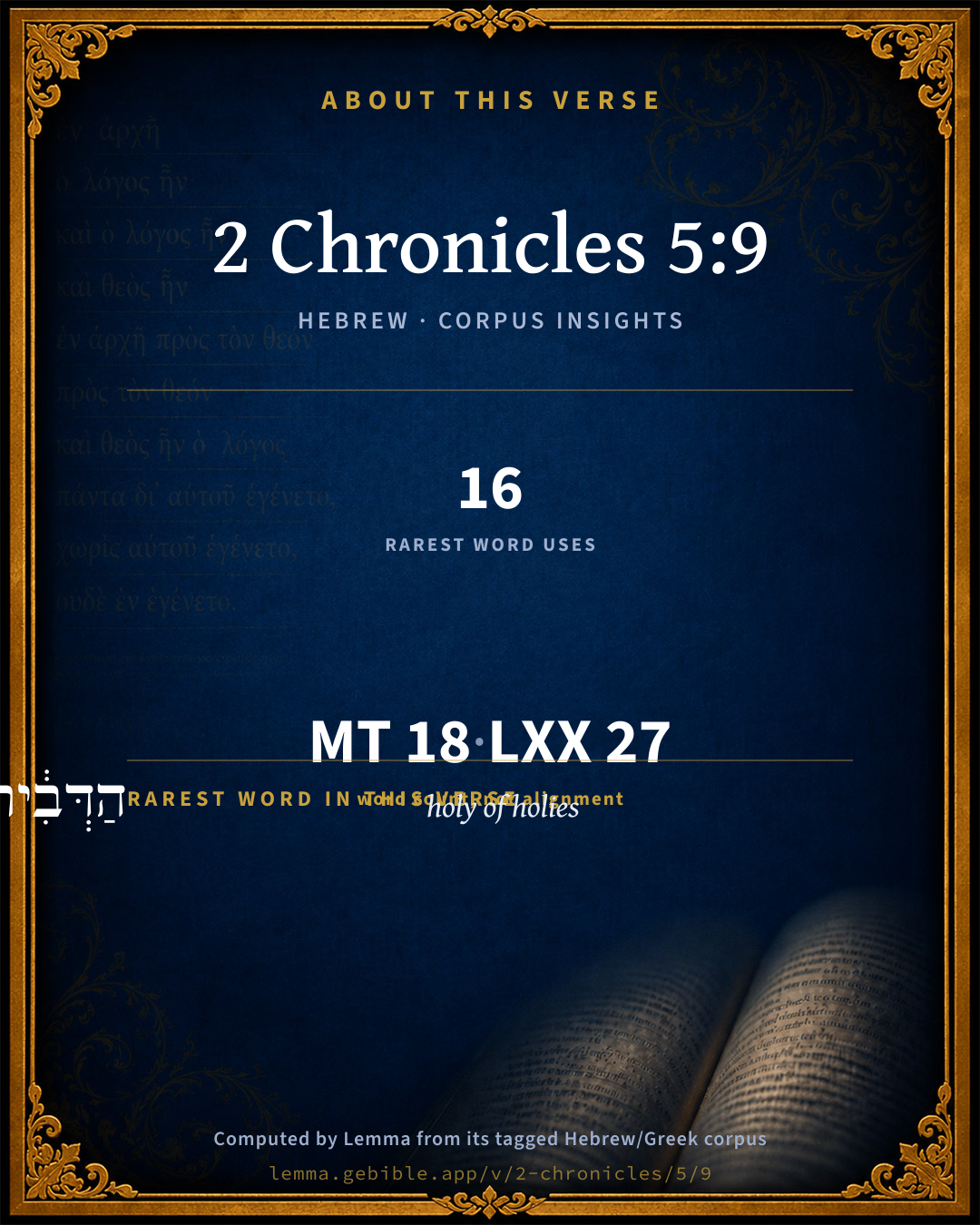
The rarest word here is הַדְּבִ֔יר holy of holies H1687 — appearing just 16 times in the whole Hebrew Bible.

Shared distinctive vocabulary

הַדְּבִ֔יר holy of holies H1687 occurs in 16 verses of the Hebrew Bible. Also found in:

Grammatical profile

  • 4 verbs
  • 8 nouns
  • 1 pronoun
  • 3 prepositions
  • 1 adverb
  • 1 particle

Verb forms

  • וַֽיַּאֲרִיכוּ֮ Hiphil · Sequential Imperfect
  • וַיֵּרָאוּ֩ Niphal · Sequential Imperfect
  • יֵרָא֖וּ Niphal · Imperfect
  • וַֽיְהִי Qal · Sequential Imperfect

Repetition

Words recur within this verse — often emphatic in Hebrew:

  • הַבַּדִּים֒ apart H905 ×2
  • וַיֵּרָאוּ֩ to see H7200 ×2

Hebrew & Septuagint length

In English translation the verse runs 32 words from the Hebrew and 33 from the Septuagint (LXX English) — closely comparable.

A rough comparison of the two English renderings, which tokenize alike — not a word-level alignment.

Word counts can differ between the Hebrew and the Greek without any difference in meaning — e.g. the Hebrew direct-object marker אֵת has no separate Greek word, and Greek often adds the article ὁ.

In the original languages it is 18 Hebrew tokens and 27 Greek tokens — but the two are counted differently (Hebrew bundles its prefixes and suffixes into one token; the Greek is in lemma form), so that isn’t a like-for-like length.

Cross-references

1

Topical passages linked to 2 Chronicles 5:9 in the Treasury of Scripture Knowledge — connected by theme and wording, ordered by reader-vote popularity; previews shown in the World English Bible.

  • 1 Kings 8:8–9 The poles were so long that the ends of the poles were seen from the holy place before the oracle; but they were not seen outside: and there they are to this day.

Cross-references courtesy of OpenBible.info (CC BY 4.0).

Hebrew and Greek witnesses Masoretic Hebrew ↔ Greek Septuagint

The same verse in the two great witnesses to the Old Testament, shown verse-for-verse.

These are two independent witnesses, not word-aligned to each other, and the Septuagint is shown in lemma (dictionary) form.

Hebrew 2 Chronicles 5:9 Masoretic · Westminster Leningrad Codex

וַֽיַּאֲרִיכוּ֮ הַבַּדִּים֒ וַיֵּרָאוּ֩ רָאשֵׁ֨י הַבַּדִּ֤ים מִן הָאָרוֹן֙ עַל פְּנֵ֣י הַדְּבִ֔יר וְלֹ֥א יֵרָא֖וּ הַח֑וּצָה וַֽיְהִי שָׁ֔ם עַ֖ד הַיּ֥וֹם הַזֶּֽה

The poles were so long that the ends of the poles were seen from the ark before the oracle; but they were not seen outside: and there it is to this day.

World English Bible · Public Domain

Greek LXX 2 Chronicles 5:9 Septuagint · lemma form

καί ὑπερἔχω ὁ ἀναφορεύς καί βλέπω ὁ κεφαλή ὁ ἀναφορεύς ἐκ ὁ ἅγιος εἰς πρόσωπον ὁ δαβιρ οὐ βλέπω ἔξω καί εἰμί ἐκεῖ ἕως ὁ ἡμέρα οὗτος

And the staves projected, and the heads of the staves were seen from the holy place in front of the oracle, they were not seen without: and there they were to this day.

LXX2012 (modern English Septuagint) · Public Domain

On this verse, Ellicott's Commentary for English Readers discusses the Septuagint’s reading. Read the note in Commentary ↓

Hebrew: Westminster Leningrad Codex (CC BY 4.0). Greek: Septuagint (public domain); English from LXX2012 (modern English Septuagint) (Public Domain). How the Septuagint differs from the Hebrew →

Commentary

Notes on 2 Chronicles 5:9 from classic Christian and Jewish commentators (each source and its license shown beneath its notes). The classic Christian expositions comment on the surrounding passage and are grouped to its opening verse, so a note may address several verses; the Jewish commentaries on the Tanakh (Rashi and others) are per-verse, so they appear only where the commentator wrote on this verse.

Lemma curates 59 commentaries, every one of them public domain or Creative Commons licensed, each selected and text-cleaned for this edition rather than reprinted as found. About our sources →

Trapp's Complete Commentary

John Trapp

2Ch 5:9 And they drew out the staves [of the ark], that the ends of the staves were seen from the ark before the oracle; but they were not seen without. And there it is unto this day.

Ver. 9. And there it is unto this day,] i.e., Until the time that the larger Chronicles of the Kings of Judah out of which Ezra compiled this abstract - were written.

John Trapp, A Commentary or Exposition upon All the Books of the Old and New Testament (1647–1656) — public domain. Text from a community e-Sword module.

Tyndale Open Study Notes

Tyndale Open Resources

5:9 The Hebrew phrase to this day might be an idiom meaning from then on. The Ark was evidently not in the Temple following the Exile, when the Chronicler wrote.

Tyndale Open Study Notes — © Tyndale Open Resources, licensed CC BY-SA 4.0. Text via the HelloAO Bible API.

Geneva Bible (1599)

Geneva Bible translators

Or, without the Oracle.

Geneva Bible (1599) marginal notes — public domain. Text via Bolls.life.

Jamieson, Fausset & Brown

Robert Jamieson, A. R. Fausset & David Brown

there it is unto this day--that is, at the time when this history was composed; for after the Babylonish captivity there is no trace of either ark or staves.

Jamieson, Fausset & Brown — Commentary Critical and Explanatory on the Whole Bible (1871) — public domain (CC PDM 1.0). Text via the HelloAO Bible API.

Adam Clarke's Commentary

Verse 9. They drew out the staves] As the ark was no longer to be carried about, these were unnecessary.

Adam Clarke's Commentary on the Bible (1810–1826) — public domain. Text from a community e-Sword/MySword module.

Ellicott's Commentary for English Readers

(9) And they drew out . . . were seen.—Rather, And the staves were so long that the tips of the staves were seen. &c.

From the ark.—1Ki_8:8, “from the Holy Place.” So the LXX. and four Hebrew MSS. The priests in the great hall could see the tips of the staves projecting within the Holy of Holies; but persons outside (“without”) of the great hall could not see them.

And there it is unto this day.—And it (the ark) remained there unto this day. So Vulg., “fuit itaque arca ibi.” LXX., Syr., Targ., Arab., They—i.e., the poles were there; and so some Heb. MSS., and 1Ki_8:8. This is no doubt right. A letter has fallen out of the Hebrew text. That the chronicler has preserved this remark without modification to suit altered circumstances, and indeed that the compiler of Kings did the same long before him, is a striking instance of the way in which Oriental historiographers are content to borrow with literal exactitude from the works of predecessors, even in cases where such borrowing appears to the modern mind infelicitous.

A Bible Commentary for English Readers, edited by Charles John Ellicott (1878–1897) — public domain. Text from a community e-Sword module.

The Cambridge Bible for Schools and Colleges

gen. ed. J. J. S. Perowne

9. And they drew out the staves of the ark] R.V. And the staves were so long.

from the ark] Read (with LXX. and 1Ki_8:8) from the holy place. One standing in the holy place and looking towards the Holy of Holies could see the heads of the staves.

And there it is unto this day] These words are taken over with the loss of one letter (which here makes the difference between singular and plural) from 1Ki_8:8, but they are out of place in Chron., for when the Chronicler wrote the ark had long ago disappeared. The vessels which were brought back from the Babylonian captivity are specified in Ezr_1:9-10, but the ark of the covenant is not reckoned among them.

The Cambridge Bible for Schools and Colleges (gen. ed. J. J. S. Perowne; Cambridge University Press, 1878–1918) — public domain. Text from a community e-Sword module.

Albert Barnes' Notes on the Bible

From the ark - Or, according to a different reading here and according to 1Ki 8:8, some read, “the ends of the staves were seen from the Holy place.”

There it is unto this day - This should be corrected as in the margin.

Albert Barnes' Notes on the Bible (1834–1885) — public domain. Text from a community e-Sword/MySword module.

Haydock's Catholic Bible Commentary

Oracle, pushing out the veil, (Haydock) in the tabernacle of Moses, but not in the temple, which was of larger dimensions. (Calmet) --- But if. Hebrew, "but they were not seen without. And there it is till this day."

George Leo Haydock (1774–1849), Haydock's Catholic Family Bible and Commentary, 1859 edition — public domain. Excludes Psalms (Douay-Rheims chapter numbering differs from Protestant) and Deuterocanonical books (Catholic canon only).

Matthew Poole's English Annotations

When this history was first written: not when it was reviewed by Ezra, who made some additions to it; for after the return from Babylon neither staves nor ark were any more seen or heard of.

Matthew Poole's English Annotations on the Holy Bible (1683–1685) — public domain. Text from a community e-Sword/MySword module.

The Pulpit Commentary

They drew out; i.e. the staves projected. A similar intransitive occurs in Exo_20:12. Were seen from the ark. The words, "from the ark," are here probably by misposition, and should follow the words, the staves projected; while the parallel tells us what should be in their place here, namely, "from the holy place". (1Ki_8:8) The confusion and omission will merely lie with some copyists, for five manuscripts show the words "from the holy place." There it is unto this day. The parallelreads, (1Ki_8:8) there they are unto this day," i.e. the staves. In either case, whether the ark or the staves were spoken of, the memorandum is exceedingly interesting and noteworthy, as a patent bare copy of an old record dating before the destruction of the temple, on the part of whether the writer of Kings or Chronicles. Plainly the historian touches ground, and shows us that we do also; for it is evident that, far from cunningly devised fable, he has before him in either case an original document.

The Pulpit Commentary (1880–1919), ed. H.D.M. Spence-Jones & Joseph S. Exell — public domain. Text from a community e-Sword module.

John Wesley's Explanatory Notes

To this day - When this history was first written; not when it was reviewed by Ezra: for after the return from Babylon, neither staves nor ark were any more seen.

John Wesley, Explanatory Notes Upon the Whole Bible (1754–1765) — public domain. Text via the GEBible commentary corpus.

unfoldingWord translationNotes

Door43 World Missions Community

their ends were seen ... they could not be seen

This can be stated in active form. AT: "people could see their ends ... people could not see them"

to this day

This means the day on which the writer wrote.

translationWords

holy place

Moses

Horeb

covenant

people group

Israel

Egypt

unfoldingWord translationNotes — © Distant Shores Media and the Door43 World Missions Community, licensed CC BY-SA 4.0. Source: git.door43.org/Door43/en_tn.

Lesson kit

Teaching starters — assembled from the data on this page, not authored interpretation. Every prompt links to the verse data it draws on. Edit before teaching.

2 Chronicles, in the Historical, opens this verse with 18 words (16 distinct Hebrew lemmas). Its most distinctive word is dᵉbîyr (“holy of holies”). A historical commentator’s framing appears above. Read the whole chapter for the surrounding context.

Discussion questions

  1. What does “holy of holies” (dᵉbîyr) contribute to the verse as a whole?
  2. 1 Kings 6:5 shares the word «holy of holies» with this verse. How do the two illuminate each other?
  3. “apart” occurs 2× in this one verse. What is the effect of the repetition?
  4. These translations render this verse differently. What is at stake in choosing one wording over another?
  5. The verb «וַֽיַּאֲרִיכוּ֮» is Hiphil Sequential Imperfect. How does its form color the action?
  6. Reading how Trapp's Complete Commentary and Tyndale Open Study Notes read this verse, where do the two commentators agree and where do they part?

Things to notice

Reading settings

Reading text

Shown beneath each verse's original-language words.

Old Testament
Old Testament edition

Read the OT as the Masoretic Hebrew (MT) or the Greek Septuagint (LXX).

English shown for the Greek Septuagint (in the Hebrew ↔ Greek comparison).

Comparing translations? Open the Compare panel on any verse page to stack up to four side by side.