2 Chronicles 7:13

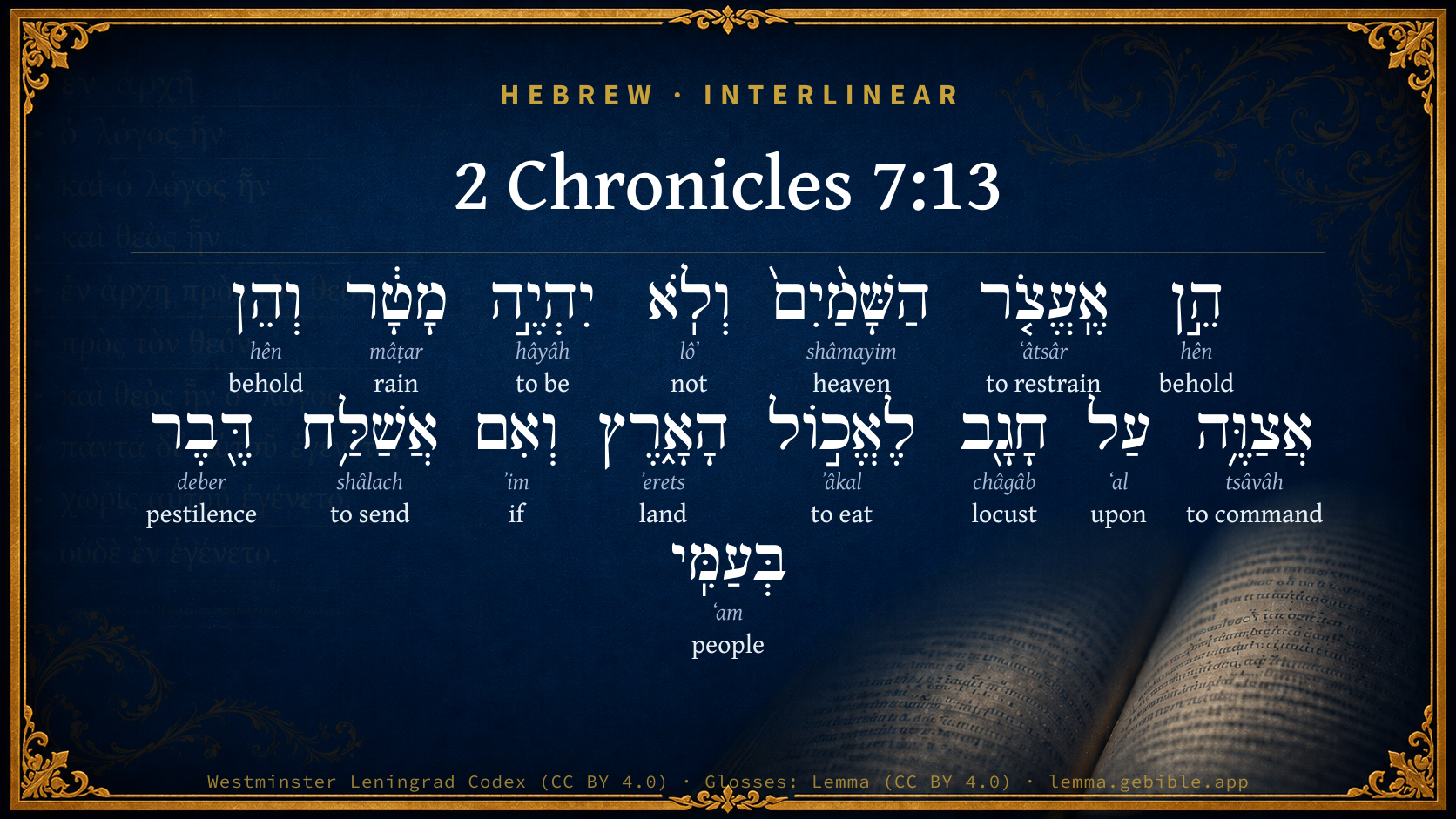
Hebrew (Westminster Leningrad Codex) 2 Chronicles 7:13 appears in the Hebrew Old Testament. The text above is from the Westminster Leningrad Codex. Each word links to its Strong’s number, a concise gloss, and parsing drawn from the Open Scriptures Hebrew Bible morphology. Click any word for its full Brown-Driver-Briggs (BDB) entry.
Download image
Cite this verse

2 Chronicles 7:13 (World English Bible). Public Domain. Lemma interlinear Bible study tool, https://lemma.gebible.app/v/2-chronicles/7/13.

Show BibTeX & RIS
BibTeX
RIS
English Translation
If I shut up the sky so that there is no rain, or if I command the locust to devour the land, or if I send pestilence among my people;
World English Bible · Public Domain
Download a study sheet

One document with this verse’s original text, its word-by-word gloss line, the meaning frame, cross-references with their text, attributed commentary, and full source and license credits — printable, and it pastes into notes with its structure intact.

This verse Autodidact and up

Study sheet (.html) Plain text (.txt)

A passage Seminary Student

Up to 50 verses in one chapter. A passage sheet keeps up to 6 commentary sources and 12 cross-references per verse, in the order this page ranks them, and says so on the sheet whenever that leaves anything out. Ask for a single verse and you get the Autodidact verse sheet above.

Everything on this page stays free to read, with no account — the sheet is a download of what is already on screen, not access to it.

Want to remove ads? Support Godless Engineer
Compare translations 3

The same verse in 3 English versions, stacked beneath the original-language interlinear above. Click any original word for its lexicon entry.

Each is an independent rendering of the whole verse — the interlinear is not word-aligned to these translations.

Highlighted words mark where these versions differ — a whole-verse word diff, not a word-by-word alignment.

  • World English Bible Public Domain
    If I shut up the sky so that there is no rain, or if I command the locust to devour the land, or if I send pestilence among my people;
  • King James Version Public Domain
    If I shut up heaven that there be no rain, or if I command the locusts to devour the land, or if I send pestilence among my people;
  • unfoldingWord Literal Text CC BY-SA 4.0
    If I restrain the heavens and there is no rain, or if I command the locust to devour the land, or if I send pestilence among my people,

unfoldingWord Literal Text — © unfoldingWord, licensed CC BY-SA 4.0. Word-aligned USFM3 via Door43 (git.door43.org/unfoldingWord/en_ult).

Versions to compare (up to 4)

3 of 4 selected

Show all 18 translations

Every available English version of this verse, each an independent rendering of the whole verse.

  • World English Bible Public Domain
    If I shut up the sky so that there is no rain, or if I command the locust to devour the land, or if I send pestilence among my people;
  • Berean Standard Bible Public Domain
    If I close the sky so there is no rain, or if I command the locust to devour the land, or if I send a plague among My people,
  • Majority Standard Bible Public Domain
    If I close the sky so there is no rain, or if I command the locust to devour the land, or if I send a plague among My people,
  • King James Version Public Domain
    If I shut up heaven that there be no rain, or if I command the locusts to devour the land, or if I send pestilence among my people;
  • American Standard Version (1901) Public Domain
    If I shut up the heavens so that there is no rain, or if I command the locust to devour the land, or if I send pestilence among my people;
  • Revised Version (1885) Public Domain
    If I shut up heaven that there be no rain, or if I command the locust to devour the land, or if I send pestilence among my people;
  • Geneva Bible (1599) Public Domain
    If I shut the heauen that there be no raine, or if I commaund the grashopper to deuoure the lande, or if I sende pestilence among my people,
  • Douay-Rheims (1899) Public Domain
    If I shut up heaven, and there fall no rain, or if I give orders, and command the locust to devour the land, or if I send pestilence among my people:
  • Young's Literal Translation Public Domain
    If I restrain the heavens and there is no rain, and if I lay charge on the locust to consume the land, and if I send pestilence among My people --
  • Literal Standard Version CC BY-SA 4.0
    If I restrain the heavens and there is no rain, and if I lay charge on the locust to consume the land, and if I send pestilence among My people—
  • Unlocked Literal Bible CC BY-SA 4.0
    Suppose that I shut up the heavens so that there is no rain, or if I command the locust to devour the land, or if I send disease among my people,
  • unfoldingWord Literal Text CC BY-SA 4.0
    If I restrain the heavens and there is no rain, or if I command the locust to devour the land, or if I send pestilence among my people,
  • Darby Bible Public Domain
    If I shut up the heavens that there be no rain, or if I command the locust to devour the land, or if I send pestilence among my people;
  • World Messianic Bible Public Domain
    “If I shut up the sky so that there is no rain, or if I command the locust to devour the land, or if I send pestilence among my people,
  • Webster's Bible Public Domain
    If I shut up heaven that there be no rain, or if I command the locusts to devour the land, or if I send pestilence among my people;
  • Free Bible Version CC BY-SA 4.0
    If I were to close shut the sky so there is no rain, or command the locust to devour the land, or send a plague among my people,
  • Bible in Basic English Public Domain
    If, at my word, heaven is shut up, so that there is no rain, or if I send locusts on the land for its destruction, or if I send disease on my people;
  • JPS Tanakh (1917) Public Domain
    If I shut up heaven that there be no rain, or if I command the locust to devour the land, or if I send pestilence among My people;

Literal Standard Version (2020), Covenant Press — licensed CC BY-SA 4.0. Text via the HelloAO Bible API (eBible.org). Unlocked Literal Bible (unfoldingWord) — licensed CC BY-SA 4.0. Text via the HelloAO Bible API (eBible.org). unfoldingWord Literal Text — © unfoldingWord, licensed CC BY-SA 4.0. Word-aligned USFM3 via Door43 (git.door43.org/unfoldingWord/en_ult). Free Bible Version, Dr. Jonathan Gallagher — licensed CC BY-SA 4.0. Text via the HelloAO Bible API (eBible.org).

Word by word

More ways to search: Search by grammar → Find every occurrence → Compare this word →

Practice this passage: Drill this verse → Learn its vocabulary →

חָגָ֖ב
châgâb
H2284
“locust”
Noun, Common, Masculine, Singular, Absolute
Part of Speech
Noun
Type
Common
Gender
Masculine
Number
Singular
State
Absolute
Full BDB Definition

Origin: of uncertain derivation

TWOT: 601a

locust, grasshopper
  1. הֵ֣ן hên H2005 “behold” Particle, Demonstrative
  2. אֶֽעֱצֹ֤ר ʻâtsâr H6113 “to restrain” Verb, Qal, Imperfect, 1st Person, Common, Singular
  3. הַשָּׁמַ֨יִם֙ shâmayim H8064 “the · heaven(s)” Particle, Definite Article + Noun, Common, Masculine, Plural, Absolute
  4. וְלֹֽא lôʼ H3808 “and · not” Conjunction + Particle, Negative
  5. יִהְיֶ֣ה hâyâh H1961 “to be” Verb, Qal, Imperfect, 3rd Person, Masculine, Singular
  6. מָטָ֔ר mâṭar H4306 “rain” Noun, Common, Masculine, Singular, Absolute
  7. וְהֵן hên H2005 “and · behold” Conjunction + Particle, Interjection
  8. אֲצַוֶּ֥ה tsâvâh H6680 “to command” Verb, Piel, Imperfect, 1st Person, Common, Singular
  9. עַל ʻal H5921 “upon” Preposition
  10. לֶאֱכ֣וֹל ʼâkal H398 “to eat” Preposition + Verb, Qal, Infinitive Construct
  11. הָאָ֑רֶץ ʼerets H776 “the · land” Particle, Definite Article + Noun, Common, Both, Singular, Absolute
  12. וְאִם ʼim H518 “and · if” Conjunction + Conjunction
  13. אֲשַׁלַּ֥ח shâlach H7971 “to send” Verb, Piel, Imperfect, 1st Person, Common, Singular
  14. דֶּ֖בֶר deber H1698 “pestilence” Noun, Common, Masculine, Singular, Absolute
  15. בְּעַמִּֽי ʻam H5971 “in/at · people · my” Preposition + Noun, Common, Masculine, Singular, Construct + Suffix, Personal, 1st Person, Common, Singular

About this verse

These counts appear in no published source. They are computed here, from the morphology-tagged text and Lemma’s own curated glosses. What Lemma adds →

16
words
15
distinct lemmas
Historical
section

Notable vocabulary

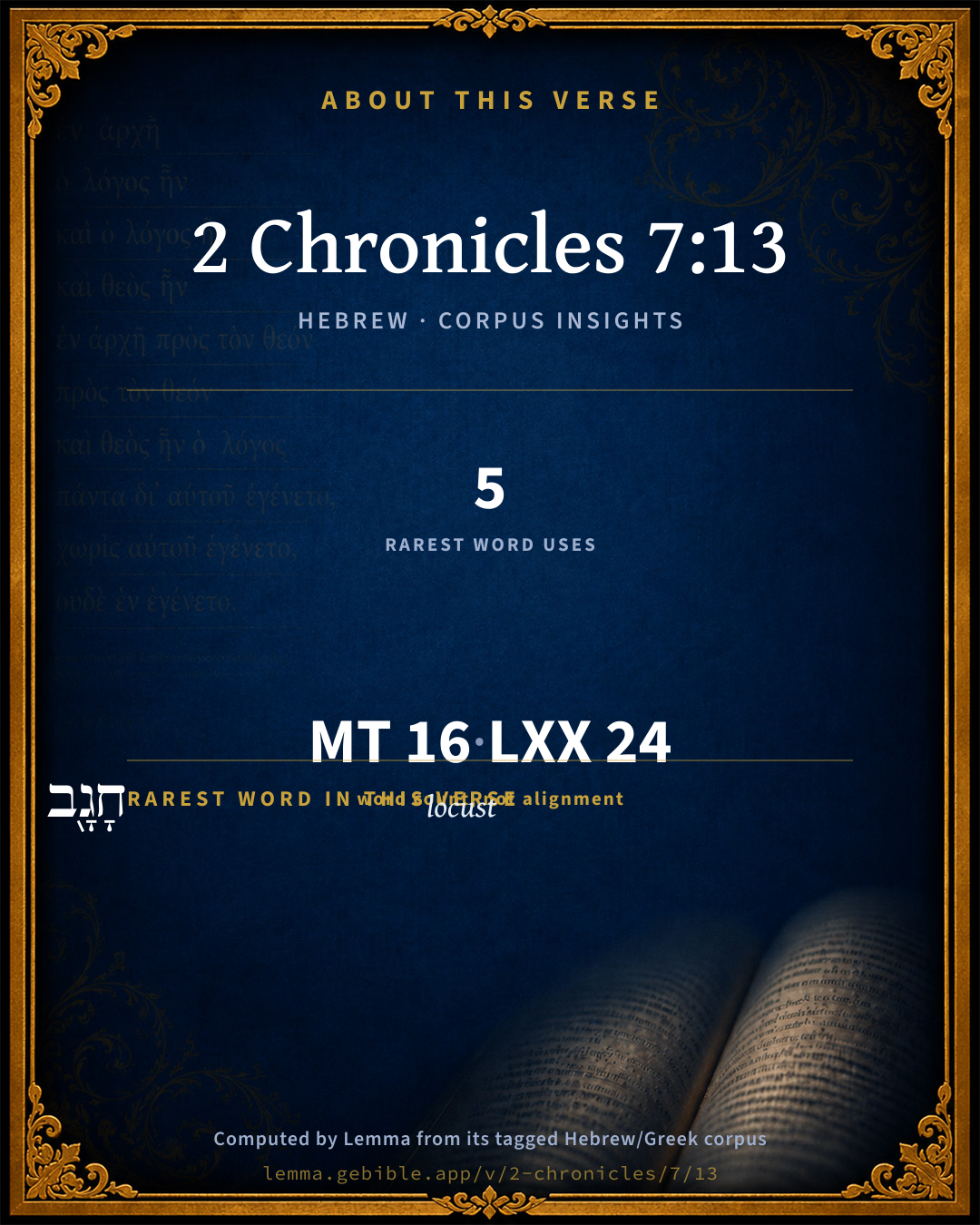
The rarest word here is חָגָ֖ב locust H2284 — appearing just 5 times in the whole Hebrew Bible.

Shared distinctive vocabulary

חָגָ֖ב locust H2284 occurs in 5 verses of the Hebrew Bible. Also found in:

Grammatical profile

  • 5 verbs
  • 6 nouns
  • 1 preposition
  • 1 conjunction
  • 3 particles

Verb forms

  • אֶֽעֱצֹ֤ר Qal · Imperfect
  • יִהְיֶ֣ה Qal · Imperfect
  • אֲצַוֶּ֥ה Piel · Imperfect
  • לֶאֱכ֣וֹל Qal · Infinitive Construct
  • אֲשַׁלַּ֥ח Piel · Imperfect

Repetition

A word recurs within this verse — often emphatic in Hebrew:

  • הֵ֣ן behold H2005 ×2

Hebrew & Septuagint length

In English translation the verse runs 30 words from the Hebrew and 32 from the Septuagint (LXX English) — closely comparable.

A rough comparison of the two English renderings, which tokenize alike — not a word-level alignment.

Word counts can differ between the Hebrew and the Greek without any difference in meaning — e.g. the Hebrew direct-object marker אֵת has no separate Greek word, and Greek often adds the article ὁ.

In the original languages it is 16 Hebrew tokens and 24 Greek tokens — but the two are counted differently (Hebrew bundles its prefixes and suffixes into one token; the Greek is in lemma form), so that isn’t a like-for-like length.

Cross-references

16

Topical passages linked to 2 Chronicles 7:13 in the Treasury of Scripture Knowledge — connected by theme and wording, ordered by reader-vote popularity; previews shown in the World English Bible.

  • 2 Chronicles 6:26–28 When the sky is shut up, and there is no rain, because they have sinned against you; if they pray toward this place, and confess your name, and turn from their sin, when you do afflict them:
  • Deuteronomy 11:17 and the anger of Yahweh be kindled against you, and he shut up the sky, so that there shall be no rain, and the land shall not yield its fruit; and you perish quickly from off the good land which Yahweh gives you.
  • Revelation 11:6 These have the power to shut up the sky, that it may not rain during the days of their prophecy. They have power over the waters, to turn them into blood, and to strike the earth with every plague, as often as they desire.
  • Revelation 3:7 "To the angel of the assembly in Philadelphia write: "He who is holy, he who is true, he who has the key of David, he who opens and no one can shut, and who shuts and no one opens, says these things:
  • 2 Samuel 24:13–15 So Gad came to David, and told him, and said to him, Shall seven years of famine come to you in your land? or will you flee three months before your foes while they pursue you? or shall there be three days' pestilence in your land? now advise you, and consider what answer I shall return to him who sent me.
  • Exodus 10:4–6 Or else, if you refuse to let my people go, behold, tomorrow I will bring locusts into your country,
  • Job 12:14 Behold, he breaks down, and it can't be built again; He imprisons a man, and there can be no release.
  • Ezekiel 14:19–21 Or if I send a pestilence into that land, and pour out my wrath on it in blood, to cut off from it man and animal;
  • Joel 2:25 I will restore to you the years that the swarming locust has eaten, The great locust, the grasshopper, and the caterpillar, My great army, which I sent among you.
  • Numbers 14:12 I will strike them with the pestilence, and disinherit them, and will make of you a nation greater and mightier than they.
  • Numbers 16:46–47 Moses said to Aaron, Take your censer, and put fire therein from off the altar, and lay incense thereon, and carry it quickly to the congregation, and make atonement for them: for there is wrath gone out from Yahweh; the plague is begun.
  • Job 11:10 If he passes by, or confines, Or convenes a court, then who can oppose him?
  • Psalms 105:34 He spoke, and the locusts came, And the grasshoppers, without number,
  • Psalms 107:34 And a fruitful land into a salt waste, For the wickedness of those who dwell in it.
  • Joel 1:4–7 What the swarming locust has left, the great locust has eaten. What the great locust has left, the grasshopper has eaten. What the grasshopper has left, the caterpillar has eaten.
  • Luke 4:25 But truly I tell you, there were many widows in Israel in the days of Elijah, when the sky was shut up three years and six months, when a great famine came over all the land.

Cross-references courtesy of OpenBible.info (CC BY 4.0).

Hebrew and Greek witnesses Masoretic Hebrew ↔ Greek Septuagint

The same verse in the two great witnesses to the Old Testament, shown verse-for-verse.

These are two independent witnesses, not word-aligned to each other, and the Septuagint is shown in lemma (dictionary) form.

Hebrew 2 Chronicles 7:13 Masoretic · Westminster Leningrad Codex

הֵ֣ן אֶֽעֱצֹ֤ר הַשָּׁמַ֨יִם֙ וְלֹֽא יִהְיֶ֣ה מָטָ֔ר וְהֵן אֲצַוֶּ֥ה עַל חָגָ֖ב לֶאֱכ֣וֹל הָאָ֑רֶץ וְאִם אֲשַׁלַּ֥ח דֶּ֖בֶר בְּעַמִּֽי

If I shut up the sky so that there is no rain, or if I command the locust to devour the land, or if I send pestilence among my people;

World English Bible · Public Domain

Greek LXX 2 Chronicles 7:13 Septuagint · lemma form

ἐάν συνἔχω ὁ οὐρανός καί μή γίγνομαι ὑετός καί ἐάν ἐντέλλω ὁ ἀκρίς καταἐσθίω ὁ ξύλον καί ἐάν ἀποστέλλω θάνατος ἐν ὁ λαός ἐγώ

If I should restrain the heaven and there should be no rain, and if I should command the locust to devour the trees, and if I should send pestilence upon my people;

LXX2012 (modern English Septuagint) · Public Domain

On this verse, The Cambridge Bible for Schools and Colleges discusses the Septuagint’s reading. Read the note in Commentary ↓

Hebrew: Westminster Leningrad Codex (CC BY 4.0). Greek: Septuagint (public domain); English from LXX2012 (modern English Septuagint) (Public Domain). How the Septuagint differs from the Hebrew →

Commentary

Notes on 2 Chronicles 7:13 from classic Christian and Jewish commentators (each source and its license shown beneath its notes). The classic Christian expositions comment on the surrounding passage and are grouped to its opening verse, so a note may address several verses; the Jewish commentaries on the Tanakh (Rashi and others) are per-verse, so they appear only where the commentator wrote on this verse.

Lemma curates 59 commentaries, every one of them public domain or Creative Commons licensed, each selected and text-cleaned for this edition rather than reprinted as found. About our sources →

Trapp's Complete Commentary

John Trapp

2Ch 7:13 If I shut up heaven that there be no rain, or if I command the locusts to devour the land, or if I send pestilence among my people;

Ver. 13. If I shut up heaven, &c.] In answer this is to that prayer of Solomon, 1Ki 8:35; 1Ki 8:37.

John Trapp, A Commentary or Exposition upon All the Books of the Old and New Testament (1647–1656) — public domain. Text from a community e-Sword module.

Joseph Benson's Commentary

2Ch 7:13. If I command the locusts to devour the land — That is, use my authority and power over them to cause them to do so. A metaphor elsewhere used in reference to irrational animals, as 1Ki 17:4, Amo 9:3, which are not properly capable of receiving a command, or of paying obedience to it. Other national judgments are here supposed, such as famine, war, and the ravages of savage beasts.

Joseph Benson's Commentary on the Old and New Testaments (1811–1818) — public domain. Text from a community e-Sword module.

Tyndale Open Study Notes

Tyndale Open Resources

7:13-15 These verses refer directly to Solomon’s prayer (see 6:26, 28, 40). God outlined for Solomon the requirements for rescue from judgment. In Solomon’s prayer, each case had been addressed separately; in the Lord’s answer, the required response is developed more generally and comprehensively. The people need humility, repentance, seeking the Lord, and prayer in order to be healed from their distresses.

Tyndale Open Study Notes — © Tyndale Open Resources, licensed CC BY-SA 4.0. Text via the HelloAO Bible API.

Adam Clarke's Commentary

Verse 13. Or if I send pestilence] "The angel of death." - Targum.

Adam Clarke's Commentary on the Bible (1810–1826) — public domain. Text from a community e-Sword/MySword module.

Ellicott's Commentary for English Readers

(13) If I shut up heaven that there be no rain.—Deu_11:17; 2Ch_6:26.

If.—Hçn, as in Jer_3:1; Isa_54:15.

The locusts.—Hâgâb, a winged and edible species (Lev_11:22). In 2Ch_6:28, two other kinds, the ’arbeh and hâsîl, were mentioned.

If I send pestilence.—2Ch_6:28; 1 Chronicles 21

A Bible Commentary for English Readers, edited by Charles John Ellicott (1878–1897) — public domain. Text from a community e-Sword module.

The Cambridge Bible for Schools and Colleges

gen. ed. J. J. S. Perowne

13. to devour the land] LXX. to devour the trees; cp. Exo_10:15; Joe_1:6-7.

13–15. These vv. have no parallel in 1 Kings.

The Cambridge Bible for Schools and Colleges (gen. ed. J. J. S. Perowne; Cambridge University Press, 1878–1918) — public domain. Text from a community e-Sword module.

Matthew Poole's English Annotations

If I command the locusts, i.e. use my authority and power over them to cause them to do so. A metaphor elsewhere used in reference to unreasonable creatures, as 1Ki 17:4; Amo 9:3, who are not properly capable of a command, or of obedience.

Matthew Poole's English Annotations on the Holy Bible (1683–1685) — public domain. Text from a community e-Sword/MySword module.

The Pulpit Commentary

Vers. 13-15. These three verses (the counterparts of (2Ch_6:26, 2Ch_6:28, 2Ch_6:40) are not in the parallel. Although we can scarcely trace the principle of their selection from the seven parts of the prayer, they would seem to have been selected from the original work, as samples of a reply which presumably embraced reference to all the seven. When, in ver. 14, it is said, I will heal their land, the telling expression, according to the Authorized Version, must be understood to refer to the removing of drought by rain. On the other hand, the Authorized Version is, in ver. 15, unfortunate in the unnecessary and misleading insertion of the italics found there, and in the use of the preposition "in" for of, the simple case construct, which is manifestly what is wanted and intended. It was not absolutely essential that prayer should be made in the place. How many references there are to prayer being made from a distance toward the place!

The Pulpit Commentary (1880–1919), ed. H.D.M. Spence-Jones & Joseph S. Exell — public domain. Text from a community e-Sword module.

unfoldingWord translationNotes

Door43 World Missions Community

Suppose that I shut up the heavens so that there is no rain

Here "heavens" refers to the sky, and is spoken of as if it were a building in which God stores the rain. See how you translated a similar phrase in 2 Chronicles 6:26. AT: "Suppose that I do not allow the rain to fall from the skies" (See: Metaphor)

devour the land

The word "land" represents the plants and crops on the land. (See: Metonymy)

if I send disease among my people

Here "send disease" represents causing diseases. AT: "if I cause my people to have diseases" (See: Metaphor)

who are called by my name

Here being called by God's name is an idiom meaning belonging to God. AT: "who belong to me" (See: Idiom)

seek my face

Here God's face represents his acceptance of them. Possible meanings are "seek my face" represents 1) urgently asking him for forgiveness. AT: "beg me to forgive them" or 2) strongly wanting to please him. AT: "choose to please me" (See: Metaphor)

turn from their wicked ways

Here "turn from" is a metaphor meaning to stop doing something, and "ways" represent behavior. AT: "stop their wicked behavior" or "stop doing wicked things" (See: Metaphor)

heal their land

Here land that does not produce much is spoken of as though it were sick. AT: "make their land good again" or "make their land produce good crops" (See: Personification)

my eyes will be open

The eyes being open is a metonym for seeing. Here it represents looking attentively. AT: "I will pay attention to you" or "I will watch you" (See: Metonymy)

my ears attentive to the prayers

The ears being attentive is a metonym for listening attentively. AT: "I will listen to the prayers" (See: Metonymy)

the prayers that are made in this place

This can be expressed in active form. AT: "to the prayers that you make in this place" or "to you as you pray to me in this place" (See: Active or Passive)

translationWords

heaven

command

devour

people of God

call

name

humble

face

turn

evil

forgive

sin

unfoldingWord translationNotes — © Distant Shores Media and the Door43 World Missions Community, licensed CC BY-SA 4.0. Source: git.door43.org/Door43/en_tn.

Rashi

Rabbi Shlomo Yitzchaki (Rashi)

If I shut up... if I command...or if I send corresponding to three prayers, “I shall hear...and forgive their sin, and heal their land.”

Rashi on the Tanakh — English translations: “The Judaica Press complete Tanach with Rashi, translated by A. J. Rosenberg” (CC BY 4.0); “Pentateuch with Rashi's commentary by M. Rosenbaum and A.M. Silbermann, 1929-1934” (public domain); “The Metsudah Tanach series, Lakewood, N.J” (CC BY 4.0); and “The Book of Joshua, Metsudah Publications, 1997” (CC BY 4.0). Text via Sefaria.

Lesson kit

Teaching starters — assembled from the data on this page, not authored interpretation. Every prompt links to the verse data it draws on. Edit before teaching.

2 Chronicles, in the Historical, opens this verse with 16 words (15 distinct Hebrew lemmas). Its most distinctive word is châgâb (“locust”). A historical commentator’s framing appears above. Read the whole chapter for the surrounding context.

Discussion questions

  1. The word châgâb carries the sense “locust.” How does it shape the verse?
  2. How does Leviticus 11:22, which shares the word «locust», read alongside this verse?
  3. What does the repetition of “behold” (2× in this one verse) do in this verse?
  4. These translations render this verse differently; the difference is in the English rendering, not the original. What questions does that raise?
  5. «אֶֽעֱצֹ֤ר» is a Qal Imperfect verb. How does that grammatical form shape the action described?
  6. Compare how Trapp's Complete Commentary and Joseph Benson's Commentary read this verse. Where do they agree or differ?

Things to notice

Reading settings

Reading text

Shown beneath each verse's original-language words.

Old Testament
Old Testament edition

Read the OT as the Masoretic Hebrew (MT) or the Greek Septuagint (LXX).

English shown for the Greek Septuagint (in the Hebrew ↔ Greek comparison).

Comparing translations? Open the Compare panel on any verse page to stack up to four side by side.