2 Chronicles 12:2

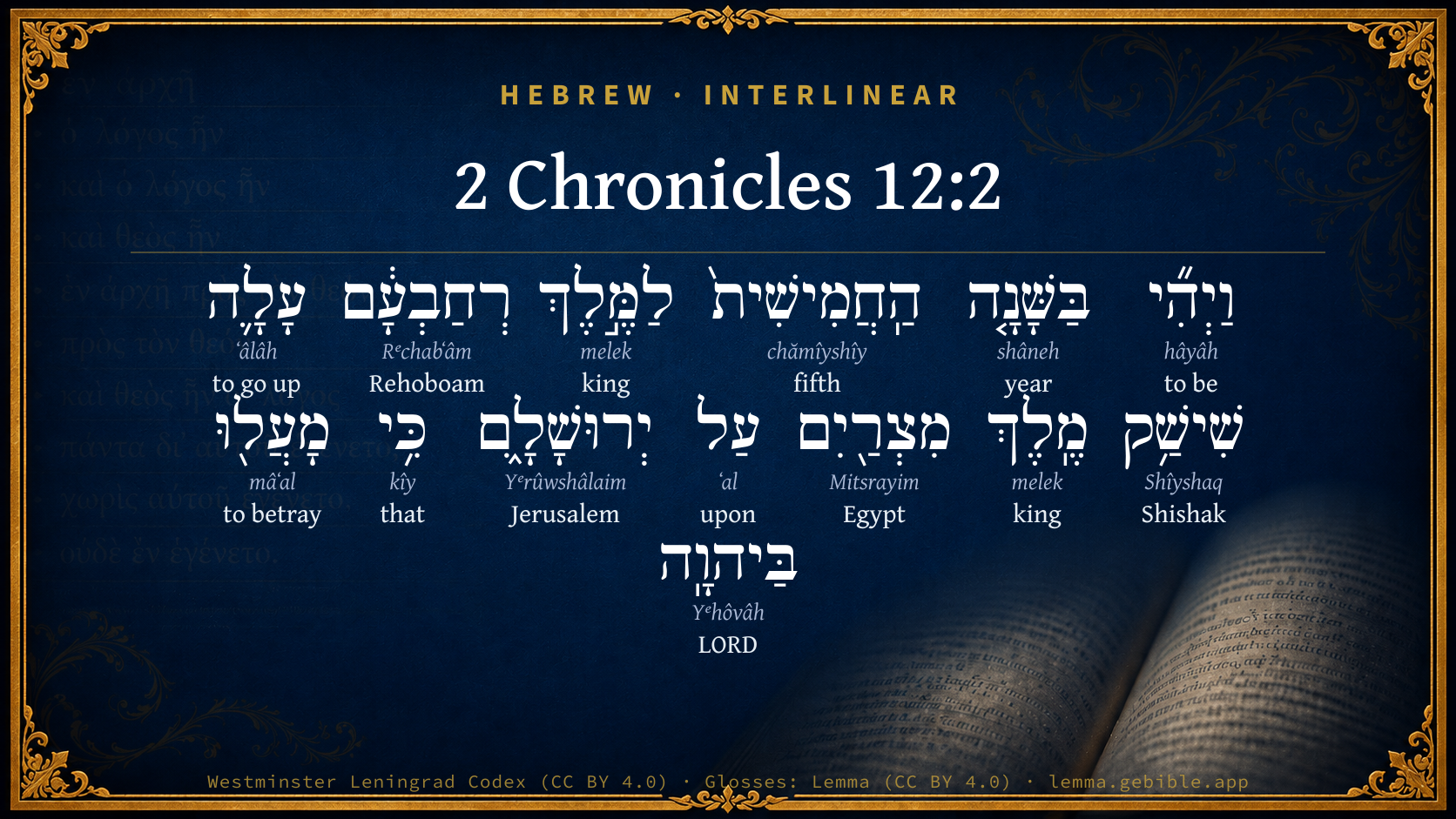
Hebrew (Westminster Leningrad Codex) 2 Chronicles 12:2 appears in the Hebrew Old Testament. The text above is from the Westminster Leningrad Codex. Each word links to its Strong’s number, a concise gloss, and parsing drawn from the Open Scriptures Hebrew Bible morphology. Click any word for its full Brown-Driver-Briggs (BDB) entry.
Download image
Cite this verse

2 Chronicles 12:2 (World English Bible). Public Domain. Lemma interlinear Bible study tool, https://lemma.gebible.app/v/2-chronicles/12/2.

Show BibTeX & RIS
BibTeX
RIS
English Translation
It happened in the fifth year of king Rehoboam, that Shishak king of Egypt came up against Jerusalem, because they had trespassed against Yahweh,
World English Bible · Public Domain
Download a study sheet

One document with this verse’s original text, its word-by-word gloss line, the meaning frame, cross-references with their text, attributed commentary, and full source and license credits — printable, and it pastes into notes with its structure intact.

This verse Autodidact and up

Study sheet (.html) Plain text (.txt)

A passage Seminary Student

Up to 50 verses in one chapter. A passage sheet keeps up to 6 commentary sources and 12 cross-references per verse, in the order this page ranks them, and says so on the sheet whenever that leaves anything out. Ask for a single verse and you get the Autodidact verse sheet above.

Everything on this page stays free to read, with no account — the sheet is a download of what is already on screen, not access to it.

Want to remove ads? Support Godless Engineer
Compare translations 3

The same verse in 3 English versions, stacked beneath the original-language interlinear above. Click any original word for its lexicon entry.

Each is an independent rendering of the whole verse — the interlinear is not word-aligned to these translations.

Highlighted words mark where these versions differ — a whole-verse word diff, not a word-by-word alignment.

  • World English Bible Public Domain
    It happened in the fifth year of king Rehoboam, that Shishak king of Egypt came up against Jerusalem, because they had trespassed against Yahweh,
  • King James Version Public Domain
    And it came to pass, that in the fifth year of king Rehoboam Shishak king of Egypt came up against Jerusalem, because they had transgressed against the LORD,
  • unfoldingWord Literal Text CC BY-SA 4.0
    And it happened in the fifth year of King Rehoboam, Shishak, the king of Egypt, came up against Jerusalem, because they were unfaithful to Yahweh.

unfoldingWord Literal Text — © unfoldingWord, licensed CC BY-SA 4.0. Word-aligned USFM3 via Door43 (git.door43.org/unfoldingWord/en_ult).

Versions to compare (up to 4)

3 of 4 selected

Show all 18 translations

Every available English version of this verse, each an independent rendering of the whole verse.

  • World English Bible Public Domain
    It happened in the fifth year of king Rehoboam, that Shishak king of Egypt came up against Jerusalem, because they had trespassed against Yahweh,
  • Berean Standard Bible Public Domain
    In the fifth year of Rehoboam’s reign, because they had been unfaithful to the LORD, Shishak king of Egypt came up and attacked Jerusalem
  • Majority Standard Bible Public Domain
    In the fifth year of Rehoboam’s reign, because they had been unfaithful to the LORD, Shishak king of Egypt attacked Jerusalem
  • King James Version Public Domain
    And it came to pass, that in the fifth year of king Rehoboam Shishak king of Egypt came up against Jerusalem, because they had transgressed against the LORD,
  • American Standard Version (1901) Public Domain
    And it came to pass in the fifth year of king Rehoboam, that Shishak king of Egypt came up against Jerusalem, because they had trespassed against Jehovah,
  • Revised Version (1885) Public Domain
    And it came to pass in the fifth year of king Rehoboam, that Shishak king of Egypt came up against Jerusalem, because they had trespassed against the LORD,
  • Geneva Bible (1599) Public Domain
    Therefore in the fift yeere of King Rehoboam, Shishak the King of Egypt came vp against Ierusalem (because they had transgressed against the Lord)
  • Douay-Rheims (1899) Public Domain
    And in the fifth year of the reign of Roboam, Sesac king of Egypt came up against Jerusalem (because they had sinned against the Lord)
  • Young's Literal Translation Public Domain
    And it cometh to pass, in the fifth year of king Rehoboam, come up hath Shishak king of Egypt against Jerusalem -- because they trespassed against Jehovah --
  • Literal Standard Version CC BY-SA 4.0
    And it comes to pass, in the fifth year of King Rehoboam, Shishak king of Egypt has come up against Jerusalem—because they trespassed against YHWH—
  • Unlocked Literal Bible CC BY-SA 4.0
    It happened in the fifth year of King Rehoboam, that Shishak, king of Egypt, came up against Jerusalem, because the people had been unfaithful to Yahweh.
  • unfoldingWord Literal Text CC BY-SA 4.0
    And it happened in the fifth year of King Rehoboam, Shishak, the king of Egypt, came up against Jerusalem, because they were unfaithful to Yahweh.
  • Darby Bible Public Domain
    And it came to pass in the fifth year of king Rehoboam, because they had transgressed against Jehovah, that Shishak king of Egypt came up against Jerusalem,
  • World Messianic Bible Public Domain
    In the fifth year of King Rehoboam, Shishak king of Egypt came up against Jerusalem, because they had trespassed against the LORD,
  • Webster's Bible Public Domain
    And it came to pass, that in the fifth year of king Rehoboam, Shishak king of Egypt came up against Jerusalem, because they had transgressed against the LORD,
  • Free Bible Version CC BY-SA 4.0
    In the fifth year of Rehoboam's reign, Shishak, king of Egypt, came and attacked Jerusalem because they had been unfaithful to God.
  • Bible in Basic English Public Domain
    Now in the fifth year of King Rehoboam, Shishak, king of Egypt, came up against Jerusalem, because of their sin against the Lord,
  • JPS Tanakh (1917) Public Domain
    And it came to pass in the fifth year of king Rehoboam, that Shishak king of Egypt came up against Jerusalem, because they had dealt treacherously with the LORD,

Literal Standard Version (2020), Covenant Press — licensed CC BY-SA 4.0. Text via the HelloAO Bible API (eBible.org). Unlocked Literal Bible (unfoldingWord) — licensed CC BY-SA 4.0. Text via the HelloAO Bible API (eBible.org). unfoldingWord Literal Text — © unfoldingWord, licensed CC BY-SA 4.0. Word-aligned USFM3 via Door43 (git.door43.org/unfoldingWord/en_ult). Free Bible Version, Dr. Jonathan Gallagher — licensed CC BY-SA 4.0. Text via the HelloAO Bible API (eBible.org).

Word by word

More ways to search: Search by grammar → Find every occurrence → Compare this word →

Practice this passage: Drill this verse → Learn its vocabulary →

שִׁישַׁ֥ק
Shîyshaq
H7895
“Shishak”
Noun, Proper
Part of Speech
Noun
Type
Proper
Full BDB Definition

Origin: of Egyptian derivation

TWOT: None

Shishak = "greedy of fine linen" - king of Egypt, Sheshonk I, 1st king of the Bubastite 22nd dynasty; ruled in Egypt during the reigns of Solomon and Rehoboam and attacked the southern kingdom under Rehoboam and apparently made it tributary
  1. וַיְהִ֞י hâyâh H1961 “and · to be” Conjunction + Verb, Qal, Sequential Imperfect, 3rd Person, Masculine, Singular
  2. בַּשָּׁנָ֤ה shâneh H8141 “in/at the · year” Preposition, Determined + Noun, Common, Feminine, Singular, Absolute
  3. הַֽחֲמִישִׁית֙ chămîyshîy H2549 “the · fifth” Particle, Definite Article + Adjective, Ordinal number, Feminine, Singular, Absolute
  4. לַמֶּ֣לֶךְ melek H4428 “to/for the · king” Preposition, Determined + Noun, Common, Masculine, Singular, Absolute
  5. רְחַבְעָ֔ם Rᵉchabʻâm H7346 “Rehoboam” Noun, Proper
  6. עָלָ֛ה ʻâlâh H5927 “to go up” Verb, Qal, Perfect, 3rd Person, Masculine, Singular
  7. מֶֽלֶךְ melek H4428 “king of” Noun, Common, Masculine, Singular, Construct
  8. מִצְרַ֖יִם Mitsrayim H4714 “Egypt” Noun, Proper
  9. עַל ʻal H5921 “upon” Preposition
  10. יְרוּשָׁלִָ֑ם Yᵉrûwshâlaim H3389 “Jerusalem” Noun, Proper
  11. כִּ֥י kîy H3588 “that” Conjunction
  12. מָעֲל֖וּ mâʻal H4603 “to betray” Verb, Qal, Perfect, 3rd Person, Common, Plural
  13. בַּיהוָֽה Yᵉhôvâh H3068 “in/at · LORD” Preposition + Noun, Proper

About this verse

These counts appear in no published source. They are computed here, from the morphology-tagged text and Lemma’s own curated glosses. What Lemma adds →

14
words
13
distinct lemmas
Historical
section

Notable vocabulary

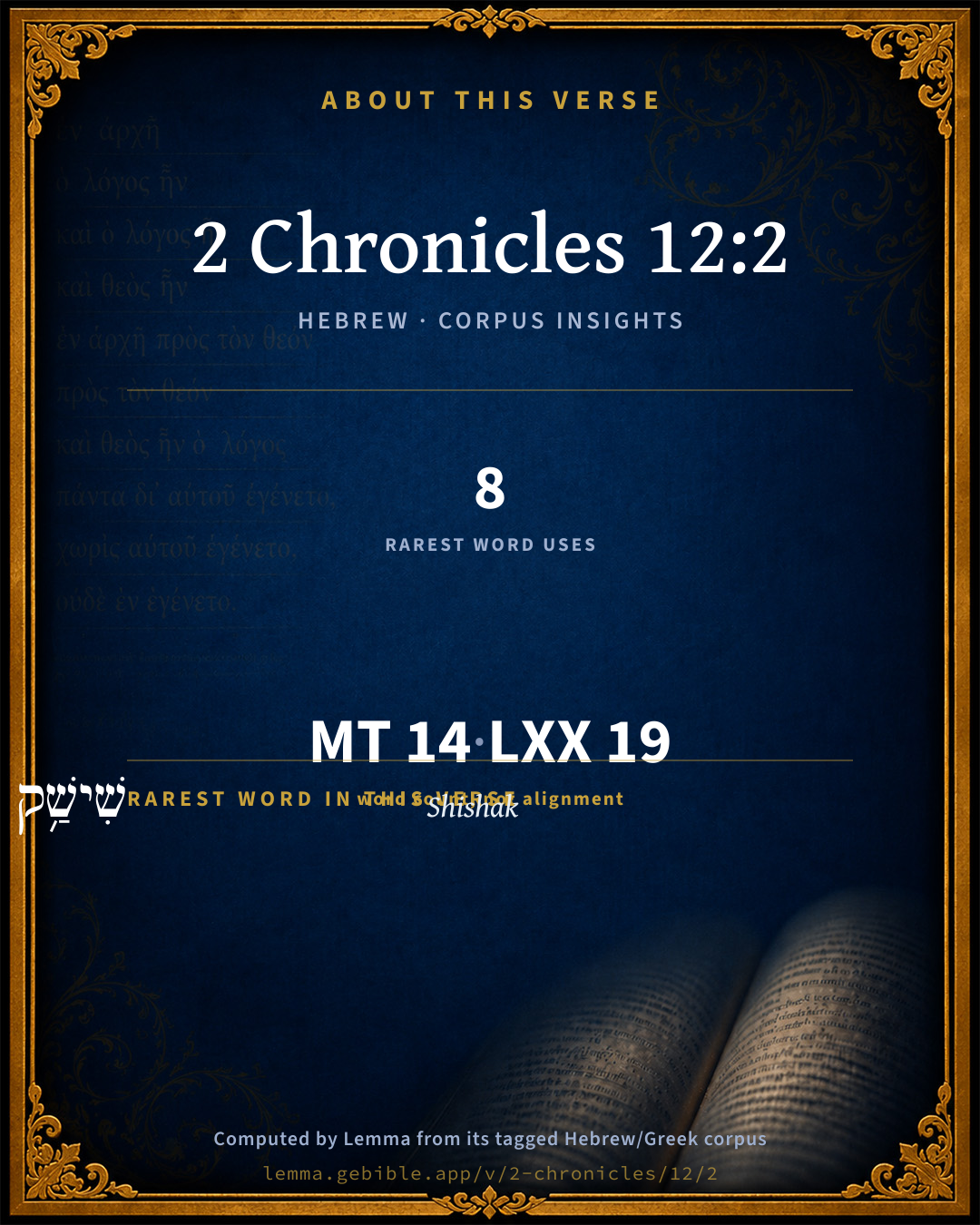
The rarest word here is שִׁישַׁ֥ק Shishak H7895 — appearing just 8 times in the whole Hebrew Bible.

Shared distinctive vocabulary

שִׁישַׁ֥ק Shishak H7895 occurs in 6 verses of the Hebrew Bible. Also found in:

Grammatical profile

  • 3 verbs
  • 8 nouns
  • 1 adjective
  • 1 preposition
  • 1 conjunction

Verb forms

  • וַיְהִ֞י Qal · Sequential Imperfect
  • עָלָ֛ה Qal · Perfect
  • מָעֲל֖וּ Qal · Perfect

Repetition

A word recurs within this verse — often emphatic in Hebrew:

  • לַמֶּ֣לֶךְ king H4428 ×2

Hebrew & Septuagint length

In English translation the verse runs 24 words from the Hebrew and 29 from the Septuagint (LXX English) — closely comparable.

A rough comparison of the two English renderings, which tokenize alike — not a word-level alignment.

Word counts can differ between the Hebrew and the Greek without any difference in meaning — e.g. the Hebrew direct-object marker אֵת has no separate Greek word, and Greek often adds the article ὁ.

In the original languages it is 14 Hebrew tokens and 19 Greek tokens — but the two are counted differently (Hebrew bundles its prefixes and suffixes into one token; the Greek is in lemma form), so that isn’t a like-for-like length.

Cross-references

12

Topical passages linked to 2 Chronicles 12:2 in the Treasury of Scripture Knowledge — connected by theme and wording, ordered by reader-vote popularity; previews shown in the World English Bible.

  • 1 Kings 11:40 Solomon sought therefore to kill Jeroboam; but Jeroboam arose, and fled into Egypt, to Shishak king of Egypt, and was in Egypt until the death of Solomon.
  • 2 Chronicles 7:19–20 But if you turn away, and forsake my statutes and my commandments which I have set before you, and shall go and serve other gods, and worship them;
  • Judges 2:13–15 They forsook Yahweh, and served Baal and the Ashtaroth.
  • 1 Kings 14:24–26 and there were also sodomites in the land: they did according to all the abominations of the nations which Yahweh drove out before the children of Israel.
  • 1 Chronicles 28:9 You, Solomon my son, know the God of your father, and serve him with a perfect heart and with a willing mind; for Yahweh searches all hearts, and understands all the imaginations of the thoughts: if you seek him, he will be found of you; but if you forsake him, he will cast you off forever.
  • 2 Chronicles 36:14–19 Moreover all the chiefs of the priests, and the people, trespassed very greatly after all the abominations of the nations; and they polluted the house of Yahweh which he had made holy in Jerusalem.
  • Psalms 106:43–44 Many times he delivered them, But they were rebellious in their counsel, And were brought low in their iniquity.
  • Isaiah 63:10 But they rebelled, and grieved his holy Spirit: therefore he was turned to be their enemy, [and] himself fought against them.
  • Jeremiah 2:19 Your own wickedness shall correct you, and your backsliding shall reprove you: know therefore and see that it is an evil thing and a bitter, that you have forsaken Yahweh your God, and that my fear is not in you, says the Lord, Yahweh of Hosts.
  • Jeremiah 44:22–23 so that Yahweh could no longer bear, because of the evil of your doings, and because of the abominations which you have committed; therefore is your land become a desolation, and an astonishment, and a curse, without inhabitant, as it is this day.
  • Lamentations 5:15 The joy of our heart is ceased; Our dance is turned into mourning.
  • Nehemiah 9:26–27 Nevertheless they were disobedient, and rebelled against you, and cast your law behind their back, and killed your prophets that testified against them to turn them again to you, and they committed awful blasphemies.

Cross-references courtesy of OpenBible.info (CC BY 4.0).

Hebrew and Greek witnesses Masoretic Hebrew ↔ Greek Septuagint

The same verse in the two great witnesses to the Old Testament, shown verse-for-verse.

These are two independent witnesses, not word-aligned to each other, and the Septuagint is shown in lemma (dictionary) form.

Hebrew 2 Chronicles 12:2 Masoretic · Westminster Leningrad Codex

וַיְהִ֞י בַּשָּׁנָ֤ה הַֽחֲמִישִׁית֙ לַמֶּ֣לֶךְ רְחַבְעָ֔ם עָלָ֛ה שִׁישַׁ֥ק מֶֽלֶךְ מִצְרַ֖יִם עַל יְרוּשָׁלִָ֑ם כִּ֥י מָעֲל֖וּ בַּיהוָֽה

It happened in the fifth year of king Rehoboam, that Shishak king of Egypt came up against Jerusalem, because they had trespassed against Yahweh,

World English Bible · Public Domain

Greek LXX 2 Chronicles 12:2 Septuagint · lemma form

καί γίγνομαι ἐν ὁ πέμπτος ἔτος ὁ βασιλεία ροβοαμ ἀναβαίνω σουσακιμ βασιλεύς αἴγυπτος ἐπί ἰερουσαλήμ ὅτι ἁμαρτάνω ἐναντίον κύριος

And it came to pass in the fifth year of the reign of Roboam, Susakim king of Egypt came up against Jerusalem, because they had sinned against the Lord,

LXX2012 (modern English Septuagint) · Public Domain

On this verse, The Pulpit Commentary discusses the Septuagint’s reading. Read the note in Commentary ↓

Hebrew: Westminster Leningrad Codex (CC BY 4.0). Greek: Septuagint (public domain); English from LXX2012 (modern English Septuagint) (Public Domain). How the Septuagint differs from the Hebrew →

Commentary

Notes on 2 Chronicles 12:2 from classic Christian and Jewish commentators (each source and its license shown beneath its notes). The classic Christian expositions comment on the surrounding passage and are grouped to its opening verse, so a note may address several verses; the Jewish commentaries on the Tanakh (Rashi and others) are per-verse, so they appear only where the commentator wrote on this verse.

Lemma curates 59 commentaries, every one of them public domain or Creative Commons licensed, each selected and text-cleaned for this edition rather than reprinted as found. About our sources →

Trapp's Complete Commentary

John Trapp

2Ch 12:2 And it came to pass, [that] in the fifth year of king Rehoboam Shishak king of Egypt came up against Jerusalem, because they had transgressed against the LORD,

Ver. 2. In the fifth year of Rehoboam.] In his fourth year they fell from God’s service to idolatry, and did evil as they could. Had they taken away the idol temple set up by Solomon - as Zisca in Bohemia, and Cromwell here, did the monasteries, they had not likely so soon and so much corrupted themselves. But herein also Manasseh was to blame; and Constantine the Great, in that he only shut up the idol temples, and destroyed them not, which Julian the apostate did soon after set open again.

Shishak king of Egypt.] See on 1Ki 14:25.

Came up against Jerusalem,] Which when he had taken, he went on to other parts, and subdued all Asia, say Herodotus and Siculus.

Because they had transgressed against the Lord.] See 1Ki 14:22-24. Shishak probably was stirred up by Jeroboam who had lived in the court of Egypt, and married a wife there of the blood-royal, as some say - to invade Rehoboam’s country: but this he could not have done, had they not prevaricated against the Lord.

John Trapp, A Commentary or Exposition upon All the Books of the Old and New Testament (1647–1656) — public domain. Text from a community e-Sword module.

Joseph Benson's Commentary

2Ch 12:2. In the fifth year Shishak came up against Jerusalem — Presently after the apostacy of the king and people, which was in the fourth year. As this great calamity came upon them so soon after they began to desert the worship of God, and by a hand they had so little reason to suspect, having had a great deal of friendly correspondence with Egypt in the last reign; and as it came with so much violence, that all the fenced cities of Judah, which Rehoboam had lately fortified and garrisoned, and on which he relied much for the safety of his kingdom, fell into the hands of the enemy without making any resistance, it plainly appeared that the Lord had sent it, because they had transgressed against him. And doubtless God brought this unexpected trouble upon them so soon after their departure from him, not only to manifest his displeasure at, and to punish them for, their crime, but also and especially to recover them to repentance before their hearts were hardened.

Joseph Benson's Commentary on the Old and New Testaments (1811–1818) — public domain. Text from a community e-Sword module.

Tyndale Open Study Notes

Tyndale Open Resources

12:2-4 Shishak, also known as Shoshenq I (945–924 BC), ruled a reunited Egypt and founded the 22nd dynasty.

Tyndale Open Study Notes — © Tyndale Open Resources, licensed CC BY-SA 4.0. Text via the HelloAO Bible API.

Jamieson, Fausset & Brown

Robert Jamieson, A. R. Fausset & David Brown

Shishak king of Egypt came up against Jerusalem--He was the first king of the twenty-second or Bubastic Dynasty. What was the immediate cause of this invasion? Whether it was in resentment for some provocation from the king of Judah, or in pursuance of ambitious views of conquest, is not said. But the invading army was a vast horde, for Shishak brought along with his native Egyptians an immense number of foreign auxiliaries.

Jamieson, Fausset & Brown — Commentary Critical and Explanatory on the Whole Bible (1871) — public domain (CC PDM 1.0). Text via the HelloAO Bible API.

Adam Clarke's Commentary

Verse 2. Shishak king of Egypt] Concerning this man, and the motive which led him to attack the Jews, see the note on 1Kg 14:31.

Transgressed against the Lord] "Against the WORD of the Lord." - Targum.

Adam Clarke's Commentary on the Bible (1810–1826) — public domain. Text from a community e-Sword/MySword module.

Ellicott's Commentary for English Readers

(2) And it came to pass.—See 1Ki_14:25, with which this verse literally coincides, except that the last clause, “because they had transgressed,” is added by the chronicler.

In the fifth year of king Rehoboam.—The order of events is thus given: For three years Rehoboam and his people continued faithful to the Lord (2Ch_11:17); in the fourth year they fell away; and in the fifth their apostacy was punished.

Shishak.—The Sesonchis of Manetho, and the sh-sh-nk of the hieroglyphs, was the first king of the 22nd dynasty. “His name,” says Ebers, “and those of his successors, Osorkon (Zerah) and Takelot, are Semitic, a fact which explains the Biblical notice that Solomon took a princess of this dynasty for his consort, and stood in close commercial relations with Egypt, as well as, on the other hand, that Hadad the Edomite received the sister of Tahpenes the queen to wife (1Ki_11:19). In the year 949 B.C. Shishak, at the instigation of Jeroboam, took the field against Rehoboam, besieged Jerusalem, captured it, and carried off a rich booty to Thebes. On a southern wall of the Temple of Karnak, all Palestinian towns which the Egyptians took in this expedition are enumerated” (Riehm’s Handwort. Bibl. Alterth., p. 333).

Because they had transgressed.—For they had been faithless to Jehovah. This is the chronicler’s own parenthetic explanation of the event, and expresses in one word his whole philosophy of Israelite history. Of course it is not meant that Shishak had any consciousness of the providential ground of his invasion of Judah.

A Bible Commentary for English Readers, edited by Charles John Ellicott (1878–1897) — public domain. Text from a community e-Sword module.

The Cambridge Bible for Schools and Colleges

gen. ed. J. J. S. Perowne

2. Shishak] The Egyptian king has commemorated this expedition in a pictorial inscription on the wall of the temple of Karnak. It appears that the Northern kingdom suffered as well as the Southern, but no permanent conquest of Canaan was attempted. (Maspero, Histoire Ancienne, ed. v. pp. 360, 1.)

because they had trespassed] A touch characteristic of the Chronicler; cp. 2Ch_13:18; 2Ch_21:10; 2Ch_24:24; 2Ch_25:20; 2Ch_27:6; 2Ch_28:19; and 1Ch_10:13-14. The Chronicler sees the working of temporal rewards and of temporal punishments everywhere.

The Cambridge Bible for Schools and Colleges (gen. ed. J. J. S. Perowne; Cambridge University Press, 1878–1918) — public domain. Text from a community e-Sword module.

John Gill's Exposition

And it came to pass in the fifth year of Rehoboam,.... In the fourth year, the apostasy of him and his people began; and, in the year following, what is next related happened, as a punishment of it:

Shishak king of Egypt came up against Jerusalem; of whom see Kg1 11:40,

because they transgressed against the Lord; transgressed the law of the Lord by falling into idolatry and other abominable evils; the Targum is,"against the Word of the Lord.''

John Gill's Exposition of the Whole Bible (1746–1763) — public domain (CC PDM 1.0). Text via the HelloAO Bible API.

Albert Barnes' Notes on the Bible

Shishak ... came up ... because they had transgressed - The writer speaks from a divine, not a human, point of view. Shishak’s motive in coming up was to help Jeroboam, and to extend his own influence.

Albert Barnes' Notes on the Bible (1834–1885) — public domain. Text from a community e-Sword/MySword module.

Matthew Poole's English Annotations

In the fifth year; presently after the apostacy of the king and people, which was in his fourth year, by comparing this with 2Ch 11:17.

Matthew Poole's English Annotations on the Holy Bible (1683–1685) — public domain. Text from a community e-Sword/MySword module.

The Pulpit Commentary

Shishak; Hebrew, qvyvi; Septuagint, Sousakim; Shishak, Sheshonk, Sesonchis, the Sheshenk I or Shashank I of the monuments, son of an Assyrian king called Nimrod or Nemaruth, became King of Egypt as first of six kings who lasted in all a hundred and seventy years, of the twenty-second dynasty of Manetho, reigning in Bubastis. To him Jeroboam had fled for refuge from Solomon. (1Ki_11:40) He reigned An. Sac. 3830 (B.C. 980) to 3851 or 3863. This makes Solomon"s reign A.S. 3799 (B.C. 1011) to 3839 (B.C. 971). Shishak"s invasion, therefore, in aid of Jeroboam, was A.S. 3844 (B.C. 966). A representation of it exists in relief sculptured on the south external wall of the temple of Amen, at Karnak, Thebes; and, together with this, an elaborate list of countries, cities, tribes, conquered by Sheshenk or tributary to him, a hundred and thirty-three in number. Among these are some of the very fifteen fenced cities (see our ver. 4) which Rehoboam built or fortified, viz. the three, Shoco, Adoraim, and Aijalon, while the erasure of fourteen names just where these are found accounts, no doubt, for the non-appearance of others of them. There are also the names of Levitical and Canaanite cities, situated in the kingdoms of the ten tribes, but belonging to the Levites who had been compelled to migrate into Judah. The dates given above are those accepted by Conder, in his "Handbook to the Bible" (see pp. 28-34), and do not quite agree with those adopted in Smith"s "Bible Dictionary," 3:1287-1294. Both of these most interesting articles will well repay perusal, as well as the article "Thebes" in the latter work, 3:1471-1475. (The name and word Shishak has no relation whatever with the Sheshach Jer_25:26; It. 41, a word which, possibly spelling Babel or even Ur, marks the name of a place, and is evidently used by Jeremiah for Babylon or Babylonia.)

Vers. 2-12.

Penalty, penitence, and forgiveness.

It was not many months before Rehoboam found out the heinousness of his offence, the magnitude of his mistake; for in the path of sin comes penalty, and behind penalty steals shame. Happily for him there was mercy behind that. We look at this succession

I AS EXPERIENCED BY THE KING OF JUDAH. First of all, following fast on his transgression, came:

1. Divine displeasure and humiliating defeat. There came in to his palace-gates the stern spokesman for God, the prophet of Jehovah, with the language of cutting censure on his lips, "Thus saith the Lord, Ye have forsaken me, therefore have I also left you," etc. (ver. 5); and with this anger of the Lord came disgraceful defeat on the field of battle. Those strong places he had so carefully fortified, of which he was so proud, and on which he so much relied, went down one after the other at the approach of the enemy, and left the capital at his mercy (vers. 3, 4). Then came:

2. Spiritual agitation. Shame, fear, confession. Rehoboam was ashamed of his great folly; he was afraid for the safety of Jerusalem, and even for his own liberty or life; he made a humble confession of his sin. He and his princes "humbled themselves" before God (ver. 6). And then came:

3. The Divine clemency.

(1) God took him back into his forgiving favour (ver. 7). "The wrath of the Lord turned from him" (ver. 12).

(2) He promised him deliverance in a short time, and he graciously fulfilled his word; for Shishak went back without destroying or sacking the capital, and without taking the life or liberty of the king.

(3) His mercy included discipline. God let Rehoboam be subject to the Egyptian king for a while that he might know the difference between a degrading servitude and an ennobling service (see next homily); and he suffered Jerusalem to be stripped of some of its proud treasures, that the king and his princes might learn that their strength and wealth were as nothing in comparison with the favour of God, and would be forfeited by their disobedience and disloyalty. God"s mercy was of such a kind as to justify repentance, but to discourage rebellion and wrong-doing.

II IN OUR OWN EXPERIENCE. Following our sin against the Lord, whether this be some special act of transgression, or whether it be the condition of estrangement and separation from him, is:

1. The Divine rebuke. This comes to our heart through the written or uttered Word of God, or through the pricking and piercing of our own conscience, or through the coming of God to the individual soul by his

2. Divine.providence. In some form or other God says to us, "Thou hast sinned, and done evil m my sight.

3. Spiritual agitation and return. Our heart is humbled; we are conscious that we have violated the Law and grieved the Spirit of God, and our soul is filled with a holy and a manly shame. And then our heart turns toward God; we "set our hearts to seek the Lord God," our Father and our Saviour and our Friend; we earnestly desire to be taken into his service. And then comes:

4. Divine forgiveness. God receives us fully into his favour; he takes us back to his heart and to his home, so that we are no longer aliens or enemies, but children at his hearth and table. Yet he makes us to know that our past sin has left some of its marks behind it. It has robbed us of some treasure; it has injured us, perhaps in our circumstances; certainly in our soul. We cannot break his righteous Law, we cannot oppose his holy and loving will, we cannot violate the laws of our own spiritual nature, without being something the poorer for our folly and our guilt. Nevertheless, the capital is not taken, the enemy withdraws; we have left us our liberty, and our power to serve the righteous and the loving Saviour. C.

Vers. 2-4.

Shishak"s invasion.

I THE INVADER. Shishak King of Egypt, the Sesonchis of Manetho, the Shashanq I of the monuments (s.c. 966). Originally the son of an Assyrian king named Nimrod, "who had met his death in Egypt and been buried at Abydos," Shashanq I of the twenty-second dynasty established his seat of royalty at Bubastis, in Lower Egypt (Brugsch, "Egypt under the Pharaohs," 2:215, 216; Ebers, in Riehm"s "Handworterbuch," art. "Sisak;" "Records of the Past," 12:93). His mother"s name was Tentespeh, his wife"s Tahpenes. (1Ki_11:19) One of his wife"s sisters married Hadad the Edomite; another became the wife of Jeroboam (Stanley, "Jewish Church," 2:275; Ewald, "History of Israel," 3:217; 4:32).

II THE ARMY.

1. Chariots. In ancient times a common instrument of war ( (Exodus (2Sa_15:1; 1Ki_20:1) Shishak had twelve hundred, or twice the number of Pharaoh"s chosen chariots in the time of Moses. (Exo_14:7) The Philistines once collected against Israel thirty thousand. (1Sa_13:5) Solomon had fourteen hundred, (1Ki_10:26) Rehoboam likely not so many in consequence of the disruption of the kingdom.

1. Horsemen. Sixty thousand; five times as many as had belonged to Solomon, (1Ki_4:26) and twelve times as many as the Philistines had brought against Israel. (1Sa_13:5) Forty thousand mounted warriors once fell before David"s troops. (2Sa_10:18)

2. Infantry. Without number, composed of native forces and mercenaries or foreign troops Lubims, Sukkims, and Ethiopians.

(1) The Lubims, or Libyans (2Ch_16:8; Dan_11:43) the Lehabim of Gen_10:13, the Temhu, or Tehennu, or more accurately the eastern portion of this people, the Lubu of the monuments (Ebers, "Egypt and the Books of Moses," p. 104), were the inhabitants of the districts of Marcotis and Libya west of the Canopic arm of the Nile (Knobel), or in the larger sense the Liby-AEgyptii of the ancients (Keil), the people dwelling between Lower Egypt and the Roman province of Africa (Kautzsch in Riehm, art. "Libyer").

(2) The Sukkim were aborigines of Africa, "cavemen," troglodytes (LXX, Vulgate), "probably the Ethiopian troglodytes upon the mountains on the west coast of the Arabian Gulf" (Bertheau), whom Strabo and Pliny mention, the latter speaking of a troglodyte city Suche, which has been identified with Suakim (Kautzsch).

(3) The Ethiopians, or Cushites, introduced among the forces of Shishak (cf. Nah_3:9) were drawn from the African territory south of Egypt.

III THE REASON.

1. Shishaks. Perhaps to assist Jeroboam in his measures of hostility against Rehoboam, and eventually to secure the supremacy of Judah, possibly also of Israel as well.

2. Jehovah"s. To punish Rehoboam and Judah for their apostasy. Though second causes need not be overlooked, they must not be permitted to obscure, far less to deny, the first. Had Rehoboam remained faithful to Jehovah, all the intrigues of Jeroboam would have failed to start Shishak on the extradition here reported.

IV THE PROGRESS. Shishak captured all the fenced cities of Judah in which Rehoboam trusted, (2Ch_11:5-9) and encamped his army before the walls of Jerusalem. Vain, after all, had been Rehoboam"s confidence. His garrisons and soldiers had yielded the first assault, The props on which men lean often prove broken reeds. The shelters to which sinners run in the day of calamity mostly turn out refuges of lies. (Isa_28:17)

Lessons.

1. The certainty of sin being sooner or later overtaken by retribution. (Num_32:23)

1. The weakness of all defences, whether for nations or for individuals, when God is not within them. (Psa_127:1)

2. When God has a sinner to chastise he can easily find an instrumentwherewith to do it. W. (Isa_10:5)

The Pulpit Commentary (1880–1919), ed. H.D.M. Spence-Jones & Joseph S. Exell — public domain. Text from a community e-Sword module.

John Wesley's Explanatory Notes

Fifth year - Presently after the apostacy of the king and people, which was in the fourth year.

John Wesley, Explanatory Notes Upon the Whole Bible (1754–1765) — public domain. Text via the GEBible commentary corpus.

Keil & Delitzsch

C. F. Keil & F. Delitzsch

In punishment of this defection (בי מעלוּ כּי, because they had acted faithlessly to Jahve), Shishak, the king of Egypt, marched with a great host against Jerusalem. This hostile invasion is also briefly narrated in Kg1 14:25-28. Shishak (Sisak) is, as we have remarked on 1 Kings 14, Sesonchis or Sechonchosis, the first king of the 22nd dynasty, who has celebrated his victory in a relief at Karnak. In this sculpture the names of the cities captured are recorded on shields, and a considerable number have been deciphered with some certainty, and by them our account is completely confirmed. According to Ch2 12:3, Shishak's host consisted of 1200 chariots, 60,000 horsemen-numbers which, of course, are founded only upon a rough estimate-and an innumerable multitude of footmen, among whom were לוּבים, Libyans, probably the Libyaegyptii of the ancients (see on Gen 10:13); סכּיּים, according to the lxx and Vulg. Troglodytes, probably the Ethiopian Troglodytes, who dwelt in the mountains on the west coast of the Arabian Gulf; and Cushites, i.e., Ethiopians. The Libyans and Cushites are mentioned in Nah 3:9 also as auxiliaries of the Egyptians.

Keil & Delitzsch — Biblical Commentary on the Old Testament (1861–1891) — public domain (CC PDM 1.0). Text via the HelloAO Bible API. (Old Testament only.)

unfoldingWord translationNotes

Door43 World Missions Community

It happened

This phrase is used here to mark where the action starts. If your language has a way for doing this, you could consider using it here.

in the fifth year of King Rehoboam

This refers to the fifth year of Rehoboam's reign as king. AT: "in the fifth year that Rehoboam was king" or "in year five of King Rehoboam's reign" (See: Assumed Knowledge and Implicit Information and Ordinal Numbers)

Shishak, king of Egypt, came up against Jerusalem

"Shishak, king of Egypt" here is a metonym for Shishak along with the Egyptian army. AT: "Shishak, king of Egypt, and his army with him, came up against Jerusalem" (See: Metonymy)

Shishak

This is the name of a man. (See: How to Translate Names)

came up against

This is an idiom that means marched against or attacked. AT: "came to attack" (See: Idiom)

twelve hundred chariots and sixty thousand horsemen

"1,200 chariots and 60,000 horsemen" (See: Numbers)

Soldiers without number

This exaggeration means that there were more soldiers than a person could easily count. AT: "Many soldiers" (See: Hyperbole and Generalization)

Libyans, Sukkites, and Cushites

These are people from Libya, Sukki, and Ethiopia. The location of Sukki is uncertain, but it may be a region in Libya. (See: How to Translate Names and Translate Unknowns)

translationWords

Egypt

Jerusalem

faithful

chariot

horseman

Ethiopia

kingdom of Judah

unfoldingWord translationNotes — © Distant Shores Media and the Door43 World Missions Community, licensed CC BY-SA 4.0. Source: git.door43.org/Door43/en_tn.

Lesson kit

Teaching starters — assembled from the data on this page, not authored interpretation. Every prompt links to the verse data it draws on. Edit before teaching.

2 Chronicles, in the Historical, opens this verse with 14 words (13 distinct Hebrew lemmas). Its most distinctive word is Shîyshaq (“Shishak”). A historical commentator’s framing appears above. Read the whole chapter for the surrounding context.

Discussion questions

  1. The word Shîyshaq carries the sense “Shishak.” How does it shape the verse?
  2. How does 1 Kings 11:40, which shares the word «Shishak», read alongside this verse?
  3. What does the repetition of “king” (2× in this one verse) do in this verse?
  4. These translations render this verse differently. What is at stake in choosing one wording over another?
  5. «וַיְהִ֞י» is a Qal Sequential Imperfect verb. How does that grammatical form shape the action described?
  6. Compare how Trapp's Complete Commentary and Joseph Benson's Commentary read this verse. Where do they agree or differ?

Things to notice

Reading settings

Reading text

Shown beneath each verse's original-language words.

Old Testament
Old Testament edition

Read the OT as the Masoretic Hebrew (MT) or the Greek Septuagint (LXX).

English shown for the Greek Septuagint (in the Hebrew ↔ Greek comparison).

Comparing translations? Open the Compare panel on any verse page to stack up to four side by side.