
Nehemiah 1:6

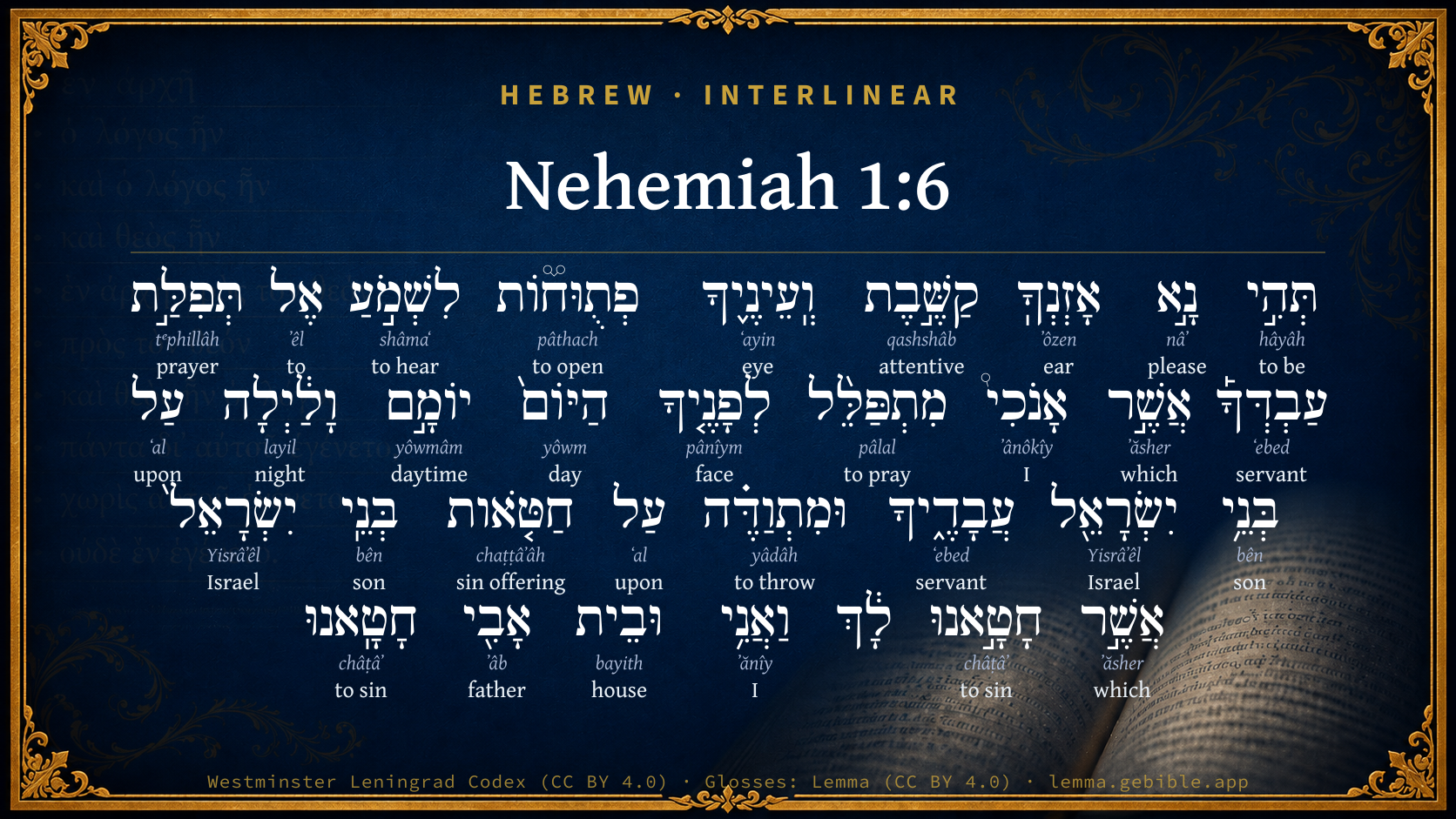
Hebrew (Westminster Leningrad Codex) Nehemiah 1:6 appears in the Hebrew Old Testament. The text above is from the Westminster Leningrad Codex. Each word links to its Strong’s number, a concise gloss, and parsing drawn from the Open Scriptures Hebrew Bible morphology. Click any word for its full Brown-Driver-Briggs (BDB) entry.
Download image
Cite this verse

Nehemiah 1:6 (World English Bible). Public Domain. Lemma interlinear Bible study tool, https://lemma.gebible.app/v/nehemiah/1/6.

Show BibTeX & RIS
BibTeX
RIS
English Translation
Let your ear now be attentive, and your eyes open, that you may listen to the prayer of your servant, which I pray before you at this time, day and night, for the children of Israel your servants while I confess the sins of the children of Israel, which we have sinned against you. Yes, I and my father's house have sinned:
World English Bible · Public Domain
Download a study sheet

One document with this verse’s original text, its word-by-word gloss line, the meaning frame, cross-references with their text, attributed commentary, and full source and license credits — printable, and it pastes into notes with its structure intact.

This verse Autodidact and up

Study sheet (.html) Plain text (.txt)

A passage Seminary Student

Up to 50 verses in one chapter. A passage sheet keeps up to 6 commentary sources and 12 cross-references per verse, in the order this page ranks them, and says so on the sheet whenever that leaves anything out. Ask for a single verse and you get the Autodidact verse sheet above.

Everything on this page stays free to read, with no account — the sheet is a download of what is already on screen, not access to it.

Want to remove ads? Support Godless Engineer
Compare translations 3

The same verse in 3 English versions, stacked beneath the original-language interlinear above. Click any original word for its lexicon entry.

Each is an independent rendering of the whole verse — the interlinear is not word-aligned to these translations.

Highlighted words mark where these versions differ — a whole-verse word diff, not a word-by-word alignment.

  • World English Bible Public Domain
    Let your ear now be attentive, and your eyes open, that you may listen to the prayer of your servant, which I pray before you at this time, day and night, for the children of Israel your servants while I confess the sins of the children of Israel, which we have sinned against you. Yes, I and my father's house have sinned:
  • King James Version Public Domain
    Let thine ear now be attentive, and thine eyes open, that thou mayest hear the prayer of thy servant, which I pray before thee now, day and night, for the children of Israel thy servants, and confess the sins of the children of Israel, which we have sinned against thee: both I and my father's house have sinned.
  • unfoldingWord Literal Text CC BY-SA 4.0
    Please let your ear be attentive and your eyes opened to listen to the prayer of your servant that I am praying before your face today, day and night, on account of the sons of Israel, your servants. And I am confessing on account of the sins of the sons of Israel that we have sinned against you. Even I and the house of my father, we have sinned.

unfoldingWord Literal Text — © unfoldingWord, licensed CC BY-SA 4.0. Word-aligned USFM3 via Door43 (git.door43.org/unfoldingWord/en_ult).

Versions to compare (up to 4)

3 of 4 selected

Show all 18 translations

Every available English version of this verse, each an independent rendering of the whole verse.

  • World English Bible Public Domain
    Let your ear now be attentive, and your eyes open, that you may listen to the prayer of your servant, which I pray before you at this time, day and night, for the children of Israel your servants while I confess the sins of the children of Israel, which we have sinned against you. Yes, I and my father's house have sinned:
  • Berean Standard Bible Public Domain
    let Your eyes be open and Your ears attentive to hear the prayer that I, Your servant, now pray before You day and night for Your servants, the Israelites. I confess the sins that we Israelites have committed against You. Both I and my father’s house have sinned.
  • Majority Standard Bible Public Domain
    let Your eyes be open and Your ears attentive to hear the prayer that I, Your servant, now pray before You day and night for Your servants, the Israelites. I confess the sins that we Israelites have committed against You. Both I and my father’s house have sinned.
  • King James Version Public Domain
    Let thine ear now be attentive, and thine eyes open, that thou mayest hear the prayer of thy servant, which I pray before thee now, day and night, for the children of Israel thy servants, and confess the sins of the children of Israel, which we have sinned against thee: both I and my father's house have sinned.
  • American Standard Version (1901) Public Domain
    Let thine ear now be attentive, and thine eyes open, that thou mayest hearken unto the prayer of thy servant, which I pray before thee at this time, day and night, for the children of Israel thy servants while I confess the sins of the children of Israel, which we have sinned against thee. Yea, I and my father's house have sinned:
  • Revised Version (1885) Public Domain
    Let thine ear now be attentive, and thine eyes open, that thou mayest hearken unto the prayer of thy servant, which I pray before thee at this time, day and night, for the children of Israel thy servants, while I confess the sins of the children of Israel, which we have sinned against thee: yea, I and my father’s house have sinned.
  • Geneva Bible (1599) Public Domain
    I pray thee, let thine eares be attet, and thine eies open, to heare the praier of thy seruat, which I pray before thee dayly, day and night for ye childre of Israel thy seruats, and confesse the sinnes of the children of Israel, which we haue sinned against thee, both I and my fathers house haue sinned:
  • Douay-Rheims (1899) Public Domain
    Let thy ears be attentive, and thy eyes open, to hear the prayer of thy servant, which I pray before thee now, night and day, for the children of Israel thy servants: and I confess the sins of the children of Israel, by which they have sinned against thee: I and my father's house have sinned.
  • Young's Literal Translation Public Domain
    let Thine ear be, I pray Thee, attentive, and Thine eyes open, to hearken unto the prayer of Thy servant, that I am praying before Thee to-day, by day and by night, concerning the sons of Israel Thy servants, and confessing concerning the sins of the sons of Israel, that we have sinned against Thee; yea, I and the house of my father have sinned;
  • Literal Standard Version CC BY-SA 4.0
    please let Your ear be attentive and Your eyes open, to listen to the prayer of Your servant, that I am praying before You today, by day and by night, concerning the sons of Israel, Your servants, and confessing concerning the sins of the sons of Israel, that we have sinned against You; indeed, I and the house of my father have sinned;
  • Unlocked Literal Bible CC BY-SA 4.0
    Listen to my prayer and open your eyes, so you may hear the prayer of your servant that I now pray before you day and night for the people of Israel your servants. I am confessing the sins of the people of Israel, which we have sinned against you. Both I and my father's house have sinned.
  • unfoldingWord Literal Text CC BY-SA 4.0
    Please let your ear be attentive and your eyes opened to listen to the prayer of your servant that I am praying before your face today, day and night, on account of the sons of Israel, your servants. And I am confessing on account of the sins of the sons of Israel that we have sinned against you. Even I and the house of my father, we have sinned.
  • Darby Bible Public Domain
    Let thine ear now be attentive, and thine eyes open, to hear the prayer of thy servant, which I pray before thee at this time, day and night, for the children of Israel thy servants, confessing the sins of the children of Israel, which we have sinned against thee: both I and my father's house have sinned.
  • World Messianic Bible Public Domain
    let your ear now be attentive and your eyes open, that you may listen to the prayer of your servant which I pray before you at this time, day and night, for the children of Israel your servants, while I confess the sins of the children of Israel which we have sinned against you. Yes, I and my father’s house have sinned.
  • Webster's Bible Public Domain
    Let thy ear now be attentive, and thy eyes open, that thou mayest hear the prayer of thy servant, which I pray before thee now, day and night, for the children of Israel thy servants, and confess the sins of the children of Israel, which we have sinned against thee: both I and my father's house have sinned.
  • Free Bible Version CC BY-SA 4.0
    please listen and focus your attention on the prayer of your servant that I am praying to you now, day and night, on behalf of your servants, the Israelites. I confess the sins that we Israelites have committed against you, including my own sins and those of my family.
  • Bible in Basic English Public Domain
    Let your ear now take note and let your eyes be open, so that you may give ear to the prayer of your servant, which I make before you at this time, day and night, for the children of Israel, your servants, while I put before you the sins of the children of Israel, which we have done against you: truly, I and my father's people are sinners.
  • JPS Tanakh (1917) Public Domain
    let Thine ear now be attentive, and Thine eyes open, that Thou mayest hearken unto the prayer of Thy servant, which I pray before Thee at this time, day and night, for the children of Israel Thy servants, while I confess the sins of the children of Israel, which we have sinned against Thee; yea, I and my father's house have sinned.

Literal Standard Version (2020), Covenant Press — licensed CC BY-SA 4.0. Text via the HelloAO Bible API (eBible.org). Unlocked Literal Bible (unfoldingWord) — licensed CC BY-SA 4.0. Text via the HelloAO Bible API (eBible.org). unfoldingWord Literal Text — © unfoldingWord, licensed CC BY-SA 4.0. Word-aligned USFM3 via Door43 (git.door43.org/unfoldingWord/en_ult). Free Bible Version, Dr. Jonathan Gallagher — licensed CC BY-SA 4.0. Text via the HelloAO Bible API (eBible.org).

Word by word

More ways to search: Search by grammar → Find every occurrence → Compare this word →

Practice this passage: Drill this verse → Learn its vocabulary →

קַשֶּׁ֣בֶת
qashshâb
H7183
“attentive”
Adjective, Adjective, Feminine, Singular, Absolute
Part of Speech
Adjective
Type
Adjective
Gender
Feminine
Number
Singular
State
Absolute
Full BDB Definition

Origin: from H7181

TWOT: 2084b , 2084c

attentive
  1. תְּהִ֣י hâyâh H1961 “to be” Verb, Qal, Jussive, 3rd Person, Feminine, Singular
  2. נָ֣א nâʼ H4994 “please” Particle, Exhortation
  3. אָזְנְךָֽ ʼôzen H241 “ear · your” Noun, Common, Feminine, Singular, Construct + Suffix, Personal, 2nd Person, Masculine, Singular
  4. וְֽעֵינֶ֪יךָ ʻayin H5869 “and · eyes · your” Conjunction + Noun, Common, Both, Dual, Construct + Suffix, Personal, 2nd Person, Masculine, Singular
  5. פְתֻוּח֟וֹת pâthach H6605 “opened” Verb, Qal, Participle Passive, Feminine, Plural, Absolute
  6. לִשְׁמֹ֣עַ shâmaʻ H8085 “to hear” Preposition + Verb, Qal, Infinitive Construct
  7. אֶל ʼêl H413 “to” Preposition
  8. תְּפִלַּ֣ת tᵉphillâh H8605 “prayer of” Noun, Common, Feminine, Singular, Construct
  9. עַבְדְּךָ֡ ʻebed H5650 “servant · your” Noun, Common, Masculine, Singular, Construct + Suffix, Personal, 2nd Person, Masculine, Singular
  10. אֲשֶׁ֣ר ʼăsher H834 “which” Particle, Relative
  11. אָנֹכִי֩ ʼânôkîy H595 “I” Pronoun, Personal, 1st Person, Common, Singular
  12. מִתְפַּלֵּ֨ל pâlal H6419 “praying” Verb, Hithpael, Participle Active, Masculine, Singular, Absolute
  13. לְפָנֶ֤יךָ pânîym H6440 “to/for · face(s) · your” Preposition + Noun, Common, Both, Plural, Construct + Suffix, Personal, 2nd Person, Masculine, Singular
  14. הַיּוֹם֙ yôwm H3117 “the · day” Particle, Definite Article + Noun, Common, Masculine, Singular, Absolute
  15. יוֹמָ֣ם yôwmâm H3119 “daytime” Adverb
  16. וָלַ֔יְלָה layil H3915 “and · night” Conjunction + Noun, Common, Masculine, Singular, Absolute
  17. עַל ʻal H5921 “upon” Preposition
  18. בְּנֵ֥י bên H1121 “sons of” Noun, Common, Masculine, Plural, Construct
  19. יִשְׂרָאֵ֖ל Yisrâʼêl H3478 “Israel” Noun, Proper
  20. עֲבָדֶ֑יךָ ʻebed H5650 “servants · your” Noun, Common, Masculine, Plural, Construct + Suffix, Personal, 2nd Person, Masculine, Singular
  21. וּמִתְוַדֶּ֗ה yâdâh H3034 “and · throwing” Conjunction + Verb, Hithpael, Participle Active, Masculine, Singular, Absolute
  22. עַל ʻal H5921 “upon” Preposition
  23. חַטֹּ֤אות chaṭṭâʼâh H2403 “sin offerings of” Noun, Common, Feminine, Plural, Construct
  24. בְּנֵֽי bên H1121 “sons of” Noun, Common, Masculine, Plural, Construct
  25. יִשְׂרָאֵל֙ Yisrâʼêl H3478 “Israel” Noun, Proper
  26. אֲשֶׁ֣ר ʼăsher H834 “which” Particle, Relative
  27. חָטָ֣אנוּ châṭâʼ H2398 “to sin” Verb, Qal, Perfect, 1st Person, Common, Plural
  28. וַאֲנִ֥י ʼănîy H589 “and · I” Conjunction + Pronoun, Personal, 1st Person, Common, Singular
  29. וּבֵית bayith H1004 “and · house of” Conjunction + Noun, Common, Masculine, Singular, Construct
  30. אָבִ֖י ʼâb H1 “father · my” Noun, Common, Masculine, Singular, Construct + Suffix, Personal, 1st Person, Common, Singular
  31. חָטָֽאנוּ châṭâʼ H2398 “to sin” Verb, Qal, Perfect, 1st Person, Common, Plural

About this verse

These counts appear in no published source. They are computed here, from the morphology-tagged text and Lemma’s own curated glosses. What Lemma adds →

33
words
26
distinct lemmas
Historical
section

Notable vocabulary

The rarest word here is קַשֶּׁ֣בֶת attentive H7183 — appearing just 5 times in the whole Hebrew Bible.

Shared distinctive vocabulary

קַשֶּׁ֣בֶת attentive H7183 occurs in 5 verses of the Hebrew Bible. Also found in:

Grammatical profile

  • 7 verbs
  • 15 nouns
  • 1 adjective
  • 2 pronouns
  • 4 prepositions
  • 1 adverb
  • 3 particles

Verb forms

  • תְּהִ֣י Qal · Jussive
  • פְתֻוּח֟וֹת Qal · Participle Passive
  • לִשְׁמֹ֣עַ Qal · Infinitive Construct
  • מִתְפַּלֵּ֨ל Hithpael · Participle Active
  • וּמִתְוַדֶּ֗ה Hithpael · Participle Active
  • חָטָ֣אנוּ Qal · Perfect
  • חָטָֽאנוּ Qal · Perfect

Repetition

Words recur within this verse — often emphatic in Hebrew:

  • עַבְדְּךָ֡ servant H5650 ×2
  • עַל upon H5921 ×2
  • בְּנֵ֥י son H1121 ×2
  • יִשְׂרָאֵ֖ל Israel H3478 ×2
  • חָטָ֣אנוּ to sin H2398 ×2
  • אֲשֶׁ֣ר which H834 ×2

Cross-references

27

Topical passages linked to Nehemiah 1:6 in the Treasury of Scripture Knowledge — connected by theme and wording, ordered by reader-vote popularity; previews shown in the World English Bible.

  • Daniel 9:20 While I was speaking, and praying, and confessing my sin and the sin of my people Israel, and presenting my supplication before Yahweh my God for the holy mountain of my God;
  • Daniel 9:4 I prayed to Yahweh my God, and made confession, and said, Oh, Lord, the great and dreadful God, who keeps covenant and loving kindness with those who love him and keep his commandments,
  • Psalms 34:15 Yahweh's eyes are toward the righteous. His ears listen to their cry.
  • Psalms 106:6 We have sinned with our fathers. We have committed iniquity. We have done wickedly.
  • Daniel 9:17–18 Now therefore, our God, listen to the prayer of your servant, and to his petitions, and cause your face to shine on your sanctuary that is desolate, for the Lord's sake.
  • 2 Chronicles 6:40 Now, my God, let, I beg you, your eyes be open, and let your ears be attentive, to the prayer that is made in this place.
  • 2 Chronicles 29:6 For our fathers have trespassed, and done that which was evil in the sight of Yahweh our God, and have forsaken him, and have turned away their faces from the habitation of Yahweh, and turned their backs.
  • Isaiah 6:5 Then I said, "Woe is me! For I am undone, because I am a man of unclean lips, and I dwell in the midst of a people of unclean lips: for my eyes have seen the King, Yahweh of Hosts!"
  • 1 John 1:9 If we confess our sins, he is faithful and righteous to forgive us the sins, and to cleanse us from all unrighteousness.
  • Luke 18:7 Won't God avenge his chosen ones, who are crying out to him day and night, and yet he exercises patience with them?
  • Lamentations 3:39–42 Why does a living man complain, a man for the punishment of his sins?
  • Lamentations 5:7 Our fathers sinned, and are no more; We have borne their iniquities.
  • 2 Timothy 1:3 I thank God, whom I serve as my forefathers did, with a pure conscience. How unceasing is my memory of you in my petitions, night and day
  • 1 Kings 8:28–29 Yet have respect for the prayer of your servant, and for his supplication, Yahweh my God, to listen to the cry and to the prayer which your servant prays before you this day;
  • Ezra 9:6–7 and I said, my God, I am ashamed and blush to lift up my face to you, my God; for our iniquities are increased over our head, and our guiltiness is grown up to the heavens.
  • Ezra 10:1 Now while Ezra prayed and made confession, weeping and casting himself down before the house of God, there was gathered together to him out of Israel a very great assembly of men and women and children; for the people wept very sore.
  • Psalms 32:5 I acknowledged my sin to you. I didn't hide my iniquity. I said, I will confess my transgressions to Yahweh, And you forgave the iniquity of my sin. Selah.
  • Psalms 55:17 Evening, morning, and at noon, I will cry out in distress. He will hear my voice.
  • Psalms 130:2 Lord, hear my voice. Let your ears be attentive to the voice of my petitions.
  • Isaiah 64:6–7 For we are all become as one who is unclean, and all our righteousness are as a polluted garment: and we all do fade as a leaf; and our iniquities, like the wind, take us away.
  • 1 Timothy 5:5 Now she who is a widow indeed, and desolate, has her hope set on God, and continues in petitions and prayers night and day.
  • 1 Samuel 15:11 It repents me that I have set up Saul to be king; for he is turned back from following me, and has not performed my commandments. Samuel was angry; and he cried to Yahweh all night.
  • 2 Chronicles 28:10 Now you purpose to keep under the children of Judah and Jerusalem for bondservants and bondmaids to you: [but] aren't there even with you trespasses of your own against Yahweh your God?
  • Ezra 10:11 Now therefore make confession to Yahweh, the God of your fathers, and do his pleasure; and separate yourselves from the peoples of the land, and from the foreign women.
  • Psalms 88:1 Yahweh, the God of my salvation, I have cried day and night before you.
  • Luke 2:37 and she had been a widow for about eighty-four years), who didn't depart from the temple, worshipping with fastings and petitions night and day.
  • Ephesians 2:3 among whom we also all once lived in the lust of our flesh, doing the desires of the flesh and of the mind, and were by nature children of wrath, even as the rest.

Cross-references courtesy of OpenBible.info (CC BY 4.0).

Hebrew and Greek witnesses Masoretic Hebrew ↔ Greek Septuagint

The same verse in the two great witnesses to the Old Testament, shown verse-for-verse.

These are two independent witnesses, not word-aligned to each other, and the Septuagint is shown in lemma (dictionary) form.

Hebrew Nehemiah 1:6 Masoretic · Westminster Leningrad Codex

תְּהִ֣י נָ֣א אָזְנְךָֽ קַשֶּׁ֣בֶת וְֽעֵינֶ֪יךָ פְתֻוּח֟וֹת לִשְׁמֹ֣עַ אֶל תְּפִלַּ֣ת עַבְדְּךָ֡ אֲשֶׁ֣ר אָנֹכִי֩ מִתְפַּלֵּ֨ל לְפָנֶ֤יךָ הַיּוֹם֙ יוֹמָ֣ם וָלַ֔יְלָה עַל בְּנֵ֥י יִשְׂרָאֵ֖ל עֲבָדֶ֑יךָ וּמִתְוַדֶּ֗ה עַל חַטֹּ֤אות בְּנֵֽי יִשְׂרָאֵל֙ אֲשֶׁ֣ר חָטָ֣אנוּ לָ֔ךְ וַאֲנִ֥י וּבֵית אָבִ֖י חָטָֽאנוּ

Let your ear now be attentive, and your eyes open, that you may listen to the prayer of your servant, which I pray before you at this time, day and night, for the children of Israel your servants while I confess the sins of the children of Israel, which we have sinned against you. Yes, I and my father's house have sinned:

World English Bible · Public Domain

Greek LXX Structure differs

The Septuagint has no separate book of Nehemiah. Its Greek text is the second half of Esdras B (2 Esdras), chapters 11–23; Ezra is the first half (1–10).

A verse-for-verse comparison isn’t shown here because the chapters and verses don’t line up. Switch to the LXX edition with the MT / LXX toggle above to read the Greek directly.

On this verse, The Cambridge Bible for Schools and Colleges discusses the Septuagint’s reading. Read the note in Commentary ↓

Hebrew: Westminster Leningrad Codex (CC BY 4.0). Greek: Septuagint (public domain); English from a public-domain English Septuagint. How the Septuagint differs from the Hebrew →

Commentary

Notes on Nehemiah 1:6 from classic Christian and Jewish commentators (each source and its license shown beneath its notes). The classic Christian expositions comment on the surrounding passage and are grouped to its opening verse, so a note may address several verses; the Jewish commentaries on the Tanakh (Rashi and others) are per-verse, so they appear only where the commentator wrote on this verse.

Lemma curates 59 commentaries, every one of them public domain or Creative Commons licensed, each selected and text-cleaned for this edition rather than reprinted as found. About our sources →

Trapp's Complete Commentary

John Trapp

Neh 1:6 Let thine ear now be attentive, and thine eyes open, that thou mayest hear the prayer of thy servant, which I pray before thee now, day and night, for the children of Israel thy servants, and confess the sins of the children of Israel, which we have sinned against thee: both I and my father’s house have sinned.

Ver. 6. Let thine ears now be attentive, and thine eyes open] Should not God see as well as hear (saith a divine), his children should want many things. We apprehend not all our wants; and so cannot pray for relief of all. He of his own accord, without any monitor, is wont to aid us. "The eyes of the Lord are upon the righteous; and his ears are open to their prayer," Psa 33:15.

That thou mayest hear the prayer of thy servant] If not secundum voluntatem, yet ad utilitatem (Aug. Confess. 1. 5, c. 8), but usually God answereth his servants’ prayers, fitting his mercy ad cardinem desiderii, to a longing heart, as here; and letting it be unto them even as they will.

Which I pray before thee now, day and night] Christ requireth his servants and suppliants to pray and not faint, Luk 18:1. Ordinarily, morning and evening without fail; extraordinarily, oftener. The Jews divide their day into prayer, work, and repast; neither will they omit prayer for their meat or labour. The Mahometans, what occasion soever they have, either by profit or pleasure, to divert them, will pray five times every day; and upon the Friday (which is their sabbath) six times. Vae torpori nostro! woe our numbness, how few and feeble are our prayers for ourselves and for brethren in distress; who have for that cause an unanswerable action against us!

And confess the sins of the children of Israel] This he did more fully and at large than is here set down; and he fitly beginnneth with confession; that having gotten off the guilt of sin, he might with more courage and comfort deprecate wrath, and beg mercy.

Which we have sinned against thee] There lay the pinch of his grief, that they sinned against so good a God.

Both I and my father’s house have sinned] Hic igitur Lyra deliravit, Lyra is incorrect when he saith here, that Nehemiah confessed his own sins, but only as a member of the same body, he himself being innocent. Comparatively innocent he was, doubtless; but that he was not without sin, and such sin as he had cause to confess to be God provoking sins, is clear by this very text. He was sensible of his own sins, and of other men’s sins too. The sins of our ancestors not bewailed and disclaimed, are set upon our score, Dan 5:22.

John Trapp, A Commentary or Exposition upon All the Books of the Old and New Testament (1647–1656) — public domain. Text from a community e-Sword module.

Joseph Benson's Commentary

Neh 1:6. Which I pray before thee night and day — He refers to all the prayers which he had for some time been addressing to God, during his sorrow for the desolations of Jerusalem.

Joseph Benson's Commentary on the Old and New Testaments (1811–1818) — public domain. Text from a community e-Sword module.

Tyndale Open Study Notes

Tyndale Open Resources

1:6 I confess that we have sinned: Like Ezra (Ezra 9:5-15) and Daniel (Dan 9:4-19), Nehemiah identified with the sins of his people, made no excuses, and accepted both his individual responsibility and the responsibility of the larger covenant group that had sinned against God.

Tyndale Open Study Notes — © Tyndale Open Resources, licensed CC BY-SA 4.0. Text via the HelloAO Bible API.

Adam Clarke's Commentary

Verse 6. Let thine ear] Hear what we say and confess. Thine eyes open - see what we suffer.

Adam Clarke's Commentary on the Bible (1810–1826) — public domain. Text from a community e-Sword/MySword module.

The Cambridge Bible for Schools and Colleges

gen. ed. J. J. S. Perowne

6. The humble access leading to the confession of sin.

let thine ear now be attentive] The word ‘attentive’ is not very common in the original. It occurs again in Neh_1:11, in Psa_130:2. And with the rendering ‘attent’ (A.V. and R.V.) in 2Ch_6:40; 2Ch_7:15. The LXX. renders πρόσεχον.

and thine eyes open] We should expect this clause to come first, as in 2Ch_6:40; 2Ch_7:15. We need not however supply the words ‘to the misery of thy people’ or ‘to him that prayeth.’ A similar passage in 1Ki_8:52, ‘that thine eyes may be open unto the supplication of thy servant,’ shows that the metaphor is not to be pressed too literally.

hear] R.V. hearken unto. An alteration due to the wish to give the full force of the Hebrew. ‘Thy servant.’ Compare 1Sa_3:9-10; 1Sa_23:10; 2Sa_7:20.

now, day and night] R.V. at this time, day and night. Literally, ‘this day, day and night,’ cf. Neh_1:11. ‘At this time’ then refers to the ‘certain days’ mentioned in Neh_1:4 : it does not mean that he went into the presence of the king on the day of this prayer.

The Vulgate ‘hodie nocte et die.’ Cf. Act_20:31 ‘night and day with tears.’

for the children of Israel thy servants] i.e. in their behalf. In spite of their sin and disobedience, the children of Israel are still God’s servants, cf. Lev_25:55; Isa_63:17. The exact phrase used here does not occur elsewhere. But the permanent ideal relation, in spite of all failure or rebellion, is frequently expressed in the prophets; cf. ‘Jacob, my servant,’ used in Isaiah (Isa_41:8; Isa_44:2 &c.), Jeremiah (Jer_30:10; Jer_46:27-28), Eze_37:25.

and confess] R.V. while I confess. The A.V. is not grammatical.

‘Confess.’ See on Ezr_10:1.

the sins of the children of Israel, which we &c.] Nehemiah identifies himself with the guilt of the people. Cf. Moses in Exo_34:9 ‘Pardon our iniquity and our sin.’

both I and my father’s house] i.e. Neither the individual nor the family being free from the responsibility of national sin. It has been remarked that, if Nehemiah belonged to the house of David, there would be a special appropriateness in these words. According to one tradition (Euseb.), he was of the tribe of Judah.

The Cambridge Bible for Schools and Colleges (gen. ed. J. J. S. Perowne; Cambridge University Press, 1878–1918) — public domain. Text from a community e-Sword module.

John Gill's Exposition

Let thine ear be now attentive,.... To his prayer, as in Neh 1:11,

and thine eyes open; to behold with pity and compassion the distressed case of Jerusalem, and the Jews in it:

I pray before thee now, day and night, for the children of Israel thy servants; this he had continued to do ever since he heard of their trouble and calamity:

and confess the sins of the children of Israel, which we have sinned against thee: both I and my father's house have sinned; he considered sin as the cause of all this evil that had befallen his people, and confesses it with sorrow and humiliation, and not their sins only, but his own personal and family sins.

John Gill's Exposition of the Whole Bible (1746–1763) — public domain (CC PDM 1.0). Text via the HelloAO Bible API.

Haydock's Catholic Bible Commentary

They. Hebrew and Septuagint, "we have sinned." (Menochius)

George Leo Haydock (1774–1849), Haydock's Catholic Family Bible and Commentary, 1859 edition — public domain. Excludes Psalms (Douay-Rheims chapter numbering differs from Protestant) and Deuterocanonical books (Catholic canon only).

Whedon's Commentary on the Bible

Daniel D. Whedon

6. Thine ear… thine eyes — He that formed the ear, shall he not hear his children’s cry? He that made the eye, shall he not see the sufferings of his people?

Daniel D. Whedon (gen. ed.), Commentary on the Old and New Testaments (1874–1909) — public domain. Text from a community e-Sword module.

The Pulpit Commentary

Both I and my father"s house have sinned. Ewald well observes, "In the prayer of Nehemiah the keynote is struck in the words, "I and my father"s house have sinned ("History of Israel," vol. 5. p. 149, note 1). The desolation which he mourns is the result of the people"s sins, and in those sins are included his own, and those of his ancestors. His own may not have been very grievous, but those of his fathers weigh upon him as if his own, and oppress his spirit.

The Pulpit Commentary (1880–1919), ed. H.D.M. Spence-Jones & Joseph S. Exell — public domain. Text from a community e-Sword module.

John Wesley's Explanatory Notes

Which I pray, &c. - He refers to all the prayers, which he had for some time been putting up.

John Wesley, Explanatory Notes Upon the Whole Bible (1754–1765) — public domain. Text via the GEBible commentary corpus.

unfoldingWord translationNotes

Door43 World Missions Community

open your eyes

"look at me." Here "open your eyes" is a metaphor that represents paying attention to someone. AT: "pay attention to me" (See: Metaphor)

so you may hear the prayer of your servant

"so that you may hear the prayer that I, your servant, am praying." The word "servant" refers to Nehemiah. This is how a person would address his superior in order to show humility and respect.

day and night

By saying that he prays both during the day and during the night, Nehemiah emphasizes the frequency of his prayers. AT: "all the time" (See: Merism)

Both I and my father's house

Here the word "house" represents family. AT: "Both I and my family" (See: Metonymy)

translationWords

pray

servant

people group

Israel

confess

sin

house

ancestor

evil

command

law, laws

decree

Moses

unfoldingWord translationNotes — © Distant Shores Media and the Door43 World Missions Community, licensed CC BY-SA 4.0. Source: git.door43.org/Door43/en_tn.

Rashi

Rabbi Shlomo Yitzchaki (Rashi)

attentive Heb. קַשֶּׁבֶת, like קוֹשֶּׁבֶת, listening, for just as one says from אוֹהֵב, אָהַב, so does one say from קָשַּׁב, קוֹשֵּׁב and קוֹשֶּׁבֶת.

Rashi on the Tanakh — English translations: “The Judaica Press complete Tanach with Rashi, translated by A. J. Rosenberg” (CC BY 4.0); “Pentateuch with Rashi's commentary by M. Rosenbaum and A.M. Silbermann, 1929-1934” (public domain); “The Metsudah Tanach series, Lakewood, N.J” (CC BY 4.0); and “The Book of Joshua, Metsudah Publications, 1997” (CC BY 4.0). Text via Sefaria.

Lesson kit

Teaching starters — assembled from the data on this page, not authored interpretation. Every prompt links to the verse data it draws on. Edit before teaching.

Nehemiah, in the Historical, opens this verse with 33 words (26 distinct Hebrew lemmas). Its most distinctive word is qashshâb (“attentive”). A historical commentator’s framing appears above. Read the whole chapter for the surrounding context.

Discussion questions

  1. The word qashshâb carries the sense “attentive.” How does it shape the verse?
  2. 2 Chronicles 6:40 shares the word «attentive» with this verse. How do the two illuminate each other?
  3. “servant” occurs 2× in this one verse. What is the effect of the repetition?
  4. These translations render this verse differently; the difference is in the English rendering, not the original. What questions does that raise?
  5. The verb «תְּהִ֣י» is Qal Jussive. How does its form color the action?
  6. Reading how Trapp's Complete Commentary and Joseph Benson's Commentary read this verse, where do the two commentators agree and where do they part?

Things to notice

Reading settings

Reading text

Shown beneath each verse's original-language words.

Old Testament
Old Testament edition

Read the OT as the Masoretic Hebrew (MT) or the Greek Septuagint (LXX).

English shown for the Greek Septuagint (in the Hebrew ↔ Greek comparison).

Comparing translations? Open the Compare panel on any verse page to stack up to four side by side.